 ARABICA
ARABICA
ARABICA
 Hanafi School on
 Moslem Law of
 (A
Remarkable Trio). Rosenmüller, Ernest Friedrich Karl.
Analecta arabica editit latine vertit et illustravit. Ern. Fried. Car. Rosenmüller.
Lipsiae: sumtibus I. A. Barthii, 1825-1828. 8vo. 3 vols. in 1. I: xii, 44, 23,
[1 (blank)] pp. II: xviii, 55, [1], 39, [1] pp., [1] f. III: viii, 56, 27, [1
(blank)] pp.
(A
Remarkable Trio). Rosenmüller, Ernest Friedrich Karl.
Analecta arabica editit latine vertit et illustravit. Ern. Fried. Car. Rosenmüller.
Lipsiae: sumtibus I. A. Barthii, 1825-1828. 8vo. 3 vols. in 1. I: xii, 44, 23,
[1 (blank)] pp. II: xviii, 55, [1], 39, [1] pp., [1] f. III: viii, 56, 27, [1
(blank)] pp.


 Click any image where the hand appears on


A very handsomely printed book in Arabic and Latin.
• Lambrecht 1129. 19th-century German boards covered with black mottled paper, boards and spine abraded; paper spine-label with hand-lettering. Institutional bookplate on front pastedown. Four-digit number in ink at base of first p. V. Housed in a modern quarter brown morocco tray case with raised bands on spine, each accented above and below with gilt beading (our last image shows the volume lying in its box). One spine compartment with title, another with publication place and dates, all others with gilt center device. A very acceptable copy of a scarce and important work for Arabic studies.

Illustrated & AnnotatedArabian Nights. The thousand and one nights, commonly called, in England, the Arabian nights’ entertainments. London: Charles Knight & Co., 1839–41. 8vo (25.3 cm, 10"). 3 vols. I: Add. engr. t.-p., xxiii, [3], [xxv]–xxxii, 618 pp.; illus. II: Add. engr. t.-p., xii, 643, [1] pp.; illus. III: Add. engr. t.-p., xii, 763, [1] pp.; illus.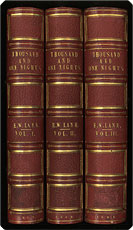
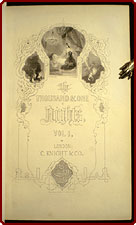
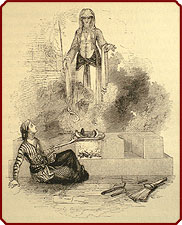 Click the interior images for enlargements.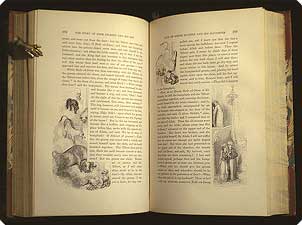
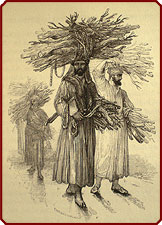
 A lavishly produced set, attractively illustrated and bound.
 For more SETS, click here.
 FIRST to
 Timbuktu & Back Caillié, René Auguste. Journal d'un voyage a Temboctou et
a Jenné, dans l'Afrique Centrale, précédé d'observations faites chez les Maures Braknas, les Nalous et d'autres peuples; pendant les années 1824, 1825, 1826, 1827, 1828. Paris: L'Imprimerie Royale, 1830. 8vo (21.1 cm, 8.25"). 3 vols. I: Frontis., [4], xii, 472, [4] pp. II: [4], 426 pp. III: [4], 404, [2] pp. (lacking 5 plates and map).
Timbuktu & Back Caillié, René Auguste. Journal d'un voyage a Temboctou et
a Jenné, dans l'Afrique Centrale, précédé d'observations faites chez les Maures Braknas, les Nalous et d'autres peuples; pendant les années 1824, 1825, 1826, 1827, 1828. Paris: L'Imprimerie Royale, 1830. 8vo (21.1 cm, 8.25"). 3 vols. I: Frontis., [4], xii, 472, [4] pp. II: [4], 426 pp. III: [4], 404, [2] pp. (lacking 5 plates and map).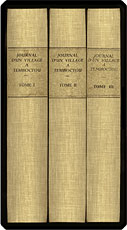
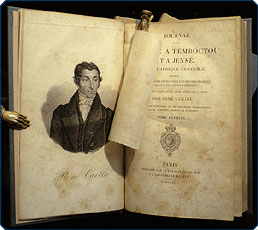 Click the interior image for an enlargement.
 Vol. I opens with a steel-engraved portrait of the author.
• Howgego, II, C2. Period-style quarter tan cloth and light blue paper–covered sides, spines with printed paper labels. Five plates and one map lacking (frontispiece present); two leaves each with tear along inner margin, not touching text; foxed throughout but without embrittlement. (24387)
For more SETS, click here.

A FAMED but UNLUCRATIVE Polyglot Dictionary Castell, Edmund. Lexicon heptaglotton, Hebraicum, Chaldaicum, Syriacum, Samaritanum, Æthiopicum, Arabicum, conjunctim; et Persicum, separatim. London: Thomas Roycroft, 1669. Folio (44.9 cm, 17.6). 2 vols. in I. Frontis., [8] pp., 44 columns (43 & 44 repeated in numbering), [2] pp., 573 columns (402, 403, 421 & 422 repeated in numbering; 340, 341, 399, & 400 skipped), [1] p., 4008 columns (376–78 & 391–93 incorrectly numbered; 484–86, 538, 1936–38, 3220–25, 3773–78, & 3950–51 repeated in numbering; 487–89, 535, & 3226–3231 skipped).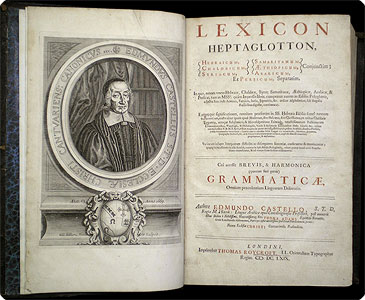
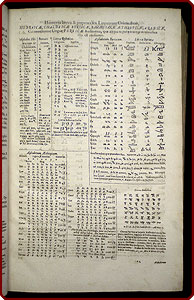
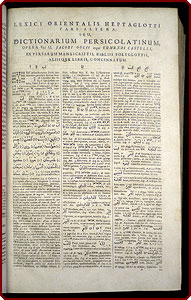 Click the images for enlargements.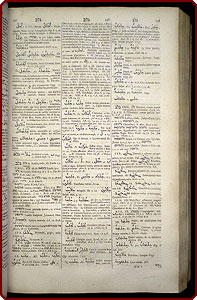
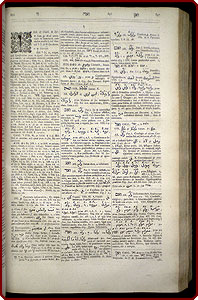
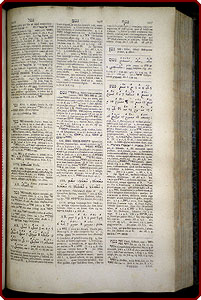
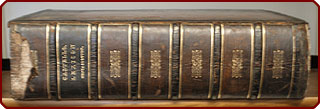
• ESTC R16460; Wing (rev. ed.) C1225; Vancil 46; Lowndes 386; Dibdin, I, 31–35. On Castell, see: Oxford Dictionary of National Biography online. 18th-century speckled calf, covers bordered with a darker calf band blind-rolled and then framed with single gilt fillet; spine with gilt-stamped leather title-label, darker-leather raised bands gilt-stamped/blind-tooled, and compartments gilt- and blind-tooled enclosing gilt-stamped floral decorations. Binding rubbed, with leather significantly lost in top compartment and and lost also at foot. All edges marbled. Front fly-leaf with inked ownership inscription as above dated 1837; title-page with old institutional pressure-stamp. Frontispiece with outer margin reinforced some time ago. One leaf slightly oversized and creased, intermittent soiling in many upper margins, one leaf with text affected but not obscured, small sections with light waterstaining to outer or upper margins; over all, a book both impressive and pleasant. Columns erratically numbered, text complete. (25792)
Sole Edition — Kabbalah & PantheismFreystadt, M. Philosophia cabbalistica et pantheismus. Regimontii Prussorum: Borntraeger (pr. by Conradus Paschke), 1832. 8vo (19.8 cm, 7.75"). xv, [1], 143, [1] pp.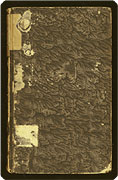
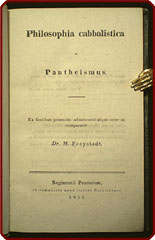
• Steineschneider, Catalogus Librorum Hebraeorum, 5085. Contemporary paste paper–covered boards, spine with hand-inked title label; binding rubbed and abraded, spine with stamped shelving number. All edges stained red. Front pastedown with 19th-century private collector’s bookplate.


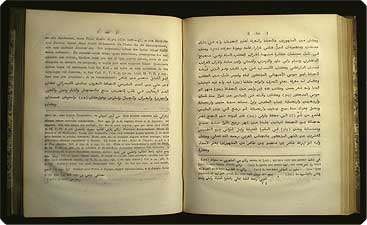
Arabic — Armenian — Antiochus Hamaker, Hendrik Arent. Specimen catalogi codicum mss. orientalium bibliothecae Academiae Lugduno-Batavae ... [bound with two other works as described below]. Lugduni Batavorum: Apud S. & J. Luchtmans, 1820. 4to (24.5 cm, 9.7"). [4], viii, 264, [4] pp. [bound with] Chahan de Cirbied, Jacques M. Notice de deux manuscrits Arméniens contenant l'histoire de Mathieu Eretz ... Paris: De l'imprimerie Impériale, 1812. 4to. 92 pp. [and] Tôchon
d'Annecy, Joseph-François . Dissertation sur l'époque de la mort d'Antiochus VII évergètes sidétès, roi de Syrie, sur deux médailles antiques de ce prince ... Paris: L.G. Michaud, 1815. 4to. Frontis., 68 pp.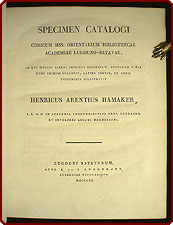
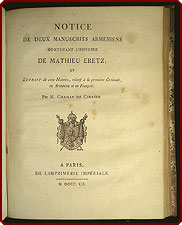 Click the images for enlargements.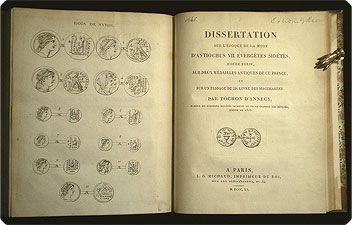
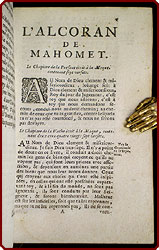
First French Koran — Pirated Edition Koran. L'Alcoran de Mahomet. Traduit d'Arabe en François, par le Sieur du Ryer, Sieur de la Garde Malezair. A la Haye: Adrian Moetjens, 1683. 12mo (13.7 cm, 5.4"). Frontis., [10], 486, [4] pp.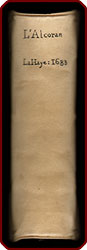
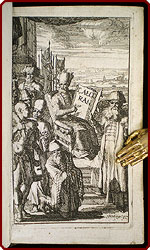
 Click the images for enlargements.
 This edition opens with a copper-engraved added title-page signed by J. Padebrugge; the main title-page bears the Elzevir sphere mark. Willems notes that it is “une copie exacte et ligne pour ligne de celle [the Elzevir edition] de 1672, dont en effect Moetjens s'était rendu adjudicataire, mais c'est positivement une réimpression.” It is, in effect, aline-for-line piracy, and a handsome one faithful to its original's good qualities.
Uncommon: OCLC and NUC Pre-1956 locate only eight U.S. holdings.
Provenance: Front pastedown with bookplate of collector Robert J. Hayhurst.
• Brunet, III, 1309; Willems 1472. Contemporary vellum, spine with early inked title; vellum remarkably clean. Original blue silk place marker present and intact. Front free endpaper with upper outer corner excised, mostly removing an early inked ownership inscription; title-page with early inked inscriptions lined through; back free endpaper with recent pencilled purchase record. One leaf with short tear from outer margin, just touching text without loss. Pages clean. A nice book. (25561)
 Victorian ArabicaNicely Presented Meredith, George. The shaving of Shagpat. New York: Pr. by the George Grady Press for the Limited Editions Club, 1955. 4to.
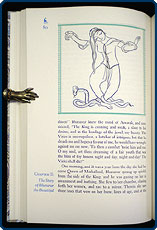
• Bibliography of the Fine Books Published by the Limited Editions Club 260. Publisher's quarter leather over printed paper-covered sides; spine extremities slightly rubbed, in slipcase showing a bit of scraping and refurbished at top fore-edge. Very nice. (13276)

IRAQ — An8th-Century Account Muhammad ibn ’Umar, al-Wakidi. Libri Wakedii de Mesopotamiae expugnatae historia pars e codice Bibliothecae Gottingensis Arabico edita et annotatione illustrata. Qua scriptione ... ad orationem publicam audiendam invitat Georgius Henricus Augustus Ewald. Gottingae: sumtibus Dieterichianis, 1827. Small 4to. xxvi, 24 pp.


 Click the interior images for enlargements.
 Provenance: From the collection of 19th-century scholar Dr. Johann August Neander (1789–1850), a convert from Judaism who became a leading scholar of Christian church history.
Evidence of Readership: A very few pencilled notes in Arabic.
• 19th-century German boards covered in mottled black paper with old paper spine label; ex-library with with minimal markings. In fact, a nice clean copy. (15001)
PRICE's History of Islam
Price, David. Chronological retrospect, or memoirs of the principal events of Mahommedan history, from the death of the Arabian legislator, to the accession of the Emperor Akbar, and the establishment of the Moghul Empire in Hindustaun. London: J. Booth; Longman, Hurst, Rees, Orme, & Brown; and Black, Parry, & Kingsbury, 1811–20. Large 4to (29.8 cm). 3 vols. in 4. I: xvi, 606, [8] pp. II: xvi, 716 pp.; 1 oversized, fold. col. map. III: xv, [1], 483, [1] pp. IV: [2], [485]–998 pp.
History of Islam
Price, David. Chronological retrospect, or memoirs of the principal events of Mahommedan history, from the death of the Arabian legislator, to the accession of the Emperor Akbar, and the establishment of the Moghul Empire in Hindustaun. London: J. Booth; Longman, Hurst, Rees, Orme, & Brown; and Black, Parry, & Kingsbury, 1811–20. Large 4to (29.8 cm). 3 vols. in 4. I: xvi, 606, [8] pp. II: xvi, 716 pp.; 1 oversized, fold. col. map. III: xv, [1], 483, [1] pp. IV: [2], [485]–998 pp.

 Click the images for enlargements.
 The work was printed by several different hands, all in Wales, and one was a woman printer: Vol. I was done by George North of Brecknock, vol. II by Henry Hughes of Brecon, and vols. III and IV by Priscilla Hughes, also of Brecon and presumably heir to Henry. Vol. II opens with a hand-colored oversized, folding map.

 Famous “Medieval” Anti-Jewish TractRare TranslationSamuel, Marochitanus (or Maroccanus). Ein Sendbrieff Rabbi Samuels von Israel, so Bürtig war auss der Stadt dess Konigs Morachiam, an Rabbi Isaac, Meystern der Synagogen, so in der Stadt Subjuliveta bemeltes Reichs ist : von der Jüden Zerstrewung, Ceremonien, Verblendung, vnd Vnglauben, auch welches die Sünde und Ursach sey, dasz Gottes Zorn so hart uber sie ergehe, und warumb sie in so langer Gefengnuss und Dienstbarkeit stecken müssen: so merhr als vor 500 Jahren in arabischer Sprach beschrieben, und hernach im Jahr
1239. in lateinische Sprach vertirt, nun aber durch ein Gottseligen Mann der Christenheit zu gut verdeutschet. Marpurg: Gedruckt ... Durch Paulum Egenolff, 1600. Small 4to. 59, [1] pp.
Famous “Medieval” Anti-Jewish TractRare TranslationSamuel, Marochitanus (or Maroccanus). Ein Sendbrieff Rabbi Samuels von Israel, so Bürtig war auss der Stadt dess Konigs Morachiam, an Rabbi Isaac, Meystern der Synagogen, so in der Stadt Subjuliveta bemeltes Reichs ist : von der Jüden Zerstrewung, Ceremonien, Verblendung, vnd Vnglauben, auch welches die Sünde und Ursach sey, dasz Gottes Zorn so hart uber sie ergehe, und warumb sie in so langer Gefengnuss und Dienstbarkeit stecken müssen: so merhr als vor 500 Jahren in arabischer Sprach beschrieben, und hernach im Jahr
1239. in lateinische Sprach vertirt, nun aber durch ein Gottseligen Mann der Christenheit zu gut verdeutschet. Marpurg: Gedruckt ... Durch Paulum Egenolff, 1600. Small 4to. 59, [1] pp. 
 Click the interior images for enlargements.
• VD16 S1581. Removed from a nonce volume, in later wrappers. Dust-soiled. Library pressure-stamp and private owner's (old) inked signature on title-page. A very good copy. (21113)


“Key
to theSacred
Language of the Old
Testament”Stock, Christian. Clavis lingvae sanctae Veteris Testamenti...cvi accedit breve dictionarium Chaldeo-Rabbinicum. Editio quinta.... Ienae: Apud Ioh. Felicem Bielckium, 1744. 8vo (22 cm, 8.625"). Frontis., [3] ff., 1198 pp., [25] ff., 133, [1 (blank)] pp., [1 (blank)] f. 
• Contemporary calf, spine gilt and with red leather label. Leather dry and flaking, with loss over corners, joints open but sewing holding, chipping at head and foot of spine, and crack down center of spine: This volume could split. Ownership inscriptions in ink on front pastedown and reverse of frontispiece. Browning from turn-ins onto endpapers and fly-leaves; light to moderate foxing throughout. All edges speckled red.


PLACE AN ORDER | E-MAIL US | GO (BACK) TO TOPIC/INTEREST TABLE | PRB&M HOME
All material © 2010
The Philadelphia Rare Books & Manuscripts
Company