 EMBLEM BOOKS
EMBLEM BOOKS
EMBLEM BOOKS
 A SCARCE Emblem Book
 Ginther, Antonius. Speculum amoris et doloris in sacratissimo ac divinissimo corde Jesu incarnati, eucharistici, et crucifixi, orbi christiano propositum....editio IV. Augustæ Vindelicorum: Joannis Jacobi Lotteri, 1743. 4to (21.1 cm, 8.4"). [38], 408, [16 (index)] pp. (lacking engraved title, pp. 49/50); illus.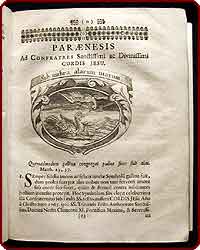
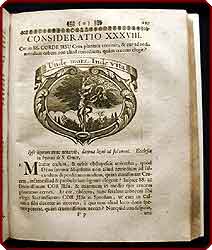
 Rare in the U.S.: We trace only the Getty copy of this edition, and earlier editions are no less rare.
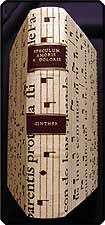
• Landwehr, German Emblem Books, 317. Boards covered in music-printed paper from an 18th-century antiphonal, spine with gilt-stamped leather title and author labels. Engraved title and pp. 49/50 (emblem VII) lacking. Title-page and next leaf with long-ago repaired holes, one on the latter affecting an initial on the verso; title-page with old inked device(?) and 19th-century institutional stamp on verso, showing through in part to recto; a small hole in a third leaf, taking perhaps a letter or two. Final blank leaf and two other leaves also stamped. One leaf torn from margins into text, repaired with Japanese tissue. Pages slightly age-toned, some with mild foxing or the odd spot. Faults noted, this is yet a worthwhile and studyable/enjoyable volume.

 Exploring One of those “Lesser Paths” of History
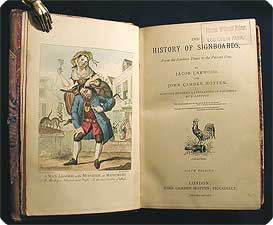
 “One Hundred Illustrations”Larwood, Jacob, & John Camden Hotten. The history of signboards, from the earliest times to the present day... sixth edition. London: John Camden Hotten, 1867. 8vo (18.8 cm, 7.4"). Col. frontis., x, 536 pp.; 19 plts.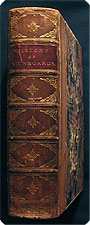
 Click the interior images for enlargement.
 emblems
and their meanings (though this is not, of course, the classic “emblem
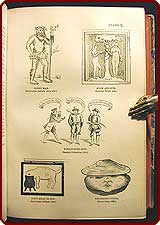
book”). “One hundred illustrations in fac-simile” are
attributed to Larwood on the title-page; the work features 19 plates, each depicting
an assortment of house- and pub-signs, as well as a hand-colored frontispiece
“Drawn by Experience . . . Engraved by Sorrow,” in which a cheerful
gin-drinking lady rides her woebegone, care-laden husband.
emblems
and their meanings (though this is not, of course, the classic “emblem
book”). “One hundred illustrations in fac-simile” are
attributed to Larwood on the title-page; the work features 19 plates, each depicting
an assortment of house- and pub-signs, as well as a hand-colored frontispiece
“Drawn by Experience . . . Engraved by Sorrow,” in which a cheerful
gin-drinking lady rides her woebegone, care-laden husband.
Provenance: Title-page stamped by a private collector: “Thomas Witherell Palmer, Log Cabin Park” (Detroit).
• Contemporary half calf with marbled paper–covered sides,
spine with gilt-stamped leather title-label and ornate gilt-stamped decorations
within compartments; binding with light to moderate rubbing overall, with
spine leather starting to show some cracking. All edges stained red.  Delightful
reading and looking, and a delightful copy.
Delightful
reading and looking, and a delightful copy.
 20 CHROMOSMurray, Hannah Lindley & Mary. The
toilet. Washington, DC: William Ballantine [Ballantyne], 1867. 8vo (21 cm, 8.25"). [4] pp.; 20 col. plts.
20 CHROMOSMurray, Hannah Lindley & Mary. The
toilet. Washington, DC: William Ballantine [Ballantyne], 1867. 8vo (21 cm, 8.25"). [4] pp.; 20 col. plts.


 Click the interior images for enlargements.
 Provenance: Inscription to Ellie Bond Robinson (from her cousin Elizabeth); elegant small booklabel, “Gardner.”
• Publisher’s textured cloth, framed in blind, front cover with gilt-stamped title; covers and corners showing very slight traces of wear. Front free endpaper with small booklabel and with inked gift inscription dated 1887. One flap (“Circumspection”) lacking, with all other flaps present and working.  An attractive copy of an uncommon item.

 Virtuous EMBLEMS — Engraved Title-Page
 after RUBENS Pietrasanta, Silvestro. Symbola heroica. Amstelaedami: Janssonio Waesbergios & Henr. Wetstenium, 1682. 4to (21.3 cm, 8.4"). lxxx, 480, [32] pp.; illus. (lacking 1 portrait).


 Click the images for enlargements.
  264 in-text copper engravings. One emblem features a telescope aimed at the sun, with the heading “Non ideo maculor”; Pietrasanta's anti-Galilean explanation is that any flaws to be perceived in the character of a virtuous prince are as imaginary as the illusory sunspots created by optical vibrations.


 Spanish Golden Age Sonnets — EMBLEMATIC Woodcuts
 the Muses Quevedo y Villegas, Francisco Gómez de. Las tres musas ultimas castellanas. Segunda cumbre del Parnaso español. Madrid: en la oficina de Alonso Balvas, a costa de la Hermandad de San Juan Evangelista, en el Martyrio de la Tina, patron del arte de la imprenta, 1729. 4to. 338 pp., [5] ff.

 Click the interior images for enlargements.full “emblem” style, with caption, image, and verses below. In addition to the images of the muses, there are nearly 40 xylographic head- and tailpieces


• Palau 244345. Contemporary limp vellum lacking ties. Age-toning or actual browning and occasional foxing as in all copies seen, because of the water used in manufacture of the paper; occasional light waterstains, brown stain at top of the title-page and some other leaves; still desirable. (25090)

Meant to be Entertaining — Still Is, for the Latinate! Schreger, Odilo. Studiosus jovialis, seu auxilia ad jocosè, & honestè discurrendum, in gratiam & usum studiosorum juvenum, aliorúmque litteratorum virorum, honestae recreationis amantium ... editio quinta. Pedeponti: Joannis Gastl, 1757. 8vo (16.4 cm, 6.5"). [4] ff., 744, [4 (index)] pp.


Uncommon. Searches of OCLC, RLIN, and NUC Pre-1956 locate only three copies in U.S. libraries.
• Goedeke, Grundriss zur Geschichte der deutschen Dichtung (for first ed.). 19th-century quarter morocco (refurbished) over paper-covered sides, spine with gilt-stamped title; edges of paper sides rubbed. Front pastedown with bookseller’s ticket from B. Westermann & Co. of New York, private collector’s 19th-century bookplate, and institutional stamp (no other markings). Small repaired hole to title-page, with four letters unobtrusively replaced. Foxed, with a few corners crumpled or dog-eared. One engraved plate from another work laid in. A pleasant, we would say “atmospheric” little volume.
The Immaculate Conception — Emblem’izedZoller, Josephus. Conceptvs chronographicvs de concepta sacra deipara. Septingentis sacræ scripturæ, Ss. Patrum, ac rationum, nec non historiarum, symbolorum, antiquitatum, et anagrammatum suffragiis roboratus.... Augustæ: Joannis Michaelis Labhart, 1712. Folio (32.5 cm, 12.75"). Frontis., [28], 353, [19 (index)] pp. (pp. 171/72 bound in after 173/74); illus. 

 Click any image above for an enlargement.
 The engraved frontispiece was done by Philipp Jacob Leidenhoffer after a design by Johann Asem; one of the engraved in-text emblems attributes its design to “I.C. Banaivir,” about whom no information could be found, while the others are unsigned.
The title-page bears an inked inscription reading “SanCto MarCo / In aVgIa DIVIte,” dated 1714; a few small scraps of paper with notes in an early inked hand are laid in.
• Landwehr, German, 660; Praz 543. Contemporary mottled sheep, covers framed in blind triple fillets, spine thickly blind-stamped with arabesque motifs; binding rubbed and abraded with leather cracked over joints and spine, spine stamping dimmed, and shelving number inked on spine. A few spots of pinhole worming to front cover, front free endpaper, and first few leaves; front pastedown with old bookseller’s ticket. Some pages with light foxing; one leaf with an old repair to the upper corner and one with a short tear from the lower margin. An interesting rarity, and one worthy of study.


PLACE AN ORDER | E-MAIL US | GO (BACK) TO TOPIC/INTEREST TABLE | PRB&M HOME
All material © 2010
The Philadelphia Rare Books & Manuscripts
Company