 FREE-THINKING
FREE-THINKING
FREE-THINKING
 FIRST
PAINE COLLECTION
FIRST
PAINE COLLECTION
 Paine, Thomas. The works of Thomas Paine. London: D. Jordan, 1792. 8vo (21.6 cm, 8.5"). Frontis., [4], 67, [1], viii, 110, [2], 142, [2], 69, [3], 29, [3], 16, 9, [1] pp.


 Click the images for enlargements.
 Individual titles in this collection are often separated and sold as if complete in themselves, but the present volume reflects their original state and the publisher's intent.
• ESTC T5785; Goldsmiths'-Kress 15080; Sabin 58244; Stephans, Paine Collection of Richard Gimbel, 1. Recent quarter calf and marbled paper–covered sides, spine with gilt-stamped leather label and gilt-stamped compartment decorations between gilt-ruled raised bands. Title-page and a few others with oval,19th-century institutional rubber-stamp; lower (closed) page edges rubber-stamped sometime later. Variable, mild to moderate foxing and other spotting, especially “in from edges”; occasional pencilled bracketing or underlining. One leaf with short tear in outer margin, not touching text. (25027)

 Defending the Immortality of the SoulAnonymous. Free thoughts upon the discourse of free-thinking. London: John Pemberton, 1713. 8vo (19.8 cm, 7.8"). [4], 68 pp.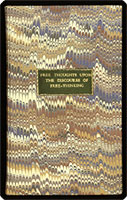
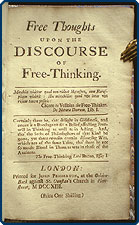
• ESTC T96164. Recent marbled paper–covered boards, front cover with gilt-stamped leather title-label. Pages slightly age-toned, else clean. (20770)


 Defending
 “Perfect Freedom of Discussion” Bailey, Samuel. Essays on the formation and publication of opinions and on other subjects. Philadelphia: R.W. Pomeroy (pr. by A. Waldie), 1831. 12mo (19.9 cm, 7.9"). [2 (adv.)], 240 pp.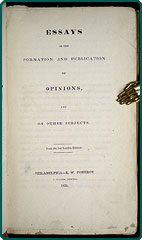
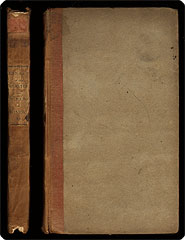
• American Imprints 5858. Uncut copy. Publisher's quarter red cloth and plain paper–covered sides, spine with printed paper label; binding rubbed/soiled, spine sunned/discolored, spine extremities chipped. Ex–social club library: traces of now-absent label at head of spine, bookplate on front pastedown, call number in a 19th-century hand on pastedown and front free endpaper. No other markings. Pages generally clean, with text block firm. (26284)

Atheist Hymnal Bennett, De Robigne Mortimer. The Truth Seeker collection of forms, hymns, and recitations. Original and selected. For the use of liberals. New York: D. M. Bennett, Liberal and Scientific Publishing House, [1877]. 12mo. vi, 7–585, [1], [6 (adv)] pp.
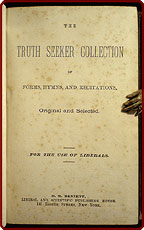
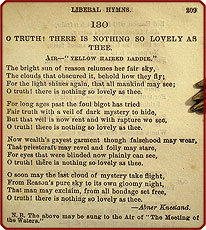 Click the interior images for enlargements.
 printed music), as well as doxologies and recitations, to express and illustrate the non-theist worldview. In several chapters he provides suggestions and guidelines for such an approach to marriage and funeral services, invocations, sentiments and toasts, epitaphs, obituaries, wills, benedictions, and baby names. Includes an index (pp. 579–85).
De Robigne Mortimer Bennett (1818–82), originally a Shaker, later became an important proponent of Freethought in the United States, founding the periodical Truth Seeker on 1 September 1873 to promote the cause of reason. He was one of Anthony Comstock's targets and was convicted after a trial in the U.S. Circuit Court for violating the Comstock Act by selling (at a Freethinker's convention) a copy of an “obscene” book (Cupid's Yokes). He served 13 months in the Albany penitentiary after a petition to President Rutherford Hayes for his release came to naught.
Publisher's advertisements in the back.
• Publisher's very dark puce cloth, gilt-stamped on the spine. Covers rubbed, with some staining and “bubbling” to cloth of front cover. Slight tear to cloth at top edge of back cover, and at head and foot of spine. Gilt on spine still mostly bright, with letters nearest front joint darkened. Mild internal foxing. A good sound copy. (24483)

“Remarks” — A Reply Bentley, Richard. Remarks upon a late discourse of free-thinking: In a letter to F.H. D.D. by Phileleutherus Lipsiensis. London: John Morphew, 1713. 8vo (19.8 cm, 7.75"). [2], [3]–85, [1(blank)] pp. (57/58 omitted in pagination).

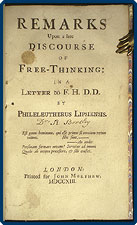
 Click the interior image for an enlargement.
 • ESTC T53380. On Bentley's response to Collins, see: Dictionary of National Biography. Recent marbled paper–covered boards, front cover with gilt-stamped leather title-label. Title-page with author's name inked in an early hand, dedication with dedicatee's name (Francis Hare) inked in the same hand. Title-page with two spots of light staining; pages otherwise clean, with a very few early inked marginalia. (20745)
This Classicist Crushes
Collins? Bentley, Richard. Remarks upon a late discourse of free-thinking: In a letter to F.H. D.D. by Phileleutherus Lipsiensis. Part the second. London: John Morphew & E. Curl, 1713. 8vo (19.7 cm, 7.75"). [4], 82, [2] pp.
Crushes
Collins? Bentley, Richard. Remarks upon a late discourse of free-thinking: In a letter to F.H. D.D. by Phileleutherus Lipsiensis. Part the second. London: John Morphew & E. Curl, 1713. 8vo (19.7 cm, 7.75"). [4], 82, [2] pp.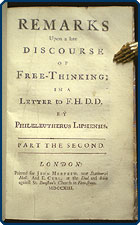
 Click the interior image for an enlargement.
 • ESTC T53381. On Bentley's response to Collins, see: Dictionary of National Biography. Recent marbled paper–covered boards, front cover with gilt-stamped leather title-label. Faint crease lines occasionally visible, pages otherwise clean. (20751)
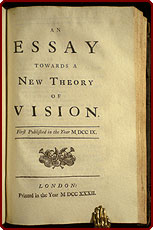
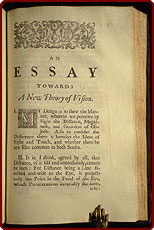
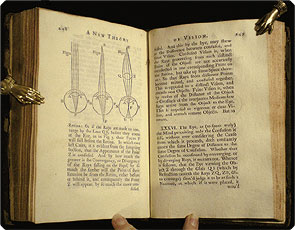
Written While Living in Rhode Island & Drawing Its Landscape Berkeley, George. Alciphron: Or, the minute philosopher. In seven dialogues. Containing an apology for the Christian religion, against whose who are called free-thinkers. London: J. Tonson, 1732. 8vo. 2 vols. I: [6] ff., 350 pp. II: [4] ff., 358 pp.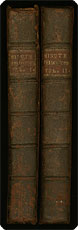
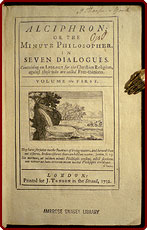
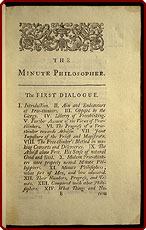
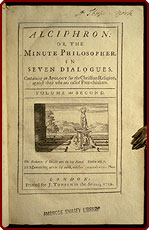 Click the interior images for enlargements.
 Presented here is Berkeley's defense of revealed religion: It ranks as a major example of English literature and of American literature too, for he wrote it while living in America waiting for money for his projected university in Bermuda. “Alciphron, a set of dialogues located notionally in England, but drawing much of the landscape description from Rhode Island,” sold well and aroused controversy after his return to Britain. The New Theory of Vision is “a work of lasting importance in the psychology of perception[; it] was transitional between Berkeley's already informed interests in mathematics and natural philosophy and a growing independence of mind in metaphysics and epistemology” (both quotations from DNB on-line).
Provenance: “A. Thorpe – York” inscribed on title-pages.
• ESTC T86056; NCBEL, II, 1852. Not in European Americana. Contemporary sheep, spines with raised bands and gilt-stamped red leather labels; covers framed and paneled in blind-stamped triple fillets with blind-stamped corner fleurons; all edges red. Leather rubbed with some loss to corners, edges, turn-ins; vol. I with pulls at both spine extremities, small gouge to front cover, front joint opening with cover almost off. Old institutional bookplates and rubber-stamp to pastedowns, title-pages, and lower edges of closed volumes; ink ownership signature to title-pages as above and a few additional ink and pencil marks; some very scattered spots or staining with pages generally clean. (21366)
 For more SETS, click here.
Prophecy
& Fulfillment
Set forth to Confute
Deism
Bible.
English. Selections. 1810. Selection of Old
Testament prophecies, concerning the Messiah, coupled with their fulfillment
in the New; exhibiting the solid foundation of the believer's hope, and the
best arguments for opposing the blasphemies of Deism. Boston: Pr. by Lincoln
& Edmands, 1810. 12mo. 12 pp.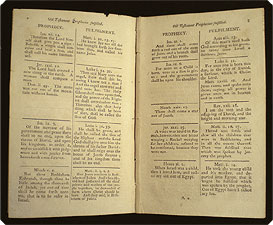 Click
the image for an enlargement.
Click
the image for an enlargement.
• Shaw & Shoemaker 19538. Good. Removed from a nonce volume. Lightly browned with worming to title-page, touching, but not obscuring, letters. (1170)
Wisdom,
Censored —
Post-PURCHASE?!Charron, Pierre. De la sagesse. Paris: Jean-François Bastien, 1783. 8vo (20 cm, 7.9"). Frontis., xviii, 768 pp.; 1 plt. (damaged/censored).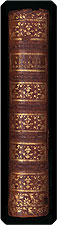
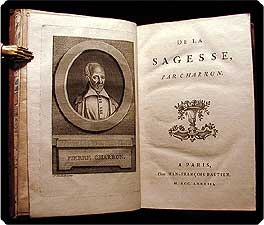
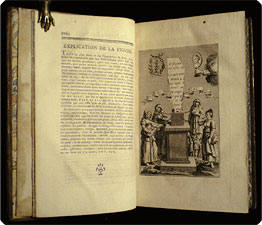 Click the interior images for enlargements.
  This
particular copy seems to have incurred someone’s personal wrath, as the
plate illustrating the allegory of Wisdom has had its central (nude) female
figure excised. The much more staid frontispiece
portrait of the author, done by Pruneau, is undamaged.
This
particular copy seems to have incurred someone’s personal wrath, as the
plate illustrating the allegory of Wisdom has had its central (nude) female
figure excised. The much more staid frontispiece
portrait of the author, done by Pruneau, is undamaged.
• Contemporary mottled calf framed in triple gilt fillets, spine gilt extra, all page edges marbled; binding with expectable acid-pitting and minor cracking of the leather over the spine and joints. One (and only one) signature foxed, leaves otherwise clean. A handsome book, defaced in a way that is depressing but also interesting.

“Ignorance
is the Foundation
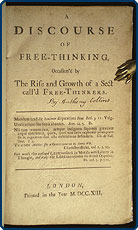
of Atheism,Collins, Anthony. A discourse of free-thinking, occasion'd by the rise and growth of a sect call'd Free-thinkers. London: 1713. 8vo (19.8 cm, 7.8"). 178, iii–vi pp. 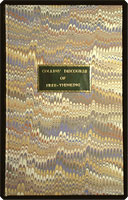
 a landmark work of
rationalistic religion. Opinions continue to vary, even in modern criticism, regarding whether Collins's work promoted deism or atheism; he himself claimed that increased independent critical thinking was responsible for the decline in belief in witchcraft.
Click the interior image for an enlargement.
a landmark work of
rationalistic religion. Opinions continue to vary, even in modern criticism, regarding whether Collins's work promoted deism or atheism; he himself claimed that increased independent critical thinking was responsible for the decline in belief in witchcraft.
Click the interior image for an enlargement. This copy has the two preliminary leaves bound in at the back (mispaginated as vi as seen in most copies) , but it is lacking the final advertisement leaf. The catchword on p. 7 is “allow'd.”
• ESTC T31966; Allibone 411–12. Recent marbled paper–covered boards, front cover with gilt-stamped leather title-label. Title-page with author's name inked in an early hand and with very elegant institutional pressure-stamp; title-page verso with shadows of pencilled numerals, first text page with inked numeral in lower margin. Final advertisement leaf lacking. Light offsetting and faint spotting (mostly confined to margins), pages otherwise clean. (20740)

(For)
Liberty &
Determinism?
— First,
YouDefine
the Terms [Collins,
Anthony]. A philosophical
inquiry concerning human liberty. The second edition corrected. London: R. Robinson,
1717. 8vo (18.8 cm, 7.375"). [1] f., vi pp., [1] f., 118 pp. 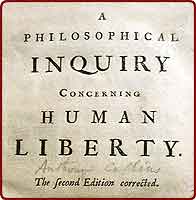
• ESTC T134533. On Anthony Collins, see: The Dictionary of National Biography, XI, 363–64. In recent blue-green wrappers; ex-library with stamps, including a very, very faint one on title-page. Uncut; traces of soiling in top margins, and occasional light ink-stains elsewhere.


The
Life of a Martyred AtheistDurand, David. La vie et les sentimens de Lucilio Vanini. Rotterdam: Aux depens de Gaspar Fritsch, 1717. 12mo (17 cm, 6.6"). xxxii, 260 pp., [3] ff.
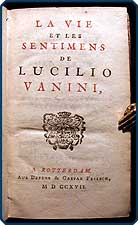
• Contemporary speckled calf, spine gilt extra and with gilt-stamped label; spine with a few small chips, joints open. Pages slightly age-toned, with pencilled emphasis marks.
Cambridge
Contradicting Collins
. . .
Gentleman
of Cambridge. An answer to the discourse on free-thinking:
Wherein the absurdity and infidelity of the sect of free-thinkers is undeniably
demonstrated. London: John Morphew & A. Dodd, 1713. 8vo (19.7 cm, 7.75").
[8], 28 pp.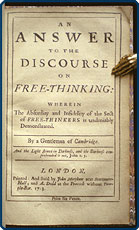
• ESTC T22052. Recent marbled paper–covered boards, front cover with gilt-stamped leather title-label. Pages clean. (20790)
BANGOR
Bangs
Collins .
. .
Hoadly, Benjamin. Queries recommended to the authors of the late discourse of free thinking ... the second edition. London: James Knapton, 1713. 8vo (19.7 cm, 7.75"). 31, [1] pp.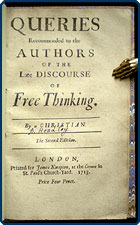
• ESTC T18251. Recent marbled paper–covered boards, front cover with gilt-stamped leather title-label. Title-page with author's name inked in an early hand; pages slightly age-toned, otherwise clean. (20775)

Rebutting a“Noted Infidel” Lamber, Louis Aloisius. Rev. L. A. Lambert, LL.D. versus Col. R. G. Ingersoll. The Christmas sermon of the noted infidel dissected by the eminent doctor. Cleveland, Ohio: The Universe Publishing Company, n.d. [ca. 1900]. 16mo. Frontis. port., xxviii, 216 pp. 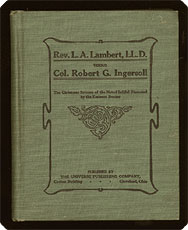
• Publisher's green cloth. Front pastedown with authorial bookplate. Spot of soil on frontispiece. Very good. (15749)
“A
Short
& Easy
Method
with theDeists”
Leslie, Charles. A short and easy method with the deists:
wherein the certainty of the Christian religion is demonstrated, by infallible proof from four rules,
which are incompatible to any imposture that ever yet has been, or that can possibly be. In a letter to
a friend. Windsor, VT: Pr. by T.M. Pomroy, 1812. 12mo. 168 pp.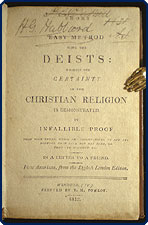
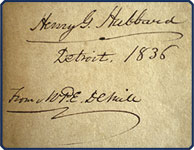 Click the title page image for an enlargement.
 Provenance: Property, in 1836, of Henry G. Hubbard of Detroit.
• Shaw & Shoemaker 25848. Contemporary sheep. Spine with compartments divided by gilt rules. Leather much rubbed with a little chipping. Browning from turn-ins onto endpapers and title-page. Top margins closely trimmed with loss of page numbers in some places. Inked ownership inscriptions on recto of front free endpaper and title-page. (5442)
“By
a Gentleman of Pittsburgh”
McSherry, Michael. A glance at religion and infidelity: With
strictures on an infidel review. By a gentleman of Pittsburgh. Pittsburgh: Wilson & Marks, 1834.
12mo. 39, [1] pp.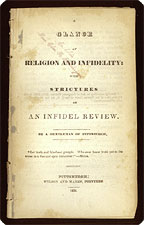
• Removed from a nonce volume. Title-page ink- and pressure-stamped by a private collector; pages mildly age-toned. (15424)
“The
Deist Unmasked”
Ogden, Uzal, & Charles Leslie. Antidote to deism. The deist
unmasked; or An ample refutation of all the objections of Thomas Paine, against the Christian
religion; as contained in a pamphlet, intitled, The age of reason; addressed to the citizens of these
states. Newark, N. J.: Pr. by John Woods, 1795. 12mo. 2 vols. I: xxiv, [13]–327 pp. II: xxii,
[13]–342 pp.
 Click the interior image for an enlargement.
 Provenance: M. La Rue Perrine, on title-page.
• Evans 29237; Felcone, New Jersey Books, 206. Original sheep, volume number in gilt on spines, title gilt-stamped on a red leather spine labels. Bindings abraded and leather of spines cracking; spines with white-lettered call number and remnants of paper shelf label; covers rubbed and scraped, with leather at base of front cover of vol. I torn with loss; black stain and faint ink notation on front cover of vol. I; gilt on spines darkened. Ex-library, with bookplates on front pastedowns, pressure-stamp on title-page of vol. II, and penciled call numbers on verso of title-pages. Signature of a contemporary owner at top margin of title-pages. Front fly-leaves with ink notation in an early hand. Pages age-toned. Front free endpapers torn at gutter. Front endpapers of vol. II heavily stained. Browning at edges of front and back blank pages only. Small chip within text of pp. 21/22 of vol. II, with loss of several words but no loss of overall sense. A couple of leaves chipped in fore-margin. (20002)
Famous
Religious
& Social DebateOwen,
Robert, & Alexander Campbell. Debate on the evidences of Christianity; containing an examination of the “social system,” ... reported by Charles H. Sims, Stenographer. Bethany, Va.: Pr. & pub. by Alexander Campbell, 1829. 8vo. 2 vols. in 1. 251, [1 (blank)] pp.; 301, [1 (blank)] pp.  Click the image at right for an enlargement.
 • Shoemaker 39945; Goldsmiths', Robert Owen, 1771-1858: Catalogue of an exhibition of printed books held in the Library of the University of London, 79a. Uncut copy, in original quarter cloth, with paper spine label. Binding worn, covers detached (such bindings are notoriously delicate), and with the usual amount of foxing to pages. Housed in a cloth clamshell box. A good copy.
Early U.S. Printings — Both Parts Paine,
Thomas. The age of reason. Being an investigation of true and
of fabulous theology. Boston: Thomas Hall, 1794. 12mo. 199, [5] pp. [bound
with] The age of reason; being an investigation of true and of fabulous
theology. Part II. New-York: Re-printed by Mott & Lyon, for Fellows &
Adam and J. Reid, 1706. 12mo. 199, [5] pp. 


 Click the interior images for enlargements.
 • Part I: Evans 27458; ESTC W31697. Part II: Evans 30941; ESTC W31705. Recent full calf, period style. Old library stamp on first title-page. A very nice set of both parts. (20627)
TWO
Responses toAnthony
Collins
Pycroft,
Samuel. A brief enquiry into free-thinking in matters of religion;
and some pretended obstructions to it ... Cambridge: Pr. at the University Press
for Edmund Jeffery & Jonah Bowyer, 1713. 8vo (19.8 cm, 7.75"). [2], 150,
[2 (errata)] pp. (lacking half-title). [bound with] Addenbrooke,
John. A short essay upon free-thinking. London: Jonah
Bowyer, 1714. 8vo. [8], 16 pp. 

 Click the interior images for enlargements.
 Provenance: The first work's title-page has “Ex dono Autoris” inscribed in the upper margin in an early hand.
• Pycroft: ESTC T144698; Allibone 1712. Addenbrooke: ESTC T88427. Recent marbled paper–covered boards, front cover with gilt-stamped leather title-label. Pycroft half-title lacking; title-page with annotation as above. Pages slightly age-toned, with light spotting to final leaves of Enquiry and throughout Essay. (20760)
Printed by the Thomases of WorcesterSaint-Pierre, Jacques Henri Bernardin de. A vindication of divine Providence; derived from a philosophic and moral survey, of nature and of man... first American edition. Worcester: J. Nancrede (pr. by Thomas, Son & Thomas), 1797. 8vo in 4s (20.2 cm, 7.9"). Frontis., 331, [1 (blank)] pp., lacking the folding map.

This is the separate issue of vol. I, which was issued without the map and has “The End” at the bottom of p. 331—the two-volume issue has “End of first volume” instead.
 This copy includes a pencilled marginal comment, commanding, “Read this if thou canst be an atheist — or
a fool.”
This copy includes a pencilled marginal comment, commanding, “Read this if thou canst be an atheist — or
a fool.”
• ESTC W36508; Bristol B10094; not in Evans. Contemporary treed sheep, spine with gilt-stamped leather title-label and double gilt rules; binding with small scrapes and rubbed patches, upper board edge darkened, and leather starting to crack over the spine and joints. Without the folding map. First and last few leaves foxed.
Free Love Advocate Takes onInerrancy of the Bible Slenker, Emilina Drake. Studying the Bible: or brief criticisms of some principal scripture texts. Boston: Josiah P. Mendum, 1870. 12mo (19 cm; 7.5"). iv, 153, [1 (blank)] pp.

Slenker, daughter of a Shaker preacher, was a well-known liberal author, editor, and advocate of free love and contraception who at one point in her career spent six months in jail for sending private correspondences on sex and contraception.
Mendum, the publisher of this work, was also the publisher of the Boston Investigator, the first U.S. rationalist news publication, in which Studying the Bible first appeared in parts; he had Slenker, then living in Elizabethown, East Tennessee, revise that serialization for this book publication.
Provenance: Handsome 19th-century private ownership stamp of L.P.M. Petit on title-page and elsewhere.
WorldCat locates only six U.S. holdings (one in the Houdini collection at the Library of Congress).
• Publisher's textured black cloth over boards, rubbed and chipped; front joint starting and partially open. Gilt lettering on spine, faded. Inside, just a bit of foxing. (25946)
Sermons from“Silver-Tongued Smith” Smith, Henry. The sermons of Master Henry Smith, gathered into one volume. Printed according to his corrected copies in his life time. [& others by the same author, as called for, as below]. London: Pr. by Thomas Harper, by the assignes of Ioan Man, and Benjamin Fisher, 1637. 4to (18.3 cm, 7.2"). 600 (593–600 bound in later in volume). [with, as called for, the same author's] God's arrow against atheists. London: Pr. by J.H. for Edward Brewster & Robert Bird, 1637. [4], 96 (i.e., 98) pp. [with] Three sermons made by Mr. Henry Smith. London: John Smethwick, 1637. 56 pp. [and with] Twelve
sermons, preached by Mr. Henry Smith. With prayers, both for the morning and evening thereunto adjoyned. London: Pr. by John Haviland for George Edwards, 1637. [254] pp.

 Click the interior images for enlargements.

• ESTC S103687; STC (rev.), 22734. ESTC S106857; STC (rev.) 22676. ESTC S104574; STC (rev.) 22747. ESTC S125529; STC (rev.) 22783. On Smith, see: Oxford Dictionary of National Biography. Later half black sheep in imitation of morocco with red marbled paper–covered boards; moderately rubbed. Ex-library: spine with faded traces of call number and label, front pastedown with institutional bookplate, rubber-stamp on bottom edges of closed book. Pp. 593–757 partially and very neatly paginated in red pen as in continuation of the first portion of the volume; some inked letter corrections as above. Pages age-toned, with intermittent moderate to dark spotting; final portion of volume with a few leaves waterstained. Shouldernotes occasionally shaved and page edges with occasional short tears. First two leaves with outer edges ragged; several with lower margins or outer corners repaired, in one case with loss of about ten words. On the whole, a volume that shows its age but is not giving in to it. (24098)
NOT
by a “Free-Thinker”
Whitehead, William Adee. The alleged atheism of the
Constitution. From the Northern Monthly for November, 1867. Newark: 1867. 8vo. 15, [1 (blank)]
pp.
• NSTC 2W17788. Original wrappers, front wrapper chipped at edges, back wrapper chipped at inner edge and with paper remnants affixed at top. Leaves loose (wrappers included). Long tear in fore-margin of title-leaf and small chips in inner margins of title- and final leaves. Some short marginal tears. Small chips to lower outer margins. Lengthwise fold mark. (8931)
“The Great bauble of the Christian Priest, Exploded
— ‘Busted’”Woolley, Milton. The career of Jesus Christ: Being a supplement to the author’s Science of the Bible. Streator, IL: Free Press Publishing House, 1877. 8vo (20.7 cm, 8.2"). Frontis. (incl. in pagination), 52, [2] pp.; [60 (20 blank)] ff. Click the image to the left
  The printed Career is followed in this little volume by an extended manuscript section containing neatly written excerpts from Wooley’s Science of the Bible or an Analysis of the Hebrew Mythology.
• Contemporary half calf over textured cloth, spine with gilt-stamped leather title-label and gilt-ruled raised bands; front cover detached, leather scuffed. All page edges marbled. Upper portion of front free endpaper torn away; two front fly-leaves partially excised. Back free endpaper with pencilled owner’s name. Printed portion very slightly age-toned, with faint creasing to first section.
For
a short “shelf” devoted to

PLACE AN ORDER | E-MAIL US | GO (BACK) TO TOPIC/INTEREST TABLE | PRB&M HOME
All material © 2010
The Philadelphia Rare Books & Manuscripts Company
 For Books for the BUSTED