 HUMAN RIGHTS
HUMAN RIGHTS
HUMAN RIGHTS
 BUILDER of the FIRST
 New World Utopian Community
  (A
Figure Not So Widely Known as He Should Be). Moreno, Juan
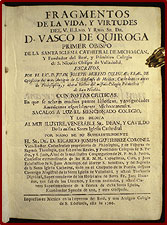
Joseph. Fragmentos de la vida, y virtudes del v. illmo. y rmo. Sr. Dr.
D. Vasco de Quiroga primer obispo de la santa iglesia cathedral de Michoacan,
y fundador del real, y primitivo Colegio de s. Nicolàs obispo de Valladolid
... Con notas criticas, en que se aclaran muchos puntos historicos, y antiguedades
americanas especialmente michoacanenses. Mexico: en la imprenta del Real, y mas
antiguo Colegio de S. Ildefonso, 1766. Small 4to (20.5 cm; 8"). [13] ff., 202
pp., [2] ff., 29, [1 (errata)] pp., port.
(A
Figure Not So Widely Known as He Should Be). Moreno, Juan
Joseph. Fragmentos de la vida, y virtudes del v. illmo. y rmo. Sr. Dr.
D. Vasco de Quiroga primer obispo de la santa iglesia cathedral de Michoacan,
y fundador del real, y primitivo Colegio de s. Nicolàs obispo de Valladolid
... Con notas criticas, en que se aclaran muchos puntos historicos, y antiguedades
americanas especialmente michoacanenses. Mexico: en la imprenta del Real, y mas
antiguo Colegio de S. Ildefonso, 1766. Small 4to (20.5 cm; 8"). [13] ff., 202
pp., [2] ff., 29, [1 (errata)] pp., port.
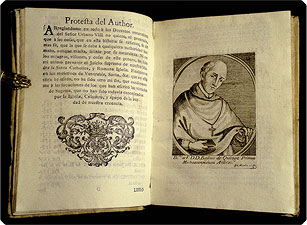
 Click the interior images for enlargements.
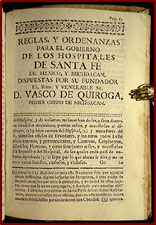
  Not the least of his accomplishments was the creation of two pueblo-hospitals for native Americans, and appended and integral to this biography are his “Reglas, y ordenanzas para el gobierno de los Hospitales de Santa Fé de México, y Michoacàn,” which occupy the final 29 pages.
Historians still consider this to be the definitive biography of Quiroga. The engraved portrait of him, handsome and from the burin of José Morales, adds a face to the words of the biographer and to the account of the deeds of the biographee.
• Medina, Mexico, 5099; Wellcome, Medical Americana, M.134; Palau 181902; Beristain, III, 2059. Contemporary limp vellum lacking ties. A very good copy. (23061)

 Defending
 “Perfect Freedom of Discussion” Bailey, Samuel. Essays on the formation and publication of opinions and on other subjects. Philadelphia: R.W. Pomeroy (pr. by A. Waldie), 1831. 12mo (19.9 cm, 7.9"). [2 (adv.)], 240 pp.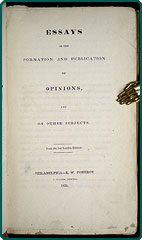
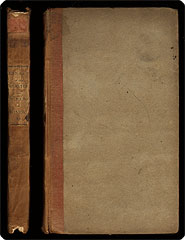
• American Imprints 5858. Uncut copy. Publisher's quarter red cloth and plain paper–covered sides, spine with printed paper label; binding rubbed/soiled, spine sunned/discolored, spine extremities chipped. Ex–social club library: traces of now-absent label at head of spine, bookplate on front pastedown, call number in a 19th-century hand on pastedown and front free endpaper. No other markings. Pages generally clean, with text block firm. (26284)


 “Natural Equality”
— Newark,
1802
Brown, William Lawrence. An essay on the natural equality of men; on the rights that result from it, and on the duties which it imposes.... The second American edition. Newark: John Wallis, 1802. 12mo (17.3 cm, 6.8"). [2 (1 blank)], 141, [1 (blank)] pp.
“Natural Equality”
— Newark,
1802
Brown, William Lawrence. An essay on the natural equality of men; on the rights that result from it, and on the duties which it imposes.... The second American edition. Newark: John Wallis, 1802. 12mo (17.3 cm, 6.8"). [2 (1 blank)], 141, [1 (blank)] pp.
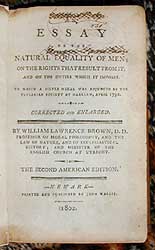
• Shaw & Shoemaker 1953. On Brown, see: Dictionary of National Biography, VII, 37–38 (under William Laurence Brown). Relatively unworn library buckram; library name pressure-stamped on covers and its bookplate to front pastedown. Hinges reinforced at rebinding with cloth and first few pages fragile along line of reinforcement; front free endpaper separated. Title-page and a few others faintly stamped, title-page with crossed-out ownership inscription. Some offsetting; a very few instances of pencilled underlining; corners occasionally dog-eared or chipped. Overall a fairly decent copy, suffering a bit from earlier "conservation."

 First
German-Language EditionSocial
& Economic Causes
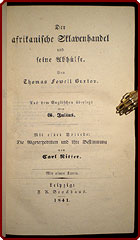
Buxton, Thomas Fowell. Der afrikanische Sklavenhandel und
seine Abhülse ... mit einer Vorrede: Die Nigerexpedition und ihre Bestimmung. Leipzig: F.A.
Brockhaus, 1841. 8vo (21.6 cm, 8.5"). lxx, 453, [3] pp.; 1 fold. map.
First
German-Language EditionSocial
& Economic Causes
Buxton, Thomas Fowell. Der afrikanische Sklavenhandel und
seine Abhülse ... mit einer Vorrede: Die Nigerexpedition und ihre Bestimmung. Leipzig: F.A.
Brockhaus, 1841. 8vo (21.6 cm, 8.5"). lxx, 453, [3] pp.; 1 fold. map.
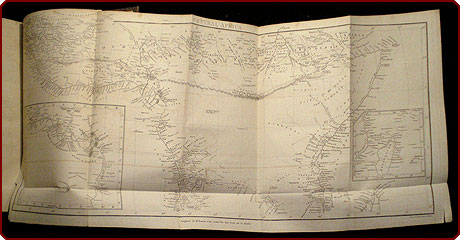
The volume is illustrated with an oversized, folding engraved map captioned in English.
Uncommon: OCLC and NUC Pre-1956 find only nine U.S. holdings (one deaccessioned).
• Goldsmiths'-Kress 32415.2; Sabin 9688. On Buxton, see: Oxford Dictionary of National Biography online and Allibone, 317. Boards covered with German-style black-flecked brown paper, spine with printed paper label. Pages slightly age-toned, with a very few scattered instances of light spotting; map with faint offsetting and short tear along lower inner margin, not touching image. An attractive copy. (25325)

First Printing in Latin America — Montes de Oca Engraved Title Casas, Bartolomé de las. Breve relacion de la destruccion de las Indias Occidentales. México: en la oficina de Don Mariano Ontiveros, 1822. 16mo (15 cm; 5.75"). [1] f., 164 pp.
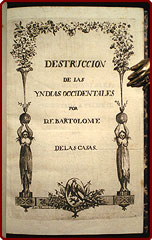
 Click the title-page image above for an enlargement.
 This edition begins with a handsome engraved title by the famous Mexican
engraver Luis Montes de Oca, signed in the lower left corner and bearing the
Mexican national emblem in the lower center of the plate. This
is one of the first appearances of that emblem, and it is most fitting that
it be the work of this artist.
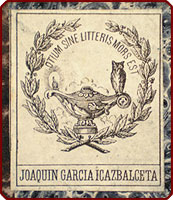
Provenance: Bookplate of the famous 19th-century Mexican collector, bibliographer, and historian of the book, Joaquín García Icazbalceta.
• Palau 46951. 19th-century quarter black morocco with
marbled paper sides; spine tooled in gilt to replicate a raised-band spine
with spine compartments; two small abrasions. Interior with light, scattered
foxing only.A
lovely little book. (25216)

Paine
Was a DIRTY
Man!Cheetham, James. The life of Thomas Paine, author of Common sense, The crisis, Rights of man, &c. &c. &c. New York: Southwick & Pelsue, 1809. 8vo (22.2 cm, 8.75"). 347, [1] pp.
DIRTY
Man!Cheetham, James. The life of Thomas Paine, author of Common sense, The crisis, Rights of man, &c. &c. &c. New York: Southwick & Pelsue, 1809. 8vo (22.2 cm, 8.75"). 347, [1] pp.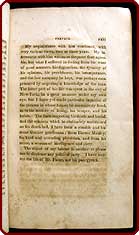
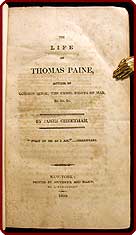 Click either image for an enlargement.
 Provenance: Pencilled note on endpaper, “From Ralph E. McCoy’s Library”; McCoy, emeritus Dean of Libraries at Southern Illinois University, Carbondale, published widely on the First Amendment freedoms.
• Howes C336; Sabin 12379; Shaw & Shoemaker 17193. Later quarter plain brown paper over contemporary tan paper–covered sides; edges and corners rubbed. Front free endpaper (modern) with pencilled note of McCoy’s ownership; front fly-leaf with pencilled gift inscription dated 1849. Offsetting and foxing throughout. A very sound copy.
“Official Edition” — A Human Rights MilestoneColombia. Constitution. 1853. Constitucion política de la Nueva Granada. Año de 1853. [Bogotá]: no publisher/printer, 1853. Small 8vo (20 cm, 7.9"). 12 pp.
 Click the images for enlargements.
 There were two editions in 1853, the other being 24 pages in length.
• Palau 59737. Original printed yellow wrappers, creased and a little dusty. Very good condition.
“I am anxious you should do a writing portrait . . . ” Cook, Eliza. A.L.s. (“Eliza”) to “My dear Sec.” London: 6 June 1860. 12mo (7.25" x. 4.5"). 1 p.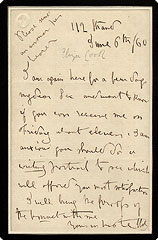 Click the image for an enlargement.
  a Chartist poet, author, and proponent of political and sexual freedom for women. She writes, “I am again here for a few days . . . and want to know if you can receive me on Friday about eleven. I am anxious you should do a writing portrait to see which will afford you most satisfaction. I will bring the proofs of the sonnet with me.”
Provenance: Residue of the stock of Seven Gables Bookshop (1930–79), via the son of Michael Papantonio (2009).
• Very good condition. Tipped onto a slightly larger sheet. With the integral blank. (25726)
Davis Himself
on the Civil War
— Many
Plates &
Maps
Davis,
Jefferson. The rise and fall of the Confederate government.
New York: D. Appleton & Co., 1881. 8vo (23.8 cm, 9.4"). 2 vols. I: xxi,
[3], 707, [5 (adv.)] pp.; 9 plts., 1 map. II: xvii, [3], 808, [4 (adv.)] pp.;
10 plts., 13 fold. maps.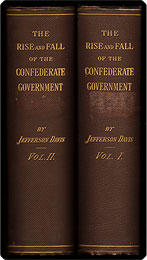
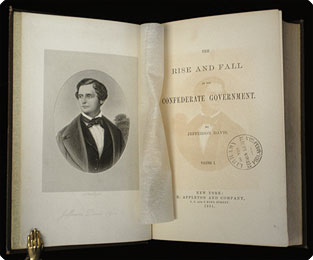
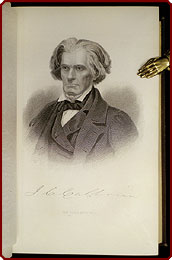 Click
the images for enlargements.
Click
the images for enlargements.
• Howes D120. Publisher's pebbled brown cloth, covers framed in blind with central gilt-stamped horse and rider medallion on front, spines with gilt-stamped title; edges/extremities lightly rubbed and spines each with a patch lightened (moreso to vol. I). Ex–social club library: call number on endpapers, title-pages rubber-stamped. Minor offsetting from some plates, pages otherwise clean. (26900)
 “Apology”
 NOT
Accepted!
[Dexter, Franklin]. A letter to the
Hon. Samuel A. Eliot, representative in Congress from the city of Boston, in
reply to his apology for voting for the fugitive slave bill. Boston: Wm. Crosby
& H.P. Nichols, 1851. 8vo. 57 pp.
NOT
Accepted!
[Dexter, Franklin]. A letter to the
Hon. Samuel A. Eliot, representative in Congress from the city of Boston, in
reply to his apology for voting for the fugitive slave bill. Boston: Wm. Crosby
& H.P. Nichols, 1851. 8vo. 57 pp.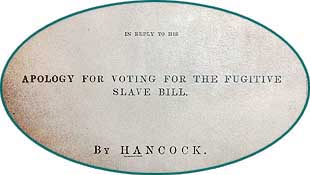
 First edition.
• Sabin 19890; Dumond 63. Sewn, in original printed wrappers, slightly chipped. Five-digit number stamped on front wrapper, and a neat paper label at upper left corner. A very nice copy.

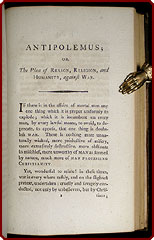
Two Tracts onPEACE Erasmus, Desiderius. The complaint of peace: With a digression, on the folly of kings in unlimited monarchies. To which is added, Antipolemus: Or, the plea of reason, religion, and humanity, against war. London: [s.n.], 1795. 8vo (21.7 cm, 8.5"). [2], x, 150, v–xliii, [1], 183, [1 (blank)] pp.
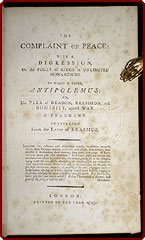
 Click the images for enlargements.
 • ESTC N31610. On Knox, see: Oxford Dictionary of National Biography online. Contemporary treed sheep, spine with gilt-stamped leather title-label and board edges gilt; binding rubbed, irregularly darkened, and chipped, with front joint open (sewing presently holding) and back joint starting. Ex–social club library: 19th-century bookplate, inked call number on endpapers, title-page pressure-stamped. No other markings. Collation matches ESTC's description. Varying degrees of foxing/browning, with most leaves unaffected or only a little so. All edges saffron. (26377)
An Indian Author Objects to aRacist
SystemFurdoonjee,
Nowrozjee (i.e., Naurozji Faridunji).
On the civil administration of the Bombay Presidency...published in England at the request of the Bombay Association. London: John Chapman, 1853. 8vo. vii, [1], 88 pp.
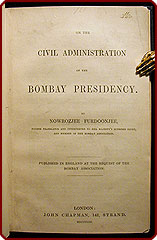
A search of RLIN, OCLC, NSTC, and NUC Pre-1956 shows only four U.S. holdings of this pamphlet.
• NSTC 2N1853. Recent moiré cloth–covered boards. Title-page with small inked numerals in upper outer corner. One leaf with short edge tear just touching text.
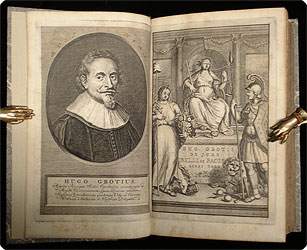
Grotius on THE LAW of War & of the Sea,& on Natural Law Grotius, Hugo. Hugonis Grotii De jure belli ac pacis libri tres, in quibus jus naturae & gentium, item juris publici praecipua explicantur. Cum annotatis auctoris, ejusdemque dissertatione de Mari libero, ac Libello singulari de aequitate, indulgentia, & facilitate, nec non Joann. Frid. Gronovii v.c. notis in totum opus De jure belli ac pacis. Amstelaedami: Apud Janssonio-Waesbergios, 1720. 8vo (20 cm; 8"). Frontis., engr. title-page, [13] ff., xxxv, [1] pp., [2] ff., 483, [1] pp., [1] f., [483!]–936 pp.; 43, [1] pp., [42] ff.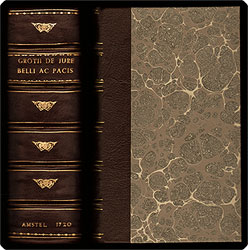
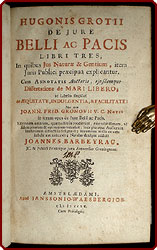 Click the images for enlargements.
 Grotius saw his book published for the first time in 1625 at Paris: It studies the legality of war and immediately established itself as a foundational work on the topic. Modern scholars regard it asfoundational in international law.
This edition contains added scholarship from Joannes Fredericus Gronovius (1611–71) and Jean Barbeyrac (1674–1744). In addition to De jure belli ac pacis the reader will find two other important Grotius tracts at the rear of the volume: Mare liberum and Libellus singularis de aequitate, indulgentia et facilitate, meaning the volume treats not just of law of war, but natural law, international law, maritime law, and law of the sea.
There are two issues of this edition, the other having “Ex Officina Wetsteniana” on the title-page in place of “Apud Janssonio-Waesbergio.” In both editions the title-page is printed in black and red, and of course, they have the same pagination. The work has side- and shouldernotes, an engraved portrait of Grotius, and an added engraved title-page.
• Meulen & Diermanse (1950 ed), Grotius, 602. Modern quarter claret-colored morocco with gilt-accented raised bands; gilt center device in each spine compartment. Marbled paper sides. Library pressure-stamps on title-page, no other markings; light age-toning and occasional spotting or foxing. A very nice copy with all edges decorated — more than “speckled,” not quite “marbled,” definitely attractive. (26526)
 Not “That” Hardy — Nor That One, EitherHardy, Thomas. The patriot. Addressed to the people, on the present state of affairs in Britain and in France. With observations on republican government, and discussions of the principles advanced in the writings of Thomas Paine. Edinburgh: J. Dickson, & London: G. Nicol, 1793. 8vo in 4s (19.5 cm, 7.7"). [4], 76 pp.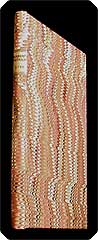
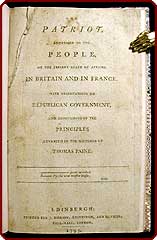 • First edition. This response to Paine’s Rights of Man is attributed to a Scottish clergyman (sometimes called Hardie) who taught church history at Edinburgh University — not to the radical politician of the same name who was charged with treason in 1794.
• ESTC T102145; Sabin 59081. Recent marbled paper–covered boards, spine with printed paper label. Original sewing holes visible in inner margins; some leaves lightly foxed, with final page darkened.
Religion Wantsto Be Free Harris, William. Observations on national establishments in religion in general, and on the establishment of Christianity in particular. Together with some occasional remarks on the conduct and behaviour of the teachers of it. London: S. Bladon, 1767. 8vo (21.2 cm, 8.4"). [2], 60 pp. (half-title lacking).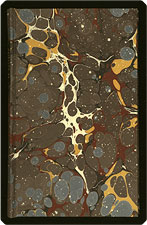
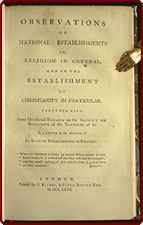
Uncommon: Only three U.S. institutions report holdings.
• ESTC T3154. Recent marbled paper–covered boards, spine with gilt-stamped leather title-label. Lacking the half-title. Pages lightly age-toned. (21078)

Anti–Slave
Trade[Harrison,
George]. An address to the right reverend the prelates of England and Wales,
on the subject of the slave trade. London: J. Parsons, 1792. 8vo (19 cm, 7.5").
15, [1 (blank)] pp.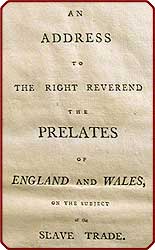
• ESTC N46161. Marbled paper–covered boards, old-style, front cover with printed paper label. Pages skillfully reinforced at inner margins; clean throughout.
An Attempt at Peace during the Wars of the Huguenots Henry III, King of France (1551–89). Edictum Henrici regis Galliæ de pace, nuper a typographo regio Lutetiæ editum cum priuilegio regis, è Gallico in Latinum sermonem fideliter conuersum. Inscriptio hæc suit: Edictum regis ad compositionem tumultuum huius regni pertinens. [Paris: Frédéric Morel], 1576. 4to (19.5 cm; 7.75"). [1] f., 38 pp.
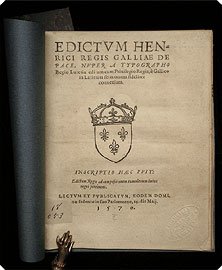
Click the image for an enlargement.  WorldCat locates only three copies in North America.
• Lindsay & Neu 884; VD16 F2427. In modern wrappers. Small 19th-century library label on title-page. Pressure-stamp on title- and three other leaves; strip of heavy paper adhered to inner margin of last leaf. (3190)
A Human Rights Appeal/Exposé — American Indian Advocacy Jackson, Helen Fiske Hunt. A century of dishonor[.] A sketch of the United States government's dealings with some of the Indian tribes. By H. H. New York: Harper & Brothers, 1881. 12mo. x, 457, [1 (blank)] pp.; 6 pp. (ads).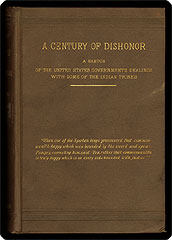
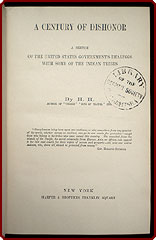 Click the images for enlargements.
 Jackson grew up in Massachusetts and was a close friend of Emily Dickinson. Her marriage in 1852 to a Captain Hunt ended tragically, for he and their two children were dead by 1865. For health reasons she moved to Colorado and in 1875 married a banker named William Jackson. She developed a keen interest in the plight of the American Indian and secured the extraordinary privilege of doing research in the Americana Department of the Astor Library in New York City during the morning hours before the doors officially opened.
She hoped this work would effect a reversal of government policy and herself purchased sufficient copies to send one to every member of both houses of Congress. She then turned to fiction as another avenue of attack: Her best-known novel, Ramona, was her attempt to produce for American Indians a work that would affect their lot as Uncle Tom's Cabin did the plight of black slaves.
A landmark book.
• BAL 10444. Publisher's brown cloth, lettered in gold. Ex–social club library: 19th-century bookplate, call number on endpaper, rubber-stamp on title-page, no other markings. Two small areas of minor discoloration on spine where paper shelving labels removed. Overall a very nice copy. (26260)

A
Southerner
Calls forABOLITION
in 1767
[Lee, Arthur]. [drop-title] Extract from an
address in the Virginia Gazette, of March 19, 1767. [Philadelphia?: Pr. by Joseph
Crukshank?, 1780?]. Small 12mo. 4 pp.
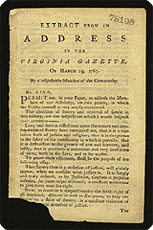
Click
the image for an enlargement.
• Evans 16773; Hildeburn, The Issues of the Press in Pennsylvania, 1685–1784, 4006. Five-digit number stamped above the title; pp. 1 and 2 separated from 3 and 4, and gutter margin repaired, reattaching the halves. Semicircular tear in lower, inside area of all pages, costing a total of 9 or 10 words.

Separation of Church & State — RELIGIOUS LIBERTYFirst Collected Edition Locke, John. Letters concerning toleration. London: A. Millar, H. Woodfall, I. Whiston & B. White, I. Rivington, et al., 1765. 4to (29.5 cm, 11.6"). Frontis., [8], 399, [1 (blank)] pp.
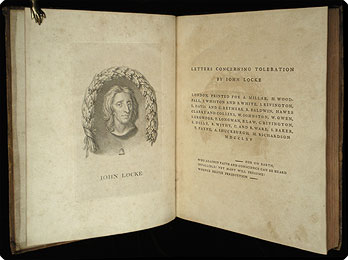 Click the images for enlargements.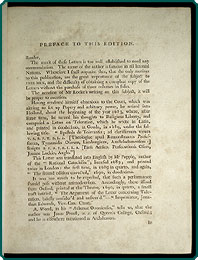
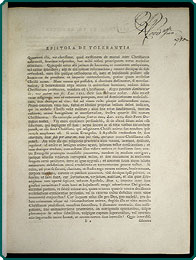
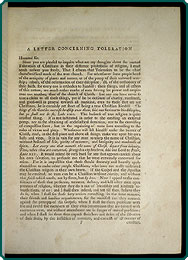 This is a lovely, “gentleman's library” edition, well printed with generous margins.
Provenance: Two text pages and back pastedown with flourished ownership inscriptions of Richard Wood, Jr., dated 1780.
• ESTC T114245; Graesse, IV, 243; Lowndes 1380; Allibone 1113–14. Contemporary speckled calf, spine with gilt-ruled raised bands and gilt-stamped leather title-label; binding lightly rubbed/scuffed overall, joints starting from top and front hinge (inside) starting; spine with a chip and a small paper label. Front pastedown with three bookplates most tantalizingly layered over one another, the most recent being from a 19th-century social club library; front free endpaper with pencilled and inked numerals in an early hand. Pages age-toned and faintly to moderately spotted; minor offsetting from frontispiece to title-page. (26302)
Marmontel's Political-Philosophical Novel withGravelot's Illustrations Marmontel, Jean François. Bélisaire. Paris: Chez Merlin, 1767. 8vo (19.9 cm, 7.8"). [4], x, 340, [6] pp.; 4 plts.
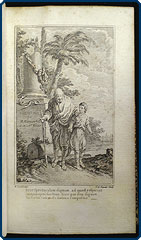
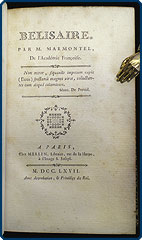
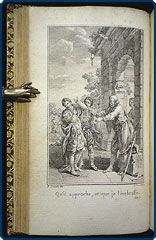 Click the images for enlargements.
 Merlin also printed a duodecimo edition in 1767; in the present edition, “Fragmens de philosophie morale” is found on pp. 273–340, followed by the Addition and Approbation.
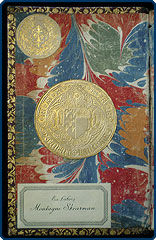
Provenance: Front pastedown with gilt-stamped armorial bookplate of notable 19th-century book collector Edward Hailstone, gilt-stamped “I.T.” bookplate with motto “Inter folia fructus,” and bookplate of Sir Montague Shearman.
Binding: Contemporary crimson morocco, covers framed in gilt triple fillets; spine gilt extra with gilt-stamped leather labels, board edges and turn-ins with gilt rolls. This volume (complete in itself) seems at one time to have been part of a set of Marmontel's works, and bears an (unnumbered) spine label reading “Oeuvres de Marmontel.”
• Brunet, III, 1440; Cohen de Ricci, Guide de l’amateur de livres à gravures du XVIIIe siècle, 688; Graesse 406; Tchermezine 455. Binding as above, with edges, extremities, and joints showing minor rubbing. Front pastedown with bookplates as above; front free endpaper with affixed slip of early cataloguing; rear pastedown with small chip out of paper. Light spots of foxing, slightly heavier around plates. All edges gilt. (25776)
FIRST
PAINE COLLECTION
Paine, Thomas. The works of Thomas Paine. London: D. Jordan, 1792. 8vo (21.6 cm, 8.5"). Frontis., [4], 67, [1], viii, 110, [2], 142, [2], 69, [3], 29, [3], 16, 9, [1] pp.


 Click the images for enlargements.
 Individual titles in this collection are often separated and sold as if complete in themselves, but the present volume reflects their original state and the publisher's intent.
• ESTC T5785; Goldsmiths'-Kress 15080; Sabin 58244; Stephans, Paine Collection of Richard Gimbel, 1. Recent quarter calf and marbled paper–covered sides, spine with gilt-stamped leather label and gilt-stamped compartment decorations between gilt-ruled raised bands. Title-page and a few others with oval,19th-century institutional rubber-stamp; lower (closed) page edges rubber-stamped sometime later. Variable, mild to moderate foxing and other spotting, especially “in from edges”; occasional pencilled bracketing or underlining. One leaf with short tear in outer margin, not touching text. (25027)
 For
a bit more THOMAS PAINE, click
here.
For
a bit more THOMAS PAINE, click
here.
Hoping
for “a Great
Charter for Liberty
of Conscience”Penn, William. The great and popular objection against the repeal of the penal laws & tests briefly stated and consider’d, and which may serve for answer to several late pamphlets upon that subject. London: Andrew Sowle, 1688. 4to (19.8 cm, 7.75"). 23, [1 (blank)] pp.

 Click the interior images for enlargements.
 Despite this strongly worded treatise against persecution (which argues that all men should be able to make a free and open choice of faith and worship), the statutes remained in place for many years to come.
• Wing (rev.) P1298A; ESTC R12742. Recent marbled paper–covered boards. Title-page with tiny, unobtrusive numeral inked in upper outer corner, first text page with numeral stamped in lower margin (no other markings). Title-page and first text page with moderate foxing, others clean.
Jailhouse Law — Philadelphia 1801Pennsylvania.
Collection of the penal laws of the Commonwealth of Pennsylvania. Philadelphia: Pr. by Budd & Bartram, for the use of the Prison, 1801. 8vo (19.5 cm, 7.6").
72 pp.

 Click any image where the hand appears on
 Many institutions report microform holdings, but very few hold actual copies.
• Sabin 59986; Shaw & Shoemaker 1114. Contemporary-style quarter tan cloth over blue paper-covered sides, spine with printed paper label. Paper embrittled and somewhat fragile; pages age-toned and foxed.
A Woman forEQUAL PAY, 1869 Penny, Virginia. Think and act. A series of articles pertaining to men and women, work and wages. Philadelphia: Claxton, Remsen & Haffelfinger, 1869. 8vo (20 cm; 7.87"). 372 pp.

 Click the images for enlargements.
 An early plea for equal pay, equal opportunity, and equal dignity.
• Publisher's green cloth, abrasion to top of spine. Ex–social club library with rubber-stamps, call number in ink on preliminary pages in a 19th-century hand. A rather nice copy. (26251)
The Land & Indian Problems Pimentel, Francisco. Memoria sobre las causas que han originado la situacion actual de la raza indígena de México, y medios de remediarla. Mexico: Impr. de Andrade y Escalante, 1864. 8vo. 241, [1] pp., [1] f. [with the same author's] La economía política aplicada a la propiedad territorial en México. México: Imprenta de Ignacio Cumplido, 1866. 8vo. 265, [1 (blank)] pp., [1] f.

 Click the interior images for enlargements.
The Pope Appointsa New Grand Inquisitor for Spain Pope Paul V (1552–1621; pontificate 1605–21). Letter to King Philip III of Spain, in Latin, on vellum. Rome: 4 January 1619. Narrow strip (10 x 40.5 cm; 4" x 16"). [1] leaf. Click the image for enlargement.
 This contemporary file copy was retained in Rome and signed “S. Card. S. Susannae” (i.e., Cardinal Scipione Cobelluzzi, who was also at this time the Librarian of the Vatican Library).
• Written in a very handsome italic on very good quality vellum. Light discoloration along lower edge, below the writing. (26978)
Muggletonian Stand againstReligious Persecution Reeve, John, & Lodowick Muggleton. A remonstrance from the eternall God: Declaring severall spirituall transactions unto the Parliament, and Common-wealth of England, unto His Excellency, the Lord Generall Cromwell, the Councell of State, the Councell of Warre, and to all that love the second appearing of the Lord Jesus, the onely wise God and everlasting Father, blessed for ever. [London]: 1653. 4to (19.1 cm, 7.5"). 15, [1 (blank)] pp.

 Click the images for enlargements. Clicking on the righthand image above, and reading the last, italicized paragraph, is rewarding.
 OCLC and ESTC locate only six U.S. institutional holdings.
• ESTC R40093; Wing (rev. ed.) R682; Smith, Anti-Quakeriana, 303. Period-style calf, covers framed in blind double fillets, spine with gilt-ruled raised bands and gilt-stamped leather title-label. Title-page and first text page institutionally perforation-stamped, first text page with inked and rubber-stamped numerals in lower margin. Title-page with several tears repaired (with loss of a few letters from table of contents) and a sliver of the bottom edge replaced (with loss of lower portion of publication date); pages generally age-toned and soiled, first one with upper margin repaired. Edges trimmed closely and tattered. A “survivor.” (26010)
TheGlorious Revolution's Centennial Revolution Society (London). An abstract of the history and proceedings of the Revolution Society, in London. To which is annexed a copy of the Bill of Rights. [London]: Pr. by Order of the Committee, 1789. 8vo. 40, 7, [1 (blank)] pp., [1] f., pp. 41–78, [1 (blank)] f., pp. 79–87, 90–92, pp. 79–86, 93–96 (page numbers 88, 89 not used).

 Click the interior images for enlargements.
 Uncommon: No U.S. copy of this issue located via OCLC and ESTC locates only the Harvard copy. There were other, less complete editions of 40 pp., 58 pp., and 78 pp.
• ESTC N15187. Recent full calf, period style; spine with raised bands accented in gilt, oxblood leather gilt-lettered title, publication date and place in gilt at base; covers framed and paneled in gilt rules with gilt-stamped corner fleurons. Shallow chip to top outer corners of final two leaves. One word on p. 32 is blotted out in ink by an early owner with the correction supplied above it. Penned signature (partly cropped) at top edge of p. 79. Pp. 79–92 duplicated, nothing missing. (23766)
British Words of Support forColonial Rights Rokeby, Matthew Robinson-Morris, Baron. Considerations on the measures carrying on with respect to the British colonies in North-America. London printed; Hartford reprinted: Eben. Watson, 1774. 8vo (21.6 cm, 8.5"). 63, [1] pp.
 Click the interior image for enlargement.
 • Evans 13585; ESTC W30498; Howes R-372; Trumbull, Connecticut, 1305; Adams, Amer. Pamphlets, 134j; Sabin 72151; Allibone 1839. On Robinson-Morris, see: Oxford DNB online. Period-style quarter calf with marbled paper–covered sides, leather edges tooled in blind, spine with gilt-stamped title and elegant small decorations at head and foot. Pages age-toned; three leaves with minor staining. Title-page with repaired chip to outer margin, traces of early inked inscriptions in center of page, and partially shaved inscription in upper margin. Last text page with inked inscription in lower margin, partially shaved at beginning of inscription. (24866)
Let's NOT Bring Backthe Inquisition S., Y. O. Anecdota importante relativa a la Inquisicion de España, y varias reflexiones sobre el mismo asunto. Mejico: Impr. de D.M. Ontiveros, 1820. Small 4to. 35, [1 (blank)] pp.

Uncommon: OCLC locates only the copies at the Bancroft and Chilean National libraries; although, clearly, there is or was one in the Sutro Library.
• Sutro 175. Removed from a nonce volume. A good clean copy. (21742)
Eyewitness Report of theArmenian Genocide, Inscribed by the Author Shahbaz, Yonan H. The rage of Islam: An account of the massacre of Christians by the Turks in Persia ... fourth edition. Philadelphia: The Judson Press, [1929]. 8vo (20 cm, 7.9"). Frontis., xiv, [4], 210 pp.; 1 fold. map., 16 plts.
 The 16 plates of illustration are interesting, sometimes moving.
Click the images for enlargements.
The 16 plates of illustration are interesting, sometimes moving.
Click the images for enlargements. Presentation copy: Front free endpaper inscribed “Compliments of the Author. To Dr. Franklin Feb. 19th 1930.”
• Starr, Baptist Bibliography, S2241. Publisher's maroon cloth, front cover and spine with gilt-stamped title; insignificant wear to corners and spine extremities, foot of spine with small area of faint discoloration. Title-page institutionally pressure-stamped, dedication page with inked notation along inner margin and rubber-stamped numeral in lower margin. Back pastedown with traces of now-absent bookplate. Sewing starting to loosen. Pages and plates clean. (26041)
Educational
& Career
Rights forBlacks in
the Spanish EmpireSpain.
Sovereigns, etc., 1808–33 (Ferdinand VII). Broadside.
Begins: “Don Francisco Xavier Venegas...`Exmô, Señor = La Regencia
del Reyno se ha servido dirigirme el Decreto que sigue...Deseando las Córtes
generales y extraordinarias facilitar á los súbditos Españoles,
que por qualquiera línea traigan su orígen del Africa, el estudio
de las ciencias, y el acceso á la carrera eclesiástica....’”
Mexico, 25 September 1812. Folio extra (48 cm; 17.25"). [1] p. Click
the image to the right
Click
the image to the right While Ferdinand VII remained the prisoner of Napoleon, the Regency promulgated several important human rights acts, and this was one of the most important. The Regency ratified and published it 29 January and on 31 January it was ordered distributed throughout the empire.
• Not in Medina, Mexico; not in Garritz, Impresos novohispanos;
not in Sutro. One horizontal fold, top margin a little crumpled and irregular;
left margin with a V-shaped bit of blank margin missing at fold, otherwise
only a little irregular. Revenue stamps on the verso. Viceroy Venegas’s
paraph (“rúbrica”) below his printed name. A
very good copy.
Freedom
of the Press in the
Spanish EmpireSpain. Sovereigns,
etc., 1808–33
(Ferdinand VII). Broadside. Begins: “Don
Francisco Xavier Venegas...`Exmô. Sr. = ...sabed: que en las Córtes
generales y extraordinarias, congregadas en la Real Isla de Leon, se resolvió y
decretó lo siguiente...Articulo I. Todos los cuerpos y personas particulares,
de qualquiera condicion y estado que sean, tienen libertad de escribir, imprimir
y publicar sus ideas politicas sin necesidad de licencia, revision ó aprobacion
alguna anteriores a la publicacion....” Mexico, 5 October 1812. Folio
extra (48 cm; 17.25"). [1] p. 
• Garritz, Impresos novohispanos, 1612. Not in Medina, Mexico; not in Sutro. One horizontal fold; right margin a little crumpled. Revenue stamps on the verso. Viceroy Venegas’s paraph (“rúbrica”) below his printed name. A very good copy.

Abolition of Torture Spain. Cortes. Broadside. Begins: “ ...El Sr. Secretario del Supremo Consejo de Indias ... me remite la real cédula del tenor siguiente ... Que abolido para siempre el tormento en todos los dominios de la monarquia espanola ... “ Mexico: no publisher/printer, 15 October 1811. Folio (44 cm; 17"). 1 p.
Rare. No copies located via OCLC or NUC Pre-1956.
• Not in Medina, Mexico; not in Garritz; not in Sutro. Folded once, otherwise as issued. With Viceroy Venegas's paraph next to his printed name at the base of the document. (24594)

Censoring
Mexican
CLERGY
Spain. Consejo de Regencia. Broadside, begins: “... Los reyes de España, encargados de concordar el decoro de la Santa Iglesia con la seguridad y tranquilidad del Reyno....” Mexico: no publisher/printer, 12 January 1814. Folio (41 cm; 16"). 1 p.
OCLC locates only the copies at the John Carter Brown and the Bancroft Libraries. NUC Pre-1956 adds no others.
• Garritz 1917. Not in Medina, Mexico; not in Sutro. Folded once, otherwise as issued. With Viceroy Calleja's paraph next to his printed name at the base of the document. (24595)
Freedom
of the Press — Philadelphia, 1800United States. Senate. Committee of Privileges. Report of the Committee of Privileges, on the measures it will be proper to adopt, relative to a publication in the General Advertizer, or Aurora, of the 19th of February last. [Philadelphia: Pr. by John Ward Fenno?, 1800]. 8vo. 7, [1] pp.
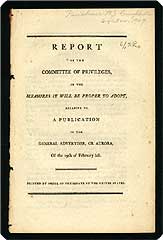
At the heart of the controversy was Duane’s support of Jefferson for president and his exposure of the notorious Ross election bill by which the Federalists sought to thwart Jefferson’s bid for that office.
• Evans 38856; ESTC W021879. Removed from a nonce volume. Clean and in nice condition.
Early
U.S. Edition
of aPioneering
WorkWollstonecraft, Mary. A vindication of the rights of woman: With strictures on political and moral subjects. Boston: Peter Edes for Thomas & Andrews, 1792. 8vo (21.6 cm, 8.5"). 340 pp.

This Boston edition most likely appeared shortly after the Philadelphia edition printed in the same year; among the prominent American women’s rights activists known to have read and been influenced by the Vindication are Judith Sargent Murray, Abigail Adams, and (later) Elizabeth Cady Stanton.
• Evans 25054; ESTC W2450; PMM 242 (for first ed.); Windle, Mary Wollstonecraft Godwin, A5d. Recent quarter calf over marbled paper–covered boards, spine with gilt-stamped leather title and author labels and gilt-stamped devices between raised bands. Half-title mounted; a few leaves with old repairs to lower inner margins. Pages age-toned, with offsetting, staining, and spotting.
See also ABOLITION: See
also FREEDOM OF THE PRESS: See
also the LAW webshelves . . .
 &/or Click
here for a database including
&/or Click
here for a database including  keywords,
e.g. = FREEDOM OF, CENSOR, TORTURE,and/or
RIGHTS . . .
keywords,
e.g. = FREEDOM OF, CENSOR, TORTURE,and/or
RIGHTS . . .

PLACE AN ORDER | E-MAIL US | GO (BACK) TO TOPIC/INTEREST TABLE | PRB&M HOME
All material © 2010
The Philadelphia Rare Books & Manuscripts
Company