 JUDAICA \ HEBRAICA
[INCLUDING “CHRISTIAN HEBRAICA”]
JUDAICA \ HEBRAICA Private Press, The Index Expurgatorius
 (A Great Book)!
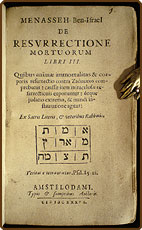
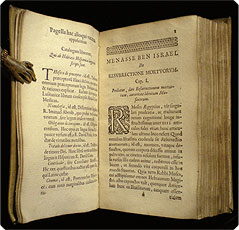
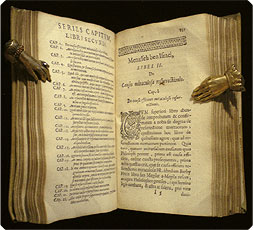
Menasseh ben Israel. De resurrectione
mortuorum libri III. Quibus animae immortalitas & corporis resurrectio contra
Zaducaeos comprobatur: caussae item miraculosae resurrectionis exponuntur: deque
judicio extremo, & mundi instauratione agitur: ex sacris literis, & veteribus
Rabbinis. Amstelodami: Typis & sumptibus auctoris, 1636. 8vo. [24], 133, [11],
137–241, [11], 245–346, [6] pp. [bound with his] ...
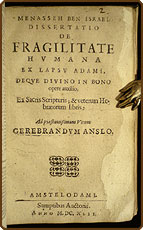
Dissertatio de fragilitate humana ex lapsu Adami deque divino in bono opere auxilio,
exrsacris scripturis, et veterum Hebraeorum libris ... Amstelodami: Sumptibus
auctoris, 1642. 8vo. 16, 141, [1] pp.
(A Great Book)!
Menasseh ben Israel. De resurrectione
mortuorum libri III. Quibus animae immortalitas & corporis resurrectio contra
Zaducaeos comprobatur: caussae item miraculosae resurrectionis exponuntur: deque
judicio extremo, & mundi instauratione agitur: ex sacris literis, & veteribus
Rabbinis. Amstelodami: Typis & sumptibus auctoris, 1636. 8vo. [24], 133, [11],
137–241, [11], 245–346, [6] pp. [bound with his] ...
Dissertatio de fragilitate humana ex lapsu Adami deque divino in bono opere auxilio,
exrsacris scripturis, et veterum Hebraeorum libris ... Amstelodami: Sumptibus
auctoris, 1642. 8vo. 16, 141, [1] pp. 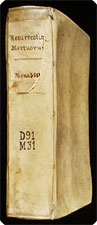
 Click the interior images for enlargements.
  Both
are from the author's own press, one of the first Hebrew-language presses in
the Netherlands.
Both
are from the author's own press, one of the first Hebrew-language presses in
the Netherlands.
 A
PRB&M “FEATURED BOOK” —
A
PRB&M “FEATURED BOOK” —


 Famous for Its
 Maps of the Holy LandAdrichem (a.k.a. Adrichom), Christiaan van. Theatrum Terrae Sanctae et biblicarum historiarum cum tabulis geographicis aere expressis. [colophon: Coloniae Agrippinae: Officina Birckmannica, sumptibus Hermanni Mylij, 1628]. Folio (37 cm; 14.5"). [6] ff., 256 pp., [15] ff.; 12 fold. or double-page engr. maps.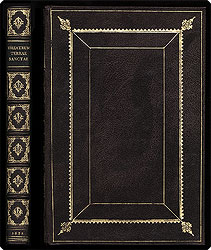
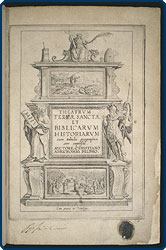
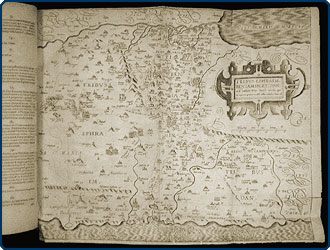
Theatrum Terrae Sanctae is famous for its engraved maps, but the work is justly sought for its descriptions of Palestine and the antiquities of Jerusalem. Additionally the work contains a chronology from Adam to 1585, the year of the author's death.
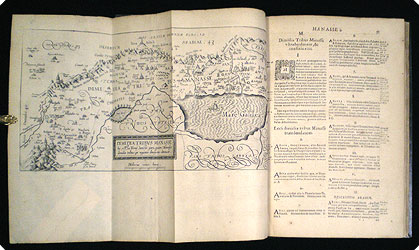
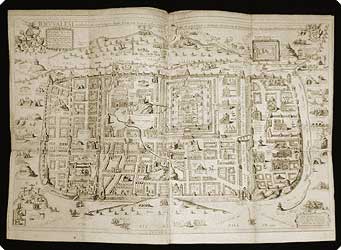
The work begins with an engraved allegorical title-page, has woodcut initials and tailpieces, and bears 12 folding or double-page engraved maps. The text is printed in roman type in double-column format.
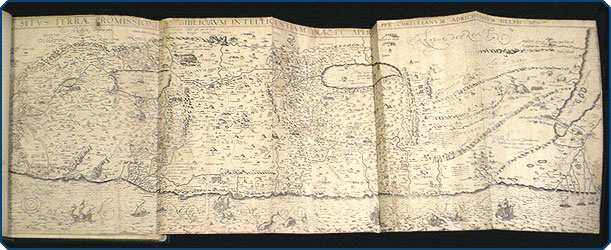
 In all, a good+ copy and a very handsome volume. (24104)
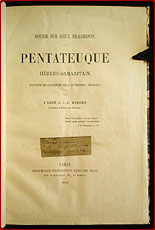
 Limited to 200 Copies — A Polyglot “Song of Moses” Bargès, Jean Joseph Léandre. Notice sur deux fragments d'un Pentateuque hébreu-samaritain rapportés de la Palestine par M. le sénateur F. de Saulcy. Paris: Imprimerie Polyglotte Édouard Blot, 1865. 8vo (24.5 cm, 9.6"). [6], 91, [1] pp.; 1 fold. plt.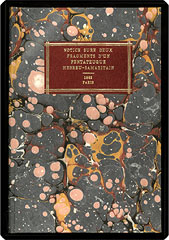
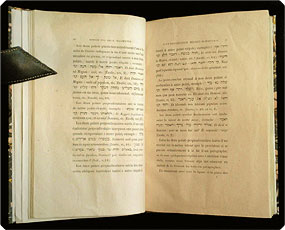 Click the interior images for enlargements.
 Uncommon: OCLC and NUC Pre-1956 locate only five U.S. holdings.
Provenance: Ownership label of George Williams (1814–78), who served as Vice-Provost of King's College from 1854 to 1857.
• Recent marbled paper–covered boards, front cover with gilt-stamped red leather title-label. Title-page with small affixed slip with ownership inscription of George Williams of King's College. Occasional edge nicks and short tears, and a number of leaves with old creases or the odd smudge; last leaf with old, small repairs to margins, and one other leaf with very good repair from blank reverse to an interior tear (no text lost or even affected). (25368)

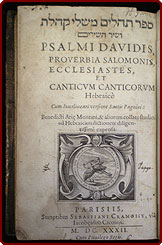
 Not from the Pepys's Library Bible. O.T. Selections. Latin & Hebrew. 1632. [two lines in Hebrew, romanized as] Sefer Tehilim Mishle Kohelet ve-Shir ha-Shirim] Psalmi Davidis, Proverbia Salomonis, Ecclesiastes, et Canticum Canticorum Hebraicè cum interlineari versione Santis Pagnini.... Parisiis: Sebastiani Cramoisy, 1632. 8vo (18.4 cm, 7.25"). [16], 416 pp.

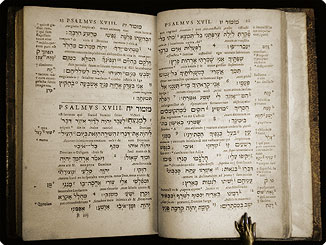
 Click the images for enlargements.
 The title-page bears Cramoisy's printer's device, inherited from his grandfather Sébastien Nivelle: two storks with the motto “Honora patrem tuum et matrem tuam ut sis longaevus super terram.” The work is also decorated with four very large, foliated Hebrew initials
Provenance: First dedication page with inked inscription of Dr. Henry Power (ca. 1626–68), a physician and natural philosopher who became one of the first elected fellows of the Royal Society. The title-page bears an inked inscription reading “S. Pepys” (lined through), but a tipped-in manuscript letter signed by Derek Pepys Whiteley, curator of the Pepys Library at Magdalene College, notes that the handwriting is “quite unlike examples of [the diarist's] signature.”
• Steinschneider, Catalogus hebraeorum in Bibliotheca Bodleiana, 459b. Not in Darlow & Moule. On Power, see: Oxford Dictionary of National Biography online. Later calf, spine with gilt-stamped leather label and gilt-ruled raised bands, board edges with gilt roll, rebacked preserving original spine; corners and joints refurbished, edges rubbed. Hinges (inside) unobtrusively reinforced. Back pastedown with institutional bookplate almost entirely obscuring early inked inscription. Title-page with early inscriptions at head and foot mostly trimmed away, also with inscription as above; dedication page with inscription as above. Pages age-toned; first few leaves with staining and minor chipping in lower portions. A very few early pencilled and inked marginalia in both Latin and Hebrew; one instance of inked underlining. (25937)
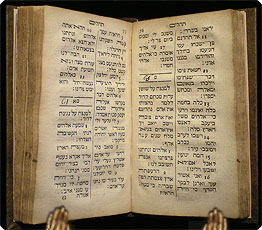
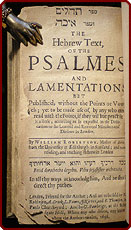
First Printing of the Hebrew Psalms in England Bible. O.T. Psalms. Hebrew. Robertson. [in Hebrew: Sepher Tehillim u-sepher echah] The Hebrew text, of the Psalmes and Lamentations but published, without the points or vowels; yet to be made use of, by any who can read with the points, if they will but practice it a little.... London: Pr. for the author, 1656. 12mo (15 cm, 5.9"). [12], 156, 149-191, 15, [2 (errata)] pp.
 Click the interior images for enlargements.
This is the first stand-alone printing of the Psalms in Hebrew in England, published around the same time as the London (i.e., “Walton”) Polyglot.
• ESTC R210526; Wing (rev.) B2742C; Cowley, Hebrew Printed Books in the Bodleian Library, 92. Not in Darlow & Moule, not in Herbert, not in Rumball-Petre. On Robertson, see: Oxford Dictionary of National Biography online. Recent quarter calf and mottled paper–covered sides; spine with gilt-stamped and gilt-ruled title, gilt-dotted raised bands, and blind-tooled compartment decorations; leather edges tooled in blind. Title-page with edges chipped, touching lower outer portion of publication information; first and last few leaves also with edges chipped, and slight darkening. (25358)
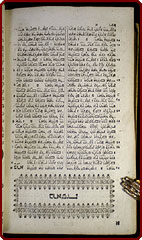
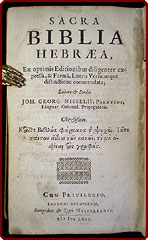
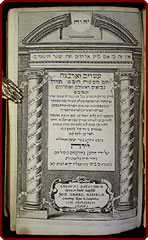
Edited & Printed by a Would-Be Academic Bible. O.T. Hebrew. 1662. Sacra Biblia Hebraea, ex optimis editionibus diligenter expressa, & formâ, literis versuumque distinctione commendata. Lugduni Batavorum: Nisselianis, 1662. 8vo (19.1 cm, 7.5"). [431] ff. (lacking 1 internal f. [blank]).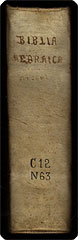
 Click the images for enlargements.
 Darlow and Moule note that the text here is based on Stephanus's Bible, with reference to the editions of Bomberg and Mannasseh ben Israel; after Nisselius's death, the work was completed by Allart Uchtmann, who wrote the preface. The Hebrew text is vocalized and, for the most part, set fairly plainly in double columns, but it is occasionally decorated with typographical ornaments. This copy includes the additional engraved title-page, which is handsome.
• Darlow & Moule 5133; Fuks & Fuks-Mansfeld, Hebrew Typography in the Northern Netherlands, 1585-1815, 48 (on Nisselius and this work, see also pp. 45–46). Contemporary vellum, soiled; spine with early inked title and old shelving number. Front free endpaper with early inked annotations; first three leaves institutionally pressure-stamped; title-pages reinforced along inner margin; one internal blank leaf lacking. Pages with light age-toning and offsetting; roughly half of volume with light staining in upper margins. All edges red. (26193)

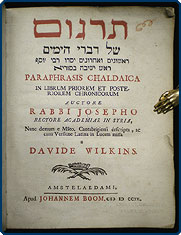
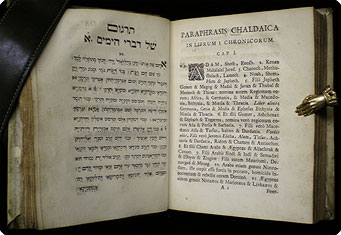
How GREAT This Scholar Must Have Felt When He Found This! Bible. O.T. Chronicles. Aramaic. Targum. 1715. [four lines in Hebrew characters, transliterated as] Targum shel Divre ha-yamim rishonim ve-aharonim, yisdo Rabi Yosef, rosh yeshivah be-Surya. [then in Latin] Paraphrasis Chaldaica in Librum priorem et posteriorem chronicorum, autore Rabbi Josepho, rectore academiae in Syria. Amstelaedami: apud Johannem Boom, 1715. 4to. [27] ff., 415, [1(blank)] pp.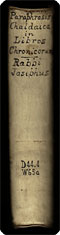
 Click the interior images for enlargements.
 Printed in Hebrew (with the points) and Latin on opposite pages, this has a title-page printed in black and red; the Latin text is in roman with occasional italic.
An uncommon work in commerce now and in Brunet's time: “Livre recherché et peu commun.” Not heavily held in U.S. libraries, if WorldCat is to be believed, for it locates only eight copies.
• Vinograd, II, 55; Amsterdam 1072; Steinschneider 1157; Zedner 148; Darlow & Moule 2416. Contemporary vellum over paste boards, boards warped and front pastedown abraded and torn by this. Spine lettered in black in 20th-century and with an old library call number at base; library pressure-stamp in lower margin of title-page. A few leaves with slightly tattered foremargins. (25775)
 Gospels in Hebrew Bible. N.T. Hebrew. 1798. The New Testament of our Lord and Saviour Jesus Christ, in Hebrew; corrected from the version published by Dr. Hutter, at Nuremburg, 1599; and republished by Dr. Robertson, at London, 1661. London: T. Plummer, 1798. 8vo (16.7 cm, 6.56"). 40, 319 (i.e., 320) pp.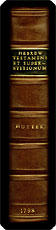
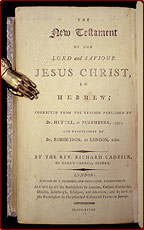
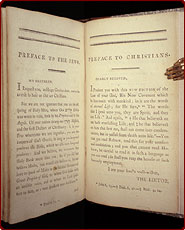
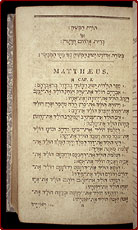 Click the interior images for enlargements.
 This volume has the first two parts bound together, comprising the four Gospels; a third part was added in 1800, but is not considered intrinsic to the work by either Darlow and Moule or Lowndes. The Hebrew is printed with the points.
Provenance: Private pressure-stamp of “J.H. Williams, Rector of Llangadwaladr” (Anglesey).
Uncommon: OCLC and ESTC find only six U.S. holdings of this Hebrew-only printing, one having since been deaccessioned.
• ESTC T2307 (for part I); Darlow & Moule 5164; Lowndes 2654; Horne, Introduction to the Critical Study & Knowledge of the Holy Scriptures, 48. Recent quarter calf and marbled paper–covered boards, spine with gilt-stamped leather title-label and gilt-dotted raised bands. Title-page with inner margin reinforced and pencilled inscription dated 1825 in upper margin; additional title-page with inked numeral in lower margin; title-page, additional title-page, final page, and one other pressure-stamped with the Rev. Williams's stamp and/or that of a seminary. Foxing; two pages with ink stains touching but not obscuring text. Final leaf with small central tear, without loss of text. Occasional unobtrusive pencilled corrections, underlining. In fact a nice clean copy. (25810)
Blogg/Bloch onHebrew Blogg, Salomon Ephraim. Aedificium Salomonis, enthaltend: Eine vollständige Geschichte der hebräischen Sprache, des Thalmuds und vieler merkwürdiger Begebenheiten des Alterthums, die bis dahin gänzlich unbekannt geblieben ... Hannover: Ernst August Telgener, 1832. 4to. xv, [1], 143, [1] pp.
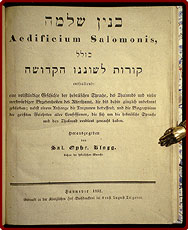
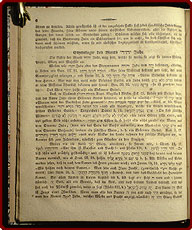 Click the interior images for enlargements.
 • Zedner, Catalogue of the Hebrew Printed Books in the Library of the British Museum, 153. Recent marbled paper–covered boards, spine with gilt-stamped leather title-label. Light age-toning and a bit of faint foxing. (23145)
Hebrew FlowersBuxtorf, Johann. Florilegium Hebraicum: Continens elegantes sententias, proverbia, apophthegmata, similitudines.... Basileae: Impensis Haered. Ludovici König, 1648. 8vo (16.7 cm, 6.55"). )(8A–Z8Aa–Bb8; [16], 390, [8 (index)] pp.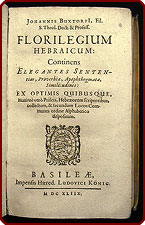
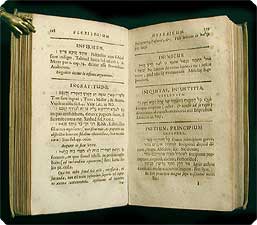
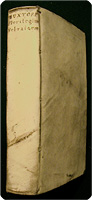
• VD17 12:128413B. Contemporary vellum with yapp edges, spine with early inked title; some light discoloration, with cut to vellum across spine. Pastedowns loose from inside covers, with bits of old manuscript used in the binding structure, showing; 19th-century bookplate attached to exposed paste board and endpapers creased. Shadow of old shelf number on verso of title-page. One leaf with small stain and hole affecting about four letters. Foxing ranging from mild to moderate.
One of Buxtorf's TWO Great Lexicons Buxtorf, Johann, the elder. Lexicon hebraicum et chaldaicum: Complectens omnes voces, tam primas quàm derivatas, quae in sacris Bibliis, Hebraeâ, & ex parte Chaldaeâ linguâ scriptis, extant ... Accessit lexicon breve rabbinico-philosophicum, communiora vocabula continens, quae in commentariis passim occurrunt ... editio sexta, de novo recognita, & innumeris in locis aucta & emendata. Basilae: Johannis König, 1655. 8vo (17.4 cm, 6.9"). [24], 976, [76 (index)] pp.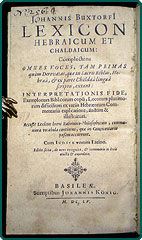
 Click the interior image for an enlargement.
 • VD17 12:131988L. 19th-century marbled paper–covered boards, spine with gilt-stamped leather title-label; paper rubbed with spine paper chipped, cracked, and shelving number inked at bottom. Pastedowns with institutional bookplates, free endpapers and lower (closed) edges institutionally rubber-stamped, title-page with early inked numeral in upper portion. First third of work with early inked annotations and underlining (some marginalia shaved), this tapering off in frequency with close of volume untouched. Two leaves with small portions of outer margins excised. Occasional small stains, pages mostly clean. (25818)
A FAMED but UNLUCRATIVEPolyglot Dictionary Castell, Edmund. Lexicon heptaglotton, Hebraicum, Chaldaicum, Syriacum, Samaritanum, Æthiopicum, Arabicum, conjunctim; et Persicum, separatim. London: Thomas Roycroft, 1669. Folio (44.9 cm, 17.6). 2 vols. in I. Frontis., [8] pp., 44 columns (43 & 44 repeated in numbering), [2] pp., 573 columns (402, 403, 421 & 422 repeated in numbering; 340, 341, 399, & 400 skipped), [1] p., 4008 columns (376–78 & 391–93 incorrectly numbered; 484–86, 538, 1936–38, 3220–25, 3773–78, & 3950–51 repeated in numbering; 487–89, 535, & 3226–3231 skipped).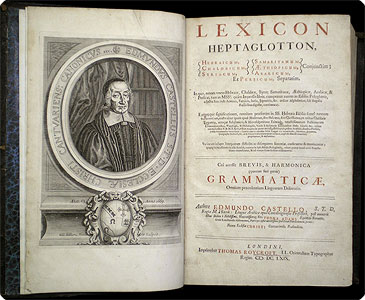
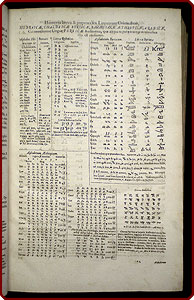
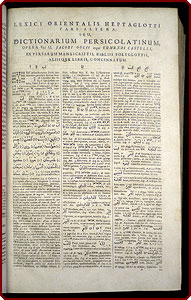 Click the images for enlargements.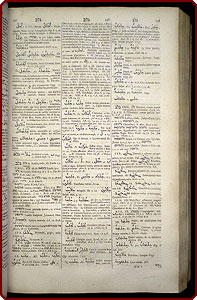
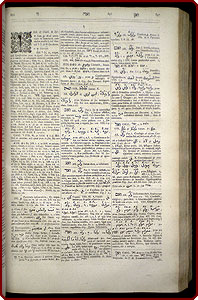
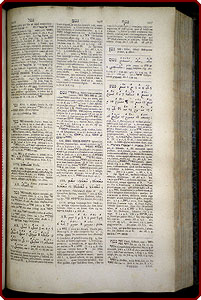
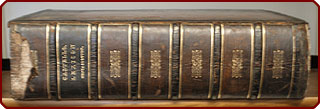
• ESTC R16460; Wing (rev. ed.) C1225; Vancil 46; Lowndes 386; Dibdin, I, 31–35. On Castell, see: Oxford Dictionary of National Biography online. 18th-century speckled calf, covers bordered with a darker calf band blind-rolled and then framed with single gilt fillet; spine with gilt-stamped leather title-label, darker-leather raised bands gilt-stamped/blind-tooled, and compartments gilt- and blind-tooled enclosing gilt-stamped floral decorations. Binding rubbed, with leather significantly lost in top compartment and and lost also at foot. All edges marbled. Front fly-leaf with inked ownership inscription as above dated 1837; title-page with old institutional pressure-stamp. Frontispiece with outer margin reinforced some time ago. One leaf slightly oversized and creased, intermittent soiling in many upper margins, one leaf with text affected but not obscured, small sections with light waterstaining to outer or upper margins; over all, a book both impressive and pleasant. Columns erratically numbered, text complete. (25792)
ImportantEarly Christian Hebrew Grammar Chevalier, Antoine-Rodolphe. Rudimenta Hebraicae linguae, accurata methodo & breuitate conscripta. Eor undem rudimentorum praxis, quae viuae vocis loco esse possit. Vitebergae: Iohan. Cratonem, [colophon: 1574]. 4to (20 cm, 7.9"). [16], 331, [1 (blank)] pp.
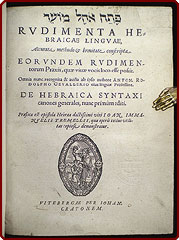
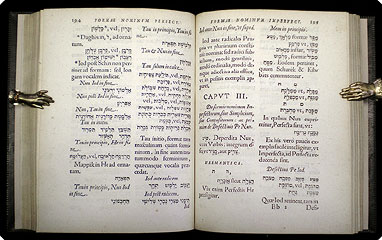 Click the images for enlargements.
 Uncommon: OCLC and NUC Pre-1956 locate only two U.S. holdings of this edition, one since deaccessioned.
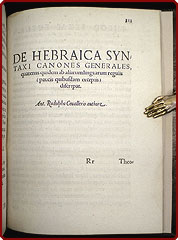
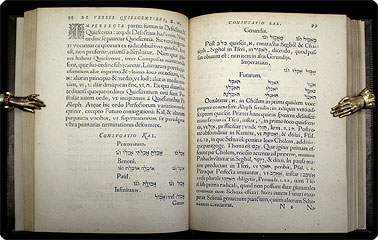 A nice copy. (25649)
Christianity Abroad, at Home, & among the (Jewish?) Native Americans Crawford, Charles. An essay on the propagation of the Gospel; in which there are numerous facts and arguments adduced to prove that many of the Indians in America are descended from the Ten Tribes ... the second edition. Philadelphia: James Humphreys, 1801. 12mo (18.3 cm, 7.2"). [1] f., 154 pp., [1] f. [with] Woodward, William Wallace. Increase of piety, or revival of religion in the United States of America; containing several interesting letters not before published. Together with three remarkable dreams, in succession, as related by a female in the Northern Liberties of Philadelphia to several Christian friends, and handed to the press by a respectable minister of the gospel. Philadelphia: W.W. Woodward, 1802. 12mo. [1] f., 114 pp.
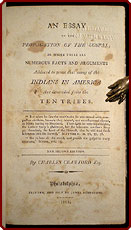
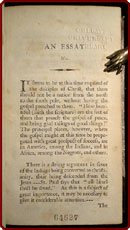 Click the interior images for enlargements.
 The second item here is the first edition of Woodward's collection of revival-themed letters to and from various clergymen, closing with an account of Mrs. Rebecca Ashburn's mysterious dreams. In these dreams a minister unknown to Mrs. Ashburn attempted to save her soul; she later identified her would-be converter as one Dr. William Rogers. This work is very uncommon in print form. OCLC and NUC Pre-1956 find only five U.S. institutional holdings of this Philadelphia printing, although it is widely held in microform.
• Essay: Sabin 17433; Shaw & Shoemaker 370; Rosenbach, American Jewish Bibliography, 123; Singerman, Judaica Americana, 0136. Increase: Shaw & Shoemaker 2587; Sabin 105172. Period-style half mottled calf and marbled paper–covered sides, spine preserving original gilt-stamped leather title-label. Title-page and first text page institutionally pressure-stamped. Pages lightly age-toned, somewhat more so in second work; one leaf with tear from outer margin extending into text. (25209)
Letters
of OBSCURE MEN —
Their Authors &
EVERYBODY ElseCrotus Rubeanus, Johannes, & Ulrich von Hutten. Duo volumina epistolarum obscurorum virorum, ad Dominum M. Ortuinum Gratium, Attico lepôre referta, denuò excusa, & à mendis repurgata. Francoforti ad Moenum: [Apud Ioannem Spies, impensis Sigismundi Feyerabenij], 1581. 8vo (16 cm, 6.25"). [179] ff. (lacking appendix: 16 ff.).

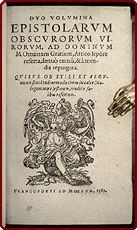
Click the images for enlargements. This example is lacking the appendix (entitled Conciliabvlvm theologistarvm adversvs Germaniae, & bonarum literarum studiosos), and thus is without the colophon providing printer and bookseller information. The title-page bears the printer's device of Feyerabend: Fame and her trumpets.
Uncommon: OCLC and NUC Pre-1956 locate only seven copies of this edition in U.S. libraries, one having been deaccessioned.
• VD16 E1729. This ed. not in Adams or Brunet. Period-style calf, covers framed in blind rolls, spine with gilt-stamped title/date and gilt- and blind-accented raised bands (blind tooling extended onto boards, terminating in decorative fleurons); spine compartments decorated in gilt and blind. Appendix (16 ff.) lacking; letters complete and the handsomely printed text all clean. (25643)
 TO Part II
. . .
TO Part II
. . . |