 MATHEMATICS
MATHEMATICS
MATHEMATICS
 Early
Illustrated Effort
at a
Early
Illustrated Effort
at a DICTIONARY
for the Masses
DICTIONARY
for the Masses
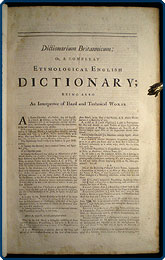
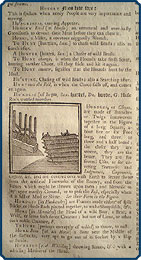
 Bailey, Nathan; Philip Miller; Thomas Lediard; George Gordon. Dictionarium Britannicum: Or a more compleat universal etymological English dictionary than any extant ... illustrated with near five hundred cuts, for giving a clear idea of those figures, not so well apprehended by verbal description ... the second edition with numerous additions and improvements. London: T. Cox, 1736. Folio (35.5 cm, 13.9"). [460] ff.; 1 plt., illus.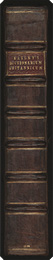
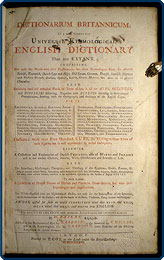
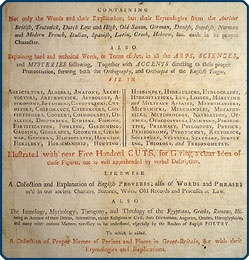
 Click the interior images for enlargements.
 The title-page is printed in red and black; a full-page plate shows an orrery (for which word there is an unusually long entry) from multiple perspectives, while many of the in-text woodcuts are depictions of heraldic terms, or mathematical and scientific concepts. Etymological information is provided in “Antient British, Teutonick, Dutch Low and High, Old Saxon, German, Danish, Swedish, Norman and Modern French, Italian, Spanish, Latin, Greek, Hebrew, &c. each in its proper Character” (from the title-page).  Our photographic detail, third image from left, above, highlights the (endearing!) ambition and achievement of this large volume.
• ESTC T87976; O'Neill B-5; Vancil 12. On Bailey, see: Oxford Dictionary of National Biography online. Contemporary mottled calf, covers framed in gilt double fillets, rebacked, spine with gilt-stamped leather title-label and gilt-ruled raised bands; sides acid-pitted and scraped. 19th-century endpapers. Title-page with old-fashioned, round institutional pressure-stamp; light soil and old inkblots (also light!) in upper portion. Pages a little browned right at edges; light or faint waterstaining visible in first third of volume, usually to lower margin only; one leaf with tear from outer margin just touching text, without loss; one lower outer corner torn away, with loss of one letter from catchword.  A sound, pleasant copy of this handsome and interesting production. (25002)

 Gold & Silver Conversion Tables
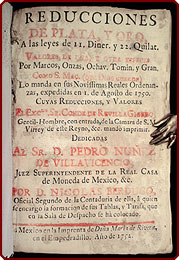
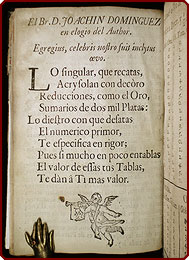
 the Press of a Woman Printer Berdugo, Nicolás. Reducciones de plata, y oro a las leyes de 11. diner. y 22. quilat. valores de una y otra especie por marcos, onzas, ochav. tomin. y gran. como S. Mag. (que Dios guarde) lo manda en sus novissimas reales ordenanzas, expedidas en 1. de agosto de 1750. Cuyas reducciones, y valores el Excmo. Sr. Conde. de Revilla Gigedo ... mandò imprimir. Mexico: Impr. de Doña Maria de Rivera, 1752. Small 8vo (14.8 cm; 5.875"). [15] ff., 324 pp.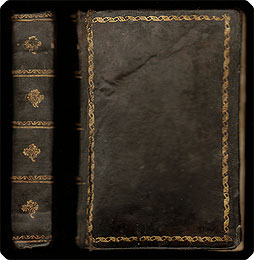
 Click the images for enlargements.
 The work was  absolutely essential for all merchants and other business people, and for government workers in the treasury department — for milled coins were the exception in Mexican commerce, cob pieces the norm, and raw gold and silver, including dust, were extremely common.
The volume ends with the “Reglas varias, para sacar juntos, o separados en pasta, o en moneda los reales derechos, que se pagan a S. Mag. De el oro y de la plata, y para reducir a toda su ley estos metales.”
An uncommon economic work: We trace fewer than nine copies in the U.S.
This was printed by Doña Maria de Rivera with a red and black title-page, and with woodcut arms on first dedication page. The charming cut of a herald cherub appears after the decima dedicated to the author at the end of the preliminaries.
• Medina, Mexico, 4073. Contemporary full Mexican calf, modestly tooled in gilt and with all edges red; recased, new endpapers. Final two leaves little ragged at edges costing a few letters and with small hole at center and short tears at inner margin; old staining and age-toning/browning throughout. There is every indication that this well-produced little volume saw time “in the field”! (26850)

WHISTCavendish. The laws and principles of whist stated and explained and its practice illustrated on an original system by means of hands played completely through. American edition. New York: Charles Scribner's Sons, & London: Thomas de la Rue & Co., 1895. 8vo. Frontis., x, 318 pp.; illus.
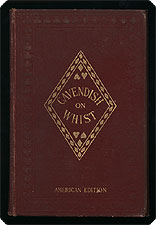
• Publisher's cloth, covers framed in blind, front cover and spine with gilt-stamped title; edges and extremities lightly rubbed, spine darkened with gilt dimmed. Front fly-leaf with inked gift inscription dated [18]96. Pages clean, two with lower corners dog-eared. All edges gilt. (13988)

Standard
& Ground
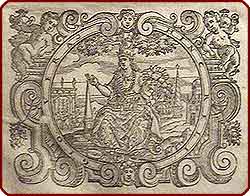
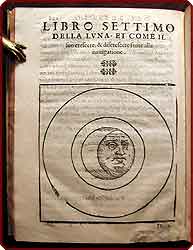
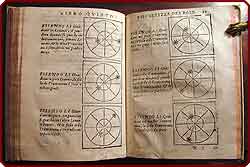
(or Wave?)-BreakingMedina, Pedro de. Arte del navigare. Venetia: Appresso Tomaso Baglioni, 1609. 4to (20.5 cm, 8"). A4 b4 2A8 B–Q8 R10; [7], [1 (blank)], 137, [1 (blank)] ff.; illus. 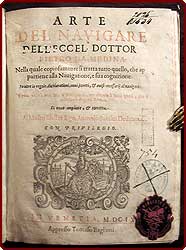
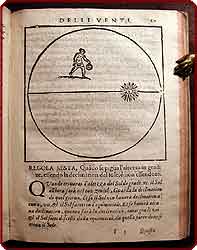
 Also included is a woodcut map showing Europe, the Atlantic, and the New World.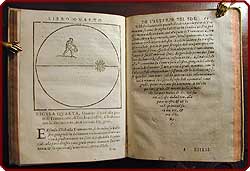
• Palau 159680; Alden & Landis, European Americana, 609/77; Medina, BHA, 123. Old vellum; red leather, gilt-lettered spine label; some staining, and chipping to edges and label. Old, careful repairs to interior worming occasionally cost individual letters (but never sense) or a little loss to an illustration. Old rubber-stamps and red and black ownership label on title-page; inked notations on title-page and front pastedown. All edges speckled red.

 Multiply
 IN YOUR HEAD by 27 . . . Orton, Hoy D. Orton's lightning calculator, and accountant's assistant. The shortest, simplest, and most rapid method of computing numbers, adapted to every kind of business, and within the comprehension of every one having the slightest knowledge of figures. Shelby, Ohio: H.D. Orton, ©1866. 12mo. vi, [9]–194 pp.
 “Energy is the price of success.” “Address all orders for this book to H.D. Orton, Shelby, O. Single copies by mail, One Dollar. For sale by all Booksellers.”
• Publisher's brown cloth shelf-back with printed paper on the boards; small rent in cloth. Very nice copy. (26558)
Life Insurance & Social Security Price, Richard. Observations on reversionary payments; on schemes for providing annuities for widows, and for persons in old age; on the method of calculating the values of assurances on lives; and on the national debt. To which are added, Four essays on different subjects in the doctrine of life-annuities and political arithmetick. London: T. Cadell, 1783. 8vo. 2 vols. I: xl, 378 pp. II: [2], 324 pp., [1 (blank)] f., [2], 95, 24 (index) pp.

 Click the interior images for enlargements.
 In addition to the dedication page, and prefaces to the first, third, and fourth editions, these volumes also include “additional notes and essays, a collection of new tables, a history of the sinking fund, a state of the public debts in January 1783, and a postscript on the population of the kingdom.” First published in 1771.
• ESTC T12986; Goldsmiths-Kress 12495. Contemporary speckled sheep, spine with gilt-stamped leather title-label, edges of boards tooled in gilt. Joints cracked and weakly holding. Covers darkened along top and outer edges; leather lost on corners. Light foxing to a few early and later leaves, including title-pages; offsetting from leather affecting only first three and final three leaves, at edges. Each volume pressure-stamped on the title-page and one other page. Title-page rectos marked with small inked initials in upper right corner, versos rubber-stamped with a five-digit number. Penciled notation at bottom margin of p. xxx (vol. I). Now housed in a blue cloth clamshell box with gilt-stamped leather labels. (24415)

 Early History of theRoyal SocietySprat, Thomas. The history of the Royal-Society of London, for the improving of natural knowledge.... The second edition corrected. London: Pr. for Robert Scot & others, 1702. 4to. (21 cm, 8.25"). [8] ff., 438 pp.; 2 foldout plts.

 Click the images for enlargements.
 First published in 1667 , this work is here in the second of numerous editions. It includes accounts by members of their scientific work: The two plates illustrate meteorological instruments and the principles of artillery recoil.
• ESTC T131282. On the Royal Society, see: Encyclopædia Britannica, 11th ed., XXIII, 791–93. On Sprat, see: The Dictionary of National Biography, LIII, 419–24. Recent quarter red morocco over marbled paper. Beading on spine bands and gilt quatrefoils in compartments; gilt-lettered title, author, and date. A foliate gilt roll at edge of leather on covers. Leaves sometime exposed to moisture and cockled, with shallow chipping and light to moderate soiling. Perforation-stamp on title-page, and rubber-stamps, including one on title-page, of a now-defunct library. All edges speckled red.
 Or click here for
related
Or click here for
related  material
. . .
material
. . .


PLACE AN ORDER | E-MAIL US | GO (BACK) TO TOPIC/INTEREST TABLE | PRB&M HOME
All material © 2010
The Philadelphia Rare Books & Manuscripts
Company