 QUAKERS — FRIENDS
QUAKERS — FRIENDS
QUAKERS — FRIENDS
 New
York Banking
— In Essence *&*
at Point
of Crisis
New
York Banking
— In Essence *&*
at Point
of Crisis
 (A
Quaker BUSINESSMAN is Author Here). Gibbons, James Sloan.
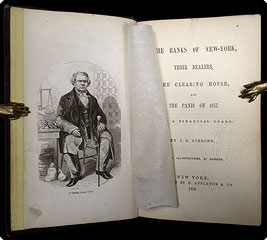
The banks of New-York, their dealers, the Clearing House, and the panic of 1857.
New York: D. Appleton & Co., 1858. 12mo (20.2 cm, 8"). Frontis., x, [2], [9]–399,
[1], 4 (adv.) pp.; 29 plts., 1 fold. chart.
(A
Quaker BUSINESSMAN is Author Here). Gibbons, James Sloan.
The banks of New-York, their dealers, the Clearing House, and the panic of 1857.
New York: D. Appleton & Co., 1858. 12mo (20.2 cm, 8"). Frontis., x, [2], [9]–399,
[1], 4 (adv.) pp.; 29 plts., 1 fold. chart.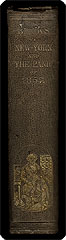
 Click the images for enlargements.
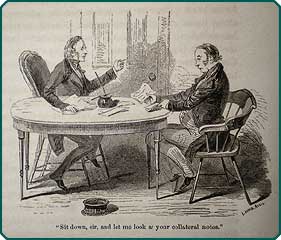
  30
wood-engraved plates by Henry Herrick: expressive depictions
of bank employees, customers, and their interactions. Gibbons, a financier by
trade and
30
wood-engraved plates by Henry Herrick: expressive depictions
of bank employees, customers, and their interactions. Gibbons, a financier by
trade and a
Quaker abolitionist, provides an excellent “picture
of the banks of New York as they are” (p. v) — often by way of “you
are there” conversations, including, on p. 95, a vigorous, decision-making
interchange as to backing
a
Quaker abolitionist, provides an excellent “picture
of the banks of New York as they are” (p. v) — often by way of “you
are there” conversations, including, on p. 95, a vigorous, decision-making
interchange as to backing a
house “too important . . . to be allowed to go down.”
a
house “too important . . . to be allowed to go down.”
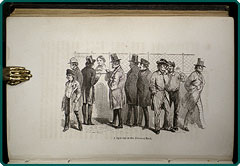
• Sabin 27289; not in Goldsmiths'-Kress. Publisher's blind-stamped textured cloth, spine with gilt-stamped title and pictorial vignette; binding cocked, extremities rubbed, spine sunned. Ex–social club library: call numbers on endpaper, front free endpaper excised, pressure-stamp on title-page, two other pages rubber-stamped, no other markings. Some plates with small areas of staining to margins. (26638)
 TWO
Quaker
Classics for
TWO
Quaker
Classics for Philadelphians,
1788
Barclay, Robert. A catechism and confession of faith, approved of and agreed unto, by the general assembly of the patriarchs, prophets, and apostles, Christ himself chief speaker in and among them. Philadelphia: Joseph James, 1788. 12mo (16.8 cm, 6.7"). viii, 147, [3] pp. [issued with] The ancient testimony of the people called Quakers, revived; by the order and approbation of the yearly meeting, held for the provinces of Pennsylvania and New-Jersey, 1722. Philadelphia: Joseph James, 1788. 34 pp.
Philadelphians,
1788
Barclay, Robert. A catechism and confession of faith, approved of and agreed unto, by the general assembly of the patriarchs, prophets, and apostles, Christ himself chief speaker in and among them. Philadelphia: Joseph James, 1788. 12mo (16.8 cm, 6.7"). viii, 147, [3] pp. [issued with] The ancient testimony of the people called Quakers, revived; by the order and approbation of the yearly meeting, held for the provinces of Pennsylvania and New-Jersey, 1722. Philadelphia: Joseph James, 1788. 34 pp. 
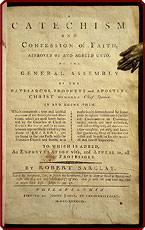
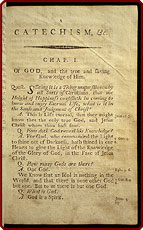 Click the interior images above for enlargements.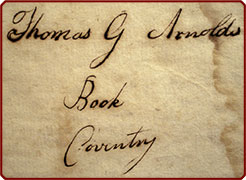
Provenance: Front fly-leaf inscribed “Thomas G. Arnolds Book Coventry,” inked in an early hand.
• ESTC W37335; Evans 20950; Sabin 3366. Contemporary speckled sheep, worn and very slightly sprung, spine scuffed with foot chipped. Pages age-toned and variably waterstained, with occasional edge nicks and crumpled corners; yet not brittle or nasty and the volume quite pleasant for reading. (24391)


 Early Troy Imprint — Interesting Provenance Barclay, Robert. A catechism and confession of faith, approved of and agreed unto, by the general assembly of the patriarchs, prophets and apostles, Christ himself chief speaker in and among them. Which containeth a true and faithful account of the principles and doctrines, which are most surely believed by the churches of Christ in Great-Britain and Ireland, who are reproachfully called Quakers. Troy, (N.Y.): Pr. by Thomas Collier, 1803. 12mo. vii, [1 (blank)], 148 pp., [1] f., 34 pp.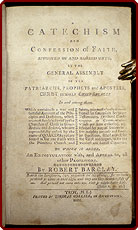
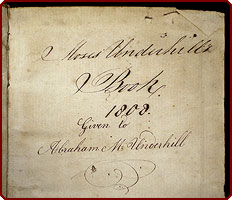 Click the images for enlargements.
 Following Barclay's standard work and with a sectional title-page, the final 34 pages offer: “The ancient testimony of the people called Quakers, revived; by the order and approbation of the yearly meeting. Held for the provinces of Pennsylvania and New-Jersey, 1722. Troy, N.Y., Printed by Thomas Collier, 1803.”
Provenance: In ink on the front free endpaper: “Moses Underhill's Book. 1808.” In a different hand, just below that: “Given to Abraham M. Underhill.” In pencil on the front fly-leaf: “North Street Library. No. 31. to be returned in 30 days to the North Street Library.”
• Shaw & Shoemaker 3752. Publisher's sheep; variable foxing, staining. A rather good copy of a very scarce book. (25738)
Woman
Author / Woman
Printer — London,
1775Brook, Mary. Reasons for the necessity of silent waiting, in order to the solemn worship of God...third edition. London: Mary Hinde, 1775. 8vo (20 cm, 7.9"). [2], 31, [1 (blank)] pp.
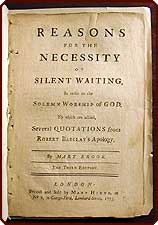
• ESTC T65811. Recent wrappers. Pages age-toned, with a few small spots.
Christianity Abroad, at Home, & among the (Jewish?) Native Americans Crawford, Charles. An essay on the propagation of the Gospel; in which there are numerous facts and arguments adduced to prove that many of the Indians in America are descended from the Ten Tribes ... the second edition. Philadelphia: James Humphreys, 1801. 12mo (18.3 cm, 7.2"). [1] f., 154 pp., [1] f. [with] Woodward, William Wallace. Increase of piety, or revival of religion in the United States of America; containing several interesting letters not before published. Together with three remarkable dreams, in succession, as related by a female in the Northern Liberties of Philadelphia to several Christian friends, and handed to the press by a respectable minister of the gospel. Philadelphia: W.W. Woodward, 1802. 12mo. [1] f., 114 pp.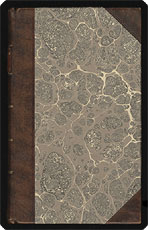
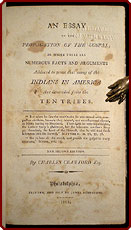
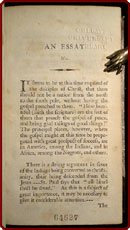 Click the interior images for enlargements.
  Philadelphia
Quakers, and the speech and letter of Seneca and Mohiconick
(signed by “Sachems,” “Counsellors,” and “Owls”
— are probably of greatest interest.
Philadelphia
Quakers, and the speech and letter of Seneca and Mohiconick
(signed by “Sachems,” “Counsellors,” and “Owls”
— are probably of greatest interest.
The second item here is the first edition of Woodward's collection of revival-themed
letters to and from various clergymen, closing with an account of Mrs. Rebecca
Ashburn's mysterious dreams. In these dreams a minister unknown to Mrs. Ashburn
attempted to save her soul; she later identified her would-be converter as
one Dr. William Rogers. This
work is very uncommon in print form. OCLC and NUC Pre-1956
find only five U.S. institutional holdings of this Philadelphia printing,
although it is widely held in microform.
• Essay: Sabin 17433; Shaw & Shoemaker 370; Rosenbach, American Jewish Bibliography, 123; Singerman, Judaica Americana, 0136. Increase: Shaw & Shoemaker 2587; Sabin 105172. Period-style half mottled calf and marbled paper–covered sides, spine preserving original gilt-stamped leather title-label. Title-page and first text page institutionally pressure-stamped. Pages lightly age-toned, somewhat more so in second work; one leaf with tear from outer margin extending into text. (25209)
 GOOD
“Traditional”
AMERICAN
History
Elliott, Charles W. The New England history, from the discovery of the continent by the Northmen, A.D. 986, to the period when the colonies declared their independence, A.D. 1776. New York: Charles Scribner, 1857. 8vo. 2 vols. I: Frontis., 479, [1] pp. II: Frontis., 492 pp.
GOOD
“Traditional”
AMERICAN
History
Elliott, Charles W. The New England history, from the discovery of the continent by the Northmen, A.D. 986, to the period when the colonies declared their independence, A.D. 1776. New York: Charles Scribner, 1857. 8vo. 2 vols. I: Frontis., 479, [1] pp. II: Frontis., 492 pp.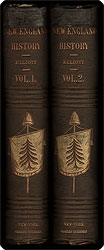
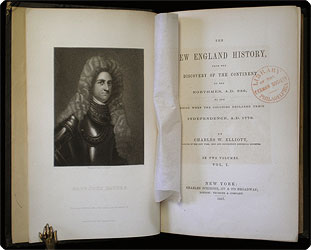 Click the images for enlargements.
 • Sabin 22260. Publisher's brown cloth, covers framed in blind, spines with gilt-stamped title and banner motif; lightly worn and moreso at corners, spines each with relatively unobtrusive strip of cloth tape at head. Ex–social club library: 19th-century bookplates, front free endpapers excised, rubber-stamp on title-pages and a few others, no other markings. (26890)
FIRST
EDITION
Gough,
John. A history of the people called
Quakers. From their first rise to the present time. Dublin: Robert Jackson,
1789. 8vo (21 cm, 8.25"). 3 (of 4) vols. I: x, [2], 546, [10 (index)] pp. (pagination
skipping 294 to 297, text complete and uninterrupted). II: [2], 557, [11] pp.
III: 526, [10] pp.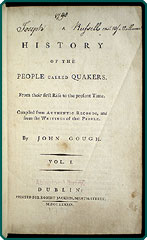
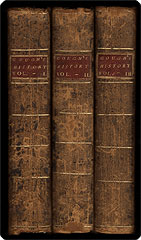
Provenance: Vol. I title-page with inscription dated 1790, reading “Joseph Russells cost 10s a Vollume [sic]”.
• ESTC T102429. Contemporary treed calf, spines with gilt-stamped leather title labels; worn but sound. Bookplates of a now-defunct institution on front pastedowns. Some instances of offsetting and foxing, generally no more than moderate, with pages otherwise clean. (8655)
 Second
Edition (?) —
“New” Fourth
Volume Present
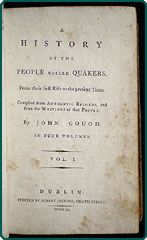
Gough,
John. A history of the people called
Quakers. From their first rise to the present time. Dublin: Robert Jackson,
1790. 8vo (21 cm, 8.25"). 4 vols. I: x, [2], 542, [10 (index)] pp. II: [2],
557, [11] pp. III: 526, [10] pp. IV: 573, [7] pp.
Second
Edition (?) —
“New” Fourth
Volume Present
Gough,
John. A history of the people called
Quakers. From their first rise to the present time. Dublin: Robert Jackson,
1790. 8vo (21 cm, 8.25"). 4 vols. I: x, [2], 542, [10 (index)] pp. II: [2],
557, [11] pp. III: 526, [10] pp. IV: 573, [7] pp.
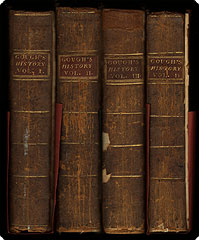
 Click the images for enlargements.
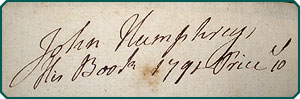
 Provenance: Each volume's front fly-leaf (facing title-page) with inscription dated 1791, reading “John Humphrey, his book 1791 Price 10s”; each volume's pastedown with small bookplate of Richard McIlvain.
• ESTC N2800. Contemporary treed calf, spines with gilt-stamped leather title labels; worn, with all front covers and free endpaper of vol. IV detached. Some instances of light offsetting and foxing, with pages generally clean; some leaves chipped or with marginal tears, one tear causing loss of a few letters from a heading. (14671)
AMERICAN POEMSHoneywood, St. John. Poems ... some pieces in prose. New York: Pr. by T. & J. Swords, 1801. 12mo (17.2 cm, 6.75"). viii, 159, [1 (errata)] pp.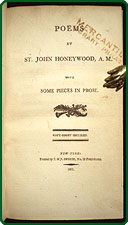
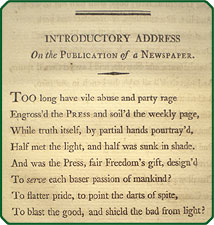
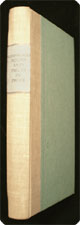
• Wegelin 996; Shaw & Shoemaker 669; Sabin 32786; Richmond 2274. Period-style quarter tan cloth with light blue paper–covered sides, spine with printed paper label. Title-page and several others rubber-stamped by a now-defunct institution. An uncommon book, with many interesting points, including some charming little head- and tailpieces.

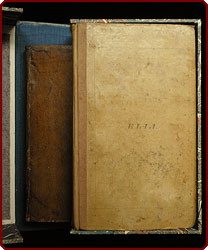
The ESSAYS that Made Lamb's Reputation — 1st U.S. Edition Lamb, Charles. Elia. Essays which have appeared under that signature in the London Magazine. Philadelphia: Carey, Lea, & Carey (pr. by Mifflin & Parry, and J.R.A. Skerrett), 1828. 12mo (I: 18.4 cm, 7.25", II: 16.8cm, 6.6"). 2 vols. I: 292 pp. II: 230 pp. (both vols. without ads.).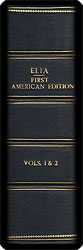
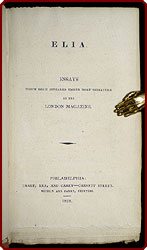
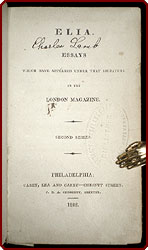 Click the images for enlargements. true
first edition of the unofficial second series, of Lamb's pseudonymously
published essays for the London Magazine. These eloquently written pieces
mingle humor and pathos as they describe the experiences of the author and his
acquaintances while attending boarding school, playing whist, listening to music,
Click the images for enlargements. true
first edition of the unofficial second series, of Lamb's pseudonymously
published essays for the London Magazine. These eloquently written pieces
mingle humor and pathos as they describe the experiences of the author and his
acquaintances while attending boarding school, playing whist, listening to music, visiting
Quaker meetings, etc. Food is a recurring topic (“A
Dissertation upon Roast Pig”); there are two essays on Valentine's Day
(one in each volume), and several on plays and actors.
visiting
Quaker meetings, etc. Food is a recurring topic (“A
Dissertation upon Roast Pig”); there are two essays on Valentine's Day
(one in each volume), and several on plays and actors.
The first series made its first appearance in book form in London, 1823. The authorized second series was not published until 1833, under the title The Last Essays of Elia; the pieces selected for the unauthorized American second series offered here are different from those contained in that volume, and mistakenly include three essays written by other hands.
• Shoemaker 33813 & 33814; NCBEL, III, 1225; NSTC 2L2346. Vol. I: Uncut copy. Publisher's quarter once-red cloth and paper sides, covers printed with “Elia” within a simple frame, spine with printed paper label; binding rubbed and lightly soiled, spine sunned to yellow. Repaired tear to one leaf, touching text without loss; remarkably clean and sound. Vol. II: Contemporary speckled sheep, spine with gilt-stamped leather title-label; rubbed, and head of spine chipped with old refurbishing. Ex–social club library: 19th-century bookplate and call number ticket on front pastedown, front free endpaper with inked numerals, title-page pressure-stamped. Author's name inked on title-page; front free endpaper and title-page reinforced at fore-edge (the latter from the back). Both volumes age-toned, with intermittent spots of staining; advertisements absent. The set now housed in a quarter blue morocco and blue cloth–covered clamshell case with marbled paper–covered sides and gilt-stamped spine. (26434)

 Quaker
Meditations —
A Neat Compendium
Quaker
Meditations —
A Neat Compendium Two
Women in the Contents —
Womanly Provenance, Too
[Law, William].
An extract from a treatise on the spirit of prayer, or the soul rising out of
the vanity of time into the riches of eternity. With some thoughts on war. Remarks
on the nature and bad effects of the use of spirituous liquors. And considerations
on slavery. Philadelphia: Joseph Crukshank, 1780. 12mo (16.3 cm, 6.45"). 84
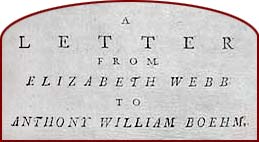
pp. [bound with] Webb,
Elizabeth. A letter...to Anthony William Boehm, with his answer.
Philadelphia: Joseph Crukshank, 1783. 44 pp. [with]
[Benezet, Anthony]. In the life
of the lady Elizabeth Hastings... [Philadelphia: Joseph Crukshank, 1784]. 8
pp.
Two
Women in the Contents —
Womanly Provenance, Too
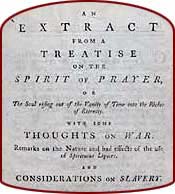
[Law, William].
An extract from a treatise on the spirit of prayer, or the soul rising out of
the vanity of time into the riches of eternity. With some thoughts on war. Remarks
on the nature and bad effects of the use of spirituous liquors. And considerations
on slavery. Philadelphia: Joseph Crukshank, 1780. 12mo (16.3 cm, 6.45"). 84
pp. [bound with] Webb,
Elizabeth. A letter...to Anthony William Boehm, with his answer.
Philadelphia: Joseph Crukshank, 1783. 44 pp. [with]
[Benezet, Anthony]. In the life
of the lady Elizabeth Hastings... [Philadelphia: Joseph Crukshank, 1784]. 8
pp. 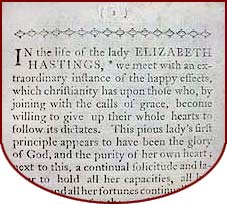
 Elizabeth Webb, "an acknowledged minister among the people called Quakers," first encountered Prince George of Denmark's chaplain Boehm while on a visit to Great Britain; the missive with which she opened her subsequent correspondence with him, here, greatly inspired him and a number of his friends.
Provenance: With inscription reading "Miss Hannah Amelia Moore / Book a Present from her worthy / Friend Ruth Patton / 1789."
• Law: ESTC W32233; Evans 16817; Hildeburn 3987. Webb: ESTC W13440; Evans 18295; Hildeburn 4409. Benezet: ESTC W6416; Evans 18355. Contemporary quarter sheep over paper-covered sides, the whole worn and abraded but the little volume quite sound. Light age-toning, occasional darker spots. Small chip in bottom margin of title-page; one leaf with paper flaw in lower corner, resulting in the loss of a very few letters.
The
Spirit of Prayer
Law, William. An extract from a treatise...called, the spirit of prayer; or, the soul rising out of the vanity of time, into the riches of eternity. With some thoughts on the nature of war, and its repugnancy to the Christian life, &c. &c. Philadelphia: Henry Miller, 1766. 8vo [signed in 4s] (17.3 cm, 6.8"). 48 pp.
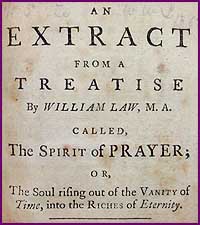
The present copy does not include the thirty pages, mentioned in the subtitle, on the nature of war; the Extract and Some Thoughts were issued as the first and second titles in a collection of religious tracts printed by Henry Miller, and also issued separately (Evans 10352 and 10505). Sabin calls for 48 pages, as found in this copy.
• Evans 10352; Sabin 39325. On Law, see: Dictionary of National Biography, XXXII, 236–40. Later neat plain cloth binding, spine with gilt-stamped morocco title label; clean. Half-title lacking. Some foxing, mostly marginal. Pencilled notes to top of title-page and final page; early inked ownership inscription to title-page verso, including Philadelphia street address.

 Good
Advice Still
Leighton, Robert. On detraction, and curiosity about the affairs of others: Chiefly taken from the writings of Archbishop Leighton. Philadelphia: To be had of Benjamin & Thomas Kite, and for sale by Solomon W. Conrad, Kimber & Sharpless, & John Richardson (J.R.A. Skerrett), 1821. 12mo. 12 pp.
Good
Advice Still
Leighton, Robert. On detraction, and curiosity about the affairs of others: Chiefly taken from the writings of Archbishop Leighton. Philadelphia: To be had of Benjamin & Thomas Kite, and for sale by Solomon W. Conrad, Kimber & Sharpless, & John Richardson (J.R.A. Skerrett), 1821. 12mo. 12 pp.
• Shoemaker 5812. Removed from a nonce volume, stapled, and respined with archival tissue.
Arguing Baptism with the QUAKERS Leslie, Charles. A discourse; shewing, who they are that are now qualify'd to administer baptism and the Lord's-Supper. Wherein the cause of Episcopacy is briefly treated. London: C. Brome, W. Keblewhite, & H. Hindmarsh, 1698. 4to (22 cm, 8.7"). [8], 62, [2 (adv.)] pp.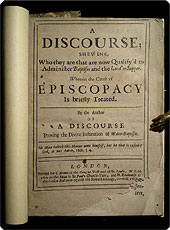
Click the image for an enlargement. • ESTC R25145; Wing (rev. ed.) L1130; McAlpin, IV, 589. Recent marbled paper wrappers. Title-page darkened and institutionally pressure-stamped, with lower outer portion torn away, just touching final number in date with no loss of sense. First few pages with edge nicks. Final (adv.) leaf with short internal tear with loss of a few letters, not affecting sense. (25009)
The End Times, According to Muggleton Muggleton, Lodowick. A true interpretation of the eleventh chapter of the Revelation of St. John, and other texts in that book; as also many other places of Scripture. London: Pr. for the author, 1662. 4to (18.9 cm, 7.4"). [16], 172, [2 (blank)] pp.

 Click the images for enlargements. Quaker.
Provenance: Final blank leaf with inked inscriptions reading “Tho.s. Scupholme His Book 1740" and “Henery Collier His Book 1759.”
• ESTC R267; Wing (rev. ed.) M3050; Smith, Anti-Quakeriana, 305. Period-style calf, covers framed in blind double fillets, spine with gilt-ruled raised bands and gilt-stamped leather title-label. Pages age-toned and spotted; one leaf with tear from lower margin into text, sewn by hand some time ago. (26004)
MUGGLETON
vs. The QUAKER
Muggleton,
Lodowick. An answer toIsaac Pennington [sic], Esq;
his book intituled, Observations on some passages of Lodowick Muggleton’s
interpretation of the 11th chapter of the Revelations.... London: Pr. by subscription,
1719. 4to (21.1 cm, 8.25"). [2] ff., 24 pp.

The title of this second edition (first edition, 1662) is within a simple border of type ornaments, and the text has two typographical headpieces and a xylographic tailpiece.
• ESTC T93652; Smith, Bibliotheca Anti-Quakeriana, 311–12. On Muggleton and the Muggletonians, see: The Dictionary of National Biography, XXXIX, 264–67; and Oxford Dictionary of the Christian Church 948. On Penington, see: The Dictionary of National Biography, XLIV, 297–300. Recent marbled paper over light boards; front cover with a paper label lettered in black. Spotting, staining, and occasional tears in the margins (repaired with tissue paper) with no loss of text. Pencilled marginalia.
“Rank Confusion” — That’s a Joke![Nares, Edward]. Heraldic anomalies; or, rank confusion in our orders of precedence, With disquisitions, moral, philosophical, and historical, on all the existing orders of society. By It Matters Not Who. London: G. and W.B. Whittaker (pr. by R. Gilbert), 1823. 8vo (19.7 cm, 7.75"). 2 vols. I: xxii, [2], 334, [2 (1 blank)] pp. II: [4], 372 pp.
 A whole chapter is dedicated to Quakers, who reject all worldly titles.
Single-click the image where the hand appears on
A whole chapter is dedicated to Quakers, who reject all worldly titles.
Single-click the image where the hand appears on Though Nares is quite capable of picking nits with a level of scrupulousness to match that of the most pedantic of scholars, he is also prone to flights of fancy such as pondering—after noting that a married woman’s moveable goods are unquestionably the property of her husband— “whether the female tongue is to be reckoned among the moveables . . . I believe it is pretty generally held to continue ‘in potestate Mulieris,’ even after marriage, and I know nothing to prevent it” (p. 148). This is followed up with references to Ovid, the Wife of Bath, and the much-storied Flitch of Bacon!
• Contemporary half calf with marbled paper sides, spines with gilt-stamped helm decorations and gilt-stamped leather title and volume labels (the volume labels recently supplied, in sympathetic style). Board edges showing light to moderate wear, with leather cracking at joints and crackled over the spines generally. Top edges gilt. Front pastedowns with bookplates now partially torn away; title-page of vol. II with an early inked ownership inscription in the upper margin. Delightful reading, as well as an overall attractive set.
 For more SETS, click here.
Hoping for “a Great Charter for Liberty of Conscience”Penn, William. The great and popular objection against the repeal of the penal laws & tests briefly stated and consider’d, and which may serve for answer to several late pamphlets upon that subject. London: Andrew Sowle, 1688. 4to (19.8 cm, 7.75"). 23, [1 (blank)] pp.

 Click the interior images for enlargements.
 Despite this strongly worded treatise against persecution (which argues that all men should be able to make a free and open choice of faith and worship), the statutes remained in place for many years to come.
• Wing (rev.) P1298A; ESTC R12742. Recent marbled paper–covered boards. Title-page with tiny, unobtrusive numeral inked in upper outer corner, first text page with numeral stamped in lower margin (no other markings). Title-page and first text page with moderate foxing, others clean.

Friendly
Memorials, Male &
Female
(Philadelphia). Society of Friends. Memorials concerning deceased Friends: Being a selection from the records of the Yearly Meetings for Pennsylvania, &c., from the year 1788 to 1819, inclusive. Philadelphia: Pr. by Solomon W. Conrad, 1821. 12mo (19.1cm, 7.5"). 184 pp.


 “Wo unto All Ministerial Counterfeits!” Reeve, John, & Lodowick Muggleton. Joyful news from heaven: Or, the last intelligence from our glorified Jesus above the stars: Wherein is infallibly recorded, how that the soul dieth in the body.... London: Pr. by T.J. for Francis Cosinet, 1658. 4to (18.9 cm, 7.4"). [2], 78, [2 (blank)] pp.


 Click the images for enlargements.
• ESTC R32277; Wing (rev. ed.) R679; Smith, Anti-Quakeriana, 304; Whitley, Baptist Bibliography, 49-658. Period-style calf, covers framed in blind double fillets, spine with gilt-ruled raised bands and gilt-stamped leather title-label. Pages age-toned and spotted; one leaf with outer and lower margins repaired some time ago as shown in last photo. (26001)
“Against the Specious Errors of theQuakers” Rudd, James. Two discourses: The former on baptism with the Holy Ghost; the latter on water-baptism. Kendal: Thomas Ashburner, 1740. 8vo (19.2 cm, 7.55"). 123, [1] pp. Click the image for an enlargement.
 Rare: ESTC, OCLC, and NUC Pre-1956 locate only two U.S. institutional holdings, one of which has been deaccessioned.
• ESTC T103464; Allibone 1887; Smith, Bibliotheca Anti-Quakeriana, 383. Recent marbled paper wrappers. Title-page with rubber-stamped numeral in upper margin, institutional perforation-stamp, and tattered outer edge; first text page also with stamped numeral and perforation-stamp; final (blank) page rubber-stamped. Pages otherwise clean. (25530)
Quaker
Preacher, at Home & Abroad
[Scott, Job]. Journal
of the life, travels and gospel labours of that faithful servant and minister
of Christ, Job Scott. New York: Isaac Collins, 1797. 12mo (18.3 cm, 7.25").
xii, [2], 360 pp. 
Provenance: Front free endpaper with early inked ownership inscription by Mary and Rebecca Bude.
• ESTC W19882; Evans 32810; Sabin 78287; Howes S228. Contemporary mottled sheep, spine with gilt-stamped leather title label; worn and abraded especially over joints and edges, spine leather cracking. Some leaves dog-eared; spots of foxing to first and last few leaves, with other pages mostly clean.
Quaker Life inDutchess County, NY — 1779Society
of Friends. To the yearly meeting. Extracts taken from the minnets of our quarterly meeting held at the Oblong by adjournments from ye 1st of the 5 month to 3ed of the same inclusive. 1779. New York: Pr. by Melbert B. Cary,
Jr. at the Sign of the Woolly Whale, 1936. 8vo (20.2 cm, 7.9"). [12] pp. 
 Long, breathless, run-on sentences make the expected Quaker standards of behavior, in this place and time, quite clear.
• Sewn in publisher’s color-flecked paper wrappers. A crisp, clean copy.


 Click here
for a database including
Click here
for a database including  keywords,
e.g. = SOCIETY OF FRIENDSand/or
QUAKER . . .
keywords,
e.g. = SOCIETY OF FRIENDSand/or
QUAKER . . .

PLACE AN ORDER | E-MAIL US | GO (BACK) TO TOPIC/INTEREST TABLE | PRB&M HOME
All material © 2010
The Philadelphia Rare Books & Manuscripts
Company