 TEMPERANCE
TEMPERANCE
TEMPERANCE
 This
was
This
was ANOTHER
of Benezet's Causes
ANOTHER
of Benezet's Causes
 Benezet, Anthony. The mighty destroyer displayed, in some account of the dreadful havock made by the mistaken use as well as abuse of distilled spirituous liquors. Philadelphia: Printed by Joseph Crukshank, 1774. 8vo (17 cm; 6.625"). 48 pp.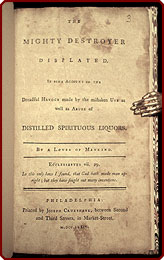
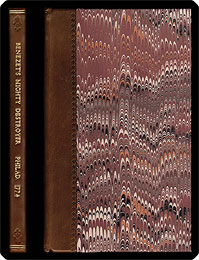
 Click the images for enlargements.
 While the title-page merely says the piece is “by a Lover of Mankind,” Benezet's authorship was well established by Evans.
• Bristol B3689; Shipton & Mooney 42555; Hildeburn 2980; ESTC W26174. Not in Blake. Recent quarter calf, old style, with marbled paper sides. Text cockled, with stray stains and age-toning; title-page crumpled. Original edition, not a modern reprint. (27123)


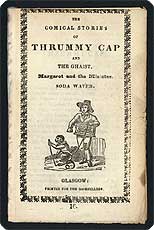
Three Verse StoriesBurness, John. The comical stories of Thrummy Cap and the ghaist. Margaret and the minister. Soda water. Glasgow: Pr.
for the booksellers, [1840?]. 12mo. 24 pp. 
 a
woodcut vignette of a man playing a barrel organ with a monkey on a leash at
his feet, with "[No.] 16" printed at the foot of the title.
a
woodcut vignette of a man playing a barrel organ with a monkey on a leash at
his feet, with "[No.] 16" printed at the foot of the title.
• NSTC 2T11878. Removed from a nonce volume. Title-page separated; title-page and some others with short edge nicks, otherwise clean and fresh. (16777)


 RarePOLITICAL Chapbook Dialogue between John and Thomas on the corn laws, the charter, teetotalism, and the probable remedy for the present disstresses. Paisley [Scotland]: Printed for the Author, by G. Caldwell, 1842. 12mo. 8 pp.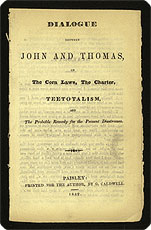
Click the image for an enlargement. • Original self wrappers. Unbound; removed. Slightly darkened. Very good. (17412)
Dunbar's First Novel Dunbar, Paul Laurence. The uncalled: A novel. New York: Dodd, Mead, & Co., 1898. 8vo (18.5 cm, 7.25"). [4], 255, [1] pp.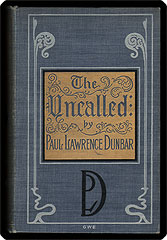
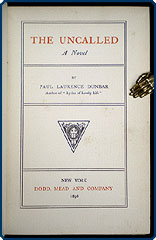
Signed binding: Publisher's blue-gray cloth, front cover with gilt-stamped title in black and silver framework, signed “GWE” (George Wharton Edwards). The front cover and spine give the author's name as Lawrence rather than Laurence, making this BAL's binding state A.
Click
the images for enlargements.
Provenance: Front free endpaper with inked gift inscription to journalist, lecturer, and poet Nixon Waterman from Edward F. Burns, likely the poet and Boston Globe editor of that name.
• BAL 4923; Wright, III, 1671. Binding as above, a little cocked, spine sunned, extremities lightly rubbed; front cover clean and bright. Front free endpaper with inked gift inscription (see above) dated Christmas 1898, half-title with extensive inked inscription dated 1953. The latter hand has made a checkmark beside almost every page number as well as occasional annotations and marks of emphasis; pages otherwise clean. (26651)

Intemperance Killed the Tailor? Elegy on Jamie Gemmill, tailor. [Paisley, Scotland?]: no publisher/printer, [18--]. 12mo. 8 pp.
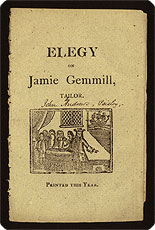 Click the image for an enlargement.
 The last page offers a “Per Contra” claiming, “Jamie Gemmill yet is leevin” — with a note on where you can find him to buy him a drink!
• Original self wrappers (unbound; removed). Very good. (17415)

Parley's Tales ofGood Temper & Cheerfulness Goodrich, Samuel G. Make the best of it, or, Cheerful Cherry, and other tales. New York: Sheldon & Co., 1865. 12mo (15.7 cm, 6.2"). [5]–viii, 170, [2 (adv.)] pp.; illus.
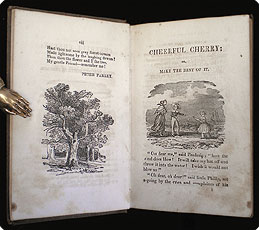 Click the images for enlargements.
Provenance: Front free endpaper with inked inscription: “Miss Alice A. Chamberlin. Presented by her Grandfather Joel Chamberlin,” dated 1865, Sennett (in New York State).
Binding: Publisher's brown cloth, covers blind-stamped with foliate decorations, spine almost fully and in fact rather gorgeously gilt-stamped with title and pictorial vignette.
• Bound as above; corners rubbed, front cover with small spots of discoloration, spine gilt lightly rubbed. Front free endpaper with inscription as above. Some light spotting, foxing, and offsetting. (25804)

 Quaker
Meditations —
A Neat Compendium
Quaker
Meditations —
A Neat Compendium Two
Women in the Contents —
Womanly Provenance, Too
[Law, William].
An extract from a treatise on the spirit of prayer, or the soul rising out of
the vanity of time into the riches of eternity. With some thoughts on war. Remarks
on the nature and bad effects of the use of spirituous liquors. And considerations
on slavery. Philadelphia: Joseph Crukshank, 1780. 12mo (16.3 cm, 6.45"). 84
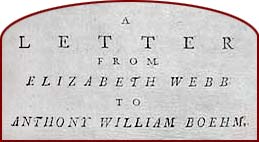
pp. [bound with] Webb,
Elizabeth. A letter...to Anthony William Boehm, with his answer.
Philadelphia: Joseph Crukshank, 1783. 44 pp. [with]
[Benezet, Anthony]. In the life
of the lady Elizabeth Hastings... [Philadelphia: Joseph Crukshank, 1784]. 8
pp.
Two
Women in the Contents —
Womanly Provenance, Too
[Law, William].
An extract from a treatise on the spirit of prayer, or the soul rising out of
the vanity of time into the riches of eternity. With some thoughts on war. Remarks
on the nature and bad effects of the use of spirituous liquors. And considerations
on slavery. Philadelphia: Joseph Crukshank, 1780. 12mo (16.3 cm, 6.45"). 84
pp. [bound with] Webb,
Elizabeth. A letter...to Anthony William Boehm, with his answer.
Philadelphia: Joseph Crukshank, 1783. 44 pp. [with]
[Benezet, Anthony]. In the life
of the lady Elizabeth Hastings... [Philadelphia: Joseph Crukshank, 1784]. 8
pp. 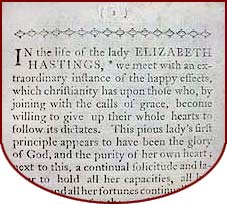
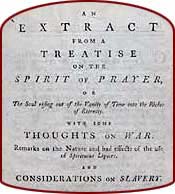 Remarks on . . . Liquors, which aims to promote health and happiness rather than directly religious concerns, is attributed by ESTC to Anthony Benezet, as is the volume's last piece, the title of which is taken from its opening lines. Lady Elizabeth Hastings was the original for Aspasia in Steele's "Tatler" and a major donor to Oxford University Queen's College.
 Elizabeth Webb, "an acknowledged minister among the people called Quakers," first encountered Prince George of Denmark's chaplain Boehm while on a visit to Great Britain; the missive with which she opened her subsequent correspondence with him, here, greatly inspired him and a number of his friends.
Provenance: With inscription reading "Miss Hannah Amelia Moore / Book a Present from her worthy / Friend Ruth Patton / 1789."
 A Temperance TaleMacneill, Hector. The history of Will and Jean: Or, the sad effects of drunkenness. Glasgow: Pr. for the booksellers, [1840?]. 12mo. 24 pp.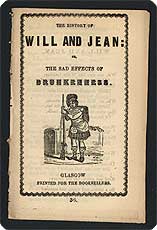
• NSTC 2W21326. Removed from a nonce volume. Slightly age-toned, with very faint staining to one leaf. (24437)
 Click here
for a database including
Click here
for a database including  keywords,
e.g. = TEMPERANCE, DRINK,and/or
PROHIBITION . . .
keywords,
e.g. = TEMPERANCE, DRINK,and/or
PROHIBITION . . .

PLACE AN ORDER | E-MAIL US | GO (BACK) TO TOPIC/INTEREST TABLE | PRB&M HOME
All material © 2010
The Philadelphia Rare Books & Manuscripts
Company