A GERMAN JEWEL
 Bible.
O.T. German. 1525. Luther. Das Alt Testament dütch.... [Zürich]:
Getruckt...durch Christophorum Froschouer, 1525. Folio (30.5 cm). 3 pts. in 1.
p 6A–T6 2A–Z6
Aa–Bb6 AA–KK6 LL8; [4], CXII, [1 (sectional title)],
CXLVII, LXVII, [1 (blank)]. [bound with] Bible.
O.T. Prophets. German. 1527. Hätzer-Denck. Alle propheten nach Hebraischer
sprach veteütscht. [colophon: Worms: Getrucht...bei Peter Schöffern,]
1527. Folio (30.5 cm). A–V6 a–d6e4f6;
lij [i.e., clii], [2 (final a blank)] ff. [bound with] Bible.
N.T. German. 1525. Luther. Die neuw Testamnt recht grüntlich teütscht....
Basel: Gedruckt durch Adam Petri, 1525. Folio (30.5 cm.). a–b6A–Z6AA–HH6II4;
[18], CLXXXIIII ff.
Bible.
O.T. German. 1525. Luther. Das Alt Testament dütch.... [Zürich]:
Getruckt...durch Christophorum Froschouer, 1525. Folio (30.5 cm). 3 pts. in 1.
p 6A–T6 2A–Z6
Aa–Bb6 AA–KK6 LL8; [4], CXII, [1 (sectional title)],
CXLVII, LXVII, [1 (blank)]. [bound with] Bible.
O.T. Prophets. German. 1527. Hätzer-Denck. Alle propheten nach Hebraischer
sprach veteütscht. [colophon: Worms: Getrucht...bei Peter Schöffern,]
1527. Folio (30.5 cm). A–V6 a–d6e4f6;
lij [i.e., clii], [2 (final a blank)] ff. [bound with] Bible.
N.T. German. 1525. Luther. Die neuw Testamnt recht grüntlich teütscht....
Basel: Gedruckt durch Adam Petri, 1525. Folio (30.5 cm.). a–b6A–Z6AA–HH6II4;
[18], CLXXXIIII ff.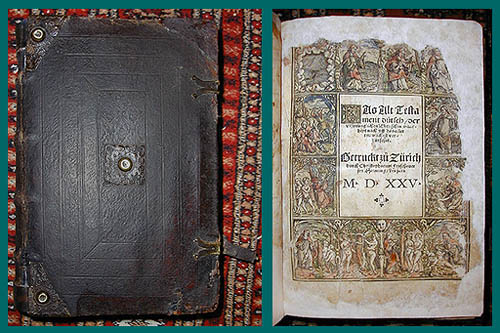
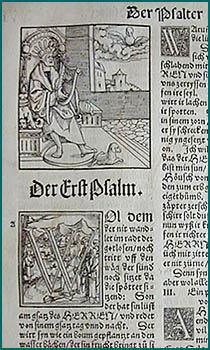
 There are 38 of these embellishments, the largest measuring 80 x 70 mm (3.75" x 1.875"). Richard Muther writes, "The illustrations of part 1 are slightly reduced copies of the eleven [still unattributed] Wittemberg edition illustrations. At the beginning of part 2 there is a (270 x 400 [mm]) map of the beloved land indicating the places at which the events described took place. The text woodcuts of part 2 (70 x 70 [mm]) are . . . in part, reprints of those found in Othmar's 1523 Augsburg edition. Part 3 has three woodcuts, with the last one appearing to be by one of Holbein's students" (p. 228).
The O.T. title-page bears an elaborate multipanel woodcut border showing various stages of the creation of the universe, God's making of man (and woman from his rib), the bliss, temptation, and fall in Eden, Adam and Eve's exposure and expulsion, and the couple's toil at farming and spinning in the postlapsarian world. The border has good quality, early hand-coloring. The text following is printed in double-column format, in fraktur type, and is enlivened not only by the cuts analyzed by Mather above, but by more than 75 historiated initials.
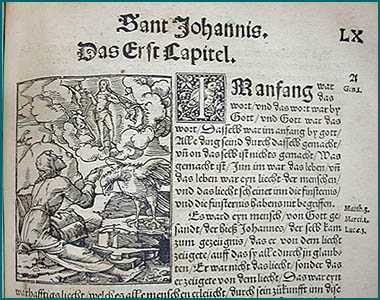
New Testament: The early owner's choice of New Testament is the second Petri folio edition, the first having appeared only two years before in 1523; it begins with an elaborate woodcut border reused unaltered from that first edition. It features Sts. Peter and Paul, the emblems of the Evangelists, the Basel Staff on a shield, and a child holding a pennant reading "1523, Adam Petri" and riding a lion (being a version of the Petri device). The N.T. text is printed in single-column format with side- and shouldernotes, employing a fraktur typeface. Throughout the text are numerous large and small historiated initials and decorative ones as well.
The illustrations of this Petri Testament are extremely important.
Binding: Bevelled wood boards, covered in rich dark cordovan-colored calf, elaborately tooled in blind using a variety of rolls, rules, and fillets forming five concentric panels on the covers, each elaborately filled with designs. Four raised bands on a plain spine. Remnants of strap and brass closures; brass bosses in the center of each cover and at the inner corners of same (bosses at the outer corners, perished). Restoration at the outer corners of covers and at the top and bottom of spine, replacing missing leather.
• Old Testament: Not in Darlow & Moule. On the illustrations, see: Richard Muther, German Book Illustration of the Gothic Period and the Early Renaissance (1460–1530), Metuchen, NJ, 1972. Age-toned. Title-page damaged with some loss of the illustrated woodcut border: Missing paper replaced via leaf casting and paper conservation work documented. Margins of five leaves of Luther's foreword bug-spotted and irregular; portions of inner margins perished and repaired. Edges of upper, lower, and outer margins of earliest leaves reinforced. Waterstaining and scattered soiling in margins. Four leaves cleanly torn and repaired.
Prophets: Darlow & Moule 4192; Reinitzer, Biblia deutch: Luthers Bibelübersetzung und ihre Tradition, 92. Age-toned. Variable staining in upper margins and some outer ones. One leaf cleanly torn into text and repaired. Occasional discoloration in text area. One leaf cleanly torn and repaired.
New Testament: Not in Darlow & Moule; Pietsch 63. On Holbein as the illustrator, see: Richard Muther, German Illustration of the Gothic Period and Early Renaissance, p. 185; Ph. Schmidt, Die Illustration der Lutherbibel, 117–23; and Holstein, German Engravings, Etchings, Woodcuts, 1400–1700, vol. 14a, 68–71. Age-toned. Soiling in margins of title-page. Waterstains in upper and foremargins of some leaves. Last leaves tattered in margins and some reinforced. A old inked marginal note or two, with more writing in the blank area of the verso of the final leaf, above the printer's device. Massive. Impressive.

PLACE AN ORDER | E-MAIL US | GO (BACK) TO TOPIC/INTEREST TABLE | PRB&M HOME
All
material © 2006
The Philadelphia Rare Books & Manuscripts
Company