 NATIVE
AMERICANA
NATIVE
AMERICANA
NATIVE
AMERICANA
NATIVE
AMERICANA
 “Cupid Befriend Me!”
  Ingraham, Joseph Holt. American lounger. Or, tales, sketches, and legends gathered in sundry journeyings by the author of “Lafitte,” &c. Philadelphia: Lea & Blanchard, 1839. 12mo. [10], 15-41, [5], 59-273 pp.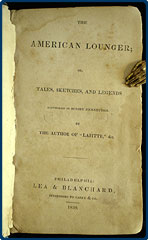
 a story about General Washington entering a leaping contest and another involving the love affair between an illegitimate son of Charles I and a young maiden from a Native American tribe in Maine.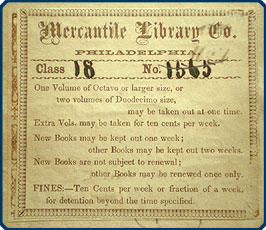

 A Human Rights
 Appeal/Exposé — American Indian Advocacy Jackson, Helen Fiske Hunt. A century of dishonor[.] A sketch of the United States government's dealings with some of the Indian tribes. By H. H. New York: Harper & Brothers, 1881. 12mo. x, 457, [1 (blank)] pp.; 6 pp. (ads).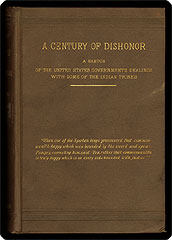
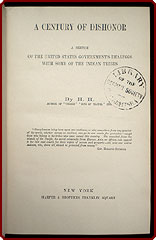
 Click the images for enlargements.
 Jackson grew up in Massachusetts and was a close friend of Emily Dickinson. Her marriage in 1852 to a Captain Hunt ended tragically, for he and their two children were dead by 1865. For health reasons she moved to Colorado and in 1875 married a banker named William Jackson. She developed a keen interest in the plight of the American Indian and secured the extraordinary privilege of doing research in the Americana Department of the Astor Library in New York City during the morning hours before the doors officially opened.
She hoped this work would effect a reversal of government policy and herself purchased sufficient copies to send one to every member of both houses of Congress. She then turned to fiction as another avenue of attack: Her best-known novel, Ramona, was her attempt to produce for American Indians a work that would affect their lot as Uncle Tom's Cabin did the plight of black slaves.
 A landmark book.
• BAL 10444. Publisher's brown cloth, lettered in gold. Ex–social club library: 19th-century bookplate, call number on endpaper, rubber-stamp on title-page, no other markings. Two small areas of minor discoloration on spine where paper shelving labels removed. Overall a very nice copy. (26260)

 For the INGALIKJetté, Jules. Canotlé Rannaga Kelékak. Délochét Roka. Winnipeg: Free Press no-rodeneletekteyar, 1904. 8vo (14.4 cm, 5.6"). 54 pp.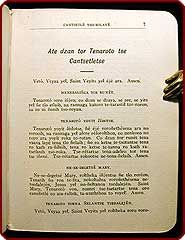
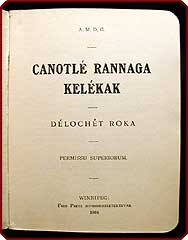
 The Ingalik inhabited the middle part of the Yukon River Valley, Alaska.
Click the image to the right
The Ingalik inhabited the middle part of the Yukon River Valley, Alaska.
Click the image to the right• Cf. Wickersham, 1050, for another title by Jetté with the same imprint. Not in Evans; not in Banks. Original stiff cloth wrappers. Pages very slightly age-toned, otherwise fine.
Methodist Missionary & Chippewa Chief's HYMNSChippewa
& English Jones, Peter, tr. Collection of hymns for the use of native Christians of the Chipeway tongue. [added title-age in Chippewa:] Nahkahmoonun kanahnahkahmoowaudt ekewh ahneshenahpaigk anahmeahchik. Kahahnekahnootahpeungkin owh Kahkewaquonnaby. New York: Printed at the conference office by J. Collord, 1829. 12mo (13.2 cm; 5.125"). [1] f., pp. [1–2], 3, then 37, 37, 38–92 pp.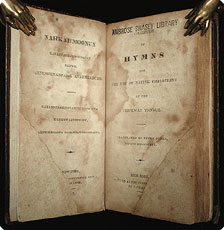
 Click the images for enlargements.
 Peter Jones (1802–56) was a mixed-blood Missisauga chief and a Methodist missionary at New Credit, Ontario.
• Pilling, Proof-sheets, 2024; Pilling, Algonquian, 266; Shoemaker 39161. Not in Sabin; not in Newberry Library, Ayer Indians; not in Boston Athenaeum, Schoolcraft Collection. Contemporary brown calf, modest triple-rule border on covers in blind; rebacked and spine blind-tooled with ruled compartments containing blind-stamped devices. Lower outer corners of both title-pages torn away and paper repairs made, with partial loss of imprint information on each page; old library rubber-stamp to top of English one. Staining, sometimes heavy; chipping of page edges; pp. 39/40 with large semicircular tear with loss of text. Far from a perfect copy, but copies are extremely uncommon in commerce these days. (25853)

 His
Surviving Oratory
&
The FIRST
BIBLIOGRAPHY
Printed
in the New World
Juan Bautista, fray. A Jesu Christo S.N. ofrece este sermonario en lengua mexicana ... Primera parte. Mexico: En casa de Diego Lopez Davalos, 1606. 4to (21.5 cm; 8.5"). [26] ff., pp. 1–559, ff. 560–99, pp. 600–39, ff. 640–47, pp. 648–55, 664–709, [1] p., [20 of 24] ff., lacks final 4 leaves.
His
Surviving Oratory
&
The FIRST
BIBLIOGRAPHY
Printed
in the New World
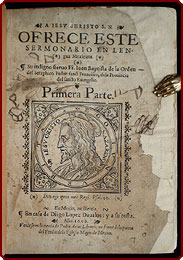
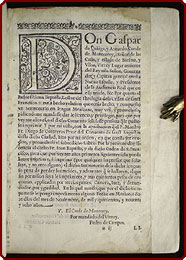
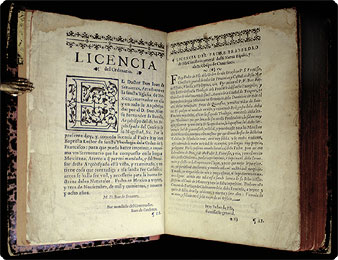
Juan Bautista, fray. A Jesu Christo S.N. ofrece este sermonario en lengua mexicana ... Primera parte. Mexico: En casa de Diego Lopez Davalos, 1606. 4to (21.5 cm; 8.5"). [26] ff., pp. 1–559, ff. 560–99, pp. 600–39, ff. 640–47, pp. 648–55, 664–709, [1] p., [20 of 24] ff., lacks final 4 leaves.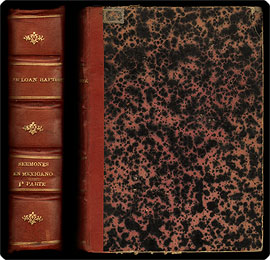
 Click the images for enlargements.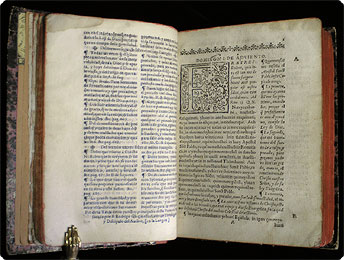
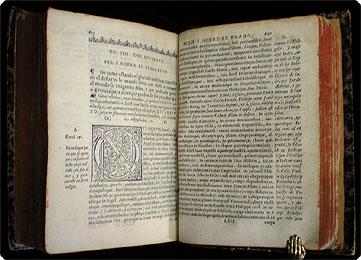
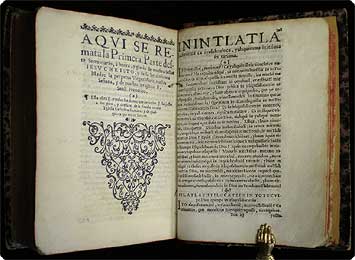
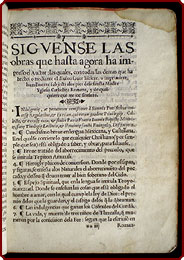
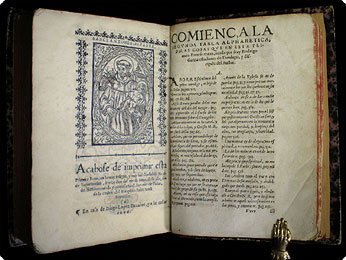
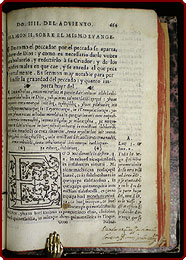
 A long unnoticed feature of this book is that it contains the first bibliography published in the New World. On signature **iiii recto and verso is a list of “las obras que hasta agora ha impesso el Auctor” (“the works that until now the author has had published”). The list is not in chronological order nor is it alphabetical by title; nonetheless it is a bibliography and supplies us with information now known only because of its inclusion here. Of the 17 items listed, several have failed to survive in any known copy, including the second part of this sermonario — though at the time of publication of this part one, “de la segunda parte esta ya impresso gran pedaço” (“of the second part a large portion is already printed”).
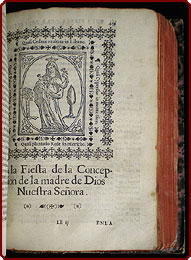
The volume is enhanced by half-page woodcuts: here, Christ's portrait profile on the title-page, St. Andrew with his Cross, St. Anne with the Virgin as infant (appearing twice), and St. Anthony of Padua. The text is in roman with side- and shouldernotes in italic type. Printer López Dávalos employs an interesting set of very large (5 x 5 cm; 2" x 2") foliated woodcut initials throughout the volume.
Provenance: 18th-century signature in a few margins of Carlos Perez; late 19th- or early 20th-century bookplate of Nicolás León; in the collection of the John Carter Brown Library (deaccessioned).
• Medina, Mexico, 227; García Icazbalceta, Lenguas, 13; H. de León-Portilla, Tepuztlahcuilolli, 342; Viñaza 114; Newberry Library, Ayer Indians, Nahuatl-21; Pilling, Proof-sheets, 235; Palau 23467; Putick & Simpson 154; Schwaller 11. For biographical information on Bautista, see: Archivo biográfico de España, Portugal, e Iberoamérica, fiche 104, frames 339–73. Late 19th-century quarter red Mexican sheep with purple and black mottled paper sides. Title- and following leaf with irregular foremargins, loss of blank areas of old repaired; waterstaining in margins of early leaves. Some worming in text costing letters here and there but not impeding sense for the reader. Last four leaves, one bearing an illustration of the Crucifixion, absent (i.e., from the section of Bible citations used in the sermons); last leaves present a bit chipped/gnawed at lower corners and one fore-edge. Old marca de fuego eradicated from top edge; all edges red and corners elegantly rounded. Some 18th-century marginalia in Spanish explicating words and phrases in the Nahuatl text. (26393)
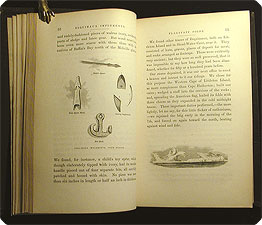
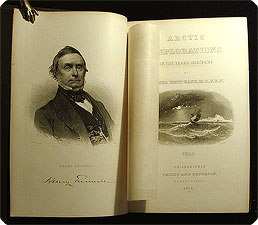
 “In Search of ” — A Brave & Sad AccountKane, Elisha Kent. Arctic explorations: The second Grinnell expedition in search of Sir John Franklin, 1853, ’54, ’55. Philadelphia: Childs & Peterson, 1856. 8vo (23.5 cm, 9.25"). 2 vols. I: Frontis., add. engr. t.-p., 464 pp.; 1 fold. map. , 11 plts., illus. II: Frontis., add. engr. t.p., 467, [1] pp.; 1 fold. map, 1 map, 7 plts.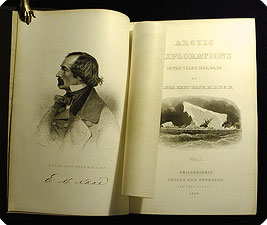
 Click the images for enlargements.
  interactions
with Native Americans as well as their diet, apparel, observations
of natural history, and dog-handling experiences.
interactions
with Native Americans as well as their diet, apparel, observations
of natural history, and dog-handling experiences.
As described by the title-pages, the volumes are “Illustrated by upwards of three hundred engravings, from sketches by the author. The steel plates executed [by J. Hamilton and others] under the superintendence of J.M. Butler, the wood engravings by Van Ingen & Snyder.” The plates total 20 altogether, including frontispieces.
 For more SETS, click here.
Special
Type for
For more SETS, click here.
Special
Type for the
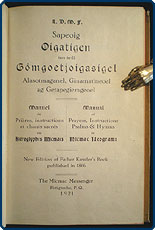
Micmac
Kauder, Christian. Sapeoig oigatigen tan tetli
gômgoetjoigasigel...manual of prayers, instructions, psalms & hymns in Micmac ideograms.
Ristigouche, Quebec: The Micmac Messenger, 1921. 16mo (18 cm, 7.125"). 456 pp. (pp.i–xii never
bound in).
the
Micmac
Kauder, Christian. Sapeoig oigatigen tan tetli
gômgoetjoigasigel...manual of prayers, instructions, psalms & hymns in Micmac ideograms.
Ristigouche, Quebec: The Micmac Messenger, 1921. 16mo (18 cm, 7.125"). 456 pp. (pp.i–xii never
bound in).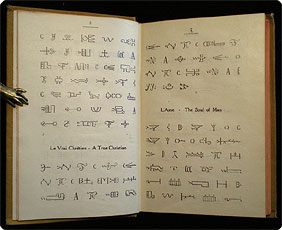
 Click the images for enlargements.
 The characters used to print this work were the invention of Father Christian
Leclercq, a 17th-century missionary, and later revised and improved by Abbé
Pierre Maillard. More than 5700 types were cut and cast for the book, and
the characters each represent words rather than sounds. This may well be the sole work printed in these
characters.
This issue without English language front matter (i.e., pp. i–xii).
• Pilling, Algonquian, p. 275 (ref). Publisher's yellow-brown cloth with simply gilt-lettered spine, to which one stain and general light soiling; each cover creased vertically from an old bump. All edges red. Internally clean. (25312)
 “Oh,
what terrible sights met my view!”
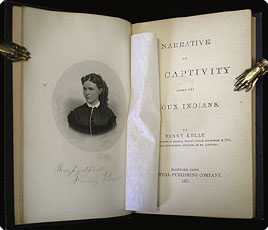
Kelly, Fanny. Narrative of my captivity among the Sioux
Indians. Hartford, CT: Mutual Publishing Co., 1871. 8vo. Frontis., 285, [1] pp., 11 plts.
“Oh,
what terrible sights met my view!”
Kelly, Fanny. Narrative of my captivity among the Sioux
Indians. Hartford, CT: Mutual Publishing Co., 1871. 8vo. Frontis., 285, [1] pp., 11 plts.
 Click the images for enlargements.
 A later issue of the first edition, with a different title-page but printed from the same stereotype plates as the first edition, which was published in Cincinnati in 1871.
Provenance: “Presented by / D. Johnstone to his / son Washington. / Brantford Setp. 12 '77.”
• Howes K62; Newberry Library, Indian Captivities, 170; Graff 2296. Publisher's blue cloth, salmon endpapers, title in gilt on spine with top and bottom of spine pulled; blind-stamped image of an Indian within borders on each cover, covers spotted. Interior clean and with remarkably little foxing; indeed, this appears only (and minimally) to the frontispiece. (25972)
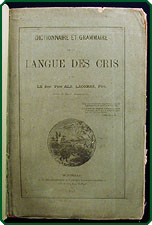
French–Cree Dictionary with GrammarLacombe, Albert. Dictionnaire de la langue des Cris. Montreal: C.O. Beauchemin & Valois, 1874. [bound with his] Grammaire de la langue des Cris. Montreal: C.O. Beauchemin & Valois, 1874. 8vo (24 cm, 9.5"). 2 pts. in 1 vol. [7] ff., [v]–xx, 711 (i.e., 709), [3 (1 blank)] pp.; fold. map; [1] f., iii, [1 (blank)], 190 pp.; fold. chart.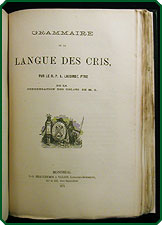
 Click the images for enlargements.
 Several bibliographies, including Pilling's Proof-sheets and Ayer, treat this as two distinct works. Indeed, the dictionary and the grammar do each have their own distinct title-pages, pagination, and signature markings. They were issued together, however, though sometimes separated for sale. The publisher’s original paper wrappers are bound into this volume.
• Pilling, Bibliography of the Algonquian Languages, 283; Newberry Library, Indian Linguistics in the Edward E. Ayer Collection, Cree-93 & Cree-9; Pilling, Proof-Sheets of a Bibliography of the Languages of the North American Indians, 2155 & 2156. Not in Vancil, Cordell Collection. Recent black moiré cloth, spine with gilt-stamped leather title-label. Wrappers (bound in) dust-soiled and with edge chips; front wrapper partially adhered to half-title and back wrapper with Grammaire half-title affixed. Map partially adhered to an additional half-title. Page edges untrimmed; pages very slightly age-toned, else clean. Pagination jumps from 708 to 711 in pt. 1, but as the word listing goes from sagamité to sagamo it seems certain that the text is complete.

 Lacombe's
Grammar
ofThis
“Beautiful”
Language
Lacombe, Albert. Grammaire de la langue des
Cris. Montréal: C.-O. Beauchemin & Valois, 1874. 8vo. [1] f., iii,
[1 (blank)], 190 pp.; fold. table.
Lacombe's
Grammar
ofThis
“Beautiful”
Language
Lacombe, Albert. Grammaire de la langue des
Cris. Montréal: C.-O. Beauchemin & Valois, 1874. 8vo. [1] f., iii,
[1 (blank)], 190 pp.; fold. table.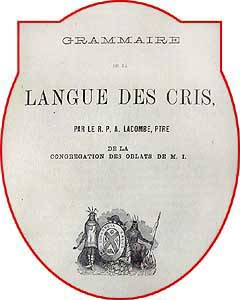
• Newberry Library, Indian Linguistics in the Edward E. Ayer Collection, Cree-95; Pilling, Algonquian, 283; Pilling, Proof-Sheets of a Bibliography of the Languages of the North American Indians, 2156; Banks 36. Not in Vancil, Cordell Collection. Modern maroon cloth with black spine and corners. Very good copy.
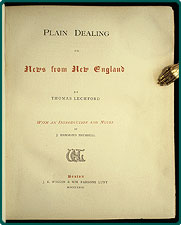
Notebook of theFirst Lawyer in Boston — The 19th-Century Reissue Lechford, Thomas. Plain dealing or news from New England. Boston: J.K. Wiggin and Wm. Parsons Lunt, 1867. 4to (cm). xl, 160, [2], 203–11, [1 (blank)] pp. (text complete despite pagination).
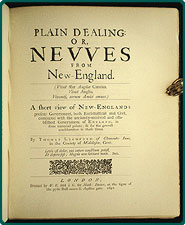
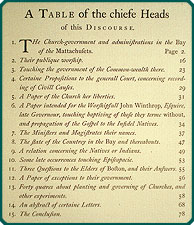 Click the interior images for enlargements. both
English and Indian in colonial New England, here with an
introduction and notes by J. Hammond Trumbull, and a facsimile of the original
London, 1642 title-page. Lechford emigrated to Boston in 1638 and became the
first practicing lawyer in what is now the U.S.
Click the interior images for enlargements. both
English and Indian in colonial New England, here with an
introduction and notes by J. Hammond Trumbull, and a facsimile of the original
London, 1642 title-page. Lechford emigrated to Boston in 1638 and became the
first practicing lawyer in what is now the U.S.
285 copies were printed; this is no. 180. The publication was dedicated to collector (“and careful reader”) George Brinley, Esq.
• Sabin 39642. Recent black moiré cloth, spine with gilt-stamped leather title-label. Several pages (including title-page) with faint shadows of institutional rubber-stamps, mostly effaced. Many signatures unopened; two index leaves with tears in upper margins from clumsy opening. Pagination shifts between text and index. (23906)
The
Road
to Heaven inNahuatl
León, Martín de. Camino del cielo en lengua mexicana, con todos los requisitos necessarios para conseguir este fin, co[n] todo lo que un Xp[r]iano deue creer, saber, y obrar, desde el punto que tiene uso de razon, hasta que muere. En Mexico: En la Emprenta de Diego Lopez Davalos, 1611. Small 4to (18.5 cm; 7.25"). Fols. 10–11, 13–69, 69[!]–73, [nothing missing] 76, 75, 77–108, 110–23.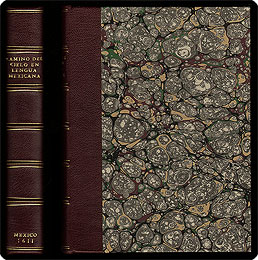
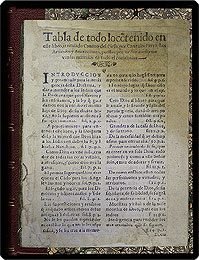
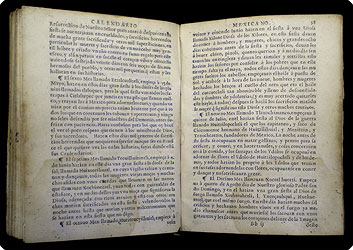 Click the images for enlargements.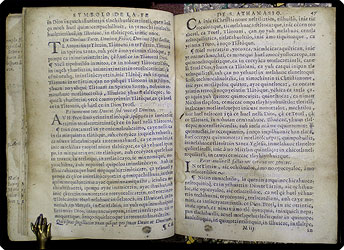
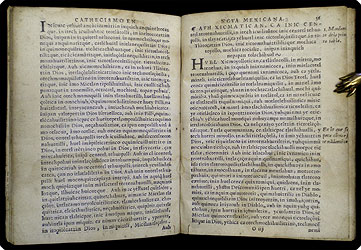
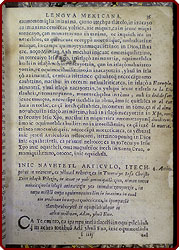
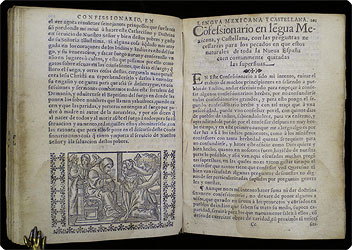
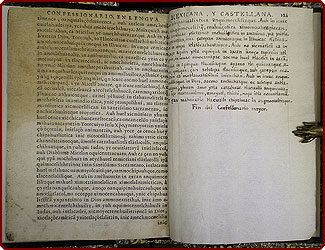 Priced much, much less than a good, complete copy; and a relic with much more than its lowered price to recommend it. (25860)
For Books for the BUSTED“Preparations
forTHE
EXPEDITION were Completed”
Lewis,
Meriwether, & William Clark. History
of the expedition under the command of Captains Lewis and Clarke, to the sources
of the Missouri, thence across the Rocky Mountains, and down the river Columbia
to the Pacific Ocean: performed during the years 1804, 1805, 1806 by order of
the government of the United States. New York: Harper & Brothers, 1842.
12mo. 2 vols. I: Frontis. map, 371, [1] pp., 2 charts, plt. II: x, [9]–395,
[1] pp., 3 charts.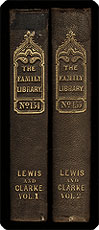
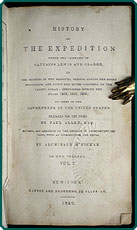
 Click the images for enlargements.
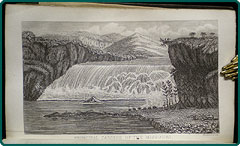
 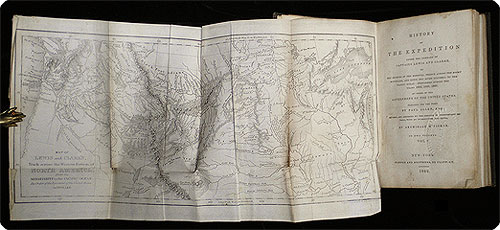 This
has a folding map, five full-page “charts,” and a lovely plate of
the Falls of the Missouri.
This
has a folding map, five full-page “charts,” and a lovely plate of
the Falls of the Missouri.
• Sabin 40833; Howes L-317. On the binding, see: Krupp, Bookcloth in England & America, 1823–50, Mis6. Publisher's brown cloth with nicely gilt-stamped spines; small strip of black tape at top of vol I. Ex–social club library: each volume with 19th-century bookplate, call number on pastedown, pressure-stamp on title-page, no other markings. Rear free endpapers of vol. I lacking; some soil and staining, more to vol. I than elsewhere, with paper strong and untattered. Both volumes sound; map, charts, and plate very nice. (26348)
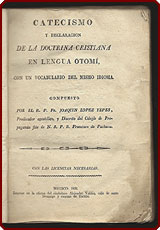
Dictionary & Catechism in OTOMÍ López Yepes, Joaquín. Catecismo y declaracion de la doctrina cristiana en lengua otomí, con un vocabulario del mismo idioma. Megico [i.e., Mexico]: Impreso en la oficina del ciudadano Alejandro Valdes, 1826. 8vo. 254 pp., [1] f.
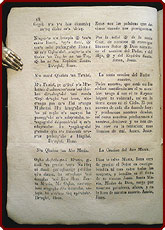
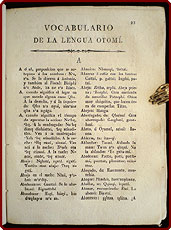 Click the interior images above for enlargements.
  More than 150 pages of this work comprise an Otomí/Spanish vocabulary. Included at the end are instructions for teaching the catechism to Indians.
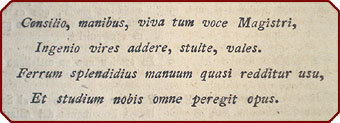
• Viñaza 420; García Icazbalceta, Apuntes, 40; Sabin 106013; Palau 142256; Pilling, Proof-sheets, 2316. Not in Newberry Library, Ayer Collection. Stitched in original wrapper; wrappers tattered, torn with some loss, and partly darkened; same for the front free endpaper and fly-leaf. Some dog-earing, and some leaves (including title) with some marginal soiling, but really, a worthwhile copy. (25558)
United
Brethren in North
AmericaLoskiel,
Georg Henrich. Geschichte der Mission der evangelischen Brüder unter
den Indianern in Nordamerika. Barby: Zu finden in den Brüdergemein, &
Leipzig: Paul Gotthelf Kummer, 1789. 8vo (19.3 cm, 7.6"). [8] ff., 783, [1] pp.
North
AmericaLoskiel,
Georg Henrich. Geschichte der Mission der evangelischen Brüder unter
den Indianern in Nordamerika. Barby: Zu finden in den Brüdergemein, &
Leipzig: Paul Gotthelf Kummer, 1789. 8vo (19.3 cm, 7.6"). [8] ff., 783, [1] pp.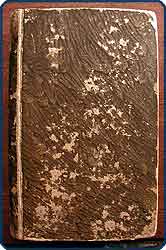
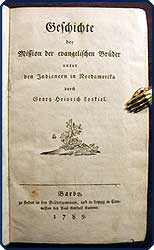 mission
work targeting Native Americans in New York, Pennsylvania,
Ohio, and surrounding regions; Sabin refers to this account as the “best
authority, both as to tradition and facts” on the Moravian efforts in
the region from 1735 through 1787. Before recounting the mission's history,
the author describes the customs, languages, and beliefs of various tribes,
along with the flora and fauna prevalent in their territories. A great deal
of Loskiel's information is taken from the accounts of Bishop Augustus Gottlieb
Spangenberg and David Zeisberger, the latter having served for over 40 years
as a missionary in North America.
mission
work targeting Native Americans in New York, Pennsylvania,
Ohio, and surrounding regions; Sabin refers to this account as the “best
authority, both as to tradition and facts” on the Moravian efforts in
the region from 1735 through 1787. Before recounting the mission's history,
the author describes the customs, languages, and beliefs of various tribes,
along with the flora and fauna prevalent in their territories. A great deal
of Loskiel's information is taken from the accounts of Bishop Augustus Gottlieb
Spangenberg and David Zeisberger, the latter having served for over 40 years
as a missionary in North America.
This first edition does not include the map found in the later English translation; the six lines of errata (rather than a full page) at the back mark the present copy as an example of the first issue.
• Howes, U.S.iana, L474; Pilling, Algonquian, 317; Sabin 42109; Vail 795. Early 19th-century German paper-covered boards, much worn and abraded, slightly cocked, spine with remnants of paper shelving label. Some corners dog-eared; scattered small spots of foxing, otherwise internally clean.
Micmac
Catechism WithIllustrations
Maillard, Antoine Simon. Le catechisme Micmac.
Ristigouche, P.Q. [Quebec]: Freres mineurs capucins, [1921]. 12mo. 128, 32 pp.; illus.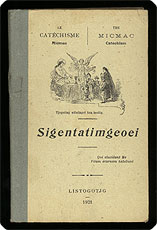
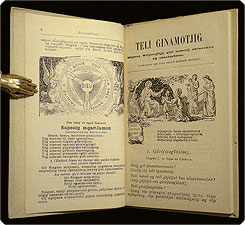 Click
the images for enlargement.
Click
the images for enlargement.
Up to p. 112, this issue is a reprint of the second edition (with the title-page labeled Deuxième edition, giving a date of 1913), after which comes a section entitled “Alasotmaganel” (rather than the “Gis Oen Melgitimg” of the actual 1913 printing). The closing section, “Gtapegiemgeoel,” is the same in both printings. The publisher's binding gives the date of 1921 on the front cover!
• Publisher's quarter cloth with printed paper-covered sides; cloth and paper showing light wear. Some offsetting and paper punctured around binding staples, otherwise a nice, even fresh copy. (12614)
Holy History & Christ’s Life, for the “Lake of Two Mountains”Mathevet, Jean-Claude. Ka titc Jezos Tebeniminang Ondaje Aking Enansinaikatek Masinaigan Ki Ojitogoban Kaiat Pejik Kanactageng Daje Mekatewikonaietc J. Cl.
Mathevet Enawindibanen. Vie de Notre-Seigneur Jésus-Christ par J. Cl. Mathevet, Ancien missionnaire du Lac des Deux-Montagnes. Deuxième édition, revue avec soin. Montréal: J.M. Valois, Libraire-Éditeur, 1892.
12mo (15.7 cm, 6.2"). xi, 384 pp.
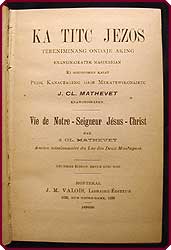
• Cf. Banks, 147; cf. Pilling, Algonquian, 345, for first (1861) ed. Not in Evans. Publisher’s cloth, with binder's title “Vie de Jésus en Algonquin”; cloth a bit wrinkled over spine and showing slight rubbing over corners, with signs of a now-absent shelf label on spine. Pages age-toned and a bit brittle as of the era, with sewing starting to loosen for some signatures. Back free endpaper with portion of upper margin torn and affixed to back pastedown.

WONDERFUL
Culs-de-Lampe by
Villavicencio
& NavarroMexico
(ecclesiastical province). 1st & 2nd Concilia (1555, 1565).
Concilios provinciales primero, y segundo, celebrados en la muy noble,
y muy leal Ciudad de México, presidiendo el Illmo. y Rmo. Señor
D. Fr. Alonso de Montúfar, en los años de 1555, y 1565. En México:
En la Imprenta de el Superior Gobierno, de el Br. D. Joseph Antonio de Hogal,
1769. Folio (27 cm; 10.5"). [10], 34, [2], 35–38, 41–184, [2], 185–396,
[12] pp.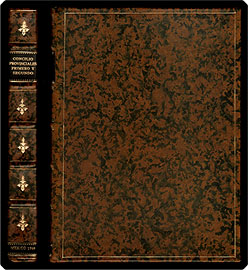
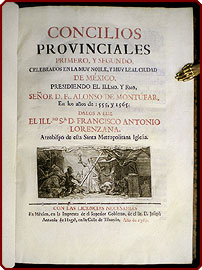
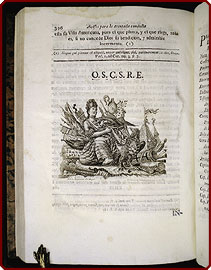
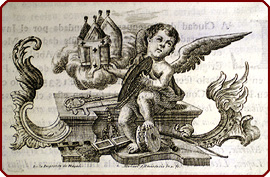
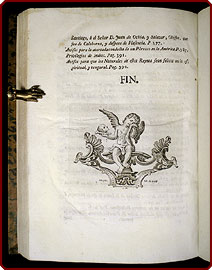
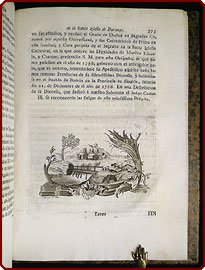 Click the images for enlargements. This text is from the press of José Hogal,
who is often called the Baskerville of Mexico.
Click the images for enlargements. This text is from the press of José Hogal,
who is often called the Baskerville of Mexico.
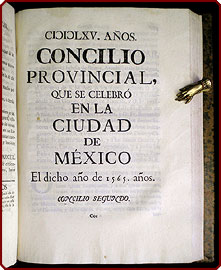
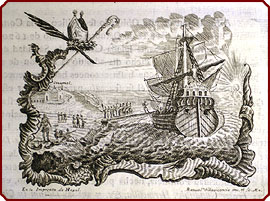
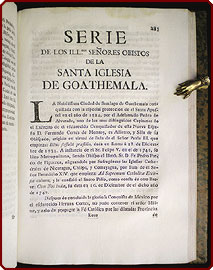
 most
curiously prohibiting Indians from owning collections of sermon and Bibles.
most
curiously prohibiting Indians from owning collections of sermon and Bibles.
The force behind this edition was archbishop Francisco Antonio Lorenzana (1722–1804), a patron of Hogal's press and of the arts, who soon after assuming the archbishopric of Mexico in 1766 saw the need for a concilium. In preparation for it he paid Hogal to publish or republish, as was the case, the acts of the first three provincial councils of Mexico, held respectively in 1555, 1565, and 1585; these appeared in 1769 and 1770. In 1771 he himself held the fourth Mexican provincial synod; ironically, those acts were not published until 1898.
• Medina, Mexico, 5299; Palau 142387; Sabin 42063.
Recent Spanish sheep mottled in the Valenciana style. Occasional light waterstain
in some upper margins, never in text. Paper crisp and printing very sharp.
 A
very good copy. (26797)
A
very good copy. (26797)
Indians
Pay HalfMexico (Viceroyalty). Royal Audiencia. [drop-title] Aranzel de el tassador, y repartidor, y porteros de la Real Audiencia, y Sala del Crimen de esta Corte. [colophon: Reimpresso en Mexico: Impr. de la Bibliotheca Mexicana, 1759]. Folio. 6 pp. 
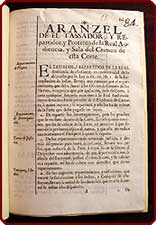
• Medina, Mexico, 4536. In recent wrappers; irregular along inner margins. (10743)
 MEXICO being one of PRB&M's specialties, we offer a
 To see an
array, click here and browse!
To see an
array, click here and browse!
“Muy
Rara”
Neve
y Molina, Luis de. Reglas de orthographia,
diccionario, y arte del idioma othomi. Mexico: Bibliotheca Mexicana, 1767. Small
8vo (14.5 cm, 5.75". [12] ff., 160 pp., engr. leaf of errata (frontis. supplied
in facsimile).

 Click the images for enlargements.
 • Medina, Mexico, 5174; García Icazbalceta, Lenguas,
55; Viñaza 356; Maggs, Bibl. Amer., II, 2154; Sabin 52413; Palau
190159. Original limp vellum, cockled and a little shrunken, upper
front edge chipped, original ties partially surviving. Ex-AAS with its attractive
bookplate (properly deaccessioned); private ownership stamp on title-page
and one other. Lacks the very rare engraved frontispiece; a facsimile reproduction
was inserted some time ago and is now loose. Text block separating from spine.
Title-leaf torn, taking a bit of border, and next leaf same with first letters
of three lines on verso taken; errata plate opposite p. 12 shaved at fore-edge,
with loss to line (not page) references. A bit of thread-like worming, without
text destruction, towards end. Overall clean. Not a pristine, but certainly a good copy of an
important and scarce book. (2154)
Nahuatl Instruction Manual — A Nahuatl Sermon onthe Virgin of Guadalupe Paredes, Ignacio de. Promptuario manual mexicano. Mexico: Impr. de la Bibliotheca Mexicana, 1759. Small 4to (20.5 cm; 8"). [22] ff., 378 (of 380), 90 pp., lacks the engr. frontis., and one text leaf.

 Click the images for enlargements. At the end, in Nahuatl, is a sermon on the Virgin of Guadalupe incorporating the history of Her apparition.
The detailed title-page and beautiful full-page woodcut coat of arms are present. The printer has also employed various handsome woodcut head- and tailpieces at different points in the text.


 For Books for the BUSTED
Romance in the Wilds ofKentucky Paulding, James Kirke. Westward ho! A tale. New
York: J. & J. Harper, 1832. 12mo (18.4 cm, 7.25"). 2 vols. I: 203, [1] pp. II: 196, [8 (adv.)] pp.
 Click the images for enlargements.
 Part of the “Harper's library of select novels” series, the work appears here with vol. I in the second printing (vol. II had only one printing); the binding is BAL's state A, with the front cover of vol. II incorrectly marked “No. XXV.”
• American Imprints 14120; Wright, I, 2024; BAL 15715. Publisher's green cloth, covers and spines stamped in black; corners bumped, spots of discoloration, spines sunned (and a little bubbled) with extremities rubbed. Ex–social club library: 19th-century bookplate and call number on endpapers, title-pages pressure-stamped. No other markings; endpapers foxed and pages with intermittent moderate spotting. (26533)
The Land & Indian Problems Pimentel, Francisco. Memoria sobre las causas que han originado la situacion actual de la raza indígena de México, y medios de remediarla. Mexico: Impr. de Andrade y Escalante, 1864. 8vo. 241, [1] pp., [1] f. [with the same author's] La economía política aplicada a la propiedad territorial en México. México: Imprenta de Ignacio Cumplido, 1866. 8vo. 265, [1 (blank)] pp., [1] f.

 Click the interior images for enlargements.
WORLD MYTHOLOGY — 8 Vols. & Thousands of Entries Pozzoli, Giovanni; Felice Romani; Antonio Peracchi, et al. Dizionario storico-mitologico di tutti i popoli del mondo. Livorno: Stamperia Vignozzi, 1824–28. 8 vols. 8vo (21 cm, 8.25"). I: 580 pp. II: 581–1163, [1] pp. (pp. 1057–64 repeated in place of pp. 1065–72). III: [1165]–1708 pp. (pagination 1551–52 repeated, 1687–88 skipped). IV: [1709]–2342 pp. V: 2351–3086 pp. (pagination skips 2519–26). VI: 3087–3855 pp. (pagination skips 3407–08). VII: 576 pp. VIII: 577–1074 pp.

 Click the middle and right hand-images for enlargements. America,
Africa, India, Japan, China, etc, along with Jewish, Greek, and Roman antiquities.
The foundation of the work was François Noel's Dictionnaire de la
Fable; copious additions and corrections were made by Pozzoli, Romani (the
famed poet, scholar, and librettist for La Scala), and Peracchi (another librettist).
The resulting encyclopedic endeavor was originally published from 1809–27
under the title Dizionario d'ogni mitologia e antichità incominciato,
according to Graesse and Brunet, who both give Pozzoli's first name as Girolamo.
Click the middle and right hand-images for enlargements. America,
Africa, India, Japan, China, etc, along with Jewish, Greek, and Roman antiquities.
The foundation of the work was François Noel's Dictionnaire de la
Fable; copious additions and corrections were made by Pozzoli, Romani (the
famed poet, scholar, and librettist for La Scala), and Peracchi (another librettist).
The resulting encyclopedic endeavor was originally published from 1809–27
under the title Dizionario d'ogni mitologia e antichità incominciato,
according to Graesse and Brunet, who both give Pozzoli's first name as Girolamo.
This set includes two volumes of supplemental text, adding a number of entries. The first edition was followed by two volumes of supplemental plates, not present here and not called for: Graesse describes this edition as “sans grav.”
The pagination is erratic in a number of places; there is a numbering gap from 2342 to 2351 between vols. IV and V, but the text and signatures are uninterrupted.
Uncommon: OCLC locates only two U.S. institutional holdings of this second edition.
Provenance: Most volumes with small inked ownership inscription in an outer margin: “G.R.W.” the mark of William Rollinson Whittingham (1805–79), fourth Episcopal Bishop of Maryland and an enthusiastic book collector.
• Brunet, IV, 851; Graesse, V, 429. Not in Sabin. Contemporary half binding, recently rebacked with tan paper, spines with printed paper labels; boards rubbed and faded with small chips, one vol. with front cover waterstained. Foxing almost throughout, generally no worse than moderate; light waterstaining in upper margins of vol. I; one leaf in vol. VII with lower outer portion torn away, with loss of words from about 18 lines on each side. Vol. II with printer's error replacing pp. 1065–72 with duplicates of pp. 1057–64; pagination erratic in other places. Most vols. with ownership mark as above; vol. VI with one pencilled and one inked marginal annotation. (25862)
FirstU.S. Edition, First IssuePrescott, William H. History of the conquest of Peru, with a preliminary view of the civilization of the Incas. New York: Harper & Bros., 1847. 8vo (24.3 cm, 9.55"). 2 vols. I: Frontis., xl, [1], 527, [1] pp.; 1 map. II: Frontis., xix, [1], 547, [1] pp.; 1 plt.

• BAL 16346; Gardner P-7; Sabin 65272. Publisher’s blind-stamped cloth, spines with gilt-stamped titles; sunned and with small spots of discoloration, spines each showing traces of a now-absent shelving label. Front pastedowns each with private collector’s bookplate, institutional rubber-stamp, and speckled show-through of binder’s glue. Light to moderate foxing throughout.
For more SETS, click here.
Catholic Catechism in Aztec — First Edition — Excellent Provenance Ripalda, Gerónimo. Catecismo mexicano. Mexico: Impr. de la Bibliotheca Mexicana, 1758. 16mo. [17] ff., 170 pp., [1] f.


 Click the images for enlargements.
 Beristain describes Paredes as being “outstanding in the Mexican language.” His volume was intended for use by missionaries, by parish priests, and by Indians: Indeed, there is a prologue intended to persuade Indians in particular to read and learn this catechism.


Provenance: Henry Ward Poole ownership signature in minute pencil on rear free endpaper, dated Mexico 1879; old paper auction label at top of spine with lot number; private ownership stamp and bookplate of John Carter Brown; later in the John Carter Brown Library, Providence; deaccessioned.
• Garcia Icazbalceta, Lenguas, 56; Viñaza 341; H. de León-Portilla, Tepuztlahcuilolli, 2286; Palau 269110; Medina, Mexico, 4500; DeBacker-Sommervogel, VI, 210–211; Sabin 71488; Leclerc 2334; Pilling, Proof-sheets, 2891. 19th-century Mexican acid-stained calf, gilt roll of a rope design on boards; gilt spine extra; spine label defective and missing much leather. Title-pages closely cropped at foremargin not costing any letters; small piece torn from the frontispiece. Light to moderate waterstaining and light wear. A rather decent copy of a decidedly important work. (26388)
For theCatholic Mohawk 1865Roman Catholic Church. Liturgy and Ritual. Mohawk. Tsiatak Nihono8entsiake onk8e on8e Akoiatonsera... le Livre des Sept Nations ou Paroissien Iroquois, auquel on a ajouté, pour l'usage de la mission du Lac des Deux-Montagnes, quelques cantiques en langue Algonquine. Tiohtiake [Montréal]: John Lovell, 1865. 12mo (18.5 cm, 7.25"). [6], [6 (blank leaves with decorative borders)] ff., 460 pp.
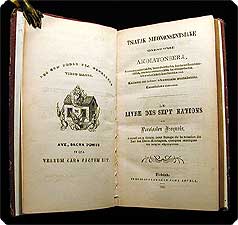 Click the image to the left
 Provenance: Inscribed in 1891 to W.D. Lighthall, prominent citizen of and author of Hochelagans and Mohawks: A Link in Iroquois History, by George S. Wilson.
• TPL 9325; Banks, 109; Pilling, Iroquian, 50; Calderisi, 16. Contemporary roan, rebacked; abrasions along edges. Half-title with short tear at binding and with pencilled inscription as above. Tear at foremargin of one blank leaf; pp. 274–75 with small area of adhesion.
 TO Part
VI
TO Part
VI |