 MEXICO - UNA PIÑATA BIBLIOGRÁFICA
Una de nuestras especialidades mayores - If you collect in this area, let us know!
MEXICO - UNA PIÑATA BIBLIOGRÁFICA
 For
a separate list of additional 19th-Century Mexicana, click
here. For
a separate list of additional 19th-Century Mexicana, click
here. NOW, ILLUSTRATED! NOW, ILLUSTRATED!
|
 He
Survived “La Noche
Triste”
& Much, Much
More
He
Survived “La Noche
Triste”
& Much, Much
More THE
CONQUEROR'S REWARD
THE
CONQUEROR'S REWARD
 (A
#1 FLAT-OUT STUNNER). Felipe
II, King of Spain.
Illuminated Document Signed (on his behalf by his sister/regent, “La Princesa”).
In Spanish, on vellum. Valladolid, 17 March 1559. Folio (58 x 54.5
cm; 23" x 21.5"; h x w), 1 leaf.
(A
#1 FLAT-OUT STUNNER). Felipe
II, King of Spain.
Illuminated Document Signed (on his behalf by his sister/regent, “La Princesa”).
In Spanish, on vellum. Valladolid, 17 March 1559. Folio (58 x 54.5
cm; 23" x 21.5"; h x w), 1 leaf.  |
|
|
|
|
|
|
|
|
|
|
|
|
|
|
|
 |
|
||||||||||||||
 |
 |
 |
 |
 |
 |
 |
|
||||||||
 |
|
||||||||||||||
 |
|
||||||||||||||
 |
 |
|
|||||||||||||
 |
 |
|
|||||||||||||
 |
 |
|
|||||||||||||
 |
 |
|
|||||||||||||
 |
|
||||||||||||||
 |
 |
 |
 |
|
|||||||||||
 |
 |
 |
 |
|
|||||||||||
 |
|
||||||||||||||
 |
 |
|
|||||||||||||
 |
 |
|
|||||||||||||
 |
|
||||||||||||||
 |
 |
|
|||||||||||||
 |
 |
|
|||||||||||||
 |
|
||||||||||||||
 |
|
||||||||||||||
 |
|
||||||||||||||
 Move
your mouse over the document above, and click,
Move
your mouse over the document above, and click,
to select and view details.
 Villanueva
was among the small but grand “army” that marched into Tenochtitlán
in the Spring of 1520 and in July of the same year were to flee the
western world's largest city fighting for their lives, on the “Noche
Triste.” He survived the hell and slaughter of the causeways and later
returned with the greatly augmented force that destroyed the Aztec capital
and its empire. Still later he was with Cortés in the exploration
and conquest of Pánuco and following that with Nuño de
Guzmán in the exploration and conquest of Zacatecas and Jalisco.
He and his brother Fernando (also a member of the Saucedo contingent)
jointly received an encomienda (Quechula) and settled in Puebla
de los Angeles where Pedro served as a regidor on the town
council in the 1540s and 1550s.
Villanueva
was among the small but grand “army” that marched into Tenochtitlán
in the Spring of 1520 and in July of the same year were to flee the
western world's largest city fighting for their lives, on the “Noche
Triste.” He survived the hell and slaughter of the causeways and later
returned with the greatly augmented force that destroyed the Aztec capital
and its empire. Still later he was with Cortés in the exploration
and conquest of Pánuco and following that with Nuño de
Guzmán in the exploration and conquest of Zacatecas and Jalisco.
He and his brother Fernando (also a member of the Saucedo contingent)
jointly received an encomienda (Quechula) and settled in Puebla
de los Angeles where Pedro served as a regidor on the town
council in the 1540s and 1550s.

 The
text of the grant of arms is elegantly indited in a standard court
semi-round gothic in sepia ink and is enclosed on the left, right, and top
sides by an illuminated and historiated sash-like border. In the upper
left and right corners are miniatures of Justice and Knowledge in sylvan settings.
Running between those two along the top of the document is a decorative panel
incorporating flowers, fruits, mythic animals, and cherubs. Below this,
the king's name is accomplished in large letters of gold on a field of red
accented with gold, and the “D” of his honorific “Don”
is given special treatment. This is elaborated in an ornate, almost
baroque style that comes close to obfuscating the fact of its being a majuscule
“d”: Wrought in gold, the letter at first appears to be
merely a “frame” for the royal coat of arms that fills its center.
The king's arms are accomplished in gold, white, black, red, and blue; the
whole being laid on a blue field with white accents.
The
text of the grant of arms is elegantly indited in a standard court
semi-round gothic in sepia ink and is enclosed on the left, right, and top
sides by an illuminated and historiated sash-like border. In the upper
left and right corners are miniatures of Justice and Knowledge in sylvan settings.
Running between those two along the top of the document is a decorative panel
incorporating flowers, fruits, mythic animals, and cherubs. Below this,
the king's name is accomplished in large letters of gold on a field of red
accented with gold, and the “D” of his honorific “Don”
is given special treatment. This is elaborated in an ornate, almost
baroque style that comes close to obfuscating the fact of its being a majuscule
“d”: Wrought in gold, the letter at first appears to be
merely a “frame” for the royal coat of arms that fills its center.
The king's arms are accomplished in gold, white, black, red, and blue; the
whole being laid on a blue field with white accents.

The panels running down the left and right
sides of the document are accomplished in red, gold, green, pink, white, red,
blue, and brown, many in several shades. The decoration includes birds
of several varieties including a fine owl, animals including a watchful rabbit,
strawberries and other fruits, and flowers, ribbons, grotesques, and butterflies.

The document is signed in the king's name by Juana (Joanna Habsburg) de Austria,“princesa de Portugal.” Married to Prince Juan of Portugal, young Juana (b. 1537) was the regent of the Spanish crown from 1554 until her brother Philip's return to Spain in September of 1559. She had just lost her husband to death and borne his posthumous son, both in January, 1554, when she left Portugal and her child in the Spring of that year to assume the regency throne in Valladolid.

 In
format and content this document differs dramatically from the cartas executorias
de hidalguía that most collectors are familiar with. Here we have a
In
format and content this document differs dramatically from the cartas executorias
de hidalguía that most collectors are familiar with. Here we have a  single
large sheet of vellum handsomely engrossed, artfully
illuminated, and exquisitely decorated with a composite border containing
miniatures. This is not a bound volume of copies of documents created
for storage in the family archive.
single
large sheet of vellum handsomely engrossed, artfully
illuminated, and exquisitely decorated with a composite border containing
miniatures. This is not a bound volume of copies of documents created
for storage in the family archive.  This was created for display
in a prominent place of honor; and it is a magnificent display item.
This is not a grant of nobility nor a confirmation of it based on something
that some vague ancestor did; rather it is a grant of a coat of arms to a
man who himself performed significant military and other service for the Crown
and whom the Crown wishes to honor both publicly and privately. Only
a few hundred of Cortés's men survived the Noche Triste, the
reentry into and destruction of Mexico City, and the subsequent conquests
in Panuco and elsewhere. The number of grants such as this to actual
members of Cortés's original “army” were few.
This was created for display
in a prominent place of honor; and it is a magnificent display item.
This is not a grant of nobility nor a confirmation of it based on something
that some vague ancestor did; rather it is a grant of a coat of arms to a
man who himself performed significant military and other service for the Crown
and whom the Crown wishes to honor both publicly and privately. Only
a few hundred of Cortés's men survived the Noche Triste, the
reentry into and destruction of Mexico City, and the subsequent conquests
in Panuco and elsewhere. The number of grants such as this to actual
members of Cortés's original “army” were few.
 And surviving grants to those
actual participants in the Conquest are extremely rare, even more so in commerce.
And surviving grants to those
actual participants in the Conquest are extremely rare, even more so in commerce.
 This
is the only royal grant of a coat of arms to an actual member of Cortés's
“army” that we have seen that has ever appeared in the marketplace.
Via published auction records and our extensive archive of dealer catalogues,
we trace no instance before this one of the offering for sale of a grant of
arms to a Conqueror of Mexico. Yes, there are examples in various libraries
and museums in Mexico and Spain, and probably in the U.S., but such examples
seem to have entered their institutional resting places via donation from
descendants of Conquerors, not via purchase.
This
is the only royal grant of a coat of arms to an actual member of Cortés's
“army” that we have seen that has ever appeared in the marketplace.
Via published auction records and our extensive archive of dealer catalogues,
we trace no instance before this one of the offering for sale of a grant of
arms to a Conqueror of Mexico. Yes, there are examples in various libraries
and museums in Mexico and Spain, and probably in the U.S., but such examples
seem to have entered their institutional resting places via donation from
descendants of Conquerors, not via purchase.

Provenance: It
is awesome to realize that this is no mere retained secretarial copy of Felipe's
grant of arms to Pedro de Villanueva. This gorgeous document not only
records the king's rewards to one of Cortés's men, but was that Conqueror's
personal property. It is the copy of the decree sent to him expressly,
by the Crown!

• On Villanueva, see: Icaza, Diccionario autobiográfico
de conquistadores y pobladores de la Nueva España, I, 88–89;
Thomas, Who's Who of the Conquistadors, 146; Himmerich y Valencia,
The Encomenderos of New Spain, 1521–1555, 262; Díaz
del Castillo, Verdadera historia de la conquista de la Nueva España,
chap. LIII. On Juana de Austria, see: the work of Dr. Kelli Ringhofer.
Overall in very good condition. Some fold tears, some minor rubbing
of small areas of images, stains as visible in our illustrations. The
wax seal and its silk cords no longer present.  Text
clear, not faded, and colors strong.
Text
clear, not faded, and colors strong.
 To review the pictures of
this document more systematically than
To review the pictures of
this document more systematically than
 This entry is repeated in the
 Cortés'
Second Letter:
The Conquest
of Mexico
Cortés'
Second Letter:
The Conquest
of Mexico
 (A
LANDMARK). Cortés, Hernando,
& Peter Martyr. Praeclara
Ferndinandi Cortesii De Nova Maris Oceani Hyspania Narratio. [colophon: Impressa
in Nurimberga: per Fridericum Peypus], 1524. Folio (30.3 cm; 11.875" ). [4],
49, 12 leaves.
(A
LANDMARK). Cortés, Hernando,
& Peter Martyr. Praeclara
Ferndinandi Cortesii De Nova Maris Oceani Hyspania Narratio. [colophon: Impressa
in Nurimberga: per Fridericum Peypus], 1524. Folio (30.3 cm; 11.875" ). [4],
49, 12 leaves.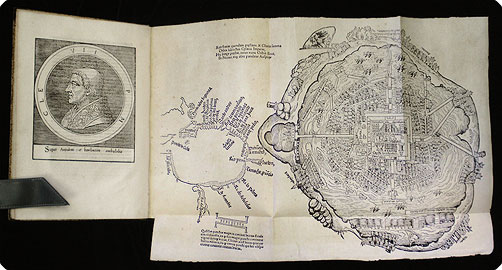
 Click the images for enlargements.
  Cortés was the first conqueror since Julius
Caesar to write a description of his conquests.
Cortés was the first conqueror since Julius
Caesar to write a description of his conquests.
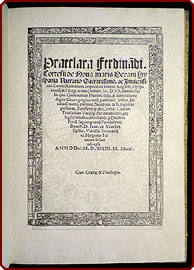 It
is here that Cortés provides a definitive name for the country,
calling it “New Spain of the Ocean Sea.” This letter
is also important for making reference to Cortés's “lost”
first letter, supposedly composed at Vera Cruz on 10 July 1520. Whether that
letter was actually lost or was suppressed by the Council of the Indies is unknown,
though there is little doubt it once existed.
It
is here that Cortés provides a definitive name for the country,
calling it “New Spain of the Ocean Sea.” This letter
is also important for making reference to Cortés's “lost”
first letter, supposedly composed at Vera Cruz on 10 July 1520. Whether that
letter was actually lost or was suppressed by the Council of the Indies is unknown,
though there is little doubt it once existed.
 It
is the text of this “second” letter, THE FIRST SURVIVING
ONE, that was the first major announcement to the world of the discovery
of major civilizations in the New World — and, as such, is a work of surpassing
importance.
It
is the text of this “second” letter, THE FIRST SURVIVING
ONE, that was the first major announcement to the world of the discovery
of major civilizations in the New World — and, as such, is a work of surpassing
importance.
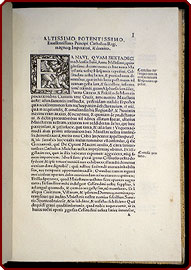
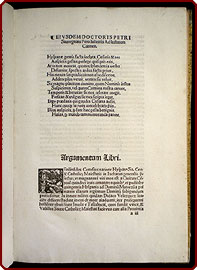
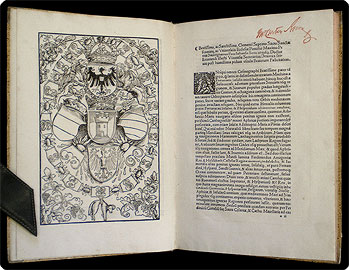
This copy bears the full-page woodcut portrait of Pope Clement VII on the verso of the fourth preliminary leaf, which is not found with all copies. Additionally, the title-page bears an interesting 14-piece composite woodcut border and the verso of that page has a stunning full-page woodcut of the coat of arms of Charles V, the Holy Roman emperor, to whom the letter is addressed. The coat of arms is surrounded by the collar of the Order of the Golden Fleece. The text is printed in roman with side- and shouldernotes; the lay-out is elegant and there is one large, handsome woodcut initial.
As usual, the letter is here bound with Peter Martyr's De Rebus, et insulis noviter repertis, which provides an account of the recently discovered islands of the West Indies and their inhabitants. It is often considered a substitute for the lost Cortés letter.
One of the most important early descriptions of Mexico and of the first encounter
of the West with the Aztec civilization, this is a work of bedrock importance
to the New World. No
complete copy has appeared for sale since 1985.
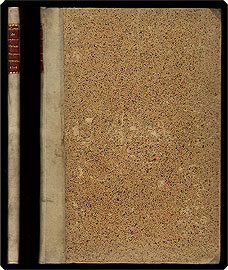
• Alden & Landis, European Americana, 524/5; Sabin 16947; Harrisse, BAV, 125. Sanz 933–34; Medina, BHA, 70; Church 53; Burden 5; JCB, German Americana, 524/4; Streeter Sale 190. 18th-century half vellum and sprinkled paper over boards, gilt red leather label. Map supplied in expert facsimile; blank leaf H8 lacking. Bookplate of John Carter Brown (Library) on front pastedown, with deaccession stamp. Occasional very minor soiling in the text, else very good — a copy clean and even crisp. (26808)
This entry is repeated in the
Full
Set of Her Works,
IncludingVillancicos
in Nahuatl &
an African Language
(&
a WORTHY FOLLOW-UP to the Above)!
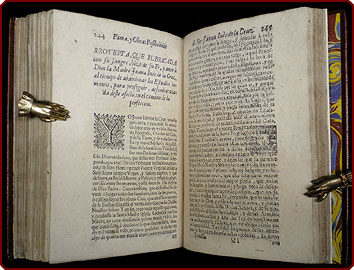
Cruz, Juana Inés de la, Sister.
Poemas de la unica poetisa americana, musa dezima, Soror Juana Ines de la Cruz
... Tercera edicion, corregida, y añadida por su authora. [with others,
as below]. Barcelona: por Joeph Llopis, 1691. 4to (21 cm; 8.25"). [8] ff.,
426 pp., [5] ff. [with the same author's] Segundo tomo de las obras de
Soror Juana Ines de la Cruz. Madrid: Impr. de Angel Pasqual Rubio, 1725. 4to
(20 cm; 8"). [4] ff., 438 pp., [3] ff. [with the same author's] Fama,
y obras posthumas del fenix de Mexico, dezima musa, poetisa americana. Madrid:
Impr. de Angel Pasqual Rubio, 1725. 4to (20 cm; 8"). [10] ff., 352 pp., [2]
ff.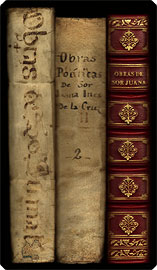
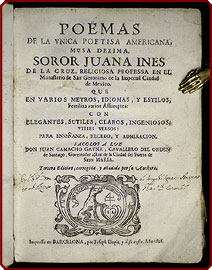
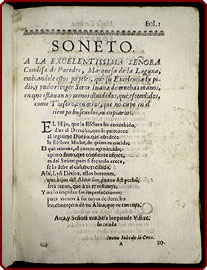
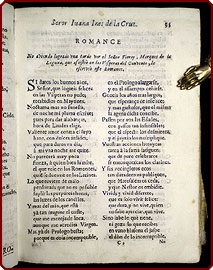 Click the images for enlargements.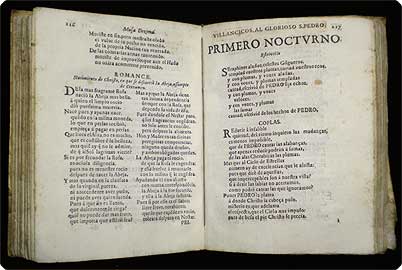
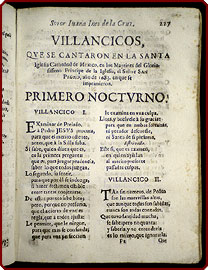
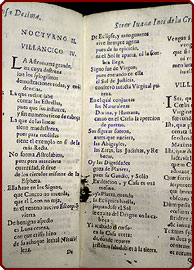 For
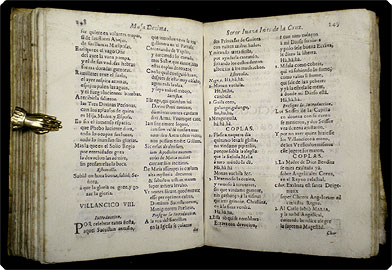
a sense of her range of subjects, click to enlarge our images.
She invented a decasyllabic meter and cultivated dramatic poetry: Among
her works are sonnets, redondillas, décimas, villancicos,
and plays, as well as prose works, including the famous Carta athenagorica
in which she criticizes the great Luso-Brazilian preacher and defender of the
Brazilian Indians, Antônio Vieira. The contents here are mostly Spanish-language,
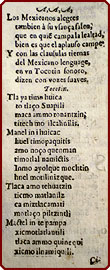
but some portions are in Latin — and a few, as is seldom recognized, are
in the black language of “Guinea” (e.g., Villancico VIII
of the “Villancicos que se cantaron en la Sta. Iglesia Metropolitana de
Mexico en honor de Maria Santissima Madre de Dios . . . y se imprimieron año
de 1679") or in Nahuatl (e.g., Villancico V of the “Villancicos
que se cantaron en la Santa Iglesia Metropolitana de Mexico, en honor de Maria
Santissima Madre de Dios . . . año de 1687, en que se imprimieron”).
For
a sense of her range of subjects, click to enlarge our images.
She invented a decasyllabic meter and cultivated dramatic poetry: Among
her works are sonnets, redondillas, décimas, villancicos,
and plays, as well as prose works, including the famous Carta athenagorica
in which she criticizes the great Luso-Brazilian preacher and defender of the
Brazilian Indians, Antônio Vieira. The contents here are mostly Spanish-language,
but some portions are in Latin — and a few, as is seldom recognized, are
in the black language of “Guinea” (e.g., Villancico VIII
of the “Villancicos que se cantaron en la Sta. Iglesia Metropolitana de
Mexico en honor de Maria Santissima Madre de Dios . . . y se imprimieron año
de 1679") or in Nahuatl (e.g., Villancico V of the “Villancicos
que se cantaron en la Santa Iglesia Metropolitana de Mexico, en honor de Maria
Santissima Madre de Dios . . . año de 1687, en que se imprimieron”).
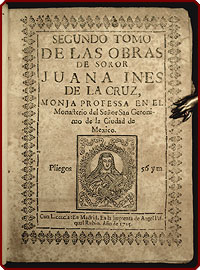
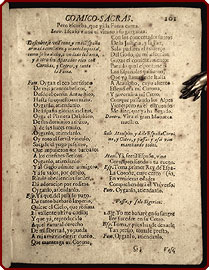
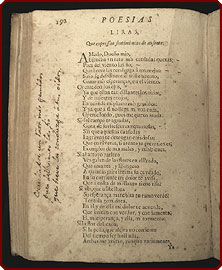
 In
the offering here, vol. I was printed during the great poet's lifetime, and
is one of the last to hold that distinction.
In
the offering here, vol. I was printed during the great poet's lifetime, and
is one of the last to hold that distinction.
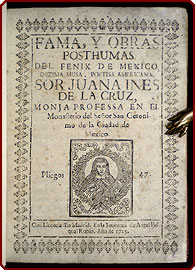
 With slight faults only, this is a handsome set
of this major writer's works. (26753)
With slight faults only, this is a handsome set
of this major writer's works. (26753)


 The Andrade Set inQuarter Red Morocco Barcía, Andrés González de. Ensayo cronologico, para la historia general de la Florida. Madrid: Imprenta de los Hijos de Doña Catalina Piñuela, 1829. 12mo. 2 vols. I: [2] ff., 508 pp., fold. table. II: [2] ff., 512 pp.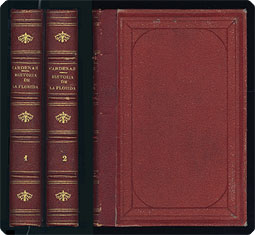
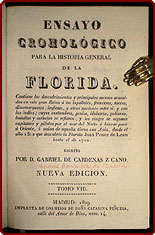
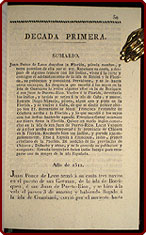
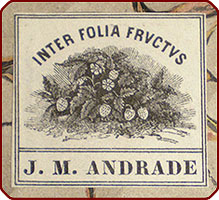 Click the page-images for enlargements.
 The present edition forms volumes 8 and 9 of the series Historia de la conquista del Nuevo Mundo.
Provenance: Bookplate of the great 19th-century Mexican collector J. M. Andrade on the front pastedown of each volume.
• This edition not in Sabin. 19th-century quarter red morocco with red textured cloth sides. Spine with raised bands and very good gilt tooling including center devices in spine compartments. Interiors clean. A very good set. (25271)
 A
A 17th-Century
Puebla
ImprintBarcia y Zambrana, José de. Epistola exhortatoria en orden a que los predicadores evangelicos no priven de la doctrina a las almas en los sermones de fiestas. Puebla: Impr. de D. Fernandez de Leon, 1693. Small 4to. [3] ff., 106 pp.
17th-Century
Puebla
ImprintBarcia y Zambrana, José de. Epistola exhortatoria en orden a que los predicadores evangelicos no priven de la doctrina a las almas en los sermones de fiestas. Puebla: Impr. de D. Fernandez de Leon, 1693. Small 4to. [3] ff., 106 pp. 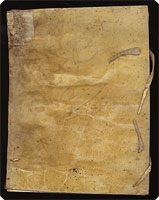
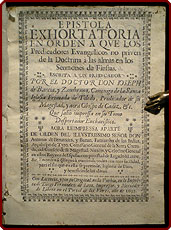
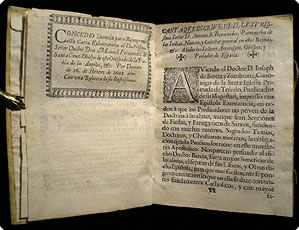
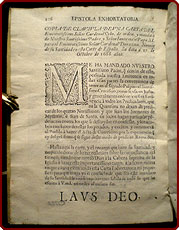 Click the interior images for enlargements.
 Uncommon: We locate five copies in the U.S.
• Medina, Puebla, 159. Contemporary limp vellum with ties. Front hinge (inside) partially open and old repair to top of spine; text block starting to separate from binding, but still strong. Large private ownership stamp on front free endpaper. Unidentified marca de fuego on top edge. In all, a decent copy. (25111)

 Very
Neat Printing — The Bishop Reports (&
Reminds) Belaunzarán
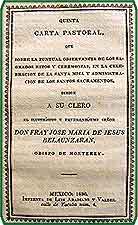
y Ureña, José María de Jesús. Cuarta carta
pastoral, que...dirige a su clero y diocesanos, en el regreso a su santa iglesia
de Monterey [sic]. Mexico: Impr. de Luis Abadiano y Valdes, 1836. 8vo.
19 pp.
Very
Neat Printing — The Bishop Reports (&
Reminds) Belaunzarán
y Ureña, José María de Jesús. Cuarta carta
pastoral, que...dirige a su clero y diocesanos, en el regreso a su santa iglesia
de Monterey [sic]. Mexico: Impr. de Luis Abadiano y Valdes, 1836. 8vo.
19 pp. 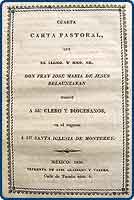
• Removed from a nonce volume. Clean, nice.

$100.00
• A call for attention to detail in the celebration of mass and other clerical duties and obligations.
• Removed from a nonce volume. Clean and nice.

The
$100.00
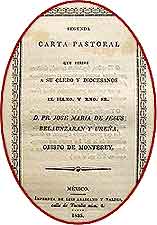
• Concerns the influx of Protestant theological and doctrinal publications.
• Removed from a nonce volume. Light stain in upper outer corners, and on title-page (only) in an additional few places. Still, a crisp, good copy.
$100.00
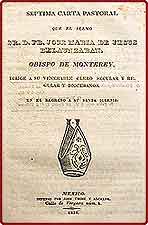
• Talks of how hard it is to be a Mexican because of the endless round of war, hunger, and turmoil, and of the need to be strong in one’s religion.
• Removed from a nonce volume. Light foxing in some upper margins. Crisp.
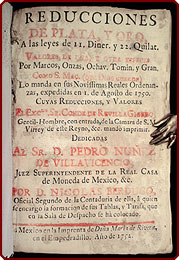
Gold & Silver Conversion Tablesthe Press of a Woman Printer Berdugo, Nicolás. Reducciones de plata, y oro a las leyes de 11. diner. y 22. quilat. valores de una y otra especie por marcos, onzas, ochav. tomin. y gran. como S. Mag. (que Dios guarde) lo manda en sus novissimas reales ordenanzas, expedidas en 1. de agosto de 1750. Cuyas reducciones, y valores el Excmo. Sr. Conde. de Revilla Gigedo ... mandò imprimir. Mexico: Impr. de Doña Maria de Rivera, 1752. Small 8vo (14.8 cm; 5.875"). [15] ff., 324 pp.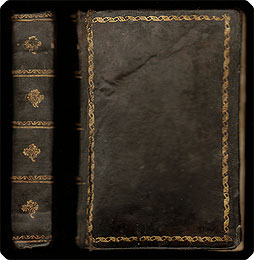
 Click the images for enlargements.
 The work was absolutely essential for all merchants and other business people, and for government workers in the treasury department — for milled coins were the exception in Mexican commerce, cob pieces the norm, and raw gold and silver, including dust, were extremely common.
The volume ends with the “Reglas varias, para sacar juntos, o separados en pasta, o en moneda los reales derechos, que se pagan a S. Mag. De el oro y de la plata, y para reducir a toda su ley estos metales.”
An uncommon economic work: We trace fewer than nine copies in the U.S.
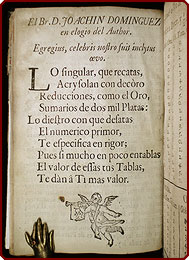
This was printed by Doña Maria de Rivera with a red and black title-page, and with woodcut arms on first dedication page. The charming cut of a herald cherub appears after the decima dedicated to the author at the end of the preliminaries.
• Medina, Mexico, 4073. Contemporary full Mexican calf, modestly tooled in gilt and with all edges red; recased, new endpapers. Final two leaves little ragged at edges costing a few letters and with small hole at center and short tears at inner margin; old staining and age-toning/browning throughout. There is every indication that this well-produced little volume saw time “in the field”! (26850)
“Genuine Specimens of Native Literature”Maya & English Presentations — With Notes Brinton, Daniel Garrison, ed. The Maya chronicles. Philadelphia: D.G. Brinton, 1882. 8vo (24 cm, 9.4"). [2], 279, [1] pp.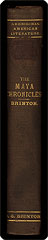
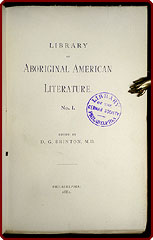
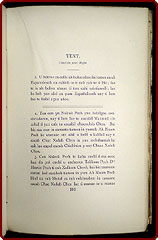
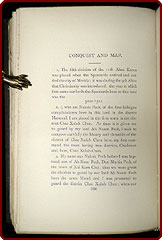 Click the images for enlargements. First printing in the U.S. of any pre-Columbian text in the original Maya. This is no. I in the “Brinton's Library of Aboriginal American Literature” series, opening with a description of the Maya and including selections from the books of Chilam Balam of Mani, Tizimin, and Chumayel, along with the chronicle of Chac Xulub Chen. Each Mayan text is accompanied by an English translation and the editor's notes.
• Not in Pilling, Proof-sheets; not in Newberry Library, Indian Linguistics in the Edward E. Ayer Collection. Publisher's brown textured cloth framed in blind, spine with gilt-stamped title; binding slightly cocked, corners and spine extremities a little rubbed, spine a bit sunned. Ex–social club library: call number on front fly-leaf, half-title and title-page rubber-stamped. No other markings. (26511)
He Served UnderMORELOS Bustamante, Carlos María de; & Pablo de Mendíbil.
Resúmen histórico de la revolución de los Estados Unidos Mejicanos. Londres [etc.]: R. Ackermann, 1828. 8vo (21.5 cm; 8.5"). Frontis., xxv, [1 (blank)],423, [1 (blank)] pp., [1 (instructions to binder)], [2 (ads for book in Spanish published by Ackermann)] ff., 4 litho. ports.
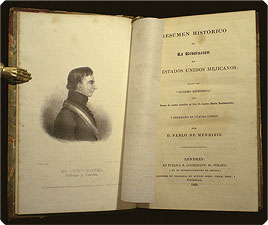
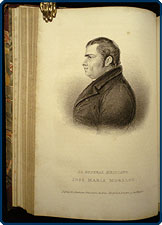 Click the interior images for enlargements.
 In this edition Lic. Pablo de Mendibil has edited the letters into four large chapters and added lithographic portraits of Hidalgo, Morelos, Bravo, Guerrero, and Guadalupe Victoria. They are variously from originals by Gauci or unidentified artists, and are lithographed by either R.Cooper or Englemann & Co.
• Sabin 47810; Palau 163362 (under Mendibil). Mid–19th century half red leather, flat spine, machine-made marbled paper on covers and as endpapers, marbled edges. Leather abraded and refurbished; interior clean and nice. (21727)

 TO Part II
. . .
TO Part II
. . . |