
 MEXICO - UNA PIÑATA BIBLIOGRÁFICA
Una de nuestras especialidades mayores - If you collect in this area, let us know!
MEXICO - UNA PIÑATA BIBLIOGRÁFICA A Nun's Copy
 Then Another Nun's
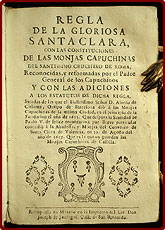
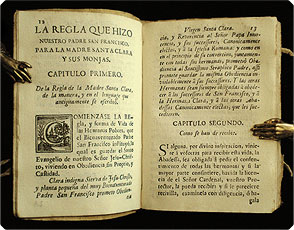
  Capuchin Nuns. Regla de la gloriosa santa Clara,con las constituciones de las monjas Capuchinas del santissimo crucifixo de Roma, reconocidas, y reformadas por el Padre General de los Capuchinos y con las adiciones a los estatutos de dicha regla ... Mexico: Reimpressa en la Imprenta del Lic. Don Joseph de Jauregui, n.d. [ca. 1760–75]. 16mo (15 cm; 6'). [4] ff., 234 pp.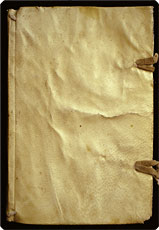
 Click the interior images for enlargements.
  As part of the last, they pray for intervention in medical and mental matters for those suffering from maladies.
Provenance: On front free endpaper in 18th-century hands: “del uso de Sor Maria Coleta,” lined through; below which, “del uso de Sor M[ari]a Juan Nep[umacen]a.
The printer has supplied two charming initials, an “I” and a “C.”
• Medina, Mexico, 9208. Publisher's limp vellum with remnants of ties. Occasional light foxing. Ownership signatures as noted. (23966)

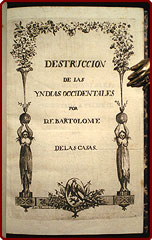
 First Printing in Latin America — Montes de Oca Engraved Title Casas, Bartolomé de las. Breve relacion de la destruccion de las Indias Occidentales. México: en la oficina de Don Mariano Ontiveros, 1822. 16mo (15 cm; 5.75"). [1] f., 164 pp.
 Click the title-page image above for an enlargement.
 This edition begins with a handsome engraved title by the famous Mexican engraver Luis Montes de Oca, signed in the lower left corner and bearing the Mexican national emblem in the lower center of the plate. This is one of the first appearances of that emblem, and it is most fitting that it be the work of this artist.
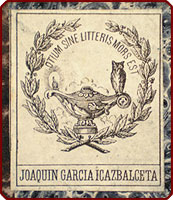
Provenance: Bookplate of the famous 19th-century Mexican collector, bibliographer, and historian of the book, Joaquín García Icazbalceta.
• Palau 46951. 19th-century quarter black morocco with marbled paper sides; spine tooled in gilt to replicate a raised-band spine with spine compartments; two small abrasions. Interior with light, scattered foxing only.  A lovely little book. (25216)

 Offices
for the Empire —
Handsome
Offices
for the Empire —
Handsome Three-Color
Title-Page
Catholic
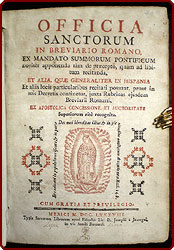
Church. Offices. Officia sanctorum
in Breviario Romano, ex mandato summorum pontificum novitèr apponenda
tàm de praecepto, quàm ad libitum recitanda, et alia, quae generaliter
in Hispania et aliis locis particularibus recitari possunt, prout in suis decretis
continetur, juxta rubricas ejusdem Breviarii Romani. Ex apostolica concessione
et auctoritate superiorum ritè recognita. Mexici: Typis Sacrorum Librorum
apud héredes Lic. D. Josephi à Jauregui, 1788. 4to (21 cm; 8").
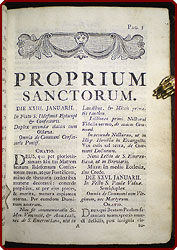
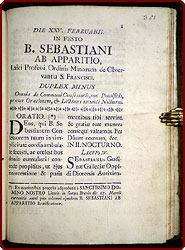
[3] ff., 360 pp. [bound in at end] [drop-title] Die XXV. februarii. In
festo B. Sebastiani ab Apparitio, laici professi Ordinis Minorum de Observantia
S. Francisci. Duplex minus. [Mexico: no publisher/printer, 1790]. Small 4to.
7, [1 (blank)] pp. [also bound in] [drop-title] Die V. julii. In festo
B. Michaelis a Sanctis Confesssoris. Mexici: Ex Typographia Matritensi Haeredu
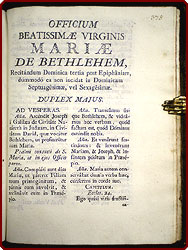
Lic. D. Josephi a Jauregui, [1786]. Small 4to. 8 pp. [with] [drop-title]
Officium Beatissimae Virginis Mariae de Bethlehem, recitandum dominica tertia
post Epiphaniam. Mexici: Ex Nova Typographia Matritensi Haeredum Lic. D. Josephi
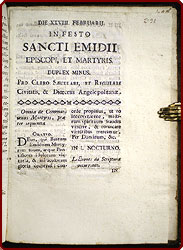
a Jauregui, [1786] Small 4to. [8] ff. [with] [drop-title] Die XXVIII.
Februarij in festo Sancti Emidii eposcopi, et martyris. Small 4to. [4] pp. Civit.
Angelop [i.e., Puebla]: Reimpres. ex Typographia Reg. Semin. Palafox, [1793].
[with] [drop-title] Die xxiii. decembris. In festo B. Nicolai Factoris,
confesoris. Mexici: Ex Typographia Matritensi Haeredum Lic. D. Josephi a Jauregui,
1791. Small 4to. 8 pp. [with] [drop-title] Die IV. junii. In festo S.
Francisci Caracciolo. No place: no publisher/printer, [1807]. Small 4to. 4 pp.
Three-Color
Title-Page
Catholic
Church. Offices. Officia sanctorum
in Breviario Romano, ex mandato summorum pontificum novitèr apponenda
tàm de praecepto, quàm ad libitum recitanda, et alia, quae generaliter
in Hispania et aliis locis particularibus recitari possunt, prout in suis decretis
continetur, juxta rubricas ejusdem Breviarii Romani. Ex apostolica concessione
et auctoritate superiorum ritè recognita. Mexici: Typis Sacrorum Librorum
apud héredes Lic. D. Josephi à Jauregui, 1788. 4to (21 cm; 8").
[3] ff., 360 pp. [bound in at end] [drop-title] Die XXV. februarii. In
festo B. Sebastiani ab Apparitio, laici professi Ordinis Minorum de Observantia
S. Francisci. Duplex minus. [Mexico: no publisher/printer, 1790]. Small 4to.
7, [1 (blank)] pp. [also bound in] [drop-title] Die V. julii. In festo
B. Michaelis a Sanctis Confesssoris. Mexici: Ex Typographia Matritensi Haeredu
Lic. D. Josephi a Jauregui, [1786]. Small 4to. 8 pp. [with] [drop-title]
Officium Beatissimae Virginis Mariae de Bethlehem, recitandum dominica tertia
post Epiphaniam. Mexici: Ex Nova Typographia Matritensi Haeredum Lic. D. Josephi
a Jauregui, [1786] Small 4to. [8] ff. [with] [drop-title] Die XXVIII.
Februarij in festo Sancti Emidii eposcopi, et martyris. Small 4to. [4] pp. Civit.
Angelop [i.e., Puebla]: Reimpres. ex Typographia Reg. Semin. Palafox, [1793].
[with] [drop-title] Die xxiii. decembris. In festo B. Nicolai Factoris,
confesoris. Mexici: Ex Typographia Matritensi Haeredum Lic. D. Josephi a Jauregui,
1791. Small 4to. 8 pp. [with] [drop-title] Die IV. junii. In festo S.
Francisci Caracciolo. No place: no publisher/printer, [1807]. Small 4to. 4 pp.
 Click the images for enlargements. All added items are very rare.

Are
U Doin' It Rite?
Catholic
Church. Liturgy & ritual. Commemorationes, seu suffragia
sanctorum Ordinis Minorum S.P.N. Francisci, quæ dicuntur in fine vesperarum
& laudum, ab  octava
Epiphaniæ usque ad Dominicam Passionis exlusivè;
& ab octava
Pentecostes usque ad Adventum exclusivè in Dominicis....
Mexici: Ex Typographia Matritensi, [ca. 1770]. 12mo. [12] ff.
octava
Epiphaniæ usque ad Dominicam Passionis exlusivè;
& ab octava
Pentecostes usque ad Adventum exclusivè in Dominicis....
Mexici: Ex Typographia Matritensi, [ca. 1770]. 12mo. [12] ff.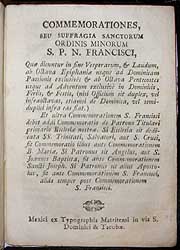
• Medina, Mexico, 8973. Sewn as issued with original plain wrappers and with later marbled wrappers.

Uncut Bifolium Catholic Church. Liturgy & ritual. [drop-title] Die XXVII. augusti. In festo Sancti Josephi Calasanctii a Matre Dei. Scolarum piarum fundatoris, duplex. [Mexico City: 1790–1800]. Folio. [1] f.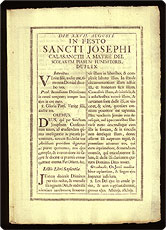
Uncut
bifolia are extremely rare.
 This
is handsomely printed!
This
is handsomely printed!
• Not in Medina, Mexico; not in González de Cossío, Cien; not in González de Cossío, 510. Folded once and never bound. Crisp. (24584)

 Another
Uncut Bifolium
— Changing Another
Mass
Catholic Church.
Liturgy & ritual. [drop-title] Dominica tertia julii. In solemnitate
SS. Redemptoris. [Mexico City, 1790–1800]. Double folio. [2 (conjugate)] ff.
Another
Uncut Bifolium
— Changing Another
Mass
Catholic Church.
Liturgy & ritual. [drop-title] Dominica tertia julii. In solemnitate
SS. Redemptoris. [Mexico City, 1790–1800]. Double folio. [2 (conjugate)] ff.
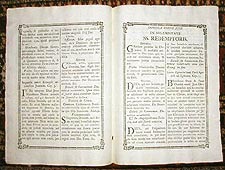
Our offering is a bifolium containing two copies of the decree, meant to be separated but never cut.  Uncut bifolia are extremely rare.
• Not in Medina, Mexico; not in González de Cossío, Cien; not in González de Cossío, 510. Folded once and never bound. Crisp.

One
More Uncut Copy
. . .
Catholic church. Liturgy & ritual. Masses. [drop-title] Die XVIII. martii. In festo S. Braulii episcopi caesar-augustani, et confessoris. Duplex. [Mexico: no publisher/printer, ca. 1750]. 4to (21.5 cm; 8.5"). [4] ff.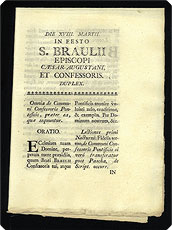
• Not in Medina, Mexico. Folded twice but never bound. Uncut. (24565)

 For
RARE CATHOLICA solo,
For
RARE CATHOLICA solo,
RULES
for the CHOIR
Catholic Church. Province of Mexico City (Mexico). Concilio Provincial (3rd, 1585). Statuta Ecclesiae Mexicanae necnon Ordo in choro servandus curante Vallisoletanae Ecclesiae capitulo sumptus suppeditante. Mexici: Apud Marianum Zunnigam, et Ontiverium, 1797. Folio (27.5 cm; 11"). [1], 140 pp., [2] ff.
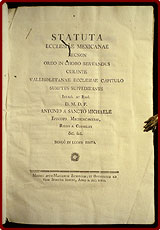
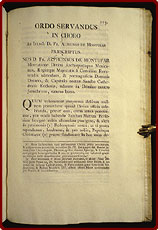
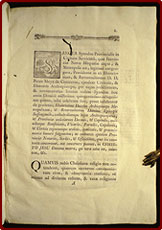 Click the interior images for enlargements.
 Uncommon. OCLC and NUC Pre-1956 locate only three copies in the U.S.
• Medina, Mexico, 8711. Contemporary vellum over paste boards of printer's waste, vellum cockled and that of the front cover lightly rodent-gnawed at board edges. Worming in text, some of which is meander type, costing letters. Not a great copy, but given the scarcity, an acceptable one. (24103)


Legal Age for Marrying Charles IV, King of Spain. Begins: Don Carlos ... Con fecha de diez de Abril de este año he tenido a bien expedir mi Real Decreto del tenor siguiente.” [Madrid: No publisher/printer, 1803]. Folio. [4] pp. (last blank).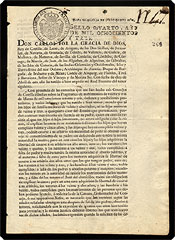
Signed by the crown with a wooden stamp, “Yo el Rey.”
This copy sent to Santiago, Chile, and docketed there.
• Removed from a nonce volume. Clean and untattered. (25817)
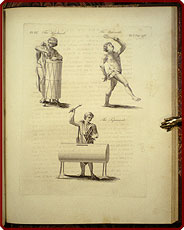
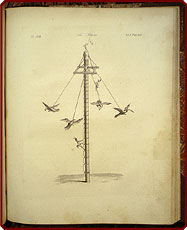
Illustrated IndigenousCustoms & Dress FIRST Edition in ENGLISH Clavigero, Francesco Saverio. The history of Mexico. Collected from Spanish and Mexican historians, from manuscripts, and ancient paintings of the Indians ... translated from the original Italian, by Charles Cullen. London: Pr. for G.G.J. and J. Robinson, 1787. 4to (28.5 cm, 11.2"). 2 vols. I: [2], xxxii, [4], 440, (441–44), 441–76 pp. (pagination skips v/vi, with text complete); 1 fold. map, 25 plts., 1 table. II: [4], 463, [1 (blank)] pp.; 1 fold. map, 1 plt.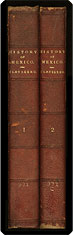
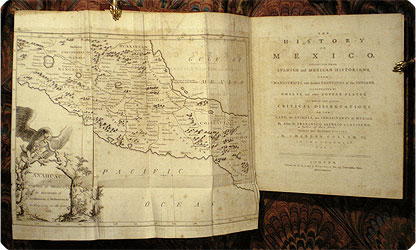 Click the interior images for enlargements.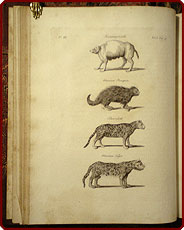
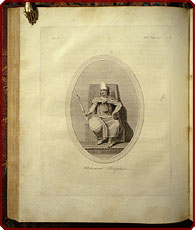
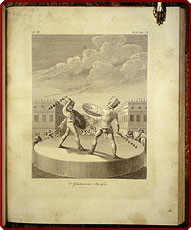
Thetwo oversized, folding maps were engraved by T. Conder; a genealogical chart in vol. I shows the descent of the Mexican kings from the 13th century, while numerous engraved plates depict Mexican artifacts, costumes, activities, flora and fauna, architecture, etc.
 For more SETS, click here.
Privileges
& Exemptions
Cofradía
de Nuestra Señora del Carmen (Mexico). Sumario de las
indulgencias, gracias y concesiones que los sumos pontifices han dispensado
a la Cofradia de Nuestra Señora del Carmen. Mexico: Impr. de la Calle
de Santo Domingo y esquina Tacuba, 1802. Samll 8vo (14.5 cm; 5.75"). [26] ff.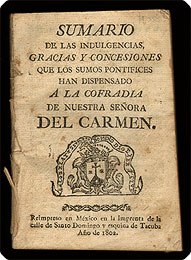 Click the image for an enlargement.
 Provenance: A copy of this work was given to each member upon admission and the last page of this copy indicates that it belonged to Joaquín Gorospe who was admitted to membership on 20 April 1803.
Uncommon: No U.S. library reports owning this edition.
• Medina, Mexico, 9488. Lacking the wrappers. Soiling to title-page and verso of last leaf. A few age spots. (26871)
The Yucatan Franz Scholes & Robert Chamberlain Colección de documentos inéditos relativos al decumbrimiento, conquista y organización de las antigua posesiones españolas de ultramar. Segunda serie. Tomo num. 13, II Relaciones de Yucatán. Madrid: Impresores de la Real Casa, 1900. 8vo. xvi, 414 pp.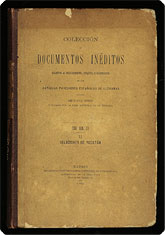
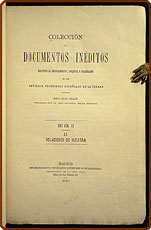
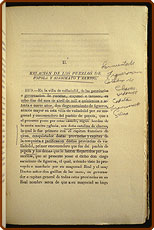 Click the interior images above for enlargements. extensively annotated in pencil by Robert Chamberlain and with occasional notes by Franz Scholes!
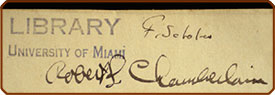
Provenance: First in the University of Miami Library, deacessioned; then in the library of Robert Chamberlain and later in that of Franz V. Scholes, both noted scholars of the Yucatán. Their signatures are on the front free endpaper and their notes are penciled in the margins of many pages.
 “The most important documentary collection for colonial Spanish America” Coleccion de documentos ineditos relativos al descubrimiento, conquista y organizacion de las antiguas posesiones españolas en América y Oceanía. Madrid: Various publishers, 1864–84 & 1966. 8vo. 42 volumes.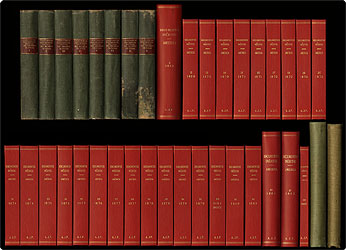
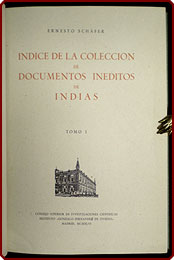
A mixed set in mixed bindings: all volumes except 11 are first editions, the exception being a 1966 reprint. Many original wrappers bound in. Volumes 1–10 in early quarter cloth, 11–42 in modern full cloth.
• Griffin, Latin America: A guide to the historical literature, 2063; Palau 56442. Bindings as above: Vols. 1–10 with abrasion/discoloration to spines, otherwise minor wear; moderate foxing, and some early annotations. Vols. 11–42, cloth bright; mostly clean internally, last 2 pages of last volume supplied in facsimile. Vol. 38 lacking fascicles 3, 4, 5, and 6. (25828)
 Our Lady of the Pueblito Colombini y Camayori, Francisco Maria. Querétaro triunfante en los campos del Pueblito. Poema histórico sagrado en quatro cantos de la milagrosa imágen de Nuestra Señora del Pueblito ... que se venera extramuros de la M.N. y M.L. ciudad de Querétaro, en el Santuario y Convento de Recoleccion de su nombre y títuto [sic]. Mexico: Mariano Joseph de Zúñiga y Ontiveros, 1801. Small 4to (20 cm; 8"). [5] ff., 108 pp., engr. plt.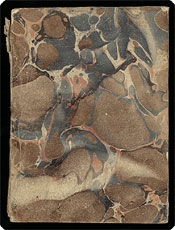
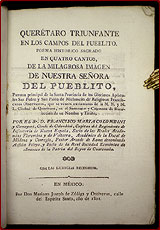
 Click the interior images for enlargements.
 The author was a captain in the Infantry Regiment of New Spain, and a member of the Florentine Academy and the Academy of Volterra. He was also the Count of Colombini.
Uncommon: Searches of WorldCat and NUC Pre-1956 locate only three copies in the U.S.
• Medina, Mexico, 9424; Palau 57013. In original marbled wrappers. Wrappers torn along spine. Some dog-earing, including to wrappers, and those corners soiled. Else a good and nice copy. (25644)
Cortés' Second Letter: The Conquest of Mexico Cortés, Hernando, & Peter Martyr. Praeclara Ferndinandi Cortesii De Nova Maris Oceani Hyspania Narratio. [colophon: Impressa in Nurimberga: per Fridericum Peypus], 1524. Folio (30.3 cm; 11.875" ). [4], 49, 12 leaves.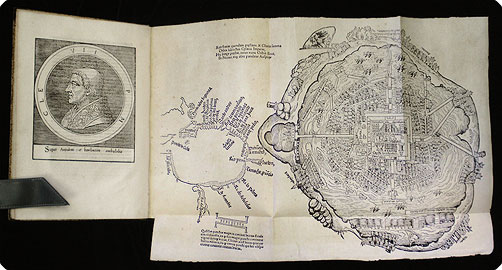 Click the images for enlargements. Cortés was the first conqueror since Julius Caesar to write a description of his conquests.
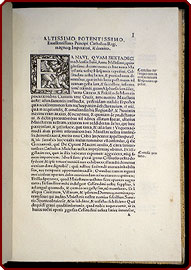
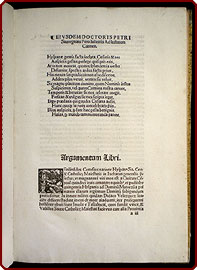
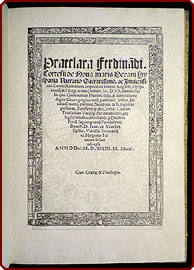 It is here that Cortés provides a definitive name for the country, calling it “New Spain of the Ocean Sea.” This letter is also important for making reference to Cortés's “lost” first letter, supposedly composed at Vera Cruz on 10 July 1520. Whether that letter was actually lost or was suppressed by the Council of the Indies is unknown, though there is little doubt it once existed.
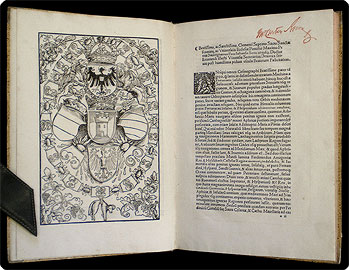
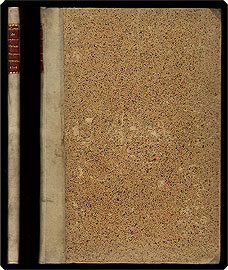 It is the text of this “second” letter, THE FIRST SURVIVING ONE, that was the first major announcement to the world of the discovery of major civilizations in the New World — and, as such, is a work of surpassing importance.
This copy bears the full-page woodcut portrait of Pope Clement VII on the verso of the fourth preliminary leaf, which is not found with all copies. Additionally, the title-page bears an interesting 14-piece composite woodcut border and the verso of that page has a stunning full-page woodcut of the coat of arms of Charles V, the Holy Roman emperor, to whom the letter is addressed. The coat of arms is surrounded by the collar of the Order of the Golden Fleece. The text is printed in roman with side- and shouldernotes; the lay-out is elegant and there is one large, handsome woodcut initial.
As usual, the letter is here bound with Peter Martyr's De Rebus, et insulis noviter repertis, which provides an account of the recently discovered islands of the West Indies and their inhabitants. It is often considered a substitute for the lost Cortés letter.
One of the most important early descriptions of Mexico and of the first encounter of the West with the Aztec civilization, this is a work of bedrock importance to the New World. No complete copy has appeared for sale since 1985.
• Alden & Landis, European Americana, 524/5; Sabin 16947; Harrisse, BAV, 125. Sanz 933–34; Medina, BHA, 70; Church 53; Burden 5; JCB, German Americana, 524/4; Streeter Sale 190. 18th-century half vellum and sprinkled paper over boards, gilt red leather label. Map supplied in expert facsimile; blank leaf H8 lacking. Bookplate of John Carter Brown (Library) on front pastedown, with deaccession stamp. Occasional very minor soiling in the text, else very good — a copy clean and even crisp. (26808)
Cortes's Stirring Lettersin French Cortés, Hernán. Correspondance de Fernand Cortès avec l'empereur Charles Quint sur la conquête du Mexique. Francfort: J.J. Kesler, 1779. 8vo. xvi, 471 pp.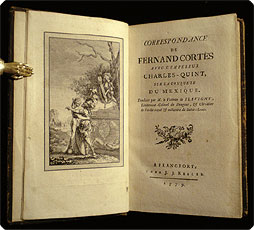
 Click the interior image for an enlargement.
 • Sabin 16953. Contemporary treed calf, front joint (outside) starting at top to open. A good+ copy — in fact, a rather nice one. (20510)
FIRST
Edition In English
Cortés,
Hernán. The despatches of Hernando Cortés,the
conqueror of Mexico, addressed to the emperor Charles V, written during the
conquest, and containing a narrative of its events. New York: Wiley & Putnam,
1843. 12mo. xii, 431 pp.; ill.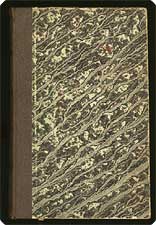
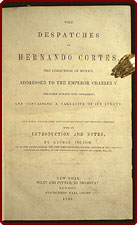
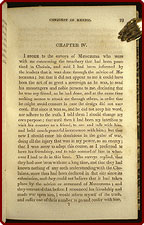
• Sabin 16964. Publisher's quarter cloth over marbled paper boards, lightly abraded; light foxing to interior. Private bookplate. Good+ copy. (20502)
For more TRANSLATIONS, click here.
Sor
Juana &
Her Arch Enemy — A
MS. TO GASP AT
Cruz,
Juana Inés de la, Sister.  Manuscript
Document Signed. In Spanish, on paper. Mexico City, 21 November
1692. Folio (31.3cm; 12.25"), 1 p. (in a larger document extending to 4 pp.)
Manuscript
Document Signed. In Spanish, on paper. Mexico City, 21 November
1692. Folio (31.3cm; 12.25"), 1 p. (in a larger document extending to 4 pp.)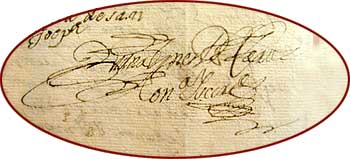
In the year before her pen is silenced and less than three before she falls
victim to the plague while caring for her sick Sisters, Sor Juana,
the New World’s greatest lyric poet,
attests to a legal document concerning her convent’s economic investments.
She was the nunnery’s contadora (bookkeeper). By way of horribly
evocative contrast, opposite her signature on the facing page is that of Francisco
Aguiar y Seijas, Archbishop of Mexico, the misogynist who caused her to give
up her writing and quasi-secular ways.
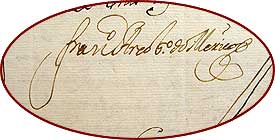
Able to bully the most gifted member of his religious community only following
the return to Spain of her last viceregal patron and protector, the Marquis
de la Laguna, Aguiar y Seijas applied increasing pressure to Sor Juana and the
prioress of her Hieronymite convent. It took him from 1688 until 1693 to put
“la decima Musa” “in her place.”
Documents signed by the polymath Sor Juana are very rare and highly sought
after; this one desirably shows the trust her Sisters placed in her. The
pairing of her signature with her arch enemy's is chilling and visually impactful.
• In very good condition.
Full Set of Her Works, IncludingVillancicos in Nahuatl & an African Language Cruz, Juana Inés de la, Sister. Poemas de la unica poetisa americana, musa dezima, Soror Juana Ines de la Cruz ... Tercera edicion, corregida, y añadida por su authora. [with others, as below]. Barcelona: por Joeph Llopis, 1691. 4to (21 cm; 8.25"). [8] ff., 426 pp., [5] ff. [with the same author's] Segundo tomo de las obras de Soror Juana Ines de la Cruz. Madrid: Impr. de Angel Pasqual Rubio, 1725. 4to (20 cm; 8"). [4] ff., 438 pp., [3] ff. [with the same author's] Fama, y obras posthumas del fenix de Mexico, dezima musa, poetisa americana. Madrid: Impr. de Angel Pasqual Rubio, 1725. 4to (20 cm; 8"). [10] ff., 352 pp., [2] ff.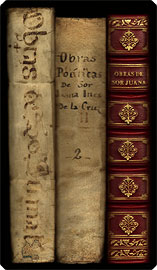
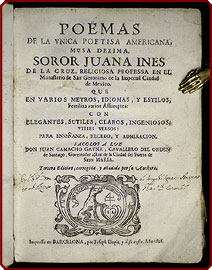
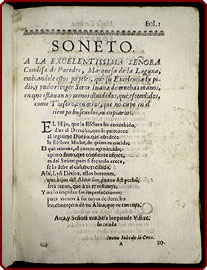
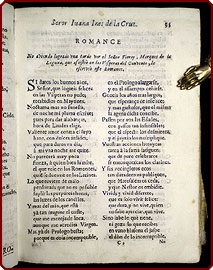 Click the images for enlargements.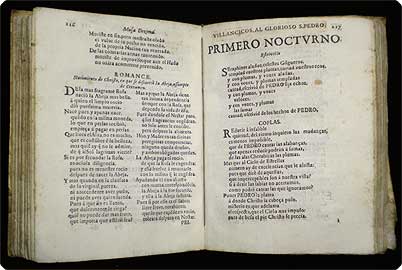
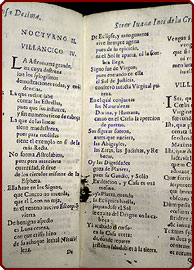 For a sense of her range of subjects, click to enlarge our images. She invented a decasyllabic meter and cultivated dramatic poetry: Among her works are sonnets, redondillas, décimas, villancicos, and plays, as well as prose works, including the famous Carta athenagorica in which she criticizes the great Luso-Brazilian preacher and defender of the Brazilian Indians, Antônio Vieira. The contents here are mostly Spanish-language, but some portions are in Latin — and a few, as is seldom recognized, are in the black language of “Guinea” (e.g., Villancico VIII of the “Villancicos que se cantaron en la Sta. Iglesia Metropolitana de Mexico en honor de Maria Santissima Madre de Dios . . . y se imprimieron año de 1679") or in Nahuatl (e.g., Villancico V of the “Villancicos que se cantaron en la Santa Iglesia Metropolitana de Mexico, en honor de Maria Santissima Madre de Dios . . . año de 1687, en que se imprimieron”).
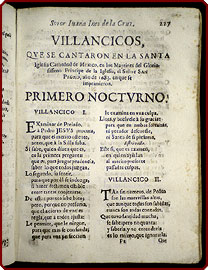
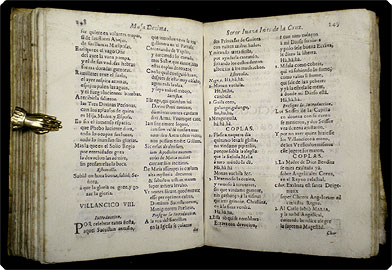
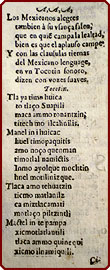
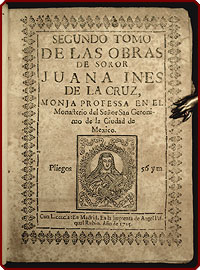
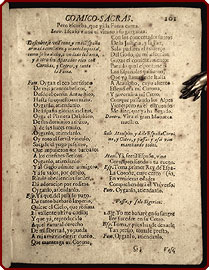
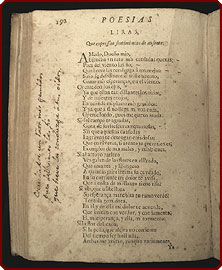
 In the offering here, vol. I was printed during the great poet's lifetime, and is one of the last to hold that distinction.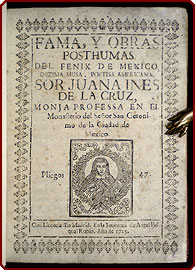
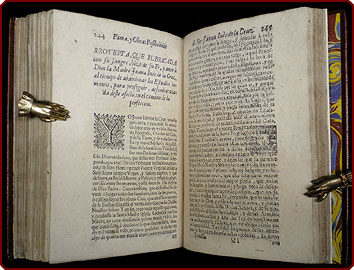
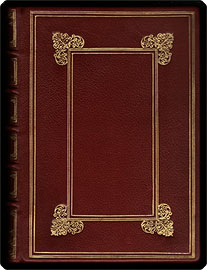 With slight faults only, this is a handsome set of this major writer's works. (26753)
 TO Part III
. . .
TO Part III
. . . |