
 MEXICO - UNA PIÑATA BIBLIOGRÁFICA
Una de nuestras especialidades mayores - If you collect in this area, let us know!
MEXICO - UNA PIÑATA BIBLIOGRÁFICA “Tell
Us About MEXICO,
Where
“Tell
Us About MEXICO,
Where MAXIMILIAN
Now Lives”
MAXIMILIAN
Now Lives”
 De Bussierre, Marie Théodore Renouard, vicomte de.
L'empire mexicain histoire des toltèques des chichimeques des aztèques et de la conquete espagnole.
Paris: Henri Plon, 1863. Small 8vo. [2] ff., 427 pp.
De Bussierre, Marie Théodore Renouard, vicomte de.
L'empire mexicain histoire des toltèques des chichimeques des aztèques et de la conquete espagnole.
Paris: Henri Plon, 1863. Small 8vo. [2] ff., 427 pp.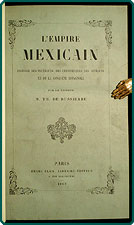
 Click the interior image for an enlargement.
 The latter part of the book offers a very brief recounting of Javier Mina, the War for Texas independence, and the U.S. intervention in the 1840s and consequent loss of California, New Mexico, etc. to the U.S.
Provenance: From the collection of Alberto Pareño, with his initials at the base of the spine.
• Sabin 9561; Palau 37698; Bernal 4295. 20th-century red cloth, with original green printed wrappers bound in. Occasional light foxing. (21371)

 The Economics of Pulque Delmonte, José; & Andrés Quintana Roo, & others. Representacion de los cosecheros de pulque al honorable congreso del estado de Mexico. Mexico: Imprenta del Aguila dirigida por José Ximeno, 1828. Small 4to (21.2 cm; 8.25"). 15, [1 (blank)] pp.
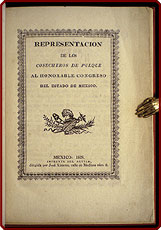 Click the interior image for an enlargement.
  An interesting and detailed, if one-sided, presentation.
The document is signed in type (on p. 15) by more than 30 growers, with Delmonte and Quintana Roo the first two names.
Rare: Both NUC and OCLC locate only the copy at Yale and CCILA locates only the copy in the Lafragua collection in Mexico.
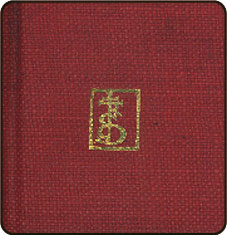
Provenance: Gilt supra-libros of John B. Stetson on the front cover. (Yes, Stetson as in the Stetson hat!)
• Not in Goldsmiths-Kress; not in Palau; not in Sutro. Bound in 20th-century red cloth. Very good copy. (24830)

 A
Conqueror of Mexico
. . .
A
Conqueror of Mexico
. . . A
Manuscript Document
SIGNED
Díaz del Castillo, Bernal.
Document Signed ("Bernal Díaz"). Santiago de Guatemala, 24 July
1556. Folio, 2 1/2 pp.
A
Manuscript Document
SIGNED
Díaz del Castillo, Bernal.
Document Signed ("Bernal Díaz"). Santiago de Guatemala, 24 July
1556. Folio, 2 1/2 pp.
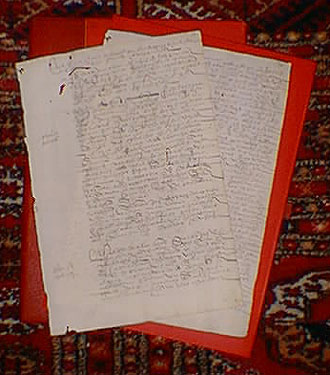
The document we here offer is a cabildo (i.e., town council) act. Bernal Díaz served as a member of the cabildo of Santiago de Guatemala for a number of years, an honor bestowed on him as a conqueror and early settler of the region. In this document the cabildo acknowledges receipt of a royal decree, reads it verbatim into its minutes, and formally agrees to comply. The king writes that he is informed that the post of notary public and "del número" in Santiago is vacant because Juan Núñez de Soria, who held the royal appointment to that position, "is gone to Our kingdoms of Peru." On the advice of the Royal Audiencia (i.e., High Court) the king appoints Juan de Rojas to be notary public and "del número."
• The document is housed in a red half morocco slipcase with an internal corset. Six small wormholes in each leaf affect one or two letters each, but not the signature of Bernal Díaz.

 Who's In Charge of What & How Much They Are Paid Díez de la Calle, Juan. Memorial informatorio al rey nuestro señor, en su real y supremo Conseio de las Indias, Camara, y Junta de Guerra. [Madrid: No publisher/printer], 1645. Small 4to. [11 (of 12)], 31 (of 32) ff. (lacks pi4 and a1).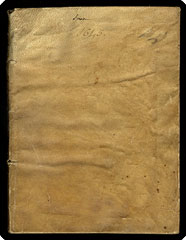
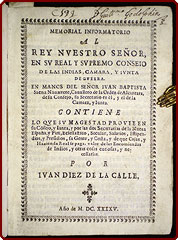
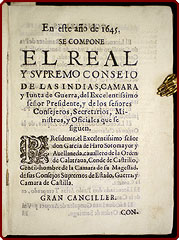
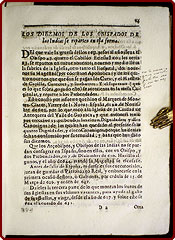 Click the interior images for enlargements.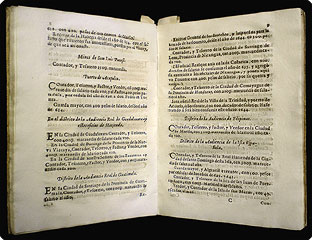
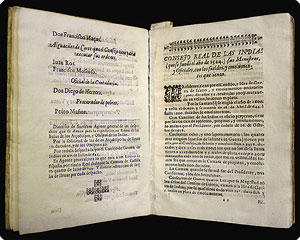
To aid in getting a refreshed grip on the administration of the New World, Philip IV of Spain asked Juan Díez de la Calle, a member of the Consejo de Indias, to produce a concise administrative handbook for use solely by the Council of the Indies, the King, and his close advisors. Here one finds all of the administrative divisions with dates of creation; office holders and their salaries and when the office was created; differences existing between administrative districts; and an interesting section on the various “annual” convoys (“armadas”) and the general in charge of each.
Provenance: Ownership signature at top of title-page of “Guill[er]mo Godolphin,” i.e., Sir William Godolphin.
• Alden & Landis, European Americana, 645/45; Palau 73741; Sabin 20133. Early limp vellum. Lacking two leaves: “Al Lector” leaf and the sectional title-leaf. A very good copy. (25808)
 Early Biography of Palafox Dinouart, Joseph-Antoine-Toussaint. Vie du vénérable Dom Jean de Palafox, evêque d'Angélopolis, & ensuite evêque d'Osme, dédiée a Sa Majeté Catholique. Cologne: Nyon, 1767. 8vo (19.7 cm, 7.75"). Frontis., iv, lvi, 576 pp.; 3 plts.
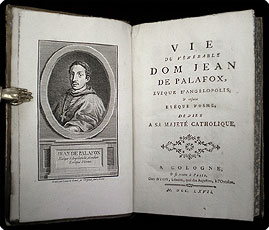 Click the images for enlargements.
 The work is illustrated with a frontispiece and three copper-engraved plates done by Louis le Grand after designs by Gravelot.
• Sabin 20201; Palau 73986; LeClerc, Bibliotheca Americana, 3180; Barbier, Dictionnaire des ouvrages anonymes et pseudonymes, 1003–04. Contemporary mottled calf, spine gilt extra with gilt-stamped leather title-label; corners, joints, and spine extremities rubbed, spine with two pinpoint holes and surface cracks to leather. Front free endpaper partially separated, with pencilled annotation on verso; inner margins of one plate and opposing page with small area of offsetting from now-absent laid-in item, pages otherwise clean. All edges marbled in blue. An attractive copy. (25799)
Gómez Farías asSlandererDocumentos relativos al promovido por el Sr. D. Eustaquio Barron contra Benito Gómez Farías. Mexico : Impr. de José Mariano Fernandez de Lara, 1856. Small 8vo. 56 pp.
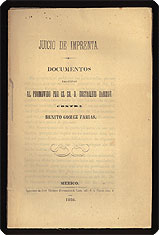
Presented here is Gómez Farías’ side of things, in a very uneditorialized manner.
At the top of the title-page: “Juicio de imprenta.”
• Sewn as issued, lacking front wrapper but rear one present. A good+ copy.


One That Got Away!Eguiara y Eguren, Juan José de. Selectae dissertationes mexicanae ad scholasticam spectantes theologiam tribus tomis distinctae. Tomus primus continet tractatus, I de Deo ut Uno & ejus attributis. II de Augustissimae trinitatis mysterio. III de SS. deigenitricis sponso Josepho. Tomus secundus complectitur tractatus, IV de libertate creata. V de ente supernaturali. VI de gratia auxiliante. VII de justificatione. Tomus tertius exhibet tractatus, VIII de voluntate divina. IX de divinis decretis. X de systemate dominicae incarnationis. XI de praedestinatione & reprobatione. XII theojuridicos offert titulos sex: de donationibus, de compensationibus, de actione Pauliana, de crimine laesae majestatis, de confiscatione, de vectigalibus. Mexici: Typis viduae Josephi Bernardi de Hogal, 1746. Folio (30 cm; 11.75"). [33] ff., 506 pp., [5] ff. 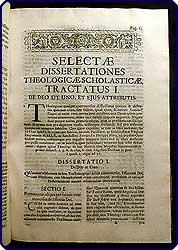
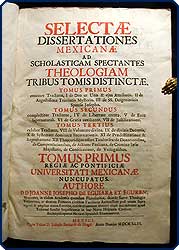 Click the image to the left or right
The Selectae dissertationes mexicanae was planned as a three-volume work but only this volume was published, the other two having been left in manuscript. It was printed by the widow Hogal, who continued to maintain the high standards of printing that she established with her husband; more than one bibliographer has compared the Hogal output favorably with that of the best European contemporaries. The title-page is in black and red with the text in double-column format in roman and italic, and the whole has decent margins. The volume was intended as a university level text for the study of certain theological concepts.
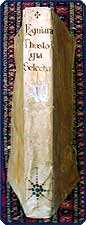
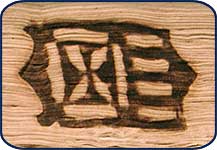
Provenance: Marca de fuego on top and bottom edges of the closed volume of the “Convento Grande de Nuestra Señora de la Merced” in Mexico City.
Very uncommon. We trace only one copy in the U.S., at the University of Texas.
• Medina, Mexico, 3763 Palau 78637; Beristain, I, 216–21. Contemporary limp vellum with remnants of button and loop ties. Marca de fuego as noted previously. Some worming into text on pages 361–94, costing letters but not impairing sense.

Troublesome
Deserters(Expediente/
Army Discipline). Manuscript documents. On paper, in Spanish.
Nueva Guatemala, 1778–91. Folio. [16] ff.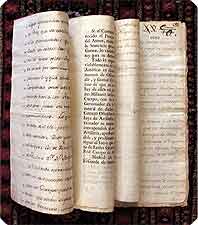 • Expediente concerning military discipline. Included are certified copies of original decrees by Secretary of the Army Galvez and portions of royal decrees, as well as a printed document. Specifically detailed are the punishments for first-time deserters, second timers, and third-time or more runways.
• Very good condition. Sewn.


 A
Capuchin
on the Trinity, with
Some
POETRY
as Well
Feliciano de Sevilla. El sol increado dios trino y uno, y
la grande excelencia de su culto y devocion. Reimpreso en Mexico: por D. Felipe de Zúñiga y
Ontiveros, 1790. 4to (20.5 cm; 8.25"). [10] ff., 464 pp.
A
Capuchin
on the Trinity, with
Some
POETRY
as Well
Feliciano de Sevilla. El sol increado dios trino y uno, y
la grande excelencia de su culto y devocion. Reimpreso en Mexico: por D. Felipe de Zúñiga y
Ontiveros, 1790. 4to (20.5 cm; 8.25"). [10] ff., 464 pp.
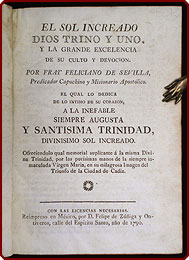
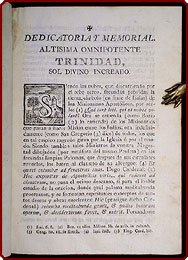 Click the images for enlargements.
 The volume ends with a “Corona Florida a la Santisima Trinidad,” being a small literary collection of coplas, canciones, and a romance “en Metafora del Sol, que discurre por los doce signos del Zodiaco.”
Binding: Publisher's mottled sheep, gilt spine extra. Marbled endpapers; all edges red.
• Medina, Mexico, 8016. Binding lightly worn. A few gatherings starting to extrude. A very good, clean copy. (26851)
 He
Survived “La Noche
Triste”
& Much, Much
More
He
Survived “La Noche
Triste”
& Much, Much
More THE
CONQUEROR'S REWARD
THE
CONQUEROR'S REWARD
 Felipe
II, King of Spain.
Illuminated Document Signed (on his behalf by his sister/regent, “La Princesa”).
In Spanish, on vellum. Valladolid, 17 March 1559. Folio (58 x 54.5
cm; 23" x 21.5"; h x w), 1 leaf.
Felipe
II, King of Spain.
Illuminated Document Signed (on his behalf by his sister/regent, “La Princesa”).
In Spanish, on vellum. Valladolid, 17 March 1559. Folio (58 x 54.5
cm; 23" x 21.5"; h x w), 1 leaf.  |
|
|
|
|
|
|
|
|
|
|
|
|
|
|
|
 |
|
||||||||||||||
 |
 |
 |
 |
 |
 |
 |
|
||||||||
 |
|
||||||||||||||
 |
|
||||||||||||||
 |
 |
|
|||||||||||||
 |
 |
|
|||||||||||||
 |
 |
|
|||||||||||||
 |
 |
|
|||||||||||||
 |
|
||||||||||||||
 |
 |
 |
 |
|
|||||||||||
 |
 |
 |
 |
|
|||||||||||
 |
|
||||||||||||||
 |
 |
|
|||||||||||||
 |
 |
|
|||||||||||||
 |
|
||||||||||||||
 |
 |
|
|||||||||||||
 |
 |
|
|||||||||||||
 |
|
||||||||||||||
 |
|
||||||||||||||
 |
|
||||||||||||||
 Move
your mouse over the document above, and click,
Move
your mouse over the document above, and click,
to select and view details.
 Villanueva
was among the small but grand “army” that marched into Tenochtitlán
in the Spring of 1520 and in July of the same year were to flee the
western world's largest city fighting for their lives, on the “Noche
Triste.” He survived the hell and slaughter of the causeways and later
returned with the greatly augmented force that destroyed the Aztec capital
and its empire. Still later he was with Cortés in the exploration
and conquest of Pánuco and following that with Nuño de
Guzmán in the exploration and conquest of Zacatecas and Jalisco.
He and his brother Fernando (also a member of the Saucedo contingent)
jointly received an encomienda (Quechula) and settled in Puebla
de los Angeles where Pedro served as a regidor on the town
council in the 1540s and 1550s.
Villanueva
was among the small but grand “army” that marched into Tenochtitlán
in the Spring of 1520 and in July of the same year were to flee the
western world's largest city fighting for their lives, on the “Noche
Triste.” He survived the hell and slaughter of the causeways and later
returned with the greatly augmented force that destroyed the Aztec capital
and its empire. Still later he was with Cortés in the exploration
and conquest of Pánuco and following that with Nuño de
Guzmán in the exploration and conquest of Zacatecas and Jalisco.
He and his brother Fernando (also a member of the Saucedo contingent)
jointly received an encomienda (Quechula) and settled in Puebla
de los Angeles where Pedro served as a regidor on the town
council in the 1540s and 1550s.

 The
text of the grant of arms is elegantly indited in a standard court
semi-round gothic in sepia ink and is enclosed on the left, right, and top
sides by an illuminated and historiated sash-like border. In the upper
left and right corners are miniatures of Justice and Knowledge in sylvan settings.
Running between those two along the top of the document is a decorative panel
incorporating flowers, fruits, mythic animals, and cherubs. Below this,
the king's name is accomplished in large letters of gold on a field of red
accented with gold, and the “D” of his honorific “Don”
is given special treatment. This is elaborated in an ornate, almost
baroque style that comes close to obfuscating the fact of its being a majuscule
“d”: Wrought in gold, the letter at first appears to be
merely a “frame” for the royal coat of arms that fills its center.
The king's arms are accomplished in gold, white, black, red, and blue; the
whole being laid on a blue field with white accents.
The
text of the grant of arms is elegantly indited in a standard court
semi-round gothic in sepia ink and is enclosed on the left, right, and top
sides by an illuminated and historiated sash-like border. In the upper
left and right corners are miniatures of Justice and Knowledge in sylvan settings.
Running between those two along the top of the document is a decorative panel
incorporating flowers, fruits, mythic animals, and cherubs. Below this,
the king's name is accomplished in large letters of gold on a field of red
accented with gold, and the “D” of his honorific “Don”
is given special treatment. This is elaborated in an ornate, almost
baroque style that comes close to obfuscating the fact of its being a majuscule
“d”: Wrought in gold, the letter at first appears to be
merely a “frame” for the royal coat of arms that fills its center.
The king's arms are accomplished in gold, white, black, red, and blue; the
whole being laid on a blue field with white accents.

The panels running down the left and right
sides of the document are accomplished in red, gold, green, pink, white, red,
blue, and brown, many in several shades. The decoration includes birds
of several varieties including a fine owl, animals including a watchful rabbit,
strawberries and other fruits, and flowers, ribbons, grotesques, and butterflies.

The document is signed in the king's name by Juana (Joanna Habsburg) de Austria,“princesa de Portugal.” Married to Prince Juan of Portugal, young Juana (b. 1537) was the regent of the Spanish crown from 1554 until her brother Philip's return to Spain in September of 1559. She had just lost her husband to death and borne his posthumous son, both in January, 1554, when she left Portugal and her child in the Spring of that year to assume the regency throne in Valladolid.

 In
format and content this document differs dramatically from the cartas executorias
de hidalguía that most collectors are familiar with. Here we have a
In
format and content this document differs dramatically from the cartas executorias
de hidalguía that most collectors are familiar with. Here we have a  single
large sheet of vellum handsomely engrossed, artfully
illuminated, and exquisitely decorated with a composite border containing
miniatures. This is not a bound volume of copies of documents created
for storage in the family archive.
single
large sheet of vellum handsomely engrossed, artfully
illuminated, and exquisitely decorated with a composite border containing
miniatures. This is not a bound volume of copies of documents created
for storage in the family archive.  This was created for display
in a prominent place of honor; and it is a magnificent display item.
This is not a grant of nobility nor a confirmation of it based on something
that some vague ancestor did; rather it is a grant of a coat of arms to a
man who himself performed significant military and other service for the Crown
and whom the Crown wishes to honor both publicly and privately. Only
a few hundred of Cortés's men survived the Noche Triste, the
reentry into and destruction of Mexico City, and the subsequent conquests
in Panuco and elsewhere. The number of grants such as this to actual
members of Cortés's original “army” were few.
This was created for display
in a prominent place of honor; and it is a magnificent display item.
This is not a grant of nobility nor a confirmation of it based on something
that some vague ancestor did; rather it is a grant of a coat of arms to a
man who himself performed significant military and other service for the Crown
and whom the Crown wishes to honor both publicly and privately. Only
a few hundred of Cortés's men survived the Noche Triste, the
reentry into and destruction of Mexico City, and the subsequent conquests
in Panuco and elsewhere. The number of grants such as this to actual
members of Cortés's original “army” were few.
 And surviving grants to those
actual participants in the Conquest are extremely rare, even more so in commerce.
This
is the only royal grant of a coat of arms to an actual member of Cortés's
“army” that we have seen that has ever appeared in the marketplace.
Via published auction records and our extensive archive of dealer catalogues,
we trace no instance before this one of the offering for sale of a grant of
arms to a Conqueror of Mexico. Yes, there are examples in various libraries
and museums in Mexico and Spain, and probably in the U.S., but such examples
seem to have entered their institutional resting places via donation from
descendants of Conquerors, not via purchase.
And surviving grants to those
actual participants in the Conquest are extremely rare, even more so in commerce.
This
is the only royal grant of a coat of arms to an actual member of Cortés's
“army” that we have seen that has ever appeared in the marketplace.
Via published auction records and our extensive archive of dealer catalogues,
we trace no instance before this one of the offering for sale of a grant of
arms to a Conqueror of Mexico. Yes, there are examples in various libraries
and museums in Mexico and Spain, and probably in the U.S., but such examples
seem to have entered their institutional resting places via donation from
descendants of Conquerors, not via purchase.

Provenance: It
is awesome to realize that this is no mere retained secretarial copy of Felipe's
grant of arms to Pedro de Villanueva. This gorgeous document not only
records the king's rewards to one of Cortés's men, but was that Conqueror's
personal property. It is the copy of the decree sent to him expressly,
by the Crown!

• On Villanueva, see: Icaza, Diccionario autobiográfico
de conquistadores y pobladores de la Nueva España, I, 88–89;
Thomas, Who's Who of the Conquistadors, 146; Himmerich y Valencia,
The Encomenderos of New Spain, 1521–1555, 262; Díaz
del Castillo, Verdadera historia de la conquista de la Nueva España,
chap. LIII. On Juana de Austria, see: the work of Dr. Kelli Ringhofer.
Overall in very good condition. Some fold tears, some minor rubbing
of small areas of images, stains as visible in our illustrations. The
wax seal and its silk cords no longer present. Text
clear, not faded, and colors strong.
 To review the pictures of
this document more systematically than
To review the pictures of
this document more systematically than

Masses
Lands & Messuages
— Pray
for the Soul of Fr. Domingo
(Endowed chaplaincy).
Dossier of original and certified copies of documents, on paper in Spanish.
Tehuacán, Mexico; Puebla, and elsewhere, 1747–1858. About 200 ff.
Pray
for the Soul of Fr. Domingo
(Endowed chaplaincy).
Dossier of original and certified copies of documents, on paper in Spanish.
Tehuacán, Mexico; Puebla, and elsewhere, 1747–1858. About 200 ff.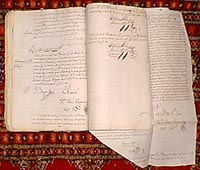
This is the file relating to that chaplaincy and its various holders during the first 100 years of its existence. It also contains a detailed listing of the lands and messuages of the hacienda and their value as of March 1748, and a certain amount of information about the development of the hacienda in the years prior to 1748.
• Sewn, dusty, tattered, incomplete at end. Written in a variety of easy-to-read hands. Some tears. Now housed in a simple phase box.
One forFranciscan Novices Franciscans.
Cartilla, y doctrina espiritual, para la crianza, y educacion de los novicios,
que tomaren el habito de la orden de n.p. S. Francisco. Mexico: Imp. de D. Felipe
de Zuñiga y Ontiveros, 1775. 12mo (14.7 cm; 5.75"). [3] ff., 118 pp.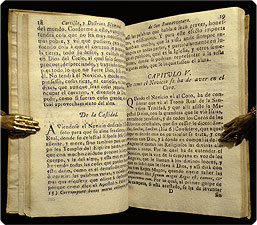
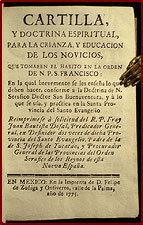 Click the images for enlargements.
 A scarce work, having been printed in a limited number of copies for the very limited-sized audience of Franciscan novices.
• Medina, Mexico, 5761. Contemporary limp vellum. Very clean and crisp. A truly excellent copy. (22204)
Were?
the Franciscans Getting
Too Uppity?
Franciscans.
Satisfacion [sic] por la religion de S. Francisco al manifiesto
que se ha publicado, ocultando su nombre el autor. [Madrid, ca. 1671?]. 30, [1
(blank)] ff.
Uppity?
Franciscans.
Satisfacion [sic] por la religion de S. Francisco al manifiesto
que se ha publicado, ocultando su nombre el autor. [Madrid, ca. 1671?]. 30, [1
(blank)] ff. Click
the image for an enlargement.
Click
the image for an enlargement.
• Not in Palau; not in Medina, BHA. Removed from a nonce volume. Title-page with shadow of pencilled numeral in upper margin; one leaf with institutional pressure stamp. Most leaves with old damage to outer margins, repaired of old in most instances, with loss of some words or letters from a number of shouldernotes; a few instances of early inked bracketing.
Surprising
Content — Capuchins
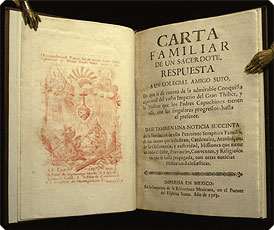
in TibetFrancisco, de Ajofrín, fray. Carta familiar de un sacerdote,
respuesta a un colegial amigo suyo, en que le dà cuenta de la admirable conquista espiritual del vasto
imperio del gran Thibèt, y la mission que los padres Capuchinos tienen alli, con sus singulares
progressos hasta el present. Dase tambien una noticia succinta de la fundacion de esta penitente
seraphica familia; de los santos que la ilustran, cardenales, arzobispos; de su observancia, y austeridad,
missiones que tiene en todo orbe, provincias, conventos, y religiosos en que se halla propagada, con
orras noticias historico-eclesiasticas. Mexico: En la imprenta de la Bibliotheca Mexicana , 1765. Small
4to. Frontis., [2] ff., 48 pp.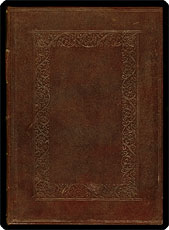
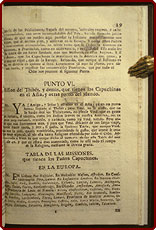
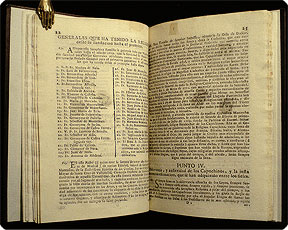 Click the images for enlargements.
 A special issue copy: Present here is an uncalled-for frontispiece. It is of four Capuchin martyrs, is signed by the artist Navarro, is engraved on copper, and is printed au sanguine -- the color reserved for only the most special copies of 18th-century books. This frontispiece is not called for by Medina and is not present in any of the copies reported as held in the U.S.
• Medina, Mexico, 4991; Palau 45600; Sabin 11098; Maggs, Bibliotheca Asiatica, 611. Full antique calf, spine gilt, leather label. Slight worming to late leaves, repaired with tape in an inoffensive fashion. Quite a good copy. (12725)
 TO Part IV
. . .
TO Part IV
. . . |
 For more BOOKS IN FRENCH,