 MEXICO - UNA PIÑATA BIBLIOGRÁFICA
Una de nuestras especialidades mayores - If you collect in this area, let us know!
MEXICO - UNA PIÑATA BIBLIOGRÁFICA The Amalgamation Process Explained
 Royal
Order
Royal
Order Garcés y Eguía, José. Nueva teórica y práctica del beneficio de los metales de oro y plata por fundicion y amalgamacion, que de orden del rey nuestro señor Don Carlos Quarto ... ha escrito y da al publico José Garcés y Eguia. Mexico: Mariano de Zuñiga y Ontiveros, 1802. Small 4to. [5] ff., 12, 168 pp.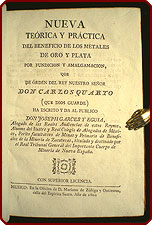

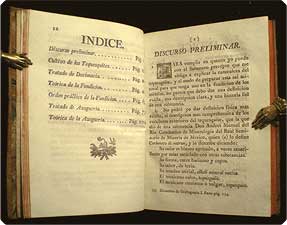
 Single-click any image where the hand appears onA work also of considerable
scarcity in the marketplace.
Single-click any image where the hand appears onA work also of considerable
scarcity in the marketplace.
• Medina, Mexico, 9502; Palau 97721; Sabin 16551. Publisher's treed sheep binding, gilt spine extra, spine label mostly perished. All edges carmine. A very good copy.

 The
Earthquake That
The
Earthquake That Changed
GuatemalaGonzález Bustillo, Juan. Extracto, ô Relacion methodica, y puntual de los autos de reconocimiento, practicado en virtud de commission del señor presidente de la Real Audiencia de este reino de Guatemala. Pueblo de Mixco [Guatemala]: Impreso en la oficina de A. Sanchez Cubillas, 1774. Folio (29.5 cm; 11.675"). [2], 86 pp. (without final leaf with one erratum)
Changed
GuatemalaGonzález Bustillo, Juan. Extracto, ô Relacion methodica, y puntual de los autos de reconocimiento, practicado en virtud de commission del señor presidente de la Real Audiencia de este reino de Guatemala. Pueblo de Mixco [Guatemala]: Impreso en la oficina de A. Sanchez Cubillas, 1774. Folio (29.5 cm; 11.675"). [2], 86 pp. (without final leaf with one erratum) 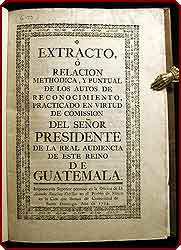
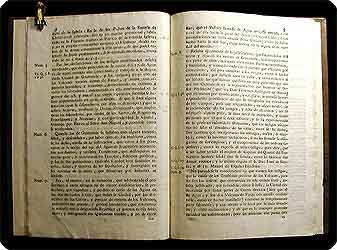 Single-click any image where the hand appears on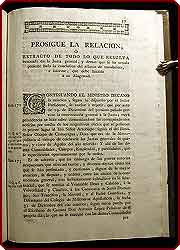
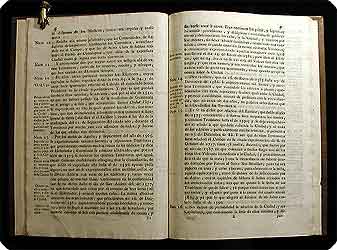
This document is one of the very few printed in the temporary capital of Mixco, a press having been salvaged from the ruins in the former capital. Thus, Mixco was the second city/town to have a press in Central America, and then, for only a short time—appoximately two years.
In addition to being important for its contents and in the realm of printing history, the González Bustillo report is uncommon: We trace only half a dozen copies in U.S. libraries.
• Medina, Guatemala, 384; Palau 105113; Sabin 27811. Modern full calf, very plain style. Without the final leaf with one erratum on it.
 For more CENTRAL AMERICANA, click here.

 On the Loyalty Oath of 1820 [Granados, Francisco]. [drop-title] La cola de las zorras de Sanson, ó defensa de su autor. [colophon: Mexico: Alejandro Valdes, 1820]. 4to. 7, [1 (blank)] pp.
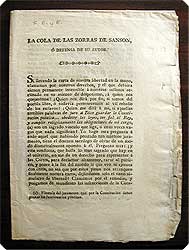
• Medina, Mexico, 11697; Garritz, Impresos novohispanos, 3585; Sutro 112; Steele 12. Folded, never bound. Minor worming affecting a few letters. Writing in pencil on first page. (3905)

Spanish as a Second Language, 1835 Granja, Juan de la. Rasgos históricos de magnanimidad, valor, y nobleeza: Anecdotas, sentencias y ejemplos raros de virtud; dichos notables, cuentos, fábulas y ocurrencias graciosas, en prosa y en verso. Nueva York: Imprenta de Don Juan de la Granja, 1835. Small 8vo. 252 pp., [2 (index, ads)] ff.
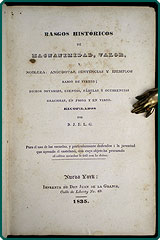 Click the images for enlargements.
 Provenance: Early 19th-century ownership signatures on front free endpaper of Anthony Coe Ogilvie and E.H.(?) Ogilvie.
• American Imprints 31923. Not in Palau. Publisher’s quarter cloth with paper-covered sides; binding waterspotted. Scattered light foxing. A good copy. (26144)

 A“TEXIAN” Survivor's Narrative — 13 Maps & Plates
Green, Thomas Jefferson. Journal of the Texian expedition against Mier; subsequent imprisonment of the author; his sufferings, and final escape from the castle of Perote. With reflections upon the present political and probable future relations of Texas, Mexico, and the United States. New York: Harper & Brothers, 1845. 8vo (22.6 cm, 8.9"). Frontis., 487, [1] pp.; 10 plts., 2 maps (1 fold.).
A“TEXIAN” Survivor's Narrative — 13 Maps & Plates
Green, Thomas Jefferson. Journal of the Texian expedition against Mier; subsequent imprisonment of the author; his sufferings, and final escape from the castle of Perote. With reflections upon the present political and probable future relations of Texas, Mexico, and the United States. New York: Harper & Brothers, 1845. 8vo (22.6 cm, 8.9"). Frontis., 487, [1] pp.; 10 plts., 2 maps (1 fold.).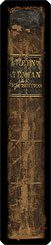
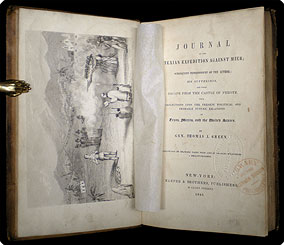 Click the images for enlargements.
 The volume is illustrated with a total of 13 steel-engraved plates, including a frontispiece and two maps, most taken from drawings done by Charles McLaughlin, “a fellow prisoner.”
• Howes G371; Sabin 28562; Streeter, Texas, 1581. Publisher's speckled sheep, spine with gilt-stamped leather title-label; worn and stained, spine head reinforced with dark cloth tape extending onto boards. Ex–social club library: 19th-century bookplate on front pastedown, call number on front endpapers, rubber- and pressure-stamps on title-page. Plates variously lightly waterstained; folding map of Rio Alcantra with outer half torn away and edge tattered. Pages with minor age-toning and occasional stains. (26394)
Guridi
y Alcocer vs.
Lopez
de Cancelada
Guridi y Alcocer, José Miguel. Censor Extraordinario. Contestación de don José Miguel Guridi Alcocer lo que contra él y los Derechos de las Cortes se ha vertido en los números 13 y 14 del Telégrafo americano.... [colophon: Cadiz: En la impr. de Don Agapito Fernandez Figueroa, 1812]. 4to (20 cm; 7.5"). 47, [1 (blank)] pp.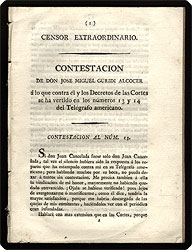
Guridi y Alcocer here defends himself and various of his statements in the Cortes from Cancelada's attacks in that newspaper, both personal and political. Guridi sought to open the (whole) New World to free trade, arguing for free access to European seeds, plant stocks, and exports generally. He also sought administrative reform, reduction in regulations, and the ending of colonial status.
WorldCat locates only two copies Worldwide.
• Palau 111215; Sutro 87. Removed from a nonce volume. One small tear in a margin, repaired. Clean and nice. (26042)
 STILL
a Most Interesting “Read”
—
An Edinburgh Edition
Hall, Basil. Extracts
from a journal, written on the coasts of Chili, Peru, and Mexico,
in the years 1820, 1821, 1822. Edinburgh: Archibald Constable & Co. and
Hurst, Robinson, & Co., 1826. 12mo (14.5 cm, 5.75"). Add. engr. t.-p., xii,
313, [1 (blank)], add. engr. t.-p., x, 311, [1] pp. (lacking map).
STILL
a Most Interesting “Read”
—
An Edinburgh Edition
Hall, Basil. Extracts
from a journal, written on the coasts of Chili, Peru, and Mexico,
in the years 1820, 1821, 1822. Edinburgh: Archibald Constable & Co. and
Hurst, Robinson, & Co., 1826. 12mo (14.5 cm, 5.75"). Add. engr. t.-p., xii,
313, [1 (blank)], add. engr. t.-p., x, 311, [1] pp. (lacking map). 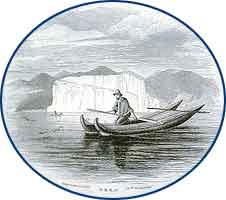
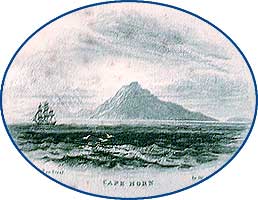
Hall's journal was first published in 1824; the present fifth edition was the second volume issued in the "Constable's miscellany of original and selected publications in the various departments of literature, science, & the arts" series. The text has been expanded from the second edition.
• Sabin 29718; Palau 112072 (first ed.). Contemporary half calf over marbled paper sides, spine ruled in double gilt fillets with gilt-stamped devices in compartments; worn and abraded with leather cracking over spine, and joints cracked but holding, Lacking map. Front free endpaper with inked ownership inscription. First and last few pages lightly spotted.

The
Mining Revival &
The Father of Mexican
Independence
Hidalgo,
Miguel de, Father of Mexican Independence. Document
Signed (Br. Hidalgo), on paper, in Spanish. No place [mining region of Real de
Bolaños or Aguas Calientes], no date [1780]. Folio, 1 p., bound in a dossier
of documents relating to the execution of the provisions of the will of Augustina
Velázquez. [with] A number of other collateral documents relating
to the Condes de Vivanco. On paper, in Spanish. Mexico City, Real de Bolaños,
Aguas Clientes, Valladolid (now Morelia), and elsewhere in Mexico. Folio (31 cm,
12.25") and smaller. Approximately
350 ff.
Mexican
Independence
Hidalgo,
Miguel de, Father of Mexican Independence. Document
Signed (Br. Hidalgo), on paper, in Spanish. No place [mining region of Real de
Bolaños or Aguas Calientes], no date [1780]. Folio, 1 p., bound in a dossier
of documents relating to the execution of the provisions of the will of Augustina
Velázquez. [with] A number of other collateral documents relating
to the Condes de Vivanco. On paper, in Spanish. Mexico City, Real de Bolaños,
Aguas Clientes, Valladolid (now Morelia), and elsewhere in Mexico. Folio (31 cm,
12.25") and smaller. Approximately
350 ff.
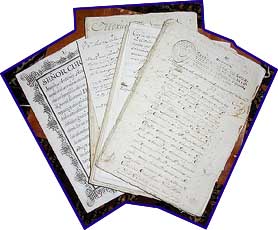
 This
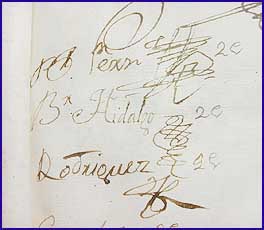
is a fine, extremely early example of Father Hidalgo's signature.
This
is a fine, extremely early example of Father Hidalgo's signature.
 The woman who provided the money for the above mentioned masses was the wife
of Antonio de Vivano (also spelled Bibano) Gutiérrez and mother of
Antonio Guadalupe de Vivano, the first two Condes de Vivanco. Cambridge scholar
David Brading credits Antonio de Vivanco with restoring the mining region
of Bolaños to prosperity in the early 1770s, following the region's
sharp decline in silver ore production during the first two-thirds of the
18th century — whereby he became very wealthy.
The woman who provided the money for the above mentioned masses was the wife
of Antonio de Vivano (also spelled Bibano) Gutiérrez and mother of
Antonio Guadalupe de Vivano, the first two Condes de Vivanco. Cambridge scholar
David Brading credits Antonio de Vivanco with restoring the mining region
of Bolaños to prosperity in the early 1770s, following the region's
sharp decline in silver ore production during the first two-thirds of the
18th century — whereby he became very wealthy.
In addition to payment for masses for her soul, Doña Augustina's will provides for large sums of money to be spent on construction work on the chapel of Our Lady of Guadalupe in the bishopric of Guadalajara. The paperwork, including receipts, associated with the distribution of her largesse is weighty and detailed.
Among
the collateral documents in this offering are copies of the last wills and
testaments of Antonio de Vivanco Gutiérrez (1796), Augustina Velázquez
(1780), and Antonio Guadalupe de Vivanco (1800); the inventory of the younger
Vivanco's massive estate (1801); and a marvelouscalligraphic
manuscript in which the bishop of Guadalajara grants
a special privilege to Vivanco the elder. All are notarially certified copies
of the originals.
• All documents in very good condition, sewn, in contemporary vellum bindings.
For
our MSS in SPANISH, click here.
Policing
the Capital (Hidalgo
Revolt). Mexico (viceroyalty). Mexico dividida en quarteles
mayores y menores...para plantear su nueva policía en el año de
1811. Mexico: Manuel Antonio Valdes, [1811]. 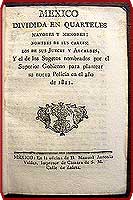
• Garritz, Impresos novohispanos, 1165; Medina, Mexico, 10591. Plain wrappers, lacking the engraved plan (which, though it is called for in the bibliographies, we have never seen in any copy in trade). Excellent copy.
Printed
to beSmuggled
into Mexico
Holbach, Paul
Henri Thiry, baron. Origen de la supersticion. Nueva-York:
se halla en la imprenta de Jose Desnoues, 1825. 12mo (18 cm; 7.125"). 222, [2
(last blank)] pp.
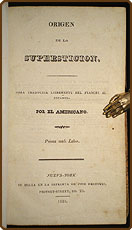
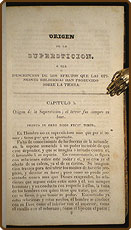
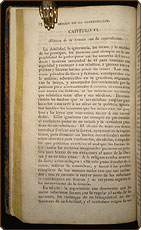
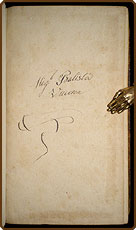 Click the interior images for enlargements.
 Fear of prosecution envelopes this New York edition as well, for, printed there because of the freedom of the press in the U.S., this was destined for export and smuggling into Spanish America where anti-religious writings and works advocating atheism were unlawful.
Rare. No copy traced via OCLC, NUC Pre-1956, Palau.
Provenance? Old inscription on rear free endpaper, upside down: “Mig.l Batista Varona.”
• Not in Shoemaker. Publisher's acid stained sheep, recently rebacked strongly and absolutely plainly (without label). Inscription as above, and another, less legible, in pencil on front free endpaper. Clean and with all edges saffron. (21281)

 TO Part V
. . .
TO Part V
. . . |