 AMERICANA TO 1820
AMERICANA TO 1820
AMERICANA TO 1820
 |
 PRE-1820 – ORDERED
BY DATE PRE-1820 – ORDERED
BY DATE
|
 The
Eliot Indian Bible
— A Leaf
from Daniel/Hosea
The
Eliot Indian Bible
— A Leaf
from Daniel/Hosea
 (A
Translation Landmark). Bible.
Algonquian. Eliot. 1663.
Mamusse wunneetupanatamwe Up-Biblum God naneeswe Nukkone Testament kah wonk
Wusku Testament. Ne quoshkinnumuk nashpe Wuttinneumoh Christ noh asoowesit John
Eliot. Nahohtãoeu ontchetãoe printeuoomuk. Cambridge [Mass.]:
Printeuoop nashpe Samuel Green kah Marmaduke Johnson, 1663. 4to (19 cm; 7.5").
[1] f.
(A
Translation Landmark). Bible.
Algonquian. Eliot. 1663.
Mamusse wunneetupanatamwe Up-Biblum God naneeswe Nukkone Testament kah wonk
Wusku Testament. Ne quoshkinnumuk nashpe Wuttinneumoh Christ noh asoowesit John
Eliot. Nahohtãoeu ontchetãoe printeuoomuk. Cambridge [Mass.]:
Printeuoop nashpe Samuel Green kah Marmaduke Johnson, 1663. 4to (19 cm; 7.5").
[1] f.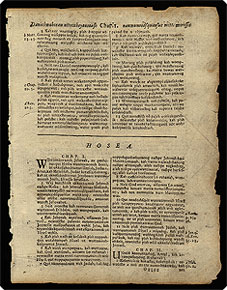
 Click the image for an enlargement.
 The text is Daniel 12:3 (being the end of Daniel's apocalyptic vision of the end days) though Hosea 1–3:5 (with its promises/foretelling of Israel's destruction). It is printed in roman brevier type, in double-column format, with generally 62 lines per column. It took 139 and a half weeks to set the type and print the Bible.
 The Bible was a monumental undertaking and achievement in its day and it remains an American monument today.
• Evans 73; Wing (rev. ed.) B2755; ESTC W38287; Darlow & Moule 6737; Pilling, Algonquian, 139–152; Pilling, Proof-sheets, 1175–77; Winship, Cambridge Press, pp. 208–44. Removed, inner margin slightly irregular; edges chipped (never approaching text) and light soiling.  Definitely, a treasure. (26071)
 Extra
Special
Extra
Special Grabhorn
Press Leaf
BookOne
of FIFTY Copies Only(Aitken
Bible Tribute). The
Bible of the Revolution. Signers' edition[:] containing
original leaves of both Old and New Testaments & an essay concerning it by
Robert R. Dearden, Jr. and Douglas S. Watson[.] San Francisco: Edwin & Robert
Grabhorn for John Howell, 1930. Tall 8vo (27 cm; 10.625"). Frontis., [1] f., pp.
[1–2], [4] ff. of facsimile, pp. [3–4], pp. 5–24, [2] ff., pp.
25–26, [2] ff. of facsimile, pp. 27–34; 3 ports., 1 illus., 4 facsims.
(including a 3-page letter from George Washington), 2 leaves from the Bible, 1
leaf from Franklin's Confession of Faith as below.
Grabhorn
Press Leaf
BookOne
of FIFTY Copies Only(Aitken
Bible Tribute). The
Bible of the Revolution. Signers' edition[:] containing
original leaves of both Old and New Testaments & an essay concerning it by
Robert R. Dearden, Jr. and Douglas S. Watson[.] San Francisco: Edwin & Robert
Grabhorn for John Howell, 1930. Tall 8vo (27 cm; 10.625"). Frontis., [1] f., pp.
[1–2], [4] ff. of facsimile, pp. [3–4], pp. 5–24, [2] ff., pp.
25–26, [2] ff. of facsimile, pp. 27–34; 3 ports., 1 illus., 4 facsims.
(including a 3-page letter from George Washington), 2 leaves from the Bible, 1
leaf from Franklin's Confession of Faith as below. 
the
first complete Bible in English printed in the U.S., the Grabhorns
produced an edition limited to 580 copies: 515 copies of the “Colonial
Edition,” 15 “editorial copies,” and 50 copies of the “Signers’
Edition."
We offer a copy of the last of those variants — the decidedly rare
Signers’ Edition. Bound in full morocco, it containstwo
original Bible leaves, one from the Old and one from the New Testament.
(The “Colonial Edition” contains only one leaf, from the Old Testament,
and it was bound in quarter leather.)
Single-click
either image, for an enlargement.

 The
Old Testament leaf here is from Isaiah (XXV:9–12, XXVI:1–XXVIII:1)
and the N.T. leaf is from I Corinthians (VII:1–VIII:7).
The
Old Testament leaf here is from Isaiah (XXV:9–12, XXVI:1–XXVIII:1)
and the N.T. leaf is from I Corinthians (VII:1–VIII:7).
Not content merely to double the ordinary offering of Aitken Bible leaves,
the Signers' Edition added  a
special insert on Benjamin Franklin that contains a third original leaf
— this from Franklin's 1745 printing of the Confession of Faith
— being, in this copy, the start of ch. XXVIII, “On Baptism.”
a
special insert on Benjamin Franklin that contains a third original leaf
— this from Franklin's 1745 printing of the Confession of Faith
— being, in this copy, the start of ch. XXVIII, “On Baptism.”
Found only here in the Signers’ Edition, in addition to the standard (and handsome) facsimile of a 3-page letter from George Washington, are a facsimile of Aitken's printing of the Declaration of Independence and a special frontispiece that presents facsimiles of all of the signatures of the signers of the Declaration of Independence.
All editions of this fine leaf book end with Edwin Grabhorn’s still-notable essay on typography in America at the time of the Revolution.
• Full crushed morocco, some spots to covers and without the slipcase; clean, and quite a good copy. (10453)


First Complete
Bible Printed
in the NEW
WORLDin
a European
LanguageBible.
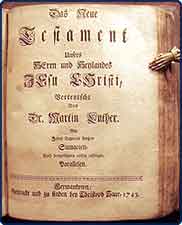
German. 1743. Luther.
[Biblia, das ist: Die Heilige Schrift Altes und Neues Testaments, nach der Deutschen
Uebersetzung D. Martin Luthers, mit jedes Capitels kurzen Summarien, auch beygefügten
vielen und richtigen Parllelen {sic}. Germantown: Gedruckt bey Christoph
Saur, 1743]. 4to (26.3 cm, 10.375"). [2] ff. (supplied in facsimile), 995, [1
(blank)], 277, [1] pp., [1] f. 

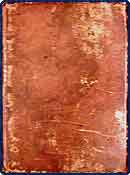 Arndt
lists three states for this edition, of which this appears to be C, based on
the absence of a two-leaf addendum giving a short history of Bible translation—that
a buyer could choose to have bound in or not.
Arndt
lists three states for this edition, of which this appears to be C, based on
the absence of a two-leaf addendum giving a short history of Bible translation—that
a buyer could choose to have bound in or not.
• Rumball-Petre, Rare Bibles, 159; Darlow & Moule 4240; O’Callaghan 22; Wright, Early Bibles of America, 24–44; Evans 5127–28; Sabin 5191; Arndt, The First Century of German Language Printing in the United States of America, 47C; Hildeburn, The Issues of the Press in Pennsylvania, 1685-1784, 804. Contemporary calf over bevelled boards. Binding scratched and abraded with tears to spine leather. Hinges (inside only) open. A printed poem has been affixed to the front pastedown, over a strip of cloth. Ownership inscriptions in German (in gothic cursive) and English on endpapers. Pp. 1–2 with loss of part of margins, some text, and part of headpiece, repaired with paper. Lightly age-toned with darker brown-spotting, some waterstaining, occasional dog ears, and some holing or chipping in the margins—some of the latter repaired with paper. First two leaves, i.e., main title-page and preface supplied in facsimile; the New Testament title-page is present.
 Saur Psalms, 1764 Bible. O.T. Psalms. German. Luther. 1764. Das kleine Davidische Psalterspiel der Kinder Zions. Germantown: Gedruckt bey Christoph Saur, 1764. 12mo. [3] ff., 570 pp., [12] ff.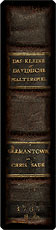
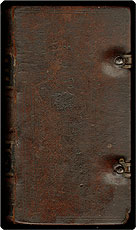
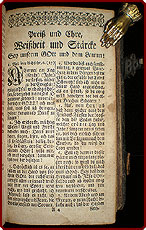 Click the images for enlargements.
 Provenance: Old inked inscription of John Ebersole, dated 1793, on front free endpaper; later pencilled signatures of Anna Ebersole and another person to pastedown.
• Evans 9602; Hildeburn, Pennsylvania, 2045; Arndt & Eck, First Century of German Language Printing in the U.S., 296; ESTC W20981. Contemporary calf with one clasp working and a remnant of the other; moderate rubbing to covers, leather on spine showing flex marks from the tight-back binding. Later spine labels. Faint library pressure-stamp on title-page; signatures as above. Age-toning and some staining; in fact the paper in cleaner condition than is often seen. (25959)
Saur's Lutheran Hymnal Bible. O.T. Psalms. Paraphrases, German. Vollständiges Marburger Gesang-Buch zur Uebung der Gottseligkeit, in 649 christlichen und trostreichen Psalmen und Gesängen Hrn. D. Martin Luthers. Germantown [PA]: Christoph Saur, 1770. (16.8 cm, 6.7"). Frontis., [12], 490, [15], 13, 83 (i.e., 84; 85/86 lacking) pp.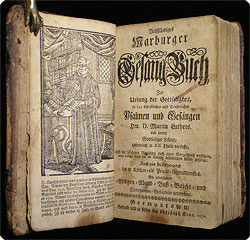
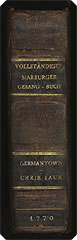 Click the interior image for an enlargement.
 The volume opens with a woodcut portrait of Martin Luther which according to Hamilton (cited in Reilly [see below]) “might have been made by Justu Fox who was working in Philadelphia at this time.”
• Evans 11714; Hildeburn, Pennsylvania, 2561; ESTC W21005; Warrington, History and Practice of Psalmody in the United States, p. 39; Reilly, Dictionary of American Printers' Ornaments & Illustrations, 1577. Contemporary sheep, rebacked some time ago, spine with gilt-stamped leather title-, place, “Chris. Saur,” and date labels; rubbed in the ordinary degree and with remnants of clasps. Back free endpaper lacking; pastedowns and blanks with old inked and pencilled signatures and writing practice(?) — which we do not make out much of, beyond “Johann(es).” Three leaves each with closed tear from outer margin extending into text; three index leaves with tattered outer edges, one with loss of lower outer portion; small section of pages with odd little dent to outer edge; last leaf present (and that leaf only) with a couple of pin-type wormholes; final leaf lacking. Pages age-toned, with moderate spotting and staining. Priced according to its described “issues,” not according to its considerable charm on shelf and in hand. (25105)
Campbell’s
Gospels in theFirst
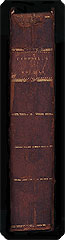
American EditionBible. N.T. Gospels. English. 1796. Campbell. The four Gospels, translated from the Greek. With preliminary dissertations, and notes critical and explanatory. By George Campbell. Philadelphia: Thomas Dobson, 1796. 4to (27.7 cm, 10.9"). vii, xvi, 488, 196 pp., [8] ff.
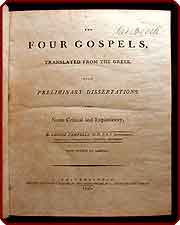
first
printing in America of the Gospels in English in any translation other than the King James or the Douai-Rheims version, this is also the first privately accomplished translation of the Gospels printed in America.
 George Campbell (1719–96) was a minister of the Church of Scotland, theologian, and principal of Marischal College. He wrote a number of theological works, including a defense of miracles in response to David Hume, and was noted for originality of argument as well as charity towards his opponents. This
translation of the Gospels was first published in England in 1789; the work consists of a preface and preliminary dissertations, the actual translation, and the notes, with the whole being very scholarly, resorting frequently to the Greek in the dissertations and notes.
George Campbell (1719–96) was a minister of the Church of Scotland, theologian, and principal of Marischal College. He wrote a number of theological works, including a defense of miracles in response to David Hume, and was noted for originality of argument as well as charity towards his opponents. This
translation of the Gospels was first published in England in 1789; the work consists of a preface and preliminary dissertations, the actual translation, and the notes, with the whole being very scholarly, resorting frequently to the Greek in the dissertations and notes.
Provenance: Title-page and contents leaf with early inked inscriptions reading “Jas. Booth.”
• ESTC W4383; Evans 30086; Hills, English Bible in America, 56. On Campbell, see: The Dictionary of National Biography. Contemporary treed sheep, rubbed and abraded with leather lost at corners/spine and cracking over joints and spine. Title-page and contents inscribed as described above; endpapers waterstained, and pages with light spots of foxing. Paper in many sections faintly blue.

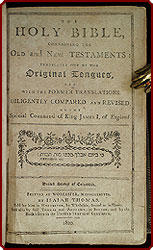
For the “United States of Columbia” Bible. English. 1800. Authorized (i.e., “King James Version”). The Holy Bible, containing the Old and New Testaments: Translated out of the original tongues, and with the former translations diligently compared and revised, by the special command of King James I, of England. Worcester, MA: Isaiah Thomas, 1800. 12mo (17.6 cm, 6.9"). [788 (of 792)] pp. (X1 and X12 lacking).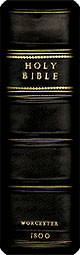
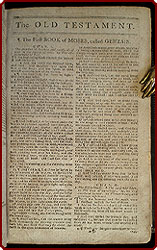 Click the images for enlargements.
  In an attempt to promote the idea of changing the country's name from the United States of America to the United States of Columbia, Thomas used the latter nomenclature on all issues of his proudly local, non-imported production.
ESTC and OCLC locate only eight institutional holdings, all in the U.S.
• ESTC W4503; Evans 36955; Hills 72; O'Callaghan 55 (for 1799 ed.). Period-style calf, framed and panelled in blind rolls, spine with gilt-stamped title and publication information and gilt-ruled raised bands, turn-ins blind-tooled. Two pages of Jeremiah (not consecutive) lacking. Pages age-toned with moderate staining; first and last few leaves with edge nicks, chips, and short tears; a few leaves creased; one leaf with lower margin chipped, resulting in loss of about four words. Some corners bumped or dog-eared. (26121)
A4-Volume
Philadelphia Bible,
1804Bible. English. 1804. Authorized (i.e., “King James Version”). The Holy Bible: Containing the Old and New Testaments; translated out of the original tongues, and with the former translations, diligently compared and revised. Philadelphia: Benjamin Johnson (pr. by Robert Carr), 1804. 8vo in 4s (22.2 cm, 8.75"). 4 vols. I: [234] ff. II: [280] ff. III: [230] ff. (lacking 1 contents f.). IV: [231] ff. (lacking 1 prelim. blank).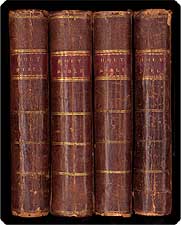
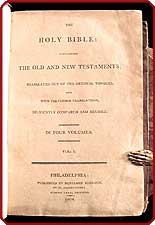
Provenance: Front free endpaperswith inscription reading “Mary Miller — Greenwich No. 2 10mo [?] 1st 1837.”
• Hills 114; Shaw & Shoemaker 5850. Contemporary sheep, abraded, with leather cracking over spines and joints cracked or cracking; spines with gilt-stamped leather title labels. Vol. III lacking first contents leaf; vol. IV lacking front free endpaper and preliminary blank. Occasional spots of foxing and varying degrees of age-toning; some leaves with edge chips.

AT LEAST THREE “FIRSTS” — First English SeptuagintBible. English. 1808. Thomson. The Holy Bible, containing the Old and New Covenant, commonly called the Old and New Testament: Translated from the Greek. By Charles Thomson.... Philadelphia: Pr. by Jane Aitken, 1808. 8vo. 4 vols. I: [252] ff. II: [245] ff. III: [222] ff. IV: [240] ff.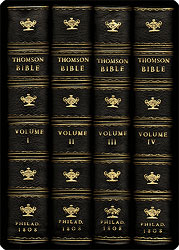
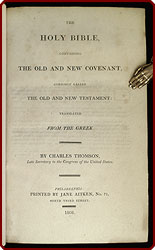 Click the images for enlargements. It was also the first translation of the Greek New Testament into English by a native of Ireland, and of course it is the work of a key figure of the American Revolution.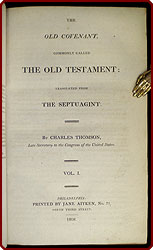
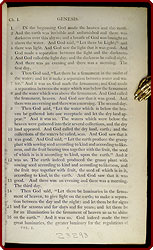
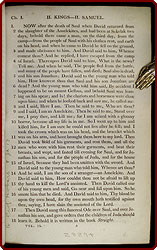
On 4 July 1776 only two signatures were affixed to the unanimously adopted Declaration of Independence — those of John Hancock, president of the Congress, and Charles Thomson, secretary, in order to authenticate the document that had been voted on and approved. Yet by a curious twist of fate (read rather, surely, of a political enemy's knife), when the calligraphic copy that is so well known to every school child was ready shortly after 19 July, authenticator Thomson was not invited to sign it!
When he had retired from public life in 1789, Thomson was to turn his interest in the Bible and Greek to the 20-year task of producing this monumentally important work.
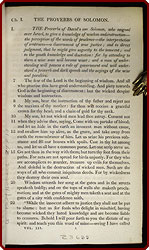
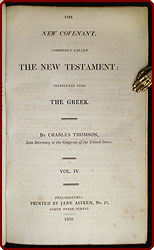
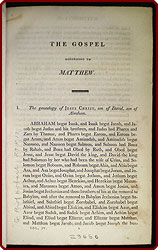
Its printer was the daughter of Robert Aitken, who had printed the first Bible in English in America. A major edition of the English Bible, this is essential for any Bible collection, not just for collections of American Bibles — though as an American Bible and simple Americanum it has a revered place.• Rumball-Petre, Rare Bibles, 184; Hills 153; Herbert 1514; O'Callaghan 91–92; Shaw & Shoemaker 14486. On Thomson, see: Dictionary of American Biography, XVIII, 481–82. Modern full black morocco, signed “GB” (Grace Bindings). Gilt spines. Black endpapers. The effect, richly elegant. Faintly visible pressure-stamps of a library (properly deaccessioned), each volume with neatly pencilled collection note and small old inked 5-digit number to first text leaf; in fact a remarkably clean, ever–well cared for, and handsome set. (26019)
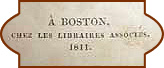
The Second American Printing of theFRENCH New TestamentBible. N.T. French. 1811. Le Maistre. Le Nouveau Testament de notre seigneur Jésus-Christ. Imprimé sur l'édition de Paris, de l'année, 1805. Revue et corrigée avec soin d'après le texte Grec. Boston<: Les Libraires Associés,
1811. 12mo (18 cm, 7"). 379, [1] pp., [2 (advertisements)] ff. 
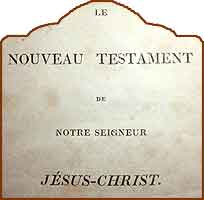
Provenance: Late-20th-century book label of Michael Zinman on front pastedown.
• Not in O'Callaghan; not in Darlow & Moule; Shaw & Shoemaker 22372. Treed sheep; flat spine with gilt rules and a black leather title label, gilt-lettered. Lightly rubbed, dry with some cracking. Inside, scattered spots of light browning and some chipping in the margins, the latter not affecting text. In fact, a nice copy. (4710)

 TO
Part IV . . . TO
Part IV . . . |