 THE CARIBBEAN
BENEDICTINES Come
to the New World
THE CARIBBEAN
THE CARIBBEAN
BENEDICTINES Come
to the New World A
FINE Engraved Title-Page & 18 Splendid Plates
A
FINE Engraved Title-Page & 18 Splendid Plates (A
Classic of 17th-Century Caribbeana). [Plautius,
Caspar]. Nova typis
transacta navigatio novi orbis Indiae occidentalis.... [Linz], 1621. Folio (32.6
cm, 12.875"). )(4 (-)(4, blank) A–M4 N4
(-N4, blank); Engr. t.-p., [2] ff., 101, [1] pp.; 18 plts.
(A
Classic of 17th-Century Caribbeana). [Plautius,
Caspar]. Nova typis
transacta navigatio novi orbis Indiae occidentalis.... [Linz], 1621. Folio (32.6
cm, 12.875"). )(4 (-)(4, blank) A–M4 N4
(-N4, blank); Engr. t.-p., [2] ff., 101, [1] pp.; 18 plts. 


 This
book bears an ornate, emblematic engraved title-page, with portraits of St.
Brendan and Boyl and more, and no fewer than 18 leaf-filling plates by Wolfgang
Kilian. These plates, which mixfancy and realism in entirely engaging ways, include
This
book bears an ornate, emblematic engraved title-page, with portraits of St.
Brendan and Boyl and more, and no fewer than 18 leaf-filling plates by Wolfgang
Kilian. These plates, which mixfancy and realism in entirely engaging ways, include
 a portrait of Columbus, a scene of St. Brendan celebrating mass on the back of a whale, botanical images of the marvelous Peruvian potato, and numerous views of
  the missionaries’interaction with the natives, some friendly, and some not—the unfriendliest being notably violent and gory. Also, on p. 35–36 is given an example of purported
 native
American music, with both words and notation. This copy is one (probably the first) of two states of this sole edition (with only three leaves in the preliminaries), without the additional foldout plate found in some copies.
native
American music, with both words and notation. This copy is one (probably the first) of two states of this sole edition (with only three leaves in the preliminaries), without the additional foldout plate found in some copies.


• Alden & Landis, European Americana, 621/100; Sabin 63367; Palau 224762. Binding as above and shown at left (distortion noted), chipped on corners and at head and foot of spine. Small wormholes visible on inside of covers, running into margins of pages and plates, and a few closed tears, neither affecting print or plates. Engraved title remounted. Small stains, light spots of waterstaining, and light soiling.
 A
very covetable illustrated Americanum of the early 17th century, in an enjoyable copy.
A
very covetable illustrated Americanum of the early 17th century, in an enjoyable copy.


 Single-click
any image above, for an enlargement.
Single-click
any image above, for an enlargement.


 BROUGHAM on Literature & Science — with MS. Letter Brougham, Henry Peter, Baron Brougham & Vaux. Addresses on popular literature, and on the monument to Sir Isaac Newton: Delivered at Liverpool and Grantham. London: Edward Law, 1858. 8vo. 63, [1] pp.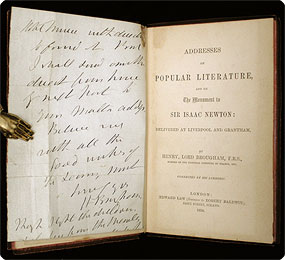
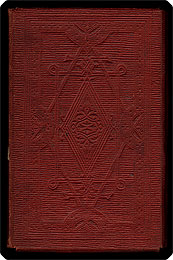
 Click the images for enlargements.
 Provenance: Ownership signature on front free endpaper, “Mr. Justice McDougall, Jamaica.”
Autograph manuscript addition: Tipped onto the title-page is a manuscript letter signed by Brougham, dated 1839. In this informal but warmly written letter apparently addressed to an uncle, he declines an invitation and briefly mentions “the children,” whom he thought were left safe from the measles at Paris; he had one living daughter at the time of this letter's composition, and may be referring to members of his extended family.
• NSTC 2B51067. Publisher's limp red cloth in imitation of morocco, yapp edges, covers blind-stamped, spine with gilt-stamped title; extremities rubbed, spine slightly darkened with small paper label, sides with small areas of minor discoloration. All edges stained red. Front free endpaper with early inked inscription and small private pressure-stamp. Pages age-toned; one early inked correction. (26986)


Explaining Haiti to the U.S. in 1837 Brown, Jonathan. The history and present condition of St. Domingo. Philadelphia: William Marshall and Co., 1837. 12mo (18.5 cm; 7.25"). 2 vols. I: iv, 307 pp. II: 289 pp.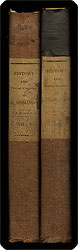
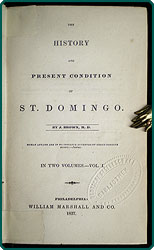 Click the image for an enlargement.
 Binding: Publisher's brown ribbon-embossed cloth with original paper spine labels.
• Sabin 8530; Palau 36231; Library Company, Afro-Americana (rev. ed.), 1701. On binding: Krupp, Bookcloth in England and America, 1823--50, Fs 1. Publisher's cloth, light spotting on covers with spine label of one volume chipped and the other faded; discoloration to head of spine head, vol. I, and strips of black cloth tape at head of spine and onto boards of vol. II. Ex–social club library: each volume with a 19th-century bookplate, call number on endpaper, pressure-stamp on title-page, no other markings. Title-page and front free endpaper of vol. I neatly joined/reinforced with old paper tape; a firm, decent set. (26410)

Legal Age for Marrying Charles IV, King of Spain. Begins: Don Carlos ... Con fecha de diez de Abril de este año he tenido a bien expedir mi Real Decreto del tenor siguiente.” [Madrid: No publisher/printer, 1803]. Folio. [4] pp. (last blank).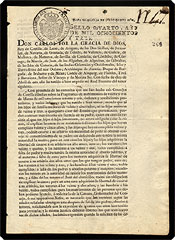
Signed by the crown with a wooden stamp, “Yo el Rey.”
This copy sent to Santiago, Chile, and docketed there.
• Removed from a nonce volume. Clean and untattered. (25817)
 “The most important documentary collection for colonial Spanish America” Coleccion de documentos ineditos relativos al descubrimiento, conquista y organizacion de las antiguas posesiones españolas en América y Oceanía. Madrid: Various publishers, 1864–84 & 1966. 8vo. 42 volumes.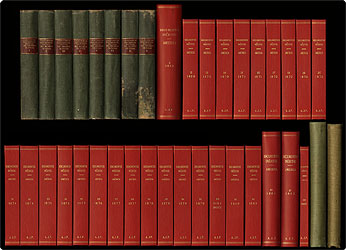
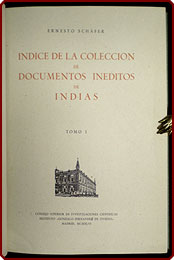
A mixed set in mixed bindings: all volumes except 11 are first editions, the exception being a 1966 reprint. Many original wrappers bound in. Volumes 1–10 in early quarter cloth, 11–42 in modern full cloth.
• Griffin, Latin America: A guide to the historical literature, 2063; Palau 56442. Bindings as above: Vols. 1–10 with abrasion/discoloration to spines, otherwise minor wear; moderate foxing, and some early annotations. Vols. 11–42, cloth bright; mostly clean internally, last 2 pages of last volume supplied in facsimile. Vol. 38 lacking fascicles 3, 4, 5, and 6. (25828)
Who's
In Charge of What
& How
Much They Are Paid
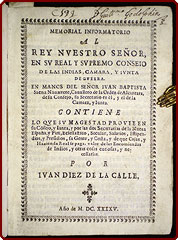
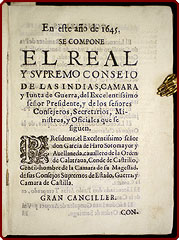
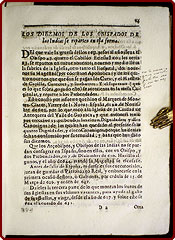
Díez de la Calle, Juan. Memorial informatorio al rey
nuestro señor, en su real y supremo Conseio de las Indias, Camara, y Junta de Guerra. [Madrid:
No publisher/printer], 1645. Small 4to. [11 (of 12)], 31 (of 32) ff. (lacks pi4 and a1).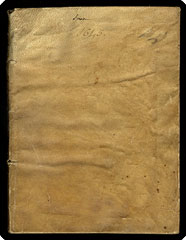
 Click the interior images for enlargements.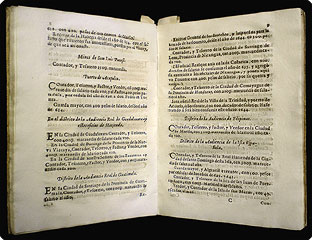
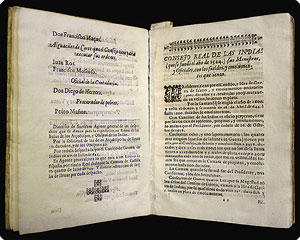
To aid in getting a refreshed grip on the administration of the New World, Philip IV of Spain asked Juan Díez de la Calle, a member of the Consejo de Indias, to produce a concise administrative handbook for use solely by the Council of the Indies, the King, and his close advisors. Here one finds all of the administrative divisions with dates of creation; office holders and their salaries and when the office was created; differences existing between administrative districts; and an interesting section on the various “annual” convoys (“armadas”) and the general in charge of each.
Provenance: Ownership signature at top of title-page of “Guill[er]mo Godolphin,” i.e., Sir William Godolphin.
• Alden & Landis, European Americana, 645/45; Palau 73741; Sabin 20133. Early limp vellum. Lacking two leaves: “Al Lector” leaf and the sectional title-leaf. A very good copy. (25808)
17th-Century
Spanish America
from anEnglishman’s
PerspectiveGage, Thomas. Manuscript on paper, in English. [New Survey of the West Indies]. Philadelphia?, mid 19th-century? 8vo (18.8 cm, 7.375"). [3 (blank)], [81], [1 (blank)] ff. 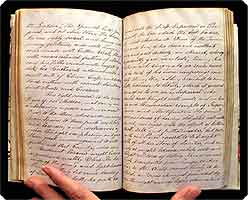
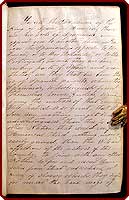 Single-click
either image for an enlargement.
Single-click
either image for an enlargement.
• On Gage, see: The Dictionary of National Biography,
XX, 353–55. Recent marbled paper over light boards. Second and third
blank leaves pasted together. Some light soiling, and some chipping and tears
without apparent loss of text. Rubber-stamps from a now-defunct library. The
paper here is decidedly blue; the hand is very readable.
For
our MSS in ENGLISH: Click here.  Or for VOYAGES,
TRAVELS, & books on"EXOTIC" PLACES, click
here.
Or for VOYAGES,
TRAVELS, & books on"EXOTIC" PLACES, click
here.
“Where theplantain growshot wind blows” Gilbert, James Stanley. Panama patchwork. Poems by James Stanley Gilbert. Illustrated. No place: no publisher, [1906]. 8vo. Frontis. port., x, 166 pp.; 20 plts. (incl. frontis.).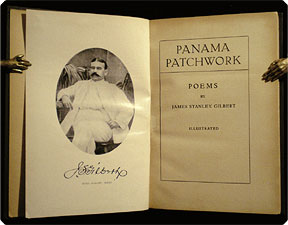
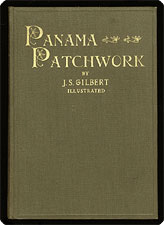
• Publisher's gilt-stamped green cloth. Lightly toned. Small abrasion on two pages, not affecting text. A very good copy. (23652)
Making West
Indies Investments Safe
for AllGreat
Britain. Laws, statutes, etc. 1760–1820 (George III).
Anno regni Georgii III...decimo tertio...[An act to encourage the subjects of
foreign states to lend money upon the security of freehold or leasehold estates,
in any of His Majesty’s colonies in the West Indies...]. London: Charles
Eyre & William Strahan, 1773. Folio (31 cm, 12.2"). [1] f., 299–306
pp.
West
Indies Investments Safe
for AllGreat
Britain. Laws, statutes, etc. 1760–1820 (George III).
Anno regni Georgii III...decimo tertio...[An act to encourage the subjects of
foreign states to lend money upon the security of freehold or leasehold estates,
in any of His Majesty’s colonies in the West Indies...]. London: Charles
Eyre & William Strahan, 1773. Folio (31 cm, 12.2"). [1] f., 299–306
pp. 
A good example of the solid, workaday English law-printing of its period, opening with an attractive foliate initial crowned with a seated griffin.
• ESTC N57352. Removed from a nonce volume. Pages clean save for some very minor browning in outer margins.
SO SAD! Jemmy &
Nancy of Yarmouth; or the constant lovers: A tragical ballad.
Glasgow: Pr. for the booksellers, [ca. 1835?]. 12mo. 8 pp. 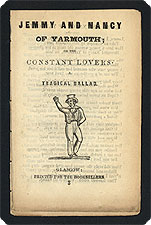
Barbados,
Jemmy is wooed by a wealthy "Barbadoes Lady," but he remains true to his love.
On the return journey to England, Nancy's father has him murdered. He appears
to Nancy as a ghost to claim her and she keeps her vows to him by drowning herself
in the sea. This uncommon Scottish edition bears a woodcut title vignette of
a young man dancing with one arm raised, with "[No.] 3" printed at foot of title.
• This ed. not in NSTC. Removed from a nonce volume. Page edges slightly darkened, otherwise clean. (16757)
FromNew England to the NILE[Justel, Henri, ed.]. Recueil de divers voyages faits en Afrique et en l’Amerique, qui n’ont point esté encore publiez.... Paris: Louis Billaine, 1674. 4to (23.7 cm, 9.4"). á4ã4A–Z4Aa–Hh4 Ii2Kk4Ll21§–4§45§2 **A–**C4 a2b–g4 *A–*K4L2; [8] ff., 262, 35, [1 (blank)] 23, [1 (blank)], 49, [1 (blank)] pp., [1] f., 81, [1 (blank)] pp., 3 fold. plans, 4 maps (3 fold.), 9 plts.
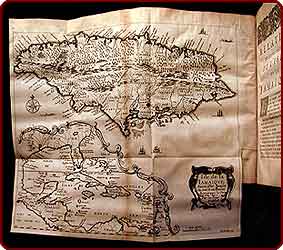
 Barbados, the Nile River, Ethiopia, “l’Empire du Prète-Jean,” Guiana, Jamaica, and the English colonies, with illustrations including banana and palmetto trees, Caribbean
pottery, and maps of New England, Jamaica
(including Florida and the Antilles), andBarbados.
Barbados, the Nile River, Ethiopia, “l’Empire du Prète-Jean,” Guiana, Jamaica, and the English colonies, with illustrations including banana and palmetto trees, Caribbean
pottery, and maps of New England, Jamaica
(including Florida and the Antilles), andBarbados.
Some of both the voyages and the maps make their first published appearances here—among them the New England map depicting the Maryland and Virginia coastlines, engraved by R. Michault after one contained in Richard Blome’s Description of the Island of Jamaica, part of which work appears here translated into French. Altogether, a volume notable both for its strong African and North American content and for the aesthetic appeal of its plates and pleasingly ornamented typography.

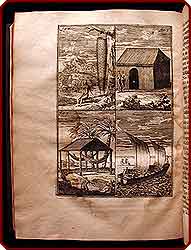 Single-click images where the hand appears on
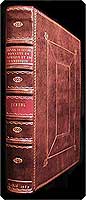 • Sabin
36944; Alden & Landis
674/159; Beinecke Lesser Antilles Collection 68; Baer, 17th-Century Maryland,
78. Recent 17th-century style mottled calf with covers framed in a gilt roll
and double-panelled in gilt fillets with gilt-stamped corner fleurons,; spine
with gilt-stamped leather title and author labels and gilt-stamped decorative
devices. Several pages (not including title) and the versos of a few plates
stamped by a now-defunct institution. Paper slightly embrittled. Light waterstaining
to a number of leaves and plates, mostly in margins; the first map with two
repairs. One leaf (blank?) prior to Colonies Angloises excised; lacking the folding map of the Nile. A good
copy, in a handsome binding of recent vintage and contemporaneous style.
• Sabin
36944; Alden & Landis
674/159; Beinecke Lesser Antilles Collection 68; Baer, 17th-Century Maryland,
78. Recent 17th-century style mottled calf with covers framed in a gilt roll
and double-panelled in gilt fillets with gilt-stamped corner fleurons,; spine
with gilt-stamped leather title and author labels and gilt-stamped decorative
devices. Several pages (not including title) and the versos of a few plates
stamped by a now-defunct institution. Paper slightly embrittled. Light waterstaining
to a number of leaves and plates, mostly in margins; the first map with two
repairs. One leaf (blank?) prior to Colonies Angloises excised; lacking the folding map of the Nile. A good
copy, in a handsome binding of recent vintage and contemporaneous style.

By anEye-Witness to the Action Knowles, Charles. An account of the expedition to Carthagena, with explanatory notes and observations. London: M. Cooper, 1743. 8vo (20 cm, 7.99"). [2] ff., 58 pp.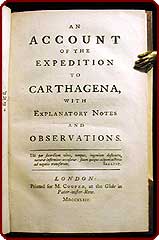
 Click the interior image for an enlargement.
 The Appendix here provides a fairly comprehensive exposition of the enemy's defensive position at the time of the English arrival, while the main body describes ship movements and land fortifications in detail.
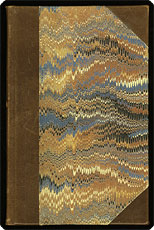
• ESTC T18830; Sabin 11128; Alden & Landis 743/1. On Knowles, see: The Dictionary of National Biography. Recent half calf with paper-covered sides; spine with gilt-stamped title. A clean and very good copy. (24824)
A Good, Old-Fashioned, INDEX to Complicated Law Stuff Perez y Lopez, Antonio Xavier. Teatro de la legislacion universal de España é Indias. Madrid: Various publishers, 1791–98. Small 4to. 28 volumes.

 Click the images for enlargements.
• Palau 221275; Sabin 60899. Modern quarter brown calf over marbled paper boards, with red and green spine labels. A clean, very nice set, with only a bit of minor dampstaining and the odd spot or paper flaw in all the many volumes. All edges red. (25829)

African-American Author on“HAYTI” — The First New-World Black-Ruled Nation Sanders (a.k.a. Saunders), Prince. By authority. Haytian papers. A collection of the very interesting proclamations, and other official documents; together with some account of the rise, progress, and present state of the kingdom of Hayti. London: Pr. for W. Reed, 1816. 8vo. [2] ff., xv, [1], 228 pp.


 Click the images for enlargements.


• Sabin 29578; not in Library Company, Afro-Americana, but see 9145 for the 1818 U.S. edition. Early 20th-century brown half-calf, gilt-stamped; rubbed on joints and corners. Ex-library (properly deaccessioned), with bookplates, call number on spine in gilt, pressure-stamp on title-page, abrasion to rear pastedown where once was a charge pocket. Occasional instances of spotting or soil; in fact, a good copy. (26021)
Avoiding
aU.S.
Navy Energy Crisis (1860)U.S.
House of Representatives. Committee on Naval Affairs. Contract
for coal...May 24, 1860. Mr. Morse, from the Committee on Naval Affairs, made
the following report. The Committee on Naval Affairs, to whom was referred so
much of the annual report of the Secretary of the Navy as relates to a "conditional
contract" made by him for the purpose of securing a supply of coal for the use
of the navy, and other privileges in the Republic of New Granada, report as follows...."
[Washington, D.C., 1860]. 2 parts in 1 vol. 79 pp., 3 large fold. maps; 15 pp.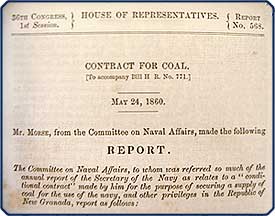
• Very Good condition, in recent wrappers.

Plan
del Perú — But Cuban
Content Also!
Vidaurre [y Encalada], Manuel Lorenzo de. Plan del Perú, defectos del gobierno español antiguo. Necesarias reformas....Contiene al fin...los motivos políticos que obligan á la isla de Cuba á declarar inmediatamente su independencia. Philadelphia: Impr. por Juan Francisco Hurtel, 1823. 8vo. 225, [1 (blank)] pp., [2] ff.
Cuban
Content Also!
Vidaurre [y Encalada], Manuel Lorenzo de. Plan del Perú, defectos del gobierno español antiguo. Necesarias reformas....Contiene al fin...los motivos políticos que obligan á la isla de Cuba á declarar inmediatamente su independencia. Philadelphia: Impr. por Juan Francisco Hurtel, 1823. 8vo. 225, [1 (blank)] pp., [2] ff.

In this work printed in Philadelphia, Vidaurre calls for republican reforms in Peru. This was a major change of political stance for him, for he had loyally served the crown in both his native Peru and, after the commencement of the Wars of Independence, in Spain. His attack on the Spanish political system and call for liberal republican reforms involves passionate denunciation of slavery, and his "renuncia" (pp. 197-225) speaks at length about Cuba's current socio-political conditions and explains why Cuba should follow the lead of the former Spanish colonies of the American mainland. On the basis of this work, which is dedicated to Simón Bolívar, The Liberator appointed Vidaurre head of the supreme court at Trujillo.
• Sabin 99491; Shaw & Shoemaker 14780. On Vidaurre, see: Archivo biográfico de España, Portugal, e Iberoamérica, fiche 1012, frames 251-56 & 261-62. Modern quarter green morocco and marbled paper sides. Foxing, some staining. Complete with the errata leaf, and solid.
Let's CelebrateOur Filibustering Spirit Wells, William Vincent. Walker's expedition to Nicaragua; a history of the Central America war; and the Sonora and Kinney Expeditions, including all the recent diplomatic correspondence, together with a new and accurate map of Central America, and a memoir and portrait of General William Walker. New York: Stringer and Townsend, 1856. 12mo (19 cm;
7.375"). Fold. map, vi pp., pp. [11]–316, without the frontis. portrait.

 Click the interior images for enlargements.
 As an historical record, this is probably the best contemporary account of Walker and the expedition. It details events up through Walker's “election” as president of Nicaragua and the subsequent U.S. recognition of his government in June 1856. Walker was forced out ten months later.
The large map of Central America opposite the title-page bears the imprint of J.H. Colton, New York, 1856, and includes insets of the Isthmus of Panama and “The Nicaragua Route” for getting from the U.S. eastern seaboard to California.
• Howes W256; Nicaraguan National Bibliography 20727 (not calling for the map). Not in Sabin. On Wells, see DAB, X, 646. Publisher's charcoal-colored cloth, stamped in blind on covers; spine with author's name, title, and Walker's logo of “Estado Soberano de Nicaragua” in gilt. Lacks the wood-engraved portrait of Walker. (24825)


PLACE AN ORDER | E-MAIL US | GO (BACK) TO TOPIC/INTEREST TABLE | PRB&M HOME
All material © 2010
The Philadelphia Rare Books & Manuscripts
Company