 WORLDWIDE CATHOLICA
WORLDWIDE CATHOLICA
WORLDWIDE CATHOLICA
 |
 ORDERED
BY DATE ORDERED
BY DATE
|
 French
 Woodcut-Illustrated
— Contemporary
Binding —
Vulgate
Woodcut-Illustrated
— Contemporary
Binding —
Vulgate Bible.
Latin. Vulgate. 1513. Biblia cum concordantiis veteris et novi testamenti
necnon et iuris canonici. Lugduni: M. Jacobum Sacon, 1513. Folio (34.5 cm, 13.5").
aa8 bb6 a–z8 A–Q8 R6
AA–BB8 CC10 (-aa1, CC9,10); [13], CCCXVII, [25] ff.
(lacking title-page & last 2 ff. of the Interpretationes).
Bible.
Latin. Vulgate. 1513. Biblia cum concordantiis veteris et novi testamenti
necnon et iuris canonici. Lugduni: M. Jacobum Sacon, 1513. Folio (34.5 cm, 13.5").
aa8 bb6 a–z8 A–Q8 R6
AA–BB8 CC10 (-aa1, CC9,10); [13], CCCXVII, [25] ff.
(lacking title-page & last 2 ff. of the Interpretationes).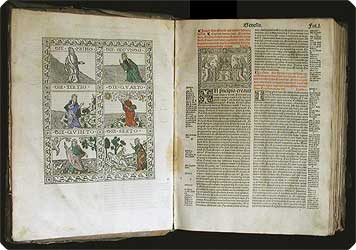
 Click any image where the hand appears on
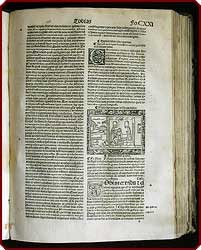
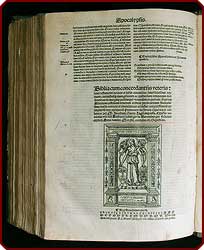
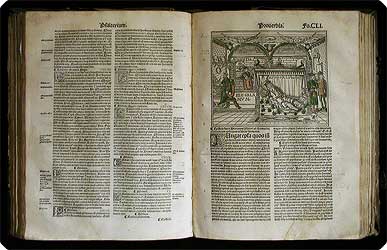
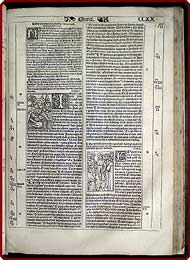
This Bible is illustrated with  two full-page and 130 in-text woodcuts (including some repeated images), a few of which have early hand-coloring, mostly but not entirely in green or
yellow. One full-page cut shows the six days of Creation — partially hand-colored in green, brown, red, blue, and yellow — while another depicts the manger scene. The text is followed by the Interpretationes nominum hebraicorum, a dictionary of Hebrew names often appended to manuscript and early printed Bibles.
two full-page and 130 in-text woodcuts (including some repeated images), a few of which have early hand-coloring, mostly but not entirely in green or
yellow. One full-page cut shows the six days of Creation — partially hand-colored in green, brown, red, blue, and yellow — while another depicts the manger scene. The text is followed by the Interpretationes nominum hebraicorum, a dictionary of Hebrew names often appended to manuscript and early printed Bibles.
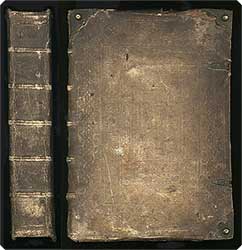
Binding: Contemporary blind-tooled, alum-tawed pigskin over beech boards, elaborately worked using embossing rolls with religious vignettes and busts. Covers with etched metal corner bosses and remnants of leather and metal clasps.
• Adams B988; c.f. Darlow & Moule 6101 & 6091. Binding as above, spine with hand-inked title; overall dust-soiled and darkened with several short tears to leather; leather no longer tight to the boards. Straps, clasp locking-mechanisms, and lower front metal corner now lost. Title-page and final two ff. of Interpretationes lacking; front pastedown separated from board and back pastedown lacking. First and last few leaves with insect damage to outer edges. First text page (contents) with old institutional rubber-stamp and shadow of pencilled numeral. A few leaves separated; a number of leaves with short tears from lower margins, a few extending into text, in many cases with traces of old repairs. Two leaves with lower outer corners torn away, one repaired some time ago. Pages age-toned, some waterstained. Scattered contemporary inked marginalia; some light underlining and a few instances of early inked doodling. Despite its faults, this is rare and imposing.
 An ILLUSTRATED RENAISSANCELarge Folio Bible Bible. Latin. Vulgate. 1529. Textus Biblie. [colophon: Impressum autem Lugduni {i.e.,Lyons}: per Joha[n]nem Crespin, M.ccccc.xxix {1529}]. Folio extra. [18], 268, [17] ff.
 Click the images for enlargement.
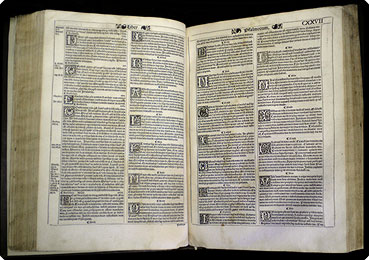
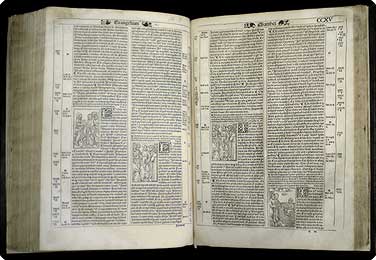
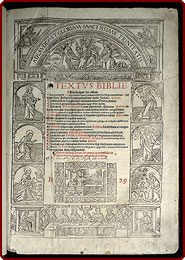
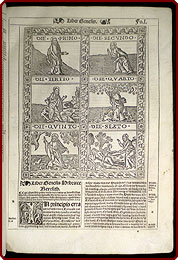
 more than 120 woodcuts. The woodcuts of the Old Testament are of good size, measuring approximately 3.8 x 6 cm (1.5" x 2.25") and with their four-element frames each one fills a text column left to right (5.5 x 8.5 cm; 2.25" x 3.25"). The cuts, “with the exception of the Creation, are close copies of those used in Jacques and Jean Mareschal's Lyons Bibles of 1523–1541" (Mortimer). They are also closely related to those used in Sacon's Bibles, which were by Hans Springinklee. The bottom border element on some has the initials “P B A” and the left and right elements of other frames read “Pour” “LEM.” The New Testament illustrations are smaller, 5.5 x 3.5 cm (2.25" x 1.375"), and each fills only half a column left to right.
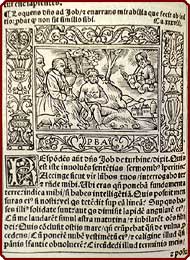
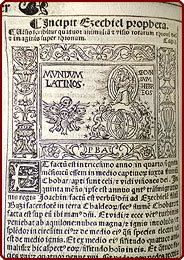
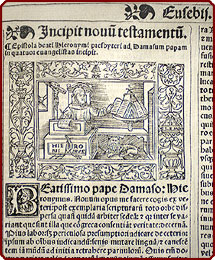
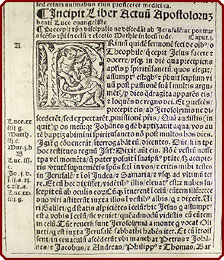
 Genesis opens with a gorgeous six-panel cut that is yet a bit larger, depicting God in His six days of Creation.
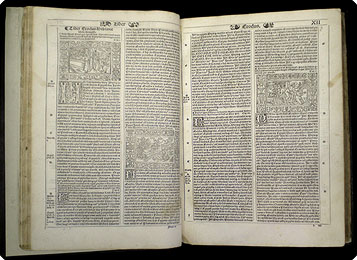
Evidence of readership: Scattered throughout are short marginal notes in a late 17th- or early 18th-century continental hand, in Latin, as well as underscoring and marks in the margins of important passages or words or thoughts.
This is the second Crespin edition, the first having appeared in 1527.
• Mortimer, French, 66; Fairfax-Murray, French, 36. Not in Darlow & Moule. Full calf old style: Round spine with gilt-accented raised bands and with title, place, and date gilt-stamped directly on spine; blind rules extending onto covers from each band to terminate in a trefoil, and covers framed in blind double fillets. Title-leaf crinkled; the occasional stain; moderate soil, light old staining, and/or wear variously to upper outer corners, lower gutter corners, and the odd foremargin, with a number of strengthenings to these instances. Marginalia slightly trimmed in 19th century. Library rubber-stamp on lower edges of closed volume; heavy library pencilling to a rear blank; no other such marks. Overall a good and satisfactory copy of a nicely illustrated Renaissance book. (24810)
Only
the Second
Printing
of theCatholic
New Testament
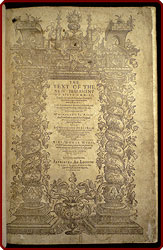
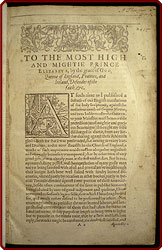
in EnglandBible. N.T. English. Rheims–Bishops’ version. 1601. The text of the New Testament of Jesus Christ, translated out of the vulgar Latine by the Papists ... at Rhemes ... Whereunto is added the translation out of the original Greeke, commonly used in the Church of England, with a confutation of all such arguments, glosses, and annotations, as conteine manifest impietie, of heresie ... against the Catholike Church of God ... [ed.] by W. Fulke. London: Robert Barker, 1601. Folio (31.5 cm, 12.25"). [21] ff., 914 [i.e., 912] pp., [5] ff.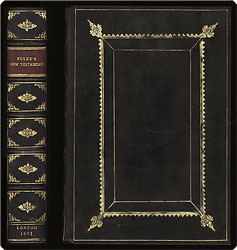
 Click the interior images for enlargements.
 As Darlow and Moule comment, “by printing the Rheims Testament in full, side by side with the Bishops' version, [Fulke] secured for the former a publicity which it would not otherwise have obtained, and was indirectly responsible for the marked influence which Rheims exerted on the Bible of 1611.” Alan Thomas elaborates by observing that “many a dignified or felicitous phrase was silently lifted by the editors of King James's Version, and thus passed into the language” (Great Books and Book Collectors, p. 108).
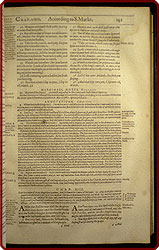
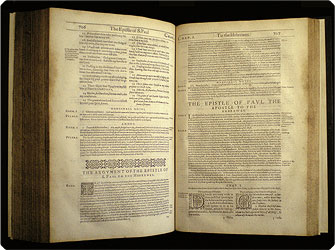 All early editions of the Rheims NT are important and most are scarce. The present one has a handsome architectural woodcut border on the title-page; it is signed by the woodcut artist, “N.H.” The text is printed in double-column format, with side- and shouldernotes and with the apparatus at the bottom of the page.
Provenance: Signature of a contemporary owner “A. Thorpe, York,” undated, on A2.
• STC 2900; Darlow & Moule 265; Herbert 265; ESTC S115769. Modern black calf, covers framed with single gilt rule and paneled in gilt rolls with corner fleurons. Title-page mounted, with outer edge and small hole in lower margin reinforced; dust-soiled. A2 with early inked ownership signature (see above) and notation; reinforced at hinge (inside). Other markings: two pages with marginal notations and four pages with corrections, both inked by an early hand. Bug-spotting on several preliminary leaves. Light waterstaining on some early and later leaves, with occasional odd stains and spots elsewhere, not impairing sense of text. Dust-soiling on index pages. Two preliminary leaves missing small pieces of paper in blank margins; small hole at top outer corner of Kkkk4; and small chip at top edge of Hhhh2. Fold-mark at top outer corner of Vvv2. In fact, a very nice copy of an important book. (24477)
Syers’s
Bible — A
GOOD
But DOOMED
Production
Bible. English. Douai–Rheims. 1811–13. The Holy Bible, translated from the Latin Vulgate... the Old Testament, first published by the English College at Doway, A.D. 1609, and the New Testament, first published by the English College at Rhemes, A.D. 1582; with annotations, references, and an historical and chronological index. Manchester: Oswald Syers, 1811–13. Folio (cm). [approx. 702] ff., lacking title–page, but having both cancel and cancelland of N.T. L2 present; (several signatures incorrectly signed); 19 plts. (1 excised & laid in).
DOOMED
Production
Bible. English. Douai–Rheims. 1811–13. The Holy Bible, translated from the Latin Vulgate... the Old Testament, first published by the English College at Doway, A.D. 1609, and the New Testament, first published by the English College at Rhemes, A.D. 1582; with annotations, references, and an historical and chronological index. Manchester: Oswald Syers, 1811–13. Folio (cm). [approx. 702] ff., lacking title–page, but having both cancel and cancelland of N.T. L2 present; (several signatures incorrectly signed); 19 plts. (1 excised & laid in).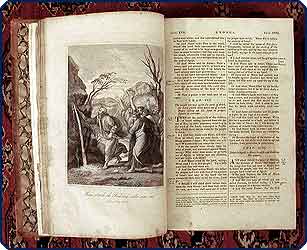
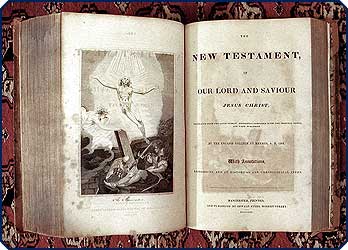 Click either image for an enlargement.
 The text generally follows the Challoner–Rheims revision, although the notes are collected from various sources. The volume is illustrated with two frontispieces and17 plates engraved by J. Bottomley, Symns and Mitchell, and others after paintings by Westall, Raphael, Reynolds, et al. Issued in parts in a small print run, this Bible is now uncommon.
• Darlow & Moule 1034. Contemporary treed calf, rebacked some time ago in plain calf with gilt-ruled bands and gilt-stamped title-label; sides rubbed and scraped, with spine scuffed, leather worn over extremities, front joint cracked from weight of oversized volume. Hinges (inside) reinforced with cloth tape. Lacking title-page. Plate from Genesis I:4 removed, and laid back in with margins cut away. First few leaves with edges ragged. Pages with offsetting around plates; occasional light spots of staining, mostly confined to outer margins.
 New Testament — “Old Catholic”Bible. N.T. Dutch. Verhulst. 1825. Het Nieuwe Testament van onzen heere Jesus Christus, vertaelt volgens de gemeyne Latynsche overzettinge ... Brussel: J.-B. Dupon, 1825. 12mo (17.2 cm, 6.75"). [6], 568 pp.
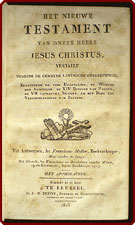
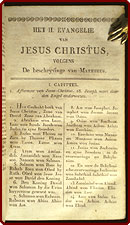
• Darlow and Moule 3369. Contemporary diced calf, spine tooled in blind, with gilt-stamped leather title-label; edges and joints rubbed, sides with minor abrasions, spine sunned. Front pastedown with traces of a now-absent bookplate. Some light foxing, mostly confined to first few leaves. Pp. 5/6 and 7/8 bound in out of order. One leaf with short tear from upper margin, touching a few letters; one leaf with upper outer corner torn away, with loss of two letters. All edges marbled.
 For
more BIBLES &
For
more BIBLES &

 TO Part
IV . . . TO Part
IV . . . |