 WORLDWIDE CATHOLICA
WORLDWIDE CATHOLICA
WORLDWIDE CATHOLICA
 An
An IRISH Bishop!
 M'Gee, Thomas D'Arcy. A life of the Rt. Rev. Edward Maginn, coadjutor bishop of Derry, with selections from his correspondence. New York: P. O'Shea, 1858. 8vo. xiii, [1], 359 pp.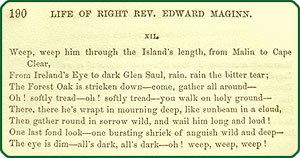
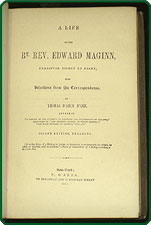
• Publisher's purple cloth, stamped in gilt on the spine; boards lightly soiled, corners bumped; spine sunned, pulled at head and foot, cloth of spine with a couple of very tiny tears and black spots. Front pastedown with bookplate. Small piece cut from bottom blank areas of four leaves of preliminaries, blank leaf at front torn out. Several pages with stains in margins. Very good. (14498)


 Micmac
Catechism With
Micmac
Catechism With Illustrations
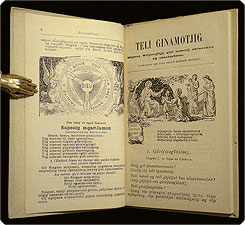
Maillard, Antoine Simon. Le catechisme Micmac.
Ristigouche, P.Q. [Quebec]: Freres mineurs capucins, [1921]. 12mo. 128, 32 pp.; illus.
Illustrations
Maillard, Antoine Simon. Le catechisme Micmac.
Ristigouche, P.Q. [Quebec]: Freres mineurs capucins, [1921]. 12mo. 128, 32 pp.; illus.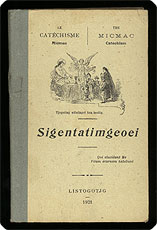
 Click
the images for enlargement.
Click
the images for enlargement.
Up to p. 112, this issue is a reprint of the second edition (with the title-page labeled Deuxième edition, giving a date of 1913), after which comes a section entitled “Alasotmaganel” (rather than the “Gis Oen Melgitimg” of the actual 1913 printing). The closing section, “Gtapegiemgeoel,” is the same in both printings. The publisher's binding gives the date of 1921 on the front cover!
• Publisher's quarter cloth with printed paper-covered sides; cloth and paper showing light wear. Some offsetting and paper punctured around binding staples, otherwise a nice, even fresh copy. (12614)
 Exact
& True?
(re: The “Popish
Plot”)
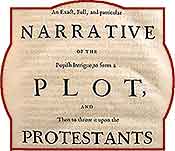
Mansell, Roderick. An exact and true narrative of the late Popish intrigue.... London: Tho. Cockerill & Benj. Alsop, 1680. Folio (30.5 cm, 12"). [A]2 b–c2 B–V2 (-O2, blank); [6] ff., 105 (i.e., 73), [1 (blank)] pp.
Exact
& True?
(re: The “Popish
Plot”)
Mansell, Roderick. An exact and true narrative of the late Popish intrigue.... London: Tho. Cockerill & Benj. Alsop, 1680. Folio (30.5 cm, 12"). [A]2 b–c2 B–V2 (-O2, blank); [6] ff., 105 (i.e., 73), [1 (blank)] pp. 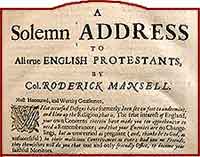
 •
ESTC R20941; Wing (rev.) M514. On the Popish Plot, see: New Catholic Encyclopedia,
X, 590–94; and the article on Titus Oates in The Dictionary of National
Biography, XLI, 296–303. Removed from a nonce volume with remnants
of previous binding at “spine” and two fly-leaves from the volume
remaining attached also, on the second of which is a list of contents in ink.
The leaves of this piece are numbered in ink consecutively on the upper outer
corners of the versos. Some staining, foxing, or soiling, and a few shallow
tears, with no loss of print. All edges speckled red.
•
ESTC R20941; Wing (rev.) M514. On the Popish Plot, see: New Catholic Encyclopedia,
X, 590–94; and the article on Titus Oates in The Dictionary of National
Biography, XLI, 296–303. Removed from a nonce volume with remnants
of previous binding at “spine” and two fly-leaves from the volume
remaining attached also, on the second of which is a list of contents in ink.
The leaves of this piece are numbered in ink consecutively on the upper outer
corners of the versos. Some staining, foxing, or soiling, and a few shallow
tears, with no loss of print. All edges speckled red.

Wonderful “Peasant”(!)
Binding
Martin, von Cochem. Der grosse Baumgarten.
Sulzbach: Im verlage der J. E. Seidelschen Kunst- und Buchhandlung, 1807. 8vo (18.5 cm;
7.375"). Frontis., [9] ff., 688 pp., [6] ff., 16 plts.
“Peasant”(!)
Binding
Martin, von Cochem. Der grosse Baumgarten.
Sulzbach: Im verlage der J. E. Seidelschen Kunst- und Buchhandlung, 1807. 8vo (18.5 cm;
7.375"). Frontis., [9] ff., 688 pp., [6] ff., 16 plts.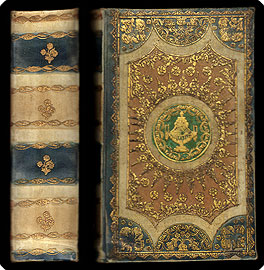
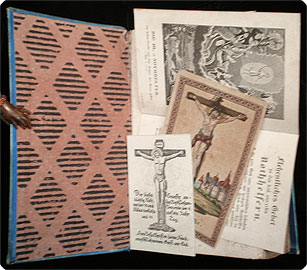 Click the images for enlargements. 16
woodcut plates.
Click the images for enlargements. 16
woodcut plates. 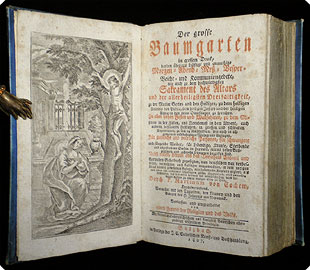
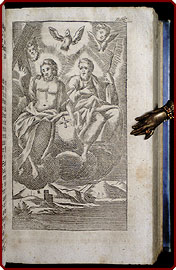
The vellum binding is elaborately tooled in gilt and in-painted in blue, green, and salmon. All edges are gilt and gauffered.
• Binding as above with light rubbing. A very handsome, interestingly late example of this uncommon binding style. (26690)

Holy History & Christ’s Life, for  the “Lake of Two Mountains”Mathevet, Jean-Claude. Ka titc Jezos Tebeniminang Ondaje Aking Enansinaikatek Masinaigan Ki Ojitogoban Kaiat Pejik Kanactageng Daje Mekatewikonaietc J. Cl.
Mathevet Enawindibanen. Vie de Notre-Seigneur Jésus-Christ par J. Cl. Mathevet, Ancien missionnaire du Lac des Deux-Montagnes. Deuxième édition, revue avec soin. Montréal: J.M. Valois, Libraire-Éditeur, 1892.
12mo (15.7 cm, 6.2"). xi, 384 pp.
the “Lake of Two Mountains”Mathevet, Jean-Claude. Ka titc Jezos Tebeniminang Ondaje Aking Enansinaikatek Masinaigan Ki Ojitogoban Kaiat Pejik Kanactageng Daje Mekatewikonaietc J. Cl.
Mathevet Enawindibanen. Vie de Notre-Seigneur Jésus-Christ par J. Cl. Mathevet, Ancien missionnaire du Lac des Deux-Montagnes. Deuxième édition, revue avec soin. Montréal: J.M. Valois, Libraire-Éditeur, 1892.
12mo (15.7 cm, 6.2"). xi, 384 pp.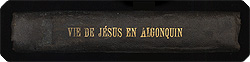
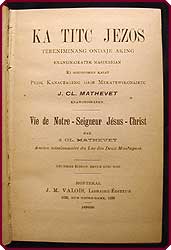
• Cf. Banks, 147; cf. Pilling, Algonquian, 345, for first (1861) ed. Not in Evans. Publisher’s cloth, with binder's title “Vie de Jésus en Algonquin”; cloth a bit wrinkled over spine and showing slight rubbing over corners, with signs of a now-absent shelf label on spine. Pages age-toned and a bit brittle as of the era, with sewing starting to loosen for some signatures. Back free endpaper with portion of upper margin torn and affixed to back pastedown.

This Hadat Least One Ardent ReaderMaurel, Antoine. The church and the sovereign pontiff. An analytical catechism. Dublin: James Duffy & Sons, 1878. 8vo. [12], xxiv, [4], [xiii]-xxvii, [1], 304 pp.
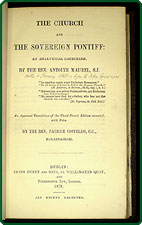
• Publisher's blind-stamped cloth, spine with gilt-stamped title; cloth showing light wear over extremities and sides. Last few leaves with mild foxing. Text with pencilled marks of emphasis, including exclamation marks added at interesting points. (13564)

 Lord
Save Us — An AttractiveSMALL
Broadside(Medical
Prayer). Broadside.
Begins: "Deprecacion contra la peste. Al divino rostro." [Mexico City, ca. 1830–50].
12mo (165 x 112 mm; 6.5" x 4.5). [1] f.
Lord
Save Us — An AttractiveSMALL
Broadside(Medical
Prayer). Broadside.
Begins: "Deprecacion contra la peste. Al divino rostro." [Mexico City, ca. 1830–50].
12mo (165 x 112 mm; 6.5" x 4.5). [1] f.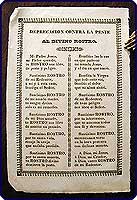 worried
devout.
worried
devout.
• Slightly irregular margins, as issued. Handsome.

The Grand Inquisitor of MANTUA Medicis, Girolamo de. Summae theologiae S. Thomae Aquinatis doctoris angelici, explicatio formalis, qua redactis ad formam syllogisticam argumentis & rationibus, textuq[ue] diligenter enucleato, mens sancti doctoris apertissime traditur & explanatur auctore R.P.F. Hieronymo de Medices. Coloniae: Sumptibus Conradi Butgenii, 1622. 8vo. [16] ff.,
1352 pp.
MANTUA Medicis, Girolamo de. Summae theologiae S. Thomae Aquinatis doctoris angelici, explicatio formalis, qua redactis ad formam syllogisticam argumentis & rationibus, textuq[ue] diligenter enucleato, mens sancti doctoris apertissime traditur & explanatur auctore R.P.F. Hieronymo de Medices. Coloniae: Sumptibus Conradi Butgenii, 1622. 8vo. [16] ff.,
1352 pp. 
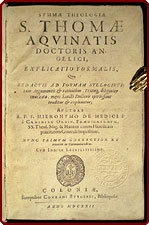
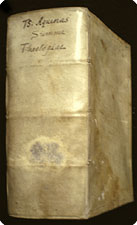 Click the interior image for an enlargement.
 According to the colophon: “Finit explicatio formalis totius primae partis Summae theologiae Sancti Thomae Aquinatis . . . Die 21. Decembris anni 1611 . . . Mantuae in aedibus Sanctissimae Inquisitionis.” The earliest edition in any U.S. library is the Venice, 1614 edition. This 1622 printing is reported as owned by only one U.S. institution, this copy having been deaccessioned by the other library of record.
• VD17 12:643261D. Contemporary vellum over light boards, small area of discoloration on spine; lacks the silk ties, bookplate removed, old library pressure-stamp on title (properly deaccessioned), NO rubber stamps. All edges stained blue. A very nice copy. (20728)
 Mere Angélique &
Her Works Memoires pour servir a l'histoire de
Mere Angélique &
Her Works Memoires pour servir a l'histoire de Port-Royal, et à la vie de la Reverende Mere Marie Angelique de Sainte Magdeleine Arnauld reformatrice de ce monastere. Utrecht: Aux depens de la Compagnie, 1742. 12mo. 3 vols. I: [2] ff., xx, 611, [1] pp. II: [2] ff., 621, [1] pp. III: [2] ff., 618 pp.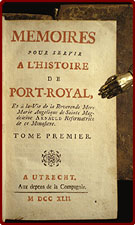
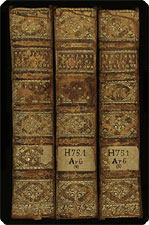 Click the interior image for an enlargement.
 • Contemporary mottled calf, spines with gilt-stamped leather title-labels, spine compartments with gilt-stamped floral decorations; covers mildly acid-pitted and considerably abraded, with leather lost at head of spine, corners, and joints. Spines with paper shelving labels or remnants thereof; front pastedowns each with bookplate. All edges marbled. Faint pencilled marginalia and bracketing; intermittent offsetting. (22804)
 For more SETS, click here.
Mercedarians
in Lima
— 1804Mercedarians. Third Order. Breve compendio de las reglas, constituciones, privilegios, gracias é indulgencias, de la Real Tercera Orden de Nra. Sra. de la Merced, nuevamente restablecida en la iglesia del convento grande de S. Miguel de Lima.... Lima, [1804]. 4to (19.8 cm, 7.75"). [33] ff. 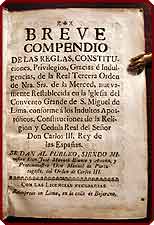
This document gives the rules, constitutions, privileges, and indulgences of the third order in Lima on the occasion of its reestablishment at the conventual church of St. Michael. A fine woodcut of the arms of the Mercedarian order, surrounded by a typographic border, graces the verso of the title-leaf.
This is the first edition of the Breve compendio; it was reprinted in 1870.
• Medina, Lima, 1945. Limp vellum lightly cockled and a little stained/soiled, with small hole to front cover from a defect in the skin; traces of adhesive on covers and a small paper label on front one. One small wormhole piercing margin of some leaves; traces of soiling and very light waterstaining. Library bookplate and personal rubber-stamp on front pastedown; old call number neatly penned (and crossed out) on title-page verso.

Anabaptists Anathemized Meshovius, Arnold. Historiae anabaptisticae libri septem: quibus eius sectae in multiplices sectas iam scissae, ortus, primi authores, progressus ... prophetae & reges monstrosi ... explicantur. Coloniae: apud Gerhard Grevenbruch, 1617. 4to (19.5 cm; 7.75"). [6] ff., 214 pp., [1 (errata)] f. 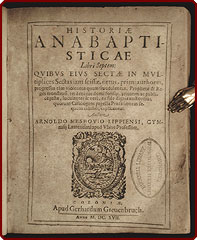
 Click the images for enlargements.
 The work is printed in a small roman type, dense on the page within a ruled border, with side- and shouldernotes. There are occasional woodcut historiated initials and head- and tailpieces.
• Hillerbrand 2441. Contemporary limp vellum lacking the ties; light waterstain on front pastedown. A totally browned copy (too much ferrous material in the water of the paper manufacture), yet not a tattered or fragile one. A few short tears, repaired. Old, large, oval stamp of a defunct seminary on title-page and one other. (26197)
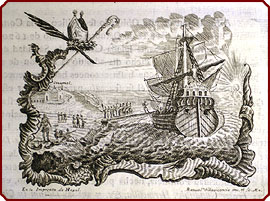
WONDERFUL
Culs-de-Lampe by
Villavicencio
& NavarroMexico
(ecclesiastical province). 1st & 2nd Concilia (1555, 1565).
Concilios provinciales primero, y segundo, celebrados en la muy noble,
y muy leal Ciudad de México, presidiendo el Illmo. y Rmo. Señor
D. Fr. Alonso de Montúfar, en los años de 1555, y 1565. En México:
En la Imprenta de el Superior Gobierno, de el Br. D. Joseph Antonio de Hogal,
1769. Folio (27 cm; 10.5"). [10], 34, [2], 35–38, 41–184, [2], 185–396,
[12] pp.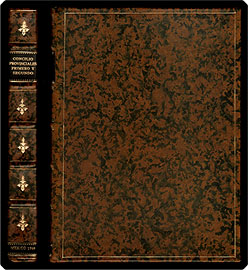
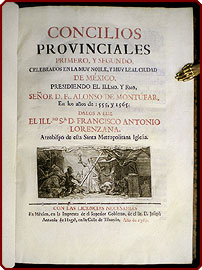
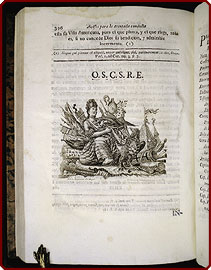
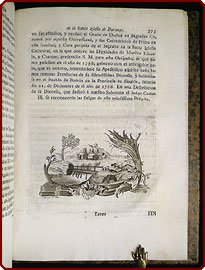 Click the images for enlargements. This text is from the press of José Hogal,
who is often called the Baskerville of Mexico.
Click the images for enlargements. This text is from the press of José Hogal,
who is often called the Baskerville of Mexico.
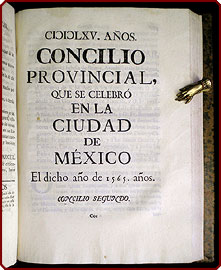
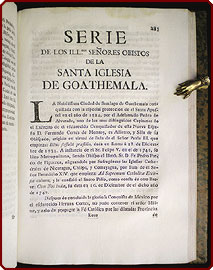
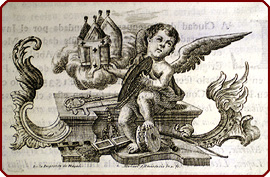
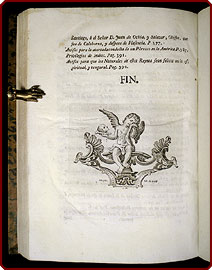
The force behind this edition was archbishop Francisco Antonio Lorenzana (1722–1804), a patron of Hogal's press and of the arts, who soon after assuming the archbishopric of Mexico in 1766 saw the need for a concilium. In preparation for it he paid Hogal to publish or republish, as was the case, the acts of the first three provincial councils of Mexico, held respectively in 1555, 1565, and 1585; these appeared in 1769 and 1770. In 1771 he himself held the fourth Mexican provincial synod; ironically, those acts were not published until 1898.
• Medina, Mexico, 5299; Palau 142387; Sabin 42063.
Recent Spanish sheep mottled in the Valenciana style. Occasional light waterstain
in some upper margins, never in text. Paper crisp and printing very sharp.
 A
very good copy. (26797)
A
very good copy. (26797)
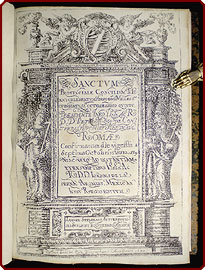
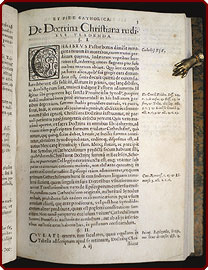
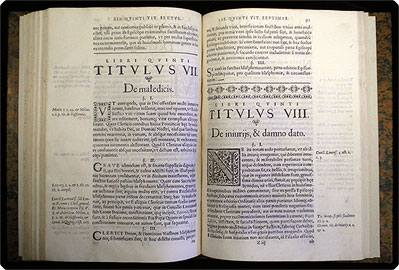
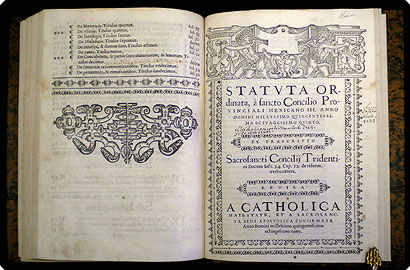
Attempting aCOMPULSORY Social Code for New SpainA Juan Ruíz Imprint Mexico (ecclesiastical province). 3rd Concilium. Sanctum provinciale concilium mexici celebratum anno dñi milless.mo quingetess.mo octuagessimo quinto. [Mexici]: Apud Ioannaem Ruiz, 1622. Folio. [5 (of 6)], 102, [1], 38, [1] ff. (lacks title-leaf, supplied in facsimile).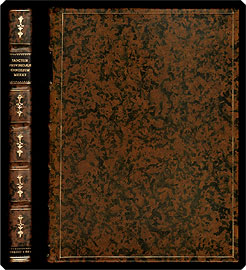
 Click the images for enlargements.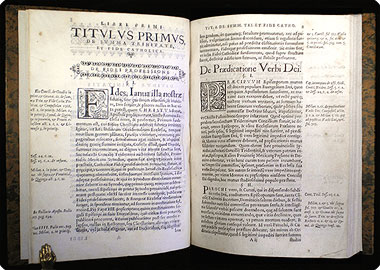
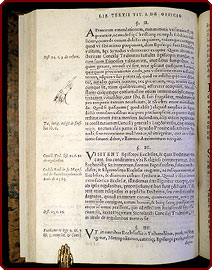
 The printer of this work, Juan Ruíz, was an important figure in colonial Mexican book arts and his books are among the most elegant produced during the 17th century in the New World. Here he provides handsome typography, accented with wonderful and large woodcut initials, some historiated, and a woodcut title-page border element originally cut for the incunable-era printer Antonio Espinosa, bearing his initials!
Evidence of readership: In addition to the expected marking in margins indicating important statement in the text (which is extensive in this copy), folios 17r, 17v, and 18r of the second foliation have interesting marginalia.
&
ANOTHER
from the
Hogal Press
Mexico
(ecclesiastical province). 3rd Concilium.
Concilium Mexicanum Provinciale III celebratum Mexici anno MDLXXXV. Praeside
D.D. Petro Moya, et Contreras archiepiscopo ejusdem urbis. Confirmatum Romae
die XXVII. Octobris anno MDLXXXIX. Mexici: Ex typ. Bac. Josephi Antonii de Hogal,
[1770]. Folio (27 cm; 10.5"). [6] ff., 328 pp., [3] ff., 141, [1] pp., [2] ff.
the
Hogal Press
Mexico
(ecclesiastical province). 3rd Concilium.
Concilium Mexicanum Provinciale III celebratum Mexici anno MDLXXXV. Praeside
D.D. Petro Moya, et Contreras archiepiscopo ejusdem urbis. Confirmatum Romae
die XXVII. Octobris anno MDLXXXIX. Mexici: Ex typ. Bac. Josephi Antonii de Hogal,
[1770]. Folio (27 cm; 10.5"). [6] ff., 328 pp., [3] ff., 141, [1] pp., [2] ff.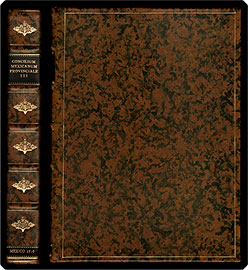
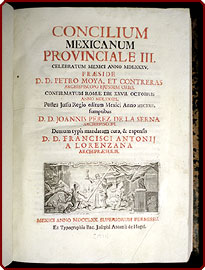
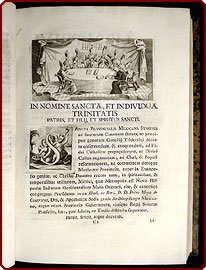
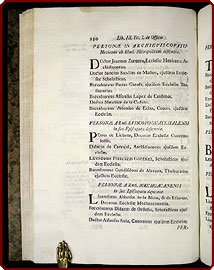 Click the images for enlargements.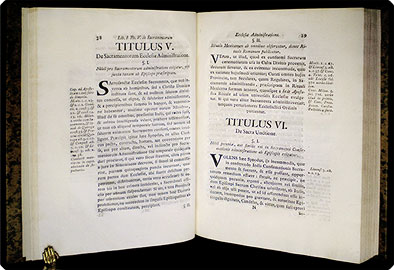
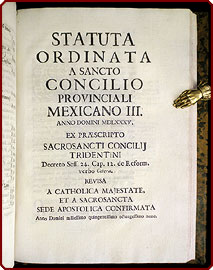
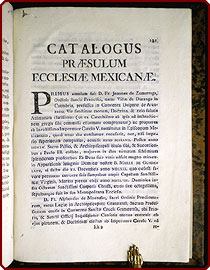
The Third Mexican Concilium, which was celebrated in Mexico city in 1585, had been called by Archbishop Moya de Contreras with the object of producing a comprehensive and compulsory social code for New Spain. The code was shaped, but only those rules directly affecting the conduct of priests (regular and secular) and nuns (cloistered and not) were promulgated.
The force behind this edition was archbishop Francisco Antonio Lorenzana (1722–1804), a patron of Hogal's press and of the arts, who soon after assuming the archbishopric of Mexico in 1766 saw the need for a concilium. In preparation for it, he paid Hogal to publish or republish, as was the case, the acts of the first three provincial councils of Mexico, held respectively in 1555, 1565, and 1585; these appeared in 1769 and 1770. In 1771 he himself held the fourth Mexican provincial synod; ironically, those acts were not published until 1898.
• Medina, Mexico, 5361; Palau 142389; Sabin 42064 .
Recent Spanish sheep mottled in the Valenciana style. Minor worming at some
inner margins, never in text. Paper crisp and printing very sharp. A very good copy. (26794)
Ending an Amnesty for Rebels Mexico. Inquisition. Broadside, begins: Nos los inquisidores apostolicos, contra la herética pravedad y apostasía en la ciudad de México, estados y provincias de esta Nueva España, Guatemala, Nicaragua, Islas Filipinas, sus distritos y jurisdicciones ... Sabed, que el ... Inquisidor General ha mandado publicar ... un edicto del tenor siguiente ... Bien sabeis como por nuestros edictos de dos de enero y diez de febrero, y con mas amplitud por el de cinco de abril del año proximo pasado, hemos llamado ... á todos los que se sintieren gravados con el horrendo crímen de la heregía ... ofreciéndoles la reconciliacion y absolucion de todos ellos ... Dado en la Inquisicion de México á ocho de junio de mil ochocientos diez y seis.... Mexico: 8 June 1816. Folio extra (60 cm; 23.5"). [1] p.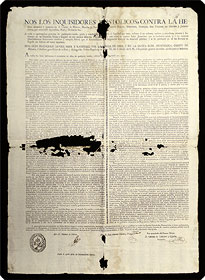
Click the image for an enlargement. Signed by each Mexican Inquisitor with his paraph and with the woodcut seal of the Inquisition in the lower left corner
Very uncommon: We trace only one copy in the U.S. — at the University of California at Berkeley.
• Not in Medina, Mexico. Several holes of various sizes, including one very large one in the middle of the first column, with loss of paper costing words and whole sentences. Otherwise, light staining and some instances of soiling most notably around the holes, only. Priced accordingly. (17028)
 Mexicana, from “contact” to Independence, is one of our
specialties.
Mexicana, from “contact” to Independence, is one of our
specialties.
The full MEXICANA “webshelf”
presents additional items of that Catholic era
not shown here — to browse, click here.
 TO Part
XIV . . . TO Part
XIV . . . |