 EGYPT
EGYPT
EGYPT
EGYPT
 Illustrated & Annotated
 Arabian Nights. The thousand and one nights, commonly called, in England, the Arabian nights’ entertainments. London: Charles Knight & Co., 1839–41. 8vo (25.3 cm, 10"). 3 vols. I: Add. engr. t.-p., xxiii, [3], [xxv]–xxxii, 618 pp.; illus. II: Add. engr. t.-p., xii, 643, [1] pp.; illus. III: Add. engr. t.-p., xii, 763, [1] pp.; illus.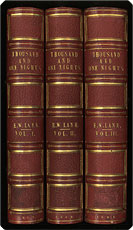
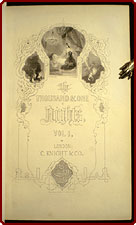
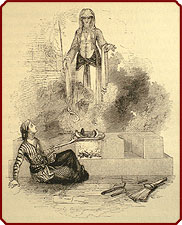
 Click the interior images for enlargements.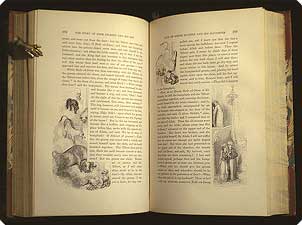
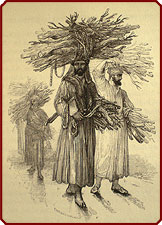
 A lavishly produced set, attractively illustrated and bound.
 For more SETS, click here.

 ABCs around the WORLD — Illustrated Diderot, Denis. Caractères et alphabets de langues mortes et vivantes (Extracted from the Encyclopédie, ou dictionnaire raisonné des sciences, des arts et des métiers). [Paris: ca. 1750–72]. Folio (30.5 cm, 12"). 24 double-p. plts. (of 25).
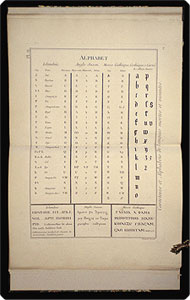
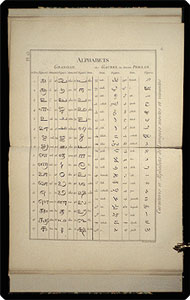
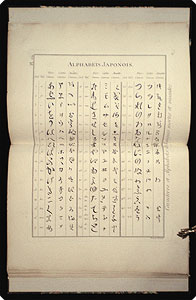 Click the images for enlargements. 24 double-spread engraved plates of alphabets for various languages. They were engraved for the article on alphabets in the Diderot Encyclopédie, a massive 20-year project aiming to encompass every branch of human knowledge that was a landmark of Enlightenment-era philosophy, attacking superstition while promoting science, rationality, and scholarship. Many of the volumes were supplemented with illustrations, such as the plates present here, designed to facilitate comparing and contrasting the alphabets and basic writing conventions of “dead and living” languages.
Languages charted in these tables include “Tartares Mouantcheoux,” Tamoul, Telongou, Persian (ancient and modern), Armenian, Russian (ancient and modern), Coptic, Hebrew, etc., with the engraving done by master artisan Robert Bénard (fl. 1750–85).
• Half green calf with green marbled paper–covered sides, spine with gilt-stamped title; slight wear to corners and spine extremities. Lacking one plate (#25). (24823)

 Rare
Variant — “WE”
Binding Detail —
Sunderland
Copy
Diodorus Siculus. Diodorus Siculus. [Operum lib. vi. priores, Latine Poggio interprete.] [Paris]: [pr. by Jean Marchant for] Jean Petit, [ca. 1507]. 4to. a–v8.4x6y4; 123, [6] ff. [bound with] Justinus, Marcus Junianus. Justini historia ex Trogo Pompeio quattor & triginta epithomatis collecta; acc. Lucius Florus et Sextus Rufus. [Paris]: De Marnef, [ca. 1507]. 4to. A8B4C6a–y8.4z6&4; [18], 140 ff.
Rare
Variant — “WE”
Binding Detail —
Sunderland
Copy
Diodorus Siculus. Diodorus Siculus. [Operum lib. vi. priores, Latine Poggio interprete.] [Paris]: [pr. by Jean Marchant for] Jean Petit, [ca. 1507]. 4to. a–v8.4x6y4; 123, [6] ff. [bound with] Justinus, Marcus Junianus. Justini historia ex Trogo Pompeio quattor & triginta epithomatis collecta; acc. Lucius Florus et Sextus Rufus. [Paris]: De Marnef, [ca. 1507]. 4to. A8B4C6a–y8.4z6&4; [18], 140 ff.

 Egyptians,
helps document the derivations of the Greek and Roman gods and also preserves
fragments of the sources he consulted. Only 15 books of this history of the
world survive intact; the noted Renaissance scholar Poggio Bracciolini
provided this translation of the first six from the original Greek for Nicholas
V.
Egyptians,
helps document the derivations of the Greek and Roman gods and also preserves
fragments of the sources he consulted. Only 15 books of this history of the
world survive intact; the noted Renaissance scholar Poggio Bracciolini
provided this translation of the first six from the original Greek for Nicholas
V.
Diodorus's work is here accompanied by Justinus’s abridged version of Trogus Pompeius’s history. Both books feature striking capitals and title-page devices. The typography of the first book is Jean Marchant’s, done for Jean Petit whose lion-and-leopard device is prominently displayed. The second book’s device shows initials of two of the three de Marnef brothers (E and G) beneath a pelican in her piety. This second book collates exactly like the Jean Petit edition of Justinus, printed sometime after December of 1507, and appears to differ from it solely in its title-page, probably reset only for insertion of the de Marnef device.
 While
one copy of Diodorus bound with Petit’s Justinus was found at Harvard, no
record of the apparently extremely scarce de Marnef variant could be located.
While
one copy of Diodorus bound with Petit’s Justinus was found at Harvard, no
record of the apparently extremely scarce de Marnef variant could be located.
Provenance: Charles Spencer, Third Earl of Sunderland, lot 3934 in the Sunderland Library sale (1882).
• Diodorus: Moreau 1508:64; not in Schweiger. Justinus: not in
Moreau, not in Schweiger. On Diodorus, see: Oxford Companion to Classical
Literature, 146. 17th-century English calf, panelled, with gilt fleurons
and elaborate front and back gilt floral center motifs, each worked with a
minute  WE.
(You need a magnifying glass, but this is THERE.) Overall, showing wear with
some leather chipped from spine, covers abraded, and joints starting. Pages
mostly clean, with slight staining to inner margins from binding supports.
Gilt cover lozenges still bright and the whole safe to be worked with.
WE.
(You need a magnifying glass, but this is THERE.) Overall, showing wear with
some leather chipped from spine, covers abraded, and joints starting. Pages
mostly clean, with slight staining to inner margins from binding supports.
Gilt cover lozenges still bright and the whole safe to be worked with.

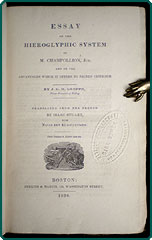
“The Great Problem of Hieroglyphics”: English Speakers Greppo, J.-G.-Honoré. Essay on the hieroglyphic system of M. Champollion, Jun. and on the advantages which it offers to sacred criticism. Boston: Perkins & Marvin, 1830. 12mo (20.4 cm, 8"). xii, 276 pp.; 2 plts.
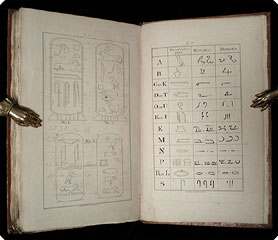 Click the images for enlargements. Two
plates at the back of the volume depict hieroglyphics and compare the “pure,”
hieratic, and demotic forms.
Click the images for enlargements. Two
plates at the back of the volume depict hieroglyphics and compare the “pure,”
hieratic, and demotic forms.
• American Imprints 1679; Allibone 2292. Publisher's red cloth, faded and discolored; recently rebacked preserving original spine label and as much of original spine cloth as possible; spine label darkened with chip. Ex–social club library: 19th-century bookplate, pressure-stamp on title-page, no other markings. Page edges untrimmed; pages moderately age-toned, otherwise clean. In fact quite a decent copy. (26382)

Hieroglyphics Illustrated — Sole EditionIdeler, Julius Ludwig. Hermapion sive rudimenta hieroglyphicae veterum Aegyptiorum literaturae. Lipsiae: Fr. Chr. Guil. Vogelii, 1841. 4to (31 cm, 12.1"). x, 314, 75, [1], 15, [1], [77]–95, [11] pp.; 28 plts. (6 folding)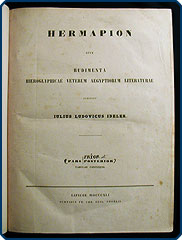
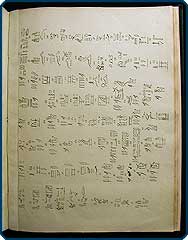
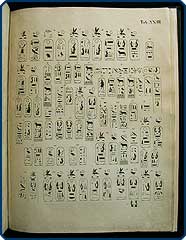
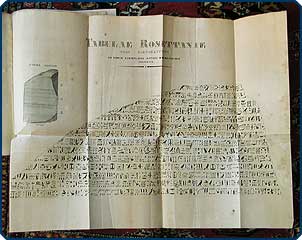 Single-click any image for an enlargement. French in addition to the predominant Latin and the hieroglyphic reproductions. 28 tipped-in plates, many of which are oversized and folded, provide illustrations of cartouches, hieroglyphs, and other characters; the text and plates were originally issued as two separate volumes, but are here bound in one.
• Brunet, II, 402. Recent black moiré cloth, covers framed with blind roll; spine with gilt-stamped leather title, author, and publication labels. Title-page with early inked annotation to volume information. Some mild foxing, with a few leaves more heavily spotted; plates browned. Plate VII with outer edge cropped, with loss of some characters; plate V with short tear from inner margin.
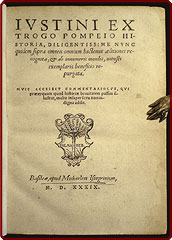
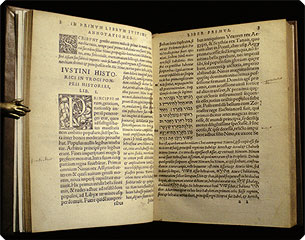
Grynaeus's Edition — Three Maps Justinus, Marcus Junianus; & Pompeius Trogus. Justini ex Trogo Pompeio historia diligentissime nunc quidem supra omnes omnium hactenus aeditiones recognita, et ab innumeris mendis - vetusti exemplaris beneficio purgata. Huic accessit commentariolus. Basilae: apud Michaelem Isingrinium, 1539. Small 4to. [16] ff., 319, [1 (blank)] pp.
 Click the interior images for enlargements.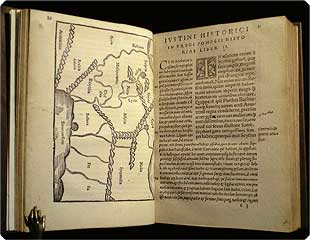
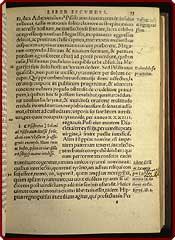
This copy has interesting, early, but now somewhat faded marginalia in a red or sepia ink. The marginalia is scattered and is at times heavy, other times light; in some sections, it is non-existent.
A rare edition: No copy traced via OCLC; VD16 locates only three copies in Europe.
• VD16 T2056. Full rich brown calf old style: Round spine with raised bands, accented in gilt rule; author and title lettered on cream-colored spine label; fillets in blind extending onto covers from each band to terminate in trefoils with blind double fillets beyond. Small rent in upper inner area of title-page with a very old and good repair on verso. Library name stamped on lower edge of closed book. (24808)
 “The First Civilizations”Lenormant, François. Les premières civilisations études d’histoire et d’archéologie. Paris: Maisonneuve & Cie., 1874. 8vo (22.5 cm, 8.85"). 2 vols. I: viii, 401, [11] pp. II: [4], 437, [3] pp.
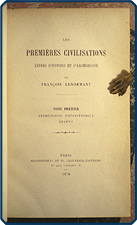
• Contemporary quarter black morocco with paper-covered sides, spines with gilt-stamped title and gilt-stamped compartment decorations; bindings clean and solid with only very minimal edge and corner wear. Front pastedowns and free endpapers each with institutional rubber-stamp (no other markings). ages slightly age-toned; a few leaves unopened.  Handsome.
For more SETS, click here.
Ancient Dress. 51 Copper-Engraved Plates.Lens, André Corneille. Le costume ou essai sur les habillements et les usages de plusieurs peuples de l’antiquité, prouvé par les monuments. Liege: Aux dépens de l’auteur, chez J.F. Bassompierre, 1776. 4to (24.9 cm, 9.8"). xxxi, [1], 411, [1] pp.; 51 plts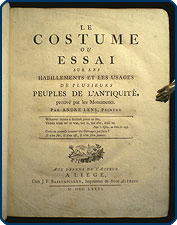
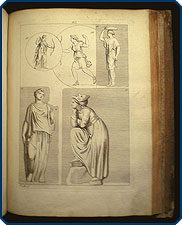
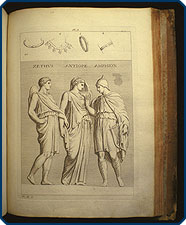 Single-click any image where the hand appears on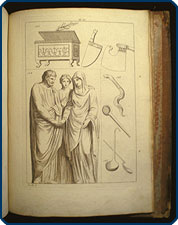
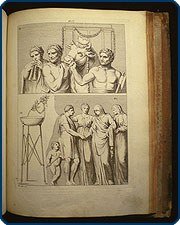
 An
EarlyENGLISH TranslationLucanus,
Marcus Annaeus [Lucan]. Lvcans Pharsalia: Or the civill warres of Rome,
betweene Pompey the great, and Ivlivs Cæsar. The whole tenne bookes, Englished
by Thomas May...the second edition, corrected, and the annotations inlarged by
the author. London: Thomas Iones (pr. by Aug. Mathews), 1631. 8vo (14.5 cm,
5.75"). π1a8A–S8T2; engr.
frontis., [146] ff. [with] May,
Thomas. A continvation of the subiect of Lucan’s historicall poem
till the death of Ivlivs Cæser the 2d edition corrected and amended. London:
James Boler, 1633. 8vo. A–K8(-K8); [79 of 80] ff.
An
EarlyENGLISH TranslationLucanus,
Marcus Annaeus [Lucan]. Lvcans Pharsalia: Or the civill warres of Rome,
betweene Pompey the great, and Ivlivs Cæsar. The whole tenne bookes, Englished
by Thomas May...the second edition, corrected, and the annotations inlarged by
the author. London: Thomas Iones (pr. by Aug. Mathews), 1631. 8vo (14.5 cm,
5.75"). π1a8A–S8T2; engr.
frontis., [146] ff. [with] May,
Thomas. A continvation of the subiect of Lucan’s historicall poem
till the death of Ivlivs Cæser the 2d edition corrected and amended. London:
James Boler, 1633. 8vo. A–K8(-K8); [79 of 80] ff.
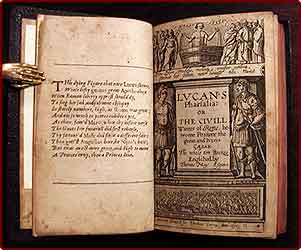
The editio princeps of the Pharsalia was printed in Rome by Sweynheym and Pannartz in 1469; Christopher Marlowe published the first English translation of any part of the Pharsalia, his rendition of the first book, in 1600, with a 1614 effort by Sir Arthur Gorges being the only other such to precede May’s standard-setting 1626 English version of books one through three.
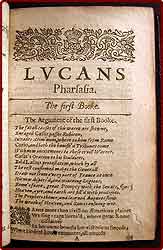 In
the present volume, this great epic poem in May’s translation is accompanied
by its translator’s English rendition of his own sequel, originally
written in Latin verse. This Continuation advances the action through
In
the present volume, this great epic poem in May’s translation is accompanied
by its translator’s English rendition of his own sequel, originally
written in Latin verse. This Continuation advances the action through
 Cleopatra’s
seduction of Caesar (May depicts the Egyptian queen with
“snowie necke” and “golden tresses”), the death of
Cato, and various additional battles before arriving at Caesar’s death.
At the time, May’s work was thought highly enough of that Charles I
allowed the Continuation’s dedication to bear his name.
Cleopatra’s
seduction of Caesar (May depicts the Egyptian queen with
“snowie necke” and “golden tresses”), the death of
Cato, and various additional battles before arriving at Caesar’s death.
At the time, May’s work was thought highly enough of that Charles I
allowed the Continuation’s dedication to bear his name.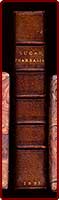
• Pharsalia: STC 16888; Schweiger, II, 567; ESTC
S108868. Continuation: STC 17712; ESTC S108892. 20th-century
black morocco in imitation of early, severe style, with raised bands from
which blind-tooling extends onto covers; spine with gilt-stamped title and
date, and turn-ins elaborately tooled in blind. Moderately worn, spine faded
not unattractively, and leather rubbed over joints. Front pastedown with bookplate,
inked date of 1986; front free endpaper with inked gift inscription dated
1944. T1-2 trimmed differently and possibly surviving from another copy; A3
of the continuation also possibly supplied. Occasional instances of very minor
staining; mostly clean. Pleasant
on shelf and in hand.
“A
Voyage to Abyssinia”
— Good,
Lively
& Readable
Account a
LITTLE SOUTH,
This Time . . .Salt, Henry. A voyage to Abyssinia, and travels into the interior of that country, executed under the orders of the British government, in the years
1809 and 1810; in which are included, an account of the Portuguese settlements on the east coast of Africa .... Philadelphia: M. Carey; Boston: Wells & Lilly (pr. by Lydia R. Bailey), 1816. 8vo (23.5 cm, 9.25"). 24, 454 pp.; fold. map.,
illus.
a
LITTLE SOUTH,
This Time . . .Salt, Henry. A voyage to Abyssinia, and travels into the interior of that country, executed under the orders of the British government, in the years
1809 and 1810; in which are included, an account of the Portuguese settlements on the east coast of Africa .... Philadelphia: M. Carey; Boston: Wells & Lilly (pr. by Lydia R. Bailey), 1816. 8vo (23.5 cm, 9.25"). 24, 454 pp.; fold. map.,
illus. 
This is an untrimmed copy in original boards, with 24 pages of advertising for Carey publications bound in at the front of the volume. The preliminary map, engraved by John Bower, has hand-colored border lines; this American edition does not call for the plates found in the English first, but does include in-text depictions of several “Ethiopic inscriptions.”
• Shaw & Shoemaker 33864; NSTC 2S3118. Publisher’s quarter tan paper over light blue paper–covered sides; front cover detached and back joint cracked, binding spotted, paper cracked and split along spine, spine label now absent and replaced with hand-inked title, spine with later paper shelving label. Front pastedown with institutional bookplate, front free endpaper with inked ownership inscription dated 1829. Half-title with portion of outer margin torn away (not touching text) and laid in. Map lightly foxed, with two short tears along folds. Pages age-toned, with occasional spots of foxing.

PLACE AN ORDER | E-MAIL US | GO (BACK) TO TOPIC/INTEREST TABLE | PRB&M HOME
All material © 2010
The Philadelphia Rare Books & Manuscripts
Company