
 LUCAN
LUCAN
LUCAN
LUCAN
 Lucan's Pharsalia or
De bello civili is an epic poem, the greatest in Latin after the Aeneid,
on the subject of the civil war between Pompey and Caesar. A native
of Cordoba, Spain, Lucan (a.d. 39–65)
was the grandson of the elder Seneca, nephew of the younger Seneca, and
the brother of the Gallio mentioned in Acts 18. He published the Pharsalia in a.d. 62
or 63, but it seems likely that his poetic talent aroused the jealously
of the vain Nero, as he forbade him to write or even plead in the courts,
and
then later compelled him to commit suicide for alleged treason. Lucan's Pharsalia or
De bello civili is an epic poem, the greatest in Latin after the Aeneid,
on the subject of the civil war between Pompey and Caesar. A native
of Cordoba, Spain, Lucan (a.d. 39–65)
was the grandson of the elder Seneca, nephew of the younger Seneca, and
the brother of the Gallio mentioned in Acts 18. He published the Pharsalia in a.d. 62
or 63, but it seems likely that his poetic talent aroused the jealously
of the vain Nero, as he forbade him to write or even plead in the courts,
and
then later compelled him to commit suicide for alleged treason.
The editio princeps of Lucan was printed
in Rome by Sweynheym and Pannartz in 1469. This little offering
of his works is (generally) in |

 “The
Most Perfect Specimen”
— Yep,
Strawberry-Hill!
“The
Most Perfect Specimen”
— Yep,
Strawberry-Hill!
 Lucanus, M Annaeus. Pharsalia cum notis Hugonis Grotii, et Richardi Bentleii. Strawberry-Hill [Twickenham]: [Strawberry Hill Press], 1760. 4to. [2] ff., 525, [1 (blank) pp., without the “Ad Lectorem” leaf.
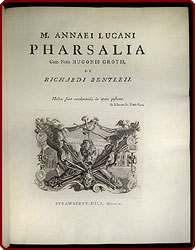
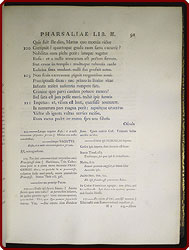
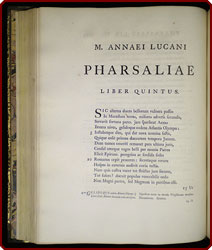
 Click the images for enlargements.
  This edition consisted of only 500 copies.
Horace Walpole (1717–97), the 4th earl of Orford, is best remembered as the author of the Gothic novel The Castle of Otranto. Among bibliophiles he is also remembered for his private press, variously known as the Officina Arbutana or the Strawberry Hill Press. Walpole's almost fantastic wealth allowed him the connoisseur's luxury of this noble enterprise, which he operated in the arena of the rebirth of fine printing in Great Britain that was being carried on by the Foulis brothers, Baskerville, and others.
Binding: Contemporary sprinkled calf with a single gilt rule framing covers, rebacked and original spine reapplied; spine with raised bands, each compartment elegantly filled with tooling and each band itself gilt-accented; complementary gilt-tooled bands at top and bottom of spine; the epitome of “gilt extra” without being gaudy. Red leather spine label lettered and ruled in gilt (“LUCAN STRAWBERRY HILL”); gilt roll on board edges and on turn-ins; marbled endpapers.
Provenance: Bookplates of Charles James Packe (British, late-19th century) and H.M. Brower (American, early- to mid-20th century).
• Hazen (1973 ed.), Bibliography of the Strawberry Hill Press, 7; Dibdin (4th ed.), Introduction to . . . Greek and Latin Classics, II, 187; ESTC T11286; Schweiger, II,565. Bound as above, corners rubbed and expertly, even beautifully, rebacked; lacks the “Ad Lectorem” leaf (only). Good paper, wide margins, only the occasional instance of offsetting or soil.  A very good copy. (25974)

 An
Early
An
Early ENGLISH TranslationLucanus,
Marcus Annaeus [Lucan]. Lvcans Pharsalia: Or the civill warres of Rome,
betweene Pompey the great, and Ivlivs Cæsar. The whole tenne bookes, Englished
by Thomas May...the second edition, corrected, and the annotations inlarged by
the author. London: Thomas Iones (pr. by Aug. Mathews), 1631. 8vo (14.5 cm,
5.75"). π1a8A–S8T2; engr.
frontis., [146] ff. [with] May,
Thomas. A continvation of the subiect of Lucan’s historicall poem
till the death of Ivlivs Cæser the 2d edition corrected and amended. London:
James Boler, 1633. 8vo. A–K8(-K8); [79 of 80] ff.
ENGLISH TranslationLucanus,
Marcus Annaeus [Lucan]. Lvcans Pharsalia: Or the civill warres of Rome,
betweene Pompey the great, and Ivlivs Cæsar. The whole tenne bookes, Englished
by Thomas May...the second edition, corrected, and the annotations inlarged by
the author. London: Thomas Iones (pr. by Aug. Mathews), 1631. 8vo (14.5 cm,
5.75"). π1a8A–S8T2; engr.
frontis., [146] ff. [with] May,
Thomas. A continvation of the subiect of Lucan’s historicall poem
till the death of Ivlivs Cæser the 2d edition corrected and amended. London:
James Boler, 1633. 8vo. A–K8(-K8); [79 of 80] ff.
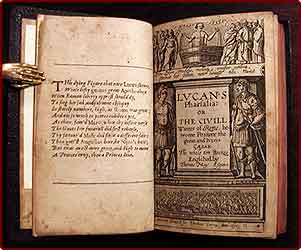
The editio princeps of the Pharsalia was printed in Rome by Sweynheym and Pannartz in 1469; Christopher Marlowe published the first English translation of any part of the Pharsalia, his rendition of the first book, in 1600, with a 1614 effort by Sir Arthur Gorges being the only other such to precede May’s standard-setting 1626 English version of books one through three.

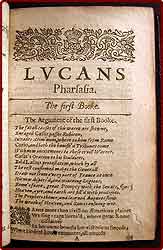 In
the present volume, this great epic poem in May’s translation is accompanied
by its translator’s English rendition of his own sequel, originally
written in Latin verse. This Continuation advances the action through
Cleopatra’s seduction of Caesar (May depicts the Egyptian queen with
“snowie necke” and “golden tresses”), the death of
Cato, and various additional battles before arriving at Caesar’s death.
At the time, May’s work was thought highly enough of that Charles I
allowed the Continuation’s dedication to bear his name.
In
the present volume, this great epic poem in May’s translation is accompanied
by its translator’s English rendition of his own sequel, originally
written in Latin verse. This Continuation advances the action through
Cleopatra’s seduction of Caesar (May depicts the Egyptian queen with
“snowie necke” and “golden tresses”), the death of
Cato, and various additional battles before arriving at Caesar’s death.
At the time, May’s work was thought highly enough of that Charles I
allowed the Continuation’s dedication to bear his name.
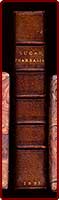 • Pharsalia: STC 16888; Schweiger, II, 567; ESTC
S108868. Continuation: STC 17712; ESTC S108892. 20th-century
black morocco in imitation of early, severe style, with raised bands from
which blind-tooling extends onto covers; spine with gilt-stamped title and
date, and turn-ins elaborately tooled in blind. Moderately worn, spine faded
not unattractively, and leather rubbed over joints. Front pastedown with bookplate,
inked date of 1986; front free endpaper with inked gift inscription dated
1944. T1-2 trimmed differently and possibly surviving from another copy; A3
of the continuation also possibly supplied. Occasional instances of very minor
staining; mostly clean. Pleasant
on shelf and in hand.
• Pharsalia: STC 16888; Schweiger, II, 567; ESTC
S108868. Continuation: STC 17712; ESTC S108892. 20th-century
black morocco in imitation of early, severe style, with raised bands from
which blind-tooling extends onto covers; spine with gilt-stamped title and
date, and turn-ins elaborately tooled in blind. Moderately worn, spine faded
not unattractively, and leather rubbed over joints. Front pastedown with bookplate,
inked date of 1986; front free endpaper with inked gift inscription dated
1944. T1-2 trimmed differently and possibly surviving from another copy; A3
of the continuation also possibly supplied. Occasional instances of very minor
staining; mostly clean. Pleasant
on shelf and in hand.

 AGAIN
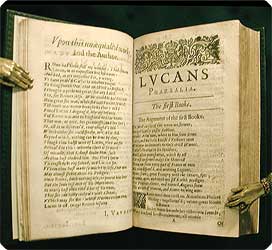
Lucan English’dLucanus, Marcus. Lucan’s Pharsalia: Or the civill warres of Rome, betweene Pompey the great, and Iulius Caesar. London: Pr. by A.M. for Will. Sheares, 1635. 8vo (14.7 cm, 5.8"). π1a8A–S8T2; [310] pp. [with] May, Thomas. A continuation of the subiect of Lucan’s historicall poem till the death of Iulius Caeser. London: James Boler, 1633. 8vo. 2A–2K8; [160] pp.
AGAIN
Lucan English’dLucanus, Marcus. Lucan’s Pharsalia: Or the civill warres of Rome, betweene Pompey the great, and Iulius Caesar. London: Pr. by A.M. for Will. Sheares, 1635. 8vo (14.7 cm, 5.8"). π1a8A–S8T2; [310] pp. [with] May, Thomas. A continuation of the subiect of Lucan’s historicall poem till the death of Iulius Caeser. London: James Boler, 1633. 8vo. 2A–2K8; [160] pp.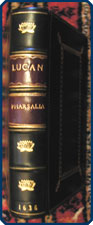
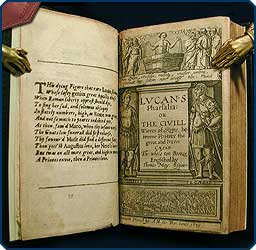
 Click
the interior images for enlargements.
Click
the interior images for enlargements.
• ESTC S108867; STC (2nd ed.) 16889. Continuation: ESTC S108892; STC (2nd ed.) 17712. Both: Lowndes, III, 1408. Period-style calf by Grace (signed “GB” on lower back turn-in), framed and panelled in gilt rolls, spine with gilt-stamped leather title and author labels and gilt-stamped decorations in compartments. Outer and lower edges of the engraved title-page of second work shaved, touching design. Light waterstaining to upper portions of approx. 25 ff. of Continuation; small area of worming to lower inner margins of a few leaves, touching the occasional catchword but not main text.
 For more 17TH-CENTURY BOOKS, click
here. For more LITERATURE, click here. For more GREEK & LATIN CLASSICS, click here. For
more TRANSLATIONS, click here.
For more 17TH-CENTURY BOOKS, click
here. For more LITERATURE, click here. For more GREEK & LATIN CLASSICS, click here. For
more TRANSLATIONS, click here.
A
NeatIllustrated
VolumeLucanus,
Marcus Annaeus [Lucan]. La Pharsale de Lvcain, ou les gverres civiles
de Cesar et de Pompée. Paris: Jean Ribou, 1670. 12mo (15 cm, 5.9"). π1ã12A–Q12R4(-R4); frontis., [12]
ff., 390 pp. (lacking final blank); illus.
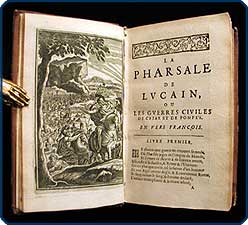 10 full-page
engravings present in this nicely printed volume include a frontispiece
displaying a bust of Lucan (a native of Cordoba, Spain) surrounded by Roman
motifs, an additional engraved title-page bearing a martial scene, and—among
other war images done by various hands—a striking rendition of Cato and
the snakes.
10 full-page
engravings present in this nicely printed volume include a frontispiece
displaying a bust of Lucan (a native of Cordoba, Spain) surrounded by Roman
motifs, an additional engraved title-page bearing a martial scene, and—among
other war images done by various hands—a striking rendition of Cato and
the snakes.
• Schweiger, II, 568 (citing the 1666 Pierre Ribou and the Loyson eds.). Contemporary mottled calf, board edges gilt-stamped, spine gilt extra, with raised bands and a gilt-stamped leather title label; moderately worn, leather cracking over joints, edges rubbed with corners bumped, spine with small chip to head exposing headband and with small paper label at foot. All page edges speckled in red and brown. Lacking final blank (only). Front pastedown with bookplate dated 1969. Pages clean; slight offsetting from a few illustrations.
“A Valuable Edition” —
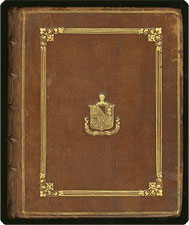
per DibdinLucanus, Marcus Annaeus. Pharsalia, cum commentario Petri Burmanni. Leidae: Apud Conradum Wishoff, Danielem Goetval, & Georg. Jacob. Wishoff, 1740. 4to (25 cm, 9.75"). [52], 735, [1 (blank)], [160 (index)] pp.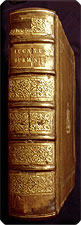
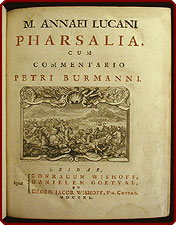
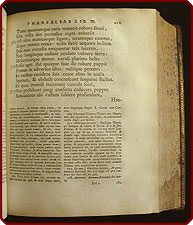 Click the interior images for enlargements.
 Binding / Provenance: Contemporary calf, framed in gilt triple fillets and panelled in gilt quadruple fillets with gilt-stamped corner fleurons and gilt-stamped central coat of arms of the Wilder family, with the motto “Virtuti moenia cedant.”
• Schweiger, II, 565; Dibdin, II, 186–87. Binding as above, rebacked making use of most of the original spine, spine with gilt-stamped compartments and gilt-stamped leather title-label; edges worn and rubbed, portions of original spine leather cracked and chipped. Front pastedown with small abraded area; front fly-leaf with inked inscriptions dated 1834 and 1938. Some leaves with faint waterstaining in upper margins and lower outer corners.  Attractive.
 Lucan
BearingPlates
after GravelotLucanus,
Marcus Annaeus. La pharsale..... Paris: Chez Merlin, 1766. 2 vols.
I: 8vo (19.5 cm, 7.75"). Frontis., [1] f., lxxix, [1 (blank)] 304 pp., [1 (errata)]
f.; 5 plates. II: 8vo (19.5 cm, 7.75"). [1] f., 315, [1] pp., [2] ff.; 5 plts.
Lucan
BearingPlates
after GravelotLucanus,
Marcus Annaeus. La pharsale..... Paris: Chez Merlin, 1766. 2 vols.
I: 8vo (19.5 cm, 7.75"). Frontis., [1] f., lxxix, [1 (blank)] 304 pp., [1 (errata)]
f.; 5 plates. II: 8vo (19.5 cm, 7.75"). [1] f., 315, [1] pp., [2] ff.; 5 plts.
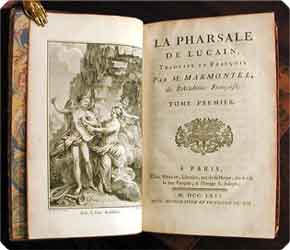
 Binding: Contemporary treed calf, spine gilt extra with badge of a thistle in compartments; red leather labels. Marbled endpapers. All edges red.
Provenance: Small booklabel of William Salloch on rear pastedown.
• Schweiger, Handbuch der classischen Bibliographie, II, 568. Cohen & DeRicci, Livres à gravure du XVIII siècle, 662. Not in Ray, The Art of the French Illustrated Book 1700–1914. Binding as above, gilt somewhat dimmed; some chipping of leather to corners and spine tips, and endpapers rubbed. Internally generally clean, with some browning from turn-ins and a few spots of soiling. Bookplate on front pastedowns.
For more SETS, click here.
A
Simple & Workman-likeBipontine
EditionLucanus,
Marcus Annaeus [Lucan]. Pharsalia ejusdem ad Calpurnium Pisonem Poemation
praemittitur notitia literaria studiis Societatis Bipontinae. Editio accurata.
Biponti: Ex typographia Societatis, 1783. 8vo (19.3 cm, 7.625"). [1] f., xxxii,
300 pp.
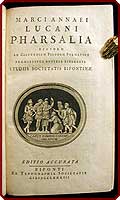 • This unassuming, rather “homey” octavo edition of 1783 was printed in Zweibrücken
at the ducal printing office, noted for printing a number of fine editions
of the classics. In addition to the usual preliminaries and the advertised notitia literaria,
a very useful list and discussion of the editions of Lucan printed up to that
point is also included in this, the first Bipontine edition of that author.
The volume’s one ornament is a striking engraved vignette on the title-page
that shows the head of Pompey being offered to Caesar.
• This unassuming, rather “homey” octavo edition of 1783 was printed in Zweibrücken
at the ducal printing office, noted for printing a number of fine editions
of the classics. In addition to the usual preliminaries and the advertised notitia literaria,
a very useful list and discussion of the editions of Lucan printed up to that
point is also included in this, the first Bipontine edition of that author.
The volume’s one ornament is a striking engraved vignette on the title-page
that shows the head of Pompey being offered to Caesar.
• Schweiger, Handbuch der classischen Bibliographie, II, 565; Dibdin (4th ed.), An Introduction to . . . Greek and Latin Classics, I, 188. Brown paper over light boards, spine with now-illegible paper label; stained and faded, corners bumped. A little foxing and soiling on endpapers and half-title; otherwise internally clean. Bookplate with inked date on front pastedown. All edges heavily speckled red.
Lucan for the First Republic
Lucanus, Marcus Annaeus. La pharsale de Lucain.... Paris: De l’imprimerie de Crapelet, 1796. 2 vols. I: 8vo (20.5 cm, 8"). [2] ff., l, 376 pp.; 5 plts. II: 8vo (20.5 cm, 8"). [2] ff., 409, [1 (blank)] pp.; 5 plts.
First Republic
Lucanus, Marcus Annaeus. La pharsale de Lucain.... Paris: De l’imprimerie de Crapelet, 1796. 2 vols. I: 8vo (20.5 cm, 8"). [2] ff., l, 376 pp.; 5 plts. II: 8vo (20.5 cm, 8"). [2] ff., 409, [1 (blank)] pp.; 5 plts. 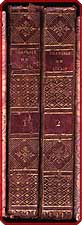
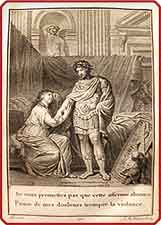
Binding: Contemporary treed calf, spines gilt extra with red labels and covers gilt-framed; gilt edges and gilt inner dentelles. Marbled endpapers in a French shell pattern. All edges gilt.
Provenance: Small booklabel of William Salloch on rear pastedown.
• Schweiger, Handbuch der classischen Bibliographie, II, 568. Cohen & DeRicci, Livres à gravure du XVIII siècle, 662. Not in Ray, The Art of the French Illustrated Book 1700–1914. Leather on spines and edges of covers dry and chipped; joints open, but sewing holding. Some closed tears to endpapers and front free endpaper of vol. I partially detached; paper generally clean with occasional spots of light browning or foxing. Bookplate on front pastedowns.  Plates clean and charming.

PLACE AN ORDER | E-MAIL US | GO (BACK) TO TOPIC/INTEREST TABLE | PRB&M HOME
All material © 2010
The Philadelphia Rare Books & Manuscripts
Company