 ANGLO-AMERICAN LAW ANGLO-AMERICAN LAW
  Exact
& True?
(re: The “Popish
Plot”)
Exact
& True?
(re: The “Popish
Plot”)
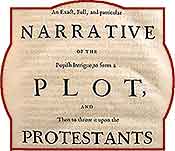
 Mansell, Roderick. An exact and true narrative of the late Popish intrigue.... London: Tho. Cockerill & Benj. Alsop, 1680. Folio (30.5 cm, 12"). [A]2 b–c2 B–V2 (-O2, blank); [6] ff., 105 (i.e., 73), [1 (blank)] pp.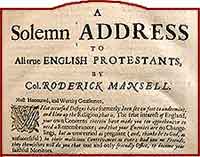
 •
ESTC R20941; Wing (rev.) M514. On the Popish Plot, see: New Catholic Encyclopedia,
X, 590–94; and the article on Titus Oates in The Dictionary of National
Biography, XLI, 296–303. Removed from a nonce volume with remnants
of previous binding at “spine” and two fly-leaves from the volume
remaining attached also, on the second of which is a list of contents in ink.
The leaves of this piece are numbered in ink consecutively on the upper outer
corners of the versos. Some staining, foxing, or soiling, and a few shallow
tears, with no loss of print. All edges speckled red.
•
ESTC R20941; Wing (rev.) M514. On the Popish Plot, see: New Catholic Encyclopedia,
X, 590–94; and the article on Titus Oates in The Dictionary of National
Biography, XLI, 296–303. Removed from a nonce volume with remnants
of previous binding at “spine” and two fly-leaves from the volume
remaining attached also, on the second of which is a list of contents in ink.
The leaves of this piece are numbered in ink consecutively on the upper outer
corners of the versos. Some staining, foxing, or soiling, and a few shallow
tears, with no loss of print. All edges speckled red.


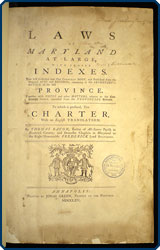
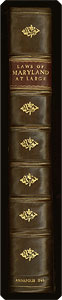
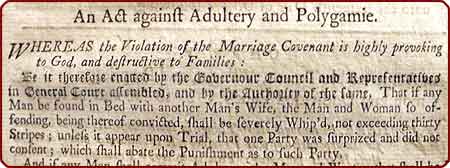
The MARYLAND Seal Makes Its Debut Maryland. Laws, statutes, etc. Laws of Maryland at large, with proper indexes. Now first collected into one compleat body, and published from the original acts and records, remaining in the secretary’s-office of the said province. Together with notes and other matters, relative to the Constitution thereof, extracted from the provincial records. To which is prefixed, the charter, with an English translation. By Thomas Bacon, Rector of All-Saints Parish in Frederick County, and Domestic Chaplain in Maryland to the Right Honourable Frederick Lord Baltimore. Annapolis: Printed by Jonas Green, printer to the province, MDCCLXV [1765]. Folio extra. [736] pp.
 unexcelled
by any other production of an American colonial press.
Additionally, it is commonly thought that this work marks the first appearance
of the Maryland seal, carved on a wood block by Thomas Sparrow, an employee
of the printer.
unexcelled
by any other production of an American colonial press.
Additionally, it is commonly thought that this work marks the first appearance
of the Maryland seal, carved on a wood block by Thomas Sparrow, an employee
of the printer.
 Click
the interior image for an enlargement.
Click
the interior image for an enlargement.
Provenance: Signature on title-page of Bruce J. Worthington, dated 1794; of Ethan Allen, dated 1856; of John H. Alexander, Esq.; in the library of the Maryland Diocesan Library (deaccessioned).
• Evans 10049; Wroth, Maryland, 254; Sabin 45186. Recent full calf, old style, by Grace Bindings (signed “G.B.” on lower turn-in of inside back cover), with gilt tooling on covers and spine, raised bands on spine, red title-label. Title-page browned around the edges and with some loss of paper; leaf now backed as is the last (bookseller's advertisements). Maryland Diocesan library stamp (deaccessioned as above) on title-page. Dedication page with very old repair along inner area of blank verso. Old damp- and/or waterstaining to early and late leaves and a few other places; occasional stray spots or small stains. Complete with the errata/advertisement leaf. A handsome, impressive volume. (20605)

 The
Laws & CharterMassachusetts
Bay (Province). Laws, statutes,
etc. The charter granted by their majesties King William and Queen Mary, to
the inhabitants of the province of the Massachusetts-Bay in New-England. Boston:
S. Kneeland, 1759. Folio (31 cm, 12.2"). [1] f., 14 pp. [with]
Acts and laws, of his Majesty’s province of the Massachusetts-Bay in New-England.
Boston: S. Kneeland, 1759. 24 (table of contents) pp., [1] f., 396 pp. (319/20
used twice, 323/24 skipped).
The
Laws & CharterMassachusetts
Bay (Province). Laws, statutes,
etc. The charter granted by their majesties King William and Queen Mary, to
the inhabitants of the province of the Massachusetts-Bay in New-England. Boston:
S. Kneeland, 1759. Folio (31 cm, 12.2"). [1] f., 14 pp. [with]
Acts and laws, of his Majesty’s province of the Massachusetts-Bay in New-England.
Boston: S. Kneeland, 1759. 24 (table of contents) pp., [1] f., 396 pp. (319/20
used twice, 323/24 skipped).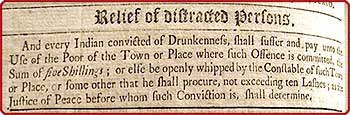
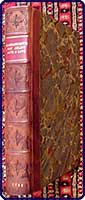
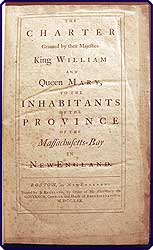
• Evans 8400 & 8399; ESTC W33793. Good-quality 20th-century quarter calf and marbled paper–covered sides, spine with gilt-stamped leather title label, raised bands, and ornately handsome blind-stamping within compartments. Back fly-leaf with inked inscription dated 1782. Some browning and spotting; one early, inked marginal annotation.
 With
a
With
a Seal Meant for ReuseMifflin, Samuel. Document signed on parchment, in English. “Exemplification of a common recovery with double vouchers of the messuage & plantation in Blockley late the estate of Morton Garrett.” Philadelphia, 1776. Folio (51.5 cm, 20.5"). [1] p.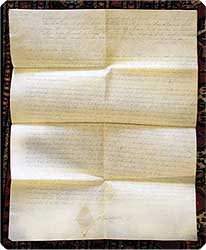
 All
the names involved here have powerful Philadelphia associations.
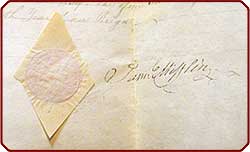
A seal is affixed to the sheet, intended to be removed and used “for
sealing of Writs in our Court.”
All
the names involved here have powerful Philadelphia associations.
A seal is affixed to the sheet, intended to be removed and used “for
sealing of Writs in our Court.”
 Blockley,
in which the land in question was located, was a township located in West
Philadelphia from about 1677 until its consolidation with the city in 1854.
The name has lingered, although it has been superceded in general usage by
the broader term “University City.”
Blockley,
in which the land in question was located, was a township located in West
Philadelphia from about 1677 until its consolidation with the city in 1854.
The name has lingered, although it has been superceded in general usage by
the broader term “University City.”
• Parchment crisp and untorn, with outermost folded portions lightly spotted; front with early inked title as given above, plus pencilled numerals. An evocative document connected to some very prominent names, in excellent condition, with its seal protected for its intended reuse by a diamond-shaped paper covering.

True
Fact?
Or Fanciful
Fiction? BLOODY
MURDER.
Mills, Henry. Narrative of the life and dying confession
of Henry Mills, of Galesboro', Pennsylvania, who, on the night of the 29th January last,
inhumanly murdered his wife and five children! Boston: Printed by H. Trumbull, 1817. 8vo. 24
pp., 1 fold. plt.
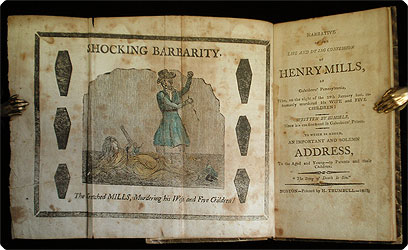 Click the images for enlargements.
 All sources say of this work that it “is of doubtful authenticity” and may well be fiction — but, it is sensational for sure!
The folding frontispiece plate is a woodcut captioned “Shocking Barbarity” and shows Mills standing over his wife who is lying on the ground; he has a knife and is raising a fist in anger. The plate has hand coloring in two blues and a yellow (but rather interestingly, not red); three coffins flank the image on each side.
• Shaw & Shoemaker 41440; McDade, Murder, 682.
In 20th-century quarter tan cloth with marbled paper sides. Age-toning and
spotting/staining, with some edge tears, throughout; additionally, creases
in frontispiece.  Apparently a pored-over copy. (26823)
 Seditious
Libel? — Convicted!M’Laren, Alexander, defendant. The trial of Alexander M’Laren, and Thomas Baird, before the High Court of Justiciary, at Edinburgh, on the 5th and 7th March 1817, for sedition. Edinburgh: John Robertson, 1817. 8vo (20 cm, 7.9"). vi, 153, [1 (blank)] pp.
Seditious
Libel? — Convicted!M’Laren, Alexander, defendant. The trial of Alexander M’Laren, and Thomas Baird, before the High Court of Justiciary, at Edinburgh, on the 5th and 7th March 1817, for sedition. Edinburgh: John Robertson, 1817. 8vo (20 cm, 7.9"). vi, 153, [1 (blank)] pp.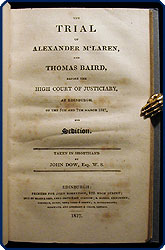
• NSTC 2M6590; Goldsmiths’-Kress 21913. Recent paper-covered boards. Mild offsetting to pages and moderate foxing to first few leaves.

Saving the Souls of the Rich via CHARITY Nelson, Robert. An address to persons of quality and estate ... To which is added, an appendix of some original and valuable papers. [with another related title, as below]. London: A. & G. Way, prs., 1715. 8vo (21.9 cm, 8.6"). Frontis., xxxi, [1], 267, [1], 55, [7] pp. [with] A poem in memory of Robert Nelson Esquire. London: Pr. by Geo. James for Richard Smith, at Bishop Beveridge’s-Head, 1715. 8vo. 21, [3] pp.
 relieving
prisoners, and establishing houses for the improvement
of ladies (both proper and fallen). The appendix provides texts of various proposals
as well as statistics on numbers of residents in hospitals and schools.
Click
the images for enlargements.
relieving
prisoners, and establishing houses for the improvement
of ladies (both proper and fallen). The appendix provides texts of various proposals
as well as statistics on numbers of residents in hospitals and schools.
Click
the images for enlargements.
The frontispiece portrait of Nelson was engraved by George Vertue after a painting by Sir Godfrey Kneller. The volume also includes all publisher's advertisements as well as the rather uncommon Poem in Memory of Robert Nelson Esquire.
This
was produced to be a handsome work, printed in large type on good paper with
wide margins — the better to appeal to a “quality” audience?
• ESTC T85360; Goldsmiths’-Kress 5249. Poem: ESTC T25431; Foxon P538. Contemporary speckled calf, framed and panelled in blind with blind-tooled corner fleurons; rebacked with speckled calf, spine with gilt-stamped leather title-label, raised bands, and blind-tooled foliate compartment decorations. Original leather abraded, front cover with small chip to outer edge and area of faint discoloration from a now-absent label; title-page institutionally rubber-stamped (no other markings). Some signatures browned and foxed, most pages clean. (25999)
Constitutional Law — SECESSION? Parker, Joel. Constitutional law: With reference to the present condition of the United States. Cambridge: Pr. by Welch, Bigelow, & Company, 1862. 8vo. 35 pp. 
• Removed from a nonce volume. (180)
The Plan forTaking Back England Parsons, Robert. The Jesuit's memorial, for the intended reformation of England, under their first popish prince. Published from the copy that was presented to the late King James II. London: British & Foreign Bible Society, 1690. 8vo (19.6 cm, 7.75"). [8], lvi, [16], 262, [2 (adv.)] pp.

 Click the interior images for enlargements.
 • ESTC R1686; Wing (rev. ed.) P569; Allibone 1518; DeBacker-Sommervogel, VI, 304–305. Not in Clancy, English Catholic Books 1641–1700. On Parsons, see: Oxford Dictionary of National Biography online. Period-style calf, framed and panelled in gilt with gilt-stamped corner fleurons, spine gilt extra with gilt-stamped leather title-label; signed binding by Starr Bookworks. Half-title verso with small inked numeral. Pages age-toned, otherwise generally clean; one leaf with an irregular fore-edge (paper flaw?), one with a closed tear to lower margin (not reaching text), a few with signs of old dog-ears, last sections especially suggesting that the text-block, in an unbound era, spent some time lying partly bent across an edge or short bar of some sort — there are no cuts or soiling from this, but the paper shows the old diagonal impressions. (25333)
Hoping for “a great charter for Liberty of Conscience”Penn, William. The great and popular objection against the repeal of the penal laws & tests briefly stated and consider’d, and which may serve for answer to several late pamphlets upon that subject. London: Andrew Sowle, 1688. 4to (19.8 cm, 7.75"). 23, [1 (blank)] pp.

 Click the interior images for enlargements.
 Despite this strongly worded treatise against persecution (which argues that all men should be able to make a free and open choice of faith and worship), the statutes remained in place for many years to come.
• Wing (rev.) P1298A; ESTC R12742. Recent marbled paper–covered boards. Title-page with tiny, unobtrusive numeral inked in upper outer corner, first text page with numeral stamped in lower margin (no other markings). Title-page and first text page with moderate foxing, others clean.
Jailhouse Law — Philadelphia 1801Pennsylvania.
Collection of the penal laws of the Commonwealth of Pennsylvania. Philadelphia: Pr. by Budd & Bartram, for the use of the Prison, 1801. 8vo (19.5 cm, 7.6").
72 pp.

 Click any image where the hand appears on

 Many institutions report microform holdings, but very few hold actual copies.
• Sabin 59986; Shaw & Shoemaker 1114. Contemporary-style quarter tan cloth over blue paper-covered sides, spine with printed paper label. Paper embrittled and somewhat fragile; pages age-toned and foxed.
Which OLD LAWS to Keep? Pennsylvania. Supreme Court. Report of the judges of the Supreme Court of Pennsylvania, of the English statutes which are in force in the Commonwealth of Pennsylvania; and of those of the said statutes which, in their opinion, ought to be incorporated into the statute law of the said commonwealth. Lancaster: Wm. Dickson, 1809. 8vo (23.1 cm, 9.1"). 28 pp.

 This copy is untrimmed, with the signatures unopened.
WorldCat and Shaw & Shoemaker locate a combined total of fewer than a dozen copies.
• Shaw & Shoemaker 18345. Sewn, as issued, but without the wrappers; edges tattered. Waterstaining, heavy on first and last few pages. Uncut. (25966)
“Carry
Off theCry
& Clamour
THIS
TROUBLESOME WOMAN”(Pollock vs. the Thane of Cawdor). Answers for John Campbel of Calder Esq; and Mr. James Anderson writer to the signet his factor: To the petition of Ruth Pollock, who calls herself relict of Captain George Campbel, son to the deceast Sir Hugh Campbel. [Edinburgh], 1717. Folio (30.5 cm, 12"). 4 pp.
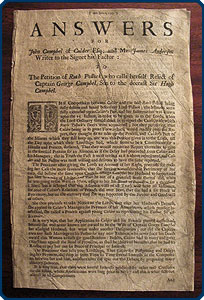
 no holdings of this item.
• Not in ESTC. Once sewn, now in a Mylar folder. Last leaf with closed tear partially repaired some time ago, costing or or obscuring a few letters to each line of about two paragraphs on either side of leaf. Age-toned, dust-soiled, creased.
 It
Says SHE
LIES . . .
(Pollock
vs. the Thane of Cawdor).
Broadside. Begins:
"Memorial for John Campbell of Calder Esq...." [Edinburgh], 1718. Folio (31.2
cm, 12.25"). [1] p.
It
Says SHE
LIES . . .
(Pollock
vs. the Thane of Cawdor).
Broadside. Begins:
"Memorial for John Campbell of Calder Esq...." [Edinburgh], 1718. Folio (31.2
cm, 12.25"). [1] p.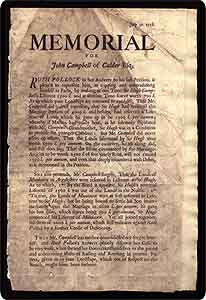 This
is an uncommon legal item, with no holdings described by OCLC, RLIN, or ESTC.
This
is an uncommon legal item, with no holdings described by OCLC, RLIN, or ESTC.
• Not in ESTC. Creased and dust-soiled, with a small hole in lower margin not touching text and a few pinholes within text. Tipped onto a leaf of 19th-century paper, now in a Mylar folder.
In
Multiple Fonts —
OneBlack-Letter(Pollock
vs. the Thane
of Cawdor [Again]). Broadside.
Begins: “Memorial for John Campbell of Calder....”[Edinburgh], 1718.
Folio (31.5 cm, 12.4"). [2] p.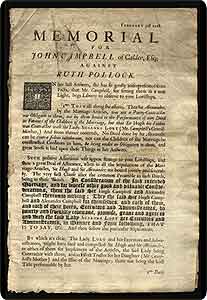
marriage
articles between Sir Alexander Campbell and Elizabeth Lort,
John Campbell’s parents; the definition of impeachment of waste is discussed.
No
holdings of this uncommon item are listed by ESTC, RLIN, OCLC.
• Creased and slightly dust-soiled but in overall good condition. Tipped onto a leaf of 19th-century paper; now in a Mylar folder.
A
“Collection Discount” will be applied should anyone take
EarlyAMERICAN Law Book “Practitioner in the law.” The Young clerk’s magazine: or, English law-repository: containing, a variety of the most useful precedents of articles of agreement, bonds, bills, recognizances, releases, letters and warrants of attorney, awards, bills of sale, gifts, grants, leases, assignments, mortgages, surrenders, jointures, covenants, copartnerships, charterparties, letters of licence, compositions, conveyances, partitions, wills, and all other instruments that relate to publick business. With necessary directions for making distresses for rent, &c. as the law between landlord and tenant now stands. To which is added, the doctrine of fines and recoveries, and their forms. Together with those of common writs, affidavits, memorials for registering deeds, &c. in Middlesex; as also a choice collection of declarations in the King’s bench and common pleas. Philadelphia: Reprinted [from the London edition] by John Dunlap and Joseph Crukshank, 1774. 12mo. [2] ff., 303, [1 (blank)] pp.

The English and Dublin editions all give as the author on the title-page, “Practitioner in the law,” but the American editions omit it.

Uncommon in commerce.
• Evans 13786; Hildeburn 3140; ESTC W21104. Contemporary tan sheep, dry, joints cracked. Ex-library: call number on binding, bookplate on front pastedown, rubber- and pressure-stamps, pencilling on verso of title-page. Some spotting, not a great deal; a dried flower laid in. Now sporting a cranberry-colored paper jacket and housed in a red cloth clamshell case with cafe au lait-colored spine labels. (24514)
From aSuccessful & Insightful Indian Civil ServantPrinsep, Henry Thoby. The India question in 1853. London: William H. Allen & Co., 1853. 8vo (19.6 cm, 7.75"). [2], 111, [1 (blank)] pp. 
• NSTC 2P27024. On Prinsep, see: DNB. Removed from a nonce volume. Lightly age-toned. Traces of soiling and small inked numeral on title-page. A few instances of pencilled sidelining.
Muggletonian Stand againstReligious Persecution Reeve, John, & Lodowick Muggleton. A remonstrance from the eternall God: Declaring severall spirituall transactions unto the Parliament, and Common-wealth of England, unto His Excellency, the Lord Generall Cromwell, the Councell of State, the Councell of Warre, and to all that love the second appearing of the Lord Jesus, the onely wise God and everlasting Father, blessed for ever. [London]: 1653. 4to (19.1 cm, 7.5"). 15, [1 (blank)] pp.

 Click the images for enlargements. Clicking on the righthand image above, and reading the last, italicized paragraph, is rewarding.
 OCLC and ESTC locate only six U.S. institutional holdings.
• ESTC R40093; Wing (rev. ed.) R682; Smith, Anti-Quakeriana, 303. Period-style calf, covers framed in blind double fillets, spine with gilt-ruled raised bands and gilt-stamped leather title-label. Title-page and first text page institutionally perforation-stamped, first text page with inked and rubber-stamped numerals in lower margin. Title-page with several tears repaired (with loss of a few letters from table of contents) and a sliver of the bottom edge replaced (with loss of lower portion of publication date); pages generally age-toned and soiled, first one with upper margin repaired. Edges trimmed closely and tattered. A “survivor.” (26010)
TheGlorious Revolution's Centennial Revolution Society (London). An abstract of the history and proceedings of the Revolution Society, in London. To which is annexed a copy of the Bill of Rights. [London]: Pr. by Order of the Committee, 1789. 8vo. 40, 7, [1 (blank)] pp., [1] f., pp. 41–78, [1 (blank)] f., pp. 79–87, 90–92, pp. 79–86, 93–96 (page numbers 88, 89 not used).

 Click the interior images for enlargements.
 Uncommon: No U.S. copy of this issue located via OCLC and ESTC locates only the Harvard copy. There were other, less complete editions of 40 pp., 58 pp., and 78 pp.
• ESTC N15187. Recent full calf, period style; spine with raised bands accented in gilt, oxblood leather gilt-lettered title, publication date and place in gilt at base; covers framed and paneled in gilt rules with gilt-stamped corner fleurons. Shallow chip to top outer corners of final two leaves. One word on p. 32 is blotted out in ink by an early owner with the correction supplied above it. Penned signature (partly cropped) at top edge of p. 79. Pp. 79–92 duplicated, nothing missing. (23766)
“We the People . . . of Rhode Island” — The 1843 Constitution Rhode Island. The Constitution of the State of Rhode Island and Providence Plantations, as adopted by the Convention, assembled at Newport, September, 1842. Providence: Pr. by Knowles & Vose, 1842. 8vo. 24 pp.
A landmark document in Rhode Island history.
Click the image for an enlargement. • Sabin 70572. Sewn. Waterstained; soiling to outer leaves. Early reader's two small ink notations on title-page, just below the imprint. Uncut, partly unopened copy, with one signature opened unevenly. (24487)
British Words of Support forColonial Rights Rokeby, Matthew Robinson-Morris, Baron. Considerations on the measures carrying on with respect to the British colonies in North-America. London printed; Hartford reprinted: Eben. Watson, 1774. 8vo (21.6 cm, 8.5"). 63, [1] pp.
 Click the interior image for enlargement.
 • Evans 13585; ESTC W30498; Howes R-372; Trumbull, Connecticut, 1305; Adams, Amer. Pamphlets, 134j; Sabin 72151; Allibone 1839. On Robinson-Morris, see: Oxford DNB online. Period-style quarter calf with marbled paper–covered sides, leather edges tooled in blind, spine with gilt-stamped title and elegant small decorations at head and foot. Pages age-toned; three leaves with minor staining. Title-page with repaired chip to outer margin, traces of early inked inscriptions in center of page, and partially shaved inscription in upper margin. Last text page with inked inscription in lower margin, partially shaved at beginning of inscription. (24866)
The Trent Affair
Rush, Benjamin. Letter on the rebellion, to a citizen of Washington from a citizen of Philadelphia. Philadelphia: John Campbell, 1862. 8vo. 23, [1 (blank)] pp.
• Sewn as issued. Once folded in six parts. Long 2 1/2 inch tears extending from fore-edges, to first three leaves. Two dog-eared corners, a few short tears to final leaf, two small holes with loss of a few words of text. (557)
“[A]
bare Narrative
of matter ofFACT,
digested in order of time”
Rushworth, John, comp. Historical collections of private passages of state, weighty matters in law, remarkable proceedings in five parliaments. Beginning the sixteenth year of King James, anno 1618. and ending ... [with the death of King Charles the First, 1648] ... London: Pr. by Tho. Newcomb for George Thomason, 1659–1701. Folio (31.5 cm; 12.5"). 5 parts in 8 vols. I: Frontis. port., [15] ff., 691, [1 (blank)], 57, [1 (blank)] pp. II: Frontis. port., [5] ff., pp. 1–617, [1 (blank)] p., pp. 717–884 pp., 1 plt. (port., Duke of Hamilton). III: pp. 885–1060, 1085–1196, 1199–1388; appendix pp. 1–315, [1 (blank)] pp.; 1 plt. (port., Earl of Strafforde). IV: Frontis. port., [3] ff., 184 pp., fols. 185–92, pp. 193–400, [16] ff., pp. 385–552, fols. 553–64, pp. 565–788, [6] ff. V: [1] f., 208 pp., pp. 259–410, 459–770, 777–99, 791–975, 974–88, [6] ff. VI: Frontis., [1] f., xvi, 148 pp., pp. 177–352, 361–656, [4] ff.; fold. plt. VIII: Title-leaf, pp. 731–890 (837, 838 repeated), 913–1056, 1059–74, 1097–1431; [1] p., [9 (index)] ff. VIII: Frontis., title-leaf, [4] ff., pp. 1–76, 101–252, 401–786, .
 Click the interior images for enlargements.


As our caption notes, this vast repository purports to have been made as “a bare narrative” of its “fact[s]”; but it now resonates with a richness far beyond mere chronicle. It repays both extended and “dip-in” reading for pleasure.
• Wing (rev. ed.) R2316, R2318–19, & R2333; Lowndes 2152. Recent half speckled calf, old style; marbled paper sides; round spines, raised bands, gilt center devices in spine compartments, bands accented with gilt beading. Binding signed by Starr Bookworks. Occasional early marginalia. Occasional foxing. Very old waterstaining in vol. VI, with cockling of paper; minor worming in upper margins of same volume (not anywhere close to text). Old library pressure- (not perforation-) stamps in some blank margins. A very nice set. (22477)

PLEASE Subdivide Us, & CreateMarlborough TownshipSalford Township (Penna.), Citizens of. Document, on paper. Philadelphia, 1 March 1741; certified copy dated12 May 1779. Folio (12.75" x 8"), 1 p., and integral blank leaf.

Click the image
for an enlargement. In the same year there was a further division, dividing what remained of Salford into Upper and Lower Salford townships.
This copy, with the paper and wax seal of the Court of Quarter Sessions, bears the autograph certification of authenticity of Hilary Baker, Jr., of that Court, and was made specifically for Andrew Ohl, as per the note on verso of the integral blank leaf.
• Written in a very clear legal hand. Fold tears as typical. Old paper repairs on verso and one spot of brown discoloration from one of those repairs. Old price and dealer’s code (Sessler’s) in pencil in lower margin.
 Military
Law &
Articles of War
1816 — Sole
Edition
Samuel, E.
An historical account of the British army, and of the law military, as declared
by the ancient and modern statutes, and articles of war for its government;
with a free commentary on the mutiny act, and the rules and articles of war;
illustrated by various decisions of courts martial. London: William Clowes,
1816. 8vo (21.5 cm, 8.5"). xvi, 734 pp., [1 (blank)] f.
Military
Law &
Articles of War
1816 — Sole
Edition
Samuel, E.
An historical account of the British army, and of the law military, as declared
by the ancient and modern statutes, and articles of war for its government;
with a free commentary on the mutiny act, and the rules and articles of war;
illustrated by various decisions of courts martial. London: William Clowes,
1816. 8vo (21.5 cm, 8.5"). xvi, 734 pp., [1 (blank)] f.
 Click
the interior image for an enlargement.
Click
the interior image for an enlargement.
• Sweet & Maxwell, A Legal Bibliography of the British Commonwealth, I, 602. Quarter green sheep over marbled paper, somewhat rubbed and front free endpaper partially detached. Scattered foxing and age-spotting, occasional pencilled marginalia. More than presentable!
TheTRYAL of the Seven Bishops Sancroft, William. The proceedings and tryal in the case
of the Most Reverend Father in God William Lord Archbishop of Canterbury, and the Right
Reverend Fathers in God, William Lord Bishop of St. Asaph, Francis Lord Bishop of Ely, John
Lord Bishop of Chichester, Thomas Lord Bishop of Bath and Wells, Thomas Lord Bishop of
Peterborough, and Jonathan Lord Bishop of Bristol. London: Pr. for J. Nicholson, J. Walthoe, G.
Conyers, J. & D. Sprint, T. Ballard, W. Mears and J. Browne, 1716. 8vo (20 cm, 7.9"). Frontis.,
[6], 376 pp. (pagination 182–89 omitted).
 This
is one of the landmark cases of English constitutional history,
analyzing the extent of the king's legislative authority; the bishops' eventual
acquittal delivered a fatal blow to James's reign.
Click
the images for enlargement.
This
is one of the landmark cases of English constitutional history,
analyzing the extent of the king's legislative authority; the bishops' eventual
acquittal delivered a fatal blow to James's reign.
Click
the images for enlargement.
The volume opens with a copper-engraved portrait of the seven bishops: Sancroft, Thomas Ken, John Lake, William Lloyd, Jonathan Trelawny, Francis Turner, and Thomas White.
• ESTC T103539. Contemporary speckled calf, framed and panelled in blind with blind-tooled corner fleurons and contrasting panel of plain calf, edges and corners rubbed; recently rebacked with complementary speckled calf, spine with raised bands. Pages age-toned with some light spotting. Some corners bumped in use and one leaf a bit crumpled in the press; complete with the handsome frontispiece. (26524)
“It
WillImmediately
RUIN a Multitude
of Families”(Schism
Act, 1714). Broadside.
Begins: “Reasons humbly offer’d to the Right Honourable the
peers of Great Britain, in Parliament assembled, against the bill to prevent the
growth of schism.... [London, 1714?]. Folio (31.5 cm, 12.4"). [2] pp.

only one U.S. holding
reported by ESTC, OCLC, and NUC Pre-1956.
• ESTC N22343. Tipped onto a leaf of 19th-century paper; now in a Mylar folder. In good untattered condition, with noticeable (but not print-obscuring) stain in lower center portion.
Voting
on UNION
with EnglandScotland. Parliament. Proceedings, 1706. Minuts of the proceedings in Parliament. Monday 4. November 1706. Edinburgh: Heirs and successors of Andrew Anderson, 1706. Folio (28.8 cm, 11.4"). [4 (1 blank)] pp.
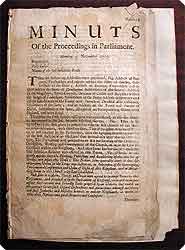 • Number 15 of the 1706–07 minutes of the Scottish Parliament. Although a number of protesters are herein recorded as arguing that “This Nation seems generally averse” to the terms of union proposed by England, and the Duke of Athol (backed by a number of supporters, whose names are given) claimed that uniting Scotland and England would be contrary to the Claim of Right and therefore high treason, these minutes close with a “yea” vote in favor of the First Article of Union.
Many of the items produced by the Anderson press bear the misspelling seen in the header here.
• ESTC P2750 (for complete sets of 1706–07 minutes). Tipped onto a leaf of 19th-century paper; now in a Mylar folder. Waterstained and creased, with uncut edges slightly ragged.
“Minuts”
— The African
& Indian
CompanyScotland.
Parliament. Committee concerning the African & Indian Company.
Broadside. Begins: “Minuts [sic]
of the proceedings in Parliament Wednesday 26. February 1707....”Edinburgh:
Heirs of Andrew Anderson, 1707. Folio (31 cm, 12.1"). [1] p.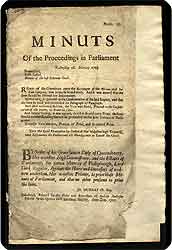
• ESTC T78547 (for holdings of complete sets). Tipped onto a leaf of 19th-century paper; now in a Mylar folder. Lower margin and bottom of outer margin slightly tattered to a curve; otherwise relatively minor creasing, soiling.
The Irish
Bar — “The Catholic Question”Sheil, Richard Lalor. Sketches of the Irish Bar...with memoir and notes by R. Shelton Mackenzie. New York: W.J. Widdleton, 1862. 8vo. (19.2 cm, 7.5"). 2 vols. I: 388 pp. II: 380 pp.

Binding: Contemporary half calf with marbled paper–covered sides, spines with blind-stamped decorative devices between raised bands and with gilt-stamped leather title and volume labels. All edges marbled.
• Bound as above; fore-edges of the two inside, touching boards as the volumes stand on the shelf, bumped hard at centers (one can’t quite imagine how); otherwise, only very minor wear. Front free endpaper with inked inscription dated 1865. Nice on shelf and in hand.
 For more SETS, click here.
TheLovat
Vassals Protest(Simon
“The Fox” Fraser).
Lovat (Scotland). Tenants. Broadside.
Begins: “Petition for the Laird of Kilravock and others the vassals of Lovat....”[Edinburgh,
ca. 1702]. Folio. [1] p.
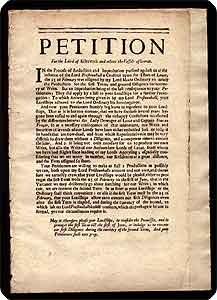
No holdings are listed
by OCLC, RLIN, ESTC, or NUC Pre-1956.
• Not in ESTC. On Fraser, see: Dictionary of National Biography, XX, 216–22. Excellent clean condition, with two small sewing holes at inner margin, one very small spot of foxing, and ink traces from printing process to outer edge. Tipped onto a leaf of 19th-century paper; now in a Mylar folder.
For
more SCOTLAND & SCOTS,
Putting DOWN the REVOLUTION in Connecticut Steadfast, Jonathan [pseud. of David Daggett]. Count the cost. An address to the people of Connecticut, on sundry political subjects, and particularly on the proposition for a new constitution. Hartford: Hudson & Goodwin, 1804. 8vo (23.6 cm, 9.25"). 21, ii, [1] pp.
 Click the interior image for an enlargement.
 First edition.
• Sabin 15716; Shaw & Shoemaker 610. Recent marbled paper–covered boards, front cover with printed paper label. Title-page with small inked “pseud.” comment next to author's name. Pages age-toned with offsetting and some light spotting (darkest to title-page); one leaf with upper margin repaired some time ago. Page edges untrimmed; one signature unopened. (25211)
Dedicated to “Patrons ofPure,Stiles, Ezra. A history of three of the judges of King Charles I. Major-General Whalley, Major-General Goffe, and Colonel Dixwell: Who, at the Restoration, 1660, fled to America; and were secreted and concealed, in Massachusetts and Connecticut, for near thirty years. With an account of Mr. Theophilus Whale, of Narragansett, supposed to have been also one of the judges. Hartford: Elisha Babcock, 1794. 12mo. 357, [5 (4 blank)], 357, [4 (3 blank)] pp.; 8 plts. (3 fold.); lacks the frontis. port.

 Click the images for enlargements.
 • Evans 27743; Howes S-999; Sabin 91742; Trumbull, Connecticut, 1425. Period-style quarter calf with marbled paper–covered sides, spine with gilt-stamped leather title and author labels and blind-tooled floral decorations in compartments. Previous owner's signature on the title-page. Rubber-stamps of the Mercantile Library, and inked marks and underlining inside, with scattered marginalia. Frontispiece portrait lacking, with eight plates (three of which are fold-out) present; each of the three folding plates with a split along one fold. Occasional marginal tears and small chips to corners; waterstaining and foxing, yet paper strong and reading easy. (3996)
Writings of anInfluential AMERICAN Jurist Story, Joseph. The miscellaneous writings, literary, critical, juridical, and political, of Joseph Story .... Boston: James Munroe & Co., 1835. 8vo (24.7 cm, 9.75"). viii, 527, [1] pp.
 Click the images for enlargements.
 • Sabin 92310; American Imprints 34408. Publisher's green pebbled cloth with some discolorations, sunned spine with gilt-stamped title; corners/edges rubbed. Ex–social club library: 19th-century bookplate and call-number ticket on front pastedown, title-page pressure-stamped, no other markings. A few early leaves separated; two leaves with outer margins reinforced some time ago. (26425)
Adultery & Divorce Tebbs, Henry Virtue. Essay on the “Scripture doctrines of adultery and divorce, and on the criminal character and punishment of adultery, by the ancient laws of England and other countries;” being a subject proposed for investigation by the Society for Promoting Christian Knowledge in the Diocese of St. David's; and to which that Society awarded its premium of fifty pounds in December, 1821. London: F. C. & J. Rivington (Pr. by J. S. Hughes), 1822. 8vo. xvi, 254, [2 (adv.)] pp.


• Modern quarter tan cloth over light blue paper-covered boards in the style of the early 19th-century, spine with printed paper label; uncut copy. Tear and chips at top margin of title-page, repaired some time ago. Title-page and several early leaves lightly age-toned and with some traces of soiling. Old ink ownership signature on title-page and p. 22, and just a bit of ink smudging at top margin of p. 23. (24445)
BEGGING
for Commercial Law Reform Tribunals
of commerce. A letter to the bankers of London, reviewing
the origin and progress of the movement in favour of tribunals of commerce....
London: Effingham Wilson, 1854. 8vo (19.7 cm, 7.75"). 47, [1 (blank)] pp.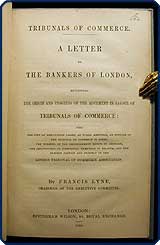
• NSTC 2L25966; not in Goldsmiths’-Kress. Recent paper-covered boards. Title-page with small inked numerals in upper outer corner. Shouldernotes shaved. Pages clean.
Folwell's Printing: The Fifth U.S. Congress United States. Laws, statutes, etc. 1797–99 (5th Cong., 1st–3rd sess.). Acts passed at the first session of the fifth Congress of the United States of America, begun and held at the city of Philadelphia, in the state of Pennsylvania, on Monday the fifteenth of May, in the year MDCCXCVII and of the independence of the United States, the twenty-first. Philadelphia: Richard Folwell, [1797–99]. 8vo (21.3 cm, 8.4"). 240, vii, [1], [241]–561, [1 (blank)], 26, iv, [48 (index)] pp.


 Click the images for enlargements. Reading or browsing, in this volume, is interesting and eye-opening.
Provenance: Old signature, “Hall Harrison,” on title-page.
• Evans 32952, 34688, & 36479; ESTC W11750; Sabin 15502, 15503, & 15504. Contemporary treed calf, rebacked with calf, spine with gilt-stamped bands and gilt-stamped leather title and publication labels; leather of boards (but not spine) crackled, chipped/chipping, and discolored from a fire, with rear board most affected and with one corner lost (3/4" up and across from the point, this showing in our extra photograph). Front pastedown with old institutional bookplate; title-page with early inked ownership inscription as above and old institutional rubber-stamp. Offsetting from binding at beginning and end, intermittent mild offsetting and faint spotting generally, a few leaves towards the back browned, with pages otherwise clean; the fire that affected the boards did not reach the interior, here. (25667)
For Books for the BUSTED
An Irish-AMERICAN'S Service & ClaimsUnited States. Congress. House. Committee of Claims. Report of the Committee of Claims to whom was referred, on the twenty-second ultimo, the petition of Oliver Pollock, of the state of Pennsylvania. January 23, 1807. Read, and referred to a committee of the whole House, on Monday next. City of Washington: A. & G. Way, printers,
1807. 8vo. 30 pp. 
• Shaw & Shoemaker 14058. Removed from a nonce volume. Librarian's lightly pencilled notation on title-page. Stray brown spots. Very good. (18017)
Abolishing “Traffick” — Proposing “Colinization” United States. Congress. [drop-title] Joint resolution for abolishing the traffick in slaves, and colinization [sic] of the free people of colour of the United States. February 11, 1817. Read, and committed to a committee of the whole House on Monday next. [Washington: William A. Davis, 1817]. 8vo. 2 pp.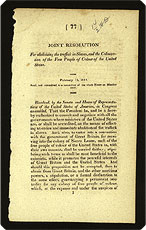
• Shaw & Shoemaker 42596; Library Company, Afro-Americana, 10583. Removed from a nonce volume. Lightly pencilled librarian's notation on p. [1]. Very mild foxing. (18436)

Laws of Oxford University of Oxford. Parecbolae sive excerpta è corpore statutorum Universitatis Oxoniensis. Accedunt articuli religionis XXXIX. in Ecclesia Anglicana recepti: nec non juramenta fidelitatis & suprematus. Oxoniae: E Theatro Sheldoniano, 1729. 8vo in 4s (15.9 cm, 6.25"). [24], 232 (lacking pp. 227–30) pp.

 Click the images for enlargements.


The title-page offers a handsome vignette of the Theatre, not one of the commonest ones.
• ESTC T118673; Madan, Oxford Books, 17. Period-style calf, framed and panelled in blind with blind-tooled corner fleurons and rather elaborate additional decorations in blind; spine with gilt-stamped title and publication information and different blind-tooled decorations. Endpapers a little smudged and title-page mounted, with edges darkened. Early inked ownership inscription in upper margin of first text page mostly torn away, with loss of a few words. Pp. 227–30 lacking, being the last bit of the printing of the Church of England's 39 Articles and the first part of the section, “De Eligendis Publicis Lectoribus.” Pages faintly age-toned, with occasional light spotting; mostly clean. (25553)
Search & SeizureVan Buren, Martin (President, 1837–1841). [drop-title] Search or seizure of American vessels on coast of Africa, &c. Message from the President of the United States, transmitting a report from the Secretary of State, in relation to seizures or search of American vessels, &c. March 3, 1841. Read, and laid upon the table. [Washington, 1841]. 8vo. 766 pp. Click
the image
for an enlargement.
Click
the image
for an enlargement. • Disbound; three holes in inner margin, not touching text. Ink notation and numeral on first page. Some dog-earing and tattering in corners and outer margins. Pencillings in several margins. Occasional mild spotting. Now housed in a simple archival phase box. (13455)
The History of Independency — Anarchia AnglicanaWalker, Clement. Relations and observations, historicall and politick, upon the Parliament, begun Anno Dom. 1640 ... together with an appendix, touching the proceedings of the Independent faction in Scotland. [London?], 1648. 4to (18.3 cm, 7.25"). A–T4t2V–Z4Aa2; [12], 174 pp. [with] An appendix to the History of Independency ... London, 1648. 4to. a–c4(-c4); [2], 20 pp. [with] Anarchia Anglicana: Or, the history of Independency. The second part. [London], 1649. 4to. A–Z4Aa–Kk4; [8], 256 pp.; 1 double-page plt. [with] The high court of justice; or Cromwells new slaughter house in England ... [London], 1651. 4to. A–I4; 71, [1 (blank)] pp. [with] M., T. The history of Independency. The fourth and last part. London: H. Brome & H. Marsh, 1660. 4to. A–R4; [8], 124 pp.

 Click any image where the hand appears on
 This variant reads “II. Bookes”on line 7 of the title-page; R4 is cancelled and not present here, as is the case in most copies. The second portion has a separate title-page printed in red and black, giving Anarchia Anglicana: Or, the History of Independency as the title and the pseudonymous Theodorus Verax as the author.
Relations: ESTC R205117; Wing (rev.) W334A. Appendix: ESTC R233193; Wing (rev.) W321A. Anarchia: ESTC R27579; Wing (rev.) W317. High Court: ESTC R207365;Wing (rev.) W325. History, fourth part: ESTC R18043; Wing (rev.) M81B. Fourth part: Issued as part of Wing W324, “and possibly separately” as well according to ESTC. Contemporary calf, covers framed and panelled in blind with blind-tooled corner fleurons, sometime rebacked with first leaves tipped (back) in; spine with new gilt-stamped title, sides rubbed and abraded. Front free endpaper lacking. Front pastedown with old institutional bookplate and pencilled notations, title-page with faded rubber-stamp (and with author’s name added in an early hand), back pastedown and lower edges of closed book rubber-stamped. Two title-pages with one short tear from outer edge each, not touching text; title-page verso with shadows of pencilled numerals. Lower and outer margins trimmed closely, in some cases touching catchwords, signature marks, or shouldernotes.
Let's Work with 'Em — A Presentation Copy
Wall, James W. The Constitution: Originating in compromise, it can only be preserved by adhering to its spirit, and observing its every obligation. An address delivered ... at the City Hall, Burlington, February 20, 1862. Philadelphia: King & Baird, 1862. 8vo. 60 pp.
• Original printed wrappers. Five-digit number stamped on front wrapper. (287)
Puritan Ex-PatRepatriated & Re-“Involved”
Ward, Nathaniel. A word to Mr. Peters, and two words
for the Parliament and kingdom. Or, An answer to a scandalous pamphlet, entituled, A word for the Armie, and two words to the kingdom: subscribed by Hugh Peters. Wherein the authority of Parliament is infringed, the fundamentall laws of the land subverted; the famous city of London blemished; and all the godly ministers of the city scandalized. In vindication of all which, this small treatise is published, by a friend to the Parliament, city, and ministery of it. London: Pr. by Fr: Neile for Tho: Underhill, 1647. Small 4to. [1] f., 38 pp.

Click the image for an enlargement. • Wing (rev. ed.) W792; Thomason E.413[7]; Sabin 101330; ESTC R21688. Removed from a nonce volume. Old two-digit number in upper outer corner of title-page. Sewing starting to separate. In modern wrappers. (20998)
Against! “Secret Confederations” Warfield, Charles. The kingdom and glory of the branch, and testament of the west. Baltimore: William Wooddy [sic], 1833. 8vo (21.9 cm, 8.6"). 261, [3 (blank)], 263–341, [1 (blank)] pp. (lacking port.).

 Click the interior images for enlargements.
 Scarce. Only 11 institutions, all in the U.S., report holdings via OCLC.
• Sabin 37866; American Imprints 22538. Period-style quarter tan cloth with light blue paper–covered sides, spine with printed paper label. Frontispiece portrait lacking. Light to moderate foxing. (23903)
Rights
Granted, Taken
Away, &
Granted AGAINWaterford (Ireland). The great charter of the liberties of the city of Waterford, with explanatory notes. To which is added a list of the mayors, bailiffs, & sheriffs of the city of Waterford, from the year 1377, to the year 1803, inclusive. Kilkenny: J. Reynolds, 1806 [but 1831?]. 8vo (23.8 cm, 9.4"). 110, [14 (1 blank)] pp.


 Click the interior images for enlargements. trade issues including the making and selling of usquebagh. The list of city officials extends to 1831 rather than the 1803 described by the title, but these leaves were almost certainly added later to remainder copies, as the paper is different. According to RLIN and OCLC, this rare item is held by only one institution outside of Ireland; no holdings are listed by NUC Pre-1956.
• NSTC C4545. Period-style calf, framed and panelled in gilt rolls, panels with gilt-stamped corner fleurons, spine with gilt-stamped leather label and gilt-stamped shamrock devices in compartments. Title-page mounted; one leaf with paper flaw with absence of a few letters, one lower outer corner torn away; previous sewing holes visible. Pages with edges untrimmed, and margins/corners variously spotted/soiled for what seem to be various reasons; some leaves chipped or dog-earred, especially in last section, and one leaf in that part pulled away from sewing. Manuscript notes extending the roster of sheriffs added to the bottom of two pages.
More Sovereignty to the PeopleWeaver, Isaac. Experience[,] the test of government: In eighteen essays. Written during the years 1805 and 1806. To aid the investigation of principles, and operation of the existing constitution and laws of Pennsylvania. Philadelphia: Pr. by William Duane, 1807. 8vo (23.2 cm, 9.125"). 60 pp. 

Sole edition.
• Shaw & Shoemaker 14179 & 12469. Recent gray-green paper over light boards; front cover with paper label, lettered in black. Uncut copy. Paper lightly age-toned and deckle edges with some light browning, waterstaining, and traces of soiling.
Corn/LAND Tax Relief! (Urges
Manchester)[Wilson, George, of Manchester]. The constitutional right to a revision of the land-tax. Being the argument on a case submitted to counsel on behalf of the National Anti-Corn league. London: [Pr. by A. Sweeting for] The National Anti-Corn-Law League, 1842. 8vo (20 cm, 7.875"). [2] ff., 55, [2], [1 (blank)] pp., [1 (blank)] f.

• Goldsmiths'-Kress 32703.2; NSTC 2R11046 & 2W25177. In recent wrappers; previously removed from nonce volume. Light soiling and staining on outer pages. Closely trimmed by binder with lost of part of last line on last two pages. Inked number on title-page.
“Occasional
Jangles . . . Not
Sufficient to Breakthe
Solemn Ty of Marriage” Younger, Alexander Dickson. Unto the Right Honourable, the Lords of Council and Session, the petition of Alexander Dickson Younger of Stonefauld.... Edinburgh, 1727. Folio (30.8 cm, 12.15"). 7, [1] pp. No holdings of this item are recorded by ESTC, OCLC, or NUC Pre-1956.
• Now in a Mylar folder. Last leaf pressure-stamped by a now-defunct institution; light age-toning, with outer margin of first page darkened. One spot of pinhole worming to all four leaves.

For ENGLISH POLITICS, click here. For
a concentrated gathering of For
EUROPEAN LAW, click here.

PLACE AN ORDER | E-MAIL US | GO (BACK) TO TOPIC/INTEREST TABLE | PRB&M HOME
All material © 2010
The Philadelphia Rare Books & Manuscripts
Company