 ENGLISH
POLITICS
ENGLISH
POLITICS
I-L • M-O • P • Q-S • T • U-Z
ENGLISH
POLITICS
Religion Laws & Liberty Queensberry, James Douglas, Duke of. The speech of James Duke of Queensberry, &c. His Majesties high commissioner to the Parliament of Scotland, on Tuesday the Twenty One day of May, 1700. [with, as issued] Polwarth, Patrick Hume, Earl of Marchmont. The speech of Patrick Earl of Marchmont, &c. Lord High Chancellor to the Parliament of Scotland, on Tuesday 21. May 1700. Edinburgh: Pr. by the heirs of Andrew Anderson, 1700. Folio (31 cm, 12.1"). 2 ff.
 Click the image for an enlargement.
 There is at least one other variant of the first piece, also printed in 1700, “For A.H.” according to its colophon. It seems likely that the two speeches were in the present case issued together — the paper and type match, and the second speech is paginated “(2)” — although these examples were later separated and existing cataloguing records are inconsistent regarding the number of leaves that should be present.  Sets of the two pieces together are scarce.
• ESTC R182313 / R33479; Goldsmiths’-Kress 03732; Wing Q160. Removed from a nonce volume, now in a Mylar folder. Leaves darkened and creased, both lower margins irregularly torn with loss of approximately 20 words. First speech with nick affecting two letters of the title.

 “Oh,
C'mon . . . ”Quincy, Josiah. [drop-title] Speech of Josiah
Quincey [sic], Representative in Congress for the state of Massachusetts,
on the joint resolution approving of the conduct of the executive of the United
States, in relation to the refusal to receive any farther communication from the
British Minister, 28th December, 1809. No place, [1810?]. 12mo. 24 pp.
“Oh,
C'mon . . . ”Quincy, Josiah. [drop-title] Speech of Josiah
Quincey [sic], Representative in Congress for the state of Massachusetts,
on the joint resolution approving of the conduct of the executive of the United
States, in relation to the refusal to receive any farther communication from the
British Minister, 28th December, 1809. No place, [1810?]. 12mo. 24 pp. Click
the image for an enlargement.
Click
the image for an enlargement.
 A very uncommon Quincy item.
 • Not in Shaw & Shoemaker. Removed from a nonce volume; stapled and respined with archival tissue. Six-digit number stamped on title-page.

 Muggletonian Stand against
 Religious Persecution Reeve, John, & Lodowick Muggleton. A remonstrance from the eternall God: Declaring severall spirituall transactions unto the Parliament, and Common-wealth of England, unto His Excellency, the Lord Generall Cromwell, the Councell of State, the Councell of Warre, and to all that love the second appearing of the Lord Jesus, the onely wise God and everlasting Father, blessed for ever. [London]: 1653. 4to (19.1 cm, 7.5"). 15, [1 (blank)] pp.

 Click the images for enlargements. Clicking on the righthand image above, and reading the last, italicized paragraph, is rewarding.
 OCLC and ESTC locate only six U.S. institutional holdings.
• ESTC R40093; Wing (rev. ed.) R682; Smith, Anti-Quakeriana, 303. Period-style calf, covers framed in blind double fillets, spine with gilt-ruled raised bands and gilt-stamped leather title-label. Title-page and first text page institutionally perforation-stamped, first text page with inked and rubber-stamped numerals in lower margin. Title-page with several tears repaired (with loss of a few letters from table of contents) and a sliver of the bottom edge replaced (with loss of lower portion of publication date); pages generally age-toned and soiled, first one with upper margin repaired. Edges trimmed closely and tattered. A “survivor.” (26010)
 The
The Glorious Revolution's Centennial Revolution Society (London). An abstract of the history and proceedings of the Revolution Society, in London. To which is annexed a copy of the Bill of Rights. [London]: Pr. by Order of the Committee, 1789. 8vo. 40, 7, [1 (blank)] pp., [1] f., pp. 41–78, [1 (blank)] f., pp. 79–87, 90–92, pp. 79–86, 93–96 (page numbers 88, 89 not used).

 Click the interior images for enlargements.
 Uncommon: No U.S. copy of this issue located via OCLC and ESTC locates only the Harvard copy. There were other, less complete editions of 40 pp., 58 pp., and 78 pp.
• ESTC N15187. Recent full calf, period style; spine with raised bands accented in gilt, oxblood leather gilt-lettered title, publication date and place in gilt at base; covers framed and paneled in gilt rules with gilt-stamped corner fleurons. Shallow chip to top outer corners of final two leaves. One word on p. 32 is blotted out in ink by an early owner with the correction supplied above it. Penned signature (partly cropped) at top edge of p. 79. Pp. 79–92 duplicated, nothing missing. (23766)
British Words of Support forColonial Rights Rokeby, Matthew Robinson-Morris, Baron. Considerations on the measures carrying on with respect to the British colonies in North-America. London printed; Hartford reprinted: Eben. Watson, 1774. 8vo (21.6 cm, 8.5"). 63, [1] pp.
 Click the interior image for enlargement.
 • Evans 13585; ESTC W30498; Howes R-372; Trumbull, Connecticut, 1305; Adams, Amer. Pamphlets, 134j; Sabin 72151; Allibone 1839. On Robinson-Morris, see: Oxford DNB online. Period-style quarter calf with marbled paper–covered sides, leather edges tooled in blind, spine with gilt-stamped title and elegant small decorations at head and foot. Pages age-toned; three leaves with minor staining. Title-page with repaired chip to outer margin, traces of early inked inscriptions in center of page, and partially shaved inscription in upper margin. Last text page with inked inscription in lower margin, partially shaved at beginning of inscription. (24866)


 Pro-Establishment — Pro-Confession
Rotheram, John. An essay on establishments in religion. With remarks on The confessional. Newcastle upon Tyne: Pr. by J. White & T. Saint for Wm. Sanby, 1767. 8vo (21.2 cm, 8.4"). [4], 148 pp.
Pro-Establishment — Pro-Confession
Rotheram, John. An essay on establishments in religion. With remarks on The confessional. Newcastle upon Tyne: Pr. by J. White & T. Saint for Wm. Sanby, 1767. 8vo (21.2 cm, 8.4"). [4], 148 pp.
 Click the images for enlargements.
 • ESTC T33309. Recent marbled paper–covered boards, spine with gilt-stamped leather title-label. Half-title with “Tracts” inked in an early hand in the upper margin; first text page with neatly inked provenance annotation (dated [19]40) in inner margin and stamped numeral in lower margin. Pages lightly age-toned, with offsetting to margins of first three leaves and a very few scattered spots of light staining. Early inked marginalia (shaved in two instances) — this of a skeptical nature — and underlining. (21075)

An AMERICAN Statesman in London Rush, Richard. Memoranda of a residence at the court of London, comprising incidents official and personal from 1819 to 1825. Including negotiations on the Oregon question, and other unsettled questions between the United States and Great Britain. Philadelphia: Lea & Blanchard, 1845. 8vo (24.5 cm, 9.6"). xii, 640 pp.


 Click the images for enlargements. social and cultural activities while in London.
• Sabin 74265; Howes R523; Allibone 1893. Publisher's brown cloth, blind-stamped, spine with gilt-stamped title and blind-stamped decorations; rubbed with cloth split at joints and front cover with spot of discoloration. Ex–social club library: 19th-century bookplate on front pastedown, old inked call number on endpapers and flyleaf (which has small old adhesions of paper to verso); no other markings. Very light to moderate waterstaining to upper inner portions of central third of the volume. (26480)
“[A]
bare Narrative
of matter of FACT,
digested in order of time”
Rushworth, John, comp. Historical collections of private passages of state, weighty matters in law, remarkable proceedings in five parliaments. Beginning the sixteenth year of King James, anno 1618. and ending ... [with the death of King Charles the First, 1648] ... London: Pr. by Tho. Newcomb for George Thomason, 1659–1701. Folio (31.5 cm; 12.5"). 5 parts in 8 vols. I: Frontis. port., [15] ff., 691, [1 (blank)], 57, [1 (blank)] pp. II: Frontis. port., [5] ff., pp. 1–617, [1 (blank)] p., pp. 717–884 pp., 1 plt. (port., Duke of Hamilton). III: pp. 885–1060, 1085–1196, 1199–1388; appendix pp. 1–315, [1 (blank)] pp.; 1 plt. (port., Earl of Strafforde). IV: Frontis. port., [3] ff., 184 pp., fols. 185–92, pp. 193–400, [16] ff., pp. 385–552, fols. 553–64, pp. 565–788, [6] ff. V: [1] f., 208 pp., pp. 259–410, 459–770, 777–99, 791–975, 974–88, [6] ff. VI: Frontis., [1] f., xvi, 148 pp., pp. 177–352, 361–656, [4] ff.; fold. plt. VIII: Title-leaf, pp. 731–890 (837, 838 repeated), 913–1056, 1059–74, 1097–1431; [1] p., [9 (index)] ff. VIII: Frontis., title-leaf, [4] ff., pp. 1–76, 101–252, 401–786, .
FACT,
digested in order of time”
Rushworth, John, comp. Historical collections of private passages of state, weighty matters in law, remarkable proceedings in five parliaments. Beginning the sixteenth year of King James, anno 1618. and ending ... [with the death of King Charles the First, 1648] ... London: Pr. by Tho. Newcomb for George Thomason, 1659–1701. Folio (31.5 cm; 12.5"). 5 parts in 8 vols. I: Frontis. port., [15] ff., 691, [1 (blank)], 57, [1 (blank)] pp. II: Frontis. port., [5] ff., pp. 1–617, [1 (blank)] p., pp. 717–884 pp., 1 plt. (port., Duke of Hamilton). III: pp. 885–1060, 1085–1196, 1199–1388; appendix pp. 1–315, [1 (blank)] pp.; 1 plt. (port., Earl of Strafforde). IV: Frontis. port., [3] ff., 184 pp., fols. 185–92, pp. 193–400, [16] ff., pp. 385–552, fols. 553–64, pp. 565–788, [6] ff. V: [1] f., 208 pp., pp. 259–410, 459–770, 777–99, 791–975, 974–88, [6] ff. VI: Frontis., [1] f., xvi, 148 pp., pp. 177–352, 361–656, [4] ff.; fold. plt. VIII: Title-leaf, pp. 731–890 (837, 838 repeated), 913–1056, 1059–74, 1097–1431; [1] p., [9 (index)] ff. VIII: Frontis., title-leaf, [4] ff., pp. 1–76, 101–252, 401–786, .
 Click the interior images for enlargements.


As our caption notes, this vast repository purports to have been made as “a bare narrative” of its “fact[s]”; but it now resonates with a richness far beyond mere chronicle.  It repays both extended and “dip-in” reading for pleasure.
• Wing (rev. ed.) R2316, R2318–19, & R2333; Lowndes 2152. Recent half speckled calf, old style; marbled paper sides; round spines, raised bands, gilt center devices in spine compartments, bands accented with gilt beading. Binding signed by Starr Bookworks. Occasional early marginalia. Occasional foxing. Very old waterstaining in vol. VI, with cockling of paper; minor worming in upper margins of same volume (not anywhere close to text). Old library pressure- (not perforation-) stamps in some blank margins. A very nice set. (22477)
AnInnocent Man Executed — His Speech, His “Paper”Russell, William. The speech of the late Lord Russel, to the sheriffs: Together with the paper deliver’d by him to them, at the place of execution, on July 21. 1683. [colophon: London: John Darby (by direction of the Lady Russel), 1683]. Folio (30.2 cm, 11.9"). 4 pp.

Click the image to the left • ESTC R36940; Wing (rev.) R2356A. On Russell, see: The Dictionary of National Biography. Unbound, spine delicately reinforced. Pages age-toned and creased, with a few tiny pinpoint holes. Tissue repair to tear from inner margin extending across both leaves, touching but not obscuring a few letters. P. 2 with numerals in an early inked hand in the outer margin.
“A Voyage to Abyssinia” — Good Lively & Readable AccountSalt, Henry. A voyage to Abyssinia, and travels into the interior of that country, executed under the orders of the British government, in the years
1809 and 1810; in which are included, an account of the Portuguese settlements on the east coast of Africa .... Philadelphia: M. Carey; Boston: Wells & Lilly (pr. by Lydia R. Bailey), 1816. 8vo (23.5 cm, 9.25"). 24, 454 pp.; fold. map.,
illus. 
This is an untrimmed copy in original boards, with  24 pages of advertising for Carey publications bound in at the front of the volume. The preliminary map, engraved by John Bower, has hand-colored border lines; this American edition does not call for the plates found in the English first, but does include in-text depictions of several “Ethiopic inscriptions.”
• Shaw & Shoemaker 33864; NSTC 2S3118. Publisher’s quarter tan paper over light blue paper–covered sides; front cover detached and back joint cracked, binding spotted, paper cracked and split along spine, spine label now absent and replaced with hand-inked title, spine with later paper shelving label. Front pastedown with institutional bookplate, front free endpaper with inked ownership inscription dated 1829. Half-title with portion of outer margin torn away (not touching text) and laid in. Map lightly foxed, with two short tears along folds. Pages age-toned, with occasional spots of foxing.
 Military
Law &
Articles of War
1816 — Sole
Edition
Samuel, E.
An historical account of the British army, and of the law military, as declared
by the ancient and modern statutes, and articles of war for its government;
with a free commentary on the mutiny act, and the rules and articles of war;
illustrated by various decisions of courts martial. London: William Clowes,
1816. 8vo (21.5 cm, 8.5"). xvi, 734 pp., [1 (blank)] f.
Military
Law &
Articles of War
1816 — Sole
Edition
Samuel, E.
An historical account of the British army, and of the law military, as declared
by the ancient and modern statutes, and articles of war for its government;
with a free commentary on the mutiny act, and the rules and articles of war;
illustrated by various decisions of courts martial. London: William Clowes,
1816. 8vo (21.5 cm, 8.5"). xvi, 734 pp., [1 (blank)] f.
 Click
the interior image for an enlargement.
Click
the interior image for an enlargement.
• Sweet & Maxwell, A Legal Bibliography of the British Commonwealth, I, 602. Quarter green sheep over marbled paper, somewhat rubbed and front free endpaper partially detached. Scattered foxing and age-spotting, occasional pencilled marginalia. More than presentable!
“It
WillImmediately
RUIN
a Multitude of Families”(Schism
Act, 1714). Broadside.
Begins: “Reasons humbly offer’d to the Right Honourable the peers
of Great Britain, in Parliament assembled, against the bill to prevent the growth
of schism.... [London, 1714?]. Folio (31.5 cm, 12.4"). [2] pp. only one U.S. holding
reported by ESTC, OCLC, and NUC Pre-1956.
only one U.S. holding
reported by ESTC, OCLC, and NUC Pre-1956.
• ESTC N22343. Tipped onto a leaf of 19th-century paper; now in a Mylar folder. In good untattered condition, with noticeable (but not print-obscuring) stain in lower center portion.
Hannah More's Copy — A Friend's Abolitionist Treatise Sharp, Granville. The just limitation of slavery in the laws of God, compared with the unbounded claims of the African traders and British American slaveholders. London: B. White and E. & C. Dilly, 1776. 8vo in 4s (20.4 cm, 8"). [2], 67, [1], 107, [3 (2 adv.)] pp.
 Click the images for enlargements.
• ESTC T137093; Goldsmiths'-Kress 11499; Library Company, Afro-Americana, 9348; Sabin 79823. On Sharp and More, see: Oxford Dictionary of National Biography online. Later quarter marbled paper (covering earlier paper) with plain paper–covered sides; faded and worn, spine paper cracking/peeling to reveal original spine beneath, front cover with small area of paper adhesion from now-absent label. Front pastedown with inscription as above, also with early inked numeral, institutional bookplates, and rubber-stamp. Pages uncut; age-toned, with light to moderate foxing. (26103)
English Politics — American Issues — Religious “Merits”Shebbeare, John. An answer to the queries, contained in a letter to Dr. Shebbeare, printed in the Public Ledger, August 10th. Together with animadversions on two speeches in defence of the printers of a paper, subscribed a South Briton. London: Pr. for S. Hooper & T. Davies, [1774]. 8vo (21 cm; 8.5"). 179, [1 (blank)] pp.


First edition, with two others appearing shortly thereafter.
• Adams, American Controversy, 74-73a. Sabin 80040. Recent boards with marbled paper covering. Paper spine label. Title-page with small 19th-century library stamp and call number in neat ink; page backed. A very nice copy.
THIS
Time Pay
AttentionSheridan, Richard Brinsley. A comparative statement of the two bills, for the better government of the British possessions in India, brought into Parliament by Mr. Fox and Mr. Pitt...second edition. London: J. Debrett, 1788. 4to (28.5 cm, 11.25"). 39, [1 (blank)] pp.
Pay
AttentionSheridan, Richard Brinsley. A comparative statement of the two bills, for the better government of the British possessions in India, brought into Parliament by Mr. Fox and Mr. Pitt...second edition. London: J. Debrett, 1788. 4to (28.5 cm, 11.25"). 39, [1 (blank)] pp.
 Single-click
lefthand image,
Single-click
lefthand image,
 The texts of both bills are present here, along with Sheridan’s analysis
of how each would address “the question of right between the public and
the [East India] Company” (p. 39).
The texts of both bills are present here, along with Sheridan’s analysis
of how each would address “the question of right between the public and
the [East India] Company” (p. 39).
• ESTC T30944; Goldsmiths’-Kress no. 13610. Recent marbled paper–covered boards, front cover with gilt-stamped leather title label and spine with gilt-stamped leather author label. Half-title and several other pages stamped by a now-defunct institution. Pages with edges untrimmed and a few small spots of staining; mostly, clean.

& the Exciseman Ends Up in Hell Sir Neil and Glengyle, the highland chieftains; a tragical ballad. And the drunken exciseman. Glasgow: Pr. for the booksellers, n.d. (ca. 1848). 12mo. 24 pp.
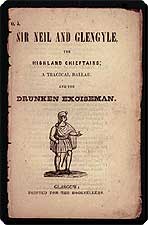 • The first named item in this chapbook is a tale of rashness and death,
 • NSTC 2N2681. Removed from a bound volume. Good++ condition. (8418)
 BALLADS Six Scotch songs. Glasgow: Pr. for the booksellers, [1840]. 12mo. 8 pp.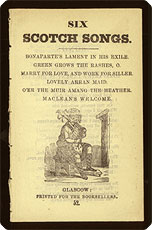
• Not in NSTC. Removed from a nonce volume. Very good. (16769)
Anti-Catholic
Self-DefenseSouthey,
Robert. Vindiciæ ecclesiæ anglicanæ. Letters to Charles
Butler, Esq. comprising essays on the Romish religion and vindicating the Book
of the Church. London: John Murray, 1826. 8vo (22.5 cm, 8.8"). xxvi, 526, [2]
pp.

• 19th-century half tan calf with marbled paper sides, spine with gilt-ruled raised bands, gilt-stamped floral decorations in compartments, and gilt-stamped leather title label; leather rubbed and chipping over joints and extremities, paper chipping over board edges, spine somewhat dulled. Hinges slightly tender, binding overall still sturdy. A few stray pencil marks. All page edges marbled—rather handsome!
For
more CATHOLICA, including
One of the FirstEnglish Histories IN English Speed, John. The historie of Great Britaine under the conquests of the Romans, Saxons, Danes and Normans. Their originals, manners, habits, warres, coines, and seales: with the successions, lives, acts, and issues of the English monarchs from Iulius Caesar, unto the raigne of King Iames, of famous memorie. London: Pr. by John Dawson [and Thomas Cotes] for George Humble, 1632. Folio (33.5 cm, 13.25"). [10] ff., 1042 pp.; 1043–1086 ff., 1087–1237, [85 (index)] pp. (lacking frontis.); illus.

 Click the interior images for enlargements.

An epitome of the “antiquarian” both in form and content, this is a marvelous compendium of royal history and lore.


The Wickedness of Government Spittlehouse, John. Certaine queries propounded to the most serious consideration of those persons now in povver. London: Livewell Chapman, 1654. 4to (18 cm, 7.1"). [2], 14 pp.

Click the image for an enlargement. ESTC and OCLC locate only six U.S. institutional holdings of this item.
• ESTC R203631; Wing (rev. ed.) S5005. On Spittlehouse, see: Oxford Dictionary of National Biography online. Later plain paper wrappers, spine reinforced with cloth tape. Title-page, first text page, and two other pages institutionally pressure-stamped; first text page with inked annotation in inner margin and numeral in lower margin. Light offsetting and spotting; first and last pages dust-soiled. (25970)
This
Led to HisExpulsion
from Commons
Steele, Richard. The crisis: or a discourse representing...the just causes of the late happy revolution. And the several settlements of the crowns of England and Scotland....With some seasonable remarks on the danger of a Popish successor. London: Pr. by Sam Buckley; Sold by Ferd. Burleigh, 1714. 4to. [1] f., vii, [1 (blank)], 37, [1 (ads)] pp.
The crux of this major political tract is Steele's polemical charge that "The Protestant Succession in the House of Hanover is in danger under Her Majesty's administration." Needless to say Queen Anne was not pleased, nor were her loyal Tories, who came to her defense. Swift, for example, wrote an important reply—The Publick Spirit of the Whigs. Eventually, the ascension of the House of Hanover to the throne saw Steele's return to a position of economic and social well-being.
• ESTC T34402; Rothschild 1950; Kress 2931. Modern marbled wrappers.
Englishmen
on theFrench
Revolution[Stone, John Hurford, et al.]. Copies of original letters recently written by persons in Paris to Dr. Priestley in America. Taken on board a neutral vessel. Third edition. London: J. Wright, 1798. 8vo (20.7 cm, 8.1"). 36 pp.

• ESTC N1989; Sabin 92070. Removed from a nonce volume, with sewing holes; now in a Mylar folder. Half-title with small numerical stamp, pencilled notations, a bit of staining and two smears/blots of old red ink. Interior slightly age-toned but clean.
A CANADIAN'sFirst & Last Appearance Sturrock, W. A military mite to the mountain of literature, or, The rhymes of a red coat. Quebec: Middleton & Dawson, 1858. 12mo (16.5 cm; 6.375"). 40 pp., [2] ff. . Click the image for an enlargement.
• TPL 5826. Publisher's printed paper–covered boards, outer corners chipped and a lighter spot to front cover where there once was an old label of some sort affecting one word of type (“Price”); old, light waterstaining (with a darker edge) and some soiling to same cover, with evidence of the onetime moisture visible also to back cover and intermittently in the interior (especially to early leaves). Fragile. (25512)
Hanoverian
HistorySwift,
Jonathan. The history of the four last years of the queen. London:
Pr. for A. Millar; Dublin: Reprinted for George & Alexander Ewing, 1758. 8vo
(22.5 cm, 8.9"). xiv, [3]–249, [1 (blank)] pp.


Provenance: Front pastedown with the bookplate of journalist, editor, and book collector Clement K. Shorter; front free endpaper and fly-leaf bearing bookplates of Geoffrey Ecroyd, Mary Priscilla Smith, Austin Smith, and Walter Hirst; title-page with inked inscription of Robert Smyth.

• ESTC T154477; NCBEL, II, 1065; Teerink 812. Later half
morocco and cloth sides, spine with raised bands and gilt-stamped title; minor
wear only to edges and spine extremities, some slight discoloration to small
patches of leather. Bookplates as described above. Page edges untrimmed. A
scattering of light spots throughout, otherwise clean. Nice.
 For
more Books with SPECIAL
For
more Books with SPECIAL
 TO Part XII
. . . TO Part XII
. . . |