
 EUROPEAN LAW
 [EMBRACING LAW OF “CONTINENTAL HERITAGE”]
 EUROPEAN LAW
 Who's
In Charge of What
& How
Much They Are Paid
Who's
In Charge of What
& How
Much They Are Paid
 Díez de la Calle, Juan. Memorial informatorio al rey nuestro señor, en su real y supremo Conseio de las Indias, Camara, y Junta de Guerra. [Madrid: No publisher/printer], 1645. Small 4to. [11 (of 12)], 31 (of 32) ff. (lacks pi4 and a1).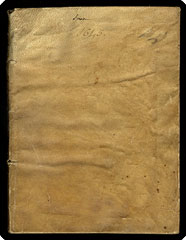
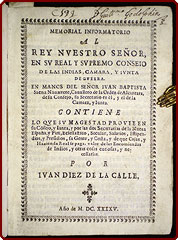
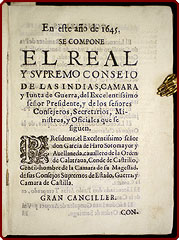
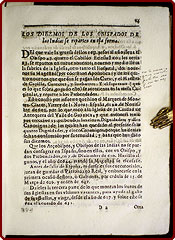
 Click the interior images for enlargements.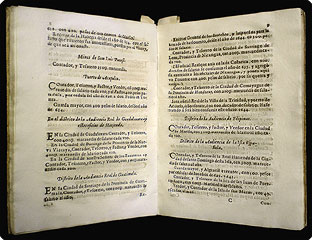
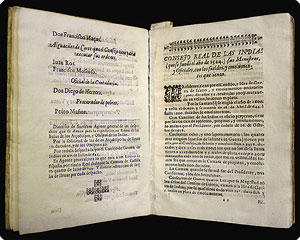
To aid in getting a refreshed grip on the administration of the New World, Philip IV of Spain asked Juan Díez de la Calle, a member of the Consejo de Indias, to produce a concise administrative handbook for use solely by the Council of the Indies, the King, and his close advisors. Here one finds all of the administrative divisions with dates of creation; office holders and their salaries and when the office was created; differences existing between administrative districts; and an interesting section on the various “annual” convoys (“armadas”) and the general in charge of each.
Provenance: Ownership signature at top of title-page of “Guill[er]mo Godolphin,” i.e., Sir William Godolphin.
• Alden & Landis, European Americana, 645/45; Palau 73741; Sabin 20133. Early limp vellum. Lacking two leaves: “Al Lector” leaf and the sectional title-leaf. A very good copy. (25808)

 Mob
Injustice
(Dissertation, 1736).
Boehmer, Justus Henning, praeses. ...De inivstitia vocationis
factae ad clamorem popvli.... Halae Magdeburgicae: Litterisoan. Christ. Grunerti,
1736. Small 4to. 42 pp.
Mob
Injustice
(Dissertation, 1736).
Boehmer, Justus Henning, praeses. ...De inivstitia vocationis
factae ad clamorem popvli.... Halae Magdeburgicae: Litterisoan. Christ. Grunerti,
1736. Small 4to. 42 pp.
• Sometime bound in a nonce volume (removed).
 For more 18TH-CENTURY GERMAN, LATIN LANGUAGE

 “La
Condamnation
des
“La
Condamnation
des Templiers”Dupuy, Pierre. Traitez concernant l’histoire de France: Sçavoir la condamnation des Templiers, avec quelques actes: L’histoire du schisme, les Papes tenans le siege en Avignon: Et quelques procez criminels. Paris: Edme Martin, 1700. 12mo (16 cm, 6.25"). Frontis., [8], 564 pp. (i.e., 570; pagination repeats 271–76)
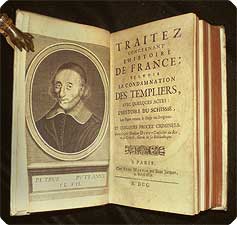
 one
of the earliest published sources for records of the Templar trial;
the preface here notes that many previous historians had judged Philip IV and
his attack on the Templars harshly “parce qu’ils ignoroient les
fondemens de cette condamnation, qui consistoient aux preuves qui te sont ici
representées” (p. [vii]).
one
of the earliest published sources for records of the Templar trial;
the preface here notes that many previous historians had judged Philip IV and
his attack on the Templars harshly “parce qu’ils ignoroient les
fondemens de cette condamnation, qui consistoient aux preuves qui te sont ici
representées” (p. [vii]).
Early editions of this work are all uncommon; only 10 U.S. holdings of this edition were found in searches of OCLC, RLIN, and NUC Pre-1956. The frontispiece portrait of “Petrvs Pvteanvs” is unsigned.
• Brunet, II, 902. Contemporary vellum, spine with stamped, gilt-framed
title; spine showing very faint traces of a now-absent label. Front pastedown
with bookplate of a 19th-century collector; frontispiece shaved close (just
into impression) by binder. Title-page browned; some intermittent moderate
foxing.  An
attractive and interesting little book.
An
attractive and interesting little book.


EarlyEl Salvador Imprint Nullifying an Appointment El Salvador. Asamblea legislativa. Broadside, begins: “Ministerio general del Gobierno del Estado del Salvador ... La Asamblea legislativa ... decreta. Se declara insubsistente el nombramiento de magistratado par que fue electo el Lic. Atanacio Urritia. San Salvador: No publisher/printer, 1833. Small 8vo. [1] p.
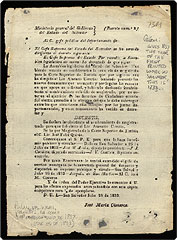
Printing seems to have arrived in El Salvador in 1825, placing this in the first decade of that art there.
Apparently rare: We trace no copy via NUC Pre-1956, WorldCat, CCILA, or METABASE.
• Removed from a nonce volume. A few small holds from insect damage, a few of the few repaired with archival tissue. Old bibliographical notations in pencil in margins. Light waterstaining in upper outer corner. (25791)

 FOUR
Important Works in ONE
Volume
FOUR
Important Works in ONE
Volume  NEATLY
Printed by Johann Maire
Erasmus, Desiderius. ...Lingua, sive, de linguæ usu atque abusu liber utilissimus. Lugduni Batavorum: ex officina Ioannis Maire, 1641. 12mo. A–S12, 410 pp., [11] ff. [bound with his] Principis Christiani institvtio per aphorismos digesta. Lugduni Batavorum: ex officina Ioannis Maire, 1641. 12mo. A–I12 K6; 228 pp. [bound with his] Querela pacis vndique gentium ejectæ, profligatæque. Lugduni Batavorum: ex officina Ioannis Maire, 1641. 12mo. A–D12 E2; 76 pp. [bound with his] Encomium moriæ, sive declamatio in laudem stultitiæ. Lugduni Batavorum: ex officina Ioannis Maire, 1641. 12mo. A–K12; 229, [2 (blank)] pp.
NEATLY
Printed by Johann Maire
Erasmus, Desiderius. ...Lingua, sive, de linguæ usu atque abusu liber utilissimus. Lugduni Batavorum: ex officina Ioannis Maire, 1641. 12mo. A–S12, 410 pp., [11] ff. [bound with his] Principis Christiani institvtio per aphorismos digesta. Lugduni Batavorum: ex officina Ioannis Maire, 1641. 12mo. A–I12 K6; 228 pp. [bound with his] Querela pacis vndique gentium ejectæ, profligatæque. Lugduni Batavorum: ex officina Ioannis Maire, 1641. 12mo. A–D12 E2; 76 pp. [bound with his] Encomium moriæ, sive declamatio in laudem stultitiæ. Lugduni Batavorum: ex officina Ioannis Maire, 1641. 12mo. A–K12; 229, [2 (blank)] pp.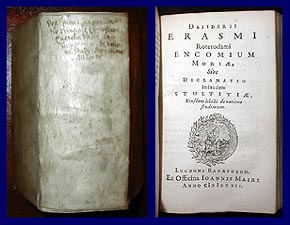
The book begins with Lingua ("On Language"), wherein Erasmus complains that humans abuse their gift of language and twist it to make a mockery of God's world and word. This is followed by the Principis Christiani Institvtio ("The Christian Education of a Prince"), directed primarily at the young Emperor Charles V Hapsburg, instructing him in, among other things, the benefits of passivism. This is considered to be one of the greatest contributions to the genre of the education of a Christian prince. The Querela Pacis ("Complaint of Peace"), next, was written in 1517 when the "Congress of Kings" met, hoping to preserve peace throughout Europe during a period of religious and social strife. Here Erasmus pleads for toleration, in some ways (but definitely not others) foreshadowing modern concepts of multiculturalism and diversity.
The volume's final work is the famous "Praise of Folly," which Erasmus claims he wrote on a journey from Italy to England while thinking about his friend Thomas More (hence the pun More -> moriæ). Here Folly, personified as a woman (of course), speaks in her own defence, pointing out the merits of the un-Christian practices of the day. That is followed by two of Erasmus's letters: "De Ratione Studii," intended for Petrus Viterius, and "De Instituendi," intended for Erasmus's students.
All works are given in the original Latin, annotated, and followed by full indices.  The resulting thick little volume is a pleasing one—Maire printed it nicely—and this copy is an exceptionally crisp and clean exemplar.
• On Erasmus, see: Hutchinson Encyclopedia of the Renaissance, 145–47. Full vellum with yapp edges. Round spine with author and title handwritten at top in sepia ink; yellow head- and tailbands well preserved. Tiny initials ink on front fly-leaf. Very little foxing. Overall, excellent.

Napoleon,
AgainFernández,
Manuel. Broadside. Begins: "Ciudadanos. Es llegado ya el momento en que
el heroico pueblo Español...." [Cardona, 1823]. Folio. [1] f.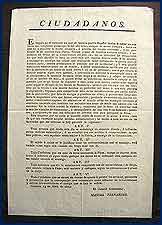 The five articles go so far as to proclaim that sharing of bad news is treason and
punishable as such.
The five articles go so far as to proclaim that sharing of bad news is treason and
punishable as such.
• One fold.

 Memoirs of
 the Minister of Police Fouché, Joseph. The memoirs of Joseph Fouché, Duke of Otranto, minister of the general police of France. London: Charles Knight (William Clowes, pr.), 1825. 8vo. Frontis. port., viii, 357, [3], 329, [1] pp.
 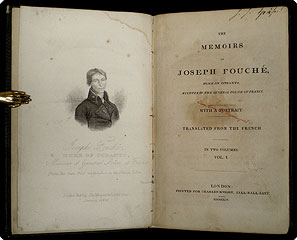 Click the image for an enlargement.
 • NSTC 2F12262, 2J13268, & 2B13609. Green cloth over boards, gilt rules and lettering to spine; cloth worn away at spine extremities and corners and splitting over front joint; preliminary pages (including frontispiece) and pp. 1–2 separated from binding. Private ownership signature at top edge of title-pages; a (different) private owner's pressure- and rubber-stamps; institutional bookplate. Off-setting to six pages from old newspaper articles or leaves laid in; old newspaper article (a review of a much later biography of Fouché) still inserted; Inner margin of pp. 327–8 repaired, not affecting text. Spotting and staining of various sorts and a few dog-ears; not a swell copy but a perfectly serviceable one. (14222)
Salt TaxFrance. Laws, statutes, etc. Compilation de l'ordonnance de Louis XIV, roy de France et de Navarre, donnée au mois de Mai 1680. Sur le fait des Gabelles. Rouen: Chez Jean-B. Besongne le fils, 1727. 8vo (17 cm, 6.7"). [60], 671, [27]
pp.
 Click the interior image
 • Not in Goldsmiths’-Kress. Contemporary mottled calf, spine gilt extra with gilt-stamped title-label; leather rubbed over corners, joints, and spine extremities, with some scuffing to back cover and leather showing minor cracking over spine. Front fly-leaf with early inked annotations; title-page with owner’s name in lower margin inked out. Pages lightly spotted; one leaf with tear from outer margin, with small loss of paper not touching text.
Were?
the Franciscans Getting
TooUppity?
Franciscans.
Satisfacion [sic] por la religion de S. Francisco al manifiesto
que se ha publicado, ocultando su nombre el autor. [Madrid, ca. 1671?]. 30, [1
(blank)] ff. Click
the image for an enlargement.
Click
the image for an enlargement.
• Not in Palau; not in Medina, BHA. Removed from a nonce volume. Title-page with shadow of pencilled numeral in upper margin; one leaf with institutional pressure stamp. Most leaves with old damage to outer margins, repaired of old in most instances, with loss of some words or letters from a number of shouldernotes; a few instances of early inked bracketing.
An Indian Author Objects to a Racist
SystemFurdoonjee,
Nowrozjee (i.e., Naurozji Faridunji).
On the civil administration of the Bombay Presidency...published in England at the request of the Bombay Association. London: John Chapman, 1853. 8vo. vii, [1], 88 pp.
Racist
SystemFurdoonjee,
Nowrozjee (i.e., Naurozji Faridunji).
On the civil administration of the Bombay Presidency...published in England at the request of the Bombay Association. London: John Chapman, 1853. 8vo. vii, [1], 88 pp.
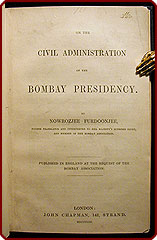
A search of RLIN, OCLC, NSTC, and NUC Pre-1956 shows only four U.S. holdings of this pamphlet.
• NSTC 2N1853. Recent moiré cloth–covered boards. Title-page with small inked numerals in upper outer corner. One leaf with short edge tear just touching text.

 TO Part
III TO Part
III |