 EUROPEAN LAW
 [EMBRACING LAW OF “CONTINENTAL HERITAGE”]
 EUROPEAN LAW
 The Choir Master’s Nephew’s Widow
 Gets
the (that’s, HER!) Children
Gets
the (that’s, HER!) Children Ramírez Carrillo, Alonso. Two documents. In Spanish, on paper. Peñafiel, Spain, 2 May 1592. Folio. [14] pp., [50] pp.

 Click the image to the left
 • Written in a clear notarial hand, but with bleed-through in the inventory, making reading slightly challenging — not, impossible. Very good condition.
 For
other, related MSS, click here.
For
other, related MSS, click here.


 The
The GENUINE
Nature of LAW
Reyher, Samuel, praeses. ...Genvina jvrivm naturæ, gentium ac civilium principia, ex limpidissimis verbi divini fontibus, ac vasti juris romani oceano, ejusque interpretibus derivata.... Kiliæ: Literis Bartholdi Reutheri, 1710. Small 4to. 46 pp.
GENUINE
Nature of LAW
Reyher, Samuel, praeses. ...Genvina jvrivm naturæ, gentium ac civilium principia, ex limpidissimis verbi divini fontibus, ac vasti juris romani oceano, ejusque interpretibus derivata.... Kiliæ: Literis Bartholdi Reutheri, 1710. Small 4to. 46 pp.

• Modern boards covered with old-style German sprinkled brown paper, with paper label on front cover. Title-page lightly soiled in top margin.

 Let's NOT Bring Backthe Inquisition S., Y. O. Anecdota importante relativa a la Inquisicion de España, y varias reflexiones sobre el mismo asunto. Mejico: Impr. de D.M. Ontiveros, 1820. Small 4to. 35, [1 (blank)] pp.

Uncommon: OCLC locates only the copies at the Bancroft and Chilean National libraries; although, clearly, there is or was one in the Sutro Library.
• Sutro 175. Removed from a nonce volume. A good clean copy. (21742)

 African-American Author on“HAYTI” — The First New-World Black-Ruled Nation Sanders (a.k.a. Saunders), Prince. By authority. Haytian papers. A collection of the very interesting proclamations, and other official documents; together with some account of the rise, progress, and present state of the kingdom of Hayti. London: Pr. for W. Reed, 1816. 8vo. [2] ff., xv, [1], 228 pp.


 Click the images for enlargements.


• Sabin 29578; not in Library Company, Afro-Americana, but see 9145 for the 1818 U.S. edition. Early 20th-century brown half-calf, gilt-stamped; rubbed on joints and corners. Ex-library (properly deaccessioned), with bookplates, call number on spine in gilt, pressure-stamp on title-page, abrasion to rear pastedown where once was a charge pocket. Occasional instances of spotting or soil; in fact, a good copy. (26021)
Natural Law
Schwarz, Ignaz. Institutiones juris universalis, naturæ et gentium, ad normam moralistarum
nostri temporis.... Augustae: Sumptibus Joannis
Antonii Fesenmayr p.m. haeredum bibliopolarum, typis Antonii Maximiliani Heiss,
1743. Folio (32.2 cm, 12.75"). [5]
ff., 195, [1], 204 pp. 

 Schwarz
critiques Protestant authors, such as Grotius, Puffendorf, Heineccius, and Thomasius,
and other writers on these subjects, pointing out where they agree with and
where they differ from Catholic teaching.
Schwarz
critiques Protestant authors, such as Grotius, Puffendorf, Heineccius, and Thomasius,
and other writers on these subjects, pointing out where they agree with and
where they differ from Catholic teaching.
He first published his Institutiones juris in 1741, and, according to DeBacker-Sommervogel, this is the third of six editions. Present here are parts 1 and 2 of 4, in which, however, all the matters above listed are discussed. This edition is printed with the title-page in red and black, a woodcut headpiece and tailpieces, and a plethora of side- and footnotes.
Provenance: Inked inscription on title-page, "Rodriguez de Arellano."
• DeBacker-Sommervogel, VII, 948. Limp vellum with remnants of ties; spine with inked title. Scattered spots of staining to spine and rear cover. Pp. 41–42 of the first series of pagination has a large chip out of the upper outer corner with loss of page numbers but no text. Pp. 155–56 has a tear in the outer margin, not touching text. Occasional worming in the outer margins, not touching text. Scattered age-spotting; a few occasions of light waterstaining in the outer margins.

In
SOME Cultures, Only BAD Women HIDE Their Faces Spain. Sovereigns, 1621–1665 (Philip IV). Prematica en que su magestad manda, que ninguna muger ande tapada, sino descubierta el rostro, de manera que pueda ser vista, y conocida, so las penas en ella contenidas, y de las demas que tratan de lo susodicho. Madrid: Pedro Tazo, 1639. Folio (28.2 cm, 11.1"). A4; 4 ff.
Click the image for an enlargement. • Palau 87353 (for Granada printing). Removed from a nonce volume. Title-page with shadow of pencilled numeral and faintly inked earlier numeral in upper margin. Pages creased but clean, with tiny hole along fold of last leaf.


Watch Your Mouth!Spain. Sovereigns, 1621–1665 (Philip IV). Prematica en que su magestad manda se executen las penas en ella contenidas, contra los que juraren, declarando, que solo queden permitidos los juramentos que se hazen judicialmente, ò para valor de algun contrato; y que en los Consejos de Inquisicion, Ordenes, y otras comunidades de estatuto, a la pregunta de las costumbres se añada la denotadeste vicio. Madrid: Pedro Tazo, 1639. Folio (28.2 cm, 11.1"). A6; 6 ff.  Click the image for an enlargement.
 • Not in Palau. Removed from a nonce volume. Title-page with shadow of pencilled numeral and faintly inked earlier numeral in upper margin. Pages creased but clean.

Educational
& Career
Rights forBlacks in
the Spanish EmpireSpain.
Sovereigns, etc., 1808–33 (Ferdinand VII). Broadside.
Begins: “Don Francisco Xavier Venegas...`Exmô, Señor = La Regencia
del Reyno se ha servido dirigirme el Decreto que sigue...Deseando las Córtes
generales y extraordinarias facilitar á los súbditos Españoles,
que por qualquiera línea traigan su orígen del Africa, el estudio
de las ciencias, y el acceso á la carrera eclesiástica....’”
Mexico, 25 September 1812. Folio extra (48 cm; 17.25"). [1] p.

Click the image to the left While Ferdinand VII remained the prisoner of Napoleon, the Regency promulgated several important human rights acts, and this was one of the most important. The Regency ratified and published it 29 January and on 31 January it was ordered distributed throughout the empire.
• Not in Medina, Mexico; not in Garritz, Impresos novohispanos; not in Sutro. One horizontal fold, top margin a little crumpled and irregular; left margin with a V-shaped bit of blank margin missing at fold, otherwise only a little irregular. Revenue stamps on the verso. Viceroy Venegas’s paraph (“rúbrica”) below his printed name. A very good copy.
The KEYSTONE
of Hispanic-American
Colonial LawHANDSOME
Edition
Spain.
Laws, statutes, etc. Recopilacion de leyes de los reinos
de las Indias. Madrid: Boix, 1841. Small folio. 4 vols. in 2. I: [6]
ff., 335, [1 (blank)] pp. II: [1] f., 334 (i.e., 332) pp., [1 (index) f. III:
[1] f., 319, [1 (blank)] pp., [1] f. IV:[1] f., 147, [1 (blank)] pp., [1] f.;
105, [1], 31, [1] pp. (all indices). 

 Click
the interior images for enlargements.
Click
the interior images for enlargements.


 handsomely
printed in double-column format. This copy is attractively
bound, as well.
handsomely
printed in double-column format. This copy is attractively
bound, as well.
• Palau 137466; Sabin 68390. Victorian acid-stained sheep with gilt spines extra. Marbled edges. Tape adhered to one title-page at inner margin. Ownershjp signatures on title-page. A nice set.
MEXICAN SILVER
MINING
Spain.
Laws, statutes, etc. Reales ordenanzas para la direccion, régimen
y gobierno del importante cuerpo de la minería de Nueva-España,
y de su real tribunal general. De orden de su magestad. Madrid, 1783. Folio
(34.3 cm, 13.5"). [1] f., XLVI, 214 pp.
SILVER
MINING
Spain.
Laws, statutes, etc. Reales ordenanzas para la direccion, régimen
y gobierno del importante cuerpo de la minería de Nueva-España,
y de su real tribunal general. De orden de su magestad. Madrid, 1783. Folio
(34.3 cm, 13.5"). [1] f., XLVI, 214 pp. 
 here
printed for the first time. Sabin
calls it a "rare and valuable compendium of the old mining laws and mineral
customs."
here
printed for the first time. Sabin
calls it a "rare and valuable compendium of the old mining laws and mineral
customs."
Galvez was a special commissioner charged with making reforms in the governing of Mexico; his work greatly influenced the 1786 replacement of the Mexican provinces with 12 intendencias. The 18th century saw a rebirth of the Mexican and the Peruvian silver industry as new technologies and techniques were introduced. Concomitant with the increased production was increased wealth for the mine owners and the crown.

 A
tall copy, regular copies being only 31 cm tall.
A
tall copy, regular copies being only 31 cm tall.

 Abolition
of a
Abolition
of a Tobacco
Monopoly
Spain.
Laws, statutes, etc. 17 March 1814. Begins: "...Sabed: Que las
Cortes han decretado lo siguiente: ...1.o Queda abolido el estanco del tabaco
en todas las provincias de la monarquía española en ambos mundos...."
[in text at end: Madrid, 17 March 1814 with final subscription in italic type
of 20 March 1814]. Folio. [2] ff. (final page blank).
Tobacco
Monopoly
Spain.
Laws, statutes, etc. 17 March 1814. Begins: "...Sabed: Que las
Cortes han decretado lo siguiente: ...1.o Queda abolido el estanco del tabaco
en todas las provincias de la monarquía española en ambos mundos...."
[in text at end: Madrid, 17 March 1814 with final subscription in italic type
of 20 March 1814]. Folio. [2] ff. (final page blank).

• Not in Palau (?); not in Maggs, Bibl. Amer.; not in Harper, Catalogue XVI. Excised from a volume and leaves no longer integral, but now rehinged. Light stain in inner margin. Rubber-stamped numbers in upper margins. Manuscript notes indicating that this copy was sent to authorities in Chile. Now housed in a quarter cloth (faux leather) folder with marbled paper sides. A nice copy of an important economic document.
Freedom
of the Press in
the Spanish
EmpireSpain.
Sovereigns, etc., 1808–33 (Ferdinand VII). Broadside.
Begins: “Don Francisco Xavier Venegas...`Exmô. Sr. = ...sabed: que
en las Córtes generales y extraordinarias, congregadas en la Real Isla
de Leon, se resolvió y decretó lo siguiente...Articulo I. Todos
los cuerpos y personas particulares, de qualquiera condicion y estado que sean,
tienen libertad de escribir, imprimir y publicar sus ideas politicas sin necesidad
de licencia, revision ó aprobacion alguna anteriores a la publicacion....”
Mexico, 5 October 1812. Folio extra (48 cm; 17.25"). [1] p. 
• Garritz, Impresos novohispanos, 1612. Not in Medina, Mexico; not in Sutro. One horizontal fold; right margin a little crumpled. Revenue stamps on the verso. Viceroy Venegas’s paraph (“rúbrica”) below his printed name. A very good copy.
Barcelona
Speed Limits, 1787
Spain. Sovereigns,
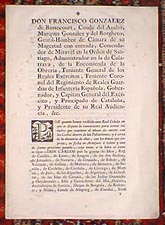
1759–1788 (Charles III). Begins: "Don Francisco Gonzalez de Bassecourt...Por
quanto hemos recibido una Real Cédula en que se dispone lo conveniente
para evitar los daños que ocasiona el abuso de correr con los Coches
dentro de la Poblaciones...." Barcelona, 1787. Folio. [2] ff.• Folded as issued; some light foxing.

Troublesome Soldiers to FaceCriminal Courts Spain. Sovereigns (1788–1808, Charles IV). Broadside, begins: “El Rey. -- Para evitar en lo sucesivo las disputas entre los Gefes de los Cuerpos de mi Exército en Indias con las Audiencias.... Mexico: No publisher/printer, 1800. Folio. [1] p.

• Not in Medina, Mexico; not in González de Cossío, Cien; not in not in González de Cossío, 510. Removed from a nonce volume. Left margin irregular. (25824)

Law
in thePeninsula
(Spanish Legal Pleadings). An assemblage of 30 pleadings before the audiencias of the various kingdoms. Granada, elsewhere, ca. 1590 – ca. 1714. Folio. 299 ff.
Typically, pleadings such as these were printed to the minimal standards of "job printing," but most present here have interesting woodcut initials, some historiated, and among them they are decorated with an interesting array of type-ornaments; eight are begun with a good-size woodcut or engraving of the Virgin, the Virgin and Child, or the Crucifixion, typically unsigned. Usually there is no indication of where the item was printed, and dates must be inferred from the contents or from the watermark of the paper.
Such Spanish documents as these are rare in non-Spanish libraries.
• All documents are removed from bound volumes, but, unless otherwise noted, are still sewn. They are in good, usable condition, and are unfoxed, with exceptions to these rules noted in the complete listing of the collection—available upon request.
 For a collection of COLLECTIONS, click
here.
For a collection of COLLECTIONS, click
here.
Adultery & Divorce Tebbs, Henry Virtue. Essay on the “Scripture doctrines of adultery and divorce, and on the criminal character and punishment of adultery, by the ancient laws of England and other countries;” being a subject proposed for investigation by the Society for Promoting Christian Knowledge in the Diocese of St. David's; and to which that Society awarded its premium of fifty pounds in December, 1821. London: F. C. & J. Rivington (Pr. by J. S. Hughes), 1822. 8vo. xvi, 254, [2 (adv.)] pp.


• Modern quarter tan cloth over light blue paper-covered boards in the style of the early 19th-century, spine with printed paper label; uncut copy. Tear and chips at top margin of title-page, repaired some time ago. Title-page and several early leaves lightly age-toned and with some traces of soiling. Old ink ownership signature on title-page and p. 22, and just a bit of ink smudging at top margin of p. 23. (24445)
Royal
Wills —
A Manuscript CompendiumFrom
the Gavito Collection
(Testaments
of the Castilian Kings). Manuscript, with binder's
title: "Testamentos de Senores Reyes de Castilla." No place, no date [probably
Spain, not before October, 1700, probably no later than 1701]. Folio. [3], 209
ff. 

 Single-click
any image where the hand appears on
Single-click
any image where the hand appears on


The volume was written on a single paper stock but by a (small) number of copyists. It bears an unidentified marca de fuego in the lower margins which usually indicates a religious library's ownership, increasing the possibility that the manuscript originated in the scriptorium of one of the orders. The purpose for compiling the documents is unclear, but since the various orders were in almost continuous litigation, and would often invoke the memory and spirit of a past monarch, a compendium such as this would have been extremely useful—especially when operating in opposition to the new, foreign monarchs, who, with their French ways of doing things, were to be challenged and "educated."
 Provenance: Gavito collection; marca de fuego as above and below.
• Contemporary limp vellum with yapp edges; recased and new endpapers applied. Clean, crisp, unwormed text. Marca de fuego reading "CDS" within a rectangular braided border.


Religous Territoriality — Early 16th-CenturyTOLEDO Toledo, Spain (bishopric). Document in Spanish, on vellum. Toledo, Spain: 30 November 1517. Small 4to (21 cm; 8.25"). [21] pp. Click the image for an enlargement.
 The Franciscans are permitted to 1) preach (to those who wish to listen) in their monasteries, the public squares, and “other public” areas of the city, but not in the parish churches; 2) hear confessions from all Christians, those who have confessed to a friar no longer having to reconfess to a diocesan priest; 3) administer the holy sacraments, including communion, only after receiving specific licence from the diocese to do so; 4) say mass on Sundays and high holy days for any and all who wish to attend; and 5) accept for burial in their monasteries the bodies of any and all Christians who wish such disposition of their remains. One last clause prohibits the diocesan priests from interfering with the Franciscans' receiving any monies or religious art work or other things specified in the wills of deceased Christians.
• Written in sepia ink in a clear and rather beautiful ecclesiastical notarial hand, on good quality vellum. Very good condition. Handsome and important. (26975)
A Tour ofRUSSIA Conducted by a SPECIALIST Tooke, William. View of the Russian empire, during the reign of Catharine the second, and to the close of the eighteenth century ... the second edition. London: Pr. by A. Strahan & G. Woodfall for T.N. Longman & O. Rees, 1800. 8vo (21.7 cm, 8.5"). 3 vols. I: xxxvi, 630 pp.; 1 fold. map. II: [2], 574 pp. III: [2], 628 pp. (pagination skips 561–64).

 Click the images for enlargements.
 The state of the Russian military forces is here described at length. The commerce section includes chapters on viniculture, sericulture, and apiculture, as well as mining and salt harvesting; at the back of the third volume are extensive tables of Russian imports and exports, merchant ships arrived and sailed, duties and taxes, and names of the most active St. Petersburg merchants. Coins and measures are also examined.
Binding: Contemporary treed calf, flat spines with gilt tooling of several sorts creating compartments, each with a large device; gilt-stamped green leather title and volume labels.
• ESTC T109837; Allibone 2434. On Tooke, see: Dictionary of
National Biography online. Bound as above, two volumes with front
covers off and all other joints weak; covers showing some gouges and spines
some chips, the set apparently having been exposed not only to normal wear/rubbing
but sometime long past to something (heat? “repairs”?) that darkened
and roughened them irregularly. Ex–social club library: front pastedowns
each with 19th-century bookplate and inked numerals, title-pages pressure-stamped.
Intermittent light foxing and light to moderate offsetting throughout; vol.
III with waterstaining in upper margins. Map lightly foxed but otherwise in
excellent condition. A set of booksstill
striking, and priced to permit the next owner to contemplate
repairs. (26366)
Guys,
Cut YourRidiculous
HAIR!Vallejo, Fernando de. Pregon en que su magestad manda, que por quanto el abuso de las guedejas y copetes con que andan algunos hombres, y los rizos con que componen el cabello ha llegado à hazer escandalo en estos reynos, ningun hombre pueda traer guedejas ni copete. Madrid: En la imprenta de Francisco Martinez, 1639. Folio (28.2 cm, 11.1"). [4] ff.
 Click the image for an enlargement.
 • Palau 236209. Removed from a nonce volume. Pages creased, with small areas of light waterstaining to upper and lower inner margins; title-page with early inked numeral and shadow of pencilled numeral in upper margin.
 Dress Right!Vallejo, Fernando de. Pregon en que su magestad manda, que ninguna muger de qualquier estado y calidad que sea pueda traer, ni traiga guardainfante, ò otro instrumento, ò trage semehante, excepto las mugeres que con licencia de las justicias publicamente son malas de sus personas. Madrid: En la imprenta de Francisco Martinez, 1639. Folio (28.2 cm, 11.1"). [4] ff.
 Click the image for an enlargement.
 • Palau 236212. Removed from a nonce volume. Title-page with small early inked numeral and shadow of pencilled numeral in upper margin; publication authorization leaf with small hole just touching letters, without loss of sense.
An Archbishop's Entail Venero y Leyva, Carlos. Documents (some signed), in Spanish, on paper. Toledo, Spain: 16 May 1642. Folio (31.5 cm; 12.35"). [38] pp.

substantial cahier deals with the terms of the entail, succession to it, its restrictions, and its endowment; all as specifically relating to Don Carlos and the situation in 1642.
Click the image for an enlargement. • Bound in a vellum wrapper handsomely indited on the front with two abstracts of the contents, writen in a fine modified gothic script. The documents' texts are written on paper in a hurried notarial hand, sometimes a little difficult to decipher. A clean, attractive manuscript. (26980)
Uncommon & Oft-CitedTreatise on Baptism Visconti, Giuseppe. Iosephi Vicecomitis Ambrosiani collegii doctoris Observationes ecclesiasticae in quo de antiquis baptismi ritibus, ac caeremoniis agitur.... Parisiis: Apud Laurentium Sonnium, 1618. 8vo (18.5 cm, 7.25"). [6], 912, [70 (index)] pp.

 Click the images for enlargements.
 The first edition of 1615 is scarce, as is this second edition, of which at least two variant issues appeared in 1618. All have the same pagination but attribute their publication to Droüart, Cramoisy, or (as in this case) Laurent Sonnius; presumably at least one of the title-pages is a cancel. All are uncommon: OCLC locates only two U.S. institutional holdings of this Sonnius printing. The work bears a woodcut title vignette, headpieces, and initials, with copious printed shouldernotes to the text.
• Starr, Baptist Bibliography, V551. On Visconti, see: Feller, Dictionnaire historique, 71. Later quarter mottled calf and speckled paper–covered sides, spine gilt extra with gilt-stamped leather title-label, rebacked preserving most of original spine; edges and extremities rubbed, spine with area of discoloration from now-absent shelving label, original spine leather chipped and cracked. Title-page with institutional rubber-stamps, numeral, and pressure-stamp; one additional page pressure-stamped. Pages age-toned with occasional light spotting and title-page dust-soiled; one spot of pinhole worming to first quarter of volume, not touching text. Early inked inscription on title-page inked over, one instance of early inked underlining. Sound and handsome. (25877)

The ENDURING LAWS of theVISIGOTHS Visigoths. Laws, statutes, etc. Fuero juzgo en latín y castellano, cotejado con los más antiguos y preciosos códices por la Real Academia Española. Madrid: Por Ibarra, 1815. Folio (34.2 cm, 13.5"). [7] ff., pp. [iii], iv–liv, [2] ff., X, 162 pp., [2] ff., XVI, 231, [1] pp.

 Click the interior images for enlargements.


• Palau 95528. Original printed wrappers with a little tattering and a small chip from the base of the spine. Light waterstaining in the outside margins of some leaves and title-page with some staining in the inside margin, not affecting printed area. In fact, in very good condition.
Enlightenment-Era Ideals of Religious Tolerance Voltaire, François-Marie Arouet de. A treatise on toleration; The ignorant philosopher; and A commentary on the Marquis ofBecaria's treatise on crimes and punishments. London: Fielding & Walker, 1779. 8vo. [4], iv, 224 [i.e., 234], [2], iii, [1], 86, [2], ii, 50 pp. (lacking frontis. portrait).


 Click the interior images for enlargements.
 Williams, a Welsh philosopher, was a founder of the Royal Literary Fund and a close friend of Oliver Goldsmith.
These collected translations are fairly widely held institutionally, but seldom seen on the market.
• ESTC T51661; Lowndes 2792; Allibone 2736. Recent period-style mottled calf, framed and panelled with gilt rules and gilt-stamped corner fleurons, panelling in contrasting calf, spine with gilt-stamped leather title and author labels, raised spine bands set off by gilt double fillets. Frontispiece portrait lacking. Light foxing; one leaf with tear from lower margin, extending into five lines of text. (23537)
Trade
in WartimeWard, Robert Plumer. An essay on contraband: Being a continuation of the treatise of the relative rights and duties of belligerent and neutral nations, in maritime affairs. London: J. Wright & J. Butterworth (pr. by G. Woodfall), 1801. 8vo (19.5 cm, 7.75"). vii, [1 (blank)], 173–255, [1 (blank)] pp. (lacking i/ii, i.e., the half-title).
• Goldsmiths'-Kress 18239; NSTC W529. Recent paper wrappers. Some instances of light foxing and offsetting.
Death to the Anabaptists! Zurich. Rat. Abschid der Stette Zürich Bern vnnd sant Gallen, von wegen der widerteüfer aussgangen. [Augsburg: Silvan Otmar, 1527]. Small 4to (19 cm; 7.5"). [6] ff.
 Click the images for enlargements.
 The concordat defines Anabaptism as a vice and the punishment ranges from fines to “drowning without mercy” depending on who the accused Anabaptist is; “foreigners” (non-natives of the jurisdictions), preachers, and backsliders are dealt with the most severely. Every citizen is bound to denounce anyone known to be or even suspected of being an Anabaptist.
The concordat was a codification of Zwingli's extreme animosity towards the sect. It is considereda major document in Mennonite history.
Provenance: Ownership signature on title-page of Howard Osgood, noted late 19th- and early 20th-century collector and scholar; old circular pressure-stamp on same page of a seminary (properly released).
WorldCat locates only three copies in North America and COPAC locates only the copy at Oxford, but there is a copy at the British Library.


PLACE AN ORDER | E-MAIL US | GO (BACK) TO TOPIC/INTEREST TABLE | PRB&M HOME
All material © 2010
The Philadelphia Rare Books & Manuscripts
Company