
 BOOKS
IN
ITALIAN!
BOOKS
IN
ITALIAN!
BOOKS
IN
ITALIAN!
BOOKS
IN
ITALIAN!
 WORLD MYTHOLOGY — 8 Vols. & Thousands of Entries
  (An
Italian Joy). Pozzoli, Giovanni; Felice Romani; Antonio
Peracchi, et al. Dizionario storico-mitologico di tutti i popoli
del mondo. Livorno: Stamperia Vignozzi, 1824–28. 8 vols. 8vo (21 cm, 8.25").
I: 580 pp. II: 581–1163, [1] pp. (pp. 1057–64 repeated in place of
pp. 1065–72). III: [1165]–1708 pp. (pagination 1551–52 repeated,
1687–88 skipped). IV: [1709]–2342 pp. V: 2351–3086 pp. (pagination
skips 2519–26). VI: 3087–3855 pp. (pagination skips 3407–08).
VII: 576 pp. VIII: 577–1074 pp.
(An
Italian Joy). Pozzoli, Giovanni; Felice Romani; Antonio
Peracchi, et al. Dizionario storico-mitologico di tutti i popoli
del mondo. Livorno: Stamperia Vignozzi, 1824–28. 8 vols. 8vo (21 cm, 8.25").
I: 580 pp. II: 581–1163, [1] pp. (pp. 1057–64 repeated in place of
pp. 1065–72). III: [1165]–1708 pp. (pagination 1551–52 repeated,
1687–88 skipped). IV: [1709]–2342 pp. V: 2351–3086 pp. (pagination
skips 2519–26). VI: 3087–3855 pp. (pagination skips 3407–08).
VII: 576 pp. VIII: 577–1074 pp.


 Click the middle and right hand-images for enlargements.
 This set includes two volumes of supplemental text, adding a number of entries. The first edition was followed by two volumes of supplemental plates, not present here and not called for: Graesse describes this edition as “sans grav.”
The pagination is erratic in a number of places; there is a numbering gap from 2342 to 2351 between vols. IV and V, but the text and signatures are uninterrupted.
Uncommon: OCLC locates only two U.S. institutional holdings of this second edition.
Provenance: Most volumes with small inked ownership inscription in an outer margin: “G.R.W.” the mark of William Rollinson Whittingham (1805–79), fourth Episcopal Bishop of Maryland and an enthusiastic book collector.
• Brunet, IV, 851; Graesse, V, 429. Not in Sabin. Contemporary half binding, recently rebacked with tan paper, spines with printed paper labels; boards rubbed and faded with small chips, one vol. with front cover waterstained. Foxing almost throughout, generally no worse than moderate; light waterstaining in upper margins of vol. I; one leaf in vol. VII with lower outer portion torn away, with loss of words from about 18 lines on each side. Vol. II with printer's error replacing pp. 1065–72 with duplicates of pp. 1057–64; pagination erratic in other places. Most vols. with ownership mark as above; vol. VI with one pencilled and one inked marginal annotation. (25862)
 This entry is repeated in the


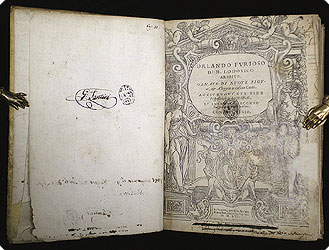
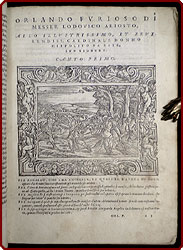
A Classic in Classic Renaissance Form Ariosto, Lodovico. Orlando furioso ... ornato di nuove figure, & allegorie in ciascun canto. Venetia: Gio. Andrea Valuassori detto Guadagnino, 1556. 4to (21.6 cm, 8.5"). [1], 274 (168 & 169 lacking), [19] ff.; illus.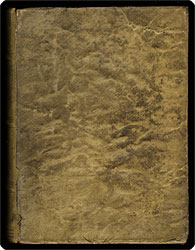
 Click the images for enlargements.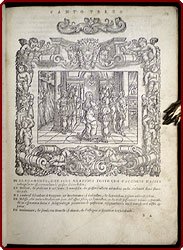
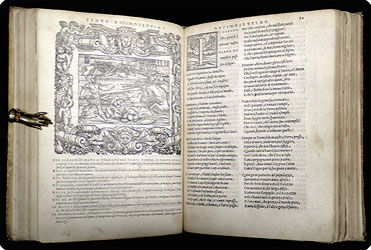
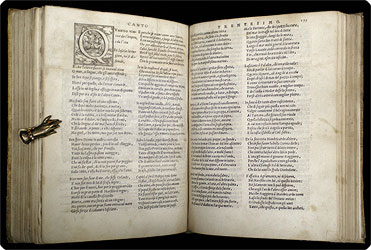
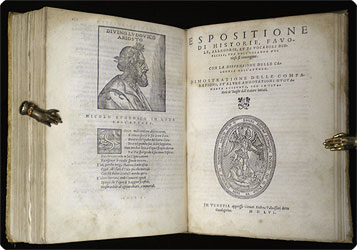
Provenance: Front free endpaper with early inked ownership inscriptions including that of G. Santini; title-page with early inked inscription (lined through) in lower margin and with Santini's small oval rubber-stamp monogram at center; one other page similarly rubber-stamped.
• Brunet, I, 435; Essling, Les livres à figures vénitiens, 115; Graesse, I, 198; Index aurel. 107.474. This ed. not in Adams, not in Mortimer. Sophisticated copy. Contemporary vellum, neatly and unobtrusively rebacked; sides dust-soiled, corners rubbed. Hinges (inside) reinforced; ownership marks as above. Title-page repaired, with small portion of image lacking, inner margin reinforced, and some reinforcements affecting sharpness of image; two leaves supplied from another edition and ff. 168 and 169 lacking; one leaf with upper border portion of image supplied and another with capital and several lines of text hand-inked as described above. Staining and spotting variously, generally light; a few early inked marks of emphasis, and scattered marginalia in Italian.  An appealing “book for the busted bibliophile” as a solid volume offering both charm and signifcance and a lowered price. (26560)

 The
First Translation of the
Bible into Italian
from
The
First Translation of the
Bible into Italian
from Hebrew
& Greek Sources
Bible.
Italian. Diodati.
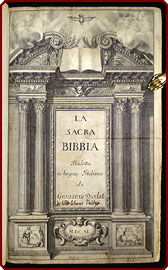
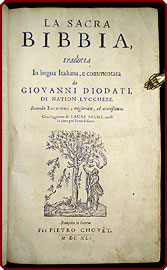
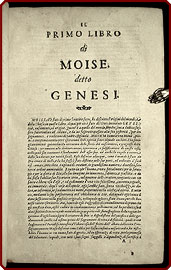
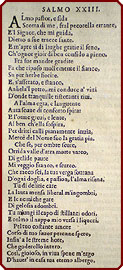
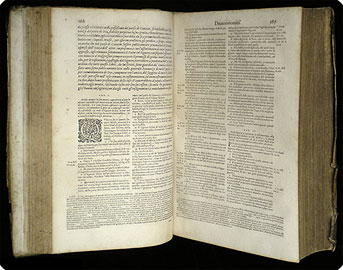
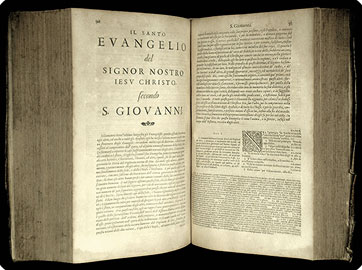
1641. La sacra bibbia tradotta in lingua Italiana, e commentata da
Giovanni Diodati. Stampata in Geneua: Per Pietro Chovët, 1641. Folio (30.5
cm; 12.125"). [3] ff., 837, [3], 331, [1], 148, 68 pp.
Hebrew
& Greek Sources
Bible.
Italian. Diodati.
1641. La sacra bibbia tradotta in lingua Italiana, e commentata da
Giovanni Diodati. Stampata in Geneua: Per Pietro Chovët, 1641. Folio (30.5
cm; 12.125"). [3] ff., 837, [3], 331, [1], 148, 68 pp.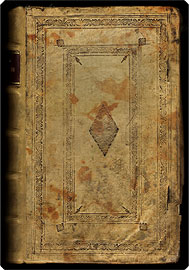
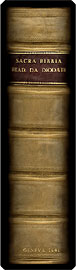
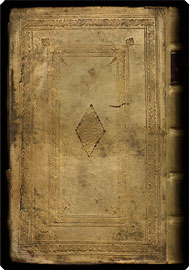 Click the images for enlargements.
 Diodati (1576–1649), a Protestant theologian, in 1609 succeeded Theodore Beza as professor of theology at Geneva, and in fact was Beza's choice for his successor. He is best remembered today as the first to translate the Bible into Italian from Hebrew and Greek sources.
A Man Scorned? Or One Satirizing a Genre? Boccaccio, Giovanni. Laberinto d'amore. Con una epistola a messer Pino de Rossi confortatoria del medesimo autore e di nuovo corretto. [colophon: Vinegia: per Pietro di Nicolini da Sabio, 1536]. Small 8vo (15.5 cm; 6"). 72 ff.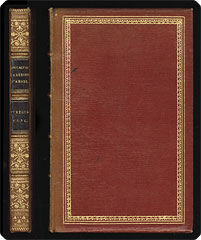
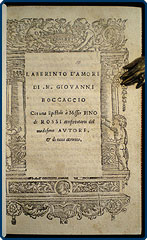
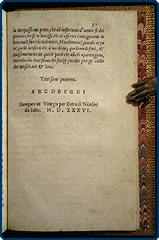 Click the interior images for enlargements.
 The work is now generally better known under the title Il Corbaccio, although all editions use the title found here. As one would expect with a Venetian-printed Renaissance work of literature, the text is in italic type; and this was printed early enough in the 16th century that the title-page offers a charming four-element architectural woodcut border.
Binding: Finely bound in 19th-century English straight-grained red morocco, with ornamental gilt border to covers, gilt-extra panelled spine, and two black leather spine labels. Board edges with a gilt roll; complex gilt inner dentelles and marbled endpapers. All edges gilt.
• Graesse, Trésor de Livres rares, I, 455; Brunet, I, 1016.; Index Aurel. 120.267. Not in Adams. Bound as above; spine lightly faded and front cover with two small spots. Some small, light stains in text (only); generally, a very good copy. (25054)

 Des Cartes in Verse — An Attractive FolioCampailla, Tommaso. L'Adamo ovvero il mondo creato poema filosofico.... Siracusa: Nelle stampe di D. Francesco Maria Pulejo, 1783. Folio (32.4 cm, 12.75"). Frontis., LII, 272 (i.e., 294), XX, 16 pp; 1 plt.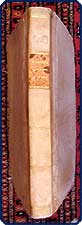
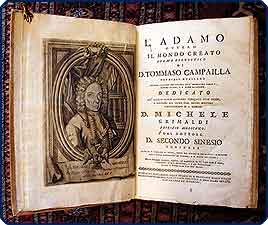 Single-click
image at left
Single-click
image at left Rare: Only one copy of this edition traced via NUC Pre-1956, OCLC, and RLIN (at the Bancroft Library).
• Quarter vellum with vellum turn-ins. Covers originally covered with gilt or marbled paper, now lost, exposing underlying paste boards—a rather interesting effect. Spine divided into compartments by gilt rolls; a tan leather label, gilt-lettered. Somewhat cockled. Pages untrimmed. Upper outer corner of title-leaf repaired with paper. Two wormholes through frontispiece, plate, and first three printed leaves, with a little loss to illustrations (which yet remain effective) and to parts of individual letters; some additional worming in the margins, not affecting text.
 TO Part
II . . . TO Part
II . . . |