
 BOOKS IN ITALIAN
BOOKS IN ITALIAN
BOOKS IN ITALIAN  Business Correspondence in
 Italian & French
 E. A. Secrétaire des negociants, ou lettres françoises it italiennes.... Par E.A. professeur de ces deux langues. Amsterdam: Et se vend à Turin, chez les Frères Reycends, Guibert e Silvestre, libraires, 1752. 12mo (19 cm, 7.5"). 333, [1 (blank)] pp., [1 (blank)] f.
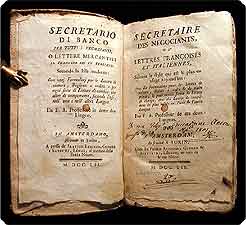
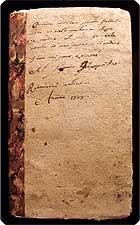
Scarce: No U.S. copies traced via NUC Pre-1956, OCLC, or RLIN; and only two via the Italian union catalogue (SBN), the British Library, the OPAC of the Dutch Royal Library, and the Catalogue collectif de France, both in France.  First of three editions.
Provenance: On blank back of Italian title-page, “Comprato da me Filipo Ricccardini in Ancona,” dated 1801; similar note on title-page in French.
• Goldsmith’s-Kress 9910.20 (for later ed. only). Uncut copy. Publisher’s cartonné binding, with some staining; spine perished and renewed with marbled paper not affecting inked notation in Italian on front cover. Some light browning and occasional spots of staining; actually rather clean for such a working volume. A few pages adhered together at their gutters, obscuring individual letters without loss of sense. Inked notations on endpapers; ownership inscriptions as above.

 DIFFERENCES
— Between
France
& SpainGarcía, Carlos. Antipatia de francesi e spagnuoli. Venetia: Presso Cristoforo Tomasini, 1640. 12mo. 216 pp.
DIFFERENCES
— Between
France
& SpainGarcía, Carlos. Antipatia de francesi e spagnuoli. Venetia: Presso Cristoforo Tomasini, 1640. 12mo. 216 pp.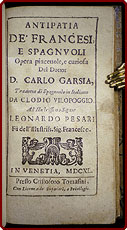

The subject of this work is the rivalry between Spain and France for political and religious supremacy in the Catholic realm of Europe, but the author also discusses national traits, as he sees them, such as manner of dressing, walking, eating, and talking.
• Palau 97802. Recent boards covered with marbled paper; leather spine label gilt with title. Some lower margins irregular due to natural paper flaws. All edges speckled red. A very good copy. (25812)

With
a Most
Lifelike Portrait
Giacinto di Santa Maria. Memorie dell’ umile servo di Dio P. Carlo Giacinto di Santa Maria.... Roma: Nella Stamperia del Bernabò, 1728. 4to (22.5 cm, 8.875"). [12] ff., 323, [1] pp.
Most
Lifelike Portrait
Giacinto di Santa Maria. Memorie dell’ umile servo di Dio P. Carlo Giacinto di Santa Maria.... Roma: Nella Stamperia del Bernabò, 1728. 4to (22.5 cm, 8.875"). [12] ff., 323, [1] pp. 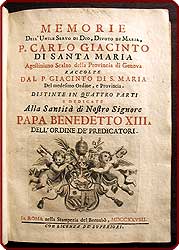
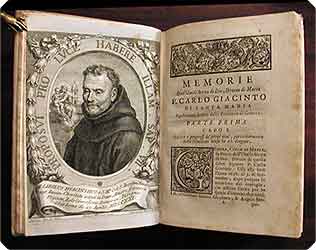
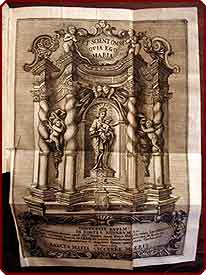
The most striking feature of this piece is the first of the two plates, a lifelike portrait of the book’s subject engraved by Heinrich Wehymer after Antonio Davide. The other plate, an unsigned etching, depicts the statue of Our Lady of Consolation in the Augustinian church at Genoa. Also present is an engraved title-page vignette depicting the arms of Pope Benedict XIII, the work’s dedicatee, and there are a few initials and woodcut head- and tailpieces, the tailpiece on the last page being especially large and handsome.
This
is apparently the sole edition of this biography, and it is rare: A search of OCLC, RLIN, and NUC Pre-1956 revealed no copies, and the Italian Library Service union catalogue lists only one holding, at the Central Library in Turin.
• Vellum over paste boards with staining on front cover; pastedowns torn along turn-ins and puter edge of front free endpaper somewhat tattered. Lightly foxed throughout, a few pages more heavily so, with a light waterstain on the bottom edge and/or lower outer corner of most leaves (barely visible, on some). Small hole in outer margin of half-title and hole with tear (from a paper defect) in the margin of pp. 51–52. The second plate with two closed tears into the engraving, without loss. All edges mottled red and blue.

With
a STRIKING
Portrait Tipped
InGiarda, Cristoforo. Vita del venerabile seruo di Dio Monsignor Francesco di Sales.... Venetia: Gio. Maria Turrini, 1664. 8vo (22 cm, 8.6"). a8A–N8O6; [8] ff., 222 (i.e, 220) pp; 1 plt.
Tipped
InGiarda, Cristoforo. Vita del venerabile seruo di Dio Monsignor Francesco di Sales.... Venetia: Gio. Maria Turrini, 1664. 8vo (22 cm, 8.6"). a8A–N8O6; [8] ff., 222 (i.e, 220) pp; 1 plt.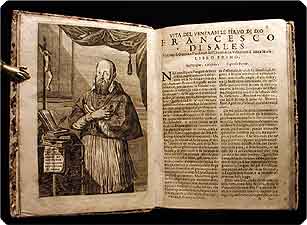
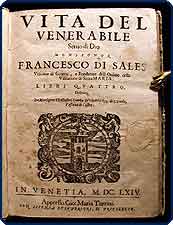
 NUC Pre-1956 gives only one holding, with no additional locations in RLIN or OCLC.
 Click
the righthand image for an enlargement.
Click
the righthand image for an enlargement.
Provenance: Front free endpaper with early inked ownership inscription of Marianna Ungarelli; title-page with blurred heraldic pressure-stamp affixed.
• Later quarter rough paper over marbled paper–covered limp boards; binding rubbed. Pages age-toned, with additional mild foxing.
 A “Learned & Curious” Work — IllustratedLanzi, Luigi. Saggio di lingua Etrusca e di altre antiche d’Italia per servire alla storia de’popoli, delle lingue e delle belle arti ... edizione seconda. Firenze: Tipografia di Attilio Tofani, 1824. 8vo (21.5 cm, 8.5"). 3 vols. I: Frontis., xxviii, [2], 357, [1] pp.; 4 plts. II: xv, [1], 496 pp.; 10 plts. III: xi, [497]–772, xliv, [4], 94, [2] pp.; 4 plts.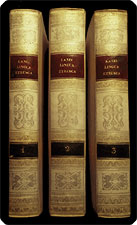
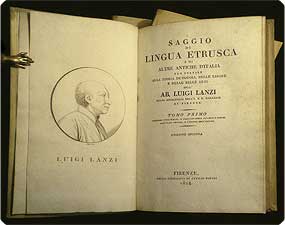 Click the interior image for an enlargement.
The three volumes are illustrated with 18 copper-etched plates, some signed by Tommaso Nasi, depicting inscriptions, coins and medallions, and other antiquities.
Binding: Contemporary vellum, spines gilt extra with gilt-stamped leather title and volume labels.
• Brunet, III, 827; Cicognara 2595; DeBacker-Sommervogel, IV, 1501. Bindings show only very minor signs of wear overall, some light speckling to spines and small spots of discoloration to two front covers, two volumes with lower corners bumped, two spine labels with small scuffs. Front pastedowns each with private collector’s bookplate and institutional rubber-stamp (no other markings), vol. I with small early inked name on front pastedown. One leaf with small hole affecting five letters. A few leaves very lightly age-toned, some plates in vol. II and first and last few leaves of each volume faintly foxed, otherwise clean. An attractive set.
 Cortés Malinche & Montezuma López de Gómara, Francisco. Historia, di Don Ferdinando Cortes, marchese della Valle, capitano varlorosissimo. In Venetia: per Giouanni Bonadio, 1564. 8vo. [8], 354 of 356 ff. (lacking fol. 1 and final blank).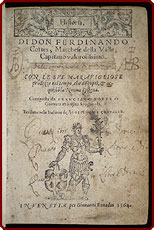
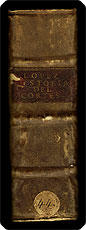
The Historia general de las Indias (first published in 1552) is divided into two parts which stand on their own although clearly written as two parts of a whole. Part I is a history of events concerning the discovery and conquests of the New World exclusive of those involving Cortés. Part II is entirely dedicated to the telling of Cortés's role in the conquest of Mexico and subsequent discoveries.
Click the images for enlargements. In this Italian translation from the pen of Agostino di Cravaliz, López's “all-Cortés” volume stands as part III of the three-volume Historia, delle nuove Indie Occidentali, with parts I and II being translations of Cieza de Leon's Historia, over Cronica del gran regno del Peru and the previously mentioned part I of Gómara's Historia general de las Indias.
The text here is printed in italic type except the capitals, which are roman. The title-page is printed in roman and italic and has the woodcut printer's device.
• Alden & Landis 564/25; Sabin 27741; Medina, BHA, 159n; Wagner, Spanish Southwest, 2v. 18th-century vellum over paste boards, soiled and a bit rubbed; red leather spine label, with a chip, and an old circular paper shelf-label. Title-page dust-soiled, mounted; small, narrow, oblong portion of blank area of title-page excised and filled in at an early time. Lacks folio 1 and final blank. Top margins closely trimmed, sometimes costing the running heads and folio numbers. (25767)
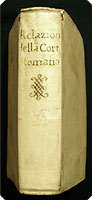
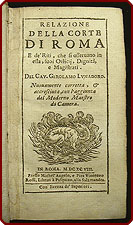
The Papal Court — As Seen by a CriticLunadoro, Girolamo. Relazione della corte di Roma e de’riti, che si osservano in esta, suoi officij, dignità, e magistrati ...nuovamente corretta, & accresciuta, con l’aggiunta del Moderno maestro di camera. Roma: Presso Michel’Angelo, e Pier Vincenzo Rossi, 1697–98. 12mo (14.3 cm, 5.6"). π8A–O12*3 2A–2G12 2H4 (-π1); [7] ff., 336, [6], 176 pp. (lacks initial blank)
 Click the interior image for an enlargement.
Francesco Sestini’s Il Moderno Maestro di Camera has a separate title-page, dated 1698; the first title-page bears the printer’s crowned salamander device and the second a vignette of Minerva. The collation here matches descriptions of other copies.
Uncommon: Searches of OCLC and RLIN locate only three copies in U.S. libraries.
Provenance: Late 18th-century private collector’s booklabel — “Ex Biblioth. Hamburg. Wolfiana”; also with a 19th-century bookplate.
• Contemporary vellum, spine with early hand-inked title; binding with small spots of light discoloration, spine title a bit scuffed. All edges speckled blue. Front pastedown with bookplates as above; front free endpaper with early inked shelving number. First gathering, including title, a cancel. Title-page reinforced at inner margin. Pages clean.
 TO Part
III . . . TO Part
III . . . |