
 MANUSCRIPTS

 For
our MSS in SPANISH: Click here.
MANUSCRIPTS
For
our MSS in SPANISH: Click here.
One of CHILE’s“Padres de la Patria”
For
our MSS in SPANISH: Click here.
MANUSCRIPTS
For
our MSS in SPANISH: Click here.
One of CHILE’s“Padres de la Patria” Edgar Allan Poe Connection
  Carrera, José Miguel de. Autograph Letter Signed to Henry Didier. In Spanish, on paper. Montevideo: 12 December 1817. Small 4to (24.5 cm x 9.5"). [2] pp., with integral address leaf.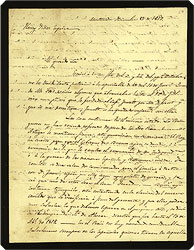
 Click the image for an enlargement.
 Writer Carrera: From one of the leading families of Chile, José Miguel Carrera led the successful coup de etat of 15 November 1811 that overthrew the Junta de Gobierno that was established in the political void after the capture of the king of Spain. As sole leader of the nation he created the first Chilean constitution, designed the first Chilean flag and coat of arms, and was responsible for bringing the first printing press to Chile. Disagreement with the Lautaro Lodge of the Masons led to his overthrow by Bernardo O’Higgins and the rift never healed, eventually leading to Carrera’s exile in Argentina, the U.S., and later Uruguay. His brothers fell into the hands of O’Higgins who had them executed.
Recipient Didier: Henry Didier was the godfather of Edgar Allan Poe’s older brother, William Henry; he was to take the boy into his home for some years, though accounts differ as to whether this happened immediately after the death of the Poe children's parents (1811) or after the death of their guardian grandfather (1816). He ran a counting house in Baltimore and William Henry worked there as a young man. Though the Poe brothers' intimacy varied due to circumstances over the years, clearly Edgar knew Didier; he would surely have visited his brother at the Didier house.
On Uruguay: “Las cosas continuan en el mismo estado. Los Portugueses no han recivido refuerzo despues de los 500 Pernambucanos. Artigas se mantiene firme, esta guarnicion no se mueve. El Rey ha escrito para que el Gobierno de Buenos Ayres se desida.”
On Argentina: “Buenos Ayres continua tranquilo, está entretenido en la eleccion del nuevo cavildo que se verificará a fines del presente.”
On Peru: “En el Perú no hay novedad considerable. [L]os españoles tienenel aquella costa 11 buques de guerra, inclusas dos de 44, pero esto no estorbó al Berg.n chileno el Aguila. . . . No pasa de 9000 veteranos el Ex[erci]to en aquel pais, aseguran que llegando los buques de guerra de Estados Unidos piensan atacar a Arequipa y seguir a Lima; no lo creo por ahora.”
On O’Higgins: “O’Higgins sigue mandando el Ex[erci]to y Brayer es sus m[ay]or gene]ral. — Pueyrredon ha mandado a esta un comisionado para que alcance de Leon que se me eche de aqui; Leon constante en su amistad y systema se negó despresiando al comisionado.”
On Prisoners: “Mi viejo Padre, 85 años de edad, ha estado incomunicado 17 dias, y ultimamente sigue su arresto en casa. . . . Mis hermanos presos aun, y lo mismo muchos de nuestros compatriotas. . . . Mr. Handle continua en su prision con todos sus oficiales y tripulacion.”
• Very good condition. Written in a very clear hand. (24646)
 Mid-Fourteenth Century
 Bifolium Catholic Church. Liturgy & Ritual. Breviary. Manuscript on vellum, in Latin. “In illo tempore dixit Iesus discipulis suis Auditis quia dictum est: “Diliges proximum tuum et odio habebis inimicum tuum.” Germany: ca. 1360. Small 8vo (12.5 x 17.5 cm; 7"x 10"; for the total bifolium). [1] ff.
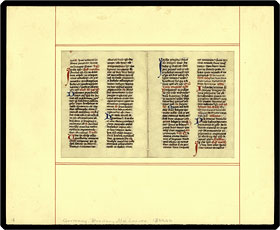 Click the image for an enlargement.
• Very good condtion, in a single-ply mat. (24660)

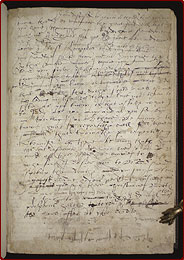
 “On the Welch Tract on [the] Pee Dee River” 1743 Chanler, Isaac. Manuscript: “The Qualifications of a Gospel Minister for, and Duty in studying rightly to divide [sic] the Word of Truth; and the Duty of those who do partake of the Benefit of his Labours, towards him fully, plainly & impartialy [sic] represented in Two Sermons on 2 Tim: 2.15. Preached at the ordination of the Revd mr. Philip James at the Welch Tract on Pee Dee River in South Carolina April 4. 1743. With some Illustrations & Enlargements.” [South Carolina: 1743]. Folio (31.5 cm; 12.4"). [20] ff.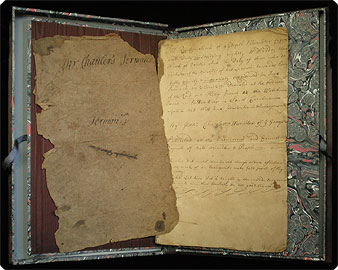
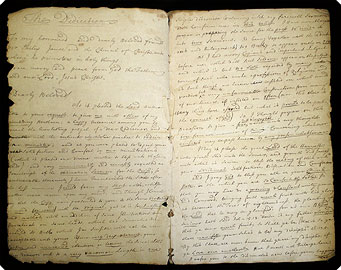
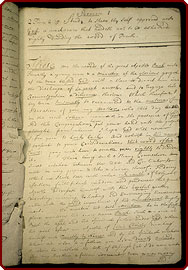
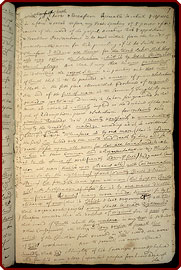 Click the images for enlargements.
 Although the title-page of this manuscript proclaims, “Published at the Unanimous and Earnest Request of Both Minister and People,” this work was never published in the sense of having been printed, or if it was printed, no copy survives, nor has any evidence of its publication.
This manuscript is apparently the only surviving evidence, and very substantial it is, of an unpublished work by this pioneer minister.
The second sermon mentioned on the title-page was on Galatians 6:6 and is not present here; it may well have never been copied out and sewn to the end of this manuscript. In any case the second sermon is apparently long-lost.
Provenance: Ex-Crozer Theological Seminary.
• Written in a clear hand with numerous corrections. Unbound, on laid paper of the 1740s; now age-toned and a bit brittle, with some fold tears. Edges of paper chipped with some small pieces missing, occasionally costing a letter (only). Now safely housed in a Mylar sleeve within a marbled paper–covered chemise within a red cloth clamshell box. (26309)

 A
CURIOUSManuscript
Playlet — The Lovers
(China, Really? Not
Hardly!). Anonymous. Manuscript, "The Lovers, A
Tragedy in Five Acts. Founded on an incident in Eastern History." On paper,
in English. [Philadelphia?, ca. 1830]. Folio (32 cm, 12.5"), 14 ff. (12.5 written
on).
A
CURIOUSManuscript
Playlet — The Lovers
(China, Really? Not
Hardly!). Anonymous. Manuscript, "The Lovers, A
Tragedy in Five Acts. Founded on an incident in Eastern History." On paper,
in English. [Philadelphia?, ca. 1830]. Folio (32 cm, 12.5"), 14 ff. (12.5 written
on). 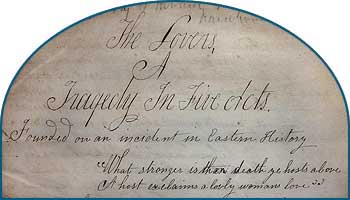
The play's length is that of a "filler" piece in a jam-packed 19th-century theatrical night of three or four plays (or parts thereof) and other "entertainments"—or, the length of a school or home production.  The style is distinctly amateur/naive. E.g., the euphonious exotic names are far from consistently Chinese and one character is "carried [from his 'chinese cottage'] to the ganges"; the author confuses exit and exeunt ("Exeunt Priest")—we wonder if this blithe vagueness as to geography and world cultures, and the seeming lack of even basic classical education, suggest a lively-minded and enthusiastically play-going but unrigorously schooled female writer?
Provenance: Gift inscription: "Horace W. Smith, Esq. to W.W., 1863." A pencil note says "By J. Howard Payne in his handwriting, W.W."—but the handwriting does not match that of Payne's MSS. at Yale and Brown Universities.
• First leaf dust-soiled and now separated. Edges of some leaves chipped costing a few letters and, very rarely, an entire word; lost letters and words are easily supplied by context. Comfortable, for working with.
 For THEATER/THEATRE, click here. For more of PHILADELPHIA interest, click here. For
more POST-1820 AMERICANA, click
here. For
more of WOMEN's interest, click here?
For THEATER/THEATRE, click here. For more of PHILADELPHIA interest, click here. For
more POST-1820 AMERICANA, click
here. For
more of WOMEN's interest, click here?
Incunable Cicero with! Extensive Evidence of Readership Cicero, Marcus Tullius. De officiis [and other works]. Venetiis [Venice]: Bernardinus Rizus, Novariensis & Bernardinus Celerius, 12 Oct. 1484. Folio. [180 of 182] ff., lacking b4–5.
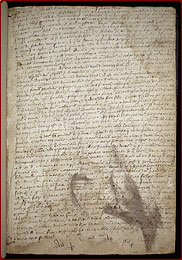
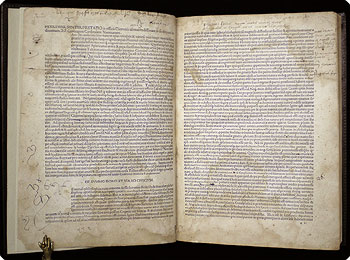
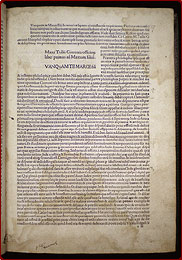 Click the interior images for enlargements.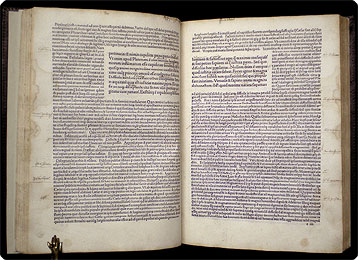
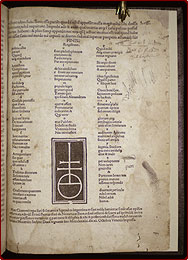
The recto of leaf a1 is blank, the text of the prefatory matter beginning on the verso.
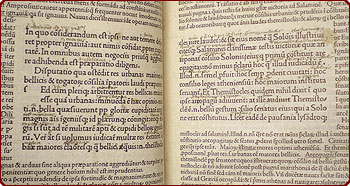
Provenance: Signature of “John Webb” in a 17th-century hand twice in margin of k3r.
Uncommon beyond the Continent: ISTC and Goff locate only two copies in the U.S. and ISTC locates only two copies in the U.K. (one incomplete), but there is a third copy at the British Library.
• ISTC ic00601000; Goff C601; HC 5274*; IGI 2910; Pr 4942; BMC, V 400; GKW 6954. Full modern walnut calf old style: Spine with raised bands, accented with gilt and blind rules, the latter extending onto covers to terminate in trefoils with blind double fillets beyond. Gilt center devices in the spine compartments. Red leather spine label lettered in gilt, and date in gilt at base of spine. Lacking two leaves (b4–5). Upper corners of leaves in gatherings & and [con] damaged with loss of paper. Lower corner of i1 torn with loss of text of both sides of leaf. Waterstaining and old dampstaining variously, this often faint and never really worse than moderate (worst at beginning/end); some age-toning and dustsoiling. Though an imperfect copy, a rarity; indeed, with its manuscript enhancements, a “uniquum.” (25766)

 "Why is a . . . ?"
 (Conundrums). Manuscript on paper, in English,
[cover-title] "Conundrums." [England, ca. 1804–14]. Small 4to (20 cm, 7.875"),
23 pp. filled; two other leaves, written-on on three sides, laid in.
(Conundrums). Manuscript on paper, in English,
[cover-title] "Conundrums." [England, ca. 1804–14]. Small 4to (20 cm, 7.875"),
23 pp. filled; two other leaves, written-on on three sides, laid in. 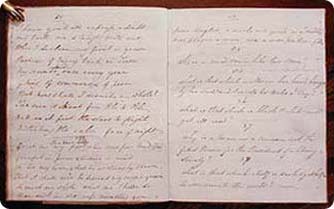
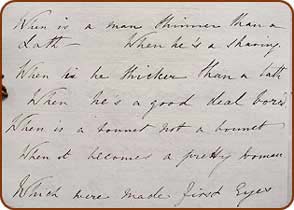
For
PUZZLES, click here.
Mr. Cook'sCommonplace Book
Cook, Benjamin H. Manuscript on paper, in English. [Rhode Island]: 1852–66. 4to (20.7 cm, 8.1"). 25, [51] pp. (28 blank).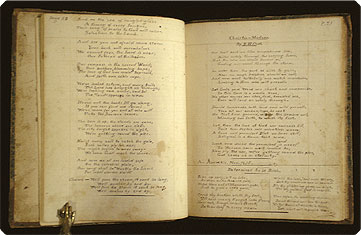 Click the interior image for an enlargement.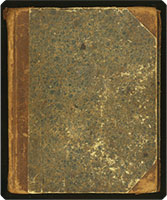
Present at the back of the volume isa
list of “disabled men in Burillville [Rhode Island] July 1863”; a later, handwritten card with some information on Benjamin Cook and some of the pieces in this volume is laid in.
• Contemporary half sheep and marbled paper–covered sides; binding rubbed and worn, spine head pulled. Back (inside) hinge cracked. Leaves excised at both front and back of volume. Some light spotting and staining. (20849)
 “I am anxious you should do a writing portrait . . . ” Cook, Eliza. A.L.s. (“Eliza”) to “My dear Sec.” London: 6 June 1860. 12mo (7.25" x. 4.5"). 1 p.
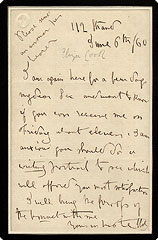 Click the image for an enlargement. a Chartist poet, author, and proponent of political and sexual freedom for women. She writes, “I am again here for a few days . . . and want to know if you can receive me on Friday about eleven. I am anxious you should do a writing portrait to see which will afford you most satisfaction. I will bring the proofs of the sonnet with me.”
Provenance: Residue of the stock of Seven Gables Bookshop (1930–79), via the son of Michael Papantonio (2009).
• Very good condition. Tipped onto a slightly larger sheet. With the integral blank. (25726)

 TO Part
III . . . TO Part
III . . . |