 PHILADELPHIA
  AT LEAST THREE “FIRSTS” — First English Septuagint
 (A
Philadelphianum on Several Counts). Bible. English.
1808. Thomson.
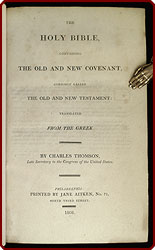
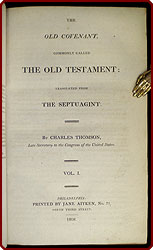
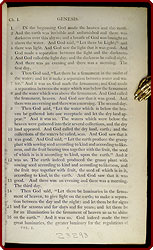
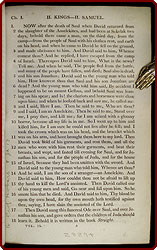
The Holy Bible, containing the Old and New Covenant, commonly called the Old and
New Testament: Translated from the Greek. By Charles Thomson.... Philadelphia:
Pr. by Jane Aitken, 1808. 8vo. 4 vols. I: [252] ff. II: [245] ff. III: [222] ff.
IV: [240] ff.
(A
Philadelphianum on Several Counts). Bible. English.
1808. Thomson.
The Holy Bible, containing the Old and New Covenant, commonly called the Old and
New Testament: Translated from the Greek. By Charles Thomson.... Philadelphia:
Pr. by Jane Aitken, 1808. 8vo. 4 vols. I: [252] ff. II: [245] ff. III: [222] ff.
IV: [240] ff.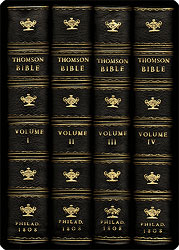
 Click the images for enlargements.
  It was
also the first translation of the Greek New Testament into English by a native
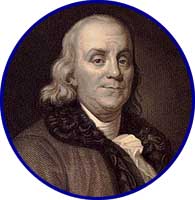
of Ireland, and of course it is the work of a key figure of the American Revolution.
It was
also the first translation of the Greek New Testament into English by a native
of Ireland, and of course it is the work of a key figure of the American Revolution.
On 4 July 1776 only two signatures were affixed to the unanimously adopted Declaration of Independence — those of John Hancock, president of the Congress, and Charles Thomson, secretary, in order to authenticate the document that had been voted on and approved. Yet by a curious twist of fate (read rather, surely, of a political enemy's knife), when the calligraphic copy that is so well known to every school child was ready shortly after 19 July, authenticator Thomson was not invited to sign it!
When he had retired from public life in 1789, Thomson was to turn his interest in the Bible and Greek to the 20-year task of producing this monumentally important work.
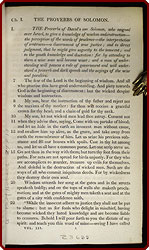
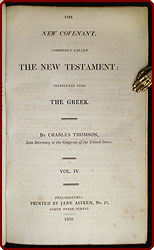
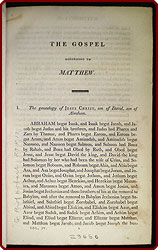
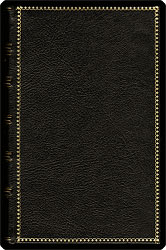
Its printer was the daughter of Robert Aitken, who had printed the first Bible in English in America.• Rumball-Petre, Rare Bibles, 184; Hills 153; Herbert 1514; O'Callaghan 91–92; Shaw & Shoemaker 14486. On Thomson, see: Dictionary of American Biography, XVIII, 481–82. Modern full black morocco, signed “GB” (Grace Bindings). Gilt spines. Black endpapers. The effect, richly elegant. Faintly visible pressure-stamps of a library (properly deaccessioned), each volume with neatly pencilled collection note and small old inked 5-digit number to first text leaf; in fact a remarkably clean, ever–well cared for, and handsome set. (26019)A major edition of the English Bible, this is essential for any Bible collection, not just for collections of American Bibles — though as an American Bible and simple Americanum it has a revered place.
 This entry is repeated in the


 Dobson Printing of
 Asplund's Annual Register Asplund, John. The annual register of the Baptist denomination, in North-America; to the first of November, 1790. Containing an account of the churches and their constitutions, ministers, members, associations, their plan and sentiments, rule and order, proceedings and correspondence. Also remarks upon practical religion. [Philadelphia: Pr. by Thomas Dobson, 1792]. Small 4to. iv, 5-57, [1], 69-70 pp.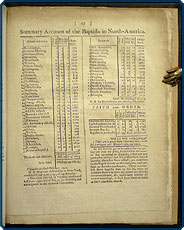
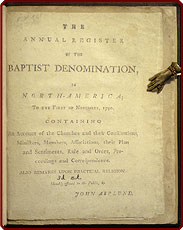 Click the images for enlargements.
 As is the case with the 70 p. issue, the first 16 p. are the same sheets as appear in the original [Richmond, April 1792] edition (Evans 26580), and were probably printed in 1791. Evans, however, postulates that the first 16 p. were printed by Dobson in September 1792. He accounts for their presence in copies of the [Richmond] edition of 60 p. by suggesting that Asplund substituted the corrected Philadelphia sheets for the unsatisfactory sheets of the earlier edition. Cf. the prefaces to the 1794 and 1796 editions, with title: The universal register of the Baptist denomination.”
In addition to its exhaustive account of who's who and what's where, this lists both principles of belief and “Rules of Decorum”; the latter, e.g., forbid laughing and whispering when another member of the association is speaking in assembly. Between the “Rules of Decorum” and the Index, Asplund remarks on the un-Christian “inconsistency” of “Keeping our fellow-creatures in bondage, who have as good a right was we, both to civil and religions liberty — Not only so; but misusing them, concerning common blessings, which certainly is a violation of the rights of nature and inconsistent with a republican government.”
• Evans 26582; ESTC W37302. Uncut copy. In 20th-century black buckram binding. Ex-library with bookplate but no other markings. (24467)
A
Philadelphian Travels
through Gran
Colombia
Bache, Richard. Notes on Colombia, taken in the years 1822–3. With an itinerary of the route from Caracas to Bogotá; and an appendix. By an officer of the United States' Army. Philadelphia: H. C. Carey & I. Lea, 1827. 8vo. [4], 8 pp., viii, [1], 10–303 pp.; 3 fold. plts. (incl. 2 maps).
Gran
Colombia
Bache, Richard. Notes on Colombia, taken in the years 1822–3. With an itinerary of the route from Caracas to Bogotá; and an appendix. By an officer of the United States' Army. Philadelphia: H. C. Carey & I. Lea, 1827. 8vo. [4], 8 pp., viii, [1], 10–303 pp.; 3 fold. plts. (incl. 2 maps).
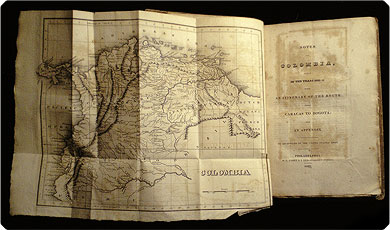
Illustrated with a folding map of Colombia, drawn by J. Finlayson and engraved by J. Yeager; a folding plan and elevation of “one of the better order of houses in Colombia”; and a folding plan of the city of Bogotá. The text is preceded by a two-page prospectus for the American Quarterly Review and a prospectus for William Strickland’s Reports upon Canals, Rail-ways, Roads, and Other Subjects (8 pp., bound at the volume's beginning).
Click the interior image for an enlargement. Provenance: From the library of Thomas Oliver; after that, the Maryland Diocesan Library.
• Shoemaker 27920; Smith, American Travellers Abroad, B1. 19th-century quarter brown cloth over tan paper-covered boards, spine with printed paper label; rebacked. Covers stained, exposed at corners, and chipped at top and fore-edges. Library markings: Rubber-stamp on front pastedown and verso of title-page; previous owner's bookplate on front pastedown (see above). Moderate foxing throughout, and other staining, heavy foxing on endpapers; offsetting from map affecting title-page. Outer and bottom edge untrimmed. Map of Colombia slightly tattered at bottom right corner. All maps generally clean and overall in very good condition. (24425)
 TWO
Quaker
Classics for
TWO
Quaker
Classics for Philadelphians,
1788
Barclay, Robert. A catechism and confession of faith, approved of and agreed unto, by the general assembly of the patriarchs, prophets, and apostles, Christ himself chief speaker in and among them. Philadelphia: Joseph James, 1788. 12mo (16.8 cm, 6.7"). viii, 147, [3] pp. [issued with] The ancient testimony of the people called Quakers, revived; by the order and approbation of the yearly meeting, held for the provinces of Pennsylvania and New-Jersey, 1722. Philadelphia: Joseph James, 1788. 34 pp.
Philadelphians,
1788
Barclay, Robert. A catechism and confession of faith, approved of and agreed unto, by the general assembly of the patriarchs, prophets, and apostles, Christ himself chief speaker in and among them. Philadelphia: Joseph James, 1788. 12mo (16.8 cm, 6.7"). viii, 147, [3] pp. [issued with] The ancient testimony of the people called Quakers, revived; by the order and approbation of the yearly meeting, held for the provinces of Pennsylvania and New-Jersey, 1722. Philadelphia: Joseph James, 1788. 34 pp. 
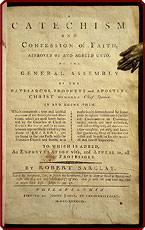
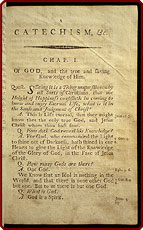 Click the interior images above for enlargements.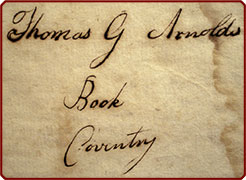
Provenance: Front fly-leaf inscribed “Thomas G. Arnolds Book Coventry,” inked in an early hand.
• ESTC W37335; Evans 20950; Sabin 3366. Contemporary speckled sheep, worn and very slightly sprung, spine scuffed with foot chipped. Pages age-toned and variably waterstained, with occasional edge nicks and crumpled corners; yet not brittle or nasty and the volume quite pleasant for reading. (24391)

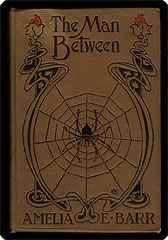
A Signed Binding byHarry B. Matthews Barr, Amelia Edith Huddleston. The man between; an international romance. New York & London: Authors and Newspapers Association, 1906. 12mo. 323 pp., incl. col. frontis., facsim. p. of authorial ms., col. plts.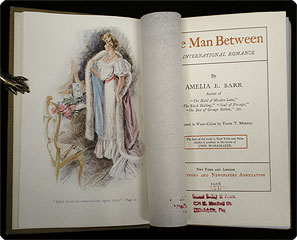
 Philadelphia
is confined to the stores of JOHN WANAMAKER.”
Click
the images for enlargements.
Philadelphia
is confined to the stores of JOHN WANAMAKER.”
Click
the images for enlargements.
Binding: Signed binding by Harry B. Matthews. Light brown cloth with an Art Nouveau spider web and spider in black and red on front cover, along with author and title in black.
• Binding as above. Ex–social club library: 19th-century bookplate and private ownership monogram, rubber-stamp on title-page, four-digit number in ink in one margin, charge pocket at rear, no other markings. (26419)
 Another of Benezet's Causes Benezet, Anthony. The mighty destroyer displayed, in some account of the dreadful havock made by the mistaken use as well as abuse of distilled spirituous liquors. Philadelphia: Printed by Joseph Crukshank, 1774. 8vo (17 cm; 6.625"). 48 pp.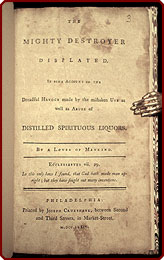
 Click the images for enlargements.
 While the title-page merely says the piece is “by a Lover of Mankind,” Benezet's authorship was well established by Evans.
• Bristol B3689; Shipton & Mooney 42555; Hildeburn 2980; ESTC W26174. Not in Blake. Recent quarter calf, old style, with marbled paper sides. Text cockled, with stray stains and age-toning; title-page crumpled. Original edition, not a modern reprint. (27123)


 Blake,
Rosenwald,
& Keynes
— Trianon Press
Blake,
Rosenwald,
& Keynes
— Trianon Press A
Presentation Copy from
the Owner of the Original
Blake, William. The book of Ahania. [colophon: Boissia, Clairvaux: Published by the Trianon Press for the William Blake Trust, London; distributed by B. Quaritch, London, 1973]. 4to (28.8 cm; 11.5"). [11] ff., 7 of which are plates (6 color).
A
Presentation Copy from
the Owner of the Original
Blake, William. The book of Ahania. [colophon: Boissia, Clairvaux: Published by the Trianon Press for the William Blake Trust, London; distributed by B. Quaritch, London, 1973]. 4to (28.8 cm; 11.5"). [11] ff., 7 of which are plates (6 color).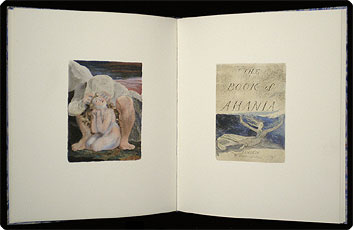 Click the image for an enlargement.
 “Commentary and bibliographical history” (p. [3–7]) signed in type by Geoffrey Keynes.
• Bentley, Blake Books, A15. Publisher's quarter black morocco with marbled paper sides. In the publisher's marbled paper slipcase. Very good condition. (25900)
Trianon Innocence
“Pre-”
(their) ExperienceBlake, William. The songs of innocence, [a facsimile of the illuminated book]. [colophon: Boissia, Clairvaux: Published by the Trianon Press for the William Blake Trust, 1954]. 8vo (22cm.; 8.625"). [60] ff. (54 facsims. of the original; 1 f. a facsim. of provenance information, 5 ff. of text.
Innocence
“Pre-”
(their) ExperienceBlake, William. The songs of innocence, [a facsimile of the illuminated book]. [colophon: Boissia, Clairvaux: Published by the Trianon Press for the William Blake Trust, 1954]. 8vo (22cm.; 8.625"). [60] ff. (54 facsims. of the original; 1 f. a facsim. of provenance information, 5 ff. of text.
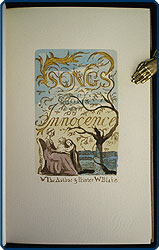
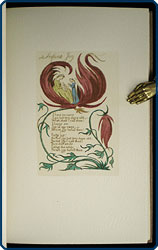 Click the images for enlargements.
 The edition was limited to 1626 copies, this being no. 840 of 1600 regular copies. The Trianon Innocence AND Experience (our emphasis) did not appear until the year after this did.
Provenance: Presentation copy from Lessing Rosenwald to his daughter Joan and her husband Isadore Scott: “For Scotty and Joannie / With love / Dad / 2/15/55" in Lessing's characteristic green ink.
• Bentley & Nurmi 156; Bentley, Blake Books, 165. Publisher's quarter tan calf, abraded; usual discoloration at hinges (inside) from the binding glue. Top edge gilt. In the publisher's leather trimmed slipcase, leather here also abraded (leather too soft!!). A clean, attractive copy with a provenance up there amongst the best imaginable. (25939)

“Northern Liberties” Broadside. Partially printed, completed in manuscript, beginning: To --------- Esq. Attorney of the Court of Common Pleas, at Philadelphia in the County of Philadelphia in the state of Pennsylvania to any other Attorney of the said Court, or of any other Court elsewhere. Philadelphia: before 1790. Folio. 1 page (13.125" x 8").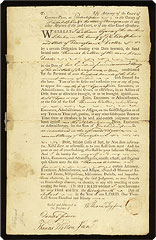
Tyson and Walton signed the document on 24 August 1791.
 An excellent display piece.
• Old folds with a few short tears. Residue of mounting tape at two points on the left margin. (14729)

 Whither,
the
Whither,
the AMERICAN
Economy?
[Carey, Mathew]. Addresses of The Philadelphia
Society for the Promotion of National Industry...Fourth edition. Philadelphia:
Pub. by M. Carey & Son, pr. by G.L. Austin, Dec. 20, 1819. 8vo (19.2 cm,
7.625"). xi, [1 (blank) pp., pp. [9]–248.
AMERICAN
Economy?
[Carey, Mathew]. Addresses of The Philadelphia
Society for the Promotion of National Industry...Fourth edition. Philadelphia:
Pub. by M. Carey & Son, pr. by G.L. Austin, Dec. 20, 1819. 8vo (19.2 cm,
7.625"). xi, [1 (blank) pp., pp. [9]–248. 
They address then-pressing topics: tariffs, protectionism, development of domestic industry, and European foreign policy.
• Shaw & Shoemaker 49095; Clarkin, Mathew Carey Bibliography, 1133. Recent quarter tan cloth with paper sides in the style of the era. Ex-library with stamp on title-page; paper brittle and age-toned. One page torn and repaired.

Second U.S. Edition: An Influential Classic Carter, Susannah. The frugal housewife: Or, completewoman cook. Philadelphia: James Carey, 1796. 12mo (17.2 cm, 6.75"). 132 pp.; 2 plts.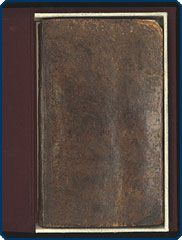
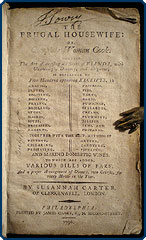
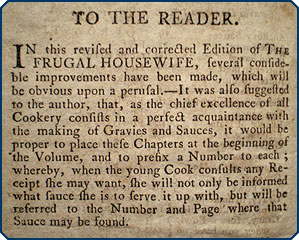 Click the interior images for enlargements.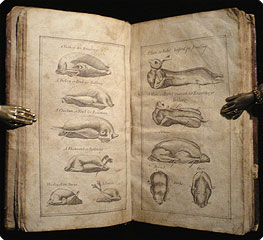
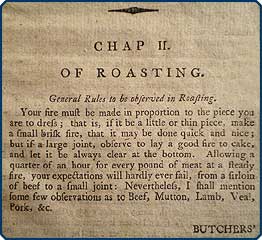
Provenance: Flourishing old signatures of “J. Lowry” to pastedown and title-page.
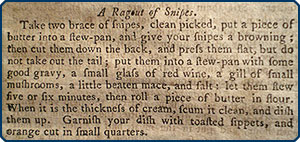 Click the interior images for enlargements.
 A
CURIOUSManuscript
Playlet — The Lovers
(China, Really? Not
Hardly!). Anonymous. Manuscript, "The Lovers, A
Tragedy in Five Acts. Founded on an incident in Eastern History." On paper,
in English. [Philadelphia?, ca. 1830]. Folio (32 cm, 12.5"), 14 ff. (12.5 written
on).
A
CURIOUSManuscript
Playlet — The Lovers
(China, Really? Not
Hardly!). Anonymous. Manuscript, "The Lovers, A
Tragedy in Five Acts. Founded on an incident in Eastern History." On paper,
in English. [Philadelphia?, ca. 1830]. Folio (32 cm, 12.5"), 14 ff. (12.5 written
on). 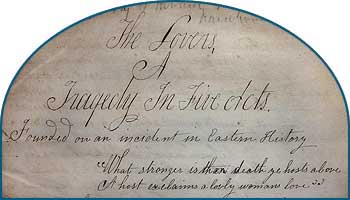
The play's length is that of a "filler" piece in a jam-packed 19th-century theatrical night of three or four plays (or parts thereof) and other "entertainments"—or, the length of a school or home production.  The style is distinctly amateur/naive. E.g., the euphonious exotic names are far from consistently Chinese and one character is "carried [from his 'chinese cottage'] to the ganges"; the author confuses exit and exeunt ("Exeunt Priest")—we wonder if this blithe vagueness as to geography and world cultures, and the seeming lack of even basic classical education, suggest a lively-minded and enthusiastically play-going but unrigorously schooled female writer?
Provenance: Gift inscription: "Horace W. Smith, Esq. to W.W., 1863." A pencil note says "By J. Howard Payne in his handwriting, W.W."—but the handwriting does not match that of Payne's MSS. at Yale and Brown Universities.
• First leaf dust-soiled and now separated. Edges of some leaves chipped costing a few letters and, very rarely, an entire word; lost letters and words are easily supplied by context. Comfortable, for working with.
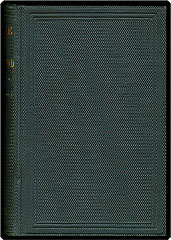
A Journalist Reports fromVirginia Cook, Joel. The siege of Richmond: A narrative of the military operations of Major-General George B. McClellan during the months of May and June, 1862. Philadelphia: George W. Childs, 1862. 12mo (19 cm, 7.5"). 358 pp.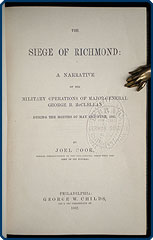
 Click the images for enlargements.
 • Sabin 16279. Publisher's textured teal cloth, spine with gilt-stamped title; sides and edges clean and showing virtually no wear, spine with head pulled, title dimmed, and small rubbed spots. Ex–social club library: number on endpaper in a good 19th-century hand, rubber- and pressure-stamp on title-page, several other pages faintly stamped. Front free endpaper lacking. A nice, clean, sound copy with its paper holding up beautifully. (26266)
Christianity Abroad, at Home, & among the (Jewish?) Native Americans Crawford, Charles. An essay on the propagation of the Gospel; in which there are numerous facts and arguments adduced to prove that many of the Indians in America are descended from the Ten Tribes ... the second edition. Philadelphia: James Humphreys, 1801. 12mo (18.3 cm, 7.2"). [1] f., 154 pp., [1] f. [with] Woodward, William Wallace. Increase of piety, or revival of religion in the United States of America; containing several interesting letters not before published. Together with three remarkable dreams, in succession, as related by a female in the Northern Liberties of Philadelphia to several Christian friends, and handed to the press by a respectable minister of the gospel. Philadelphia: W.W. Woodward, 1802. 12mo. [1] f., 114 pp.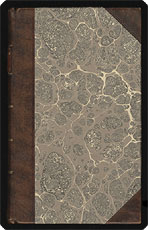
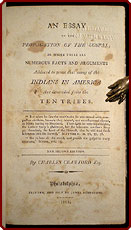
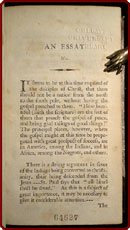 Click the interior images for enlargements.
 The second item here is the first edition of Woodward's collection of revival-themed letters to and from various clergymen, closing with an account of Mrs. Rebecca Ashburn's mysterious dreams. In these dreams a minister unknown to Mrs. Ashburn attempted to save her soul; she later identified her would-be converter as one Dr. William Rogers. This work is very uncommon in print form. OCLC and NUC Pre-1956 find only five U.S. institutional holdings of this Philadelphia printing, although it is widely held in microform.
• Essay: Sabin 17433; Shaw & Shoemaker 370; Rosenbach, American Jewish Bibliography, 123; Singerman, Judaica Americana, 0136. Increase: Shaw & Shoemaker 2587; Sabin 105172. Period-style half mottled calf and marbled paper–covered sides, spine preserving original gilt-stamped leather title-label. Title-page and first text page institutionally pressure-stamped. Pages lightly age-toned, somewhat more so in second work; one leaf with tear from outer margin extending into text. (25209)
 TO Part
II . . . TO Part
II . . . |