
 MEDICINE MEDICINE
  “Madmen
or Epileptics”
(Anyway, NOT
Bewitched)
“Madmen
or Epileptics”
(Anyway, NOT
Bewitched)
 Farmer, Hugh. An essay on the demoniacs of the New Testament. London: G. Robinson, 1775. 8vo (21.6 cm, 8.5"). [16], 416 pp.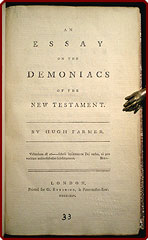

 Click the interior image for an enlargement.
 Provenance: Signature of Philip Harwood on half-title.
• ESTC T68112; Lowndes 780; Allibone 578. Recent quarter calf and marbled paper–covered sides, spine with gilt-stamped leather title-label and blind-tooled compartment decorations. Half-title with early inked ownership inscription. Half-title, title-page, and last page institutionally pressure-stamped, title-page with inked numeral in lower margin. Pages slightly age-toned, otherwise clean. (25088)


 How
to be a
How
to be a Good
& Well-Liked
Little Girl
or Boy
Forrester, Francis [pseud. of Daniel Wise]. My Uncle Toby's
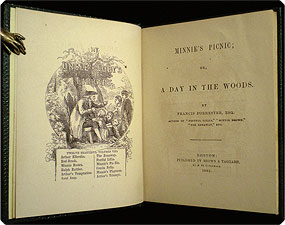
library. Boston: Brown & Taggard, 1862. 8 vols. (of 12). 8vo (15.5 cm, 6.2"). Each volume containing a frontispiece and either 64 or 62 pp.
Good
& Well-Liked
Little Girl
or Boy
Forrester, Francis [pseud. of Daniel Wise]. My Uncle Toby's
library. Boston: Brown & Taggard, 1862. 8 vols. (of 12). 8vo (15.5 cm, 6.2"). Each volume containing a frontispiece and either 64 or 62 pp.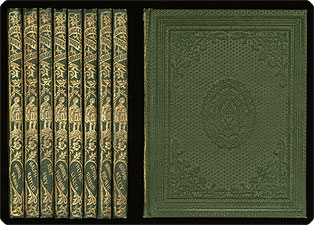
 How to Practise Calisthenics.
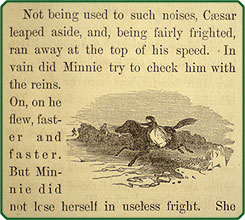
The last-named volume involves Minnie and her friends learning various exercises
(with dumbbells and other equipment) under the watchful eye of instructor Miss
Pinkney, and is illustrated with woodcuts of the movements.
How to Practise Calisthenics.
The last-named volume involves Minnie and her friends learning various exercises
(with dumbbells and other equipment) under the watchful eye of instructor Miss
Pinkney, and is illustrated with woodcuts of the movements.
• Sternick 496.4 (describing binding as red). Publisher's blind-stamped green textured cloth, spines gilt extra; bindings fresh and clean. Eight vols. of 12 present. Each volume with inked ownership inscription dated 1863 on front free endpaper. Pages slightly age-toned with occasional faint offsetting from illustrations, generally clean. A beautiful set, virtually as new. (24423)
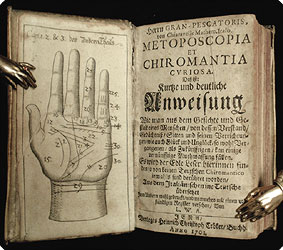
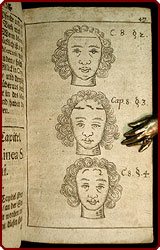
 Geomancy Chiromancy & Metoposcopia — Many Plates Gran-Pescatore, di Chiaravelle. Metoposcopia et chiromantia curiosa. Das ist: Kurtze und deutliche Anweisung Wie man aus dem Gesichte und Gestalt eines Menschen, von dessen Verstand, Gedachtniss, Sitten und seinen Verrichtungen, wie auch Gluck und Ungluck, so wohl Vergangenen, als Zukunfftigen, kan einige vernunfftige
Muthmassung fallen. [with another, as below]. Jena: Verlegts Heinrich Christoph Croker, 1701. 12mo (13.5 cm; 5.25"). Frontis., [5] ff., 250, [18] ff., [30] leaves of plates. [also bound in] Anonymous. Vollkommene Geomantia, oder sogenante Punctier-Kunst. Worin nicht allein, was von verschiednen in dieser bissher ziemlich ohnbekanten Wissenschafft hocherfahrnen Leuthen, Arabern, Welschen, Franzosonen, und Engellandern durch Fleiss und Erfahrung beobachtet worden, der curiosen teutschen Welt zu Dienst zusammen getragen. Freystadt [i.e., Jena]: [Cröcker], 1702. 12mo (13.5 cm; 5.25"). Frontis., 408 p., [3 of 5] fold. plates.
Geomancy Chiromancy & Metoposcopia — Many Plates Gran-Pescatore, di Chiaravelle. Metoposcopia et chiromantia curiosa. Das ist: Kurtze und deutliche Anweisung Wie man aus dem Gesichte und Gestalt eines Menschen, von dessen Verstand, Gedachtniss, Sitten und seinen Verrichtungen, wie auch Gluck und Ungluck, so wohl Vergangenen, als Zukunfftigen, kan einige vernunfftige
Muthmassung fallen. [with another, as below]. Jena: Verlegts Heinrich Christoph Croker, 1701. 12mo (13.5 cm; 5.25"). Frontis., [5] ff., 250, [18] ff., [30] leaves of plates. [also bound in] Anonymous. Vollkommene Geomantia, oder sogenante Punctier-Kunst. Worin nicht allein, was von verschiednen in dieser bissher ziemlich ohnbekanten Wissenschafft hocherfahrnen Leuthen, Arabern, Welschen, Franzosonen, und Engellandern durch Fleiss und Erfahrung beobachtet worden, der curiosen teutschen Welt zu Dienst zusammen getragen. Freystadt [i.e., Jena]: [Cröcker], 1702. 12mo (13.5 cm; 5.25"). Frontis., 408 p., [3 of 5] fold. plates.
 Click the images for enlargements.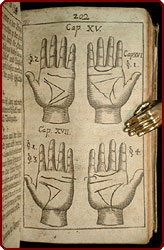
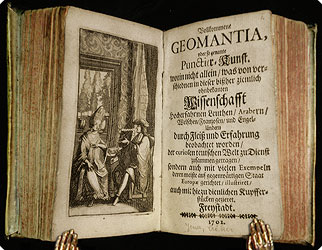
• Vollkommene: Jantz Collection, 3334. Neither work in Coumont, Demonology and Witchcraft. Contemporary vellum over paste boards, with slightly yapp edges; all edges red. Text unmarked and untattered. A very nice pair of uncommon books. (26955)

 Dance of Death Chapbook — “Très Rare”La grande danse macabre des hommes et des femmes, historiée & renouvellée de vieux Gaulois, en langage le plus poli de notre temps. Troyes: Jean-Antoine Garnier, 1728. 4to (22 cm, 8.6"). 76 pp.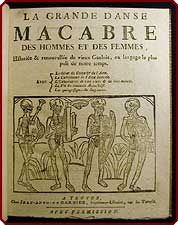
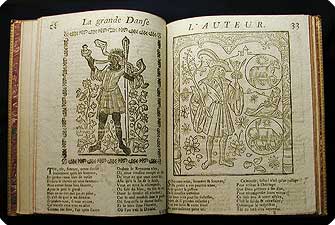
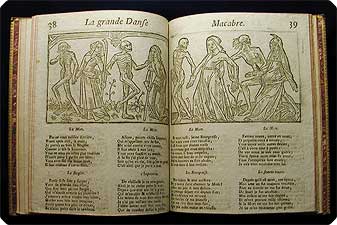 Click the images for enlargements.
Over 60 large woodcuts illustrate the text, with some images appearing in both sections. The volume concludes with several poems on the themes of life, death, and the afterlife.
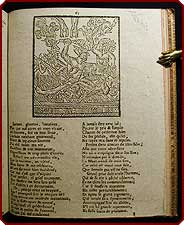
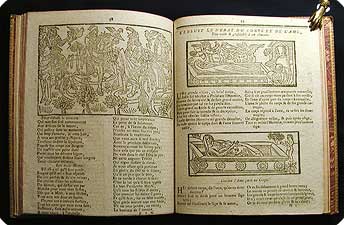
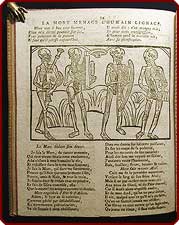
Uncommon: We trace only nine copies in the U.S., all but one in libraries east of the Mississippi.
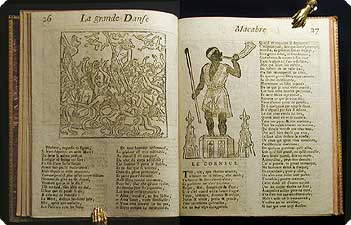
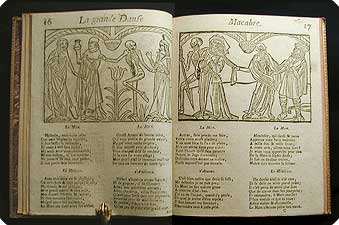
• Fairfax-Murray, French, 108; Morin, Bibliothèque bleue de Troyes, 435; Nisard, Histoire des Livres Populaires, II, 303. Binding with minor scuffing at corners and old (good) repairs to head and foot of spine, with leather starting to crack over joints; hinges tender. Pages slightly age-toned, with signature marks shaved.
 Anglo-Jewish Cookbook Greenberg, Florence. The Jewish Chronicle cookery book. London: The Jewish Chronicle, [1934]. 8vo (18.4 cm, 7.25"). vi (adv.), 307, [1] pp.
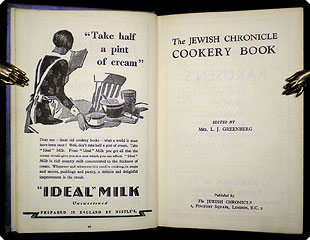
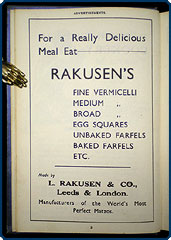 Click the images for enlargements.
 There is a small separate section on Passover cookery; there is one on “invalid cookery”; and there are advertisements front and back that tickle in themselves.
• Bitting 200. Publisher's blue cloth, spine with gilt-stamped title; binding cocked, spine sunned, covers with spots of light discoloration. One upper outer page corner torn away, not touching text; index with one inked annotation. Pages age-toned with occasional small spots, mostly clean. (26663)
That Water in the Fountain of Youth Is . . . Serpent Broth? Harcouet de Longeville. Histoire des personnes qui ont vecu plusieurs siecles, et qui ont rajeuni: Avec le secret du rajeunissement. Paris: Chez la Veuve Carpentier & Laurent le Comte, 1716. 12mo (14.7 cm, 5.75"). Frontis., [14], 248 pp.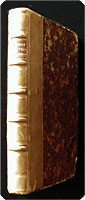
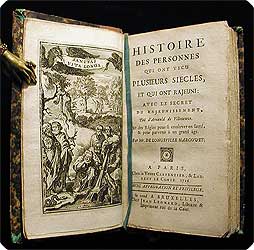 Click the interior image for an enlargement.
 • Brunet, III, 39; Osler, Biblotheca Osleriana, 5950 (first ed.). 19th-century quarter calf over marbled paper–covered sides, spine with gilt-stamped leather title-label and raised bands ruled in gilt fillets; edges and spine moderately rubbed, paper chipped over corners, corners bumped. Pages slightly age-toned, otherwise clean.
 A
PRB&M “FEATURED BOOK” —
A
PRB&M “FEATURED BOOK” —
Sutton's
Hospital in CharterhouseCharterhouse
School
Herne, Samuel. Domus carthusiana: Or an account of the most noble foundation of the charter-house near Smithfield in London. Both before and since the Reformation. London: Pr. by T.R. for Richard Marriott & Henry Brome, 1677. 8vo (18.2 cm, 7.2"). Frontis., [46], 287, [1] pp.; 2 plts.
CharterhouseCharterhouse
School
Herne, Samuel. Domus carthusiana: Or an account of the most noble foundation of the charter-house near Smithfield in London. Both before and since the Reformation. London: Pr. by T.R. for Richard Marriott & Henry Brome, 1677. 8vo (18.2 cm, 7.2"). Frontis., [46], 287, [1] pp.; 2 plts.
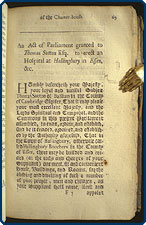
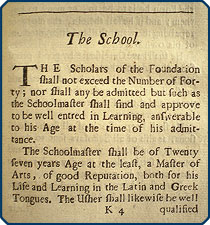 Click the images for enlargements.
 Provenance: Rolle family armorial bookplate.
• ESTC R10688; Wing (rev.) H1578; Allibone 813. Contemporary sheep, covers framed in blind double fillets; leather rubbed and scuffed, partially cracked along front joint. All edges marbled. Pastedowns peeled up, front pastedown with early inked inscription; inside front cover with armorial bookplate. Title-page with inked numeral in upper outer corner. (21012)
Systematic SkepticismHudson, Thomas Jay. The law of psychic phenomena. A working hypothesis for the systematic study ofhypnotism, spiritism, mental therapeutics, &c. Chicago: A.C. McClurg & Co., 1905. 8vo. [2], 409, [5 (adv.)] pp.
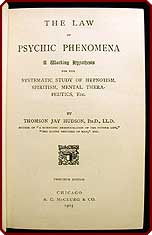
• Publisher's cloth, spine with gilt-stamped title; cloth lightly rubbed over edges and extremities, with two small creases over the front cover. One page with lower corner torn away. (14304)

Skepticism from anEcclesiastical SavantHuet, Pierre-Daniel. Pet. Dan. Huetii episcopi Abrincensis De imbecillitate mentis humanae libri tres. Amstelodami: Apud H. Du Sauzet, 1738. 12mo (17 cm, 6.75"). xxxviii, [10], 223, [1] pp. (frontis. lacking). 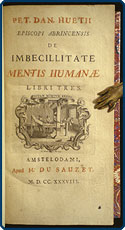
 Click the interior image for an enlargement.
 • Recent quarter calf and marbled paper–covered sides, spine with gilt-stamped leather title and author labels. Frontispiece lacking and pages showing light cockling; clean and attractive. (21114)
White Savage? — Trustworthy Memoirs?Hunter, John Dunn. Memoirs of a captivity among the Indians of North America, from childhood to the age of nineteen: With anecdotes descriptive of their manners and customs. London: Longman, Hurst, Rees, Orme, & Brown, 1823. 8vo (21 cm, 8.25"). ix, [1], 447, [1] pp.
 medicine
as practiced by the Native Americans of Hunter’s
alleged acquaintance.
Click
the image to the left for an enlargement.
medicine
as practiced by the Native Americans of Hunter’s
alleged acquaintance.
Click
the image to the left for an enlargement.
• Ayer, Narratives of Indian Captivity, 142; Howes H813; Sabin 33921. Contemporary half morocco over cloth, rebacked using original spine with gilt-stamped title and decorations in compartments; leather worn and chipped. Hinges (inside) reinforced. Pages slightly age-toned, with occasional instances of small spots of staining, and a few stray pencil marks.
 TO
Part III TO
Part III |
 For a dedicated DANCE