
 MEDICINE MEDICINE
  HEALTHFUL St. Augustine, 1829
  (A
Physician's “Come on Down!”). Anderson, Andrew.
[begins:] St. Augustine, November, 1829. Sir, The nature of the present communication
will present the best apology I can offer for asking your attention to its object....”
[St. Augustine ?]: no publisher/printer, 1829. 4to. [2] pp. with integral blank.
(A
Physician's “Come on Down!”). Anderson, Andrew.
[begins:] St. Augustine, November, 1829. Sir, The nature of the present communication
will present the best apology I can offer for asking your attention to its object....”
[St. Augustine ?]: no publisher/printer, 1829. 4to. [2] pp. with integral blank.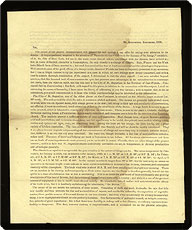
 Click the image for an enlargement.
 The format suggests this was printed for mailing to hospitals, medical societies, doctors, and newspapers. Whether it was printed in Florida is a bit problematic. There were presses in Florida, even one in St. Augustine in 1829, but the publication has no printer's slug anywhere. The typography is very good, perhaps indicating printing in Philadelphia, New York, or Boston, but that remains for a type historian to determine.
 Apparently very scarce: NO other copies traced through the standard sources including OCLC and the OPACs of the State Library of Florida, the University of Florida Library, and Florida State University Library.
 An interesting American medical publication, an interesting early American tourist item, and definitely a good piece of Floridiana.
• Not in Servies, Bibliography of Florida; but see I,1430 for a version that appeared in a newspaper. Not in Shoemaker. Old folds suggesting this was once folded to fit in a pocket. Waterstaining. Two small tears repaired with archival tissue. (23078)

 Much Varia — An Ad for a
 Papermaker! Abell, Truman. New-England farmer's almanack, with an emphemeris, for the year ... 1828. ... Fitted to the latitude and longitude of the town of Windsor, Vt. but will serve, without sensible variation, for all the adjacent states. Alstead, N. H.: Newton & Tufts; Windsor, Vt.: Simeon Ide, [1827]. 12mo. [24] ff.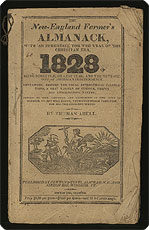
 medicines by the
author, and a publisher's advertisement by Simeon Ide.
Click the image for an enlargement.
medicines by the
author, and a publisher's advertisement by Simeon Ide.
Click the image for an enlargement. • Drake 13641; Shoemaker 29925. Uncut copy; later stitching and later oversewing; dog-earing and a bit tattered. Title-page and p. [48] age-darkened. Occasional mild staining. (10027)
Almanacs often offer both medical/health advice & 
“Aristotle's Master Piece”: Virginity, Copulation, & Generation Aristotle, pseud. The works of Aristotle, the famous philosopher. In four parts ... A new edition. New England: Pr. for the proprietor, 1806. 12mo (18.1 cm, 7.15"). 270 pp.; illus.
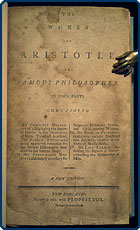
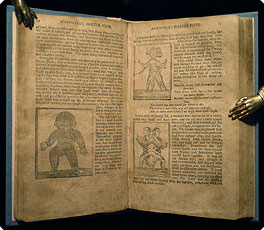
Following the obstetrical “Master Piece” portion (which includes a brief “Family Physician” section as well as “The Experienced Midwife”) are “Aristotle's Book of Problems, with other Astronomers, Astrologers, Philosophers, Physicians, &c.” and “Aristotle's Last Legacy, Unfolding the Mysteries of Nature in the Generation of Man.”
• Shaw & Shoemaker 9860; Austin, Early American Medical Imprints, 75; Bibliotheca Osleriana 1836 (for first ed.). Not in Sabin. Period-style quarter tan cloth with light blue paper–covered sides, spine with printed paper label. Title-page mounted. Early pencilled ownership inscription along one inner margin. Pages browned and stained, with occasional chipped edges. One leaf with lower outer corner torn away, affecting a few words; last leaf with small repair at upper inner corner, with loss of several letters. (25215)
 “Fundamentall to the Erecting & Building of
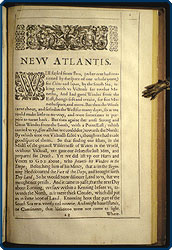
 a True Philosophy”Bacon, Francis. Sylva sylvarum or a naturall history in ten centuries. London: Pr. by J.H. for William Lee, 1627. 8vo (27.6 cm, 10.9"). Frontis., add. engr. t.-p., [10], 266, [16], 47, [3] pp. (lacking final blank f.).
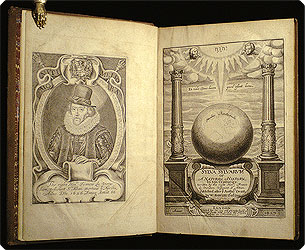
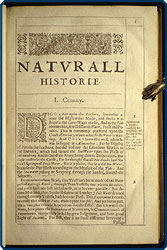 Single-click any image where the hand appears onNew Atlantis, an unfinished allegorical fantasy begun shortly after his political downfall and not long before his death. Together, the two works exemplify Bacon's scientific and literary accomplishments.
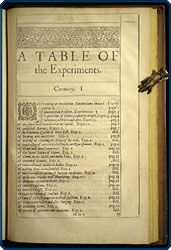

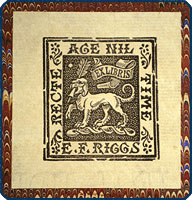
Provenance: Riggs family: Front pastedown with armorial bookplate of philanthropist Elisha Francis Riggs, who funded the Riggs Library at Georgetown University; volume inherited by T. Lawrason Riggs, founding chaplain of St. Thomas More Chapel, Yale University; donated to St. Thomas More Chapel Library; deaccessioned 2008.
• ESTC S106924; STC (2nd ed.), 1169; Gibson, Bacon, 171. On Bacon, see: Dictionary of National Biography. 18th-century calf framed in gilt single fillet, spine with recent gilt-stamped leather title and author labels, board edges with gilt roll; a little rubbed and covers with portions darkened. All edges stained yellow. Front pastedown with bookplate as above. Some pages gently age-toned, with occasional minor spotting. Small hole to added engraved title-page just beneath publication information, not affecting text. Final blank leaf (only) lacking. (24666)
 The Andrade Set inQuarter Red Morocco Barcía, Andrés González de. Ensayo cronologico, para la historia general de la Florida. Madrid: Imprenta de los Hijos de Doña Catalina Piñuela, 1829. 12mo. 2 vols. I: [2] ff., 508 pp., fold. table. II: [2] ff., 512 pp.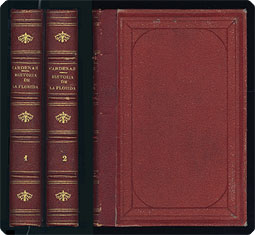
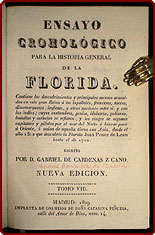
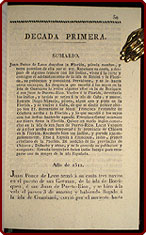
 Click the page-images for enlargements.
  New
World diseases, and so on.
New
World diseases, and so on.
The present edition forms volumes 8 and 9 of the series Historia de la conquista del Nuevo Mundo.
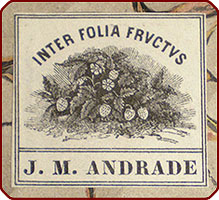
Provenance: Bookplate of the great 19th-century Mexican collector J. M. Andrade on the front pastedown of each volume.
• This edition not in Sabin. 19th-century quarter red morocco with red textured cloth sides. Spine with raised bands and very good gilt tooling including center devices in spine compartments. Interiors clean. A very good set. (25271)

 Another of Benezet's Causes Benezet, Anthony. The mighty destroyer displayed, in some account of the dreadful havock made by the mistaken use as well as abuse of distilled spirituous liquors. Philadelphia: Printed by Joseph Crukshank, 1774. 8vo (17 cm; 6.625"). 48 pp.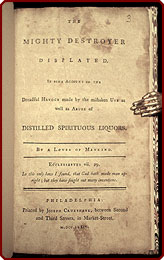
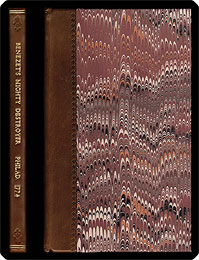 Click the images for enlargements.
 While the title-page merely says the piece is “by a Lover of Mankind,” Benezet's authorship was well established by Evans.
• Bristol B3689; Shipton & Mooney 42555; Hildeburn 2980; ESTC W26174. Not in Blake. Recent quarter calf, old style, with marbled paper sides. Text cockled, with stray stains and age-toning; title-page crumpled. Original edition, not a modern reprint. (27123)
 For more TEMPERANCE, click here.
Written While Living in Rhode Island & Drawing Its Landscape Berkeley, George. Alciphron: Or, the minute philosopher. In seven dialogues. Containing an apology for the Christian religion, against whose who are called free-thinkers. London: J. Tonson, 1732. 8vo. 2 vols. I: [6] ff., 350 pp. II: [4] ff., 358 pp.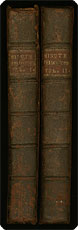
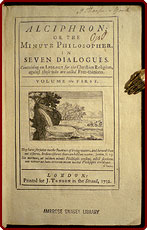
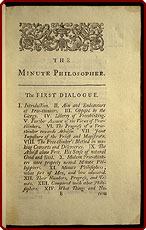
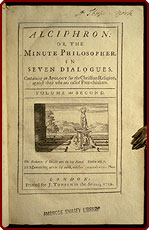 Click the interior images for enlargements. a
new theory ofvision. First published in the year
MDCCIX,” with a separate title-page, in vol. II, on pp. [211]–358.
Click the interior images for enlargements. a
new theory ofvision. First published in the year
MDCCIX,” with a separate title-page, in vol. II, on pp. [211]–358.
Presented here is Berkeley's defense of revealed religion: It ranks as a major example of English literature and of American literature too, for he wrote it while living in America waiting for money for his projected university in Bermuda. “Alciphron, a set of dialogues located notionally in England, but drawing much of the landscape description from Rhode Island,” sold well and aroused controversy after his return to Britain. The New Theory of Vision is “a work of lasting importance in the psychology of perception[; it] was transitional between Berkeley's already informed interests in mathematics and natural philosophy and a growing independence of mind in metaphysics and epistemology” (both quotations from DNB on-line).
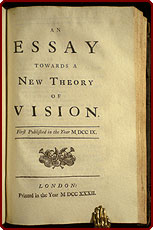
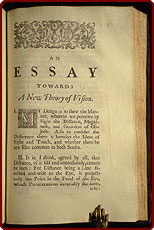
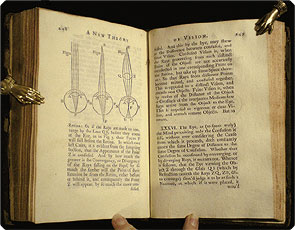
Provenance: “A. Thorpe – York” inscribed on title-pages.
• ESTC T86056; NCBEL, II, 1852. Not in European Americana. Contemporary sheep, spines with raised bands and gilt-stamped red leather labels; covers framed and paneled in blind-stamped triple fillets with blind-stamped corner fleurons; all edges red. Leather rubbed with some loss to corners, edges, turn-ins; vol. I with pulls at both spine extremities, small gouge to front cover, front joint opening with cover almost off. Old institutional bookplates and rubber-stamp to pastedowns, title-pages, and lower edges of closed volumes; ink ownership signature to title-pages as above and a few additional ink and pencil marks; some very scattered spots or staining with pages generally clean. (21366)
For more SETS, click here.
By
aMegastar
Medical ProfessorBoerhaave, Herman. Aphorismi de cognoscendis et curandis morbis, in usum doctrinae domesticae digesti ... editio sexta. Edinburgi: R. Drummond & Soc. for G. Hamilton & J. Balfour, 1744. 12mo (15.5 cm, 6.1"). [8], 330, [24 (index)] pp.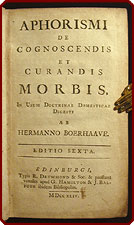
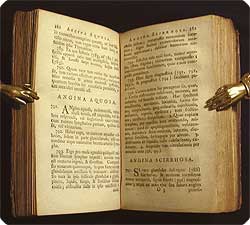
• ESTC N5425; Garrison-Morton 2199 (for first ed.). Contemporary speckled calf, spine with gilt-stamped title and compartment decorations; leather cracked and chipped on spine and joints, with minor rubbing to sides and edges. Front free endpaper with private collector’s rubber-stamp and inked name, front pastedown with small inked numeral. One front and one back fly-leaf excised. One leaf with short tear from outer margin just touching one letter; one leaf with paper flaw affecting a few letters without loss of legibility. Pages clean save for some age-toning and scattered iinstances of light staining to outer margins.
Water asCURE-ALLBourne, George Melksham. The home doctor: a guide to health. By Dr. Bourne, of San Francisco. San Francisco: San Francisco News Company, 1878. Small 8vo. Frontis. port., xx, 505, [1] pp.; illus. 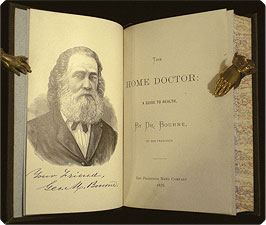
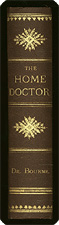 Click the interior image for an enlargement.
 • Publisher's brown buckram, stamped in gilt on the spine, in blind on covers. Paper edges marbled. Clean, free of chips or tears. A very fine copy. (24465)
Gastronomic Masterpiece ILLUSTRATED — Limited Edition Brillat-Savarin, Jean Anthelme. Physiologie du goût ou meditations de gastronomie transcendante. Paris: Les Arts & Le Livre, 1926. 2 vols. 8vo (24 cm, 9.4"). I: xlii, [2], 252 pp.; illus. II: [4], 300, [2] pp.; illus.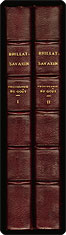
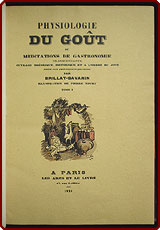
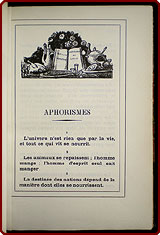
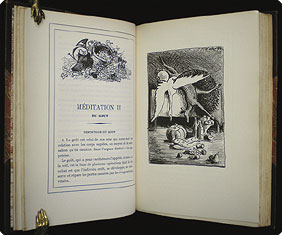
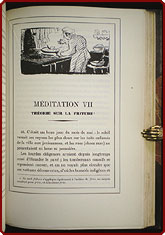 Click the images for enlargements.
 Provenance: Front pastedown of vol. I with bookplate of Francis de Neufville Schroeder, a descendent of the first mayor of New York.
• Not in Bitting. Contemporary half red morocco and marbled paper–covered sides, spines with gilt-stamped author and title; corners and joints showing some shelf wear, spines slightly darkened. Vol. I front pastedown with bookplate as above. Original yellow wrappers in near-perfect condition; overall, a lovely set. (25885)
The Author Was aStrange (Mental) Case Browne, Simon. A defence of the religion of nature, and the Christian revelation; against the defective account of the one, and the exceptions against the other, in a book, entitled, Christianity as old as the creation. London: Richard Ford, 1732. 8vo (20.6 cm, 8.1"). vi, [2], 267, 272–512 pp.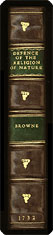
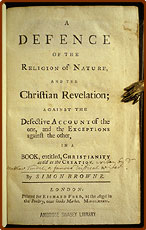
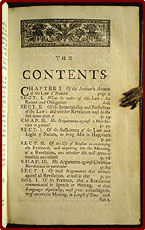 Click the interior images for enlargements.
 • ESTC T86771; Allibone 263. Period-style calf framed and panelled in blind rolls with blind-tooled corner fleurons, spine with gilt-stamped leather title and author labels, gilt-dotted raised bands, and gilt-stamped decorations in compartments (signed in blind on lower rear turn-in by Grace Bindings). Pagination jumps from 267 to 272, text complete. Title-page with early inked annotation on the authorship of Christianity as Old as the Creation, and with institutional rubber-stamp in lower margin; closed lower edges rubber-stamped. First and last few leaves lightly spotted. (23782)
A Nun's Copy Then Another Nun's Capuchin Nuns. Regla de la gloriosa santa Clara,con las constituciones de las monjas Capuchinas del santissimo crucifixo de Roma, reconocidas, y reformadas por el Padre General de los Capuchinos y con las adiciones a los estatutos de dicha regla ... Mexico: Reimpressa en la Imprenta del Lic. Don Joseph de Jauregui, n.d. [ca. 1760–75]. 16mo (15 cm; 6'). [4] ff., 234 pp.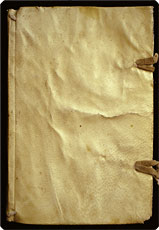
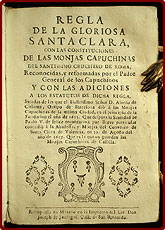
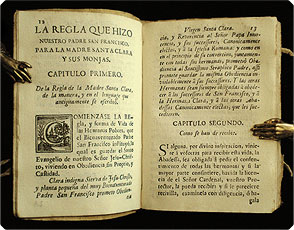 Click the interior images for enlargements. As part of the last, they pray for intervention in medical and mental matters for those suffering from maladies.
Provenance: On front free endpaper in 18th-century hands: “del uso de Sor Maria Coleta,” lined through; below which, “del uso de Sor M[ari]a Juan Nep[umacen]a.
The printer has supplied two charming initials, an “I” and a “C.”
• Medina, Mexico, 9208. Publisher's limp vellum with remnants of ties. Occasional light foxing. Ownership signatures as noted. (23966)
PrudentNew England-Style DOMESTICITY Cornelius, Mrs. Mary Hooker. The young
housekeeper's friend; or, a guide to domestic economy and comfort. Boston: Charles Tappan;
New York: Saxton & Huntington, 1846. 12mo (18.2 cm, 7.2"). 190 pp.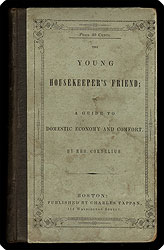
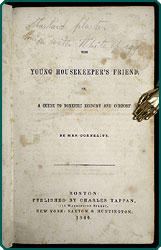
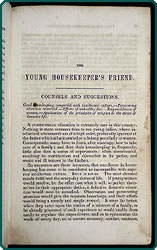 Click the images for enlargements.
 The endpapers bear several additional recipes pencilled in an early hand, including a “Cure for Felon.”
• American Imprints 46-1830; Bitting 100; Brown, Culinary Americana, 1491 (1860 ed.); Cagle & Stafford 187; Lowenstein 399. Publisher's quarter brown cloth and printed light green paper–covered sides; edges rubbed, sides lightly stained. Endpapers as above; title-page with early pencilled annotation in upper portion; foxing and staining, but no tears or tattering. In fact a good copy, the more interesting as showing it was used. (26685)
A Crukshank “Plague Year” Defoe, Daniel. The dreadful visitation, in a short account of the progress and effects of the plague, the last time it spread in the city of London, in the year 1665, extracted from the memoirs of a person who resided there during the whole time of that infection. Philadelphia: Printed by Joseph Crukshank, 1774. 8vo (17 cm; 6.6"). 16 pp.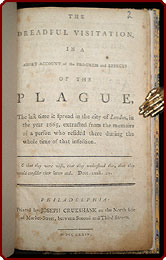
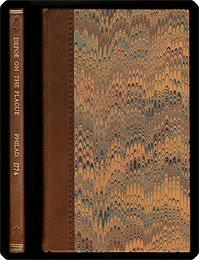 Click the images for enlargements.
 • Evans 13241; Hildeburn 3001; Austin 635; Blake p. 111; ESTC W6028. Recent quarter leather with marbled paper sides. Some staining in foremargins and corners, sometimes into text; foxing, and light age-toning. Old library pressure-stamp on title-page (properly deaccessioned). A rather okay copy. (27083)
For more LITERATURE, click here.
Descartes Illustrated Descartes, René. Renati Des Cartes opera philosophica. Francofurti ad Moenum: Sumptibus Friderici Knochii, 1692. 4to. 5 parts in 1 vol. Frontis., [47] ff.; [4] ff., 384 pp.; [16] ff., 168 pp.; [8] ff., 220 pp.; [12] ff., 74 pp., [3] ff.; [18] ff., 188 pp., 7 plts.
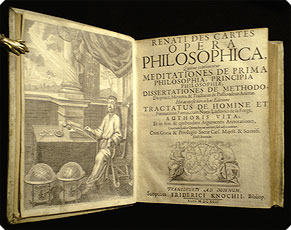
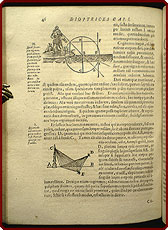 Click the interior images for enlargements.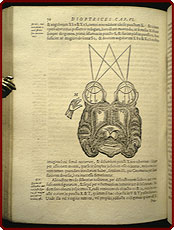
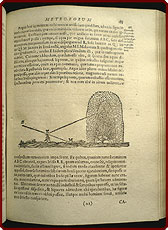
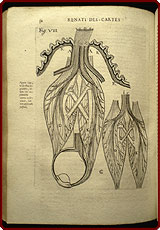
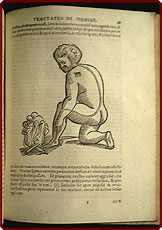
• VD17 1:620459Z. Contemporary stiff vellum. Ex-library with call number on spine and bookplate, but no other markings. A very good copy. (14709)
 Illustrated Explorations of theCountryside Dibdin, Charles. Observations on a tour through almost the whole of England, and a considerable part of Scotland, in a series of letters, addressed to a large number of intelligent and respectable friends. London: G. Goulding & John Walker (pr. by T. Woodfall), [1801–02]. 4to (28.9 cm, 11.4"). 2 vols. I: 404 pp.; 27 plts. II: [2], 406, [2] pp.; 33 plts., 1 fold. map, 1 fold. chart.
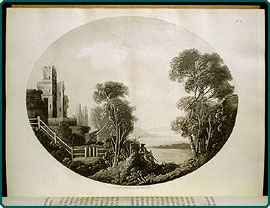
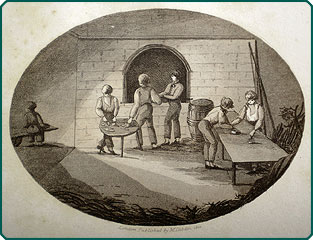 Click the images for enlargements.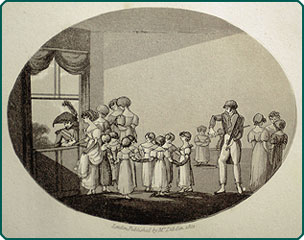
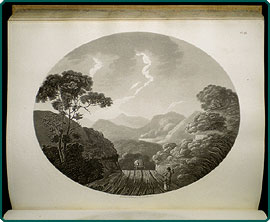
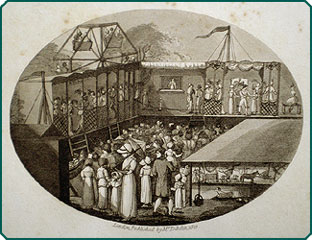 illustrated with 60 copper-engraved and aquatint plates, one folding map, and one folding chart. The copper engravings are done in two different styles; one set consists of large renditions of scenery, the other of smaller depictions of people and everyday life — the former done from Dibdin's own paintings, and the latter from drawings by his daughter Anne.
• Anderson, Book of British Topography, 373; Lowndes 638; NSTC D1044. Not in Abbey, Life in England; not in Ray, The Illustrator & the Book in England. On Dibdin, see: Oxford Dictionary of National Biography online. Recent quarter caramel morocco and ochre cloth. Light to moderate foxing; mild offsetting around plates; four pages with patch of offsetting from now-absent laid-in item. Plates depicting people all with small area of waterstaining to upper inner portions, just touching corner of platemark without affecting images; scenic plates unaffected. All edges marbled.  A solid, handsome, satisfying set. (26939)
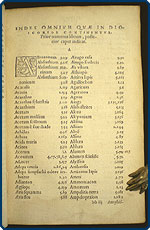
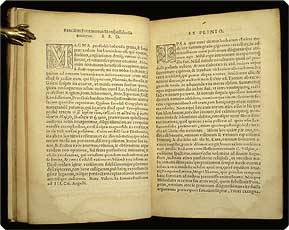
Materia Medica — Ancient Knowledge Dioscorides Pedanius, of Anazarbos. Dioscoridis libri octo Graece et Latine. Castigationes in eosdem libros. Parisiis: Apud Petrum Haultinum (colophon: Excudebat Benedictus Prevost), 1549. 8vo (16.7 cm, 6.5"). [20], 392 ff. 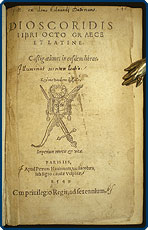
 Click the interior images for enlargements.
The work was edited by Jacques Goupyl, and is laid out with the Latin translation by Jean Ruel in side-by-side columns with the Greek text.
Provenance: Early title-page inscription, “F.M. ex dono Eduardi Davenant.”
• Adams D656; Durling 1135; Index aureliensis 154.341; Pritzel 2295. 18th-century speckled calf (front cover) and sheep (back cover) rebacked with lighter-colored sheep preserving original gilt-stamped leather title-label; boards scuffed and worn. Title-page with inked inscription as above (and in same hand, “Illuminat mentem Lectio.” First two leaves creased; first and last few leaves with light to moderate waterstaining. A very few marginalia in a tiny, neat, early inked hand. (20639)
 TO Part
II TO Part
II |