 WING
BOOKS
WING
BOOKS • A-F • G-O • P-Z •
WING
BOOKS  Doctors
vs. Druggists — A
Physician-Poet Speaks Out
Doctors
vs. Druggists — A
Physician-Poet Speaks Out [Garth, Samuel]. The dispensary. A poem. In six canto’s [sic]...the fifth edition. London: John Nutt, 1703. 8vo (20 cm, 7.9"). Frontis., [11] ff., 96 pp.
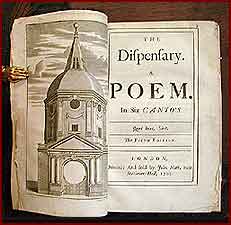
The frontispiece portrays a small but elegantly composed octagonal structure, labelled “Theatrum Cutlerianum.”
• ESTC T34564; Foxon G21; Wing (rev.) G273 (first ed.). Recent marbled paper wrappers, front cover with printed paper label. Two pages (not including title-page) stamped; one page with two pencilled corrections. Margins untrimmed and occasionally showing a few spots or light staining, pages otherwise quite clean.
 “Pvritane” Pamphlet Geree, John. The character of an old English Puritane, or non-conformist. London: Pr. by W. Wilson for Christopher Meredith, 1646. 4to (19 cm, 7.5"). [2], 6 pp.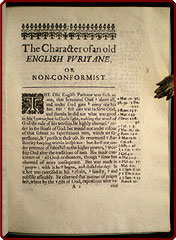
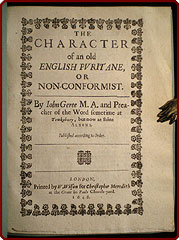
 Click the images for enlargements.
 Not widely held: ESTC, OCLC, Wing, and NUC Pre-1956 find only 10 U.S. institutional locations, one of which has now been deaccessioned.
 In its way, a handsome little production, being very much in “the character of an old English” imprint of its era — complete with sidenotes, busy type ornamentation, and exuberant font variation.
• ESTC R227244; Wing (rev. ed.) G589. On Geree, see: Oxford Dictionary of National Biography online. Recent marbled paper wrappers. Pages clean and notably wide-margined. (25007)

 Geree's
 FIRST Vindication — Infant-baptisme Geree, John. Vindiciae paedo-baptismi: Or, a vindication of infant baptism, in a full answer to Mr. Tombs his twelve arguments alleaged against it in his Exercitation, and whatsoever is rational, or material in his answer to Mr. Marshals Sermon. London: Pr. by John Field for Christopher Meredith, 1646. 4to (19 cm, 7.5"). [8], 71, [1] pp.
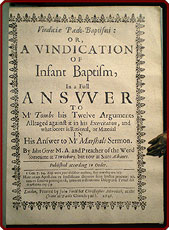 Click the image for an enlargement.
 • ESTC R200633; Wing (rev. ed.) G603. Recent marbled paper wrappers. Pages very slightly age-toned with one early inked marginal annotation, else clean and crisp. (25024)

 Geree on Infant Baptism, Again: A Vindication of His Vindication Geree, John. Vindiciae vindiciarum: Or, a vindication of his Vindication of infant-baptisme, from the exceptions of M. Harrison, in his Poedo-baptisme oppugned, and from the exceptions of M. Tombes, in his chief digressions of his late Apology, from the manner to the matter of his treatises. London: Pr. by A.M. for Christopher Meredith, 1647. 4to (19.2 cm, 7.5"). [6], 42 pp.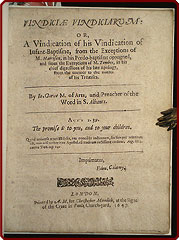
Click the image for an enlargement. Uncommon: OCLC, ESTC, Wing, and NUC Pre-1956 report only eight U.S. holdings, one of which has been deaccessioned.
• ESTC R201234; McAlpin, II, 487; Wing (rev. ed.) G604. Recent marbled paper wrappers. Title-page slightly darkened, last page with offsetting to margins, pages otherwise clean. Stubs of previous binding leaves visible at back. (25017)


 By
an
By
an Ejected
Librarian
Godefroy, Jacques, 1587-1652. The history of the united provinces of Achaia. Collected in Latine by the learned Jacobus Gothofredus, and rendred [sic] into English, with some additions, by Henry Stubbe. London: Pr. by Andrew Clark for Jonathan Edwin, 1673. Small 4to. [2] ff., 32 pp.
Ejected
Librarian
Godefroy, Jacques, 1587-1652. The history of the united provinces of Achaia. Collected in Latine by the learned Jacobus Gothofredus, and rendred [sic] into English, with some additions, by Henry Stubbe. London: Pr. by Andrew Clark for Jonathan Edwin, 1673. Small 4to. [2] ff., 32 pp. 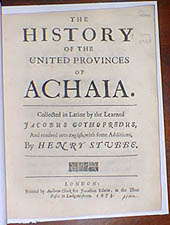
• Wing (rev.) G924; on Stubbe, see: Dictionary of National Biography, LV, 116-17. Recent marbled wrappers. Top margin closely cropped but still a very good copy.

Defending His DEFENSE of Celebrating CHRISTMAS Hammond, Henry. An account of Mr. Cawdry’s triplex diatribe concerning superstition, wil-worship, and Christmas festivall. London: Pr. by J. Flesher for Richard Royston, 1655. 4to (19.9 cm, 7.75"). [16], 295, [1 (errata)] pp.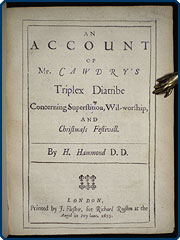
 Click the interior image for an enlargement.
 This variant is less common than the Davis imprint of the same year; WorldCat and ESTC locate only six U.S. holdings, one since deaccessioned.
• ESTC R202302; Wing (rev. ed.) H510. On Hammond, see: Oxford Dictionary of National Biography online. Recent marbled paper–covered boards, spine with gilt-stamped leather title-label. Lower (closed) edges institutionally rubber-stamped (no other markings). A few small corrections inked in an early hand. A nice copy. (25770)

Defending the Epistles of St. Ignatius Hammond, Henry. An answer to the animadversions on the dissertations touching Ignatius's epistles, and the episcopacie in them asserted. London: Pr. by J.G. for Richard Royston, 1654. 4to (19.7 cm, 7.75"). [2], 219, [1] pp.
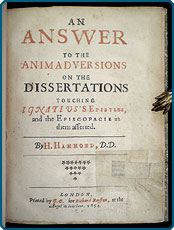
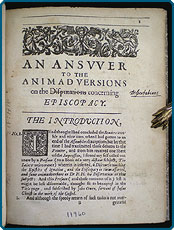
The title-page is printed in red and black, and the text is ornamented with a headpiece and one decorative initial; there are numerous quotations in Greek.
• ESTC R202518; Wing (rev. ed.) H514. On Hammond, see: Oxford Dictionary of National Biography online. Recent marbled paper–covered boards, spine with gilt-stamped leather title-label. Title-page with small excised portion (not affecting text) repaired some time ago, institutional pressure-stamp, and tiny inked annotation in lower margin; first text page with inked numeral in lower margin. Early inked corrections scattered throughout, with occasional shouldernotes and marks of emphasis. (25789)
Sutton's
Hospital inCharterhouse Charterhouse
School
Herne, Samuel. Domus carthusiana: Or an account of the most noble foundation of the charter-house near Smithfield in London. Both before and since the Reformation. London: Pr. by T.R. for Richard Marriott & Henry Brome, 1677. 8vo (18.2 cm, 7.2"). Frontis., [46], 287, [1] pp.; 2 plts.
Charterhouse
School
Herne, Samuel. Domus carthusiana: Or an account of the most noble foundation of the charter-house near Smithfield in London. Both before and since the Reformation. London: Pr. by T.R. for Richard Marriott & Henry Brome, 1677. 8vo (18.2 cm, 7.2"). Frontis., [46], 287, [1] pp.; 2 plts.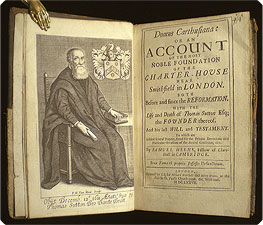
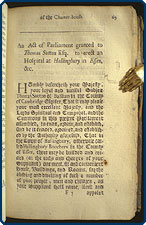
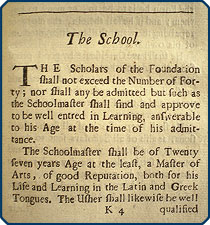 Click the images for enlargements.
 Provenance: Rolle family armorial bookplate.
• ESTC R10688; Wing (rev.) H1578; Allibone 813. Contemporary sheep, covers framed in blind double fillets; leather rubbed and scuffed, partially cracked along front joint. All edges marbled. Pastedowns peeled up, front pastedown with early inked inscription; inside front cover with armorial bookplate. Title-page with inked numeral in upper outer corner. (21012)

The Future INTERPRETED by “the English Merlin” Lilly, William. A collection of ancient and moderne prophesies concerning these present times, with modest observations thereon. London: John Partridge & Humphrey Blunden, 1645. 4to (18.1 cm, 7.1"). [8], 54, [2] pp.; illus.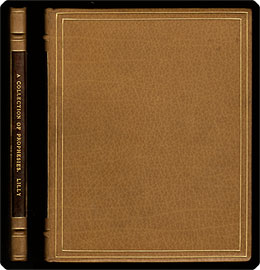
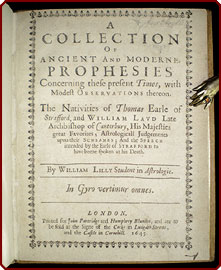
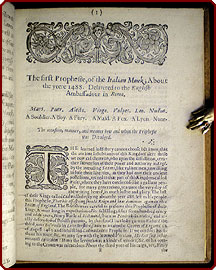 Click the images for enlargements.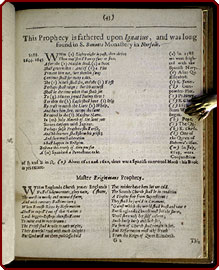
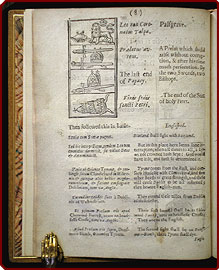
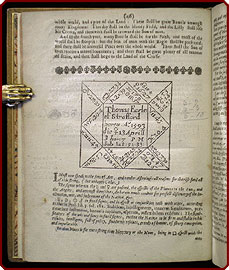 woodcuts depicting the central images of that set of predictions. Astrological charts are provided for Thomas, Earl of Strafford, and William Laud, Archbishop of Canterbury.
• ESTC R200424; Wing (rev. ed.) L2217; Huth, Catalogue, 849. Not in Coumont, Demonology and Witchcraft. On Lilly, see: Oxford Dictionary of National Biography online. Recent calf in a classic “collectors' style”; covers framed in gilt double fillets, spine with gilt-ruled raised bands and gilt-stamped leather title-label. Title-page darkened, with small closed tear and early inked ownership inscription; pages with small pencilled annotations and marks of emphasis. The shouldernotes, of a sort often trimmed-into, are here intact; and the volume is now in a tan cloth–covered slipcase, this with light dust-soiling. A solid and interesting copy of an intriguing work, one of Lilly's rarest. (26921)
 Exact
& True?
(re: The “Popish
Plot”)
Mansell, Roderick. An exact and true narrative of the late Popish intrigue.... London: Tho. Cockerill & Benj. Alsop, 1680. Folio (30.5 cm, 12"). [A]2 b–c2 B–V2 (-O2, blank); [6] ff., 105 (i.e., 73), [1 (blank)] pp.
Exact
& True?
(re: The “Popish
Plot”)
Mansell, Roderick. An exact and true narrative of the late Popish intrigue.... London: Tho. Cockerill & Benj. Alsop, 1680. Folio (30.5 cm, 12"). [A]2 b–c2 B–V2 (-O2, blank); [6] ff., 105 (i.e., 73), [1 (blank)] pp. 
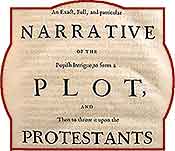 • ESTC R20941; Wing (rev.) M514. On the Popish Plot, see: New Catholic Encyclopedia, X, 590–94; and the article on Titus Oates in The Dictionary of National
Biography, XLI, 296–303. Removed from a nonce volume with remnants of previous binding at “spine” and two fly-leaves from the volume remaining attached also, on the second of which is a list of contents in ink. The leaves of this piece are numbered in ink consecutively on the upper outer corners of the versos. Some staining, foxing, or soiling, and a few shallow tears, with no loss of print. All edges speckled red.
• ESTC R20941; Wing (rev.) M514. On the Popish Plot, see: New Catholic Encyclopedia, X, 590–94; and the article on Titus Oates in The Dictionary of National
Biography, XLI, 296–303. Removed from a nonce volume with remnants of previous binding at “spine” and two fly-leaves from the volume remaining attached also, on the second of which is a list of contents in ink. The leaves of this piece are numbered in ink consecutively on the upper outer corners of the versos. Some staining, foxing, or soiling, and a few shallow tears, with no loss of print. All edges speckled red.
ThePaedo-Baptism Argument Rages On Marshall, Stephen. A defence of infant-baptism: In answer to Two treatises, and an appendix to them concerning it; lately published by Mr. Jo. Tombes. Wherein that controversie is fully discussed, the ancient and generally received use of it from the apostles dayes, untill the Anabaptists sprung up in Germany, manifested... London: Pr. by Ric. Cotes for Steven Bowtell, 1646. 4to (19.1 cm, 7.5"). [8], 256, [4 (index)] pp.
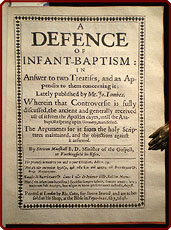
Click the image for an enlargement. Some holdings report (variously) 10 or 12 preliminary pages as present, but signature A is complete here, including one blank leaf.
• ESTC R200739; Wing (rev. ed.) M751 . Recent marbled paper wrappers. Some light staining to a few early leaves, pages otherwise almost entirely clean. (25039)
The Infant Baptism Controversy Continued! One of the Day's GREAT Preachers Marshall, Stephen. A sermon of the baptizing of infants; preached in the Abbey-Church at Westminster, at the morning lecture, appointed by the honorable House of Commons. London: Pr. by Richard Cotes for Stephen Bowtell, 1645. 4to (19 cm, 7.5"). [4], 61, [1] pp.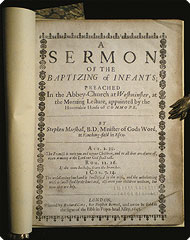
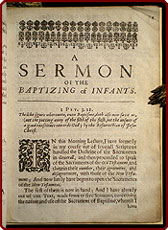
Uncommon: ESTC, OCLC, Wing, and NUC Pre-1956 find only six U.S. holdings, one of which has been deaccessioned.
• Wing (rev. ed.) M775; McAlpin, II, 361; ESTC R211892 & R31210. On Marshall, see: Oxford Dictionary of National Biography online. Recent marbled paper wrappers. Title-page institutionally pressure-stamped, with outer and upper margins darkened by offsetting from sometime binding; first few leaves with corners bumped. Based on the signatures, either a half-title or a license leaf is lacking, but this collation matches that reported by ESTC. (25019)
“NONSENCE,” or as We Would Say, “Nonsense”Meredith, Edward. Some remarques upon a late popular piece of nonsence called Julian the Apostate, &c. together, with a particular Vindication of His Royal Highness the Duke of York. By some bold truths in answer to a great many impudent calumnies raised against him, by the foolish arguments, false reasonings, and suppositions, imposed upon the publick from several scandalous and seditious pamphlets; especially from one more notorious and generally virulent than the rest, sometime since published under the title of A Tory plot, &c. London: Pr. for T. Davies, 1682. Folio. [2] ff., 35, [1 (blank)], 23, [1 (blank)] pp. . 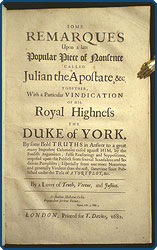
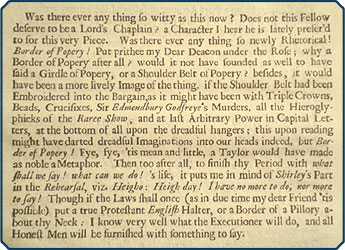
• Wing (rev. ed.) M1784; ESTC R23540. In later wrappers. A very nice copy. (21024)
The End Times, According to Muggleton Muggleton, Lodowick. A true interpretation of the eleventh chapter of the Revelation of St. John, and other texts in that book; as also many other places of Scripture. London: Pr. for the author, 1662. 4to (18.9 cm, 7.4"). [16], 172, [2 (blank)] pp.

 Click the images for enlargements.
 Provenance: Final blank leaf with inked inscriptions reading “Tho.s. Scupholme His Book 1740" and “Henery Collier His Book 1759.”
• ESTC R267; Wing (rev. ed.) M3050; Smith, Anti-Quakeriana, 305. Period-style calf, covers framed in blind double fillets, spine with gilt-ruled raised bands and gilt-stamped leather title-label. Pages age-toned and spotted; one leaf with tear from lower margin into text, sewn by hand some time ago. (26004)
The
Prophet Defends
HimselfMuggleton, Lodowick. [drop-title] The prophet Muggleton’s epistle to the believers of the commission, touching the rebellion occasioned by the nine assertions. [London?, ca. 1690]. 4to (21 cm, 8.25"). A–B4 χ1 C2; 22 pp.
Defends
HimselfMuggleton, Lodowick. [drop-title] The prophet Muggleton’s epistle to the believers of the commission, touching the rebellion occasioned by the nine assertions. [London?, ca. 1690]. 4to (21 cm, 8.25"). A–B4 χ1 C2; 22 pp. 
• ESTC R214286; Wing (rev.) M3040; Smith, Bibliotheca Anti-Quakeriana, 313. On Muggleton, see: The Dictionary of National Biography, XXXIX, 264–67; and Oxford Dictionary of the Christian Church 948. Recent marbled paper over light boards; front cover with a paper label lettered in black. Light waterstaining along the top edge, light brown-spotting, and tissue paper repairs along gutter of first and last leaves: none of this obscuring print.
 For
more of MUGGLETONIAN
For
more of MUGGLETONIAN
 TO Part
III . . . TO Part
III . . . |
 For more MEDICINE,