 16TH-CENTURY BOOKS
[ENCOMPASSING THE REFORMATIONS]
16TH-CENTURY BOOKS
 The Augsburg Confession — 51 Documents
 The First Much Annotated
  (“A”
is for “AUGSBURG”). Chytraeus, David.
Histoire de la confession d'Auxpourg, contenante les principauls traittez &
ordonnances, faittes pour la religion, quand l'electeur Iehan, duc de Saxe auec
les citez & autres princes protestants presenterent leur confession de foy
(icy inserée) a l'Empereur Charles V. os estats generauls de l'empire,
tenus a Auxpourg, 1530. Anvers: Chez Arnould Coninx, 1582. 4to (24.3 cm, 9.55").
[8], 835, [5] pp.
(“A”
is for “AUGSBURG”). Chytraeus, David.
Histoire de la confession d'Auxpourg, contenante les principauls traittez &
ordonnances, faittes pour la religion, quand l'electeur Iehan, duc de Saxe auec
les citez & autres princes protestants presenterent leur confession de foy
(icy inserée) a l'Empereur Charles V. os estats generauls de l'empire,
tenus a Auxpourg, 1530. Anvers: Chez Arnould Coninx, 1582. 4to (24.3 cm, 9.55").
[8], 835, [5] pp.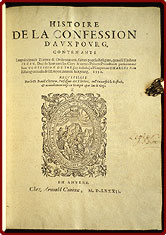
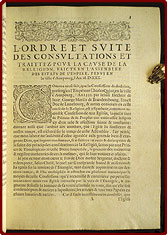
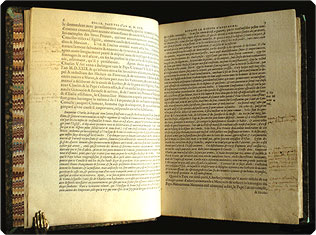
 Click the interior images for enlargements.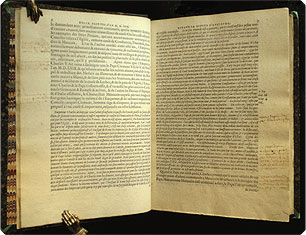
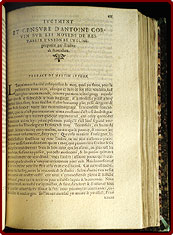
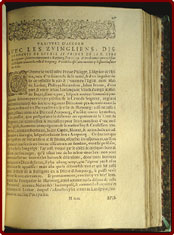
Rare. OCLC lists only four U.S. holdings and one deaccessioned copy (the present example).
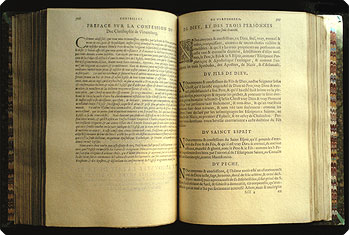
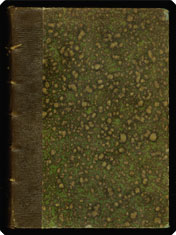
• Brunet 22420; Graesse, II, 154. Not in Adams. 19th-century quarter olive morocco with marbled paper–covered sides, spine with gilt-stamped author/title; edges and extremities rubbed. Top edge gilt. Front pastedown with bookplate as above; title-page and first text page each with early inked ownership inscription. Four leaves with small repaired tears from outer margins and three likewise from upper margins, not touching text in any case. Extensive early inked marginalia in first document, scattered examples elsewhere. (23536)
 This entry is repeated in the
 UPBRAIDING a Lutheran Theologian for
 His Statements on Transubstantiation Ad frivolas calumnias, et cavillationes sophisticas Danielis Hoffmanni doctoris theologiae responsio ministrorum Ecclesiae Bremensis, qua monetur Hoffmannus, ut suo se pede metiens, & secum habitans, ad sobrietatem sapere discat, neque supra quam sapere opertet, sapiat. Bremae: ex officina typographica Theodori Glückstein, 1584. Small 8vo (16.2 cm; 6.25"). [32] ff.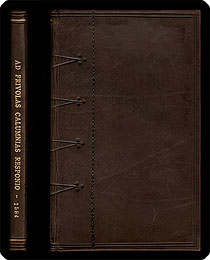
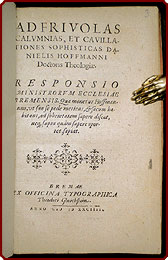
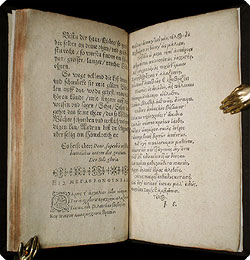 Click the images for enlargements.
 The text is in Latin printed in italic, but with some passages in Greek and others in German (the latter printed in fraktur). One final section is entirely in Greek.
There were only two editions of this printed, one year apart. This is the second (1584) and is apparently much scarcer than the first (1583): It is not listed in VD16 and WorldCat finds only two copies worldwide, one of which has been deaccessioned.
• VD16 A184 (for 1583 ed.). Recent ebony-brown calf old style: Round spine, fillets extending onto covers terminating in trefoils, and covers framed in blind double fillets. Very good condition. (26755)

 Not THAT AgricolaAgricola, Johann. Siebenhundert und funfftzig deutscher sprüchwörter ernewert und begessert durch Johan. Agricola. Mit vielen schönen lustigen und nützlichen historien und exempeln erkleret und ausgelegt. Wittenberg: Gedruckt bey J. Krafft, 1592. Small 8vo. )(8 *8 A–Z8 Aa–Xx8 (-Xx8, a blank) [14], 350 ff.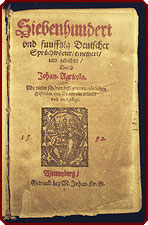
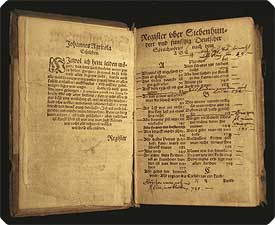
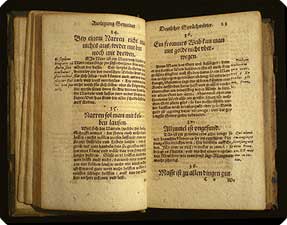 Click the interior images for enlargements.
 All 16th-century editions are scarce. Via NUC, OCLC and RLIN we locate only this copy of this edition (now deaccessioned) and that at Princeton.
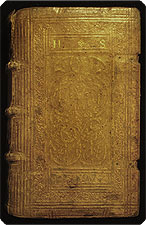
Binding: Contemporary alum-tawed sheep over wooden boards with partially bevelled edges. Elaborately blind-embossed with a roll and a center panel ornament. Front cover with initials “H. S.” and date “1597” in gilt. Rear cover with gilt putti in the areas where initials and the date appear on the front.
Evidence of readership: Marginalia in the prefatory index; very scattered early underscoring.
• VD16 A969; Goedeke, II, 8. Binding as above, lacking clasps and with old paper spine label; ex-library with bookplate and call number in old, faded, white numbering on spine. Title-page browned and tipped in; loss of paper to fore- and bottom margins of same. Some age-toning to paper and several leaves with natural paper flaws, repaired with archival tissue; three other leaves also with natural paper flaws repaired at time of binding or shortly after printing. Approximately 12 leaves with inkstains, sometimes obscuring text. One leaf (178) with a hole costing a significant loss of text. A marginally acceptable copy as regards text, in a good binding.


Reformation Concern about Monasticism Ain Schoner Dialogus wie ain Bawr mit aim Frawe[n] brüder Münch redt[,] das er die Kutten von jm würfft, vnd dem Münch arbayt zügeben, lustbarlich vnd lieblich zu lesen. [Augsburg: Philipp Ulhart d.Ä.], 1525. Small 4to (19 cm; 7.5"). 6 pp.
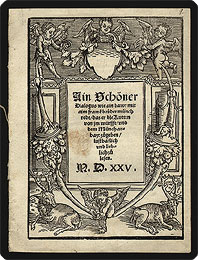 Click the image for an enlargement.
 This edition has a handsome, single-unit woodcut title-border incorporating pillars, stags, vines, and cherubs. The text is in fraktur, of course.
Rare: WorldCat locates only one copy of any edition in the U.S. (at Emory — this edition), while VD16 locates three German copies each for the Augsburg and Würzburg editions and only a microform of the Strassburg printing.
• Kuczynsk 579; VD16 S3433. Removed from a nonce volume. One small area of discoloration on title-page. Very good condition. (25922)
Anti-Anabaptist Althamer, Andreas, attrib. author. Ein kurtze Vntterricht, den Pfarherrn und Predigern: Inn meiner gnedigen Herrn der Marggraffen zu Branndenburg. [et]c. Fürstenthumben un[d] Landen, hieniden in Francken, und auff dem Gebirg verordent, wes sie das Volck wider etliche verfürische Lere, der Widertauffer, an den Feyertägen auff der Canntzel, zum getreülichsten und besten, auss götlicher Schrifft vermanen, und unterrichten sollen. [Nuremberg: Jobst Gutknecht, 1528]. Small 4to (20 cm; 8.75"). [14] ff.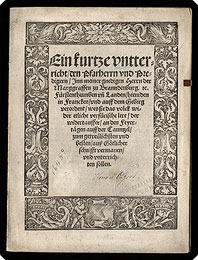 Click the image for an enlargement.
 During the Bern Disputation (1528) Althamer stood and defended the Lutheran doctrine of the Lord's Supper.
This is printed in gothic type and offers a title-page graced by a four-element woodcut border composed of floral, avian, and animal motifs, with putti not forgotten.
Provenance: Ownership signature on title-page of Howard Osgood, noted late 19th- and early 20th-century collector and scholar; old circular pressure-stamp on same page of a seminary (properly released).
WorldCat finds two copies in North America, one of which has been deaccessioned, and COPAC finds two copies in Great Britain, both at the British Library.
• Hillerbrand, Anabaptism,3577; VD16 ZV2334 or ZV2333 or B6972 (all listed without attrib. author). Removed from a nonce volume, provenance indications as above. Light dust-soiling to exterior paper; minor library pencillings and one old inked numeral; limited brown stain in blank area of last leaf, offsetting to previous page opposite. A few instances of marginal notation or textual correction in old ink and an old hand. (25960)
A Classic in Classic Renaissance Form Ariosto, Lodovico. Orlando furioso ... ornato di nuove figure, & allegorie in ciascun canto. Venetia: Gio. Andrea Valuassori detto Guadagnino, 1556. 4to (21.6 cm, 8.5"). [1], 274 (168 & 169 lacking), [19] ff.; illus.
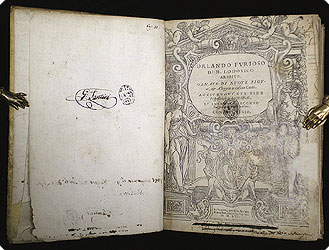
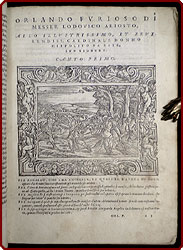 Click the images for enlargements.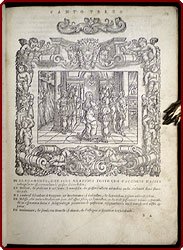
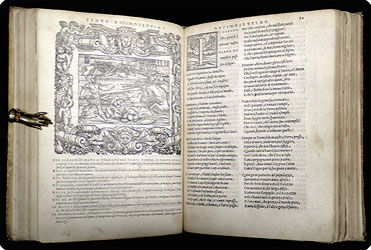
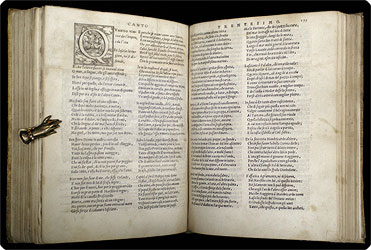
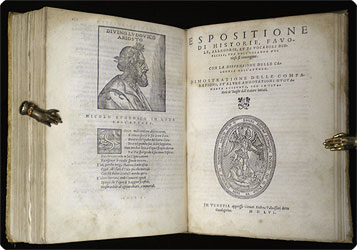
Provenance: Front free endpaper with early inked ownership inscriptions including that of G. Santini; title-page with early inked inscription (lined through) in lower margin and with Santini's small oval rubber-stamp monogram at center; one other page similarly rubber-stamped.
• Brunet, I, 435; Essling, Les livres à figures vénitiens, 115; Graesse, I, 198; Index aurel. 107.474. This ed. not in Adams, not in Mortimer. Sophisticated copy. Contemporary vellum, neatly and unobtrusively rebacked; sides dust-soiled, corners rubbed. Hinges (inside) reinforced; ownership marks as above. Title-page repaired, with small portion of image lacking, inner margin reinforced, and some reinforcements affecting sharpness of image; two leaves supplied from another edition and ff. 168 and 169 lacking; one leaf with upper border portion of image supplied and another with capital and several lines of text hand-inked as described above. Staining and spotting variously, generally light; a few early inked marks of emphasis, and scattered marginalia in Italian. An appealing “book for the busted bibliophile” as a solid volume offering both charm and signifcance and a lowered price. (26560)
A
HandsomeDated
Binding — Initials,
“A.W.” — 1539
Arrianus.
[three lines in Greek, romanized as] Arrianou Peri Alexandrou anabaseōs
historiōn biblia oktō. [then in Latin] Arriani De expeditione sive
Rebus gestis Alexandri Macedonum regis libri octo, nuper & reperti, &
quàm diligentissimè in lucem editi. Historiam quoque eandem, olim
quidem a Bartholomaeo Facio latinitate donatam, nunc vero ... mendis repurgatam,
hic adiungi curavimus ... Basileae: [Robertus Winter, 1539]. 8vo.
Vol. 1 of 2. 13, [1] pp., [321] ff. (lacks last 8 leaves).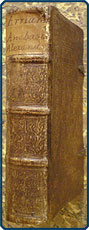
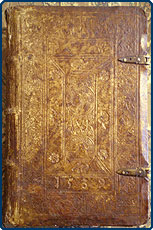
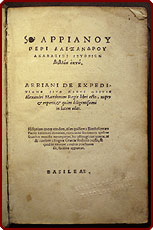 Click the middle and righthand images for enlargement.
 Present here is vol. I containing the original Greek text, the Latin translation
having been printed in a separate volume. Incomplete at the end, it lacks
the final eight leaves or the last part of the Indica (37.3–43.14),
only, with Arrian's Anabasis Alexandrou (Campaigns of Alexander)
appearingcomplete
as Books 1–7.
Binding: Contemporary alum-tawed pigskin over bevelled boards, remnants of the metal closures. Covers elaborately blind-embossed with several rolls and devices. Front cover has in its center panel the initials “A. W.,” the date 1539, and medallions of Manfred of Saxony and Luther, while the rear cover's center panel has medallions of Melanchthon and Erasmus.
• Graesse, I, 227; Legrand, Bibliographie hellénique, III, 388; Adams A2009. Binding toned to a pleasing dark tan. Old bookplate on front pastedown. Front free endpaper torn with loss. Vol. I only, and lacking those final eight leaves; the Anabasis complete. (20418)
Two
Church Fathers —
Two
Scholar PrintersAn
Apparatus by Erasmus
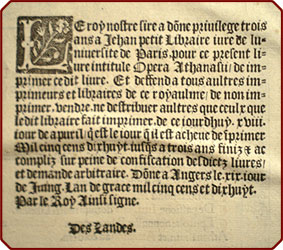
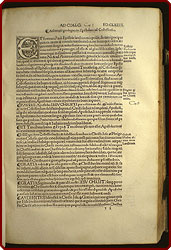
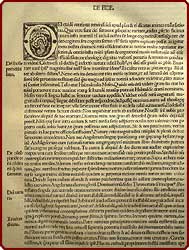
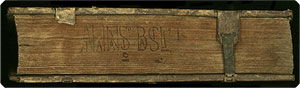
Athanasius, Saint, Patriarch of Alexandria. Athanasii Episcopi Alexandrini sanctissima, eloquentissma que opera ... que omnia olimia[m] latina facta Christophoro Porsena, Ambrosio Monacho, Angelo Politiano, interpretibus, una cum doctissima Erasmi Roterodani ad pium lectorem paraclesi. [bound with another work as below]. Parisiis: Joanne Paruo [i.e., Jean Petit] , [1519]. Folio extra. [6], 255, [66] ff. [bound with] Basil, Saint, Bishop of Caesarea.
Basilii Magni Caesariensium in Cappadocia Antistitis sanctissimi opera plane diuina, variis e locis sedulo collecta: & accuratio[n]e ac impe[n]sis Iodici Badii Asce´sii recognita & coimpressa, quorum index proxima pandetur charta. [Paris: Venundantur eidem Ascensio [i.e., Badius Ascensius, 1520]. Folio extra. [10], 178 ff. 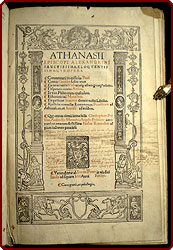
 Click any image where the hand appears on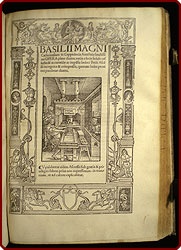
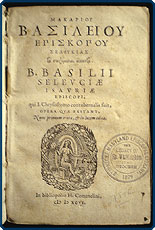
“Opera quae exstant”NOT Basilius Seleucensis. [five lines in Greek, the] B. Basilii
Seleuciae Isauriae Episcopi, qui I. Chrysostomo contubernalis fuit, Opera quae exstant. [Heidelberg]: In bibliopolio H. Commelini, 1596. 8vo (16.5 cm; 6.5"). 8, 408 pp.
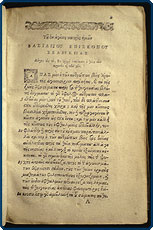 Click the interior images for enlargements.
 Provenance: Early 19th-century armorial bookplate of Robert Chambers; manuscript ownership “Ex libris G.R.W.”— William R. Wittingham, fourth Anglican bishop of Baltimore (a Latinophile who used “Guillelmus” for “William”), dated Sept. 22, 1856; later in the diocesan library of Maryland; deaccessioned 2006.
• VD16 B 727. Contemporary limp vellum with evidence of ties; slightly yapp edges. Occasional light foxing. 19th-century library stamps on the front free endpaper and title-page. A clean solid copy. (24432)
Bede's
Commentary on OLD
Testament Books
Bede,
the Venerable, Saint. Bedae presbyteri Anglosaxonis,
theologi suo aevo celeberrimi, Opus planè nouum. Cui insunt In Samuelem
prophetam, id es Regnorum primum, libri IIII ... En nouam operum Bedae portiunculam
tibi candide lector damus, iamprimu[m] ex vetustissimo corruptissimoq[ue] codice,
qui unicus nobis fuit, typis nostris ea qua potuimus diligentia transformata[m],
quam si probare te senserimus, eiusdem longe maiora, quae penes nos sunt manu
scripta, propediem exhibituri sumus, illis interim felix fruere. Basileae: [colophon:
Per Andr. Cratandrum et Ioan. Bebelium], 1533. Folio (29.5 cm; 11.75"). [4],
195, [1] ff.
OLD
Testament Books
Bede,
the Venerable, Saint. Bedae presbyteri Anglosaxonis,
theologi suo aevo celeberrimi, Opus planè nouum. Cui insunt In Samuelem
prophetam, id es Regnorum primum, libri IIII ... En nouam operum Bedae portiunculam
tibi candide lector damus, iamprimu[m] ex vetustissimo corruptissimoq[ue] codice,
qui unicus nobis fuit, typis nostris ea qua potuimus diligentia transformata[m],
quam si probare te senserimus, eiusdem longe maiora, quae penes nos sunt manu
scripta, propediem exhibituri sumus, illis interim felix fruere. Basileae: [colophon:
Per Andr. Cratandrum et Ioan. Bebelium], 1533. Folio (29.5 cm; 11.75"). [4],
195, [1] ff.
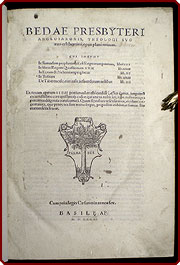
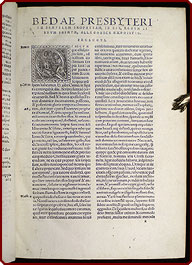
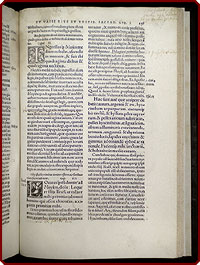 Click the images for enlargements.
 Johannes Bebelius’ printer’s device appears on the title-page and on the verso of the final leaf, while the errata are printed on the verso of leaf 195, just above the colophon.
Evidence of readership: Faded sepia marginalia and/or underlining on folios 154, 155, 156.
WorldCat locates only six copies in U.S. libraries, one of which has been deaccessioned.
• VD16 B3048. Full dark modern calf old style, green leather spine label; spine with raised bands accented with blind rules extending onto covers to terminate in trefoils, and simple blind double fillets to covers; title-page reinforced at inner margin, lightly soiled. Pinhole worming, on most pages in lower margin; occasionally in text touching a letter but not costing text. “Elenchus” leaves with light waterstain to upper outer quadrant; same in inner upper and upper margins of commentary most notable from folios 100 to end, where at times it is brown and into the text of the inner columns. (26539)
 FrenchWoodcut-Illustrated
— Contemporary
Binding
Bible.
Latin. Vulgate. 1513. Biblia cum concordantiis veteris et novi testamenti
necnon et iuris canonici. Lugduni: M. Jacobum Sacon, 1513. Folio (34.5 cm, 13.5").
aa8 bb6 a–z8 A–Q8 R6
AA–BB8 CC10 (-aa1, CC9,10); [13], CCCXVII, [25] ff.
(lacking title-page & last 2 ff. of the Interpretationes).
FrenchWoodcut-Illustrated
— Contemporary
Binding
Bible.
Latin. Vulgate. 1513. Biblia cum concordantiis veteris et novi testamenti
necnon et iuris canonici. Lugduni: M. Jacobum Sacon, 1513. Folio (34.5 cm, 13.5").
aa8 bb6 a–z8 A–Q8 R6
AA–BB8 CC10 (-aa1, CC9,10); [13], CCCXVII, [25] ff.
(lacking title-page & last 2 ff. of the Interpretationes).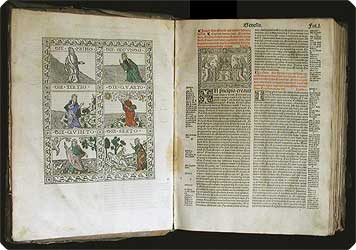
 Click any image where the hand appears on
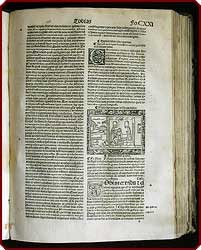
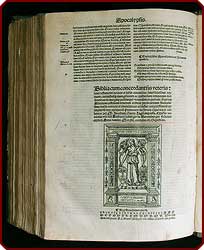
This Bible is illustrated with two full-page and 130 in-text woodcuts (including some repeated images), a few of which have early hand-coloring, mostly but not entirely in green or
yellow. One full-page cut shows the six days of Creation — partially hand-colored in green, brown, red, blue, and yellow — while another depicts the manger scene. The text is followed by the Interpretationes nominum hebraicorum, a dictionary of Hebrew names often appended to manuscript and early printed Bibles.
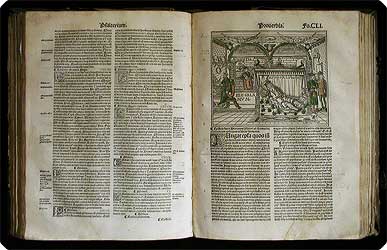
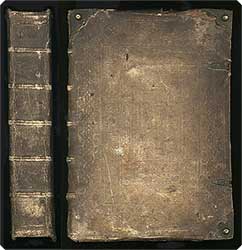
Binding: Contemporary blind-tooled, alum-tawed pigskin over beech boards, elaborately worked using embossing rolls with religious vignettes and busts. Covers with etched metal corner bosses and remnants of leather and metal clasps.
• Adams B988; c.f. Darlow & Moule 6101 & 6091. Binding as above, spine with hand-inked title; overall dust-soiled and darkened with several short tears to leather; leather no longer tight to the boards. Straps, clasp locking-mechanisms, and lower front metal corner now lost. Title-page and final two ff. of Interpretationes lacking; front pastedown separated from board and back pastedown lacking. First and last few leaves with insect damage to outer edges. First text page (contents) with old institutional rubber-stamp and shadow of pencilled numeral. A few leaves separated; a number of leaves with short tears from lower margins, a few extending into text, in many cases with traces of old repairs. Two leaves with lower outer corners torn away, one repaired some time ago. Pages age-toned, some waterstained. Scattered contemporary inked marginalia; some light underlining and a few instances of early inked doodling.  Despite its faults, this is rare and imposing.
Important
Text — Important
BindingAll
Initials HighlightedBible.
Latin. Selections. Peckham. 1514. Diuinarum sententiarum libro[rum] Biblie ad certos titulos redacte collectariu[m], ingenio siquide[m] eruditissimi sacris literis assuetissimi viri ... Joha[n]nis de Pechano ... compilatu[m] ... Parisius: Venales reperiu[n]tur in vico diui Jacobi ad intersignium diui Claudii [Francois Regnault], 1514. Small 8vo (14.5 cm; 5.875"). AA8 BB4 a–z8 [et]8 A–H8 I4 (-AA1); [11 (of 12)], cclxi [i.e., 260] ff. (without the title-leaf).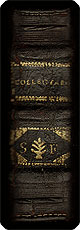
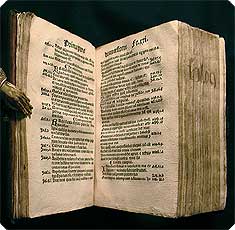 All
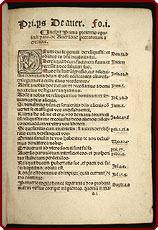
initials are highlighted in red.
All
initials are highlighted in red.
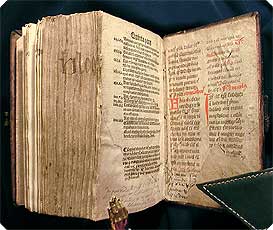
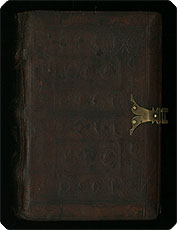
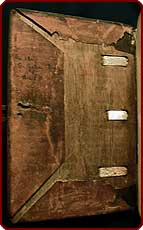 Click the images for enlargements.
  older
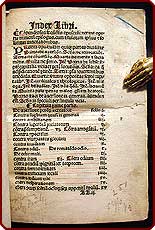
manuscript leaf.
older
manuscript leaf.
Provenance: 17th-century spine label with initials “S.F.” and a tree design between them. Ownership signature of Gordon Duff; Yale University (bookplate) — deaccessioned.
• Edition: Moreau, II, 930; Shaaber, British Authors Printed
Abroad, P57; not in Darlow & Moule. Binding: Fogelmark, Flemish
and Related Panel-Stamped Bindings, plate XXXII R.46 & pp. 48–49.
Volume rebacked and much of old spine reapplied; lacks title-leaf and
last leaf torn across corner with loss replaced of old, colophon partly supplied
in manuscript. Highlights to initials as above; occasional early underlining
or another mark and a later pencilled note on last leaf. Missing leaf and
torn second one notwithstanding (though they do lower the price), this isa
very nice copy in a notable early binding.
A
PRB&M “FEATURED BOOK” —
 An
ILLUSTRATED RENAISSANCELarge
Folio Bible
Bible.
Latin. Vulgate. 1529. Textus Biblie. [colophon: Impressum
autem Lugduni {i.e.,Lyons}: per Joha[n]nem Crespin, M.ccccc.xxix {1529}]. Folio
extra. [18], 268, [17] ff.
An
ILLUSTRATED RENAISSANCELarge
Folio Bible
Bible.
Latin. Vulgate. 1529. Textus Biblie. [colophon: Impressum
autem Lugduni {i.e.,Lyons}: per Joha[n]nem Crespin, M.ccccc.xxix {1529}]. Folio
extra. [18], 268, [17] ff.
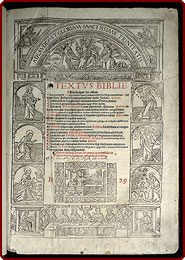
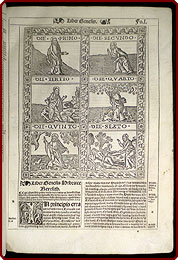
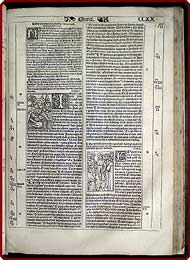 Click the images for enlargement.
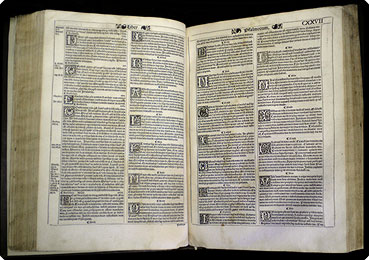
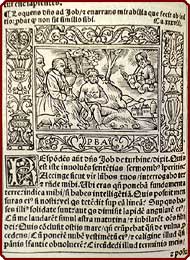
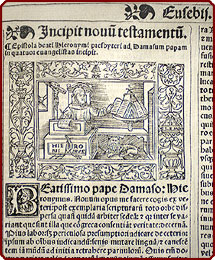
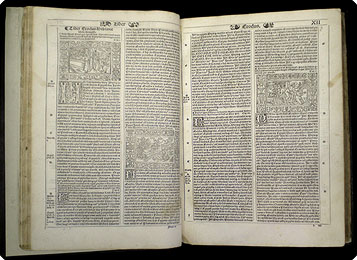
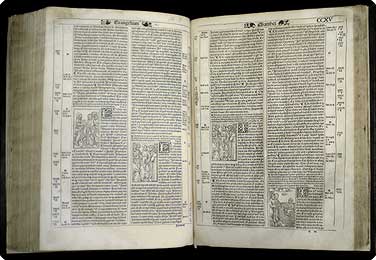 more than 120 woodcuts. The woodcuts of the Old Testament are of good size, measuring approximately 3.8 x 6 cm (1.5" x 2.25") and with their four-element frames each one fills a text column left to right (5.5 x 8.5 cm; 2.25" x 3.25"). The cuts, “with the exception of the Creation, are close copies of those used in Jacques and Jean Mareschal's Lyons Bibles of 1523–1541" (Mortimer). They are also closely related to those used in Sacon's Bibles, which were by Hans Springinklee. The bottom border element on some has the initials “P B A” and the left and right elements of other frames read “Pour” “LEM.” The New Testament illustrations are smaller, 5.5 x 3.5 cm (2.25" x 1.375"), and each fills only half a column left to right.
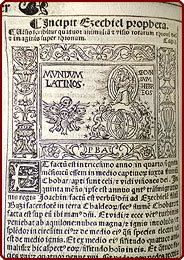
 Genesis opens with a gorgeous six-panel cut that is yet a bit larger, depicting God in His six days of Creation.
Evidence of readership: Scattered throughout are short marginal notes in a late 17th- or early 18th-century continental hand, in Latin, as well as underscoring and marks in the margins of important passages or words or thoughts.
This is the second Crespin edition, the first having appeared in 1527.
• Mortimer, French, 66; Fairfax-Murray, French, 36. Not in Darlow & Moule. Full calf old style: Round spine with gilt-accented raised bands and with title, place, and date gilt-stamped directly on spine; blind rules extending onto covers from each band to terminate in a trefoil, and covers framed in blind double fillets. Title-leaf crinkled; the occasional stain; moderate soil, light old staining, and/or wear variously to upper outer corners, lower gutter corners, and the odd foremargin, with a number of strengthenings to these instances. Marginalia slightly trimmed in 19th century. Library rubber-stamp on lower edges of closed volume; heavy library pencilling to a rear blank; no other such marks. Overall a good and satisfactory copy of a nicely illustrated Renaissance book. (24810)

 An
Early
Bible in GREEK
— Both O.T.
& N.T.
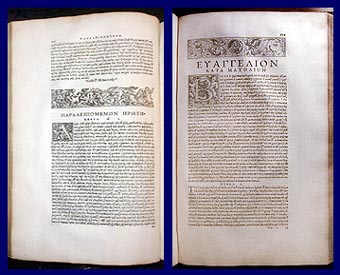
Bible.
Greek. 1545. [three lines in Greek, then] Divinae Scriptvrae, Veteris
ac Novi Testamenti, omnia innumeris locis nunc demum, & optimorum librorum
collatione, & doctorum uirorum opera, multo quàm unquam antea emendatiora,
in lucem edita. Basileae: Per Ioan. Heruagium, 1545. Folio. *4 (-*2,3,4) a–z6A–Z6Aa–Ss6Tt4Vv–Zz6AA–MM6NN4;
969, [1] pp., [3] ff.
An
Early
Bible in GREEK
— Both O.T.
& N.T.
Bible.
Greek. 1545. [three lines in Greek, then] Divinae Scriptvrae, Veteris
ac Novi Testamenti, omnia innumeris locis nunc demum, & optimorum librorum
collatione, & doctorum uirorum opera, multo quàm unquam antea emendatiora,
in lucem edita. Basileae: Per Ioan. Heruagium, 1545. Folio. *4 (-*2,3,4) a–z6A–Z6Aa–Ss6Tt4Vv–Zz6AA–MM6NN4;
969, [1] pp., [3] ff.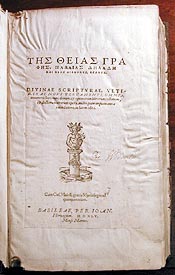
Melanchthon (1497–1560), the great Humanist and Luther's friend and supporter, wrote the preface to this edition. The three leaves bearing that essay are missing from this copy and this may be due to a Catholic or Inquisitorial censor removing them so that the text of the Bible proper could be used by Catholic readers. All of Melanchthon's writings, including introductions, were on the Index Librorum Prohibitorum. The text of the Bible proper, here, is complete.
The text of the O.T. "follows the Aldine Bible of 1518; with variant readings, and restoration of the usual order in Provers and Ecclesiasticus. The Apocrypha are grouped together as in No. 4602 [i.e., the Strassburg edition of 1524–26]. The N.T. text appears to agree with the quarto edition printed at Basel in 1545" (Darlow & Moule). The New Testament just referred to was the sole Greek-only Testament that Froben published and it follows the text of the fourth Greek N.T. of Erasmus, meaning that the N.T. here is also a close reprinting of the Erasmus fourth.
Provenance: Late-17th- / early-18th-century ownership signature of "Pet. Wedderburn; 18th-century bookplate of Lord Eliock; later pencilled signature of "[?].T. Coleridge" (not Samuel Taylor Coleridge; possibly, however, Justice John Coleridge). At back, "Ex dono D. Al: Brown, M.D." and another ownership inscription entirely in Greek.
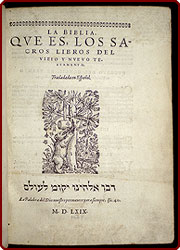
The Bear Bible — The FIRST Complete Bible in Spanish Bible. Spanish. Reina. 1569. La Biblia, que es, los sacros libros del vieio y nueuo testamento. [Basel: Thomas Guarinus for or with Samuel Apiarius], 1569. 4to. [15 of 16] ff., 1438 columns, [1] p., 544, 508 columns, [1] p., [1] f. (without the 3 leaves of “Annotationes” and the final blank); illus.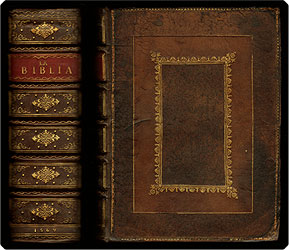
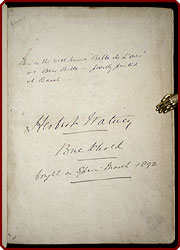
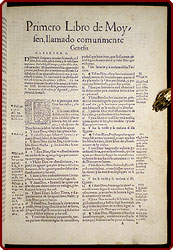
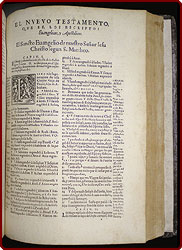
 Click the images for enlargements.
 Rather, the production of a Bible in Spanish fell to a peripatetic exiled Spaniard named Casiodoro de Reina (ca. 1520–94), a man who began his adult life as a monk, came under suspicion of being a “Reformist,” and fled Spain for Geneva — later fleeing that city for a series of others and declaring it “a new Rome” for its intolerance of new ideas. Whether the translation is solely from his pen or is the work of a committee in which he was primus inter pares is not known.
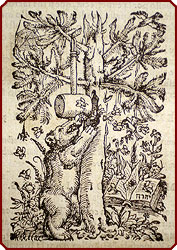
This Bible is known as the “Bible of the Bear” or the “Bear Bible” because of the printer's device on the title-page, a bear at a honey comb, which was the device of Samuel Apiarius. The relationship between Apiarius and the actual printer, Thomas Guarinus, is unresolved. The Old Testament in this translation is based on the Hebrew and derived heavily from the Latin of St. Pagninus and from the Ferrara version. The New Testament is based on the Greek of Erasmus with comparisons to the Vetus Latina and Syriac manuscripts.
There are two states of the title-page, this being state A with the line of type ornaments described in Darlow and Moule.
• VD16 B2869; Rumball-Petre262; Darlow & Moule 8472; Graesse, I, 386; Palau 2894; Adams B12061. 17th-century English calf, rebacked with new spine gilt extra very suitable in style; leather of covers a bit crackled and variously darkened; small areas of the covers at board edges replaced with new leather sympathetically gilt-tooled. Lacks the blank preliminary leaf and the four leaves at the end of “Annotationes breves sobre los lugares . . . “, both of which are very often lacking, the latter leaves having perhaps (even probably) been printed separately and later. Small piece of front fly-leaf cut away (probably removing an ownership inscription). The occasional instance of light soil or light waterstaining to fore- or bottom margins, sometimes reaching text; a generally clean and good copy. All edges mottled red and blue-green. (25772)
FIRSTLATIN BIBLE Printed in England Bible. Latin. 1580. Tremellius–Junius. Testamenti veteris Biblia Sacra sive libri canonici, priscae Iudaeorum Ecclesiae a Deo traditi, Latini recens ex Hebraeo facti, brevibusque scholiis illustrati ab Immanuele Tremellio & Francisco Iunio.... Londini: Henricus Middletonus, impensis G.B., 1579–80. 4to (21.6 cm, 8.5"). [16], 219, [1], 299, [1], 251, [1], 390, [2], 192 (some pp. bound in out of order), [4], 194, [2] pp.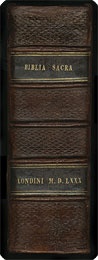
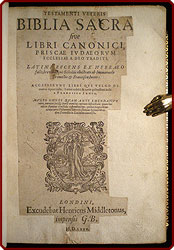
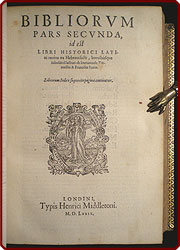
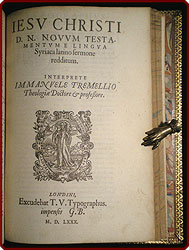 Click the interior images for enlargements.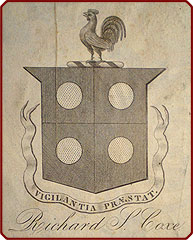
The Old Testament, Apocrypha, and New Testament are here in six parts, each
with separate title-page bearing an engraved vignette and each section including
engraved head- and tailpieces in addition to decorative capitals. The publication
information in some sections gives “Impensis G.B.” (George Bishop),
as opposed to “C.B.” (Christopher Barker) or “I.H.”
(Harrison), in whose names other variants were issued.
Provenance: Front pastedown with armorial bookplate of prominent attorney Richard S. Coxe, of whom it was once said that “he was employed in more cases upon the docket of the Supreme Court of the United States than any other lawyer in the country” (Dictionary of American Biography); front free endpaper with affixed handwritten description of the volume by Coxe; front fly-leaf with inked presentation inscription by Coxe, dated 1859.
• ESTC S121318; STC (2nd ed.) 2056.4; Rumball-Petre 240; Darlow & Moule 6166. On Coxe, see: DAB, IV, 487–88. 19th-century calf, covers framed and diced in blind with spine also blind-diced, but smaller, and bearing gilt-stamped leather title, place, and date labels; rebacked with old spine laid on, and joints strengthened. Edges and extremities lightly rubbed, spine leather with a few small cracks. Front pastedown with private bookplate as above and smaller institutional bookplate. Title-page text excised from original leaf and mounted, some time ago; outer margin of last page excised and leaf mounted. One early inked textual annotation. First few leaves with small area of worming in lower margins; one leaf with short tear from lower margin, extending into text without loss. Pages age-toned, with scattered light spotting throughout and instances of faint waterstaining; upper edges trimmed closely, occasionally affecting pagination or headers. Turn-ins with gilt roll; all edges marbled to match endpapers. (24877)
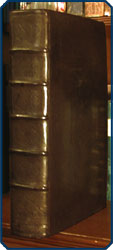
The Hebrew & Greek Volume of PLANTIN’S POLYGLOTBible.
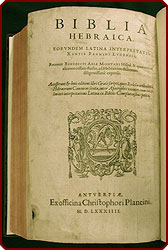
Greek & Hebrew. 1584. Biblia Hebraica & Novum Testamentum Graecum. Antuerpiae: Ex officina Christophori Plantini, 1584. Tall folio (35 cm, 13.9").
¶4 A–Z4 π1 Aa–Qq4, †4 ††6 A–O6 P8
a–x6 y8 z8 aa–gg6 AA–RR6; [viii], 186, 128, [xx], 283, [1], 203, [1] pp.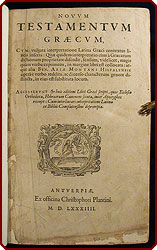
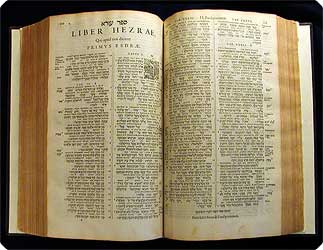
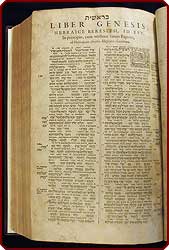
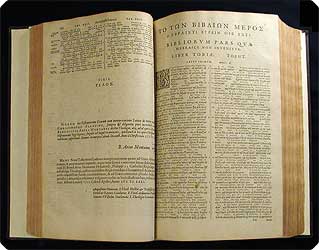
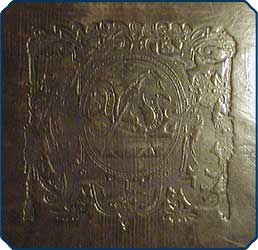
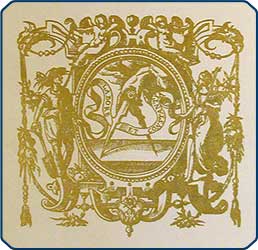
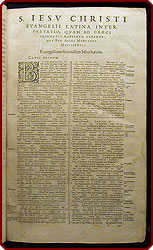 Click the images for enlargements.
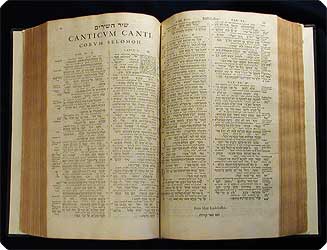
the Royal Antwerp Polyglot. It is comprised of two parts in one volume, edited by B. Arias Montanus: A “complete
Bible in the original languages, with an interlinear Latin translation; the whole reprinted from the Antwerp Polyglot. The Hebrew O.T. starts at the end of the volume, and the Greek N.T. at the beginning, followed by the Greek Apocrypha; each of the two parts has its own separate title” (Darlow and Moule).
Click the images for enlargements.
the Royal Antwerp Polyglot. It is comprised of two parts in one volume, edited by B. Arias Montanus: A “complete
Bible in the original languages, with an interlinear Latin translation; the whole reprinted from the Antwerp Polyglot. The Hebrew O.T. starts at the end of the volume, and the Greek N.T. at the beginning, followed by the Greek Apocrypha; each of the two parts has its own separate title” (Darlow and Moule).
 Front
pastedown with large, gilt-stamped version of the covers' blind Plantin device.
Both title-pages neatly backed and with marginal restoration. Lacks one blank
between New Testament sections (only). One instance of early underlining. One
leaf with tear from lower margin, not touching text. All edges stained red,
with white splotches to top and bottom ones. Overall, a very clean and well
margined copy, solid for use in an appropriate binding.
Front
pastedown with large, gilt-stamped version of the covers' blind Plantin device.
Both title-pages neatly backed and with marginal restoration. Lacks one blank
between New Testament sections (only). One instance of early underlining. One
leaf with tear from lower margin, not touching text. All edges stained red,
with white splotches to top and bottom ones. Overall, a very clean and well
margined copy, solid for use in an appropriate binding.
 For
more BIBLES, TESTAMENTS,
For
more BIBLES, TESTAMENTS,


A Man Scorned? Or One Satirizing a Genre? Boccaccio, Giovanni. Laberinto d'amore. Con una epistola a messer Pino de Rossi confortatoria del medesimo autore e di nuovo corretto. [colophon: Vinegia: per Pietro di Nicolini da Sabio, 1536]. Small 8vo (15.5 cm; 6"). 72 ff.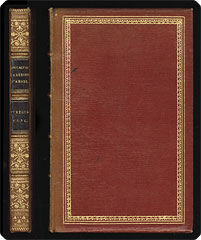
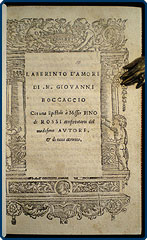
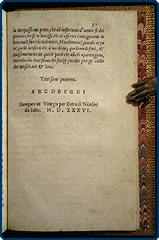 Click the interior images for enlargements.
 The work is now generally better known under the title Il Corbaccio, although all editions use the title found here. As one would expect with a Venetian-printed Renaissance work of literature, the text is in italic type; and this was printed early enough in the 16th century that the title-page offers a charming four-element architectural woodcut border.
Binding: Finely bound in 19th-century English straight-grained red morocco, with ornamental gilt border to covers, gilt-extra panelled spine, and two black leather spine labels. Board edges with a gilt roll; complex gilt inner dentelles and marbled endpapers. All edges gilt.
• Graesse, Trésor de Livres rares, I, 455; Brunet, I, 1016.; Index Aurel. 120.267. Not in Adams. Bound as above; spine lightly faded and front cover with two small spots. Some small, light stains in text (only); generally, a very good copy. (25054)
EarlyReformation
Macaronic
SatireBorsius, Marcus, attrib. author. Ex obscuroru[m] virorum salibus cribrat[us] dialogus no[m]minus eruditionis qua[m] macaronices amplectens. No place [Germany?]: No publisher/printer, no date [1520]. Small 8vo (13.5 cm; 5.25"). [20] ff. (last blank).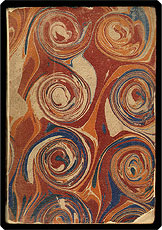
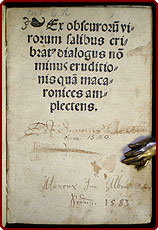
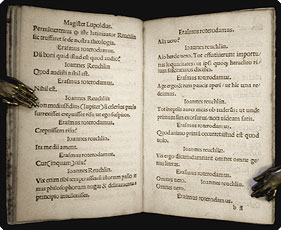
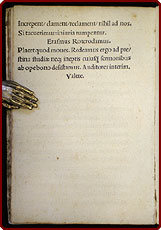 Click the images for enlargements.
 This edition is not in VD16 and only one copy is located via WorldCat. COPAC records are too abbreviated to determine if any library owns a copy.
Provenance: Two 16th-century ownership signatures on title-page: Simon Albach, undated, and Marcus Albinastes, 1583.
• This edition not in VD16; not in Index Aurel. Mid-20th-century marbled paper wrappers; old library bookplate. Title-page and a few margins with finger oil or other stains; on endpaper opposite title-page in a very old hand, “Very rare.” Else, a very good copy. (25773)
On Peace & Philosophy During theReformation Breton, Robert. Roberti Britanni Attrebatensis Orationes duae, Burdegalae quondam ab eodem habitae, altera de pace, altera de philosophia. Parisiis: Ex officina Christiani Wecheli, 1538. Small 8vo. [24] ff.
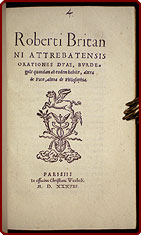
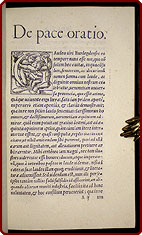 Click the interior images for enlargements.
 Rare: Searches of WorldCat and COPAC fail to locate any copies in libraries in the Anglo world.
• Full dark modern calf old style, absolutely plain without labels; spine with raised bands accented with blind rules extending onto covers to terminate in trefoils, and simple blind double fillets to covers. One old numeral inked to title-page; text unmarked with paper clean and even bright, throughout. (25746)

 TO Part
II .
. . TO Part
II .
. . |