 16TH-CENTURY BOOKS
[ENCOMPASSING THE REFORMATIONS]
16TH-CENTURY BOOKS
 Royal
Household Affairs
Royal
Household Affairs  Partial
Payment for
Her Majesty's
Partial
Payment for
Her Majesty's Tapestry
 Isabel
I, Queen of Spain.
Document on paper, in Spanish, signed "Yo la Reyna." Granada,
8 May 1501. Folio (31.2 cm, 12.25"). [1] p.
Isabel
I, Queen of Spain.
Document on paper, in Spanish, signed "Yo la Reyna." Granada,
8 May 1501. Folio (31.2 cm, 12.25"). [1] p.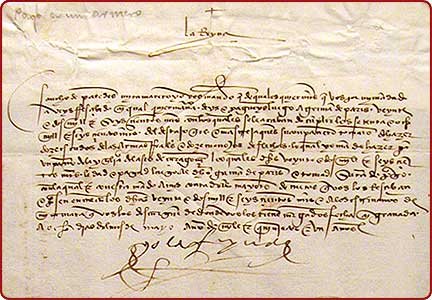
On the bottom half is a signed receipt, in Spanish, dated Granada 8 May 1501, wherein Germán de Paris and Jacques acknowledge receiving the above mentioned payment.
• The usual slash of cancellation (faintly visible above), indicating that this has been entered into the account books. Remnant of stiff paper at top of verso indicating it was once mounted in an album.
 For
our MSS in SPANISH, click here.
For
our MSS in SPANISH, click here.
 This
also appears in the HISPANIC
This
also appears in the HISPANIC

 H.
Estienne's FinalFOLIO
Text
H.
Estienne's FinalFOLIO
Text Greek, Latin, & Impressive
Isocrates. [two
lines in Greek, then] Isocratis Orationes et epistolae cvm Latina interpretatione
Hier. VVolfij, ab ipso postremùm regognita. Henr. Steph. in Isocratem
Diatribæ VII: quarum van obseruationes Harpocrationis in eundem examinat.
Gorgiae et Aristidis quædam, eiusdem cum Isocraticis argumenti. Guil. Cantero
interprete. [Geneva]: Excudebat Henricus Stephanus, 1593. Folio. [fleuron]4*6**4a–z6aa–mm6nn4;
Aa–Ll6; A–C6D4; a
–d
4a.4b.6 (-b.6, blank); [14] ff., 427, [1 (blank)],
131, [1 (blank)], xxxiiii pp., [1 (blank)], [4] ff., 31, [1 (blank)] pp., [9]
ff. (without the final blank).
Greek, Latin, & Impressive
Isocrates. [two
lines in Greek, then] Isocratis Orationes et epistolae cvm Latina interpretatione
Hier. VVolfij, ab ipso postremùm regognita. Henr. Steph. in Isocratem
Diatribæ VII: quarum van obseruationes Harpocrationis in eundem examinat.
Gorgiae et Aristidis quædam, eiusdem cum Isocraticis argumenti. Guil. Cantero
interprete. [Geneva]: Excudebat Henricus Stephanus, 1593. Folio. [fleuron]4*6**4a–z6aa–mm6nn4;
Aa–Ll6; A–C6D4; a
–d
4a.4b.6 (-b.6, blank); [14] ff., 427, [1 (blank)],
131, [1 (blank)], xxxiiii pp., [1 (blank)], [4] ff., 31, [1 (blank)] pp., [9]
ff. (without the final blank).
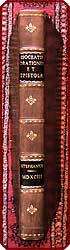
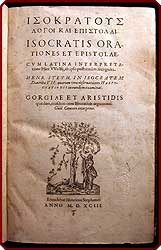

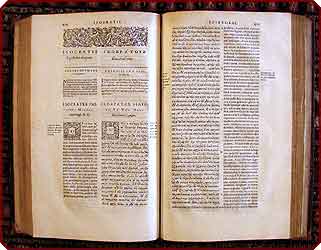
The texts of the orations and "letters" of the great Athenian orator (436–338 B.C.) are printed in double-column format, with the Greek presented in exquisite Greek type in the inner columns and the Latin translation in roman type in the outer ones. A version of the famous Estienne printer's device graces the title-page.
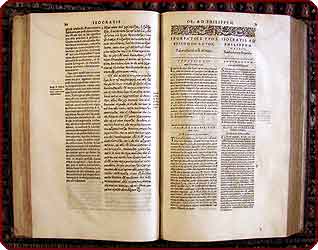
 Single-click either double-page image for an enlargement.
• Adams O219; Renouard (2nd ed.), Annales de l'imprimerie des Estienne, 155.1; Schreiber, Estienne, 225; Schweiger, Handbuch der classischen Bibliographie, I:181; Dibdin (4th ed.), An Introduction to . . . Greek and Latin Classics, II:126. 18th-century plain calf, recently rebacked; round spine, raised bands accented with gilt ruling. Gilt-tooled center devices in spine compartments. Two gilt-lettered spine labels. Title-page dust-soiled; a library's blind pressure-stamps; properly deaccessioned with no additional stamps.  A covetable exemplar.

Contentious Counterpoint — Contemporary Binding Jewel, John. A defence of the apologie of the Churche of Englande conteininge an answeare to a certaine booke lately set foorthe by M. Hardinge, and entituled, A confutation of &c. London: Henry Wykes, 1567. Folio (30.9 cm, 12.1"). [24], 742, [6] pp. (title-page in facsim., pp. 675/76 lacking; pagination erratic).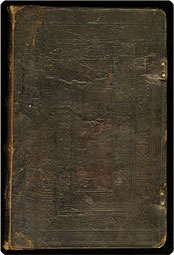
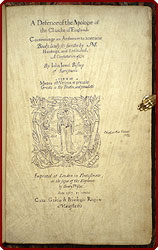
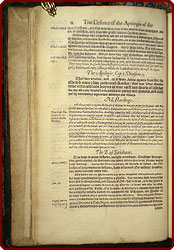
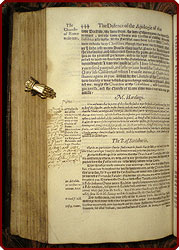 Click the interior images for enlargements.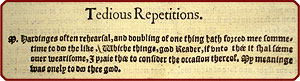
Binding: Contemporary calf over heavy boards, panelled and framed in blind with floral, geometric, and armorial blind-tooling within panels; a pencilled note on the front free endpaper says, “Richardson binding.” There once were clasps, now lost.
Provenance: Title-page with small inked inscription, dated 1836, of Charles Nice Davies (1794–1842), a Welsh linguist, librarian at the Congregational Library, and divinity tutor at Brecon College.
• STC (2nd ed.) 14600.5; ESTC S112182. Bound as above, rebacked preserving original spine; leather cracked, edges and extremities rubbed, clasps now lost, hinges (inside) reinforced some time ago. Institutionally rubber-stamped on lower closed page edges, front pastedown, and first contents page. Title-page provided in early pen and ink facsimile, with inscription as above; last text page with commentary on the book's age, dated 1724 and 1913. Early inked underlining and marks of emphasis throughout; occasional marginalia, two pages dealing with women and the Church having extensive annotations. Pp. 675/76 lacking. One leaf with tear from upper margin extending into three lines of text, without loss; one leaf with large chip from lower margin, not affecting text. Scattered spots of staining only — a clean, strong volume. (24511)

Grynaeus's Edition — Three Maps Justinus, Marcus Junianus; & Pompeius Trogus. Justini ex Trogo Pompeio historia diligentissime nunc quidem supra omnes omnium hactenus aeditiones recognita, et ab innumeris mendis - vetusti exemplaris beneficio purgata. Huic accessit commentariolus. Basilae: apud Michaelem Isingrinium, 1539. Small 4to. [16] ff., 319, [1 (blank)] pp.
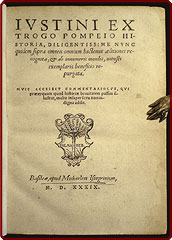
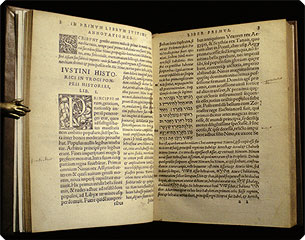 Click the interior images for enlargements.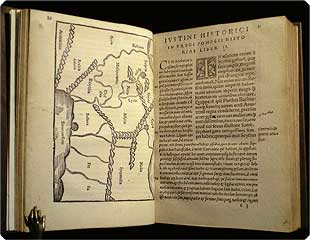
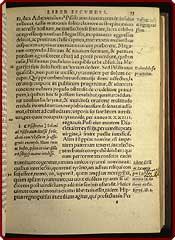
This copy has interesting, early, but now somewhat faded marginalia in a red or sepia ink. The marginalia is scattered and is at times heavy, other times light; in some sections, it is non-existent.
A rare edition: No copy traced via OCLC; VD16 locates only three copies in Europe.
• VD16 T2056. Full rich brown calf old style: Round spine with raised bands, accented in gilt rule; author and title lettered on cream-colored spine label; fillets in blind extending onto covers from each band to terminate in trefoils with blind double fillets beyond. Small rent in upper inner area of title-page with a very old and good repair on verso. Library name stamped on lower edge of closed book. (24808)

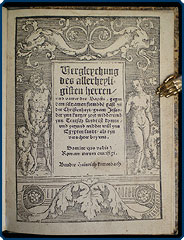
“A Bitingly SARCASTIC Portrayal of thePAPACY” Kettenbach, Heinrich von. Vergleychung des allerheyligisten herren, und vatter des Bapsts, gegen dem seltzamen frembden gast, in der Christenheyt, gnant Jesus, der in kurtzer zeyt widerumb in Teutschlandt ist komen, und yetzund wider will in Egiptenlandt als eyn verachter bey unns. [Wittenberg?: Nickel Schirlentz?, 1523]. Small 4to (19 cm; 7.5"). [12] ff.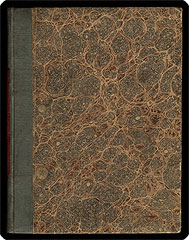
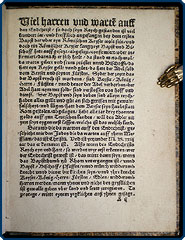 Click the images for enlargements.
 Title-page with a woodcut single-element border featuring a bearded near-naked man with a child and a naked woman opposite with a child; Adam and Eve, with Cain and Abel?
This is the issue without the colophon.
WorldCat locates only two copies of any edition in North America and COPAC finds one copy of this edition in Great Britain.
• VD16 K835(?) or K836(?); Schrodt & Vogelstein 149–50; Köhler 2039. 20th-century quarter green cloth with marbled paper sides; crescent of light waterstaining to foremargin of nearly all leaves. Blank leaf at end with later 16th-century writing in German; same leaf with damage from a liquid spill causing a hole piercing earlier leaves also, affecting perhaps four letters; these leaves show the stain from the spill in graded degrees from “notable” to “faint.” (25962)
 His Works & More — A Cut of aScholar ReadingLactantius. Lepida Lactantii Firmiani opera accurate graeco adiuncto castigata: Eiusde[m] Nephytomon: Carmina de Phoenice. & Christi resurrectione. Io. Chry. De eucharistia sermo. Lau. Vall. sermo. Phil. ad Theo. adhortatio. [colophon: Parisiis: Pro Ioha{n}ne Petit fidelissimo bibliopola in Bellouisu, Impressi anno Domini. M.cccccix {1509}]. 4to (19.5 cm; 7.5"). A6 B4 a–z8,4 2A4 2B8 C–N4,8 O6 P4; [10], ccxxxv, [1] ff.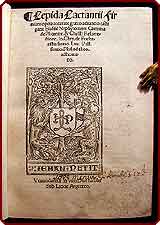
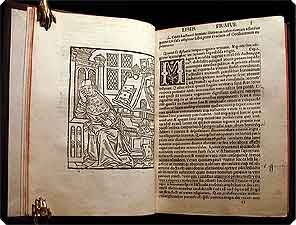 Click either image above for enlargement.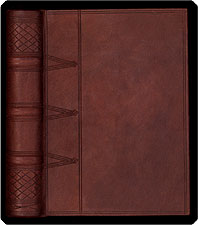
 A 16th-century reader has added a significant amount of marginal commentary on the text.
• Moreau 1509:127; Panzer, VIII, 537, no. 324; Adams L13. Not in Schweiger. Recent calf old style, tooled in blind on spine and covers. Faint traces of water and resultant mild arrested mildew in lower outer corners of earliest few pages. Marginalia in some parts affected by a binder’s trimming; in other cases, not. All edges carmine. A very good copy.
This Author Covers a Lot HereLindanus, Guilelmus Damasus. In hoc libello contenta: Tabulae grassantium passim haeresen anasceuasticae ... Quibus Subtexitur sectae Lutheranae trimembris epitome. Antuerpiae: Apud Joannem Withagium, 1562. Small 8vo. [46], 26 ff.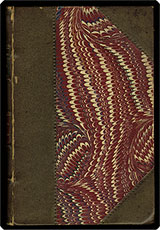
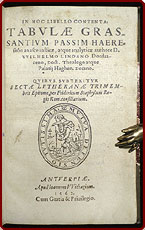
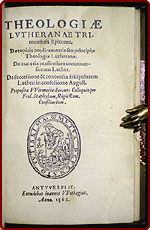
Rare in the U.S., withWorldCat locating only one copy in America (this at Notre Dame).
• Adams 728. 19th-century half-calf with marbled paper sides; leather (only) cracked at hinges, with volume holding quite sound. Library bookplate but no other markings. (19937)

Cortés Malinche & Montezuma López de Gómara, Francisco. Historia, di Don Ferdinando Cortes, marchese della Valle, capitano varlorosissimo. In Venetia: per Giouanni Bonadio, 1564. 8vo. [8], 354 of 356 ff. (lacking fol. 1 and final blank).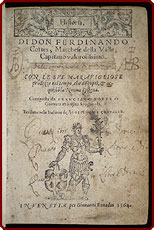
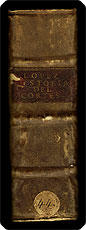
The Historia general de las Indias (first published in 1552) is divided into two parts which stand on their own although clearly written as two parts of a whole. Part I is a history of events concerning the discovery and conquests of the New World exclusive of those involving Cortés. Part II is entirely dedicated to the telling of Cortés's role in the conquest of Mexico and subsequent discoveries.
Click the images for enlargements. In this Italian translation from the pen of Agostino di Cravaliz, López's “all-Cortés” volume stands as part III of the three-volume Historia, delle nuove Indie Occidentali, with parts I and II being translations of Cieza de Leon's Historia, over Cronica del gran regno del Peru and the previously mentioned part I of Gómara's Historia general de las Indias.
The text here is printed in italic type except the capitals, which are roman. The title-page is printed in roman and italic and has the woodcut printer's device.
• Alden & Landis 564/25; Sabin 27741; Medina, BHA, 159n; Wagner, Spanish Southwest, 2v. 18th-century vellum over paste boards, soiled and a bit rubbed; red leather spine label, with a chip, and an old circular paper shelf-label. Title-page dust-soiled, mounted; small, narrow, oblong portion of blank area of title-page excised and filled in at an early time. Lacks folio 1 and final blank. Top margins closely trimmed, sometimes costing the running heads and folio numbers. (25767)
Parasites in Apotheosis Lucianus, Samosatensis. [three lines in Greek characters transliterated as] Loukianou Peri Parasitou, etoi hoti techne he parasitike, [then in roman characters] Luciani parasitus, ubi artem ese parasiticam astruit. Parisiis: Ex officina Christiani Wecheli, 1536. Small 8vo. [20] ff.
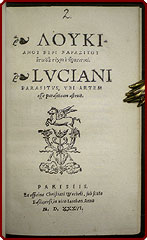
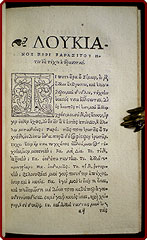 Click the interior images for enlargements.
 Text entirely in elegant Greek and with but one woodcut initial. The printer's device of a Pegasus is on the title-page.
Rare: We find no copy in WorldCat or COPAC. Moreau locates one copy in the Anglo world, at the Morgan Library.
• Moreau, V, 228. Full dark modern calf old style, absolutely plain without labels; spine with raised bands accented with blind rules extending onto covers to terminate in trefoils, and simple blind double fillets to covers. One old numeral inked to title-page; text unmarked with paper clean and even bright, throughout. (25728)

 King-Killing
is
King-Killing
is NOT
to Be Indulged
In
[Masson, Jean Papire]. Ad Franc. Hotomani
Franco-galliam Antonii Matharelli...responsio. Lutetiæ: Ex off. Federici
Morelli, 1575. 8vo. A–L8; 163, [1] pp., [6] ff.
NOT
to Be Indulged
In
[Masson, Jean Papire]. Ad Franc. Hotomani
Franco-galliam Antonii Matharelli...responsio. Lutetiæ: Ex off. Federici
Morelli, 1575. 8vo. A–L8; 163, [1] pp., [6] ff. 

Provenance: Charles Spencer, Third Earl of Sunderland, lot 6554 in the Sunderland Library sale (1882).
• Adams M866. 17th-century sprinkled calf, plain sides, round spine, raised bands, gilt spine extra. Leather worn. Old dust-stain on title-page. A library's blind pressure-stamps; properly deaccessioned with no additional stamps. Speckled edges. A very good copy.

Sole Aldine Edition Mela, Pomponius. Pomponivs Mela. Ivlivs Solinvs. Itinerarivm Antonini Avg. Vibivs Seqvester. P. Victor de regionibus urbis Romae. Dionysius Afer de situ orbis Prisciano interprete. [colophon: Venetiis: In aedibvs Aldi, et Andreae soceri mense, M.D. XVIII {1518}]. 8vo (16.5 cm; 6.5"). 233, [1] ff., without the final two leaves (one blank, one with Aldine device).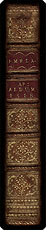
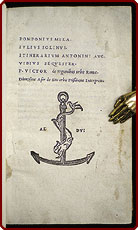
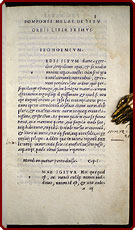
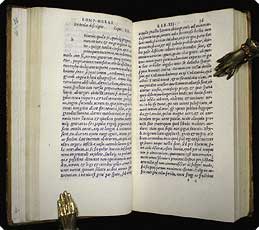 Click the images for enlargements.
 The sole Aldine edition of these works, it is also the editio princeps of Publius Victor, the second edition of Antoninus Augustus' Itinerarium, and the third edition of Dionysius in Latin.
As is to be expected, the text is in italic with spaces and guide letters provided for (unaccomplished) initials.
The register (leaf G2 recto) lists a gathering *4 that is not found here or in any known copy, so the reference would seem to be incorrect.
Binding: 18th-century English sprinkled tan calf, gilt spine extra and board edges gilt-tooled.
• Renouard, Alde, 83; Adams M1053; Schweiger, II, 607 (“seltene Ausg.”). Bound as above, small darkened spot near top of spine; joints starting to open but covers still nicely attached; without the final two leaves (one blank, one with Aldine device). Bookplate. Title-page holed at gutter, not nearing device; light waterstaining and a bit of dust-soiling to first and last leaves. Interior otherwise clean, even bright. (25876)
ALLYou Ever Wanted to Know aboutthe PSALMS Musculus, Wolfgang. In sacrosanctum Dauidis Psalterium commentarii, in quibus et reliqua Catholicae religionis nostre capita passim, non praetermissis orthodoxorum etiam Patrum sententiis, ita tractantur, ut Christianus lector nihil desiderare amplius possit. Basileae: [colophon: Per Ioannem Heruagium, 1551]. Folio (33 cm; 13"). [6] ff., 1702 (i.e., 1694 ) pp., [1 (blank)], [45] ff. (lacks final blank).


 Click the images for enlargements.
 The texts of the psalms are given in Latin, as is the commentary and explication. As one will surmise from the size of this work, the commentary and explications are much, much more extensive than the psalms themselves!
The text is printed in roman, single-column format, with phrases and passages in Greek and Hebrew in those typefaces. Each psalm begins with a four-line woodcut historiated initial; and the typographer's lay-out and execution are both workmanlike and handsome.
Provenance: 19th-century booklabel of collector W. Jackson.
• VD 16 ZV 1677. 19th-century vellum, later recased in that binding and hinges (inside) strengthened with cloth; soiled. Pin-hole type worming at front and rear of volume, in-text and touching but only rarely costing a letter, never impairing ability to read and understand; light waterstaining in some lower margins or across corners. A very few old marginal notes or corrections. (25943)
 Marriage Law from aNoted
Mysogynist . . . Nevizzano, Giovanni. Sylvae nuptialis libri sex: In quibus ex dictis moder. materia matrimonii, dotium, filiationis, adulterii, originis, successionis & monitorialium plenissimè discutitur: vnà cum remediis ad sedandum factiones Guelphorum & Giebelinorum. Item modus iudicandi & exequendi iussa principum. Ad haec, de authoritatibus
doctorum, priuilegiisque miserabilium personarum. Quae omnia ex quaestione, an nubendum sit, vel non, desumpta sunt. [Geneva?]: Ioannes Lertotius, 1592. 8vo. [32], 601, [5], pp.
Marriage Law from aNoted
Mysogynist . . . Nevizzano, Giovanni. Sylvae nuptialis libri sex: In quibus ex dictis moder. materia matrimonii, dotium, filiationis, adulterii, originis, successionis & monitorialium plenissimè discutitur: vnà cum remediis ad sedandum factiones Guelphorum & Giebelinorum. Item modus iudicandi & exequendi iussa principum. Ad haec, de authoritatibus
doctorum, priuilegiisque miserabilium personarum. Quae omnia ex quaestione, an nubendum sit, vel non, desumpta sunt. [Geneva?]: Ioannes Lertotius, 1592. 8vo. [32], 601, [5], pp.


Click the interior image for enlargement. • Not in Adams. Contemporary vellum with yapp edges and remnants of ties, spine with inked title: spots of staining, light soiling, and (on spine) traces of a paper label. Lightly age-toned with occasional light soiling. Early inked notations on front pastedown and title-page. Inked call number on title-page. (11869)
An
Edition that HasEscaped
the Bibliographers?
Nicolaus, de Plove (a.k.a. Nicolaus de Blony). TRactatus [sic] sacerdotalis d[e] sacrame[n]tis: de[que] diuinis officiis et eoru[m] administrato[n]ibus. [Strassburg: Johann Knobloch, 1502–8?]. Small 4to (19 cm; 7.5"). A8C–D4D8F–K4L–M8N–R4S8T6 (-T5); [97 (of 98)] ff. (without the “tabula”).


 Click the images for enlargements.
 The text is complete but it is clear that the next to the last leaf is missing: It would contain the “Tabula” and possibly the colophon. The final blank is present.
Nicolaus's text is printed in double-column format in gothic, black-letter type, with guide letters but the initials unaccomplished.
Evidence of readership: Marginalia throughout; a small area at the beginning of four lines on A6v with early reader's inking over of the lightly printed letters (in a near perfect approximation of the gothic type).
Provenance: Ownership signature of “G. Lunndro, Woodmansey, 1852”; bookplate of Madison University; later bookplate of Colgate University (i.e., Madison changed names in 1890); later transferred to Colgate Rochester Divinity School. Deaccessioned.
• Not in VD16; not in Adams. 19th-century plain boards. Ex-library with bookplates of two different institutions; pressure-stamp on title- and other leaves; five-digit acquisition number stamped in lower margin of first leaf of the prologue; residue of a charge pocket on rear pastedown and ink transfer to rear free endpaper. (26026)
Osiander’s
Grund und Ursache
— RADICAL
Lutheranism, 1524
[Osiander, Andreas]. Grundt vnd Vrsach...wie vnd warumb...die...Pröbst zu Nüremberg die Misspreüch bey der heiligen Mess...abgestelt vnterlassen vnd geendert haben. Nüremberg: [Gedruckt durch Hanz Hergott], 1524. 8vo (15 cm, 6"). A8 (A6, blank; -A7–8) B–F8 χ2 (=A7–8; χ2, blank); [5], [1 (blank)], [41], [1 (blank)] ff.
 “put an end to the Mass.” Written early in his career, this pamphlet appears to have made Osiander’s reputation as a prominent Lutheran reformer. This is the rarer of two 1524 editions (we were able to trace only one copy in the U.S.), and it is listed by VD16 as the first. The other was printed in October of the same year by Hieronymus Höltzel, also of Nuremberg. More were printed the following year in Wittemberg, Leipzig, Augsburg, Zwickau, Erfurt, and later in Königsburg (ca. 1526) and Magdeburg (1545). This edition is printed in schwabacher with the title within a woodcut architectural border; a woodcut historiated initial is used twice.
• Not in Adams. VD16 O1015; Soltész, Catalogus librorum sedecimo saeculo . . . in Bibliotheca Nationali Hungariae . . . , O176; Seebass, Bibliographia Oseandrica, 5.2. On Osiander, see: Oxford Dictionary of the Christian Church 1014–15. Modern speckled paper wrappers. 19th-century elegant private library stamp, paper label with inked short title and remnants of another on title-page, small leather tab on the outer edge of leaf. A little tattering to title-page and top edge of F1 bumped; internally generally clean. Inked marginalia in an early hand: in German on the title- and last (blank) page and elsewhere in Latin, some letters shaved by the binder in a few places.
Comedias Parabosco, Girolamo. L’hermafrodito. Comedia... di nuovo ricorretta e ristampata. Vinegia: Gabriel Giolito de’Ferrari, 1560. (13.5 cm, 5.25"). 48 ff. [bound with the same author’s] Il Marinaio. Vinegia: Gabriel Giolito de’Ferrari, 1560. 59 ff. (lacking ff. 2 & 3, and final blank). [with] Il viluppo. Comedia nova....Vinegia: Gabriel Giolito de’Ferrari, 1568. 59, [1] ff. [with] Il pellegrino. Vinegia: Gabriel Giolito de’Ferrari, 1560. 36 ff. 

 Click
the righthand or middle image for an enlargement.
Click
the righthand or middle image for an enlargement.
• Adams P238, P239, P246 (1560 ed. only), P243; Brunet, IV, 356. Contemporary vellum-covered boards, spine with inked title; vellum slightly soiled, with spine title faded. All edges stained blue. First title-page mounted and several leaves with outer margins or upper outer corners reinforced, two pages with loss of a few letters at upper outer corners. Second play lacking two preliminary leaves and final register leaf. Two leaves with annotations in an early inked hand, now faded; pages with intermittent mild waterstaining.
Neoplatonic
CreationismPhiloponus, Joannes Grammaticus. ... In Procli Diadochi duo de viginti argumenta De mundi aeternitate. Opus varia multiplicique philosophiae cognitione refertum. Lugduni: [colophon: Nicolaus Edoardus Campanus], 1557. Folio (33.5 cm, 13.15"). a–b4a–z6A–B6 (-B6); 295, [3 (blank)] pp. (lacking final blank f.)

 Click the images above for enlargements.

 Printed
in Black & Red — Woodcut Initials — PLANTIN
LEAVES
(Plantin Press). Offered are a selection of very attractive leaves from a sadly incomplete and imperfectly identified Roman Missal printed at Christopher Plantin's press in Antwerp, circa 1570. All leaves are 8vo, measuring approximately 197 x 142 mm or 7 3/4" x 5 3/8" (h x w), and each page is printed in double-column format, in black ink with some words or lines in red; amount of printing in red varies from page to page.
Printed
in Black & Red — Woodcut Initials — PLANTIN
LEAVES
(Plantin Press). Offered are a selection of very attractive leaves from a sadly incomplete and imperfectly identified Roman Missal printed at Christopher Plantin's press in Antwerp, circa 1570. All leaves are 8vo, measuring approximately 197 x 142 mm or 7 3/4" x 5 3/8" (h x w), and each page is printed in double-column format, in black ink with some words or lines in red; amount of printing in red varies from page to page.

Available AT THIS WRITING, subject to prior sale: C (the Israelites gathering manna), D (man kneeling in prayer, before a radiance), I (Sts. Peter and Paul), M (woman giving alms), S (the Savior[?] with an orb), and V (the Ascension).
• Each leaf is offered unmatted, in a museum-recommended and -approved clear Mylar sleeve that will allow it to be enjoyed without worry of soiling it with hand oils or dust.

 TO
Part IV . . . TO
Part IV . . .
|