
 NEW & OLD
WORLD
NEW & OLD
WORLD HISPANICA — Una miscelánea
NEW & OLD
WORLD  He Survived “La Noche Triste” & Much, Much More
 THE
CONQUEROR'S REWARD
THE
CONQUEROR'S REWARD
 (A
CONQUISTADOR'S GRANT OF ARMS). Felipe
II, King of Spain.
Illuminated Document Signed (on his behalf by his sister/regent, “La Princesa”).
In Spanish, on vellum. Valladolid, 17 March 1559. Folio (58 x 54.5
cm; 23" x 21.5"; h x w), 1 leaf.
(A
CONQUISTADOR'S GRANT OF ARMS). Felipe
II, King of Spain.
Illuminated Document Signed (on his behalf by his sister/regent, “La Princesa”).
In Spanish, on vellum. Valladolid, 17 March 1559. Folio (58 x 54.5
cm; 23" x 21.5"; h x w), 1 leaf.  |
|
|
|
|
|
|
|
|
|
|
|
|
|
|
|
 |
| ||||||||||||||
 |
 |
 |
 |
 |
 |
 |
|
||||||||
 |
| ||||||||||||||
 |
| ||||||||||||||
 |
 |
| |||||||||||||
 |
 |
| |||||||||||||
 |
 |
| |||||||||||||
 |
 |
| |||||||||||||
 |
| ||||||||||||||
 |
 |
 |
 |
| |||||||||||
 |
 |
 |
 |
| |||||||||||
 |
| ||||||||||||||
 |
 |
| |||||||||||||
 |
 |
| |||||||||||||
 |
| ||||||||||||||
 |
 |
| |||||||||||||
 |
 |
| |||||||||||||
 |
| ||||||||||||||
 |
| ||||||||||||||
 |
| ||||||||||||||
 Move your mouse over the document above, and click,
to select and view details.
 Villanueva was among the small but grand “army” that marched into Tenochtitlán in the Spring of 1520 and in July of the same year were to flee the western world's largest city fighting for their lives, on the “Noche Triste.” He survived the hell and slaughter of the causeways and later returned with the greatly augmented force that destroyed the Aztec capital and its empire. Still later he was with Cortés in the exploration and conquest of Pánuco and following that with Nuño de Guzmán in the exploration and conquest of Zacatecas and Jalisco. He and his brother Fernando (also a member of the Saucedo contingent) jointly received an encomienda (Quechula) and settled in Puebla de los Angeles where Pedro served as a regidor on the town council in the 1540s and 1550s.

 The text of the grant of arms is elegantly
indited in a standard court semi-round gothic in sepia ink and is enclosed
on the left, right, and top sides by an illuminated and historiated sash-like
border. In the upper left and right corners are miniatures of Justice
and Knowledge in sylvan settings. Running between those two along the
top of the document is a decorative panel incorporating flowers, fruits, mythic
animals, and cherubs. Below this, the king's name is accomplished in
large letters of gold on a field of red accented with gold, and the “D”
of his honorific “Don” is given special treatment. This
is elaborated in an ornate, almost baroque style that comes close to obfuscating
the fact of its being a majuscule “d”: Wrought in gold,
the letter at first appears to be merely a “frame” for the royal
coat of arms that fills its center. The king's arms are accomplished
in gold, white, black, red, and blue; the whole being laid on a blue field
with white accents.
The text of the grant of arms is elegantly
indited in a standard court semi-round gothic in sepia ink and is enclosed
on the left, right, and top sides by an illuminated and historiated sash-like
border. In the upper left and right corners are miniatures of Justice
and Knowledge in sylvan settings. Running between those two along the
top of the document is a decorative panel incorporating flowers, fruits, mythic
animals, and cherubs. Below this, the king's name is accomplished in
large letters of gold on a field of red accented with gold, and the “D”
of his honorific “Don” is given special treatment. This
is elaborated in an ornate, almost baroque style that comes close to obfuscating
the fact of its being a majuscule “d”: Wrought in gold,
the letter at first appears to be merely a “frame” for the royal
coat of arms that fills its center. The king's arms are accomplished
in gold, white, black, red, and blue; the whole being laid on a blue field
with white accents.

The panels running down the left and right
sides of the document are accomplished in red, gold, green, pink, white, red,
blue, and brown, many in several shades. The decoration includes birds
of several varieties including a fine owl, animals including a watchful rabbit,
strawberries and other fruits, and flowers, ribbons, grotesques, and butterflies.

The document is signed in the king's name by Juana (Joanna Habsburg) de Austria, “princesa de Portugal.” Married to Prince Juan of Portugal, young Juana (b. 1537) was the regent of the Spanish crown from 1554 until her brother Philip's return to Spain in September of 1559. She had just lost her husband to death and borne his posthumous son, both in January, 1554, when she left Portugal and her child in the Spring of that year to assume the regency throne in Valladolid.

 In
format and content this document differs dramatically from the cartas executorias
de hidalguía that most collectors are familiar with.
Here we have a
In
format and content this document differs dramatically from the cartas executorias
de hidalguía that most collectors are familiar with.
Here we have a  single large sheet
of vellum handsomely engrossed, artfully illuminated, and exquisitely decorated
with a composite border containing miniatures. This is not a bound volume
of copies of documents created for storage in the family archive.
single large sheet
of vellum handsomely engrossed, artfully illuminated, and exquisitely decorated
with a composite border containing miniatures. This is not a bound volume
of copies of documents created for storage in the family archive.  This
was created for display in a prominent place of honor; and it is a magnificent
display item. This is not a grant of nobility nor
a confirmation of it based on something that some vague ancestor did; rather
it is a grant of a coat of arms to a man who himself performed significant
military and other service for the Crown and whom the Crown wishes to honor
both publicly and privately. Only a few hundred of Cortés's men
survived the Noche Triste, the reentry into and destruction of Mexico
City, and the subsequent conquests in Panuco and elsewhere. The number
of grants such as this to actual members of Cortés's original “army”
were few.
This
was created for display in a prominent place of honor; and it is a magnificent
display item. This is not a grant of nobility nor
a confirmation of it based on something that some vague ancestor did; rather
it is a grant of a coat of arms to a man who himself performed significant
military and other service for the Crown and whom the Crown wishes to honor
both publicly and privately. Only a few hundred of Cortés's men
survived the Noche Triste, the reentry into and destruction of Mexico
City, and the subsequent conquests in Panuco and elsewhere. The number
of grants such as this to actual members of Cortés's original “army”
were few.
 And surviving grants to those actual participants in the Conquest are extremely
rare, even more so in commerce.
And surviving grants to those actual participants in the Conquest are extremely
rare, even more so in commerce.  This
is the only royal grant of a coat of arms to an actual member of Cortés's
“army” that we have seen that has ever appeared in the marketplace.
Via published auction records and our extensive archive of dealer catalogues,
we trace no instance before this one of the offering for sale of a grant of
arms to a Conqueror of Mexico. Yes, there are examples in various libraries
and museums in Mexico and Spain, and probably in the U.S., but such examples
seem to have entered their institutional resting places via donation from
descendants of Conquerors, not via purchase.
This
is the only royal grant of a coat of arms to an actual member of Cortés's
“army” that we have seen that has ever appeared in the marketplace.
Via published auction records and our extensive archive of dealer catalogues,
we trace no instance before this one of the offering for sale of a grant of
arms to a Conqueror of Mexico. Yes, there are examples in various libraries
and museums in Mexico and Spain, and probably in the U.S., but such examples
seem to have entered their institutional resting places via donation from
descendants of Conquerors, not via purchase.

Provenance: It
is awesome to realize that this is no mere retained secretarial copy of Felipe's
grant of arms to Pedro de Villanueva. This gorgeous document not only
records the king's rewards to one of Cortés's men, but was that Conqueror's
personal property. It is the copy of the decree sent to him expressly,
by the Crown!

• On Villanueva, see: Icaza, Diccionario autobiográfico
de conquistadores y pobladores de la Nueva España, I, 88–89;
Thomas, Who's Who of the Conquistadors, 146; Himmerich y Valencia,
The Encomenderos of New Spain, 1521–1555, 262; Díaz
del Castillo, Verdadera historia de la conquista de la Nueva España,
chap. LIII. On Juana de Austria, see: the work of Dr. Kelli Ringhofer.
Overall in very good condition. Some fold tears, some minor rubbing
of small areas of images, stains as visible in our illustrations. The
wax seal and its silk cords no longer present.  Text
clear, not faded, and colors strong.
Text
clear, not faded, and colors strong.
 To review the pictures of this document more systematically than
 MEXICO is one of our great specialties.
 For CHIVALRY & HERALDRY, click here. For more of MILITARY/NAVALFor our MSS in SPANISH, click here.
This entry is repeated in the


 The Bear Bible — The FIRST Complete Bible in Spanish
  (A
Landmark Spanish Bible). Bible.
Spanish. Reina. 1569. La Biblia, que es, los sacros libros
del vieio y nueuo testamento. [Basel: Thomas Guarinus for or with Samuel Apiarius],
1569. 4to. [15 of 16] ff., 1438 columns, [1] p., 544, 508 columns, [1] p., [1]
f. (without the 3 leaves of “Annotationes” and the final blank); illus.
(A
Landmark Spanish Bible). Bible.
Spanish. Reina. 1569. La Biblia, que es, los sacros libros
del vieio y nueuo testamento. [Basel: Thomas Guarinus for or with Samuel Apiarius],
1569. 4to. [15 of 16] ff., 1438 columns, [1] p., 544, 508 columns, [1] p., [1]
f. (without the 3 leaves of “Annotationes” and the final blank); illus.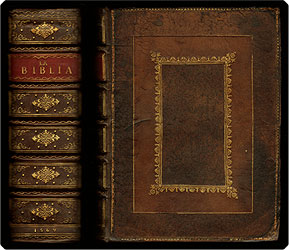
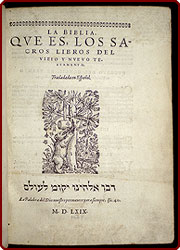
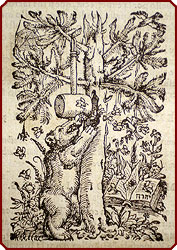
 Click the images for enlargements.
 Rather, the production of a Bible in Spanish fell to a peripatetic exiled Spaniard named Casiodoro de Reina (ca. 1520–94), a man who began his adult life as a monk, came under suspicion of being a “Reformist,” and fled Spain for Geneva — later fleeing that city for a series of others and declaring it “a new Rome” for its intolerance of new ideas. Whether the translation is solely from his pen or is the work of a committee in which he was primus inter pares is not known.
This Bible is known as the “Bible of the Bear” or the “Bear Bible” because of the printer's device on the title-page, a bear at a honey comb, which was the device of Samuel Apiarius. The relationship between Apiarius and the actual printer, Thomas Guarinus, is unresolved. The Old Testament in this translation is based on the Hebrew and derived heavily from the Latin of St. Pagninus and from the Ferrara version. The New Testament is based on the Greek of Erasmus with comparisons to the Vetus Latina and Syriac manuscripts.
There are two states of the title-page, this being state A with the line of type ornaments described in Darlow and Moule.
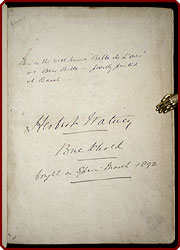
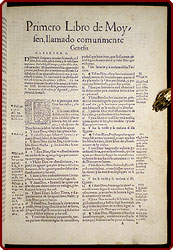
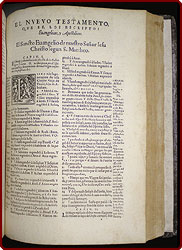
• VD16 B2869; Rumball-Petre262; Darlow & Moule 8472; Graesse, I, 386; Palau 2894; Adams B12061. 17th-century English calf, rebacked with new spine gilt extra very suitable in style; leather of covers a bit crackled and variously darkened; small areas of the covers at board edges replaced with new leather sympathetically gilt-tooled. Lacks the blank preliminary leaf and the four leaves at the end of “Annotationes breves sobre los lugares . . . “, both of which are very often lacking, the latter leaves having perhaps (even probably) been printed separately and later. Small piece of front fly-leaf cut away (probably removing an ownership inscription). The occasional instance of light soil or light waterstaining to fore- or bottom margins, sometimes reaching text; a generally clean and good copy. All edges mottled red and blue-green. (25772)
For 16TH-CENTURY BOOKS, click here. For BIBLES & TESTAMENTS, click here. For TRANSLATIONS, click here. & it appears in the GENERAL
This entry is repeated in the

Full Set of Her Works, IncludingVillancicos in Nahuatl & an African Language (A
Worthy Follower of Those First Two). . . .
Cruz, Juana Inés de la, Sister.
Poemas de la unica poetisa americana, musa dezima, Soror Juana Ines de la Cruz
... Tercera edicion, corregida, y añadida por su authora. [with others,
as below]. Barcelona: por Joeph Llopis, 1691. 4to (21 cm; 8.25"). [8] ff.,
426 pp., [5] ff. [with the same author's] Segundo tomo de las obras de
Soror Juana Ines de la Cruz. Madrid: Impr. de Angel Pasqual Rubio, 1725. 4to
(20 cm; 8"). [4] ff., 438 pp., [3] ff. [with the same author's] Fama,
y obras posthumas del fenix de Mexico, dezima musa, poetisa americana. Madrid:
Impr. de Angel Pasqual Rubio, 1725. 4to (20 cm; 8"). [10] ff., 352 pp., [2]
ff.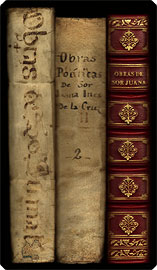
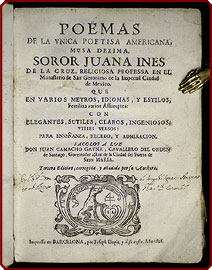
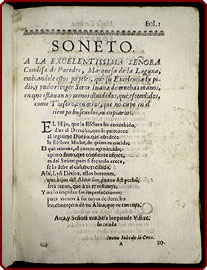
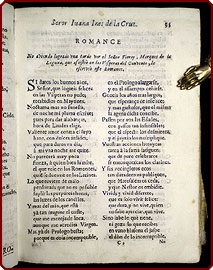 Click the images for enlargements.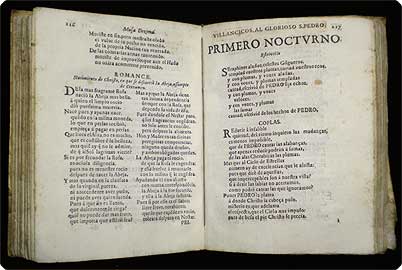
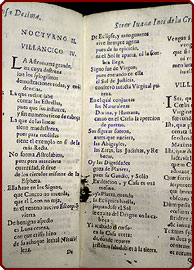 For a sense of her range of subjects, click to enlarge our images. She invented a decasyllabic meter and cultivated dramatic poetry: Among her works are sonnets, redondillas, décimas, villancicos, and plays, as well as prose works, including the famous Carta athenagorica in which she criticizes the great Luso-Brazilian preacher and defender of the Brazilian Indians, Antônio Vieira. The contents here are mostly Spanish-language, but some portions are in Latin — and a few, as is seldom recognized, are in the black language of “Guinea” (e.g., Villancico VIII of the “Villancicos que se cantaron en la Sta. Iglesia Metropolitana de Mexico en honor de Maria Santissima Madre de Dios . . . y se imprimieron año de 1679") or in Nahuatl (e.g., Villancico V of the “Villancicos que se cantaron en la Santa Iglesia Metropolitana de Mexico, en honor de Maria Santissima Madre de Dios . . . año de 1687, en que se imprimieron”).
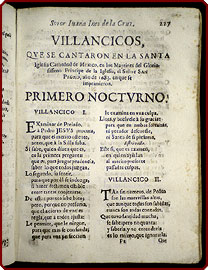
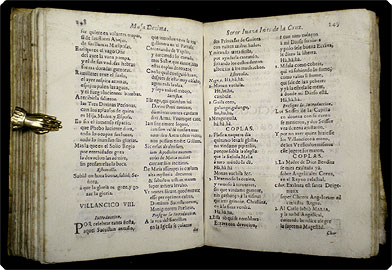
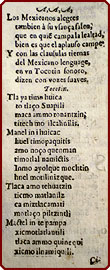
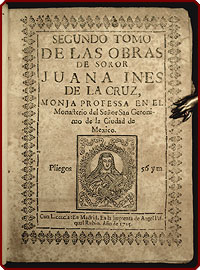
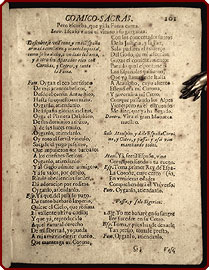
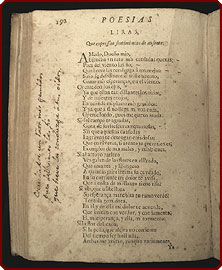
 In the offering here, vol. I was printed during the great poet's lifetime, and is one of the last to hold that distinction.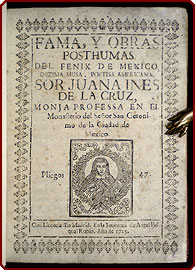
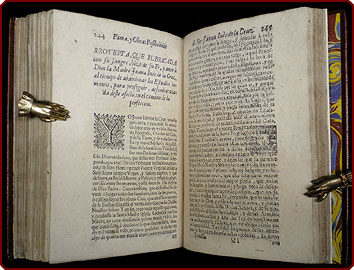
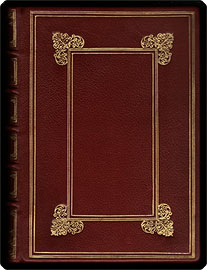
 With slight faults only, this is a handsome set of this major writer's works. (26753)
For more 17TH-CENTURY BOOKS, click here. For more 18TH-CENTURY BOOKS, click here. MEXICO is one of our great specialties. For more LITERATURE, click here. For more of WOMEN's interest, click here. & it appears in the GENERAL A
12-page, unillustrated PDF-format list now offers some of
our greatest rarities:
A
12-page, unillustrated PDF-format list now offers some of
our greatest rarities:
¡RARISIMA!
Spanish New World
Wonders
—
please CLICK
HERE.

Christian
ChronicleAdrichem, Christiaan van. Chronicon de Christiano Adricomio Delfo; traducido de latin en español por Don Lorenco Martinez de Marcilla. Madrid: En La Imprenta Imperial, 1679. Small 4to. π4 A–Z4 Aa–Pp4 Qq2; [4] ff., 284 (i.e., 286) pp., [11] ff.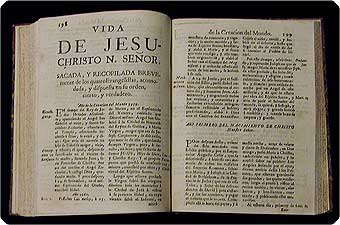
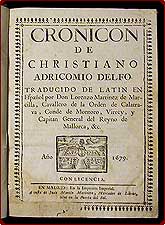 translation into Spanish of Adrichem’s history of Biblical events to the year 109 a.d. An additional “Chronicon Breve” at the end of the volume gives a chronology from Adam and Eve to the year 1585.
Click either imageThe title is within a typographic border; text is printed in double-column format, in roman type.
• Palau 2864. 19th-century half sheep with marbled paper sides; binding shows wear. Lower margin of title-leaf and leaves of the preliminaries with minor worming; repaired with pasted-over paper. Some side- and shouldernotes shaved with loss. Sporadic soiling, not severe.
For more 17TH-CENTURY BOOKS, click here. For more CATHOLICA, click here. This
additionally appears in the GENERAL
 13th-Century Law Suit — 16th-Century Copy Almudevar (Spain). Document, in Latin, on paper. Almudevar: 13 April 1263 (i.e., copied ca. 1590). Small 4to (21 cm; 8.25"). [4] pp.
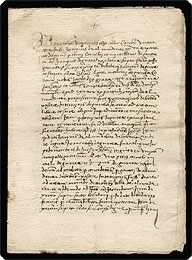
Click the image for an enlargement. • Written in a very clear legal notarial hand, in sepia ink. Very good. (27071)
For the 16TH CENTURY, click here. For more COMMERCE / TRADE / For a bit more AGRICULTURE, click here. Or for EUROPEAN LAW, click here.& for our MSS in SPANISH,
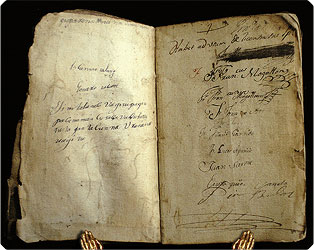
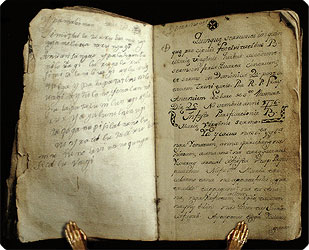
Extended MANUSCRIPT in an UNCOMMON PHILIPPINE LANGUAGE Antonio Lobato de Santo Tomás. Manuscript in Ibanag on paper: “Quinque sermones in quinque precipuis festivitatibus B. Maria Virginis. Quibus accedunt sermo in feria quarta cinerumz et sermo in dominica 2o post octavam trinitatis. Per R. P. fray Antoniium Lobatao de Sto. Thomas. Tuguegarao, The Philippines: 1776–80. Small 4to. 196 pp.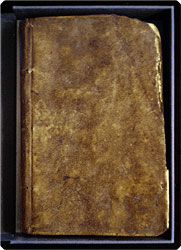
 Click the interior images for enlargements.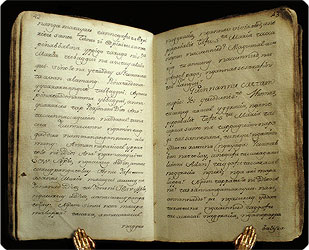
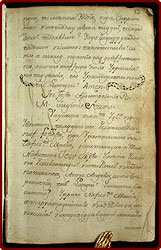
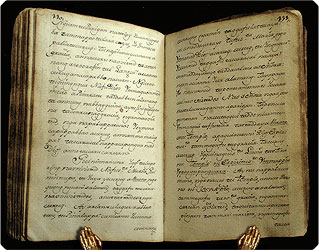 a large body of work set down in the Ibanag language, from the 18th century and as written/spoken by one of the seminal scholars of the language, should be obvious for anyone researching the language as understood by missionaries, as used by missionaries, as influenced by Spanish, and as held out by Spaniards of authority as the model of Ibanag speech to be emulated. Beyond this, of course, is the interest of the sermons themselves, letting us see what the Ibanaq speakers were hearing from their missionaries — or, at least, this missionary — in this place, in this period.
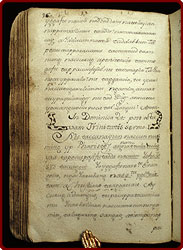
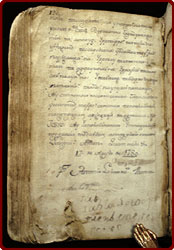
Provenance: A signature “Fr. Antonio Lobato de Sto. Thomas” appears at the bottom of the last page and is almost certainly that of the the friar himself, which would mean that this is his autograph manuscript of the sermons.
• Contemporary very stiff vellum. Binding gnawed by a rodent with loss. Written on a good quality European paper, with some soiling and an occasional stain. No faults are serious and overall this is a remarkably good survival for an 18th-century Philippines manuscript. Now housed in a blue cloth clamshell box. (23668)
For 18TH-CENTURY BOOKS, click here. For more MANUSCRIPTS, click here. For DICTIONARIES/GRAMMARS/ For VOYAGES, TRAVELS, & books on“EXOTIC” PLACES, click here. Or, for CATHOLICA, click here. &, in the GENERAL
Printed
by Hogal —
Illustrated
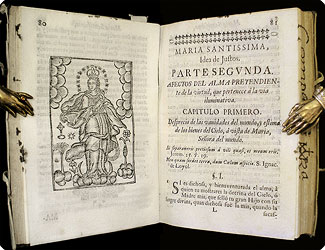
with Four
Woodcuts
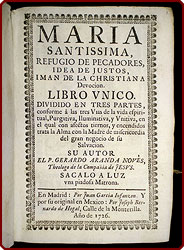
Aranda Novés, Gerardo. Maria Santissima, refugio de
pecadores, idea de justos, iman del la christiana devocion. Libro unico. Dividido en tres partes,
conforme a las tres vias de la vida espiritual, purgativa, iluminativa, y unitiva, en el qual con
afectos tiernos, y encendidos trata la alma con la madre de misericordia del gran negocio de su
salvacion. Mexico: por Joseph Bernardo de Hogal, 1726. 8vo (15 cm; 6"). [4] ff., 341 pp. (blank
verso of p. 265 omitted in numbering), [2] ff., 1 plt.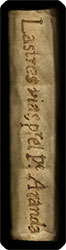
 Click the images for enlargements.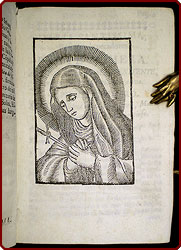
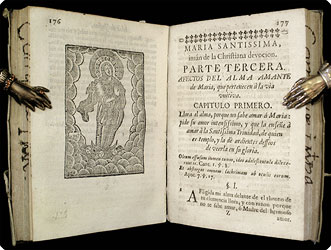 An
uncommon work of mariology; in the U.S. only the New York Public Library reports
owning a copy.
An
uncommon work of mariology; in the U.S. only the New York Public Library reports
owning a copy.
• Medina, Mexico, 2844. Contemporary vellum over light boards, with the ties. Top and bottom edges of the closed volume with inked ownership of an unidentified conventual library. Clean copy. (26872)
For more 18TH-CENTURY BOOKS, click here. For more ILLUSTRATED BOOKS, click here. For more CATHOLICA, click here. MEXICO is one of our great specialties. For COLLECTED PRESSES This book also appears in the GENERAL
 TO Part II TO Part II |