 AGRICULTURE
AGRICULTURE
AGRICULTURE
 The
The Latest
Agricultural Innovations,
with COLOR-PRINTED
Plates
Latest
Agricultural Innovations,
with COLOR-PRINTED
Plates
 (A
Great Read & Eye-Opener). Wells, David Ames. The
year-book of agriculture; or, the annual of agricultural progress and discovery,
for 1855 and 1856. Exhibiting the most important discoveries and improvements....
Philadelphia: Childs & Peterson, 1856. 8vo (24 cm, 9.45"). 399, [1] pp.; 5
plts. (4 col.).
(A
Great Read & Eye-Opener). Wells, David Ames. The
year-book of agriculture; or, the annual of agricultural progress and discovery,
for 1855 and 1856. Exhibiting the most important discoveries and improvements....
Philadelphia: Childs & Peterson, 1856. 8vo (24 cm, 9.45"). 399, [1] pp.; 5
plts. (4 col.).


 Click the images for enlargements.
  Andrew
J. Downing, “the most eminent of American horticulturists
and professors of Rural Architecture” (p. 5). Much interesting material
is present here on the cultivation of various fruits and vegetables, the introduction
of exotic domesticated animals (Chinese yaks, cashmere goats, camels) into the
United States and Europe, statistics of American production, and various mechanical
and technical innovations.
Andrew
J. Downing, “the most eminent of American horticulturists
and professors of Rural Architecture” (p. 5). Much interesting material
is present here on the cultivation of various fruits and vegetables, the introduction
of exotic domesticated animals (Chinese yaks, cashmere goats, camels) into the
United States and Europe, statistics of American production, and various mechanical
and technical innovations.


 Illustrated
with four color plates done by Max and Louis N. Rosenthal of the famed Philadelphia
firm Rosenthal's, producers of some of the earliest chromolithographs
in the U.S. The frontispiece here, after a drawing by B.L.C. Wailes, depicts
a blossoming cotton plant, while the three other chromolithographed plates show
a more mature example, the cotton caterpillar, and rot in cotton. The volume
is additionally illustrated with a number of in-text steel and wood engravings.
Illustrated
with four color plates done by Max and Louis N. Rosenthal of the famed Philadelphia
firm Rosenthal's, producers of some of the earliest chromolithographs
in the U.S. The frontispiece here, after a drawing by B.L.C. Wailes, depicts
a blossoming cotton plant, while the three other chromolithographed plates show
a more mature example, the cotton caterpillar, and rot in cotton. The volume
is additionally illustrated with a number of in-text steel and wood engravings.
• Allibone 2641. Not in Reese, Stamped with a National Character. Publisher's blind-stamped green cloth, spine with gilt-stamped title; spine sunned, chipped at head, and with small darkened area. Ex–social club library: Call number on front pastedown, front free endpaper lacking, title-page and several others (not plates) with old, round, light rubber-stamp. Pages age-toned, otherwise clean. (26420)

 Much Varia — An Ad for aPapermaker! (AMERICAN!
ALMANACS)
.
Abell, Truman.
New-England farmer's almanack, with an emphemeris, for the year ... 1828. ...
Fitted to the latitude and longitude of the town of Windsor, Vt. but will serve,
without sensible variation, for all the adjacent states. Alstead, N. H.: Newton
& Tufts; Windsor, Vt.: Simeon Ide, [1827]. 12mo. [24] ff.
Much Varia — An Ad for aPapermaker! (AMERICAN!
ALMANACS)
.
Abell, Truman.
New-England farmer's almanack, with an emphemeris, for the year ... 1828. ...
Fitted to the latitude and longitude of the town of Windsor, Vt. but will serve,
without sensible variation, for all the adjacent states. Alstead, N. H.: Newton
& Tufts; Windsor, Vt.: Simeon Ide, [1827]. 12mo. [24] ff.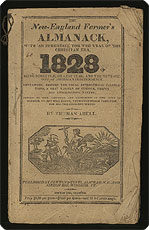
Click the image for an enlargement. • Drake 13641; Shoemaker 29925. Uncut copy; later stitching and later oversewing; dog-earing and a bit tattered. Title-page and p. [48] age-darkened. Occasional mild staining. (10027)
 For more ALMANACS, click here.
 “Fundamentall to the Erecting & Building ofa True Philosophy”Bacon, Francis. Sylva sylvarum or a naturall history in ten centuries. London: Pr. by J.H. for William Lee, 1627. 8vo (27.6 cm, 10.9"). Frontis., add. engr. t.-p., [10], 266, [16], 47, [3] pp. (lacking final blank f.).
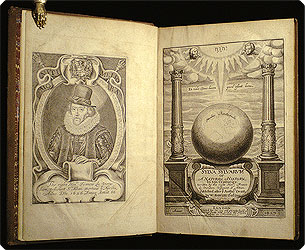
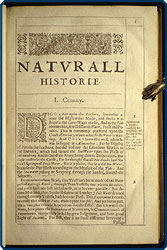 Single-click any image where the hand appears onNew Atlantis, an unfinished allegorical fantasy begun shortly after his political downfall and not long before his death. Together, the two works exemplify Bacon's scientific and literary accomplishments.
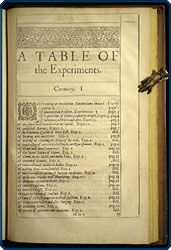
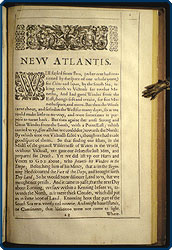
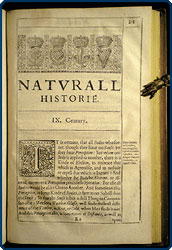
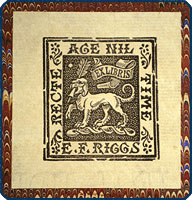
Provenance: Riggs family: Front pastedown with armorial bookplate of philanthropist Elisha Francis Riggs, who funded the Riggs Library at Georgetown University; volume inherited by T. Lawrason Riggs, founding chaplain of St. Thomas More Chapel, Yale University; donated to St. Thomas More Chapel Library; deaccessioned 2008.
• ESTC S106924; STC (2nd ed.), 1169; Gibson, Bacon, 171. On Bacon, see: Dictionary of National Biography. 18th-century calf framed in gilt single fillet, spine with recent gilt-stamped leather title and author labels, board edges with gilt roll; a little rubbed and covers with portions darkened. All edges stained yellow. Front pastedown with bookplate as above. Some pages gently age-toned, with occasional minor spotting. Small hole to added engraved title-page just beneath publication information, not affecting text. Final blank leaf (only) lacking. (24666)


 Volcanic Illustrations — Baily's Central American Survey Baily, John. Central America; describing each of the states of Guatemala, Honduras, Salvador, Nicaragua, and Costa Rica; their natural features, products, population, and remarkable capacity for colonization. London: Trelawney Saunders, 1850. 8vo (19.5 cm, 7.6"). Frontis., xii, 164 pp.; 2 plts.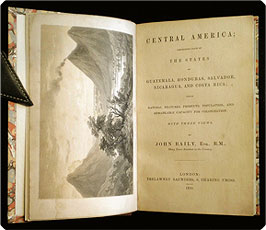
 Click the interior image for an enlargement.
 The volume is illustrated with three engraved views, all three incorporating volcanos. As usual, this copy does not include the oversized map, which was printed and published separately.
• Palau 21943; Sabin 2771; Nicaraguan National Bibliography 1476. 20th-century quarter red morocco and marbled paper–covered sides, spine with gilt-stamped title; minor wear to corners and spine extremities. Plates with light waterstaining to lower portions; frontispiece, title-page, and plates backed with linen. (25454)
 Quaint
Rural CustomsCarleton, Will.
Farm festivals. New York: Harper & Brothers, copyright 1881. 8vo. 167,
[1], 6 (adv.)] pp.; 18 plts. (incl. in pagination), illus.
Quaint
Rural CustomsCarleton, Will.
Farm festivals. New York: Harper & Brothers, copyright 1881. 8vo. 167,
[1], 6 (adv.)] pp.; 18 plts. (incl. in pagination), illus. 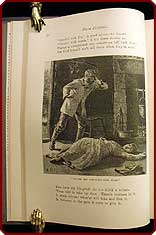
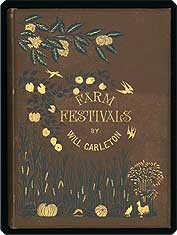
• BAL 2482 (second printing state, with plates included in pagination). Publisher's brown cloth, front cover stamped in gilt and green, spine with gilt-stamped title; front cover lightly scuffed, with corners rubbed. Front fly-leaf with inked gift inscription "to My Daughter," dated 1890; newspaper clipping about Carleton affixed to front fly-leaf, poem affixed to back fly-leaf as described above. Several insurance advertisements, religious leaflets, and other ephemera laid in. (14367)


“The
Little Sleeper”
& “Paul's
Run Off with the Show”ILLUSTRATED
Carleton, Will.
Farm legends.
New York: Harper & Brothers, c. 1887. 8vo. 187, [1], 4 (adv.) pp.;
17 plts., illus. 


An ExpertPromotes AMERICAN Sericulture — His Son Promotes His Business Comstock, Franklin G. A practical treatise on the culture of silk, adapted to the soil and climate of the United States. Hartford: Wm. G. Comstock, 1836. 12mo (19.1 cm, 7.5"). 108 pp.; illus.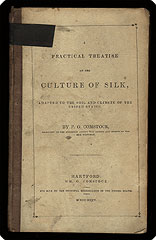
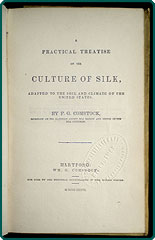
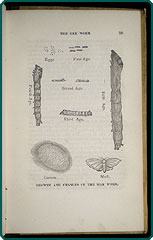
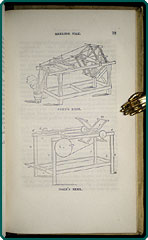 Click the images for enlargements.
 The advertisement on the back cover of this volume notes that William G. Comstock (the author's son and publisher) offered for sale 100,000 white Italian mulberry trees; 10,000 Chinese mulberry plants; and 2,000,000 “silk worms eggs,” among other items of sericulture.
• American Imprints 36859. Publisher's quarter brown cloth and printed paper–covered sides, moderately rubbed and soiled; spine sunned and a strip of black cloth tape across its head. Ex–social club library: 19th-century bookplate, call number on pastedown, front free endpaper with inked number covered over by black tape, pressure-stamp on title-page. No other markings. Pages clean. (26271)
“New, Useful, & Entertaining” Daboll, Nathan. New-England almanac, for the year ... 1808 ... By Nathan Daboll. New-London [Conn.]: Pr. by Ebenezer P. Cady, [1807]. 12mo. [18] ff.
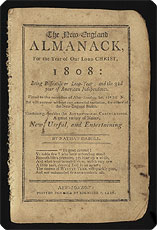
Click the image for an enlargement. • Drake 707; Shaw & Shoemaker 13185. Removed from a nonce volume and resewn. (9489)
 For a bit more AGRICULTURE, click here.
Representing the Farmer's Weekly Museum — 1796 [Dennie, Joseph]. The lay preacher; or short sermons, for idle readers. Walpole, NH: David Carlisle, Jr., 1796. 12mo (17 cm, 6.75"). 132 pp. 
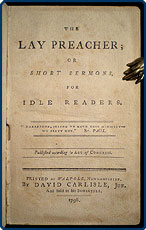
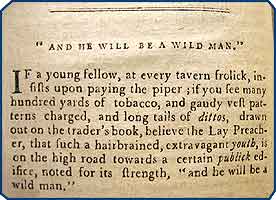
Provenance: Front fly-leaf is inscribed "P Doddridge to his sister Harriett" in an early hand. There is a Doddridge County in New Hampshire, but who "P" and "Harriett" were, we cannot say.
• ESTC W20627; BAL 4633; Evans 30335; Sabin 19585. On Dennie, see: Dictionary of American Biography, V, 235–37. Contemporary mottled sheep rebacked with plain cloth, abraded (most notably over edges and corners); hinges taped (inside) some time ago. Some offsetting and a few scattered light spots; one page with portion of text insufficiently inked during printing. Chip out of one page margin, just touching but not obscuring outermost letters. (4706)
 Illustrated Explorations of theCountryside Dibdin, Charles. Observations on a tour through almost the whole of England, and a considerable part of Scotland, in a series of letters, addressed to a large number of intelligent and respectable friends. London: G. Goulding & John Walker (pr. by T. Woodfall), [1801–02]. 4to (28.9 cm, 11.4"). 2 vols. I: 404 pp.; 27 plts. II: [2], 406, [2] pp.; 33 plts., 1 fold. map, 1 fold. chart.
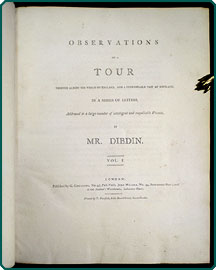
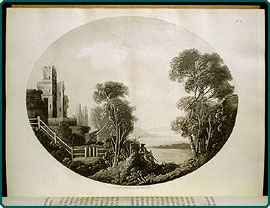
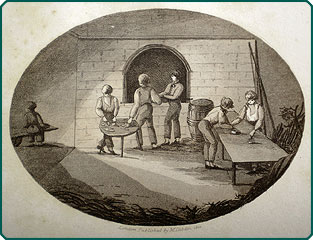 Click the images for enlargements.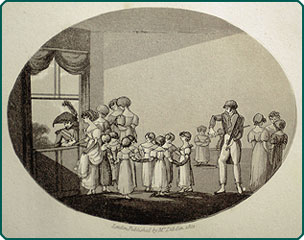
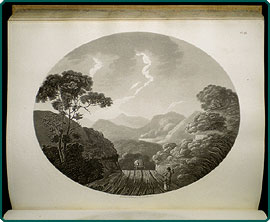
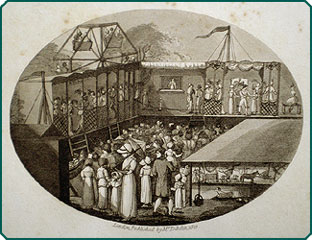 illustrated with 60 copper-engraved and aquatint plates, one folding map, and one folding chart. The copper engravings are done in two different styles; one set consists of large renditions of scenery, the other of smaller depictions of people and everyday life — the former done from Dibdin's own paintings, and the latter from drawings by his daughter Anne.
• Anderson, Book of British Topography, 373; Lowndes 638; NSTC D1044. Not in Abbey, Life in England; not in Ray, The Illustrator & the Book in England. On Dibdin, see: Oxford Dictionary of National Biography online. Recent quarter caramel morocco and ochre cloth. Light to moderate foxing; mild offsetting around plates; four pages with patch of offsetting from now-absent laid-in item. Plates depicting people all with small area of waterstaining to upper inner portions, just touching corner of platemark without affecting images; scenic plates unaffected. All edges marbled.  A solid, handsome, satisfying set. (26939)
The Lives of PlantsDigby, Kenelm. Discovrs svr la vegetation des plantes, fait par le Cheualier Digby, le 23. Ianuier 1660, en presence de Messieurs de l’Academie Royale d’Angleterre.... Paris: Chez la veuve Moet, 1667. 12mo (15. 6 cm, 6.2"). ã8A–G6H4 (-H4, blank); [16], 89, [1 (blank)] pp.

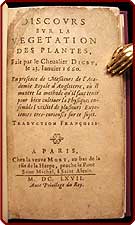
Rare. Searches via OCLC, RLIN, and NUC locate only five copies worldwide: Two in the U.S. (both at same university!) and three in France.
• Duveen D494. Recent calf with covers framed in single gilt fillets, spine with gilt-stamped title label and gilt-ruled raised bands. Leaves with some dustsoiling and dampstaining; now heavily sized, many with margins repaired and a few with stray pencil marks. Lacks final blank leaf (only). In fact, a rather nice copy of a very uncommon item.

Creationist Guide to the Natural World — A Pretty 4-Volume Set Duncan, Henry. Sacred philosophy of the seasons; illustrating the perfections of God in the phenomena of the year. Boston: Marsh, Capen, Lyon, & Webb, 1839. 12mo (18.5 cm, 7.3"). 4 vols. I: xvi, 389, [1] pp. II: 391, [1] pp. III: 401, [1] pp. IV: 416 pp.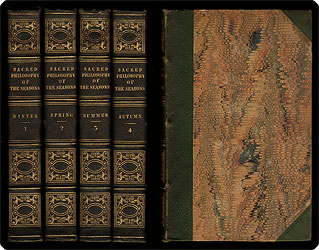
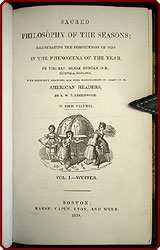 Click the images for enlargements. The practical sciences of agriculture, husbandry, and manufacture have their places here along with much on the physical and biological worlds as such.
Bindings: Publisher's half green morocco and marbled paper–covered sides, spines with gilt-stamped title and decorations; very attractive.
• American Imprints 55446. Spines slightly darkened; lightly rubbed. Ex–social club library: 19th-century bookplates, call number on endpapers, no other markings.  A clean, sound handsome set. (27171)
CRANBERRIESEastwood, B. A complete manual for the cultivation of the cranberry, with a description of the best varieties. New York: C.M. Saxton, Barker, & Co., 1860. 8vo. Engr. t.-p., 120 pp; 9 plts. 
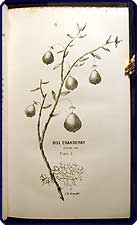
• Publisher's embossed cloth, spine with gilt-stamped title; corners and spine extremities showing minor wear, with gilt oxidized. Front free endpaper with pencilled inscription; some page edges with small blotches.  Binding very handsome in its subtle way. Impossible! to get a good image of! (12986)
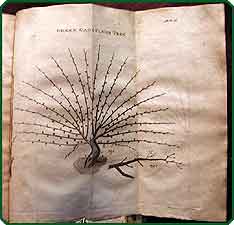
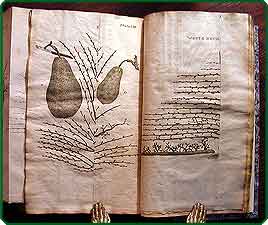
From Apricots to Walnuts — 13 PlatesForsyth,
William. A treatise on the culture and management of fruit trees.... To
which are added an introduction and notes, adapting the rules of the treatise
to the climates and seasons of the United States of America. By William Cobbett.
Albany: D. & S. Whiting, 1803. 8vo (21.5 cm, 8.5"). 280 pp. (pp. [v], vi bound
in after p. viii); 13 plts. 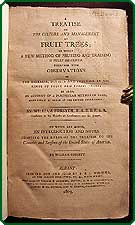
• NSTC C26475; Shaw & Shoemaker 4218; Gaines, Cobbett, 62c. On Forsyth, see: Dictionary of National Biography, XX, 35. On Cobbett, see: Dictionary of National Biography, XI, 142–45; Appleton, I, 669. Recent quarter walnut brown calf over marbled paper; spine with two red leather labels, gilt-lettered with a single fillet above and below; remainder of spine divided into compartments by blind rules, with gilt-stamped date at base. Pages and plates lightly age-toned, a little cockled, and lightly soiled throughout with some shallow chipping, light foxing, and waterstaining. Rubber-stamps from a now-defunct library, including one on title-page. Pencilled ownership inscription on title-page. A nicer book than the faults-list makes it sound like, to read or work with.
“The Yaks are Strong & Hardy” Gerard, Alexander. Account of Koonawur in the Himalaya,
etc. etc. etc. London: James Madden & Co., 1841. 8vo (23 cm, 9"). xiii, [3], 190, [2], [195]–308 (i.e.,
310), xxvi, [2 (adv.)] pp.; 1 fold. map.
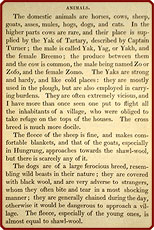
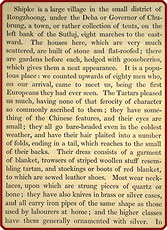 Click the interior images for enlargements.
 Gerard's observations cover botany, linguistics, culture, and commerce, as well as geography. The area of his travels is depicted by an oversized, folding map of his own design.
• NSTC 2G5453; Howgego, II, G7. Contemporary brown cloth, spine with gilt-stamped title; rebacked and 95% of original spine reapplied, with the publisher's name at the foot of the spine chipped. Front pastedown and back of map each with institutional rubber-stamp (no other markings), front free endpaper with inked ownership inscription dated [18]49. Hinges (inside) reinforced. Last preface page with small inked annotation. Pages slightly age-toned; map with light offsetting and one short tear starting along fold, not touching image. (24291)
Guridi
y Alcocer vs.
Lopez
de Cancelada
Guridi y Alcocer, José Miguel. Censor Extraordinario. Contestación de don José Miguel Guridi Alcocer lo que contra él y los Derechos de las Cortes se ha vertido en los números 13 y 14 del Telégrafo americano.... [colophon: Cadiz: En la impr. de Don Agapito Fernandez Figueroa, 1812]. 4to (20 cm; 7.5"). 47, [1 (blank)] pp.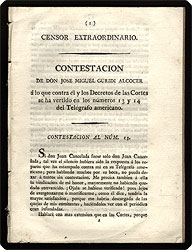
Guridi y Alcocer here defends himself and various of his statements in the Cortes from Cancelada's attacks in that newspaper, both personal and political. Guridi sought to open the (whole) New World to free trade, arguing for free access to European seeds, plant stocks, and exports generally. He also sought administrative reform, reduction in regulations, and the ending of colonial status.
WorldCat locates only two copies Worldwide.
• Palau 111215; Sutro 87. Removed from a nonce volume. One small tear in a margin, repaired. Clean and nice. (26042)
AMERICAN
Grapes AMERICAN
Wine AMERICAN Author Husmann, George. American grape growing and wine making ... fourth edition — revised and rewritten. New York: Orange Judd, 1902. 8vo (18.5 cm, 7.25"). viii, 269, [11 (adv.)] pp.; illus.

Provenance: Ownership stamp of “C. Witter . . . St. Louis, Mo.”
• Amerine & Borg, Bibliography on Grapes, Wines, Other Alcoholic Beverages, & Temperance, 1851. Publisher's dark green cloth, covers with blind-stamped grapevine borders, spine with gilt-stamped decorative title; spine extremities slightly rubbed, front cover with a few tiny spots of faint discoloration, otherwise a clean, fresh copy. Title-page with private owner's rubber-stamp in lower margin. Pages clean. A nice book. (20691)

Michoacán MeasuredMartínez de Lejarza, Juan José. Análisis estadístico de la provincia de Michuacan, en 1822. Mexico: Imprenta nacional del supremo gobierno de los Estados-Unidos, 1824. Small 4to (20 cm; 8"). [2] ff., ix, [1 (blank)], 281, [1 (blank)] pp., 9 fold. tables.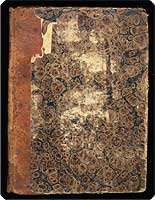
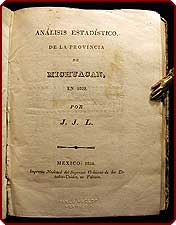 Click the image to the left
 Such statistical publications as this were essential for the government of the newly independent nation, especially for planning purposes and for use when negotiating with bankers for the loans so essential to the nascent nation.
Interestingly, the population statistics ignore distinctions such as “indio,” “mestizo,” etc. The brief paragraphs about the towns and hamlets are filled with facts such as that the nuns of one particular town still wear hats of the Quiroga style.
An observation having nothing to do with the text: The paper on which this work is printed is very thin laid paper with no apparent watermark. The quality is not “European” and this cataloguer (DMS), with nearly 40 years experience with Mexican books, wonders if the paper is from one of Mexico's first paper mills?
• Palau 155712; not in Sutro. Later 19th-century quarter sheep with stone pattern marbled paper sides. Binding worn, text skewed in binding. Private ownership pressure stamp on title-page.
Enlightenment CatholicismMuratori, Lodovico Antonio. Della pubblica felicita oggetto de' buoni principi.... Lucca, 1749. 8vo (18.8 cm, 7.375"). [6] ff., 236 pp.
 agriculture,
exhibiting the combination of deep orthodox Christian faith and respect for
freedom of science and scholarship that made him the chief representative of
18th-century “enlightened Catholicism.” First published 1749, this
is the second edition.
Click
the interior image for an enlargement.
agriculture,
exhibiting the combination of deep orthodox Christian faith and respect for
freedom of science and scholarship that made him the chief representative of
18th-century “enlightened Catholicism.” First published 1749, this
is the second edition.
Click
the interior image for an enlargement.
• Goldsmith’s Kress 8390. On Muratori, see: New Catholic Encyclopedia, X, 81. Contemporary vellum over paste boards with remnants of gilt label on spine; soiled, stained, and chipped with loss of top layer of vellum on rear cover and part of spine. Interior with light foxing, water- and other staining. Far from splendid, far from dead. (11592)
Making Meat into aBalanced Meal National Live Stock & Meat Board. Food combinations: Meat and what to serve with it. Chicago: National Live Stock & Meat Board, [1928]. 8vo. 16 pp.; illus. Click
the image for an enlargement.
Click
the image for an enlargement.
• Not in Brown, Culinary Americana. Publisher's printed paper wrappers; pamphlet creased once vertically, slightly age-toned overall. (26062)
For
COOKERY, click here.
Breeding
Neat Cattle
[Pennsylvania
Agricultural Society]. Hints for American husbandmen, with communications
to the Pennsylvania Agricultural Society. Philadelphia: Clark & Raser, 1827.
8vo (22.8 cm, 9"). [178] pp.; 3 plts. (of 4; also lacking frontis.).

 Click the images for enlargements.
 • Shoemaker 30185; on Powel, see: Dictionary of American Biography, XV, 143–44. Contemporary paper wrappers, front with printed paper label and separated from spine but present; chipping, soiling, and pencilling, with staining especially to lower edge of front wrapper. Pages untrimmed; varying degrees of foxing and staining; lacking frontispiece and one plate — a still-interesting volume priced according to its faults.
 AMERICAN
Sericulture a
Possible Source ofRevenue?
Pullein, Samuel. The culture of silk: or, an essay on its rational practice and improvement. In four parts... For the use of the American colonies. London: Pr. for A. Millar, 1758. 8vo. Frontis., xv, [1 (blank)], 299, [1] pp., plt.
AMERICAN
Sericulture a
Possible Source ofRevenue?
Pullein, Samuel. The culture of silk: or, an essay on its rational practice and improvement. In four parts... For the use of the American colonies. London: Pr. for A. Millar, 1758. 8vo. Frontis., xv, [1 (blank)], 299, [1] pp., plt. 
In the period 1750 through 1820 there was considerable interest in the development of this potentially lucrative enterprise. The work in hand is divided into four parts: "I. On the raising and planting of mulberry trees. II. On hatching and rearing the silkworms. III. On obtaining their silk, and breed. IV. On reeling their silk-pods."
The two plates (one being the frontispiece) show various machinery and tools for, and stages of, the production of silk. The author, a "reverend," flourished 1734–60.
• Sabin 66625. Recent quarter calf, antique style. Round spine with raised bands accented with gilt ruling. Gilt center devices in spine compartments. Green morocco title-label. Marbled paper sides. Light foxing. A very good copy.
The FIRST English-Language History of Java Raffles, Thomas Stamford, Sir. The history of Java ... second edition. London: John Murray, 1830. 8vo (21.6 cm, 8.5"). 2 vols. I: xlviii, 536 pp.; 1 fold. table. II: iv, 332, clxxix, [1] pp.

 Click the images for enlargements.
 The editor's advertisement, type-signed by Sophia Raffles (Sir Thomas's second wife), notes that the plates from the first edition and some additional plates were published in “a separate quarto volume, detached entirely from the present work” (p. xi). This did not actually appear until 1844 and so is not present here.
• Brunet, IV, 1088; Graesse, VI, 17; Lowndes 2037. On Raffles,
see: Oxford Dictionary of National Biography online. Contemporary
calf, covers framed in blind triple fillets with gilt-stamped corner fleurons,
spines with gilt-stamped leather title and volume labels and with gilt-stamped
and blind-tooled compartment decorations; board edges with blind roll. Binding
rubbed at joints/edges and with small scuffs, portions of boards variously
stained/sunned; still quite attractive. Ex–social club library: 19th-century
bookplate and inked call number on each front pastedown, title-pages pressure-
and lightly rubber-stamped; no other markings. Fore-edge of vol. I shows signs
of old water exposure, without actual waterstaining to pages themselves save
in a few cases where upper or outer margins are touched; pages clean. A
pleasant old pair of books. (26379)
Three Plates with Cottage Designs (Rural Housing Issues). Third annual report of the directors of the Association for Promoting Improvement in the Dwellings and Domestic Condition of Agricultural Labourers in Scotland. Edinburgh: Pr. for the Association by William Blackwood & Sons, 1857. Uncommon pamphlet, detail-packed as to both present housing realities and desirable changes, illustrated with three plates containing plans and elevations for cottage designs by architect William Fowler.
 Click the images for enlargement.
 • NSTC 2A17980 (for all years 1855–61). Removed from a nonce volume. Title-page with small inked numeral in upper outer corner, otherwise clean. (17033)
How aHacienda Grew San Nicolas el Chico, Hacienda de. Manuscript: “Titulos pertenecientes a la Hacienda de San Nicolas el Chico de la propriedad del Señor Gorgonio de la Concha. In Spanish, on paper. Mexico & Tulancingo: 1643–1753. Folio. 75 ff.


In 1643 the crown offered for sale two caballerías of land and the rights to two accesses to water for that land — and Pedro del Castillo of Tulancingo successfully acquired the land and water rights for 200 pesos.


TheScience
of Soap
(Soapmaking
Scrapbook). Manuscript/print extracts on paper, in English. [Northeast
U.S., 1899–1902]. 8vo (20.3 cm, 8"). [106 (44 blank)] ff.

 statistics
regarding the fat yield of a steer; also present are occasional motivational pieces entirely unrelated to soap.
statistics
regarding the fat yield of a steer; also present are occasional motivational pieces entirely unrelated to soap.
• Pebbled cloth, lightly worn. Leaves with minor cockling, some staining and offsetting. Some pages with portions excised; one leaf excised entirely.
“Take 500 Protestations . . . ” Spofford, Thomas. Astronomical diary, or almanack, for the year ... 1819. ... Calculated for the meridian of Andover ... but will serve without any error of consequence for any of the New-England states. Boston: Hews & Goss, [1818]. 12mo. [18] ff. how to compose a “modern” love letter plus a (truly) humorous description of marriage. Two states of gathering C noted. In the second, a note has been added at foot of p. [34], correcting information given in the calendar pages about a solar eclipse on April 24th. This is a copy in the state without the correction.
• Drake 3819; Shaw & Shoemaker 43108. Uncut copy; old stitching. A very good copy. (9622)
For more ALMANACS, click here.
Omens & Charms — Signs & Dreams Spofford, Thomas. The Yankee. The Farmer’s almanack for the year of our Lord and Saviour 1832 ... Calculated for the meridian of Boston, (Mass.) lat. 42° 21’ north, but will serve for any of the states of New England; for New York, and Michigan Territory. .../ By Thomas Spofford. [7 lines of verse]. Boston: Willard Felt & Co. sold by him, and by David Felt, 1831. 12mo. 36 pp.
Click the image for an enlargement. • Drake 4017. Uncut, stitched, partly unopened. (21434)
A Tour ofRUSSIA Conducted by a SPECIALIST Tooke, William. View of the Russian empire, during the reign of Catharine the second, and to the close of the eighteenth century ... the second edition. London: Pr. by A. Strahan & G. Woodfall for T.N. Longman & O. Rees, 1800. 8vo (21.7 cm, 8.5"). 3 vols. I: xxxvi, 630 pp.; 1 fold. map. II: [2], 574 pp. III: [2], 628 pp. (pagination skips 561–64).

 Click the images for enlargements.
 The state of the Russian military forces is here described at length. The commerce section includes chapters on viniculture, sericulture, and apiculture, as well as mining and salt harvesting; at the back of the third volume are extensive tables of Russian imports and exports, merchant ships arrived and sailed, duties and taxes, and names of the most active St. Petersburg merchants. Coins and measures are also examined.
Binding: Contemporary treed calf, flat spines with gilt tooling of several sorts creating compartments, each with a large device; gilt-stamped green leather title and volume labels.
• ESTC T109837; Allibone 2434. On Tooke, see: Dictionary of
National Biography online. Bound as above, two volumes with front
covers off and all other joints weak; covers showing some gouges and spines
some chips, the set apparently having been exposed not only to normal wear/rubbing
but sometime long past to something (heat? “repairs”?) that darkened
and roughened them irregularly. Ex–social club library: front pastedowns
each with 19th-century bookplate and inked numerals, title-pages pressure-stamped.
Intermittent light foxing and light to moderate offsetting throughout; vol.
III with waterstaining in upper margins. Map lightly foxed but otherwise in
excellent condition. A set of booksstill
striking, and priced to permit the next owner to contemplate
repairs. (26366)
“Horse-Hoing” — 6NIFTY Fold-Out PlatesTull,
Jethro. The horse-hoing husbandry: Or, an essay on the principles
of tillage and vegetation.... London: Pr. for the author, and sold by G. Strahan,
T. Woodward, A. Miller, J. Stagg, and J. Brindley, 1733. Folio (30.2 cm, 11.875").
[4], x, 200 pp.; pp. [201–202]. 6 fold-out plts. [bound with] Tull,
Jethro. A supplement to the essay on
horse-hoing husbandry.... London: Pr. for and sold by the author, and may be had
at Mr. Mills's, London, at John Aitkins's, Esq, in Edinburgh, and at the Bear
in Hungerford, Berks., 1736. Folio. pp. [203–205], 206–69; [1] pp.


 Single-click any image, for an enlargement.

 six beautifully engraved, pleasantly intelligible plates (“W. Thorpe, sculp.) illustrate some of Tull’s inventions, including improved plows and drills for planting seeds.

• Goldsmiths’-Kress 7065; ESTC T81915 and N24607. Contemporary calf with remnants of gilt; dry, flaking, and partially gone to red, with some chips to edges, corners, and spine tips; old repairs to joints. Remnants of bookplate on front pastedown. Old water/mildew damage to lower margins, occasionally making its way a bit into text; several leaves repaired, long since. Plates generally quite clean and always pleasing, with faintest waterstaining to lower portion of plate 6 (only). All edges speckled red.
“Horse-Hoeing”
— COBBETT's
Introduction
Tull, Jethro. The horse-hoeing husbandry: or, a treatise on the principles of tillage and vegetation, wherein is taught a method of introducing a sort of vineyard culture into the corn-fields, in order to increase their product and diminish the common expense. By Jethro Tull. London: William Cobbett, 1829. 8vo. xxiv, 466 pp., 1 plt. (included in pagination).

 Click the interior images for enlargements.
 Published at the beginning of renewed interest in the U.S. and England in “scientific agriculture.”
• Goldsmiths'-Kress 25812. Publisher's blind-embossed green cloth, rebacked with much of old spine unobtrusively reapplied. Binding a little soiled and spine darkened with gilt of title dimmed; tips of corners chipped. Instances of dust-soiling at some top margins; one leaf with loss and soiling along outer edge without affecting text. Ex-library with old rubber-stamp on the title-page and several other pages. (24439)
Trees Bees & MoreVanière, Jacques. Praedium rusticum. Editio nova longè auctior & emendatior. Tolosæ: Petrum Robert, 1742. 12mo (17.3 cm, 6.8"). [4] ff., 319, [7 (index)] pp.


• Goldsmiths’-Kress 7892.2; DeBacker-Sommervogel, VIII, 444. Contemporary speckled calf, spine gilt extra with gilt-stamped leather title-label; binding scuffed and rubbed, with leather cracking over joints and spine extremities chipped. All edges speckled red. Front free endpaper and fly-leaf partially affixed to front pastedown; front pastedown with inked initials. Pages beautifully clean.

 Poetic
Farm Management?
— In Latin
& German
Virgilius Maro, Publius. [Werke ubersetzt von Johann Heinrich Voss]. Altona: bey Johann Friedrich Hammerich, 1800. Vol. 3 of 4 (i.e. Landbau). 8vo. [2] ff., 461, [1(blank)] pp.
Poetic
Farm Management?
— In Latin
& German
Virgilius Maro, Publius. [Werke ubersetzt von Johann Heinrich Voss]. Altona: bey Johann Friedrich Hammerich, 1800. Vol. 3 of 4 (i.e. Landbau). 8vo. [2] ff., 461, [1(blank)] pp.
 For those interested in the history of technology, a plate presents — both in words and images—the evolution of the plough from the days of Hesiod to the time of Virgil.
Though an "odd vol," this is a pleasing book, done up in a typical German style of the era. Paper marbled in browns, black, and greens is used over boards, with slivers of leather at corners; a round spine bears gilt ruling and a cream-colored label with author, title, translator, and volume number. All edges are green and the whole is exceptionally well preserved.
• Schweiger, Handbuch der classischen Bibliographie, II: 1206. Bound as above. Vol. 3 of 4. Some little foxing but almost no scuffing.
Two Manuscripts . . .Ybrillos, Spain. Ecclesiastical Cabildo. Manuscript. On paper, in Spanish. Calahorra, 12 July 1750. Folio (31 cm; 12.25"). [17] ff. [bound with and after] Castildelgado, Spain. Manuscript. On paper, in Spanish. Castildelgado, 22 April 1664. Folio (31 cm; 12.25"). [10] ff. 
The Castildelgado document is the settling of a dispute with the town of Ybrillos over pasturing rights.
• Bound in limp vellum with remnants of ties. Written in clear notarial hands. A very little tattering; in very good condition.
See
also, perhaps, GARDENING — click here.

PLACE AN ORDER | E-MAIL US | GO (BACK) TO TOPIC/INTEREST TABLE | PRB&M HOME
All material © 2010
The Philadelphia Rare Books & Manuscripts
Company