
 NEW & OLD
WORLD
NEW & OLD
WORLD HISPANICA — Una miscelánea
NEW & OLD
WORLD  In
SOME
Cultures, Only
In
SOME
Cultures, Only BAD
Women HIDE
Their FACES
BAD
Women HIDE
Their FACES
 Spain. Sovereigns, 1621–1665 (Philip IV). Prematica en que su magestad manda, que ninguna muger ande tapada, sino descubierta el rostro, de manera que pueda ser vista, y conocida, so las penas en ella contenidas, y de las demas que tratan de lo susodicho. Madrid: Pedro Tazo, 1639. Folio (28.2 cm, 11.1"). A4; 4 ff.
 Click the image for an enlargement.
 • Palau 87353 (for Granada printing). Removed from a nonce volume. Title-page with shadow of pencilled numeral and faintly inked earlier numeral in upper margin. Pages creased but clean, with tiny hole along fold of last leaf.
 For 17TH-CENTURY BOOKS, click here. For EUROPEAN LAW, click here.
 For CLOTHING & FASHION, click here. For more of WOMEN's interest, click here.

 Watch Your Mouth!Spain. Sovereigns, 1621–1665 (Philip IV). Prematica en que su magestad manda se executen las penas en ella contenidas, contra los que juraren, declarando, que solo queden permitidos los juramentos que se hazen judicialmente, ò para valor de algun contrato; y que en los Consejos de Inquisicion, Ordenes, y otras comunidades de estatuto, a la pregunta de las costumbres se añada la denotadeste vicio. Madrid: Pedro Tazo, 1639. Folio (28.2 cm, 11.1"). A6; 6 ff.
  Click
the image for an enlargement.
Click
the image for an enlargement.
• Not in Palau. Removed from a nonce volume. Title-page with shadow of pencilled numeral and faintly inked earlier numeral in upper margin. Pages creased but clean.
For 17TH-CENTURY BOOKS, click
here.For
more INQUISITION material, click here. For
more CATHOLICA, click here.
OR
for more (GENERAL)
Encouraging Local IndustrySpain. Sovereigns,
1759–1788 (Charles III). Real cedula de su magestad
de 14. de diciembre de 1784. concediendo por punto general la libertad de que
sin distincion de personas, se puedan fabricar todo genero de tegidos de lino,
y cañamo en los terminos que se propone. Vich: Juan Dorca y Morera, 1785. Folio.
[4] ff., [1 (blank)] f. 
 Click the interior image for an enlargement.
 • Modern half vellum over burgundy cloth sides. Contemporary inked notation at top right corner of title-page. Very good. (21056)

Troublesome Soldiers to FaceCriminal Courts Spain. Sovereigns (1788–1808, Charles IV). Broadside, begins: “El Rey. -- Para evitar en lo sucesivo las disputas entre los Gefes de los Cuerpos de mi Exército en Indias con las Audiencias.... Mexico: No publisher/printer, 1800. Folio. [1] p.

• Not in Medina, Mexico; not in González de Cossío, Cien; not in not in González de Cossío, 510. Removed from a nonce volume. Left margin irregular. (25824)
For more 18TH-CENTURY BOOKS, click here. For more BROADSIDES, click here. MEXICO is one of our great specialties. For EUROPEAN (Heritage!) For more of MILITARY/NAVAL
Educational
& Career
Rights for Blacks in
the Spanish EmpireSpain.
Sovereigns, etc., 1808–33 (Ferdinand VII). Broadside.
Begins: “Don
Francisco Xavier Venegas...`Exmô, Señor = La Regencia del Reyno se ha servido dirigirme el Decreto que sigue...Deseando las
Córtes generales y extraordinarias facilitar á los súbditos Españoles, que por qualquiera línea traigan su orígen del Africa, el estudio de las ciencias, y el acceso á la carrera eclesiástica....’” Mexico, 25 September 1812. Folio extra (48 cm; 17.25"). [1] p.
Blacks in
the Spanish EmpireSpain.
Sovereigns, etc., 1808–33 (Ferdinand VII). Broadside.
Begins: “Don
Francisco Xavier Venegas...`Exmô, Señor = La Regencia del Reyno se ha servido dirigirme el Decreto que sigue...Deseando las
Córtes generales y extraordinarias facilitar á los súbditos Españoles, que por qualquiera línea traigan su orígen del Africa, el estudio de las ciencias, y el acceso á la carrera eclesiástica....’” Mexico, 25 September 1812. Folio extra (48 cm; 17.25"). [1] p.
 Click
the image to the right
Click
the image to the right While Ferdinand VII remained the prisoner of Napoleon, the Regency promulgated several important human rights acts, and this was one of the most important. The Regency ratified and published it 29 January and on 31 January it was ordered distributed throughout the empire.
• Not in Medina, Mexico; not in Garritz, Impresos novohispanos;
not in Sutro. One horizontal fold, top margin a little crumpled and irregular;
left margin with a V-shaped bit of blank margin missing at fold, otherwise
only a little irregular. Revenue stamps on the verso. Viceroy Venegas’s
paraph (“rúbrica”) below his printed name. A
very good copy.
Freedom of the Press in the Spanish EmpireSpain.
Sovereigns, etc., 1808–33 (Ferdinand VII). Broadside.
Begins: “Don Francisco Xavier Venegas...`Exmô. Sr. = ...sabed: que
en las Córtes generales y extraordinarias, congregadas en la Real Isla
de Leon, se resolvió y decretó lo siguiente...Articulo I. Todos
los cuerpos y personas particulares, de qualquiera condicion y estado que sean,
tienen libertad de escribir, imprimir y publicar sus ideas politicas sin necesidad
de licencia, revision ó aprobacion alguna anteriores a la publicacion....”
Mexico, 5 October 1812. Folio extra (48 cm; 17.25"). [1] p.

• Garritz, Impresos novohispanos, 1612. Not in Medina, Mexico; not in Sutro. One horizontal fold; right margin a little crumpled. Revenue stamps on the verso. Viceroy Venegas’s paraph (“rúbrica”) below his printed name. A very good copy.
For more MEXICANA, click here. For a short “shelf” devoted to For more HUMAN RIGHTS in
The KEYSTONE
of Hispanic-American
Colonial Law HANDSOME
Edition
Spain.
Laws, statutes, etc. Recopilacion de leyes de los reinos
de las Indias. Madrid: Boix, 1841. Small folio. 4 vols. in 2. I: [6]
ff., 335, [1 (blank)] pp. II: [1] f., 334 (i.e., 332) pp., [1 (index) f. III:
[1] f., 319, [1 (blank)] pp., [1] f. IV:[1] f., 147, [1 (blank)] pp., [1] f.;
105, [1], 31, [1] pp. (all indices).
HANDSOME
Edition
Spain.
Laws, statutes, etc. Recopilacion de leyes de los reinos
de las Indias. Madrid: Boix, 1841. Small folio. 4 vols. in 2. I: [6]
ff., 335, [1 (blank)] pp. II: [1] f., 334 (i.e., 332) pp., [1 (index) f. III:
[1] f., 319, [1 (blank)] pp., [1] f. IV:[1] f., 147, [1 (blank)] pp., [1] f.;
105, [1], 31, [1] pp. (all indices). 

 Click
the interior images for enlargements.
Click
the interior images for enlargements.


 handsomely
printed in double-column format. This copy is attractively
bound, as well.
handsomely
printed in double-column format. This copy is attractively
bound, as well.
• Palau 137466; Sabin 68390. Victorian acid-stained sheep with gilt spines extra. Marbled edges. Tape adhered to one title-page at inner margin. Ownershjp signatures on title-page. A nice set.
For
other EUROPEAN LAW, click here.

 Abolition
of the
Abolition
of the TOBACCO
Monopoly
Spain.
Laws, statutes, etc. 17 March 1814. Begins: "...Sabed: Que las
Cortes han decretado lo siguiente: ...1.o Queda abolido el estanco del tabaco
en todas las provincias de la monarquía española en ambos mundos...."
[in text at end: Madrid, 17 March 1814 with final subscription in italic type
of 20 March 1814]. Folio. [2] ff. (final page blank).
TOBACCO
Monopoly
Spain.
Laws, statutes, etc. 17 March 1814. Begins: "...Sabed: Que las
Cortes han decretado lo siguiente: ...1.o Queda abolido el estanco del tabaco
en todas las provincias de la monarquía española en ambos mundos...."
[in text at end: Madrid, 17 March 1814 with final subscription in italic type
of 20 March 1814]. Folio. [2] ff. (final page blank).
• Not in Palau (?); not in Maggs, Bibl. Amer.; not in Harper, Catalogue XVI. Excised from a volume and leaves no longer integral, but now rehinged. Light stain in inner margin. Rubber-stamped numbers in upper margins. Manuscript notes indicating that this copy was sent to authorities in Chile. Now housed in a quarter cloth (faux leather) folder with marbled paper sides. A nice copy of an important economic document.
For
more relating to TOBACCO, click here.
MEXICAN SILVER
MINING
Spain.
Laws, statutes, etc. Reales ordenanzas para la direccion, régimen
y gobierno del importante cuerpo de la minería de Nueva-España,
y de su real tribunal general. De orden de su magestad. Madrid, 1783. Folio
(34.3 cm, 13.5"). [1] f., XLVI, 214 pp.
SILVER
MINING
Spain.
Laws, statutes, etc. Reales ordenanzas para la direccion, régimen
y gobierno del importante cuerpo de la minería de Nueva-España,
y de su real tribunal general. De orden de su magestad. Madrid, 1783. Folio
(34.3 cm, 13.5"). [1] f., XLVI, 214 pp. 
 here
printed for the first time. Sabin
calls it a "rare and valuable compendium of the old mining laws and mineral
customs."
here
printed for the first time. Sabin
calls it a "rare and valuable compendium of the old mining laws and mineral
customs."
Galvez was a special commissioner charged with making reforms in the governing of Mexico; his work greatly influenced the 1786 replacement of the Mexican provinces with 12 intendencias. The 18th century saw a rebirth of the Mexican and the Peruvian silver industry as new technologies and techniques were introduced. Concomitant with the increased production was increased wealth for the mine owners and the crown.

 A
tall copy, regular copies being only 31 cm tall.
A
tall copy, regular copies being only 31 cm tall.
For
EUROPEAN LAW, click here. For
more MEXICANA, click here. For
MINING, click here.
 Bound
forPresentation
by Queen IsabellaSpain.
Ministerio de Hacienda. Presupuestos
generales de gastos é ingresos para el año de 1850, segun la ley
sancionada en 20 de Febrero del mismo año. Madrid: La Viuda de Burgos,
1850 [i.e., 1849]. 8vo signed in 4s (22.1 cm, 8.65"). 761, [1 (blank)]
pp.
Bound
forPresentation
by Queen IsabellaSpain.
Ministerio de Hacienda. Presupuestos
generales de gastos é ingresos para el año de 1850, segun la ley
sancionada en 20 de Febrero del mismo año. Madrid: La Viuda de Burgos,
1850 [i.e., 1849]. 8vo signed in 4s (22.1 cm, 8.65"). 761, [1 (blank)]
pp.


Provenance: Infante Duc de Montpensier (sixth son of King Louis Philippe), husband of the Infanta Maria Louisa (Queen Isabella’s sister), with his bookplate.
• Palau 236716. Binding as described above, covers showing only very minor wear, spine slightly faded. Front pastedown with bookplate described above. Pages gently age-toned, a few showing mild foxing but most clean. Very attractive.
Law
in thePeninsula
(Spanish Legal Pleadings). An assemblage of 30 pleadings before the audiencias of the various kingdoms. Granada, elsewhere, ca. 1590 – ca. 1714. Folio. 299 ff.
Typically, pleadings such as these were printed to the minimal standards of "job printing," but most present here have interesting woodcut initials, some historiated, and among them they are decorated with an interesting array of type-ornaments; eight are begun with a good-size woodcut or engraving of the Virgin, the Virgin and Child, or the Crucifixion, typically unsigned. Usually there is no indication of where the item was printed, and dates must be inferred from the contents or from the watermark of the paper.
Such Spanish documents as these are rare in non-Spanish libraries.
• All documents are removed from bound volumes, but, unless otherwise noted, are still sewn. They are in good, usable condition, and are unfoxed, with exceptions to these rules noted in the complete listing of the collection—available upon request.
He’s
Back . . .(Spanish Poetry). [drop-title] La pia del pueblo español. Cancion patriotica en celebridad de la venida de nuestro amado rey el señor don Fernando el VII. [at end: Madrid: Impr. de Alvarez, 1814]. Small 4to. [3] pp. on [2] ff.

 • Not in Palau. Modern marbled boards with cordovan-colored gilt morocco title-label on front cover. A very good copy.

Satirical Political Poetry(Spanish Succession, War of). Sentencias breves, y verdaderas à la alusion de estos tiempos, sacados, y asimilados por vn leal Sancho, gran expositor de refranes. [Spain, ca. 1705–1710]. 8vo. [2] ff.
• Palau 308809 and 308810 (same work with different attributed dates; that of 1750 clearly erroneous). Disbound, with pen-trials and some worming in gutter margin.

 Colonial
Support for theRoyal
Retreat — MS. Accounting,
1781–85
(Subsidies for the Escorial). Contemporary copy of a manuscript, on paper, in Spanish. Lima, 1787. Folio, 23 pp.
Colonial
Support for theRoyal
Retreat — MS. Accounting,
1781–85
(Subsidies for the Escorial). Contemporary copy of a manuscript, on paper, in Spanish. Lima, 1787. Folio, 23 pp.
• Certified copy of a document relating to the 13,200 ducats annually due the monks of the monastery of the Escorial in Spain, promised them in perpetuity by King Philip IV in 1654. In exchange for this annual subsidy of proceeds from encomiendas in Huaylas, Chuquitanta, Conchucas, and other regions in Peru, the monks promised to say masses and to do certain other religious acts for the crown. This document contains specific and detailed accounting data for the years 1781, 1782, 1783, 1784, and 1785.
• Sewn, in good condition.
 For
more FOR ANDEANISTS, click here.
For
more FOR ANDEANISTS, click here.
Royal Wills — A Manuscript CompendiumFrom
the Gavito Collection
(Testaments of the Castilian Kings). Manuscript, with binder's title: "Testamentos de Senores Reyes de Castilla." No place, no date [probably Spain, not before October, 1700, probably no later than 1701]. Folio. [3], 209 ff. 

 Single-click
any image where the hand appears on
Single-click
any image where the hand appears on


The volume was written on a single paper stock but by a (small) number of copyists. It bears an unidentified marca de fuego in the lower margins which usually indicates a religious library's ownership, increasing the possibility that the manuscript originated in the scriptorium of one of the orders. The purpose for compiling the documents is unclear, but since the various orders were in almost continuous litigation, and would often invoke the memory and spirit of a past monarch, a compendium such as this would have been extremely useful—especially when operating in opposition to the new, foreign monarchs, who, with their French ways of doing things, were to be challenged and "educated."
 Provenance: Gavito collection; marca de fuego as above and below.
• Contemporary limp vellum with yapp edges; recased and new endpapers applied. Clean, crisp, unwormed text. Marca de fuego reading "CDS" within a rectangular braided border.
 For
EUROPEAN LAW, click here. For
Books with SPECIAL For
more MANUSCRIPTS, click here.
For
EUROPEAN LAW, click here. For
Books with SPECIAL For
more MANUSCRIPTS, click here.
A French ECONOMICSPY Thiéry de Menonville, Nicolas-Joseph. Traité de la culture du nopal, et de l'éducation de la cochenille dans les colonies françaises de l'Amérique; précédé d'un voyage a Guaxaca. Au Cap-Français [i.e. Bordeaux?]: Chez la veuve Herbault ... ; À Paris: Chez Delalain, le jeune ... ; & à Bordeaux : Chez Bergeret ..., 1787. 8vo (19.5 cm; 7.75"). 3 parts in 1 vol. CXLIV, 261, [5], 264–436, [3], 2–94, [2] p., [2] folded leaves of plates (with multiple images).


 Click the images for enlargements.
 Thiéry de Menonville was an economic spy and his visit to Mexico had one and only one purpose: To learn how to make cochinea. So he learned about the insect, its host plant (the nopal), and the care and nurturing of both; then he smuggled cuttings of the cactus with the insect in residence to Haiti.
His work details not only his trip to Oaxaca to find the plant and bug but also the proven methods of caring for the host and insect. Two handsome, hand-colored folding plates show the cactus in flower and several views of the color-producing creepy-crawly.
• Wellcome, Medical Americana, H.56; Blake, 18th Century Printed Books in the National Library of Medicine, p. 449; Pritzel 9214; Leclerc 1413; Brunet 6048; Sabin 95349; Palau 331673. Modern quarter claret-colored morocco, round spine with gilt beading on bands and gilt rules defining the bands; gilt center devices in spine compartments. Natural paper flaws to lower outer corners of five leaves; tear on pp. 113–14, repaired; pp. 241–301 with worm damage, now repaired, and with irregular inner margins with paper loss, repaired and leaves tipped in. Corners in some sections bumped/crumpled; some soiling/spotting (not to the plates); in fact, a decent copy of an increasingly difficult to find important economic treatise. (26023)
For more 18TH-CENTURY BOOKS, click here. For more BOOKS IN FRENCH, click here. MEXICO is one of our great specialties. For more COMMERCE / TRADE / For a little more SCIENCE, click here. For NATURAL HISTORY, click here. For more ILLUSTRATED BOOKS, click here. For more VOYAGES, TRAVELS, & books on“EXOTIC” PLACES, click here. This book also appears in the GENERAL
The Lost Andrade Copy? — Dedicating a School for Girls Torres, Ignacio de. Sermon de Santa Rita de Cassia, qve en la solemne fiesta, qve le consagra annual la devocion de el Licenciado Antonio Gonzalez Lasso. Mexico: Por Juan de Ribera, en el Empedradillo, 1682. Small 4to. [6], 12 ff.


In his sermon, Torres discusses the need for and goodness that comes from schools for girls. The text is printed in roman with side- and shouldernotes in italic, and contains two woodcut initials.
Rare: Medina knew of this only from the Andrade copy. WorldCat finds no copies, nor does COPAC; no copy was found via the OPACs of the Spanish National Library and the Mexican National Library. We must wonder if this IS the Andrade copy that was seen by Medina.
• Medina, Mexico, 1260; Andrade 763. Modern full red morocco, gilt extra on covers and spine; gilt roll of a chain design on the turn-ins. Partial, unidentified marca de fuego on top and bottom edges. A two-digit number in ink in margin of title-page; an old waterstain curving across the bottom outside page corners, light in front and heavier towards the back. In a neat cloth slipcase. (25764)
For more 17TH-CENTURY BOOKS, click here. MEXICO is one of our great specialties. For CHILDREN / EDUCATION, click here. For more of WOMEN's interest, click here. &
this appears in the GENERAL
MORE War News . . .Traslado de una compendiosa relacion, que fue escrita de Milan à un señor desta Corte, de las gloriosas vitorias que ha tenido el excelentissimo señor Marques de Leganes en el dicho estado, contra las armas de Francia, y coligados. Madrid: Por la viuda de Juan Gonçalez, 1638. Folio (28.2 cm, 11.1"). 3 ff. Click the image for an enlargement.
• Almirante, Bibliografía militar de España, 694; Palau 339184. Removed from a nonce volume; creased, with pages slightly age-toned.
Preached in Morelia, Printed in Puebla Trejo, Antonio de. Oracion evangelica del pasmo de la
penitencia S. Pedro de Alcantara, en fiesta que celebró en su dia. Puebla: Por los Herederos del
Capitan Juan de Villa-Real, 1699. Small 4to (18.5 cm; 7.25" ). [7] ff., 32 pp.
 Click the images for enlargements.
 This is printed in roman and italic type, the title-page with a double border of printer's ornaments. Adorning the dedication leaf is a woodcut of the coat of arms of the bishop of Valladolid. The text has three large woodcut initials and side- and shouldernotes.
In the U.S., we locate only the copy at the John Carter Brown Library.
• Medina, Puebla, 204; Beristain, III, 199. Removed from a nonce volume; closely trimmed at top, affecting some page numbers, type borders, and the word “approbacion” at the top of that leaf. Brown stains variably, as from spilled sacramental oil. (26395)
For more 17TH-CENTURY BOOKS, click here. MEXICO is one of our great specialties. For more CATHOLICA, click here.
Survey ofLand HoldingsUlloa Troche y Sesse, Diego. Manuscript documents. On paper, in Spanish. Olmedo, Spain, 4 May 1731. Folio. 19 ff.

Don Diego styles himself “señor de la Villa de la Ventosa,” and a citizen of Olmedo.
• Bound in limp vellum. Written in a very clear hand. Very good condition.
For
more MANUSCRIPTS, click
here.

Unique
Bifolium: AnUnrecorded
Example of Early PrintingUrbis,
& Orbis. Broadside.
Begins: "Vrbis, & Orbis. Sanctissimus D.N. Clemens Papa X de consilio Ementissimorum
Cardinalium Sac. Rituum Congregationi Præpositorum ad preces sibi porrectas...."
Guatemala: José Pineda Ibarra, 1673. 4to. Two copies printed on an uncut
half sheet (one on recto, one on verso); size of sheet 31 x 21 cm. 
Guatemala was the fourth Latin American city to have a printing press (after Mexico, Lima, and Puebla de los Angeles); the press was brought at the instigation of the bishop of Guatemala, Payo Enríquez de Ribera, who wished to have a work of his own published. In reply to the bishop's appeal for a printer, José Pineda Ibarra arrived at Antigua in 1660. He had worked as an assistant to several printers in Mexico, but according to Medina did not have his own press; when Payo de Ribera's representative found him, he had moved to Puebla, but was apparently not doing well there. (Medina does not list him as a printer in Puebla—presumably he was again working for others.) The bishop apparently paid for the press that was taken to Guatemala, and Pineda Ibarra later purchased it from him. Torre Revello (quoted in Furlong) remarks that despite the dearth of materials, Pineda Ibarra managed to print exceedingly well: "Ningún tipógrafo de los que le sucedieron, durante el periodo colonial, logró superar la pulchritud y elegancia de sus trabajos." This example shows not only several sizes of type, but a woodcut of a papal tiara, at the top of the edict, flanked by typographical ornaments; a line of typographical ornament also appears on either side of the date of the edict, near the bottom of the page.
The various religious orders in Guatemala had promised to make it worth the while of a printer to come, by giving him commissions. Judging from the list of over 30 works Pineda Ibarra printed before 1673—eulogies, sermons, constitutions, regulations, descriptions of religious festivities—the orders fulfilled their promise; his major productions, however, were Bishop de Ribera's Explicatio apologetica nonnullarum propositionum . . . , 1663, and Diego Saenz Ovecuri's La Thomasiada, 1667. Also a bookseller and binder, Pineda Ibarra died in 1679. He was succeeded in 1681 by his son, Antonio de Pineda Ibarra, under whom the press operated until 1721.
The text in hand, a papal edict of 23 July 1672, changes the office for St. Peter Nolasco used by Mercedarians from semiduplex to duplex, at the request of the Queen of France. The Orden Real de Nuestra Señora de la Merced, Redemción de Cautivos, was already established in Guatemala (cf. Medina, Guatemala, 38), and probably paid Pineda Ibarra to print this work.
• Not in Medina, Guatemala; on the printer, see: Medina's introduction, pp. xviii–xx. Not in Valenzuela, Imprenta en Guatemala; O'Ryan, Bib. Guatemalteca; NUC; BMC. See, however, Oswald, p. 539; Furlong, Orígenes, p. 91; and Woodbridge and Thompson, Printing in Colonial Spanish America, pp. 81–84.
For
more BROADSIDES, click
here.
Avoiding
aU.S.
Navy Energy Crisis (1860)U.S. House of Representatives. Committee on Naval Affairs.Contract for coal...May 24, 1860. Mr. Morse, from the Committee on Naval Affairs, made the following report. The Committee on Naval Affairs, to whom was referred so much of the annual report of the Secretary of the Navy as relates to a "conditional contract" made by him for the purpose of securing a supply of coal for the use of the navy, and other privileges in the Republic of New Granada, report as follows...." [Washington, D.C., 1860]. 2 parts in 1 vol. 79 pp., 3 large fold. maps; 15 pp.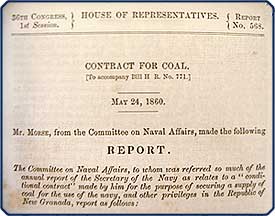
• Very Good condition, in recent wrappers.
For more POST-1820 AMERICANA, click here. For
more of PANAMANIAN interest, click here. For more of MILITARY/NAVAL interest, click here. For
a little more CARIBBEANA, click here.
 TO Part XV TO Part XV |