
 NEW & OLD
WORLD
NEW & OLD
WORLD HISPANICA — Una miscelánea
NEW & OLD
WORLD  Jesuit Born in FLORIDA
 Virgin of Guadalupe
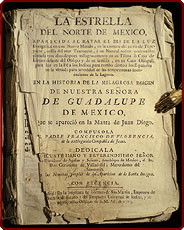
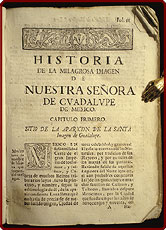
 Florencia, Francisco de. La estrella del norte de Mexico, aparecida al rayar el dia de la luz evangelica en este Nuevo Mundo, en la cumbre del cerro de Tepeyac, orilla del mar Tezcucano. Barcelona: en la imprenta de Antonio Velazquez, 1741. 4to. [4 of 10] ff., 260, [2] ff. (lacking title and 5 leaves of preliminary matter).
 Click the interior images for enlargements.
 In addition to recounting the Juan Diego story, Florencia examines the reliability of published accounts relating to the Virgin, discusses alleged later appearances, epitomizes the character of Juan Diego, and canvasses many other aspects of the Guadalupe legend. He also proposes the context for a novena in her honor.
• European Americana 741/85; Palau 92342 (the reported 1714 edition is a ghost, there having been a typographical error of 1714 for 1741 in the Robredo catalogue); DeBacker-Sommervogel, III, 796–97; Sabin 24807; Grajales & Burrus 141 (erroneously giving place of printing as Mexico!). Contemporary limp vellum, lacking ties; text block loose in binding. Lacking title-page but a copy of the 1785 title-supplied instead; title tattered, soiled and loose. Lacks also the first five preliminary leaves, and a heavily dog-eared copy. Some old pen trials here and there in blank areas. Definitely one for a “busted bibliophile.” (24393)
 MEXICO is one of our great specialties.
 For more CATHOLICA, click here. For a whole short shelf devotedFor more JESUITANA, click here. Or for PRE-1820 AMERICANA, click here. For Books for the BUSTED
 Louis
XVI — TaxesFrance.
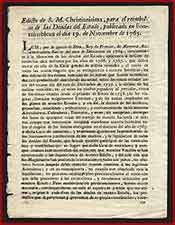
Sovereigns, 1774–1792 (Louis XVI).[drop-title] Edicto de S. M. Christianisima,
para el reembolso de las deudas del estado, publicado en Fontainebleau el dia
19. de Noviembre de 1765. [Spain, 1765]. 8vo. [2] ff.
Louis
XVI — TaxesFrance.
Sovereigns, 1774–1792 (Louis XVI).[drop-title] Edicto de S. M. Christianisima,
para el reembolso de las deudas del estado, publicado en Fontainebleau el dia
19. de Noviembre de 1765. [Spain, 1765]. 8vo. [2] ff.
• Not in Palau. Disbound from a volume of pamphlets, but in very good condition.
 One forFranciscan Novices Franciscans. Cartilla, y doctrina espiritual, para la crianza, y educacion de los novicios, que tomaren el habito de la orden de n.p. S. Francisco. Mexico: Imp. de D. Felipe de Zuñiga y Ontiveros, 1775. 12mo (14.7 cm; 5.75"). [3] ff., 118 pp.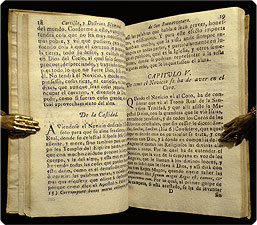
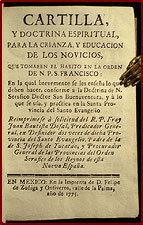 Click the images for enlargements.
 A scarce work, having been printed in a limited number of copies for the very limited-sized audience of Franciscan novices.
• Medina, Mexico, 5761. Contemporary limp vellum. Very clean and crisp. A truly excellent copy. (22204)
MEXICO is one of our great specialties. For more CATHOLICA, click here.
 Were?
the Franciscans Getting
Too
Were?
the Franciscans Getting
Too Uppity?
Franciscans.
Satisfacion [sic] por la religion de S. Francisco al manifiesto
que se ha publicado, ocultando su nombre el autor. [Madrid, ca. 1671?]. 30, [1
(blank)] ff.
Uppity?
Franciscans.
Satisfacion [sic] por la religion de S. Francisco al manifiesto
que se ha publicado, ocultando su nombre el autor. [Madrid, ca. 1671?]. 30, [1
(blank)] ff. Click
the image for an enlargement.
Click
the image for an enlargement.
• Not in Palau; not in Medina, BHA. Removed from a nonce volume. Title-page with shadow of pencilled numeral in upper margin; one leaf with institutional pressure stamp. Most leaves with old damage to outer margins, repaired of old in most instances, with loss of some words or letters from a number of shouldernotes; a few instances of early inked bracketing.
For 17TH-CENTURY BOOKS, click
here. For
CATHOLICA, click here.
For
EUROPEAN LAW, click here. MEXICO
is one of our great specialties. Or
for SOUTH AMERICANA, click
here.

 Surprising Content — Capuchins in TibetFrancisco, de Ajofrín, fray. Carta familiar de un sacerdote, respuesta a un colegial amigo suyo, en que le dà cuenta de la admirable conquista espiritual del vasto imperio del gran Thibèt, y la mission que los padres Capuchinos tienen alli, con sus singulares progressos hasta el present. Dase tambien una noticia succinta de la fundacion de esta penitente seraphica familia; de los santos que la ilustran, cardenales, arzobispos; de su observancia, y austeridad, missiones que tiene en todo orbe, provincias, conventos, y religiosos en que se halla propagada, con orras noticias historico-eclesiasticas. Mexico: En la imprenta de la Bibliotheca Mexicana , 1765. Small 4to. Frontis., [2] ff., 48 pp.
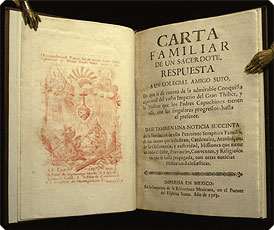
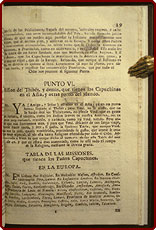
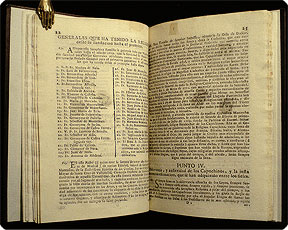 Click the images for enlargements.
 A special issue copy: Present here is an uncalled-for frontispiece. It is of four Capuchin martyrs, is signed by the artist Navarro, is engraved on copper, and is printed au sanguine -- the color reserved for only the most special copies of 18th-century books. This frontispiece is not called for by Medina and is not present in any of the copies reported as held in the U.S.
• Medina, Mexico, 4991; Palau 45600; Sabin 11098; Maggs, Bibliotheca Asiatica, 611. Full antique calf, spine gilt, leather label. Slight worming to late leaves, repaired with tape in an inoffensive fashion. Quite a good copy. (12725)
For more 18TH-CENTURY BOOKS, click here. MEXICO is one of our great specialties. For more CATHOLICA, click here. For ILLUSTRATED BOOKS, click here. This
also appears in the GENERAL
Spanish
Edition of
the Spiritual
Conferences inFrançois de Sales, St. Verdaderos entretenimientos del glorioso señor San Francisco de Sales.... Madrid: Por Andres Ortega a costa de Bartholome Ulloa, 1768. 4to (20.8 cm, 8.125"). [14] ff., 350 pp., [1 (blank)] f.
Spiritual
Conferences inFrançois de Sales, St. Verdaderos entretenimientos del glorioso señor San Francisco de Sales.... Madrid: Por Andres Ortega a costa de Bartholome Ulloa, 1768. 4to (20.8 cm, 8.125"). [14] ff., 350 pp., [1 (blank)] f.


• Palau 290780. Recent quarter red morocco over red cloth, spine gilt extra, red marbled endpapers, and top edge red. Clean, attractive interior.
 17th-Century
Spanish America
from an
17th-Century
Spanish America
from an Englishman’s
PerspectiveGage, Thomas. Manuscript on paper, in English. [New Survey of the West Indies]. Philadelphia?, mid 19th-century? 8vo (18.8 cm, 7.375"). [3 (blank)], [81], [1 (blank)] ff.
Englishman’s
PerspectiveGage, Thomas. Manuscript on paper, in English. [New Survey of the West Indies]. Philadelphia?, mid 19th-century? 8vo (18.8 cm, 7.375"). [3 (blank)], [81], [1 (blank)] ff. 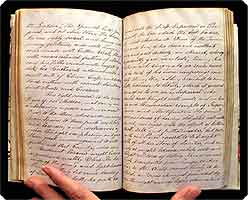
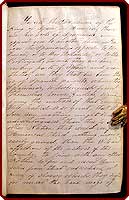 Single-click any image where the hand appears on
• On Gage, see: The Dictionary of National Biography, XX, 353–55. Recent marbled paper over light boards. Second and third blank leaves pasted together. Some light soiling, and some chipping and tears without apparent loss of text. Rubber-stamps from a now-defunct library.  The paper here is decidedly blue; the hand is very readable.
For more MANUSCRIPTS, click here.
The Amalgamation Process Explained Royal
OrderGarcés y Eguía, José. Nueva teórica y práctica del beneficio de los metales de oro y plata por fundicion y amalgamacion, que de orden del rey nuestro señor Don Carlos Quarto ... ha escrito y da al publico José Garcés y Eguia. Mexico: Mariano de Zuñiga y Ontiveros, 1802. Small 4to. [5] ff., 12, 168 pp.
Royal
OrderGarcés y Eguía, José. Nueva teórica y práctica del beneficio de los metales de oro y plata por fundicion y amalgamacion, que de orden del rey nuestro señor Don Carlos Quarto ... ha escrito y da al publico José Garcés y Eguia. Mexico: Mariano de Zuñiga y Ontiveros, 1802. Small 4to. [5] ff., 12, 168 pp.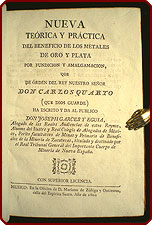

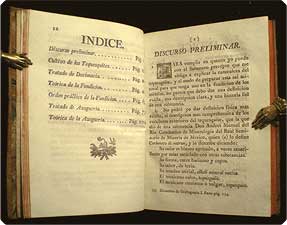 Single-click any image where the hand appears onA work also of considerable
scarcity in the marketplace.
Single-click any image where the hand appears onA work also of considerable
scarcity in the marketplace.
• Medina, Mexico, 9502; Palau 97721; Sabin 16551. Publisher's treed sheep binding, gilt spine extra, spine label mostly perished. All edges carmine. A very good copy.
MEXICO is one of our great specialties. For a little more SCIENCE, click here. For more INVENTIONS, click here. Or for MINING, click here. This
also appears in the GENERAL
DIFFERENCES
— Between
France
& SpainGarcía, Carlos. Antipatia de francesi e spagnuoli. Venetia: Presso Cristoforo Tomasini, 1640. 12mo. 216 pp.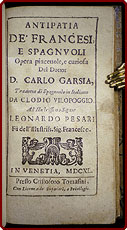

The subject of this work is the rivalry between Spain and France for political and religious supremacy in the Catholic realm of Europe, but the author also discusses national traits, as he sees them, such as manner of dressing, walking, eating, and talking.
• Palau 97802. Recent boards covered with marbled paper; leather spine label gilt with title. Some lower margins irregular due to natural paper flaws. All edges speckled red. A very good copy. (25812)
For more 17TH-CENTURY BOOKS, click here. For more BOOKS IN ITALIAN, click here. For more CONDUCT Books, click here. For more CATHOLICA, click here. For more TRANSLATIONS, click here. This book also appears in the GENERAL
Venezuela’s First NewspaperGazeta de Caracas. Suplemento a la Gazeta de Caracas. Caracas: Gallagher y Lamb, 27 April 1810 Folio (31 cm; 12.25"). 1 p.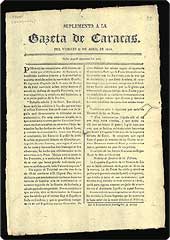 Click the image for an enlargement.
 Uncommon: Charno locates copies of the supplement only at the Newberry and University of Texas libraries.
• Charno, Latin American Newspapers in United States Libraries, pp. 590–92. As issued. Worming in foremargin, touching two letters; repaired; small hole where paper was thin at center of leaf, taking a bit of a rule but no text. Pencilling in margins. A very good copy.
BilingualLaws
of ToroGómez, Antonio. Ad leges tauri commenatrium absolutissimum. Editio nova cæteris longe locupletior.... Lugduni: Joannis Posuel, 1701. Folio (34 cm, 13.5"). ã2A–C4 D–Z6 Aa–Zz6 Aaa–Ccc6 Ddd4; [2] ff., 504 pp., [40 (index)] ff.
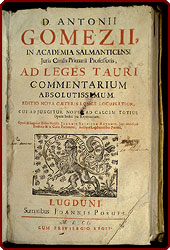
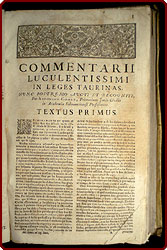
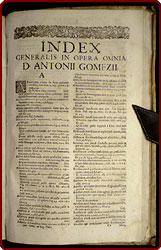 Click the images for enlargements.
 The text is mostly in Latin, with portions in Spanish; the printer has made use of nicely cut head- and tailpieces as well as a striking woodcut printer’s vignette (“De forti dulcedo”) on the red and black title-page.
RLIN and OCLC show only two U.S. holdings of this edition.
Provenance: Front free endpaper with bookplate of Michael J. O’Farrell, the first Bishop of the Diocese of Trenton; also with bookplate noting O’Farrell’s gift of the book to an institution.
• Palau 103253. Contemporary limp vellum, cockled and lightly soiled, with ties now lacking; spine with faded inked title. Title-page dusty, thin, and holed, with lower outside corner torn away, touching one letter and a red rule; date altered to 1601 by erasure of the first “C” in the roman-numeralled date! Leaves browned, foxed; instances of early inked marginalia and blots. Uncommon, as well as interesting for its contemporary use and its later provenance. (12184)
The Earthquake That Changed GuatemalaGonzález Bustillo, Juan. Extracto, ô Relacion methodica, y puntual de los autos de reconocimiento, practicado en virtud de commission del señor presidente de la Real Audiencia de este reino de Guatemala. Pueblo de Mixco [Guatemala]: Impreso en la oficina de A. Sanchez Cubillas, 1774. Folio (29.5 cm; 11.675"). [2], 86 pp. (without final leaf with one erratum) 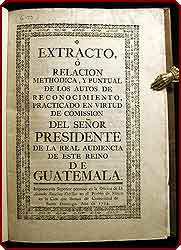
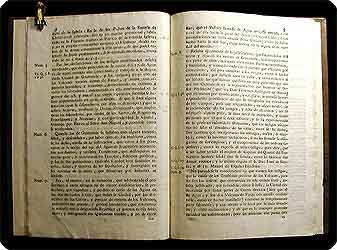 Single-click any image where the hand appears on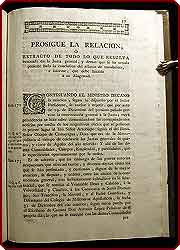
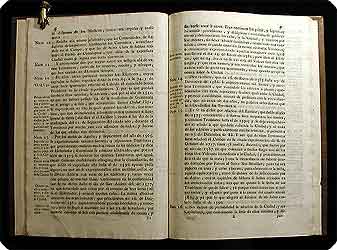
This document is one of the very few printed in the temporary capital of Mixco, a press having been salvaged from the ruins in the former capital. Thus, Mixco was the second city/town to have a press in Central America, and then, for only a short time—appoximately two years.
In addition to being important for its contents and in the realm of printing history, the González Bustillo report is uncommon: We trace only half a dozen copies in U.S. libraries.
• Medina, Guatemala, 384; Palau 105113; Sabin 27811. Modern full calf, very plain style. Without the final leaf with one erratum on it.
For 18TH-CENTURY BOOKS, click here. For more CENTRAL AMERICANA, click here. For NATURAL HISTORY, click here.

 CONTRA-BANDO González de Salcedo, Pedro. Tratado juridico politico del contra-bando.... Madrid: Juan Muñoz, 1729. Folio (30 cm, 12.75"). [6] ff., 400 pp.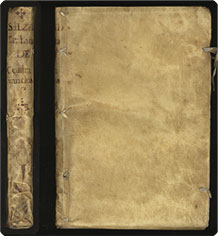
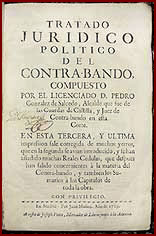
 In all, an important and bedrock work for the study of Spanish commercial policy. First published in 1654: We offer here the third edition, corrected.
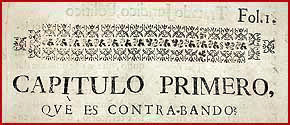 For more 18TH-CENTURY BOOKS, click here. For more COMMERCE / TRADE / For EUROPEAN LAW, click here.

 On the Loyalty Oath of 1820 [Granados, Francisco]. [drop-title] La cola de las zorras de Sanson, ó defensa de su autor. [colophon: Mexico: Alejandro Valdes, 1820]. 4to. 7, [1 (blank)] pp.
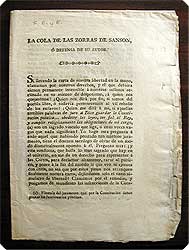
• Medina, Mexico, 11697; Garritz, Impresos novohispanos, 3585; Sutro 112; Steele 12. Folded, never bound. Minor worming affecting a few letters. Writing in pencil on first page. (3905)
MEXICO is one of our great specialties.
Spanish as a Second Language, 1835 Granja, Juan de la. Rasgos históricos de magnanimidad, valor, y nobleeza: Anecdotas, sentencias y ejemplos raros de virtud; dichos notables, cuentos, fábulas y ocurrencias graciosas, en prosa y en verso. Nueva York: Imprenta de Don Juan de la Granja, 1835. Small 8vo. 252 pp., [2 (index, ads)] ff.
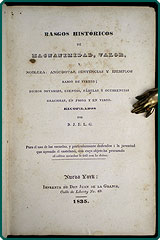 Click the images for enlargements.
 Provenance: Early 19th-century ownership signatures on front free endpaper of Anthony Coe Ogilvie and E.H.(?) Ogilvie.
• American Imprints 31923. Not in Palau. Publisher’s quarter cloth with paper-covered sides; binding waterspotted. Scattered light foxing. A good copy. (26144)
MEXICO is one of our great specialties. For more Books with SPECIAL For more POST-1820 AMERICANA, click here. Or for CHILDREN / EDUCATION, click here.
Defending the Origins Story of the Virgin of Guadalupe Guridi Alcocer, José Miguel. Apología de la aparicion de
Nuestra Señora de Guadalupe de Méjico, en respuesta a la disertacion que la impugna. Mexico: En la oficina de Don Alejandro Valdes, 1820. Small 4to (21.5 cm; 8"). [5] ff., 201, [1] pp., [4] ff. (without the plate).
Virgin of Guadalupe Guridi Alcocer, José Miguel. Apología de la aparicion de
Nuestra Señora de Guadalupe de Méjico, en respuesta a la disertacion que la impugna. Mexico: En la oficina de Don Alejandro Valdes, 1820. Small 4to (21.5 cm; 8"). [5] ff., 201, [1] pp., [4] ff. (without the plate).
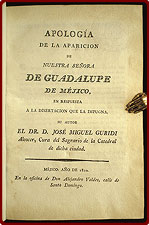
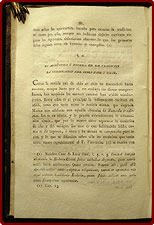 Click the interior images for enlargements.
 The work ends with a list of subscribers, making this one of the few colonial Mexican books with such a list.
• Medina, Mexico, 11897; Palau 111216; Garritz 3593. Mid-19th-century sheep, nicely gilt-tooled; leather a little dry and rubbed. Faint 19th-century stamps of an ecclesiastical library. Without the Montes de Oca plate; else, a very good copy. (23969)
For more CATHOLICA, click here. For a whole short shelf devoted MEXICO is one of our great specialties.
Guridi
y Alcocer vs.
Lopez
de Cancelada
Guridi y Alcocer, José Miguel. Censor Extraordinario. Contestación de don José Miguel Guridi Alcocer lo que contra él y los Derechos de las Cortes se ha vertido en los números 13 y 14 del Telégrafo americano.... [colophon: Cadiz: En la impr. de Don Agapito Fernandez Figueroa, 1812]. 4to (20 cm; 7.5"). 47, [1 (blank)] pp.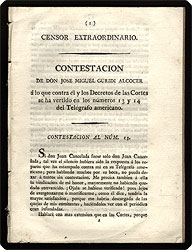
Guridi y Alcocer here defends himself and various of his statements in the Cortes from Cancelada's attacks in that newspaper, both personal and political. Guridi sought to open the (whole) New World to free trade, arguing for free access to European seeds, plant stocks, and exports generally. He also sought administrative reform, reduction in regulations, and the ending of colonial status.
WorldCat locates only two copies Worldwide.
• Palau 111215; Sutro 87. Removed from a nonce volume. One small tear in a margin, repaired. Clean and nice. (26042)
MEXICO is one of our great specialties. For SOUTH AMERICANA, click here. For more COMMERCE / TRADE / For a bit more AGRICULTURE, click here.
 TO Part VII TO Part VII |