
 NEW & OLD
WORLD
NEW & OLD
WORLD HISPANICA — Una miscelánea
NEW & OLD
WORLD  The Andrade Set in
 Quarter Red Morocco
  Barcía, Andrés González de. Ensayo cronologico, para la historia general de la Florida. Madrid: Imprenta de los Hijos de Doña Catalina Piñuela, 1829. 12mo. 2 vols. I: [2] ff., 508 pp., fold. table. II: [2] ff., 512 pp.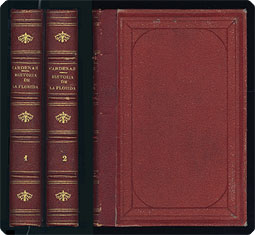
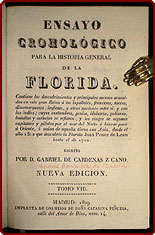
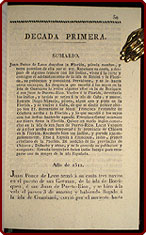
 Click the page-images for enlargements.
 The present edition forms volumes 8 and 9 of the series Historia de la conquista del Nuevo Mundo.
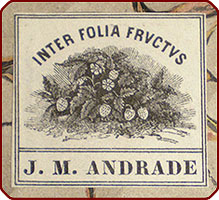
Provenance: Bookplate of the great 19th-century Mexican collector J. M. Andrade on the front pastedown of each volume.
• This edition not in Sabin. 19th-century quarter red morocco with red textured cloth sides. Spine with raised bands and very good gilt tooling including center devices in spine compartments. Interiors clean. A very good set. (25271)
 For more POST-1820 AMERICANA, click here.
 MEXICO is one of our great specialties. For more of NATIVE AMERICAN interest, click here. For more MEDICINE, click here. For more of MILITARY/NAVAL For more Books with SPECIAL This set also appears in the GENERAL
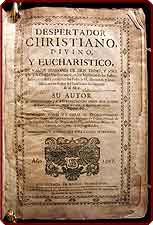
 “Christian Alarm-Clock!”Barcia y Zambrana, José de. Despertador christiano, divino, y eucharistico, de varios sermones.... Madrid: Por Alonso Balvàs a costa de Francisco Laso, 1727. Folio (30 cm, 11.875"). [6] ff., 406 pp., [13] ff.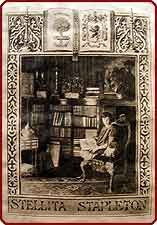
Provenance: Bookplate of Stellita Stapleton (first half of 20th century; see image above right).
• Palau 24060. Contemporary limp leather with traces of ties; binding worn with a little holing. Title-page torn and repaired with some obscuring of letters; paper browned and text dog-eared with some staining and tattering, resulting in no apparent loss of text. Inked ownership inscriptions on title-page.
 17th-Century
 Puebla ImprintBarcia y Zambrana, José de. Epistola exhortatoria en orden a que los predicadores evangelicos no priven de la doctrina a las almas en los sermones de fiestas. Puebla: Impr. de D. Fernandez de Leon, 1693. Small 4to. [3] ff., 106 pp.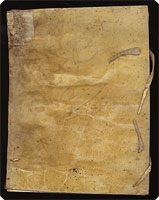
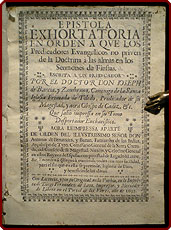
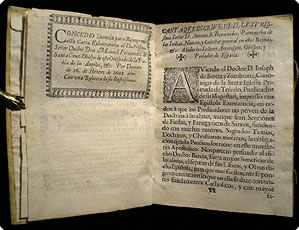
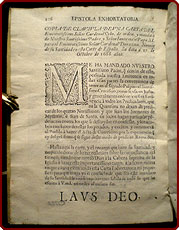 Click the interior images for enlargements.
 Uncommon: We locate five copies in the U.S.
• Medina, Puebla, 159. Contemporary limp vellum with ties. Front hinge (inside) partially open and old repair to top of spine; text block starting to separate from binding, but still strong. Large private ownership stamp on front free endpaper. Unidentified marca de fuego on top edge. In all, a decent copy. (25111)
For more 17TH-CENTURY BOOKS, click here. MEXICO is one of our great specialties. For more CATHOLICA, click here.

 First
First ENGLISH Appearance: Life of Ximenes Baudier, Michel. The history of the administration of Cardinal Ximenes, great minister of state in Spain. London: John Wilkins, 1671. 8vo (16.7 cm, 6.6"). Frontis., [48], 150 pp. (final blank f. lacking).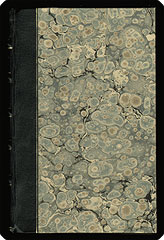
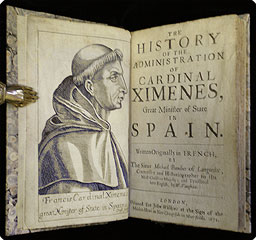 Click the images for enlargements.
  a striking copper-engraved frontispiece portrait of Cardinal Cisneros, done by Thomas Cross.
• ESTC R6814; Wing (rev. ed.) B1164; Lowndes 3014; Allibone 2513. Not in Brunet. Recent quarter morocco and marbled paper–covered sides, spine with gilt-stamped title, gilt-ruled raised bands, and gilt-stamped compartment decorations. Lower edges (closed) institutionally rubber-stamped; frontispiece recto rubber-stamped and with inked ownership inscription; title-page and last text page pressure-stamped. Pages age-toned with occasional light spotting; edge speckling sometimes bleeding into margins. Lacking final blank (only); all edges speckled brown. (25935)
For more 17TH-CENTURY BOOKS, click here. For more BIOGRAPHIES, mostly 20th-Century For more CATHOLICA, click here. For more TRANSLATIONS, click here. For more WING BOOKS, click here. This book also appears in the GENERAL
 “Cancion
Patriotica de Caracas”
— RareBELLO
Poetry BroadsideBello, Andrés. Broadside, begins: “Cancion Patriotica de Caracas.” [Caracas: Gallagher y Lamb, 1810]. Folio (31 cm; 12.25"). 1 p.
“Cancion
Patriotica de Caracas”
— RareBELLO
Poetry BroadsideBello, Andrés. Broadside, begins: “Cancion Patriotica de Caracas.” [Caracas: Gallagher y Lamb, 1810]. Folio (31 cm; 12.25"). 1 p.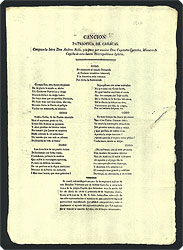 Click the image for an enlargement.
the
premiere of this one, as unknown as that one is famous, is stirring to visualize.
Beginning, “Caraqueños, otra época empieza: / De la gloria la senda se
abrio,” it was sung for the first time by Cayetano Carreño himself and six other
voices, the night of 23 April 1810, with the accompaniment of the military orchestra
of the “Batallon Veterano.” The performance took place below the balcony on
which were assembled the members of the Supreme Junta.
Click the image for an enlargement.
the
premiere of this one, as unknown as that one is famous, is stirring to visualize.
Beginning, “Caraqueños, otra época empieza: / De la gloria la senda se
abrio,” it was sung for the first time by Cayetano Carreño himself and six other
voices, the night of 23 April 1810, with the accompaniment of the military orchestra
of the “Batallon Veterano.” The performance took place below the balcony on
which were assembled the members of the Supreme Junta.
That Bello wrote this patriotic song is known, and even the first few lines
were recorded for history, but beyond that  the
text is not recorded and is not found in his Obras
completas or, apparently anywhere else.
the
text is not recorded and is not found in his Obras
completas or, apparently anywhere else.
In addition to the historic collaboration of Bello and Carreño, this fabulous document has the distinction of having been printed by Venezuela’s first press, that of Gallagher and Lamb, which only arrived in Caracas in October of 1808, and was almost certainly printed on 24 April, the day after the hymn was first sung!
Very
Rare.
This broadside was unknown to both Medina and Pedro Grases. Searches of NUC,
OCLC, and RLIN fail to find any copy at all, as is the case when searching
the OPACs of the national libraries of Venezuela, Colombia, Spain, France,
and England.
• Not in Medina, Caracas; not in Grases, Historia de la imprenta en Venezuela; not in Villasana. As issued. Worming in foremargin, repaired. A very good copy.
For more BROADSIDES, click here. For more SOUTH AMERICANA, click here. For more LITERATURE, click here. This
also appears in the GENERAL
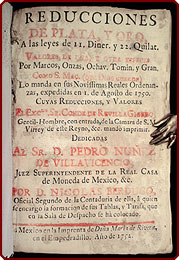
 Gold & Silver Conversion Tablesthe Press of a Woman Printer Berdugo, Nicolás. Reducciones de plata, y oro a las leyes de 11. diner. y 22. quilat. valores de una y otra especie por marcos, onzas, ochav. tomin. y gran. como S. Mag. (que Dios guarde) lo manda en sus novissimas reales ordenanzas, expedidas en 1. de agosto de 1750. Cuyas reducciones, y valores el Excmo. Sr. Conde. de Revilla Gigedo ... mandò imprimir. Mexico: Impr. de Doña Maria de Rivera, 1752. Small 8vo (14.8 cm; 5.875"). [15] ff., 324 pp.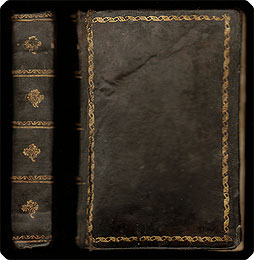
 Click the images for enlargements.
 The work was  absolutely essential for all merchants and other business people, and for government workers in the treasury department — for milled coins were the exception in Mexican commerce, cob pieces the norm, and raw gold and silver, including dust, were extremely common.
The volume ends with the “Reglas varias, para sacar juntos, o separados en pasta, o en moneda los reales derechos, que se pagan a S. Mag. De el oro y de la plata, y para reducir a toda su ley estos metales.”
An uncommon economic work: We trace fewer than nine copies in the U.S.
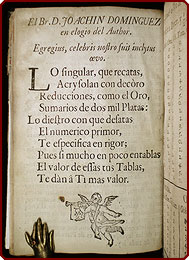
This was printed by Doña Maria de Rivera with a red and black title-page, and with woodcut arms on first dedication page. The charming cut of a herald cherub appears after the decima dedicated to the author at the end of the preliminaries.
• Medina, Mexico, 4073. Contemporary full Mexican calf, modestly tooled in gilt and with all edges red; recased, new endpapers. Final two leaves little ragged at edges costing a few letters and with small hole at center and short tears at inner margin; old staining and age-toning/browning throughout.  There is every indication that this well-produced little volume saw time “in the field”! (26850)
For more 18TH-CENTURY BOOKS, click here. MEXICO is one of our great specialties. For more COMMERCE / TRADE / For a little more SCIENCE, click here. For more MATHEMATICS, click here. For more of WOMEN's interest, click here.

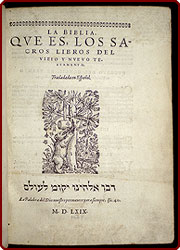
The Bear Bible — The FIRST Complete Bible in Spanish Bible.
Spanish. Reina. 1569. La Biblia, que es, los sacros libros
del vieio y nueuo testamento. [Basel: Thomas Guarinus for or with Samuel Apiarius],
1569. 4to. [15 of 16] ff., 1438 columns, [1] p., 544, 508 columns, [1] p., [1]
f. (without the 3 leaves of “Annotationes” and the final blank);
illus.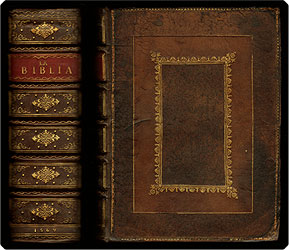
 Click the images for enlargements.
 Rather, the production of a Bible in Spanish fell to a peripatetic exiled Spaniard named Casiodoro de Reina (ca. 1520–94), a man who began his adult life as a monk, came under suspicion of being a “Reformist,” and fled Spain for Geneva — later fleeing that city for a series of others and declaring it “a new Rome” for its intolerance of new ideas. Whether the translation is solely from his pen or is the work of a committee in which he was primus inter pares is not known.
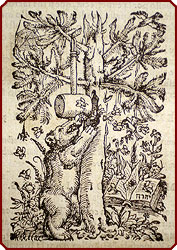
This Bible is known as the “Bible of the Bear” or the “Bear Bible” because of the printer's device on the title-page, a bear at a honey comb, which was the device of Samuel Apiarius. The relationship between Apiarius and the actual printer, Thomas Guarinus, is unresolved. The Old Testament in this translation is based on the Hebrew and derived heavily from the Latin of St. Pagninus and from the Ferrara version. The New Testament is based on the Greek of Erasmus with comparisons to the Vetus Latina and Syriac manuscripts.
There are two states of the title-page, this being state A with the line of type ornaments described in Darlow and Moule.
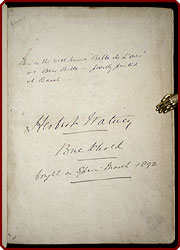
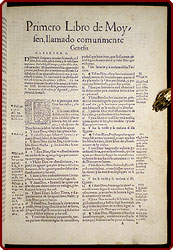
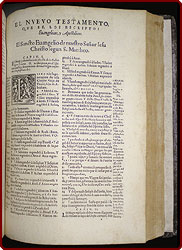
• VD16 B2869; Rumball-Petre262; Darlow & Moule 8472; Graesse, I, 386; Palau 2894; Adams B12061. 17th-century English calf, rebacked with new spine gilt extra very suitable in style; leather of covers a bit crackled and variously darkened; small areas of the covers at board edges replaced with new leather sympathetically gilt-tooled. Lacks the blank preliminary leaf and the four leaves at the end of “Annotationes breves sobre los lugares . . . “, both of which are very often lacking, the latter leaves having perhaps (even probably) been printed separately and later. Small piece of front fly-leaf cut away (probably removing an ownership inscription). The occasional instance of light soil or light waterstaining to fore- or bottom margins, sometimes reaching text; a generally clean and good copy. All edges mottled red and blue-green. (25772)
For 16TH-CENTURY BOOKS, click here. For BIBLES & TESTAMENTS, click here. For TRANSLATIONS, click here. & it appears in the GENERAL
Hands
OffOur
Guano!Briceño, Mariano de. Memoir justificatory of the conduct of the government of Venezuela on the Isla de Aves question, presented to his excellency the secretary of state of the United States.... Washington City: F.H. Sage, printer, 1858. 8vo (21.5 cm, 8.5"). 22 pp., [1 (blank)] f.
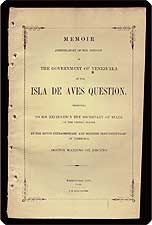
• Not in Palau. Original yellow printed wrappers, removed from a nonce volume with stab holes in the inner margins; inside wrappers with a short closed tear and a little shallow chipping, light soiling and a few stray marks. Fold mark down the center and traces of soiling on the top edges.
For a little more CARIBBEANA, click here. For more POST-1820 AMERICANA, click here. For more COMMERCE / TRADE /
He Served UnderMORELOS Bustamante, Carlos María de; & Pablo de Mendíbil.
Resúmen histórico de la revolución de los Estados Unidos Mejicanos. Londres [etc.]: R. Ackermann, 1828. 8vo (21.5 cm; 8.5"). Frontis., xxv, [1 (blank)],423, [1 (blank)] pp., [1 (instructions to binder)], [2 (ads for book in Spanish published by Ackermann)] ff., 4 litho. ports.
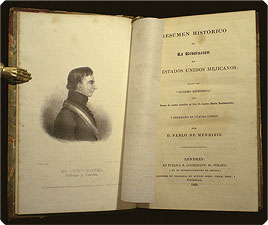
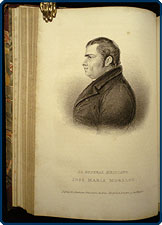 Click the interior images for enlargements.
 In this edition Lic. Pablo de Mendibil has edited the letters into four large chapters and added lithographic portraits of Hidalgo, Morelos, Bravo, Guerrero, and Guadalupe Victoria. They are variously from originals by Gauci or unidentified artists, and are lithographed by either R.Cooper or Englemann & Co.
• Sabin 47810; Palau 163362 (under Mendibil). Mid–19th century half red leather, flat spine, machine-made marbled paper on covers and as endpapers, marbled edges. Leather abraded and refurbished; interior clean and nice. (21727)
MEXICO is one of our great specialties. For more ILLUSTRATED BOOKS, click here. For more of MILITARY/NAVAL interest, click here. For more BIOGRAPHIES, mostly 20th-Century
 TO Part III TO Part III |