 SCIENCE
 See also: Astronomy, Inventions, Medicine, Natural History . . .
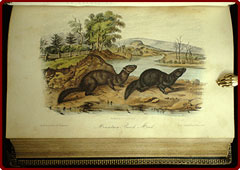
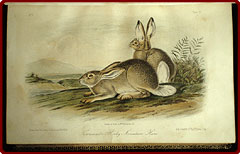
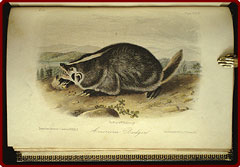
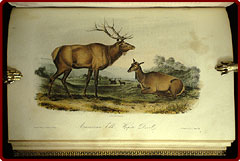
SCIENCE  Wildcats,
Bears,
Rabbits,
Otters,
Skunks,
Buffalo,
& “Wapite”
Wildcats,
Bears,
Rabbits,
Otters,
Skunks,
Buffalo,
& “Wapite” Audubon, John
James, & John Bachman. The quadrupeds of North America. New-York:
V.G. Audubon, 1854. Royal 8vo (27.5 cm; 10.75"). 3 vols. I: viii, 383, [1 (blank)]
pp., 50 plts. II: [2] ff., 334 pp., 49 plts. III: v, [1], 348 pp., [1] f., 51
plts.
Audubon, John
James, & John Bachman. The quadrupeds of North America. New-York:
V.G. Audubon, 1854. Royal 8vo (27.5 cm; 10.75"). 3 vols. I: viii, 383, [1 (blank)]
pp., 50 plts. II: [2] ff., 334 pp., 49 plts. III: v, [1], 348 pp., [1] f., 51
plts.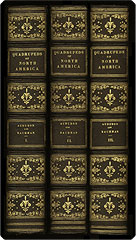
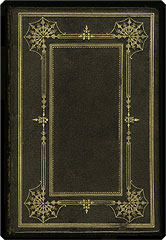
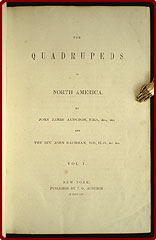
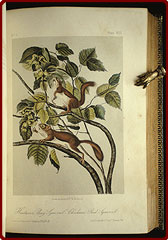
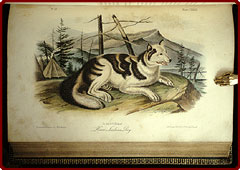
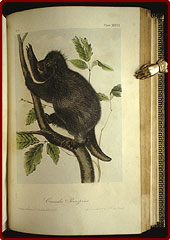
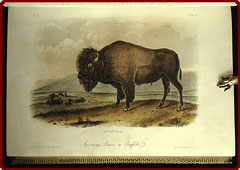
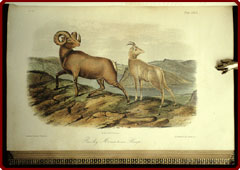
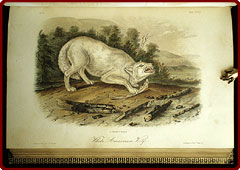
 155 fine handcolored lithographed plates by W. E. Hitchcock and R. Trembly after J.J. and J.W. Audubon, lithographed by J.T. Bowen.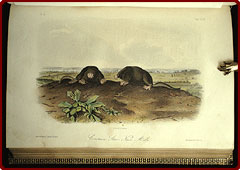
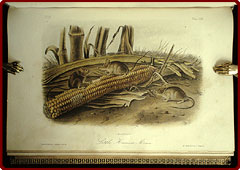
 A lovely set. (23904)
 For AMERICANA
POST-1820,
For AMERICANA
POST-1820,

 Bacon
— Latinized for LongevityBacon,
Francis. ... Opera omnia, cum novo eoque insigni augmento tractatuum hactenus ineditorum, & ex idiomate anglicano in latinum sermonem translatorum, opera Simonis Johannis Arnoldi, ecclesiae Sonnenburgensis inspectoris. Lipsiae:
Impensis Johannis Justi Erythropili, excudebat Christianus Goezius, 1694. Folio (33.5 cm, 13.25"). ):(6 A–Z6 Aa–Zz6 Aaa–Iii6 Kkk–Zzz4 Aaaa–Hhhh4 Iiii6 [-):(1]; [8] ff., 1584 columns, [49 (index)] pp. (half-title lacking).
Bacon
— Latinized for LongevityBacon,
Francis. ... Opera omnia, cum novo eoque insigni augmento tractatuum hactenus ineditorum, & ex idiomate anglicano in latinum sermonem translatorum, opera Simonis Johannis Arnoldi, ecclesiae Sonnenburgensis inspectoris. Lipsiae:
Impensis Johannis Justi Erythropili, excudebat Christianus Goezius, 1694. Folio (33.5 cm, 13.25"). ):(6 A–Z6 Aa–Zz6 Aaa–Iii6 Kkk–Zzz4 Aaaa–Hhhh4 Iiii6 [-):(1]; [8] ff., 1584 columns, [49 (index)] pp. (half-title lacking). 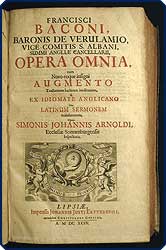
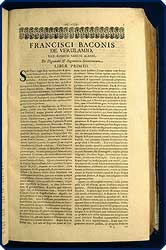
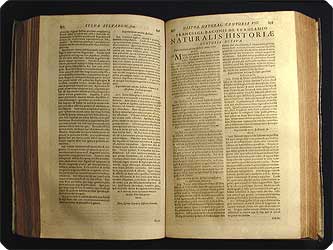
 Click the interior images for enlargements.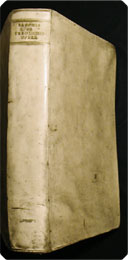
This offers evidence of early readership in form of underlining in ink and occasional marginal notations, confined to early portion of the tome.
• Gibson, Bacon, 243a. On Bacon, see: Oxford Companion to English Literature, 56–57. Contemporary vellum, spine with gilt-stamped title; vellum showing minor scuffing and spots of discoloration. Front pastedown with a 19th-century bookplate; front free endpaper with edge nicks and short edge tears. Lacking half-title. Early inked marginalia and underlining, as above; leaves age-toned with intermittent light offsetting and foxing. One leaf with short tear from upper margin, not extending into text.

 “Fundamentall to the Erecting & Building of
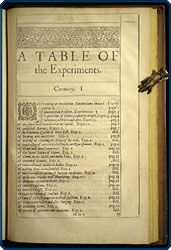
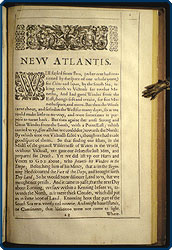
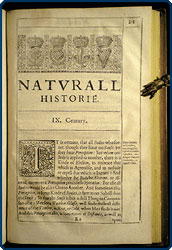
 a True Philosophy”Bacon, Francis. Sylva sylvarum or a naturall history in ten centuries. London: Pr. by J.H. for William Lee, 1627. 8vo (27.6 cm, 10.9"). Frontis., add. engr. t.-p., [10], 266, [16], 47, [3] pp. (lacking final blank f.).
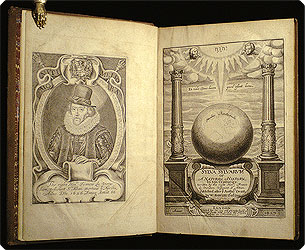
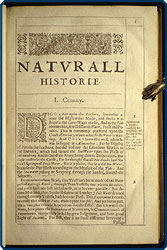 Single-click any image where the hand appears onNew Atlantis, an unfinished allegorical fantasy begun shortly after his political downfall and not long before his death. Together, the two works exemplify Bacon's scientific and literary accomplishments.
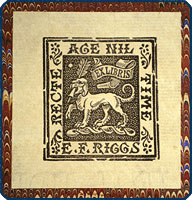
Provenance: Riggs family: Front pastedown with armorial bookplate of philanthropist Elisha Francis Riggs, who funded the Riggs Library at Georgetown University; volume inherited by T. Lawrason Riggs, founding chaplain of St. Thomas More Chapel, Yale University; donated to St. Thomas More Chapel Library; deaccessioned 2008.
• ESTC S106924; STC (2nd ed.), 1169; Gibson, Bacon, 171. On Bacon, see: Dictionary of National Biography. 18th-century calf framed in gilt single fillet, spine with recent gilt-stamped leather title and author labels, board edges with gilt roll; a little rubbed and covers with portions darkened. All edges stained yellow. Front pastedown with bookplate as above. Some pages gently age-toned, with occasional minor spotting. Small hole to added engraved title-page just beneath publication information, not affecting text. Final blank leaf (only) lacking. (24666)
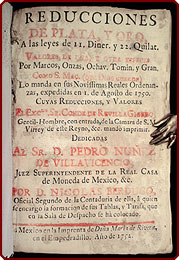
 Gold & Silver Conversion Tablesthe Press of a Woman Printer Berdugo, Nicolás. Reducciones de plata, y oro a las leyes de 11. diner. y 22. quilat. valores de una y otra especie por marcos, onzas, ochav. tomin. y gran. como S. Mag. (que Dios guarde) lo manda en sus novissimas reales ordenanzas, expedidas en 1. de agosto de 1750. Cuyas reducciones, y valores el Excmo. Sr. Conde. de Revilla Gigedo ... mandò imprimir. Mexico: Impr. de Doña Maria de Rivera, 1752. Small 8vo (14.8 cm; 5.875"). [15] ff., 324 pp.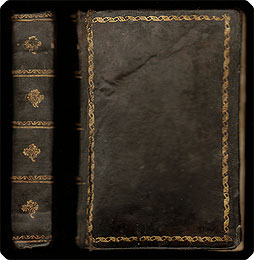
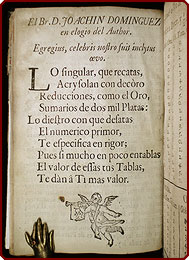 Click the images for enlargements.
 The work was  absolutely essential for all merchants and other business people, and for government workers in the treasury department — for milled coins were the exception in Mexican commerce, cob pieces the norm, and raw gold and silver, including dust, were extremely common.
The volume ends with the “Reglas varias, para sacar juntos, o separados en pasta, o en moneda los reales derechos, que se pagan a S. Mag. De el oro y de la plata, y para reducir a toda su ley estos metales.”
An uncommon economic work: We trace fewer than nine copies in the U.S.
This was printed by Doña Maria de Rivera with a red and black title-page, and with woodcut arms on first dedication page. The charming cut of a herald cherub appears after the decima dedicated to the author at the end of the preliminaries.
• Medina, Mexico, 4073. Contemporary full Mexican calf, modestly tooled in gilt and with all edges red; recased, new endpapers. Final two leaves little ragged at edges costing a few letters and with small hole at center and short tears at inner margin; old staining and age-toning/browning throughout.  There is every indication that this well-produced little volume saw time “in the field”! (26850)
Written While Living in Rhode Island & Drawing Its Landscape Berkeley, George. Alciphron: Or, the minute philosopher. In seven dialogues. Containing an apology for the Christian religion, against whose who are called free-thinkers. London: J. Tonson, 1732. 8vo. 2 vols. I: [6] ff., 350 pp. II: [4] ff., 358 pp.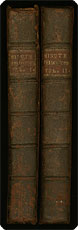
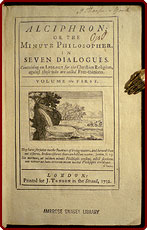
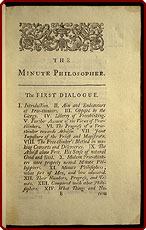
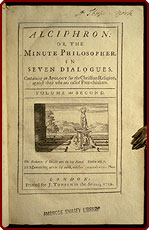 Click the interior images for enlargements.
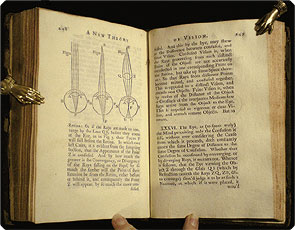
 Presented here is Berkeley's defense of revealed religion: It ranks as a major example of English literature and of American literature too, for he wrote it while living in America waiting for money for his projected university in Bermuda. “Alciphron, a set of dialogues located notionally in England, but drawing much of the landscape description from Rhode Island,” sold well and aroused controversy after his return to Britain. The New Theory of Vision is “a work of lasting importance in the psychology of perception[; it] was transitional between Berkeley's already informed interests in mathematics and natural philosophy and a growing independence of mind in metaphysics and epistemology” (both quotations from DNB on-line).
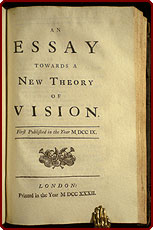
Provenance: “A. Thorpe – York” inscribed on title-pages.
• ESTC T86056; NCBEL, II, 1852. Not in European Americana. Contemporary sheep, spines with raised bands and gilt-stamped red leather labels; covers framed and paneled in blind-stamped triple fillets with blind-stamped corner fleurons; all edges red. Leather rubbed with some loss to corners, edges, turn-ins; vol. I with pulls at both spine extremities, small gouge to front cover, front joint opening with cover almost off. Old institutional bookplates and rubber-stamp to pastedowns, title-pages, and lower edges of closed volumes; ink ownership signature to title-pages as above and a few additional ink and pencil marks; some very scattered spots or staining with pages generally clean. (21366)
 For more SETS, click here.
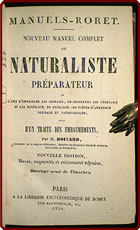
The PLATES areInteresting & um, Explicit Boitard, Pierre. Nouveau manuel complet du naturaliste préparateur, ou l’art d’empailler les animaux, de conserver les végétaux et les minéraux, de préparer les pièces d’anatomie normale et pathologique ... nouvelle édition. Paris: Librairie encyclopédique de Roret, 1852. 12mo (14.7 cm, 5.8"). [4], 510 pp.; 4 fold. plts. (of 5).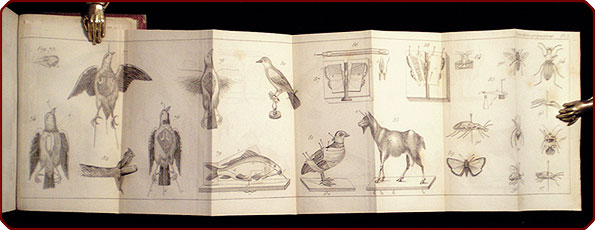 Click the interior images for enlargement.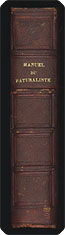
• Contemporary quarter morocco with pebbled cloth–covered sides, spine with gilt-stamped title; corners and spine extremities rubbed. Front pastedown with private collector’s bookplate, this and the front free endpaper then institutionally rubber-stamped. One plate lacking (no. 5). Pages slightly age-toned; plates with small spots of light foxing. (20363)
A Not-So-Brief History ofTime Brady, John. Clavis calendaria; or, a compendious analysis of the calendar: Illustrated with ecclesiastical, historical, and classical anecdotes ... second edition. London: Pr. for the author & sold by Longman, Hurst, Rees, Orme, & Brown, et al., 1812–13. 8vo (21.6 cm, 8.5"). 2 vols. I: xxxvi, 387, [1] pp.; 1 plt. II: [2], 395, [1] pp. 
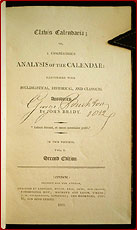
Click the images for enlargements.
Vol. I is illustrated with one wood-engraved plate depicting a Saxon almanac, and seven in-text engravings depicting Odin, Frigga, Thor, and the other deities with days named in their honor.
Provenance: Signature on title-pages of George Buckton, vol. I dated 1812 and vol. II dated 1813.
• Allibone 237 (listing 1813 & 1814 eds. only); NSTC B4120. Contemporary treed calf, rebacked preserving original spines with gilt-stamped titles, gilt-ruled and -dotted compartment bands, and gilt-stamped compartment decorations; original spine leather chipped, cracked, and darkened as by fire. Covers with corners and edges unobtrusively rubbed; portions nearest spines showing evidence of heat exposure; hinges (inside) reinforced. Front pastedowns each with institutional bookplate, vol. I front pastedown with bookseller's ticket and affixed early cataloguing slip, vol. I back pastedown and vol. II front pastedown with inked library inscription. Title-pages with inked ownership inscriptions as above. Offsetting from plate and to endpapers from binding, pages otherwise clean though with all edges (i.e., of closed book) darkened.  A particularly handsome exemplar of popular scholarship of the day. (25436)
Gastronomic Masterpiece ILLUSTRATED — Limited Edition Brillat-Savarin, Jean Anthelme. Physiologie du goût ou meditations de gastronomie transcendante. Paris: Les Arts & Le Livre, 1926. 2 vols. 8vo (24 cm, 9.4"). I: xlii, [2], 252 pp.; illus. II: [4], 300, [2] pp.; illus.
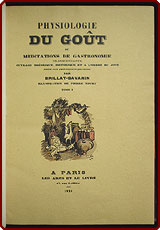
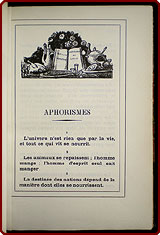
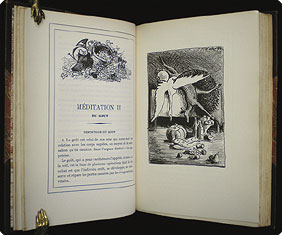
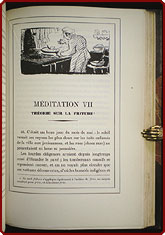 Click the images for enlargements.
 Provenance: Front pastedown of vol. I with bookplate of Francis de Neufville Schroeder, a descendent of the first mayor of New York.
• Not in Bitting. Contemporary half red morocco and marbled paper–covered sides, spines with gilt-stamped author and title; corners and joints showing some shelf wear, spines slightly darkened. Vol. I front pastedown with bookplate as above. Original yellow wrappers in near-perfect condition; overall, a lovely set. (25885)
For
more COOKERY, click here.

BROUGHAM on Literature & Science — with MS. Letter Brougham, Henry Peter, Baron Brougham & Vaux. Addresses on popular literature, and on the monument to Sir Isaac Newton: Delivered at Liverpool and Grantham. London: Edward Law, 1858. 8vo. 63, [1] pp.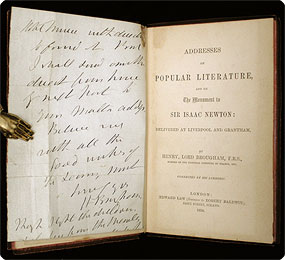
 Click the images for enlargements.
 Provenance: Ownership signature on front free endpaper, “Mr. Justice McDougall, Jamaica.”
Autograph manuscript addition: Tipped onto the title-page is a manuscript letter signed by Brougham, dated 1839. In this informal but warmly written letter apparently addressed to an uncle, he declines an invitation and briefly mentions “the children,” whom he thought were left safe from the measles at Paris; he had one living daughter at the time of this letter's composition, and may be referring to members of his extended family.
• NSTC 2B51067. Publisher's limp red cloth in imitation of morocco, yapp edges, covers blind-stamped, spine with gilt-stamped title; extremities rubbed, spine slightly darkened with small paper label, sides with small areas of minor discoloration. All edges stained red. Front free endpaper with early inked inscription and small private pressure-stamp. Pages age-toned; one early inked correction. (26986)

 TO Part
II . . . TO Part
II . . . |