
 SCIENCE
 See also: Astronomy, Inventions, Medicine, Natural History . . .
SCIENCE  Science for Children
 Marles, J. de. Les cent merveilles des sciences et des arts. Huitieme edition. Tours: Alfred Mame et fils, 1869. 12mo. Frontis., add. engr. t.-p., [2], 5-240 pp.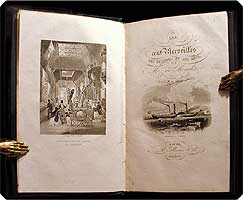
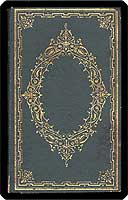
• Contemporary gilt-stamped green cloth with a bit of light wear to the head and foot of the spine, otherwise bright and lovely. Some page edges uncut. (10569)

Standard
& Ground
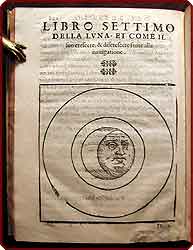
(or Wave?)-BreakingMedina, Pedro de. Arte del navigare. Venetia: Appresso Tomaso Baglioni, 1609. 4to (20.5 cm, 8"). A4 b4 2A8 B–Q8 R10; [7], [1 (blank)], 137, [1 (blank)] ff.; illus. 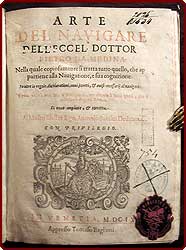
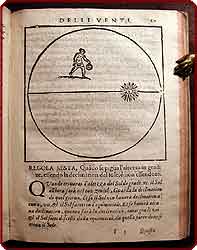
 Also included is a woodcut map showing Europe, the Atlantic, and the New World.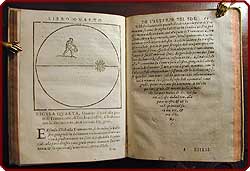
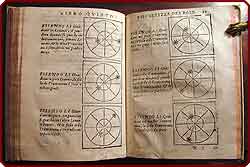
• Palau 159680; Alden & Landis, European Americana, 609/77; Medina, BHA, 123. Old vellum; red leather, gilt-lettered spine label; some staining, and chipping to edges and label. Old, careful repairs to interior worming occasionally cost individual letters (but never sense) or a little loss to an illustration. Old rubber-stamps and red and black ownership label on title-page; inked notations on title-page and front pastedown. All edges speckled red.


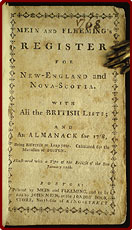
 Colonial-era American Almanac Mein and Fleeming's register for New-England and Nova Scotia. With all the British lists; and an almanack for 1768, being bissextile or leap year. Calculated for the meridian of Boston. Illustrated with a type of the eclipse of the sun of January 19th. Boston: Printed by Mein and Fleeming, and to be sold by John Mein at the London Book-Store, north-side of King-Street, [1767]. 12mo. 92, [4] pp.; illus.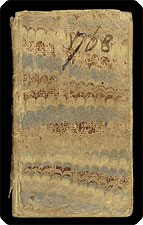
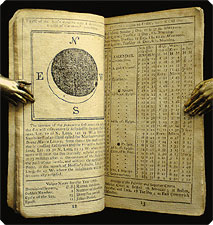
 Click the interior images for enlargements.
  The last leaf, filled on both sides, lists a “Grand Assortment” of books available from
• Evans 10687; Drake 3164; ESTC w22665. Sewn in original marbled wrappers. Usual foxing and light age-toning of almanacs of this era and region. Some dog-earing and “thumbing”; small piece of wrapper missing from lower spine. Else very good. (18214)
 Read by Rousseau & Voltaire
Muralt, Béat Louis de. Lettres fanatiques. Londres: Aux
depens de la Compagnie, 1739. 12mo. 2 vols. I: [2], viii, [2], 276 pp. II: [4], 327, [1 (blank)] pp.
Read by Rousseau & Voltaire
Muralt, Béat Louis de. Lettres fanatiques. Londres: Aux
depens de la Compagnie, 1739. 12mo. 2 vols. I: [2], viii, [2], 276 pp. II: [4], 327, [1 (blank)] pp.

Uncommon. A search of ESTC, OCLC, and NUC Pre-1956 finds only four U.S. holdings of this title. ESTC notes that this is a false imprint and that the work was likely printed in the Netherlands; one source suggests Lausanne.
• ESTC T112988; Caillet, Manuel bibliographique des sciences psychiques ou occultes..., 7879. Recent quarter calf with marbled paper–covered sides, spines with gilt-stamped titles. Title-pages each with inked ownership inscription dated 1804 in lower margin, name lined through; first page of preface with inked numeral in lower margin. Upper outer corners rounded, with most of these (and some margins) browned in vol. I. All edges speckled blue and brown. (23261)
 For more SETS, click here.
 The Scientist as
 Bible ScholarNewton, Isaac. Observations upon the prophecies of Daniel, and the Apocalypse of St. John. In two parts. London: Printed by J. Darby and T. Browne...and sold by J. Roberts...[et al.], 1733. 4to (26 cm). vi, [2], 323 pp

 Click the image above right
• Wallis, Newton, 328.1; ESTC T41883, T18642, N64145. Recent quarter calf over marbled paper, spine with raised bands; gilt-lettered and -ruled label from a previous binding retained, chipped about the edges. Bookplate on front pastedown. Some light waterstaining and some cockling, and a few leaves with shallow chipping or tattering; these, with good repairs. Ample margins. In sum a handsome book.


Sir
Isaac &
His (actually, not so) Mystical
Side
Newton, Isaac. Observations upon the prophecies of Daniel. London: James Nisbet, &T. Stevenson, Cambridge, 1831. 8vo (23.5 cm; 9"). [1] f., xii, 250 pp.

 Click the interior images for enlargements.
 “A new edition, with the citations translated, and notes by P. Borthwick . . . of Downing College, Cambridge.”
• Publisher's quarter green cloth with paper-covered boards. Rebacked in sympathetic cloth and new paper label (antique style) applied. Boards show age-stains and wear but are solid. Old library pressure-stamp on title-page. In an open back slipcase of green library cloth; spine of box with author, title, and call number in gilt. A nice copy, sound for reading. (21773)
Manufacturing Very
Various Articles
for Market
Phin, John.
Very
Various Articles
for Market
Phin, John.  Trade
“secrets” and private recipes. A collection
of recipes, processes and formulae. New York: Industrial Publication Co., 1887.
8vo (18.6 cm, 7.4"). 96, [4] pp.
Trade
“secrets” and private recipes. A collection
of recipes, processes and formulae. New York: Industrial Publication Co., 1887.
8vo (18.6 cm, 7.4"). 96, [4] pp.

 Click the images for enlargements.
  quasi-medical
goods, intended for those inclined to set up shop for themselves; the “recipes”
for amandine, blacking, face powder, corn salve, fly paper, egg preservatives,
an ink eraser, and a simplemicroscope
are exact and interesting.
quasi-medical
goods, intended for those inclined to set up shop for themselves; the “recipes”
for amandine, blacking, face powder, corn salve, fly paper, egg preservatives,
an ink eraser, and a simplemicroscope
are exact and interesting.
Publishers' advertisements at back offer other useful volumes, and tout this one as, “not by any means a clap-trap book, though it exposes many clap-traps.”
• Publisher's black pebbled cloth, covers blind-stamped, spine with blind-stamped title; limited fading and rubbing, sewing starting to loosen. Front pastedown with inked inscription, front free endpaper with intriguing “Fraters Florere” rubber-stamp. Pages faintly age-toned, otherwise clean. (26631)
Get
Cured or
Get CleanYOU
Choose: “Druggs”
or Soap [A FAVORITE BOOK HERE]
Pomet, Pierre. A compleat history of druggs, written in French by Monsieur Pomet ... To which is added, what is further observable on the same subject, from Mess. Lemery and Tournefort ... Illustrated with above four hundred copper cutts ... Done into English from the originals. London: Pr. for R. & J. Bonwicke, and R. Wilkin; John Walthoe & Tho. Ward,, 1725. 4to (22.5 cm; 9"). xii, 419, [1] pp., [4] ff.; 86 plts.
[A FAVORITE BOOK HERE]
Pomet, Pierre. A compleat history of druggs, written in French by Monsieur Pomet ... To which is added, what is further observable on the same subject, from Mess. Lemery and Tournefort ... Illustrated with above four hundred copper cutts ... Done into English from the originals. London: Pr. for R. & J. Bonwicke, and R. Wilkin; John Walthoe & Tho. Ward,, 1725. 4to (22.5 cm; 9"). xii, 419, [1] pp., [4] ff.; 86 plts.


 86 etched plates, mostly with four
specimens per plate; but there are also full-page images of a silk factory, a fishery, and of “negro's [sic] making Roucou.” Other plates are of unicorns, whales, rhinos, elephants.
86 etched plates, mostly with four
specimens per plate; but there are also full-page images of a silk factory, a fishery, and of “negro's [sic] making Roucou.” Other plates are of unicorns, whales, rhinos, elephants. 
 Americana content is noteworthy, with discussion of cacao, chocolate, “guinea pepper,” “long American pepper,” tobacco, and so on. Two surprising sections are devoted to glass manufacture and achieving color in glass, and soap making.
• Wellcome Catalogue, IV, 412; Graesse, Trésor de Livres rares, V, 398; Alden & Landis 725/158; not in Sabin; ESTC T111989; Pritzel 7258n; Junersforgg & Hasenkamp, Coffee, 1177– 1179. Recent full calf antique-style with gilt concentric panels on covers and gilt corner devices on same; round spine with raised bands, each accented by gilt rules. Some plates closely trimmed at foremargin. A very pleasing copy. (21774)
 A
PRB&M “FEATURED BOOK” —
A
PRB&M “FEATURED BOOK” —
 If
YouLook
Like a Swine
. . . Porta, Giambattista della. Della fisionomia dell'huomo.... Venetia: Presso Christoforo Tomasino, 1644. 4to (23 cm, 9"). a6 A–Z8 Aa–Nn8; [6] ff., 570 (i.e., 572) pp., [2] ff.; illus.
If
YouLook
Like a Swine
. . . Porta, Giambattista della. Della fisionomia dell'huomo.... Venetia: Presso Christoforo Tomasino, 1644. 4to (23 cm, 9"). a6 A–Z8 Aa–Nn8; [6] ff., 570 (i.e., 572) pp., [2] ff.; illus. 

"Porta's system . . . leads him constantly to conclusions of analogies between plants, animals and men. Similar humours are found in various apparently unrelated organisms. Plants and animals that correspond in shape are interrelated. A leaf formed like a stag horn shares the character of the deer. The horse is a noble animal, therefore it is a sign of nobility to walk erect with the head held high. Men who resemble a donkey are like that animal: timid, stupid, nervous. He who looks like an ostrich is akin to it in character: he is timid, elegant, vicious, stolid. A man who reminds us of a swine is a swine, eating greedily and having all the other characteristics, such as rudeness, irascibility, lack of discipline, sordidness, lack of intelligence [and] modesty. In a similar way, men who look like ravens are impudent; those who resemble oxen are stubborn, lazy, irascible; men who have lips shaped like those of a lion are hearty, magnanimous, courageous; others who make us think of a ram are timid, malicious and humble. When practising medicine, Porta had many occasions to observe his patients, and to study their character and complexion; the results of this studious inquiry are laid down in his book." (Seligmann)
 This
work was written in Latin and first published in 1586 under the title De
humana physiognomia. It saw 19 editions before 1701, and has been translated
into Italian (1598; translation by Salvatore Scarano), German (1651), French
(1655), and English (1817).
This
tenth Italian edition is replete with a large number of intriguing (and humorous)
woodcuts. The first is a portrait
of Porta, and, while some of the rest show anatomical figures, the vast majority
contrast the shapes of faces and bodies of animals and men. The title-page vignette
is of Aesculapius, the Greco-Roman god of healing.
This
work was written in Latin and first published in 1586 under the title De
humana physiognomia. It saw 19 editions before 1701, and has been translated
into Italian (1598; translation by Salvatore Scarano), German (1651), French
(1655), and English (1817).
This
tenth Italian edition is replete with a large number of intriguing (and humorous)
woodcuts. The first is a portrait
of Porta, and, while some of the rest show anatomical figures, the vast majority
contrast the shapes of faces and bodies of animals and men. The title-page vignette
is of Aesculapius, the Greco-Roman god of healing.
Appended to Della fisionomia humana are the Fisionomia naturale of Giovanni Ingegneri († 1600), the Physionomia of Polemon (ca. a.d. 88 – a.d. 145) in an Italian translation, Porta’s Della celeste fisionomia (a repudiation of astrology), and two short related treatises by Livius Agrippa and Luigi Settala (1552–1633). Della celeste fisionomia has a number of interesting woodcuts showing pagan gods and constellations.
• Seligmann, The History of Magic, 319. On physiognomy,
see: Thorndike, History of Magic and Experimental Science, VII, 448
& following. On Porta, see: Webster’s New Biographical Dictionary
811. Vellum over paste boards, soiled and cockled with a little chipping and
front joint opening. Ex-library: paper labels on spine and rubber-stamps,
including one on title-page. Pages cockled with traces of soiling on top edges;
a few edges bumped.  Plates
in very clear, strong impressions.
Plates
in very clear, strong impressions.
The
Cabinet Cyclopaedia:
SILK
Porter, George Richardson, & Dionysius Lardner, eds. A treatise on the origin, progressive improvement, and present state of the silk manufacture. Philadelphia: Carey & Lea, 1832. 12mo (18.7 cm, 7.4"). 276 pp.; illus.
 Click the images for enlargements.
 • Goldsmiths'-Kress 27353.19; this vol. not in American Imprints. Publisher's quarter red cloth and tan paper–covered sides, spine with printed paper label; binding lightly worn and faded, with paper chipped, spots of soiling, head of spine chipped and band of cloth tape extending across it. Ex–social club library: 19th-century bookplate, call number on endpaper, pressure-stamp on title-page. No other markings. Uncut copy; pages generally clean. (26262)
Powell’s Report on theUinta MountainsPowell, J.W. Report on the geology of the eastern portion of the Uinta Mountains and a region of country adjacent thereto. Washington: Government Printing Office, 1876. Folio (30 cm, 11.75"). vii, [1], 218 pp.; 4 plts.

• Publisher’s cloth, spine with gilt-stamped title (attractively oxidized); cloth rubbed at extremities, spine with small spot of faint discoloration from a now-absent label. Front pastedown institutionally rubber-stamped (no other markings). Erratum slip tipped in. A cleaner copy than most seen on the market.

His
“Christian History”
(the Early Era)
—
Corrected
& EXPANDEDPriestley, Joseph. A general history of the Christian church, to the fall of the Western Empire ...the second edition improved. Northumberland [PA]: Pr. for the author by Andrew Kennedy, 1803–04. 8vo (21.7 cm, 8.5"). 2 vols. I: xix, [1], 488 pp. II: 552 (i.e., 554), [2] pp.


chemist
who may be best remembered today for experiments with gasses that led to the
discovery of oxygen. Covering the early development of Christianity, the two
volumes also address some contemporaneous events in Judaism and among various
heathen groups.
The work was printed in Northumberland, Pennsylvania, where Priestley settled in 1782, when his liberal political opinions and defense of the French Revolution (in addition to his status as a nonconforming minister of questionable orthodoxy) obliged him to emigrate from England to the United States.
Provenance: Both title-pages inscribed by N. Irwin.
• Shaw & Shoemaker 4912 & 7121. Recent quarter calf over marbled paper–covered sides, spines with gilt-stamped leather title and volume labels. Title-pages with faint impression of a once-pencilled shelf number; some leaves lightly foxed.
His
“Christian History”
(the Later Era)
— First
EditionPriestley, Joseph. A general history of the Christian church, from the fall of the Western Empire to the present time.... Northumberland [PA]: Pr. for the author by Andrew Kennedy, 1802–03. 8vo (21.6 cm, 8.5"). 4 vols. I: xxxvi, 475, [1 (blank)] pp. II: vii, [1], 539, [1 (blank)] pp. III: [6], 488 pp. IV: x, [3], xii–xiii, [1], 480 pp.
 Click
the image to the left for an enlargement.
Click
the image to the left for an enlargement.
This work was printed in Northumberland, Pennsylvania, where Priestley settled in 1782, his liberal political opinions and defense of the French Revolution (in addition to his status as a nonconforming minister of questionable orthodoxy) having obliged him to emigrate from England to the United States.
Provenance: Each title-page inscribed by N. Irwin.
• Shaw & Shoemaker 2933 & 4913. Recent quarter calf over marbled paper–covered sides, paper darkened at edges and/or turn-ins on some volumes, most notably vol. IV; spines with gilt-stamped leather title and volume labels. Title-pages with faint impression of a once-pencilled shelf number; a few page edges slightly ragged; some instances of small spots of foxing, mostly in margins, and varying degrees of offsetting. Please note these are octavo values — they're substantial, but we think the photo may make them look a bit taller than they actually are.
For more SETS, click here.
The Wonder ofBIRDS Rennie, James. Natural history of birds. Their architecture, habits, and faculties. New York: Harper & Brothers, 1840. 12mo. 308 pp., illus.

 Click the images for enlargements. “With numerous [in-text wood] engravings” — definitely, charming.
• See: Wood 553; Freeman 3166. Publisher's tan cloth printed with publishing information on front cover and ads for various Harper Library series on the back. Strip of cloth tape at top of spine and slightly onto the covers; ex–social club library, with 19th-century bookplate, call number on endpaper, pressure-stamp on title-page, no other markings. A nice, clean little book. (26731)
Raising & Studying “Fairy Creatures” Robertson-Miller, Ellen. Butterfly and moth book. New York: Charles Scribner's Sons, 1912. 8vo. Frontis., xviii, [2], 249, [1] pp.; illus.

 Click the interior images for enlargements.
 “Personal” this is, both in construction and in style; it is written in accessible language and with wonder given full rein. But it is real science. (Robertson-Miller published in agricultural and other scientific journals.)
Binding: Publisher's sage green cloth, front cover and spine stamped in olive, black, and pale green.
• Bound as above with lower edge of front cover darkened, corners and spine extremities lightly rubbed. Front hinge slightly tender. Pages clean. (22214)
For NATURAL HISTORY, click here.
An
Arctic Explorer
Scoresby-Jackson, R. E. The Life of William Scoresby.
London, Edinburgh, & New York: T. Nelson & Sons, 1861. 8vo. Frontis., engr. title-page, ix, [1
(blank)] pp., fold. map, pp. [9]–406 pp., 5 color plates.

 Click the images for enlargements.
 The work is illustrated with a frontispiece portrait, a folding map of the coast of Greenland and part of the Arctic Circle, and five plates in color (notably “ice blue”) of snow flakes, ice floes, an atmospheric phenomenon, and two views of different parts of the Greenland coast.
• Sabin 35452 & 78184. Publisher's purple textured cloth, boards blind embossed and front one with a gilt center device; spine sunned; lettered in gilt. Top of spine with small loss of cloth and an excellent repair; one plate with a separated sliver of tissue-guard adhered to it. Ex–social club library: call number on endpaper, very light rubber- and pressure-stamp on title-page, pressure-stamp on another page, light rubber stamp on map, no other markings. A good++ copy. (26822)
“Easy” Einstein?Slosson, Edwin E. Easy lessons in Einstein. New York: Harcourt, Brace & Co., 1921. 8vo. Frontis., vii, [1], 123, [1] pp.; 1 plt., illus. 
• Publisher's tan cloth, front cover and spine stamped in black; binding a bit sprung with light wear to lower edges. Pages age-toned but clean. (16724)
TheScience
of Soap
(Soapmaking Scrapbook). Manuscript/print extracts on paper,
in English. [Northeast U.S., 1899–1902]. 8vo (20.3 cm, 8"). [106 (44 blank)]
ff.


• Pebbled cloth, lightly worn. Leaves with minor cockling, some staining and offsetting. Some pages with portions excised; one leaf excised entirely.
Inventions et DecouvertesSoulange, Ernest. Les curieuses origines des inventions et decouvertes. 2e edition. Tours: Mame et Cie, 1848. 12mo. [2], add. engr. t.-p., [2], 260 pp.; 3 plts. 

• Not in Von Hunersdorff, Coffee. Publisher's embossed gilt-paper binding, moderately worn with the spine and board edges a bit darkened; still a very attractive, unusual binding. Front pastedown with small bookseller's ticket and with remnants of a school prize bookplate. Pages mostly clean, with scattered hints of light foxing. (10592)
Early History of theRoyal SocietySprat, Thomas. The history of the Royal-Society of London, for the improving of natural knowledge.... The second edition corrected. London: Pr. for Robert Scot & others, 1702. 4to. (21 cm, 8.25"). [8] ff., 438 pp.; 2 foldout plts.

 Click the images for enlargements.
  First published in 1667 , this work is here in the second of numerous editions. It includes accounts by members of their scientific work: The two plates illustrate meteorological instruments and the principles of artillery recoil.
• ESTC T131282. On the Royal Society, see: Encyclopædia Britannica, 11th ed., XXIII, 791–93. On Sprat, see: The Dictionary of National Biography, LIII, 419–24. Recent quarter red morocco over marbled paper. Beading on spine bands and gilt quatrefoils in compartments; gilt-lettered title, author, and date. A foliate gilt roll at edge of leather on covers. Leaves sometime exposed to moisture and cockled, with shallow chipping and light to moderate soiling. Perforation-stamp on title-page, and rubber-stamps, including one on title-page, of a now-defunct library. All edges speckled red.
“The Grammarian Must Either Associate with,Musician”Steele, Joshua. Prosodia rationalis: Or, an essay towards establishing the melody and measure of speech, to be expressed and perpetuated by peculiar s ymbols. The second edition ... London: Pr. by J. Nichols for T. Payne & Son, B. White, and H. Payne, 1779. 4to (29.2 cm, 11.5"). vi, [2], vii–xvii, [1], 243, [1
(blank)] pp.
 Click the images for enlargements.

 Not a pretty copy, but a usable and fascinating book.
Common Sense & the Principles of Human Thought Stewart, Dugald. Elements of the philosophy of the human mind ... the second edition, corrected. London: Pr. by A. Strahan for T. Cadell Jun., W. Davies, & W. Creech, 1802. 8vo (21.5 cm, 8.5"). xii, 587, [1 (blank)] pp.


 Click the images for enlargement.
 • NSTC 2S40115. On Stewart, see: Dictionary of National Biography, XVIII, 1169–73. Contemporary treed calf, spine with gilt-stamped leather title-label and gilt-stamped decorations; rubbed with front joint opening and top spine compartment showing old shelving notations. Ex–social club library: Front pastedown with old inked numeral and 19th-century bookplate affixed over an older one; front free endpaper with inked call number offsetting to bookplate. No other markings; pages gently age-toned. (26443)

 TO Part
IV . . . TO Part
IV . . . |