
 NEW & OLD
WORLD
NEW & OLD
WORLD HISPANICA — Una miscelánea
NEW & OLD
WORLD  Much
More
Much
More Detailed
than Normal
Detailed
than Normal
 Dávalos, Juan Eusebio. [drop-title] Relacion de los servicios del general Don Juan Eusebio Davalos, cavallero del orden de Alcantara, los de su padre, y antepassados. [Madrid, 1743]. Folio. [2] ff.

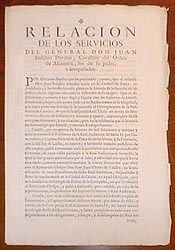
• Palau 259438. Folded as issued.
 For
more JESUITANA, click here.
For
more JESUITANA, click here.


 “Tell Us About MEXICO, Where
 MAXIMILIAN Now Lives” De Bussierre, Marie Théodore Renouard, vicomte de. L'empire mexicain histoire des toltèques des chichimeques des aztèques et de la conquete espagnole. Paris: Henri Plon, 1863. Small 8vo. [2] ff., 427 pp.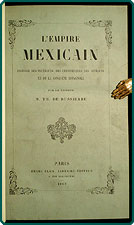
 Click the interior image for an enlargement.
 The latter part of the book offers a very brief recounting of Javier Mina, the War for Texas independence, and the U.S. intervention in the 1840s and consequent loss of California, New Mexico, etc. to the U.S.
Provenance: From the collection of Alberto Pareño, with his initials at the base of the spine.
• Sabin 9561; Palau 37698; Bernal 4295. 20th-century red cloth, with original green printed wrappers bound in. Occasional light foxing. (21371)
 For more BOOKS IN FRENCH, click here. MEXICO is one of our great specialties. For more of NATIVE AMERICAN interest, click here. This also appears in the GENERAL
 The Economics of Pulque Delmonte, José; & Andrés Quintana Roo, & others. Representacion de los cosecheros de pulque al honorable congreso del estado de Mexico. Mexico: Imprenta del Aguila dirigida por José Ximeno, 1828. Small 4to (21.2 cm; 8.25"). 15, [1 (blank)] pp.
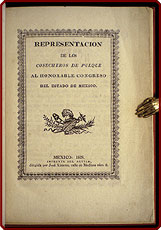 Click the interior image for an enlargement.
  An interesting and detailed, if one-sided, presentation.
The document is signed in type (on p. 15) by more than 30 growers, with Delmonte and Quintana Roo the first two names.
Rare: Both NUC and OCLC locate only the copy at Yale and CCILA locates only the copy in the Lafragua collection in Mexico.
Provenance: Gilt supra-libros of John B. Stetson on the front cover. (Yes, Stetson as in the Stetson hat!)
• Not in Goldsmiths-Kress; not in Palau; not in Sutro. Bound in 20th-century red cloth. Very good copy. (24830)
MEXICO is one of our great specialties. For more COMMERCE / TRADE /
 A
Conqueror of Mexico
. . .
A
Conqueror of Mexico
. . . A
Manuscript Document
SIGNED
Díaz del Castillo, Bernal.
Document Signed ("Bernal Díaz"). Santiago de Guatemala, 24 July
1556. Folio, 2 1/2 pp.
A
Manuscript Document
SIGNED
Díaz del Castillo, Bernal.
Document Signed ("Bernal Díaz"). Santiago de Guatemala, 24 July
1556. Folio, 2 1/2 pp.
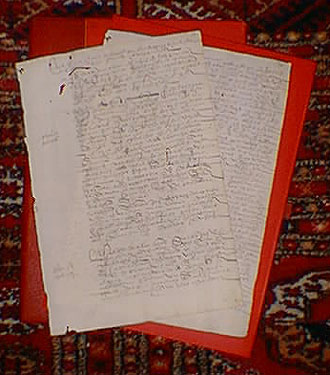
The document we here offer is a cabildo (i.e., town council) act. Bernal Díaz served as a member of the cabildo of Santiago de Guatemala for a number of years, an honor bestowed on him as a conqueror and early settler of the region. In this document the cabildo acknowledges receipt of a royal decree, reads it verbatim into its minutes, and formally agrees to comply. The king writes that he is informed that the post of notary public and "del número" in Santiago is vacant because Juan Núñez de Soria, who held the royal appointment to that position, "is gone to Our kingdoms of Peru." On the advice of the Royal Audiencia (i.e., High Court) the king appoints Juan de Rojas to be notary public and "del número."
• The document is housed in a red half morocco slipcase with an internal corset. Six small wormholes in each leaf affect one or two letters each, but not the signature of Bernal Díaz.
For
our MSS in SPANISH, click here.
MEXICO
is one of our great specialties.
An
Amazing Tale
— A FamousMEXICAN
Artist's Interpretive Illustrations
Diaz
del Castillo, Bernal. The discovery and conquest of Mexico,
1517–1521. Mexico: Pr. by Rafael Loera y Chávez for ... The Limited
Editions Club, 1942. Folio (33 cm; 13.25"). xxii, 263, [1] pp.
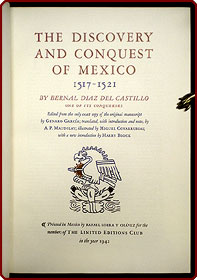
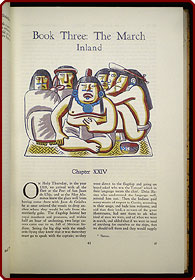
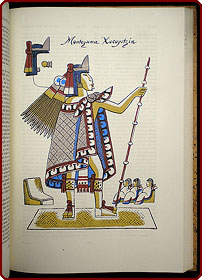
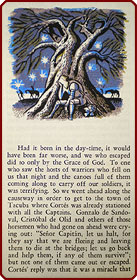 Click the images for enlargements.
  illustrated
by Miguel Covarrubias; it is signed on the colophon page
by all three. The text is an abridgment of Maudsley's 1908 translation, which
in turn is based on Genaro García's 1904 publication of the text from
the original manuscript.
illustrated
by Miguel Covarrubias; it is signed on the colophon page
by all three. The text is an abridgment of Maudsley's 1908 translation, which
in turn is based on Genaro García's 1904 publication of the text from
the original manuscript.
Printed in double-column format, this very handsome and coveted edition bears 6 full-page, 12 half-page, and 28 in-text color illustrations, plus one double-page color map, all by Covarrubias.
• Limited Editions Club, Bibliography of the Fine Books Published by The Limited Editions Club, 1929–1985, 207. Publisher's Spanish-style sheep (pasta española) with red spine labels; some rubbing to spine. In the slipcase, as issued; case rubbed with some loss of paper and, around opening, small chips to cardboard. A clean and unfoxed copy of the text and illustrations. (26672)
For more LIMITED EDITIONS CLUB books, click here. For more ILLUSTRATED BOOKS, click here. For more of MILITARY/NAVAL For more of NATIVE AMERICAN interest, click here. MEXICO is one of our great specialties.
 Who's In Charge of What & How Much They Are Paid Díez de la Calle, Juan. Memorial informatorio al rey nuestro señor, en su real y supremo Conseio de las Indias, Camara, y Junta de Guerra. [Madrid: No publisher/printer], 1645. Small 4to. [11 (of 12)], 31 (of 32) ff. (lacks pi4 and a1).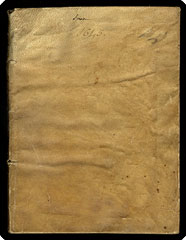
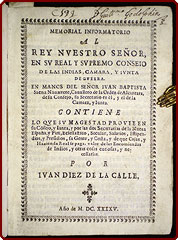
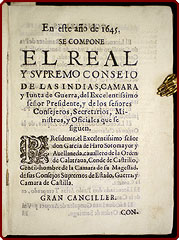
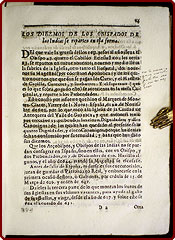 Click the interior images for enlargements.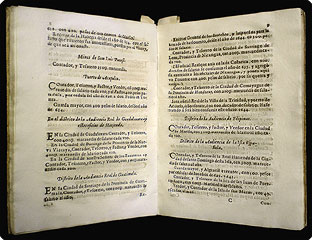
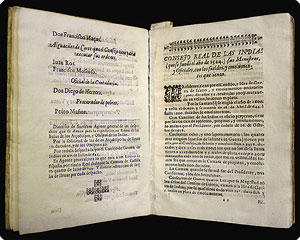
To aid in getting a refreshed grip on the administration of the New World, Philip IV of Spain asked Juan Díez de la Calle, a member of the Consejo de Indias, to produce a concise administrative handbook for use solely by the Council of the Indies, the King, and his close advisors. Here one finds all of the administrative divisions with dates of creation; office holders and their salaries and when the office was created; differences existing between administrative districts; and an interesting section on the various “annual” convoys (“armadas”) and the general in charge of each.
Provenance: Ownership signature at top of title-page of “Guill[er]mo Godolphin,” i.e., Sir William Godolphin.
• Alden & Landis, European Americana, 645/45; Palau 73741; Sabin 20133. Early limp vellum. Lacking two leaves: “Al Lector” leaf and the sectional title-leaf. A very good copy. (25808)
For more SOUTH AMERICANA, click here. For more CENTRAL AMERICANA, click here. MEXICO is one of our great specialties. For CARIBBEANA, click here. For EUROPEAN (Heritage!) For more COMMERCE / TRADE / For
MARITIME matters, click here. For
more Books with SPECIAL
Early Biography of Palafox Dinouart, Joseph-Antoine-Toussaint. Vie du vénérable Dom Jean de Palafox, evêque d'Angélopolis, & ensuite evêque d'Osme, dédiée a Sa Majeté Catholique. Cologne: Nyon, 1767. 8vo (19.7 cm, 7.75"). Frontis., iv, lvi, 576 pp.; 3 plts.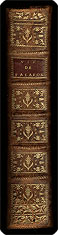
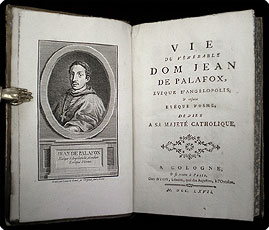 Click the images for enlargements.
 The work is illustrated with a frontispiece and three copper-engraved plates done by Louis le Grand after designs by Gravelot.
• Sabin 20201; Palau 73986; LeClerc, Bibliotheca Americana, 3180; Barbier, Dictionnaire des ouvrages anonymes et pseudonymes, 1003–04. Contemporary mottled calf, spine gilt extra with gilt-stamped leather title-label; corners, joints, and spine extremities rubbed, spine with two pinpoint holes and surface cracks to leather. Front free endpaper partially separated, with pencilled annotation on verso; inner margins of one plate and opposing page with small area of offsetting from now-absent laid-in item, pages otherwise clean. All edges marbled in blue. An attractive copy. (25799)
For more 18TH-CENTURY BOOKS, click here. For more BOOKS IN FRENCH, click here. MEXICO is one of our great specialties. For more ILLUSTRATED BOOKS, click here. For more of NATIVE AMERICAN interest, click here.For more JESUITANA, click here. Or for more PRE-1820 AMERICANA, click here. This
appears in the GENERAL
Gómez Farías asSlandererDocumentos relativos al promovido por el Sr. D. Eustaquio Barron contra Benito Gómez Farías. Mexico : Impr. de José Mariano Fernandez de Lara, 1856. Small 8vo. 56 pp.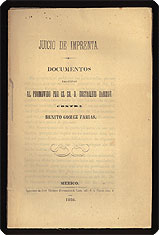
Presented here is Gómez Farías’ side of things, in a very uneditorialized manner.
At the top of the title-page: “Juicio de imprenta.”
• Sewn as issued, lacking front wrapper but rear one present. A good+ copy.
MEXICO is one of our great specialties. For a short “shelf” devoted to
Comunero Revolt Echauri, Martín José. Document Signed. In Spanish, on paper. San Miguel (Argentina): 14 May 1735. Folio (31 cm x 12.25"). [1] p.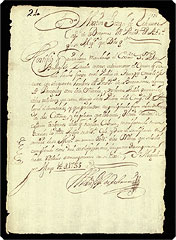 Click the image for an enlargement.
 The Comunero Revolt in Argentina (ca. 1723–35) was a prolonged episode of uprising against the colonial government by residents in northeastern Argentina (Corrientes) and an adjacent part of Paraguay who felt marginalized by the Jesuit domination of the Guarani Indian labor pool and the Society of Jesus’s near monopoly of the yerba mate and tobacco trade with Buenos Aires.
• Very good condition. Margins a little irregular; paper a little rumpled. Written in a clear, easy to read hand. (24647)
For more SOUTH AMERICANA, click here. For more of NATIVE AMERICAN interest, click here. For more of MILITARY/NAVAL For more COMMERCE / TRADE /For more JESUITANA, click here. For more MANUSCRIPTS, click here. For our MSS in SPANISH, click here. This
appears in the GENERAL
Presidents
Archbishops Foreign Relations (Ecuador). A small collection of 13 items. Guayaquil, Quito, San José, & Lima, 1834-57.
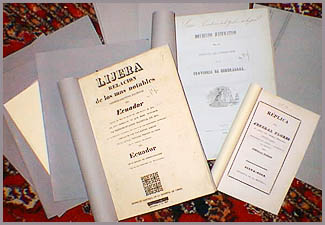
This offering contains original documents touching on many of these and other matters.
For details, please e-mail us.

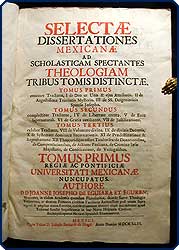
One That Got Away!Eguiara y Eguren, Juan José de. Selectae dissertationes mexicanae ad scholasticam spectantes theologiam tribus tomis distinctae. Tomus primus continet tractatus, I de Deo ut Uno & ejus attributis. II de Augustissimae trinitatis mysterio. III de SS. deigenitricis sponso Josepho. Tomus secundus complectitur tractatus, IV de libertate creata. V de ente supernaturali. VI de gratia auxiliante. VII de justificatione. Tomus tertius exhibet tractatus, VIII de voluntate divina. IX de divinis decretis. X de systemate dominicae incarnationis. XI de praedestinatione & reprobatione. XII theojuridicos offert titulos sex: de donationibus, de compensationibus, de actione Pauliana, de crimine laesae majestatis, de confiscatione, de vectigalibus. Mexici: Typis viduae Josephi Bernardi de Hogal, 1746. Folio (30 cm; 11.75"). [33] ff., 506 pp., [5] ff. 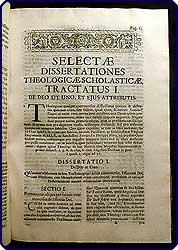
 Click the image to the left or right
The Selectae dissertationes mexicanae was planned as a three-volume work but only this volume was published, the other two having been left in manuscript. It was printed by the widow Hogal, who continued to maintain the high standards of printing that she established with her husband; more than one bibliographer has compared the Hogal output favorably with that of the best European contemporaries. The title-page is in black and red with the text in double-column format in roman and italic, and the whole has decent margins. The volume was intended as a university level text for the study of certain theological concepts.
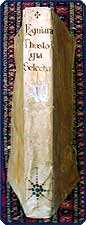
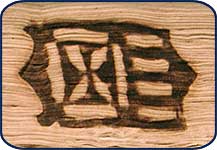
Provenance: Marca de fuego on top and bottom edges of the closed volume of the “Convento Grande de Nuestra Señora de la Merced” in Mexico City.
Very uncommon. We trace only one copy in the U.S., at the University of Texas.
• Medina, Mexico, 3763 Palau 78637; Beristain, I, 216–21. Contemporary limp vellum with remnants of button and loop ties. Marca de fuego as noted previously. Some worming into text on pages 361–94, costing letters but not impairing sense.
MEXICO is one of our great specialties. This book also appears in the GENERAL

EarlyEl Salvador Imprint Nullifying an Appointment El Salvador. Asamblea legislativa. Broadside, begins: “Ministerio general del Gobierno del Estado del Salvador ... La Asamblea legislativa ... decreta. Se declara insubsistente el nombramiento de magistratado par que fue electo el Lic. Atanacio Urritia. San Salvador: No publisher/printer, 1833. Small 8vo. [1] p.
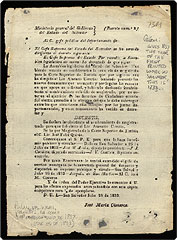
Printing seems to have arrived in El Salvador in 1825, placing this in the first decade of that art there.
Apparently rare: We trace no copy via NUC Pre-1956, WorldCat, CCILA, or METABASE.
• Removed from a nonce volume. A few small holds from insect damage, a few of the few repaired with archival tissue. Old bibliographical notations in pencil in margins. Light waterstaining in upper outer corner. (25791)
For more CENTRAL AMERICANA, click here. For more BROADSIDES, click here. For EUROPEAN (Heritage!)
 Chile, 1593 — AWoman Presses Her CaseEscobedo, Francisca de. Two documents signed. In Spanish, on paper. Santiago, Chile, 7 January 1593. Folio, [2] pp.
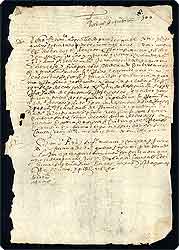
Click the image to the left • Written in a small notarial hand and slightly difficult to read. All edges tattered with some loss of paper and of an occasional word or end of word, not impairing sense.
For our MSS in SPANISH, click here. For more of WOMEN's interest, click here. For more SOUTH AMERICANA, click here.

TellingSpanish
Americans about América
Everett, Alexander Hill. América: O examen general de la situacion política de las diferentes potencias del continente occidental, con conjeturas sobre su suerte futura. Northampton: Simeon Butler, 1828. 8vo (22.2 cm, 8.75"). [4], 296 (i.e., 294) pp. (pagination skips from 274 to 276, text complete).
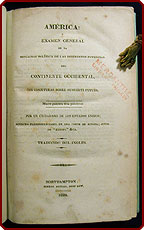
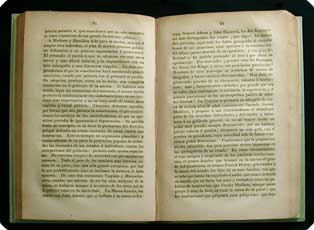 Click
the interior images for enlargements.
Click
the interior images for enlargements.
• Sabin 23225; not in Shoemaker. Period-style quarter tan cloth with paper-covered sides, spine with printed paper label. Title-page and a few others rubber-stamped by a now-defunct institution; title-page with inner margin repaired. Mild to moderate foxing throughout.
In Defense ofModerationFeijoo, Benito Jerónimo. Ilustracion apologetica al primero, y segundo tomo del Theatro critico.... Quarta impression. Madrid: Por los herederos de Francisco del Hierro, 1737. 4to (20.3 cm, 8"). [16] ff., 207, [1 (blank)] pp.
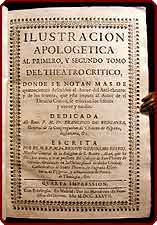
Provenance: Bookseller’s ticket of the “Livraria de Braamcamp-Freire” on front pastedown.
• Palau 91083. Speckled sheep; spine with double gilt rules above and below each band, second compartment with a brown leather label, gilt-lettered, and the rest with a gilt diamond-shaped floral device. Leather abraded with some loss at head and foot of spine and on edges of covers. Browning from turn-ins and some little tears or chipping to endpapers. Interior generally clean with occasional fine spotting.
For
18TH-CENTURY BOOKS, click here.
 A
Capuchin
on the Trinity, with
Some
POETRY
as Well
Feliciano de Sevilla. El sol increado dios trino y uno, y
la grande excelencia de su culto y devocion. Reimpreso en Mexico: por D. Felipe de Zúñiga y
Ontiveros, 1790. 4to (20.5 cm; 8.25"). [10] ff., 464 pp.
A
Capuchin
on the Trinity, with
Some
POETRY
as Well
Feliciano de Sevilla. El sol increado dios trino y uno, y
la grande excelencia de su culto y devocion. Reimpreso en Mexico: por D. Felipe de Zúñiga y
Ontiveros, 1790. 4to (20.5 cm; 8.25"). [10] ff., 464 pp.
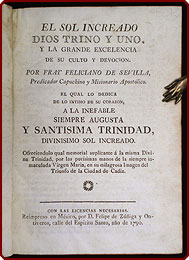
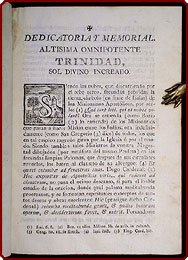 Click the images for enlargements.
 The volume ends with a “Corona Florida a la Santisima Trinidad,” being a small literary collection of coplas, canciones, and a romance “en Metafora del Sol, que discurre por los doce signos del Zodiaco.”
Binding: Publisher's mottled sheep, gilt spine extra. Marbled endpapers; all edges red.
• Medina, Mexico, 8016. Binding lightly worn. A few gatherings starting to extrude. A very good, clean copy. (26851)
For more 18TH-CENTURY BOOKS, click here. MEXICO is one of our great specialties. For CATHOLICA, click here. For LITERATURE, click here. For a bit of ASTRONOMY, click here.
Napoleon,
Again Fernández,
Manuel. Broadside. Begins: "Ciudadanos. Es llegado ya el momento en que
el heroico pueblo Español...." [Cardona, 1823]. Folio. [1] f.
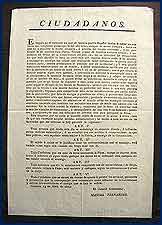
 The five articles go so far as to proclaim that sharing of bad news is treason and
punishable as such.
The five articles go so far as to proclaim that sharing of bad news is treason and
punishable as such.
• One fold.
For a bit more of NAPOLEONIC interest,
click here.
The
King Aids a WidowFernando
VII, King of Spain. Document
Signed (“Yo El Rey”), on paper, in Spanish. “En Palacio”
[i.e., Madrid], 1 March 1815. Folio (29.8 cm, 12.75"), 4 pp.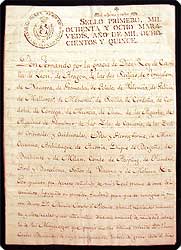
• Written in a very clear hand, with the paper and wax seal below the king’s signature (wax desicated and paper loose, but present). Two blank leaves at end. Very good condition.
 TO Part VI TO Part VI |