
 NEW & OLD
WORLD
NEW & OLD
WORLD HISPANICA — Una miscelánea
NEW & OLD
WORLD  The
Mining Revival &
The Father of
The
Mining Revival &
The Father of Mexican
Independence
Mexican
Independence
 Hidalgo,
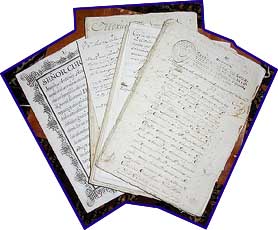
Miguel de, Father of Mexican Independence. Document
Signed (Br. Hidalgo), on paper, in Spanish. No place [mining region of Real de
Bolaños or Aguas Calientes], no date [1780]. Folio, 1 p., bound in a dossier
of documents relating to the execution of the provisions of the will of Augustina
Velázquez. [with] A number of other collateral documents relating
to the Condes de Vivanco. On paper, in Spanish. Mexico City, Real de Bolaños,
Aguas Clientes, Valladolid (now Morelia), and elsewhere in Mexico. Folio (31 cm,
12.25") and smaller.
Hidalgo,
Miguel de, Father of Mexican Independence. Document
Signed (Br. Hidalgo), on paper, in Spanish. No place [mining region of Real de
Bolaños or Aguas Calientes], no date [1780]. Folio, 1 p., bound in a dossier
of documents relating to the execution of the provisions of the will of Augustina
Velázquez. [with] A number of other collateral documents relating
to the Condes de Vivanco. On paper, in Spanish. Mexico City, Real de Bolaños,
Aguas Clientes, Valladolid (now Morelia), and elsewhere in Mexico. Folio (31 cm,
12.25") and smaller.  Approximately
350 ff.
Approximately
350 ff.
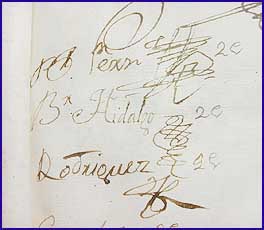
 This
is a fine, extremely early example of Father Hidalgo's signature.
This
is a fine, extremely early example of Father Hidalgo's signature.
 The woman who provided the money for the above mentioned masses was the wife
of Antonio de Vivano (also spelled Bibano) Gutiérrez and mother of
Antonio Guadalupe de Vivano, the first two Condes de Vivanco. Cambridge scholar
David Brading credits Antonio de Vivanco with restoring the mining region
of Bolaños to prosperity in the early 1770s, following the region's
sharp decline in silver ore production during the first two-thirds of the
18th century — whereby he became very wealthy.
The woman who provided the money for the above mentioned masses was the wife
of Antonio de Vivano (also spelled Bibano) Gutiérrez and mother of
Antonio Guadalupe de Vivano, the first two Condes de Vivanco. Cambridge scholar
David Brading credits Antonio de Vivanco with restoring the mining region
of Bolaños to prosperity in the early 1770s, following the region's
sharp decline in silver ore production during the first two-thirds of the
18th century — whereby he became very wealthy.
In addition to payment for masses for her soul, Doña Augustina's will provides for large sums of money to be spent on construction work on the chapel of Our Lady of Guadalupe in the bishopric of Guadalajara. The paperwork, including receipts, associated with the distribution of her largesse is weighty and detailed.
 Among
the collateral documents in this offering are copies of the last wills and
testaments of Antonio de Vivanco Gutiérrez (1796), Augustina Velázquez
(1780), and Antonio Guadalupe de Vivanco (1800); the inventory of the younger
Vivanco's massive estate (1801); and a marvelouscalligraphic
manuscript in which the bishop of Guadalajara grants
a special privilege to Vivanco the elder. All are notarially certified copies
of the originals.
Among
the collateral documents in this offering are copies of the last wills and
testaments of Antonio de Vivanco Gutiérrez (1796), Augustina Velázquez
(1780), and Antonio Guadalupe de Vivanco (1800); the inventory of the younger
Vivanco's massive estate (1801); and a marvelouscalligraphic
manuscript in which the bishop of Guadalajara grants
a special privilege to Vivanco the elder. All are notarially certified copies
of the originals.
• All documents in very good condition, sewn, in contemporary vellum bindings.
For
more MANUSCRIPTS, click here.  For
more of MINING interest, click here.
For
more of WOMEN's interest, click here. For
more CATHOLICA, click here. And
for more MEXICANA, click here.
For
more of MINING interest, click here.
For
more of WOMEN's interest, click here. For
more CATHOLICA, click here. And
for more MEXICANA, click here.

Printed to beSmuggled into Mexico Holbach, Paul Henri Thiry, baron. Origen de la supersticion. Nueva-York: se halla en la imprenta de Jose Desnoues, 1825. 12mo (18 cm; 7.125"). 222, [2 (last blank)] pp.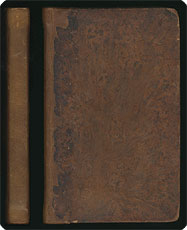
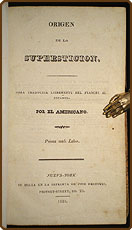
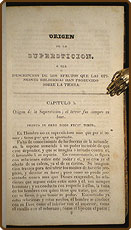
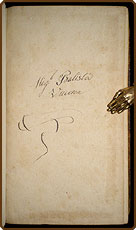
 Click the interior images for enlargements.
 Fear of prosecution envelopes this New York edition as well, for, printed there because of the freedom of the press in the U.S., this was destined for export and smuggling into Spanish America where anti-religious writings and works advocating atheism were unlawful.
Rare. No copy traced via OCLC, NUC Pre-1956, Palau.
Provenance? Old inscription on rear free endpaper, upside down: “Mig.l Batista Varona.”
• Not in Shoemaker. Publisher's acid stained sheep, recently rebacked strongly and absolutely plainly (without label). Inscription as above, and another, less legible, in pencil on front free endpaper. Clean and with all edges saffron. (21281)
For more POST-1820 AMERICANA, click here. MEXICO is one of our great specialties. For more RELIGION, click here. For FALSE IMPRINTS, click here. For a short “shelf” devoted to This book also appears in the GENERAL
Respuesta(Holy
Roman Empire). Respuesta de su Magestad Imperial al manifiesto publicado
por el Rey de Francia. Barcelona: Rafael Figuero, 1688. 4to. 12 pp.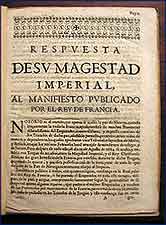
• Palau 262674. Wrappers.

 Mixtec Region of Puebla(Huastepec region). Manuscript map, on paper in ink and colors. Small 8vo (20.5
cm x 20.5 cm; 8" x 8"), 1 p. Central Mexico, ca. 1770.
Mixtec Region of Puebla(Huastepec region). Manuscript map, on paper in ink and colors. Small 8vo (20.5
cm x 20.5 cm; 8" x 8"), 1 p. Central Mexico, ca. 1770.
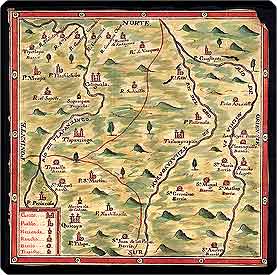
Click
the image at left, for an enlargement.
This map depicts the parishes of Tzilacayoapan, Quicoya, Tlapanzingo, and Caliguala in the Mixtec region of Puebla, Mexico. The map also shows various still-extant towns, including Huastepec, other then-extant towns that are now gone, various ranchos or haciendas, and smaller villages. The map is accomplished in red, green, yellow, brown, and grey. The lettering is precise and the whole very appealing.
• Very good condition. Small piece of upper outer corner torn with small loss of margin. Clearly once tipped into a volume of manuscripts or other documents.
MEXICO is one of our great specialties. For more MANUSCRIPTS, click here.For
our MSS in SPANISH, click here. Or
for ILLUSTRATED BOOKS, click
here.
Skepticism from an Ecclesiastical SavantHuet, Pierre-Daniel. Pet. Dan. Huetii episcopi Abrincensis De imbecillitate mentis humanae libri tres. Amstelodami: Apud H. Du Sauzet, 1738. 12mo (17 cm, 6.75"). xxxviii, [10], 223, [1] pp. (frontis. lacking).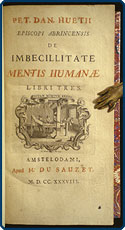
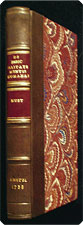 Click the interior image for an enlargement.
 • Recent quarter calf and marbled paper–covered sides, spine with gilt-stamped leather title and author labels. Frontispiece lacking and pages showing light cockling; clean and attractive. (21114)
For more 18TH-CENTURY BOOKS, click here. For more RELIGION, click here. For more CATHOLICA, click here. For more TRANSLATIONS, click here. For more MEDICINE, click here. Or for Books for the BUSTED
Advice to Guerrero on the Day He Deposed Pres. Gomez Pedraza Ibar, Francisco. Hoy se echan los cimientos al templo de la paz; o, Felicitacion al segundo presidente. [colophon: Mexico: Impr. á cargo de T. Urbide y Alcalde, 1829]. Folio. [2] ff.
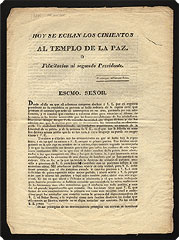
Click the image for an enlargement. Rare: We locate only the copy at the Bancroft Library.
• Folded, as issued. A slim wormtrack in the foremargin, not touching any text; one pin-type wormhole in the text touching or costing one letter on each page. Clean, a nice copy. (25814)
MEXICO is one of our great specialties. For more of MILITARY/NAVAL For FREEMASONRY, ODD
AnotherPensador
Mejicano"Intruso, El." Respuesta de otro pensador mejicano sobre bagages y coches de providencia. [Mexico]: Alejandro Valdes, 1820. 4to. [2] ff.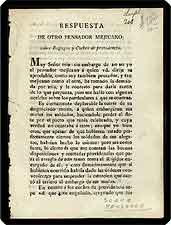
Searches of OCLC, RLIN and NUC Pre-1956 locate only four copies in the U.S.
• Medina, Mexico, 11808; Garritz, Impresos novohispanos, 3654; Steele 46; Sutro 134. Removed from a volume with ragged inner margin. Faint rubber-stamp in one margin.
Partial
Payment for
Her Majesty'sTapestry
Isabel
I, Queen of Spain.
Document on paper, in Spanish, signed "Yo la Reyna." Granada, 8 May
1501. Folio (31.2 cm, 12.25"). [1] p. 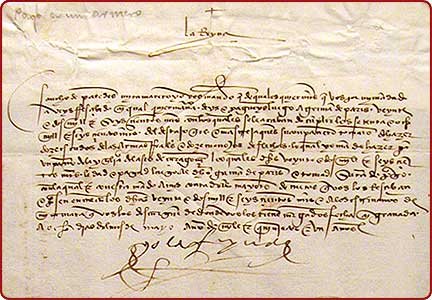
On the bottom half is a signed receipt, in Spanish, dated Granada 8 May 1501, wherein Germán de Paris and Jacques acknowledge receiving the above mentioned payment.
• The usual slash of cancellation (faintly visible above), indicating that this has been entered into the account books. Remnant of stiff paper at top of verso indicating it was once mounted in an album.
For
16TH-CENTURY BOOKS, click here. For
more COMMERCE / TRADE / For
more MANUSCRIPTS, click here. For
more of WOMEN's interest, click here.The
Surrender of Valladolid,
now, MORELIA
Iturbide,
Agustín de. [drop-title] Contestaciones
que precedieron a la capitulacion de la ciudad de Valladolid, entre los señores
coronels d. Agustin de Iturbide, y d. Luis Quintanar. [colophon: México:
en la oficina de Alejandro Valdes, 1821]. Small 4to (19.5 cm; 7.5"). 15, [1
(blank)] pp.
Valladolid,
now, MORELIA
Iturbide,
Agustín de. [drop-title] Contestaciones
que precedieron a la capitulacion de la ciudad de Valladolid, entre los señores
coronels d. Agustin de Iturbide, y d. Luis Quintanar. [colophon: México:
en la oficina de Alejandro Valdes, 1821]. Small 4to (19.5 cm; 7.5"). 15, [1
(blank)] pp.
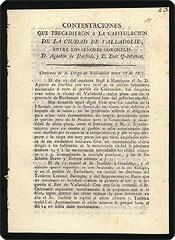
Click the image for an enlargement. Uncommon. We trace only three copies in the U.S.
• Garritz 4724; Sutro, Supplement, 145. Not in Medina, Mexico. Removed from a nonce volume. Very good condition. (24785)
MEXICO is one of our great specialties. For more of MILITARY/NAVAL
Exam
Time in 1790
Querétaro
Iturriaga, Manuel. Questiones academicas, que ofrece
reverente el rector del Real Colegio de San Francisco Xavier de la ciudad de Queretaro al Exmo.
Señor Don Juan Vicente de Guemez Pacheo de Padilla Horcasitas y Aguayo.... Mexico: Por D.
Felipe de Zuñiga y Ontiveros, 1790. 8vo (20 cm; 8"). [1] f., 12 pp., 1 plt.
1790
Querétaro
Iturriaga, Manuel. Questiones academicas, que ofrece
reverente el rector del Real Colegio de San Francisco Xavier de la ciudad de Queretaro al Exmo.
Señor Don Juan Vicente de Guemez Pacheo de Padilla Horcasitas y Aguayo.... Mexico: Por D.
Felipe de Zuñiga y Ontiveros, 1790. 8vo (20 cm; 8"). [1] f., 12 pp., 1 plt.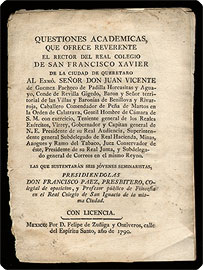
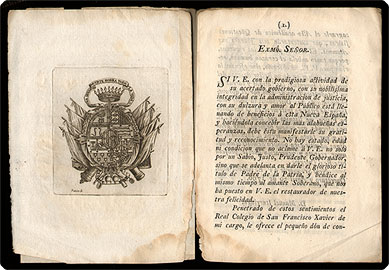 Click the images for enlargements.
 The plate is a very fine copper engraving of the viceroy's coat of arms and is signed in the plate “Garcia.” (There is also one handsome headpiece.)
• Not in Medina, Mexico; not in CCILA; not in Catálogo Colectivo del Patrimonio Bibliográfico Español; not in Catálogo Colectivo del Patrimonio Bibliográfico Mexicano. Never bound, never stitched; irregular at the lower area of the inner margin of all leaves with rodent-gnawing visible. Light waterstaining in lower inner corners as well. Some finger soiling; light chipping along top edges. Title-page lightly dust-soiled. (26879)
For more 18TH-CENTURY BOOKS, click here. MEXICO is one of our great specialties. For CHILDREN / EDUCATION, click here.
 This
Great English
Rabbi DefendsOral
Law — London,
5474/1714 (Jewish–Jewish Controversy). Nieto, David. [Hebrew title-page romanized as] Mateh Dan ve-kuzari helek sheni: yokhiah...amitut Torah shebe-‘al peh [and Spanish title-page opposite] Matteh Dan y segunda parte del Cuzari.... Londres: Thomas Ilive, 5474 [A.D. 1714].
4to. [10], 254 ff.
This
Great English
Rabbi DefendsOral
Law — London,
5474/1714 (Jewish–Jewish Controversy). Nieto, David. [Hebrew title-page romanized as] Mateh Dan ve-kuzari helek sheni: yokhiah...amitut Torah shebe-‘al peh [and Spanish title-page opposite] Matteh Dan y segunda parte del Cuzari.... Londres: Thomas Ilive, 5474 [A.D. 1714].
4to. [10], 254 ff.


 Hebrew with
parallel Spanish text, presented in double-column format,
and it begins with two engraved title-pages, one in each language. The text
is composed of five dialogues that defend the Oral Law against the teachings
of the Karaites, or “Followers of the Bible”—who were (and
are) not Biblical literalists in the same sense that Protestant fundamentalists
are, but Jews whose exclusive dedication to the Torah involves radical rejection
of the entire Talmudic, Rabbinic tradition.
Single-click any image of this book, for an enlargement.
Hebrew with
parallel Spanish text, presented in double-column format,
and it begins with two engraved title-pages, one in each language. The text
is composed of five dialogues that defend the Oral Law against the teachings
of the Karaites, or “Followers of the Bible”—who were (and
are) not Biblical literalists in the same sense that Protestant fundamentalists
are, but Jews whose exclusive dedication to the Torah involves radical rejection
of the entire Talmudic, Rabbinic tradition.
Single-click any image of this book, for an enlargement.Works of Jewish controversy written by Jews and published in England in the period to 1720 were few in number and are now very uncommon. Those controversial treatises actually in Hebrew were and are particularly rare. Searches via ESTC, RLIN, OCLC, and NUC Pre-1956 locate fewer than a dozen copies of this text in U.S. libraries.
• Roth, Magna Bibliotheca Anglo-Judaica, 336; Palau 191134; ESTC T210368. 18th-century diced russia. Joints and board edges rubbed with joints tender and starting at tops and bottoms. Some margin pencil marks but a clean, complete copy of a scarce and very important book.
For more 18TH-CENTURY BOOKS, click here.For a bit more JUDAICA / HEBRAICA, click here. And
this
appears in the GENERAL
From the FIRST Printing Press inBRAZIL João VI, King of Portugal, 1769–1826. [drop-title] Alvará. Eu el Rey. Faço saber aos que este Alvará virem. Que Tomando em consideração os graves prejuizos que ao Meu Real Serviço.... [at end: Rio de Janeiro: Na Impressão Regia, March 1816]. Small folio. [1] f.
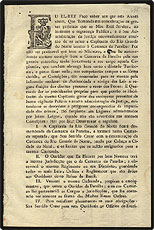
 WorldCat
failed to locate a copy of this.
WorldCat
failed to locate a copy of this.
• Not in Almedia Camargo & Borba de Moraes, A Impressao regia. Removed from a nonce volume. A few small wormholes, one semicircular and affecting five letters of text, but not hindering intelligibility. (25825)
For
PORTUGAL / PORTUGUESE, click
here. For
SOUTH AMERICANA, click here. For EUROPEAN (Heritage!) For COLLECTED PRESSES
His
Surviving Oratory
&
The FIRST
BIBLIOGRAPHY
Printed
in the New World
Juan Bautista, fray. A Jesu Christo S.N. ofrece este sermonario en lengua mexicana ... Primera parte. Mexico: En casa de Diego Lopez Davalos, 1606. 4to (21.5 cm; 8.5"). [26] ff., pp. 1–559, ff. 560–99, pp. 600–39, ff. 640–47, pp. 648–55, 664–709, [1] p., [20 of 24] ff., lacks final 4 leaves.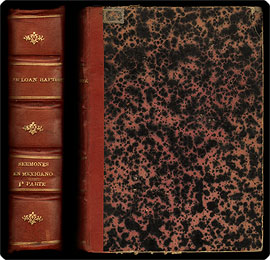
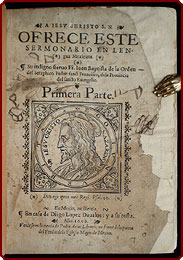
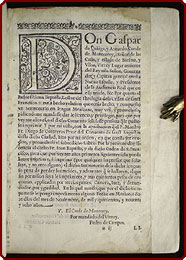
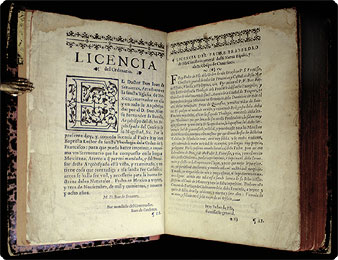 Click the images for enlargements.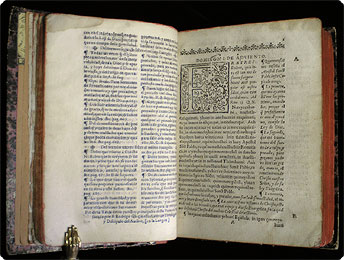
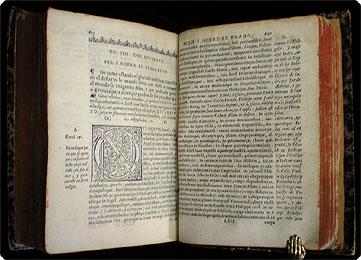
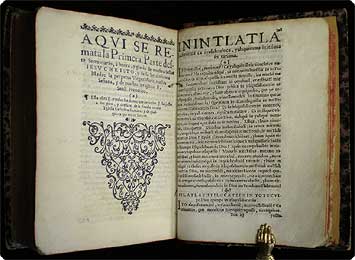
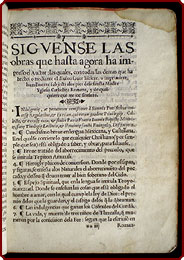
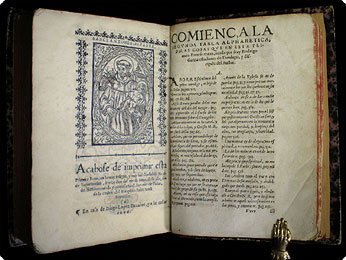
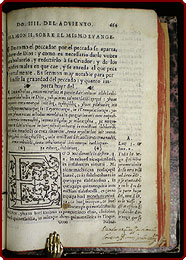
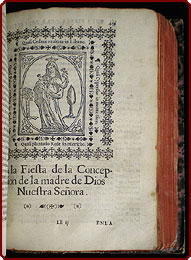
A long unnoticed feature of this book is that it contains the first bibliography published in the New World. On signature **iiii recto and verso is a list of “las obras que hasta agora ha impesso el Auctor” (“the works that until now the author has had published”). The list is not in chronological order nor is it alphabetical by title; nonetheless it is a bibliography and supplies us with information now known only because of its inclusion here. Of the 17 items listed, several have failed to survive in any known copy, including the second part of this sermonario — though at the time of publication of this part one, “de la segunda parte esta ya impresso gran pedaço” (“of the second part a large portion is already printed”).
The volume is enhanced by  half-page woodcuts: here, Christ's portrait profile on the title-page, St. Andrew with his Cross, St. Anne with the Virgin as infant (appearing twice), and St. Anthony of Padua. The text is in roman with side- and shouldernotes in italic type. Printer López Dávalos employs an interesting set of very large (5 x 5 cm; 2" x 2") foliated woodcut initials throughout the volume.
Provenance: 18th-century signature in a few margins of Carlos Perez; late 19th- or early 20th-century bookplate of Nicolás León; in the collection of the John Carter Brown Library (deaccessioned).
• Medina, Mexico, 227; García Icazbalceta, Lenguas, 13; H. de León-Portilla, Tepuztlahcuilolli, 342; Viñaza 114; Newberry Library, Ayer Indians, Nahuatl-21; Pilling, Proof-sheets, 235; Palau 23467; Putick & Simpson 154; Schwaller 11. For biographical information on Bautista, see: Archivo biográfico de España, Portugal, e Iberoamérica, fiche 104, frames 339–73. Late 19th-century quarter red Mexican sheep with purple and black mottled paper sides. Title- and following leaf with irregular foremargins, loss of blank areas of old repaired; waterstaining in margins of early leaves. Some worming in text costing letters here and there but not impeding sense for the reader. Last four leaves, one bearing an illustration of the Crucifixion, absent (i.e., from the section of Bible citations used in the sermons); last leaves present a bit chipped/gnawed at lower corners and one fore-edge. Old marca de fuego eradicated from top edge; all edges red and corners elegantly rounded. Some 18th-century marginalia in Spanish explicating words and phrases in the Nahuatl text. (26393)
For more of NATIVE AMERICAN interest, click here. MEXICO is one of our great specialties. For more CATHOLICA, click here. For more ILLUSTRATED BOOKS, click here. For more Books with SPECIAL This book also appears in the GENERAL
Spanish Statecraft — First English Appearance Juan de Santa María, fray. Christian policie: Or, the Christian common-wealth. London: Pr. by Thomas Harper for Richard Collins, 1632. 4to (22 cm, 8.6"). [18 of 19 (lacks blank {only})], 481, [1] pp.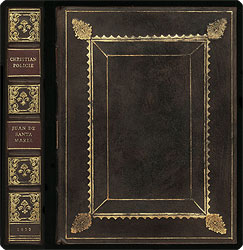
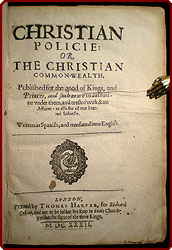
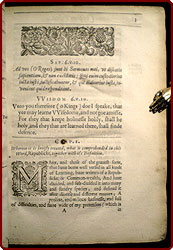 Click the images for enlargements. scholar and poet James Mabbe, known for his translations of Cervantes and other works of Spanish literature and theology.
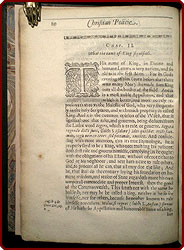
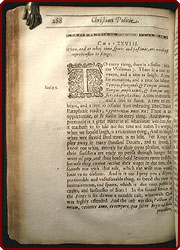
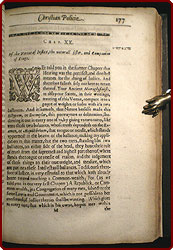
Uncommon: ESTC, OCLC, and NUC Pre-1956 find only 9 U.S. holdings.
• ESTC S107911; STC (2nd ed.) 14831. Period-style calf framed and panelled in gilt fillets with gilt-stamped corner fleurons; spine gilt extra with gilt-stamped leather title and author labels. Lacks initial blank leaf, as is the case with virtually all copies. Two leaves with tattered outer edges, one leaf with small hole affecting a few letters; pages with some moderate offsetting, a few browned. (25084)
For more 17TH-CENTURY BOOKS, click here. For more CATHOLICA, click here. For more RELIGION, click here. For more LITERATURE, click here. Or for more TRANSLATIONS, click here. This book also appears in the GENERAL
 TO Part VIII TO Part VIII |