
 NEW & OLD
WORLD
NEW & OLD
WORLD HISPANICA — Una miscelánea
NEW & OLD
WORLD  Heroic
Lima — Heroic Literature
Heroic
Lima — Heroic Literature Valdés, Rodrigo de. Poema heroyco hispano-latino panegyrico de la fundacion, y grandezas de la muy noble, y leal ciudad de Lima. Obra postuma. Madrid: En la Imprenta de Antonio Roman, 1687. Small 4to (20 cm; 8"). §4–§§§§§§§4 a–g4 A–Z4 Aa4; [56] ff., 184 pp,
[4] ff.
Valdés, Rodrigo de. Poema heroyco hispano-latino panegyrico de la fundacion, y grandezas de la muy noble, y leal ciudad de Lima. Obra postuma. Madrid: En la Imprenta de Antonio Roman, 1687. Small 4to (20 cm; 8"). §4–§§§§§§§4 a–g4 A–Z4 Aa4; [56] ff., 184 pp,
[4] ff. 

 Click either image above
for an enlargement.
Click either image above
for an enlargement. 
The poem was left unpublished at the time of the author’s death and Francisco Garabito de León Messía saw to its publication.
• Palau 347681; Medina, BHA, 1806; European Americana 687/140; DeBacker-Sommervogel, VIII, 376–77. Recased in old vellum. A very good copy.

Guys,
Cut Your Ridiculous
HAIR!Vallejo, Fernando de. Pregon en que su magestad manda, que por quanto el abuso de las guedejas y copetes con que andan algunos hombres, y los rizos con que componen el cabello ha llegado à hazer escandalo en estos reynos, ningun hombre pueda traer guedejas ni copete. Madrid: En la imprenta de Francisco Martinez, 1639. Folio (28.2 cm, 11.1"). [4] ff.
Ridiculous
HAIR!Vallejo, Fernando de. Pregon en que su magestad manda, que por quanto el abuso de las guedejas y copetes con que andan algunos hombres, y los rizos con que componen el cabello ha llegado à hazer escandalo en estos reynos, ningun hombre pueda traer guedejas ni copete. Madrid: En la imprenta de Francisco Martinez, 1639. Folio (28.2 cm, 11.1"). [4] ff.

Click
the image for an enlargement.
• Palau 236209. Removed from a nonce volume. Pages creased, with small areas of light waterstaining to upper and lower inner margins; title-page with early inked numeral and shadow of pencilled numeral in upper margin.
 For 17TH-CENTURY BOOKS, click
here. For
EUROPEAN LAW, click here.
For 17TH-CENTURY BOOKS, click
here. For
EUROPEAN LAW, click here. For
CLOTHING & FASHION, click
here. This
also appears in the GENERAL
For
CLOTHING & FASHION, click
here. This
also appears in the GENERAL
 Dress Right!Vallejo, Fernando de. Pregon en que su magestad manda, que ninguna muger de qualquier estado y calidad que sea pueda traer, ni traiga guardainfante, ò otro instrumento, ò trage semehante, excepto las mugeres que con licencia de las justicias publicamente son malas de sus personas. Madrid: En la imprenta de Francisco Martinez, 1639. Folio (28.2 cm, 11.1"). [4] ff.
 Click the image for an enlargement.
 • Palau 236212. Removed from a nonce volume. Title-page with small early inked numeral and shadow of pencilled numeral in upper margin; publication authorization leaf with small hole just touching letters, without loss of sense.
For 17TH-CENTURY BOOKS, click here. For EUROPEAN LAW, click here. For more of WOMEN's interest, click here. For CLOTHING & FASHION, click here. This appears in the GENERAL

 Famous, Devoutly Catholic; BUT He still Ran afoul
 the INQUISITIONValtanás, Domingo de (a.k.a. Baltanas, Baltanas Mexia, Baltanas Messia ). Exposicion de los evangelios con sermones desde primero domingo de adviento hasta el domingo. xxv. despues de la Trinidad ... co[n] anotaciones morales dignas de saber. Sevilla: en casa de Martin de Montesdoca, 1558. 4to (21cm; 8.25"). [3], 186, [8], lxxv folios (lacking Initial blank and fol.lxx).

 Click the images for enlargements.

The Exposicion de los evangelios con sermones begins with a visually complex title-page printed in black and red and featuring a large woodcut of the Crucifixion, which in this copy has the wounds of Christ additionally touched in a penman's red; and it then proceeds to present 57 sermons, each centered on a moral state or quality (laziness, adversity, sin, patience, charity, love), a doctrinal topic (the trinity, confession, the Passion of Christ, prayer, false prophets, forgiveness of sins), or some aspect of the Gospels. Each sermon is printed in roman type with sidenotes in gothic and begins with two readings, one from one of the four Gospels and the other from another part of the Bible. The work continues with the “Segunda parte de la exposicion de los eva[n]gelios de sanctos en particular, y del comun, con sermones sacados de diversos autores catholicos,” which has its own sectional title-page, signatures, and foliation. It has a four-element woodcut border anda small woodcut of the Annunciation.
All of Valtanás’s writings are scarce. The Catálogo Colectivo del Patrimonio Bibliográfico locates only 9 titles (one catalogued under Baltanas) as held by Spanish libraries and one of those titles is not for a true work but rather for the just mentioned “Segunda parte.” The OPAC of the Spanish National Library shows one additional title not found via the CCPB. This title is not traced via WorldCat, COPAC, Catálogo Colectivo del Patrimonio Bibliográfico, or the OPAC of the Spanish National Library.
• Palau 349174 (giving incorrect date of publication, as per Nicolás Antonio, and saying it is printed in gothic type when it is in roman). Not in Adams; not in Index Aurel., although one book is listed there under “Baltanas.” Late 17th- or early 18th-century dark Spanish sheep, gilt spine extra and with a red leather gilt label. Light to occasionally moderate waterstaining, mostly in margins, variously occurring throughout the volume; lacking an initial blank leaf and one text leaf (i.e., lxx) in the “Segunda parte.”  A darned good copy of a very rare book. (26174)
For 16TH-CENTURY BOOKS, click here. For CATHOLICA, click here. For more INQUISITION material, click here. For RELIGION, click here. This book also appears in the GENERAL
A
Viceroy Who
Was theSon
of a Viceroy,Velasco, Luis de; marqués de Salinas (viceroy of New Spain). Document Signed (“Don Luis de V[ela]sco”), in Spanish, on paper. Mexico: 7 July 1590. Folio (30 cm; 11.875"). [1] p. Click the image for an enlargement.
 In this manuscript he grants Maria Verdugo three caballerías of land in “el monte del pueblo de Quaguacan [sic, for Cuahuacan], terminos de Tlalnepantla.” The specific location is given as are the names of the property-holders bordering her grant.
• Paper uniformly age-toned; mounted on a later, larger sheet of laid paper. Some chipping at the edges of the document with loss of a few letters. Written in a very clear notarial hand in black ink. Signature unaffected and bold. (24527)
For 16TH-CENTURY BOOKS, click here. MEXICO is one of our great specialties.For our MSS in SPANISH, click here. For more of WOMEN's interest, click here.
An Archbishop's Entail Venero y Leyva, Carlos. Documents (some signed), in Spanish, on paper. Toledo, Spain: 16 May 1642. Folio (31.5 cm; 12.35"). [38] pp. substantial cahier deals with the terms of the entail, succession to it, its restrictions, and its endowment; all as specifically relating to Don Carlos and the situation in 1642.
Click the image for an enlargement.
substantial cahier deals with the terms of the entail, succession to it, its restrictions, and its endowment; all as specifically relating to Don Carlos and the situation in 1642.
Click the image for an enlargement. • Bound in a vellum wrapper handsomely indited on the front with two abstracts of the contents, writen in a fine modified gothic script. The documents' texts are written on paper in a hurried notarial hand, sometimes a little difficult to decipher.  A clean, attractive manuscript. (26980)
For the 17TH CENTURY, click here. For more CATHOLICA, click here. For more COMMERCE / TRADE / For EUROPEAN LAW, click here. For more MANUSCRIPTS, click here.For our MSS in SPANISH, click here.

Shortly After theDeclaration of IndependenceVenezuela. Junta Suprema Gubernativa. Broadside, begins: “Americanos. El orden politico del otro hemisferio ha reducido la España á ser victima de la perfidio y ooresion y este pueblo generoso conducido de uno en otro infortunio va ya á ser borrado del catalogo de las naciones ... ” [Caracas: Gallagher y Lamb, 1811]. Folio (31 cm; 12.25"). 1 p.
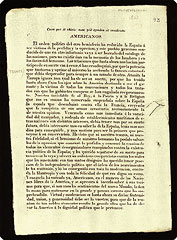
Click the image for an enlargement.
This document dates from immediately after July 5th, as internal evidence shows. Here the Junta Suprema explains what it sees to be the political reality of Spain’s dissolution into non-nationhood under Napoleon and thereby justifies “Venezuela [having] entered now, Americanos, into the number of free nations of the Americas.”
Very Rare. This broadside was unknown to Medina. Grases located only the copies in the Public Record Office (London) and the Archivo de Indias (Seville). Searches of NUC, OCLC, and RLIN fail to find any copy at all. Further, no copies were found when searching the OPACs of the national libraries of Venezuela, Colombia, Spain, France, and England.
• Not in Medina, Caracas; not in Villasana. Grases, Historia de la imprenta en Venezuela, Repertorio #72. As issued. Worming in foremargin; repaired. Pencilling in margins. A very good copy.

 Venezuela
& Ecuador Combative
Venezuela. Legación. Ecuador. [cover-title] Legacion venezolana en el Ecuador. [drop-title] Documentos relativos a la mision del honorable Señor Coronel Andres Maria Alvarez, encargado de negocios de Venezuela cerca del gobierno del Ecuador. [Quito?, ca. 1858]. Tall 4to. 24 pp.
Venezuela
& Ecuador Combative
Venezuela. Legación. Ecuador. [cover-title] Legacion venezolana en el Ecuador. [drop-title] Documentos relativos a la mision del honorable Señor Coronel Andres Maria Alvarez, encargado de negocios de Venezuela cerca del gobierno del Ecuador. [Quito?, ca. 1858]. Tall 4to. 24 pp.
• In modern wrappers, preserving the original front printed wrapper.


UncommonSpanish-Language
Edition
Vertot, René Aubert
de. Historia de las revoluciones de Portugal, escrita en Frances...y traducida
en lengua Castellana. Primera edicion. Leon de Francia: Hermanos De Ville, 1747.
12mo (17.2 cm, 6.75"). vii, [1], 372, [14 (index)] pp. 

Provenance: With the armorial bookplate of D. Feliciano Ramirez de Arellano, Marqués de la Fuensanta del Valle, and bookseller's ticket from a Lisboa dealer.
• Palau 361040. Contemporary treed calf, spine gilt extra with gilt-stamped leather title label, covers showing only light wear; joints and board edges rubbed, leather lost over spine head and cracking over foot, spine also with small traces of paper label. Hinges slightly tender.
For
more 18TH-CENTURY BOOKS, click
here. For
more PORTUGAL/PORTUGUESE, click
here.
For more Books with INTERESTING
Extremely Important & Equally RareVetancurt, Agustín de. Arte de lengva mexicana.... Mexico: Francisco Rodriguez Lupercio, 1673. Small 4to. π4A–P4 (-π2,3); [4 (of 6)], 49 [i.e. 50], [8] ff.
 Click any image where the hand appears on
 At the end of this highly important and extremely rare grammar are found a comprehensive index, a short catechism, and instructions on the commandments and the sacraments of the Catholic Church, beingall in Nahuatl. Part One of the text expresses Vetancurt's important insight that Nebrija's classical, early-16th-century paradigm for the study of European languages, specifically Latin and Spanish, had its shortcomings when applied to the major New World language under scrutiny—though in the end he resigns himself to using that five-part organization, which was the one most familiar to his readers.
We note that virtually all bibliographies have failed to state that leaf E1 is misfolioed as 14 (it should be 15 and the error is not corrected subsequently), and that leaf H4 is misfolioed as 19 (that error not affecting the subsequent numbering).
Provenance: Marca de fuego of an unidentified Mexican conventual library.
• Viñaza 204 (failing to note error in foliation, as do all bibliographies except Graff); Medina, Mexico, 1103; Newberry Library, Indian Linguistics in the Edward E. Ayer Collection, Nahuatl 237; García Icazbalceta, Lenguas, 80; León-Portilla, Tepuztlahcuilolli, 2816; Sabin 99385; Pilling 4002. Graff 4475 (this copy; giving correct collation). On the marcas de fuego, see: Sala, Marcas de fuego, pp. 28 and 39. On Vetancurt, see: Archivo biográfico de España, Portugal, e Iberoamérica, fiche 118, frames 17–36 and 73–74. Contemporary limp vellum, shrunken and cockled, missing pieces along fore-edge of front cover and at base of spine. Some burn holes at tops of some pages resulting from embers’ straying during the branding of the book. Inner margins with expanded openings and occasional tearing around the sewing stations (i.e., paper has suffered from tight binding). Lacks two preliminary leaves containing approbations. Some foxing; last leaf (only) with foremargin insect-eaten. Text of the grammar complete. A significant work seldom acquirable.
MEXICO is one of our great specialties. For more of NATIVE AMERICAN interest, click
here. For DICTIONARIES/GRAMMARS, ETC., click here. For more 17TH-CENTURY BOOKS, click here.
Spanish Southwest Mexican Art New World Biography Vetancurt, Agustín de (a.k.a., Vetancur). Chronica de la Provincia del Santo Evangelio de Mexico. Quarta parte del Teatro mexicano de successos religiosos. Mexico: por María de Benavides, viuda de Juan de Ribera, 1697. Folio (30 cm; 11.875"). [12], 136, [4], 153, 56 pp.

 Click the images for enlargements.


Provenance: Augustinian monastic library of Morelia (marca de fuego on upper edge of closed book; on verso of title-page in an 18th-century hand: “pertenece al convento de San Augustin de Valladolid”); private use of Fr. Manuel Aigustin Farias (noted on the verso of title-page in an 18th-century hand, prelim. p. 12, first p. 1); later owned by José Martín de Infanzón (prelim. p. 9).
• Medina, Mexico, 1684; Palau 361217; Sabin 99386; Andrade 1073; Tovar de Teresa, Bibliografía novohispana de arte, 105; Wagner, Spanish Southwest, 68. Early vellum over boards, rebacked; new endpapers and title-page backed for strength. Stray stains and ink markings variously, the latter in margins; minor worming in some lower margins, with waterstaining notable in the final section and a brown stain perhaps of another nature in upper gutter-ward areas of the same section, sometimes into text. Final six leaves with loss of lower outer corner, including some text; paper replaced and text in excellent facsimile. Volume now housed in a quarter blue morocco tray case with gilt spine. (26824)
For more 17TH-CENTURY BOOKS, click here. For more PRE-1820 AMERICANA, click here. For more of CALIFORNIA interest, click here. MEXICO is one of our great specialties. For more CATHOLICA, click here. For more ART REFERENCE, click here. For more BIOGRAPHIES, mostly 20th-Century For more ARCHITECTURE, click here. For more Books with SPECIAL This book also appears in the GENERAL
 Plan
del Perú , with Considerable
Plan
del Perú , with Considerable
 Cuban
Content As Well
Vidaurre [y Encalada], Manuel Lorenzo de. Plan del Perú, defectos del gobierno español antiguo. Necesarias reformas....Contiene al fin...los motivos políticos que obligan á la isla de Cuba á declarar inmediatamente su independencia. Philadelphia: Impr. por Juan Francisco Hurtel, 1823. 8vo. 225, [1 (blank)] pp., [2] ff.
Cuban
Content As Well
Vidaurre [y Encalada], Manuel Lorenzo de. Plan del Perú, defectos del gobierno español antiguo. Necesarias reformas....Contiene al fin...los motivos políticos que obligan á la isla de Cuba á declarar inmediatamente su independencia. Philadelphia: Impr. por Juan Francisco Hurtel, 1823. 8vo. 225, [1 (blank)] pp., [2] ff.
In this work printed in Philadelphia, Vidaurre calls for republican reforms in Peru. This was a major change of political stance for him, for he had loyally served the crown both in his native Peru and, after the commencement of the Wars of Independence, in Spain. His attack on the Spanish political system and call for liberal republican reforms involves passionate denunciation of slavery, and his "renuncia" (pp. 197-225) speaks at length about Cuba's current socio-political conditions and explains why Cuba should follow the lead of the former Spanish colonies of the American mainland.
On the basis of this work, dedicated
to Bolívar, The Liberator
appointed Vidaurre head of the supreme court at Trujillo.
• Sabin 99491; Shaw & Shoemaker 14780. On Vidaurre, see: Archivo biográfico de España, Portugal, e Iberoamérica, fiche 1012, frames 251-256 & 261-262. Modern quarter green morocco and marbled paper sides. Foxing, some staining. Complete with the errata leaf, and solid.
For
more books FOR ANDEANISTS, click here. For
more CUBANA, click here.
FIRST Accounts of a Conquest & an Attempted ConquestThe Itza Maya & the Lacandón!Villagutierre Sotomayor, Juan de. Historia de la conquista de la provincia de el Itza, reduccion, y progressos de la de el Lacandon, y otras naciones de indios barbaros, de la mediacion de el reyno de Guatimala, a las provincias de Yucatan, en la America septentrional. Madrid: Lucas Antonio de Bedmar y Narvaez, 1701. Folio (28.5 cm; 11.5"). Engr. “frontispiece,” [32] ff., 660 pp., [17] ff.

 Click any image above for an enlargement. This is the first published book dedicated solely to the history of the Yucatán and the Maya, here offered in its first edition, first issue (with the incorrect catchword “gla” at the foot of the recto of the 22nd preliminary leaf).
Although touted as “Primera parte” on the title-page, there were no further parts; this Historia is complete, “all published.”
• Palau 366681; Medina, Biblioteca hispano-americana, 2051; Sabin 99643; Leclerc 1546; Salvá 3422; Heredia 3407; Alden & Landis, European Americana, 701/262. On Villagutierre, see: Archivo biográfico de España, Portugal, e Iberoamérica, fiche 1019, frames 213–16. 19th-century Spanish sheep (“pasta española”), covers abraded and with pinhole-type worming to spine; loss of lower inch of spine leather to insects. Browning to text due to impurities in water during paper manufacture. Small insect damage to margins of first four leaves, not touching any text; similar small damage in inner margins of last four leaves. Over all, a decent copy of a scarce work.
For more 18TH-CENTURY BOOKS, click here. MEXICO
is one of our great specialties. For
more of NATIVE AMERICAN interest, click
here. For
more of MILITARY/NAVAL interest, click
here.
A Fundamental WorkHandsomely Printed Villaseñor y Sánchez, José Antonio de. Theatro americano, descripcion general de los reynos y provincias de la Nueva España y sus jurisdicciones. México: En la Imprenta de la Viuda de D. Joseph Bernardo de Hogal, Impresora del Real y Apostólico Tribunal de la Santa Cruzada en todo este Reyno, 1746–48. 2 vols. in 1 (29.5 cm; 11.5"). I: [9] ff., 232 pp., [2] ff., pp. 233–382, [5] ff., lacks engr. title. II: [6] ff., 428 pp., [5] ff., lacks engr. title.

 Click the images for enlargements.

 The volumes are from the famous press of the widow of José Bernardo de Hogal, the Baskerville of Mexico, and they retain all of the fine characteristics that are associated with the Hogal name, including handsome black and red title-pages, great typography (here in double-column format), and use of good quality paper.
The author was general accountant of the Treasury's office of mercury accounting (the element was important in silver refining) and one of the most illustrious Cosmographers of New Spain. He wrote this treatise at the insistence of the viceroy, who was greatly pleased by it.
• Sabin 99686; Medina, Mexico, 3802; Tovar de Teresa, Bibliografía novohispana de arte, II, 86/87. Recent full dark brown calf, round spines, raised bands accented with gilt rules; green and red leather spine labels; gilt center devices. Covers with elaborate gilt roll at edges, concentric center compartments and gilt corner devices. Lacking the engraved title, only. Present are intermittent touches of limited worming and, in vol. II, the occasional old stain to a top margin's edge. This is a clean and indeed BEAUTIFUL SET. (26378)
MEXICO is one of our great specialties. For more ART REFERENCE, click here. For more ARCHITECTURE, click here. For more RELIGION, click here. For more SETS, click here. For COLLECTED PRESSES This set also appears in the GENERAL
Copiously & Usefully Illustrated Vindel, Francisco. Solaces bibliográficos. Madrid: Instituto
Nacional del Libro Español, 1942. 12mo. xi, 193 [1] pp., illus.
 Click the images for enlargements.
 This copy with an authorial inscription to a recipient whose name has been gently, but entirely, obliterated!
• Good quality red cloth, original wrappers bound in; grey spine label. Very good copy. (21546)
For more BOOKS ABOUT BOOKS, click here. For more of WOMEN's interest, click here.

The ENDURING LAWS of theVISIGOTHS Visigoths. Laws, statutes, etc. Fuero juzgo en latín y castellano, cotejado con los más antiguos y preciosos códices por la Real Academia Española. Madrid: Por Ibarra, 1815. Folio (34.2 cm, 13.5"). [7] ff., pp. [iii], iv–liv, [2] ff., X, 162 pp., [2] ff., XVI, 231, [1] pp.

 Click the interior images for enlargements.


• Palau 95528. Original printed wrappers with a little tattering and a small chip from the base of the spine. Light waterstaining in the outside margins of some leaves and title-page with some staining in the inside margin, not affecting printed area. In fact, in very good condition.
Men
of Cajamarca —
TWOEYEWITNESS
Accounts of Events
Xerez, Francisco de. Libro primo de la Conqvista del Perv & prouincia del Cuzco de le Indie occidentali. [colophon: Vinegia {i.e., Venice}: Stampato per Stephano da Sabio, 1535]. 4to. [62] ff.


 Click the interior images for enlargements. true
entertainment cast in the tradition of the romance of chivalry;
not surprisingly, it was a blockbuster.
Click the interior images for enlargements. true
entertainment cast in the tradition of the romance of chivalry;
not surprisingly, it was a blockbuster.


Appended to Xerez's account (fols. [43v] to [55r]) is a translation of Miguel de Estete's account of Pizarro's army's journey from Cajamarca to Pachacamac and then to Jauja. Estete too was present at Cajamarca and is said to have been the first Spaniard to lay hands on Atahuallpa.

 A very good copy.
(25785)
A very good copy.
(25785)
Bulls
Bow Down &
Fiends Are PowerlessXiménez, Mateo. Compendio della vita del beato Sebastiano d'Apparizio, laico professo dell'ordine de' Minori Osservanti del Padre S. Francesco della provincia del Santo Evangelio nel Messico. Roma: Stamperia Salomoni, 1789. 4to (24.2 cm, 9.5"). xvi pp., port., 228 pp., [1] f. [with] Coleccion de estampas que representan los principales pasos, echos, y prodigios del Bto.. Frai Sebastian de Aparizio, relig[ios]o. franciscano de la provincia del S[an]to Evangelio de Mexico. Dispuesta por el R.P. Fr. Mateo Ximenez. Roma: por el incisor Pedro Bombelli, 1789. 4to (23.5
cm, 9.125"). Engr. title, [100] of [129] plts.

 Click any image where the hand appears on


 Finding the "life" and the volume of plates together is uncommon. Only by happenstance did the two volumes come to us within months of one another, from two different continents, allowing us to marry them for this offering. For example, in the U.S., only the Lilly and Bancroft Libraries report owning both works. There is some question as to the number of plates in a complete copy of the Colección: Some sources call for an engraved title-page and 128 plates, while others call for 129 plates. There seems not to have been an edition of the Vita in Spanish.


For more 18TH-CENTURY BOOKS, click here.
For more BOOKS IN ITALIAN, click here.
For
GOOD Books for the BUSTED
Or for more ILLUSTRATED BOOKS, click here.
Two
Manuscripts . . .Ybrillos, Spain. Ecclesiastical Cabildo. Manuscript. On paper, in Spanish. Calahorra, 12 July 1750. Folio (31 cm; 12.25"). [17] ff. [bound with and after] Castildelgado, Spain. Manuscript. On paper, in Spanish. Castildelgado, 22 April 1664. Folio (31 cm; 12.25"). [10] ff. 
The Castildelgado document is the settling of a dispute with the town of Ybrillos over pasturing rights.
• Bound in limp vellum with remnants of ties. Written in clear notarial hands. A very little tattering; in very good condition.
For
more MANUSCRIPTS, click here.
Peruvian
ConquestIllustrated Zárate, Agustín de. Histoire de la decouverte et de laconquete du Perou. Traduite de l'Espagnol...par S.D.C. Paris: La compagnie des libraires, 1716. 8vo (17 cm, 6.75"). 2 vols. I: Frontis., [40], 360 pp.; 13 (2 fold.) plts., 1 fold. map. II: [8], 479, [1 (blank)] pp.

 Click the interior images for enlargements.


• Sabin 106261; Palau 379641. Contemporary mottled sheep and calf as above, corners and edges worn, all joints cracking, both volumes with minor worming to front covers and pinholes to spines; vol. I with loss of leather over spine head (half of top compartment). Pencilled check marks scattered throughout; front free endpaper and recto of last text page of vol. II with annotations.
For more 18TH-CENTURY BOOKS, click here. For more of ANDEAN INTEREST, click here. For more ILLUSTRATED BOOKS, click here. For more SETS, click here!
In
Paper Wrappers,
1774Zárate,
Agustin de. Histoire de la découverte et de la conquête du
Perou, traduite de l’Espagnol d’Augustin de Zarate, par S.D.C. Paris:
Par la compagnie des libraires, 1774. 8vo (18 cm, 7.1"). I: Frontis., xl, 360
pp.; 1 fold. map, 10 engr. plts., 2 fold. engr. plts. II: viii, 479, [1 (blank)]
pp.

• Sabin 106266; Palau 379645. Volumes bound in paper wrappers, back wrapper lacking in both cases; front wrappers reinforced with printed papers taken from other items. Reverse of frontispiece in vol. I and front pastedown in vol. II with small bookplates of private collector. Edges untrimmed. Scattered spots; pages and plates generally in good clean condition.
For more 18TH-CENTURY BOOKS, click
here. For
more BOOKS IN FRENCH, click here. For
a short shelf devoted to the INCA, click
here. For
more ILLUSTRATED BOOKS, click here.
 To
browse
our unillustrated,
readily printableplease
click the link above.
To
browse
our unillustrated,
readily printableplease
click the link above.
For ¡RARISIMA!
Spanish New World
Wonders —
 Click here
to SEARCH OUR SHOPCAT'S
Click here
to SEARCH OUR SHOPCAT'S

PLACE AN ORDER | E-MAIL US | GO (BACK) TO TOPIC/INTEREST TABLE | PRB&M HOME
All material © 2010
The Philadelphia Rare Books & Manuscripts
Company