 DICTIONARIES
ALSO GRAMMARS, SIGNIFICANT WORD LISTS, LANGUAGE STUDIES
& SELECTED BOOKS
 IN
“EXOTIC”
LANGUAGESDICTIONARIESIN
“EXOTIC”
LANGUAGES
IN
“EXOTIC”
LANGUAGESDICTIONARIESIN
“EXOTIC”
LANGUAGES Early
ILLUSTRATED Effort
at a DICTIONARY
Early
ILLUSTRATED Effort
at a DICTIONARY for
the Masses
for
the Masses
 (A
Delight to Work or Play With). Bailey, Nathan; Philip Miller;
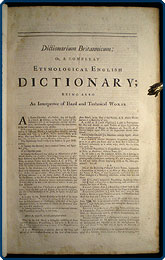
Thomas Lediard; George Gordon. Dictionarium Britannicum: Or a more
compleat universal etymological English dictionary than any extant ... illustrated
with near five hundred cuts, for giving a clear idea of those figures, not so
well apprehended by verbal description ... the second edition with numerous additions
and improvements. London: T. Cox, 1736. Folio (35.5 cm, 13.9"). [460] ff.; 1 plt.,
illus.
(A
Delight to Work or Play With). Bailey, Nathan; Philip Miller;
Thomas Lediard; George Gordon. Dictionarium Britannicum: Or a more
compleat universal etymological English dictionary than any extant ... illustrated
with near five hundred cuts, for giving a clear idea of those figures, not so
well apprehended by verbal description ... the second edition with numerous additions
and improvements. London: T. Cox, 1736. Folio (35.5 cm, 13.9"). [460] ff.; 1 plt.,
illus.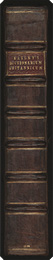
 Click the interior images for enlargements.
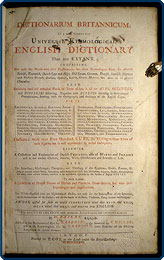
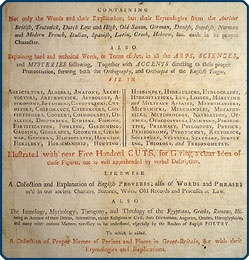
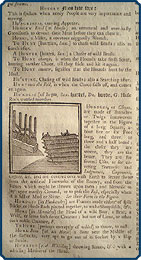
 The title-page is printed in red and black; a full-page plate shows an orrery (for which word there is an unusually long entry) from multiple perspectives, while many of the in-text woodcuts are depictions of heraldic terms, or mathematical and scientific concepts. Etymological information is provided in “Antient British, Teutonick, Dutch Low and High, Old Saxon, German, Danish, Swedish, Norman and Modern French, Italian, Spanish, Latin, Greek, Hebrew, &c. each in its proper Character” (from the title-page). Our photographic detail, third image from left, above, highlights the (endearing!) ambition and achievement of this large volume.
• ESTC T87976; O'Neill B-5; Vancil 12. On Bailey, see: Oxford Dictionary of National Biography online. Contemporary mottled calf, covers framed in gilt double fillets, rebacked, spine with gilt-stamped leather title-label and gilt-ruled raised bands; sides acid-pitted and scraped. 19th-century endpapers. Title-page with old-fashioned, round institutional pressure-stamp; light soil and old inkblots (also light!) in upper portion. Pages a little browned right at edges; light or faint waterstaining visible in first third of volume, usually to lower margin only; one leaf with tear from outer margin just touching text, without loss; one lower outer corner torn away, with loss of one letter from catchword.  A sound, pleasant copy of this handsome and interesting production. (25002)


 TheFIRST
Latin Gradus
Aler, Paul. Gradus ad Parnassum, sive Novus synonymorum epithetorum, et phrasium poeticarum thesaurus ... Lipsiae: Apud Michaelem Blochbergerum, 1738. 8vo (17.7 cm, 7"). [8], 48, 768 (i.e., 760) pp.
TheFIRST
Latin Gradus
Aler, Paul. Gradus ad Parnassum, sive Novus synonymorum epithetorum, et phrasium poeticarum thesaurus ... Lipsiae: Apud Michaelem Blochbergerum, 1738. 8vo (17.7 cm, 7"). [8], 48, 768 (i.e., 760) pp.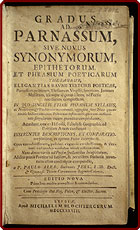
• DeBacker-Sommervogel, II, 1092–95 (for other eds.). Contemporary vellum, spine with inked title; lightly soiled, front cover with partially effaced early inked ownership inscription and back cover with faded early inked inscription. Front pastedown institutionally rubber-stamped, front free endpaper lacking, title-page with early inked ownership inscription partially effaced (resulting in small holes). Pages age-toned, with occasional foxing. (24349)

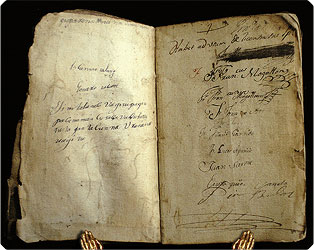
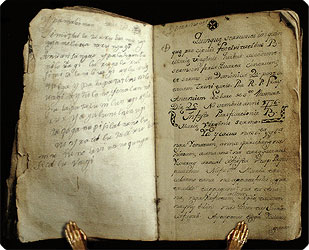
Extended MANUSCRIPT in an UNCOMMON PHILIPPINE LANGUAGE Antonio Lobato de Santo Tomás. Manuscript in Ibanag on paper: “Quinque sermones in quinque precipuis festivitatibus B. Maria Virginis. Quibus accedunt sermo in feria quarta cinerumz et sermo in dominica 2o post octavam trinitatis. Per R. P. fray Antoniium Lobatao de Sto. Thomas. Tuguegarao, The Philippines: 1776–80. Small 4to. 196 pp.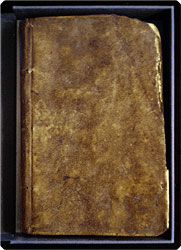
 Click the interior images for enlargements.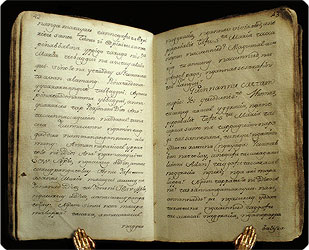
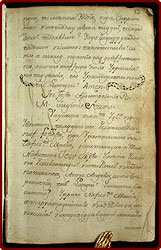
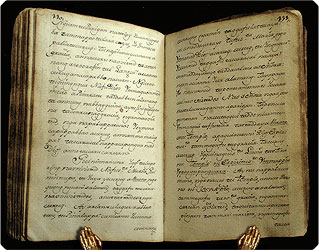
 a large body of work set down in the Ibanag language, from the 18th century and as written/spoken by one of the seminal scholars of the language, should be obvious for anyone researching the language as understood by missionaries, as used by missionaries, as influenced by Spanish, and as held out by Spaniards of authority as the model of Ibanag speech to be emulated. Beyond this, of course, is the interest of the sermons themselves, letting us see what the Ibanaq speakers were hearing from their missionaries — or, at least, this missionary — in this place, in this period.
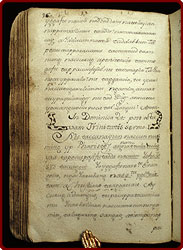
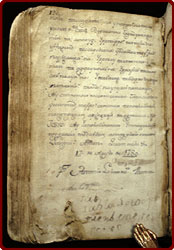
Provenance: A signature “Fr. Antonio Lobato de Sto. Thomas” appears at the bottom of the last page and is almost certainly that of the the friar himself, which would mean that this is his autograph manuscript of the sermons.
• Contemporary very stiff vellum. Binding gnawed by a rodent with loss. Written on a good quality European paper, with some soiling and an occasional stain. No faults are serious and overall this is a remarkably good survival for an 18th-century Philippines manuscript. Now housed in a blue cloth clamshell box. (23668)

“Iroquoian”
Studies
1915
Barbeau, Cornelius Marius. ...Classification of Iroquoian radicals with subjective pronominal prefixes. Ottawa: Government Printing Bureau, 1915. Large 8vo. [2] ff., 30 pp.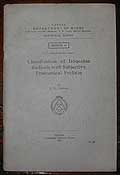
• Not in Banks. Not in Evans. Stapled into original stiff printed wrappers, very good condition. Inner hinges of cloth tape.
 Those interested in American Indian Languages may like to
 AMERICAN INDIANS, WITH MUCH IN

 Defining
 “Child” for Baptismal Purposes — RAREBarker, Thomas. The duty, circumstances, and benefits of baptism, determined by evidence ... with an appendix, shewing the meaning of several Greek words in the New Testament. London: B. White, 1771. 8vo (20.5 cm, 8"). x, 208, [6 (index & errata)] pp.
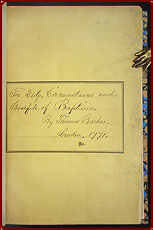
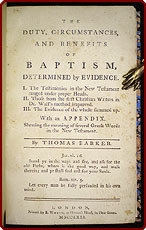 Click the interior images for enlargements.
  Closing
the work is a collection of New Testament usages of various Greek words for
“child” or “children,” with analysis of their contexts
and connotations.
Closing
the work is a collection of New Testament usages of various Greek words for
“child” or “children,” with analysis of their contexts
and connotations.
The author was a dedicated observer of meteors and comets and published several well-received works on those subjects in addition to his religious and philosophical treatises.
Rare: OCLC and ESTC locate only one U.S. holding, since deaccessioned; there are only two holdings found in the U.K.
• ESTC T68482. Recent marbled paper–covered boards, spine with gilt-stamped leather title-label; yellow wrapper with early hand-inked title bound in. Title-page institutionally pressure-stamped and a five-digit number inked twice to the first page of the preface; no other markings. First and last few leaves with minor foxing; other scattered spots mostly confined to margins. Occasional pencillled annotations. (25768)
A
Modest Beginning
for An
Influential Work
Bartlett, John, comp. A collection of familiar quotations, with complete indices of authors and subjects. Cambridge [Mass.]: John Bartlett, 1855. Small 8vo (18 cm; 7"). vii, [1], 295, [1] pp.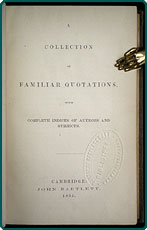
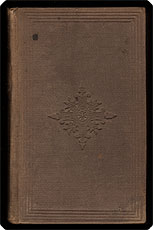
• Grolier, American 100, 64. Publisher's brown cloth stamped in blind, volume cocked; spine with head pulled and area of discoloration on spine, otherwise light edge wear only. Ex–social club library: 19th-century bookplate, call number on front pastedown, lacks front free endpaper, pressure-stamp on title-page, no other markings. Paper good and quotations delightful. (26307)

 Greek–Dutch! — A Dictionary,
1822Bergman, Jean Théodore. Handwoordenboek der Grieksche taal, volgens etymologische orde, ten dienste der scholen. Te Zutphen: H.C.A. Thieme, 1822.
8vo in 4s (22.5 cm, 8.8"). 2 vols. in 1. XXII, 532, [4], 533–996 pp. (pagination skips 305–08, text apparently uninterrupted).
Greek–Dutch! — A Dictionary,
1822Bergman, Jean Théodore. Handwoordenboek der Grieksche taal, volgens etymologische orde, ten dienste der scholen. Te Zutphen: H.C.A. Thieme, 1822.
8vo in 4s (22.5 cm, 8.8"). 2 vols. in 1. XXII, 532, [4], 533–996 pp. (pagination skips 305–08, text apparently uninterrupted).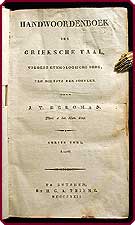
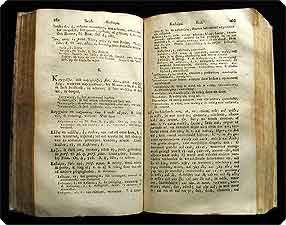
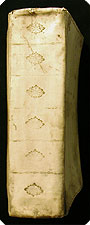
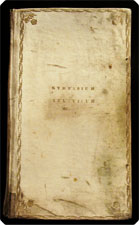 Click any image where the hand appears on
Provenance: Covers gilt-stamped “Gymnasium Velavicum.”
• Contemporary vellum-covered boards, covers framed in gilt rolls with gilt-stamped corner fleurons, spine with gilt-stamped bands and decorations within compartments; vellum chipped over spine extremities and showing moderate dust-soiling. Upper portion of front free endpaper excised; half-title crumpled, with inner and outer margins chipped. Pagination skips from 304 to 309, with signature complete and text apparently uninterrupted. Some edges and corners waterstained and a few lower margins inkstained, with occasional instances of edge chipping. Creasing to a handful of index leaves.
First
Printing in EUROPE of
theBhagavadgitā Bhagavadgita.
Bhagavadgītā Bhagavad-Gita, id est Thespesion melos sive
almi Krishnae et Arjunae colloquium de rebus divinis, Bharateae episodium. Textum
recensuit, adnotationes criticas ed interpretationem latinam adiecit Augustus
Guilelmus a Schlegel. Bonnae: in Academia Borussica Rhenana Typiis Regis, Prostat
apud E. Weber, 1823. 8vo (23 cm; 9"). xxvi, 189 pp.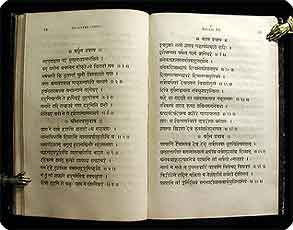
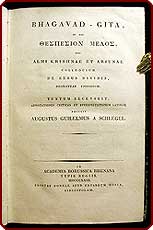 Click either image
Provenance: From the collection of 19th-century scholar Dr. Johann August Neander (1789–1850), a convert from Judaism who became a leading scholar of Christianity.
Uncommon: Of U.S. institutional copies we trace fewer than 10.
• 19th-century German black mottled paper over boards. Binding shows wear. Ex-library with call number tag on spine; bookplate.
The Eliot Indian Bible — A Leaf from Daniel/Hosea Bible. Algonquian. Eliot. 1663. Mamusse wunneetupanatamwe Up-Biblum God naneeswe Nukkone Testament kah wonk Wusku Testament. Ne quoshkinnumuk nashpe Wuttinneumoh Christ noh asoowesit John Eliot. Nahohtãoeu ontchetãoe printeuoomuk. Cambridge [Mass.]: Printeuoop nashpe Samuel Green kah Marmaduke Johnson, 1663. 4to (19 cm; 7.5"). [1] f.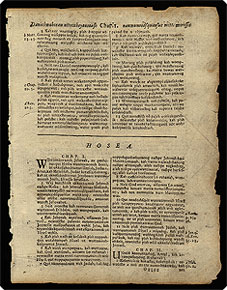 Click the image for an enlargement.
 The text is Daniel 12:3 (being the end of Daniel's apocalyptic vision of the end days) though Hosea 1–3:5 (with its promises/foretelling of Israel's destruction). It is printed in roman brevier type, in double-column format, with generally 62 lines per column. It took 139 and a half weeks to set the type and print the Bible.
 The Bible was a monumental undertaking and achievement in its day and it remains an American monument today.
• Evans 73; Wing (rev. ed.) B2755; ESTC W38287; Darlow & Moule 6737; Pilling, Algonquian, 139–152; Pilling, Proof-sheets, 1175–77; Winship, Cambridge Press, pp. 208–44. Removed, inner margin slightly irregular; edges chipped (never approaching text) and light soiling. Definitely, a treasure. (26071)
 A
POLYGLOT
Mass Lectionary
— Latin,
Greek,
Hebrew, GermanBible.
N.T. Polyglot. Hutter. Selections. 1601.
Lectiones evangeliorum & epistolarum, anniversariae. Ebraicé, cum radice,
literis servilibus, & Latina lectione. Græcé, Latiné,
& Germanicé. Harmonicé & symmetricé...editæ
ab Elia Huttero.... Noribergae: 1601. 8vo. (19 cm, 7.5"). A–Z8
Aa–Zz8 Aaa–Ccc8; 781, [1 (blank)] pp., [1 (blank)]
f.; plts.
A
POLYGLOT
Mass Lectionary
— Latin,
Greek,
Hebrew, GermanBible.
N.T. Polyglot. Hutter. Selections. 1601.
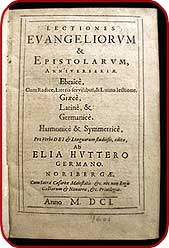
Lectiones evangeliorum & epistolarum, anniversariae. Ebraicé, cum radice,
literis servilibus, & Latina lectione. Græcé, Latiné,
& Germanicé. Harmonicé & symmetricé...editæ
ab Elia Huttero.... Noribergae: 1601. 8vo. (19 cm, 7.5"). A–Z8
Aa–Zz8 Aaa–Ccc8; 781, [1 (blank)] pp., [1 (blank)]
f.; plts. 
 a
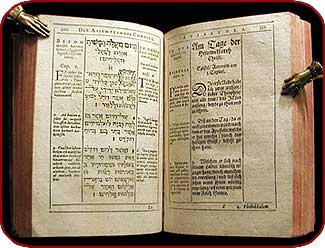
Hebrew translation of the liturgical epistles and gospels
for use at Mass, accompanied by a transcription of the Hebrew into Latin letters,
as well as the Greek, Latin, and German versions. The Hebrew text incorporates
some small handsome woodcut initials, and the printer has also employed some
interesting woodcut headpieces.
a
Hebrew translation of the liturgical epistles and gospels
for use at Mass, accompanied by a transcription of the Hebrew into Latin letters,
as well as the Greek, Latin, and German versions. The Hebrew text incorporates
some small handsome woodcut initials, and the printer has also employed some
interesting woodcut headpieces.
Elias Hutter (1553–1609) was an orientalist and professor of Hebrew
at Leipzig. The text here is drawn from his famous and sought after polyglot
New Testament in 12 languages (Nuremberg, 1599), and so shares in the censure
Hutter received for there translating and inserting "in some versions missing
passages which he found in others" (Darlow and Moule)—but, he was open
about that. The
present work was apparently for devout students of Hebrew,
both to further their knowledge of that language and to give them comparative
texts for study and meditation on the week’s lessons.  Polyglot
lectionaries are not common, and this is the only polyglot lectionary of the
epistles and gospels listed by NUC
Pre-1956 before the 19th century.
Polyglot
lectionaries are not common, and this is the only polyglot lectionary of the
epistles and gospels listed by NUC
Pre-1956 before the 19th century.
• Not in Darlow & Moule, but see 1430, 1431, 1432, 1433, and 1434 for Hutter’s polyglot New Testament in 12 languages, and his St. Matthew’s Gospel, St. Mark’s Gospel, polyglot Psalter, and polyglot New Testament in four languages. Sheep, spine simply gilt with a red leather title label; leather rubbed and abraded, front joint opening. Pages with some instances of light waterstaining or browning. All edges red.
Revised
First Marathi
N.T. — First
American Press in INDIA
Bible. N.T. Marathi. Hall et al. 1836. The New Testament of Our Lord and Saviour Jesus Christ. Translated from the original Greek into Maráthí. [Bombay]: The Bombay Auxiliary Bible Society (pr. at the American Mission Press), 1836. 8vo (21 cm, 8.25"). [662] pp.
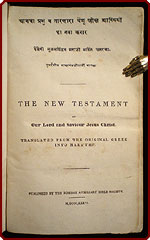
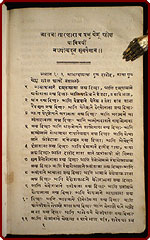 Click the interior images for enlargements.
 Uncommon: OCLC and NUC Pre-1956 find only three U.S. holdings, one of which has been deaccessioned.
• Darlow & Moule 6673; Book of a Thousand Tongues (2nd ed.) 818 (for 1830 ed.). Contemporary half sheep with marbled paper–covered boards, spine with gilt-stamped title; rubbed, scuffed, and faded, spine with small area of discoloration from now-absent shelving label. Front cover slightly sprung, front hinge (inside) strongly reinforced some time ago with cloth tape. Front pastedown with institutional bookplate and rubber-stamp, title-page verso also stamped; front free endpaper with pencilled ownership inscription; rear pastedown and free endpaper with light pencilled annotations. Pages age-toned, with scattered spots of light foxing; some corners dog-eared; one leaf with small hole with loss of a few letters. Occasional inked and pencilled annotations (in Marathi). (25144)
Uncommon
Edition ofMartyn's
Landmark Translation
Bible.
N.T. Persian. 1841.
Martyn. The New Testament of Our Lord and Saviour Jesus Christ, translated
from the original Greek into Persian, at Sheeraz.... Calcutta: Pr. at the Baptist
Mission Press for the American & Foreign Bible Society, 1841. 8vo (24.2
cm, 9.5"). [4], 584 pp.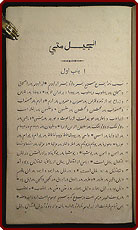
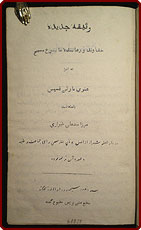
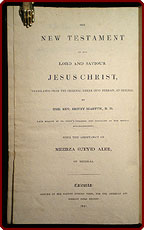 Click the images for enlargements.
 Scarce. OCLC and NUC Pre-1956 find only one U.S. holding of this edition.
• Darlow & Moule 7340; Book of a Thousand Tongues (2nd ed.) 1047 (for first ed.). Publisher's blue textured cloth, spine with printed paper label; boards and spine sunned (spine more so), with cloth cracked at joints and rubbed at extremities, spine label chipped and faded, spine with small area of discoloration and inked shelving number. Front pastedown with institutional bookplates. Two leaves towards front and last two leaves each with inner margins reinforced some time ago. Pages slightly age-toned, with occasional small pencilled marks of emphasis and marginalia in both English and Farsi. (25151)
First Printing ofAny Portion of the Bible in This Language Bible. O.T. Genesis. Fang. 1894. La Genèse, premier livre de Moïse. Londres: Societé Biblique Britannique et Étrangè, 1894. 12mo (16 cm; 6.25"). Frontis. color map, 186 pp.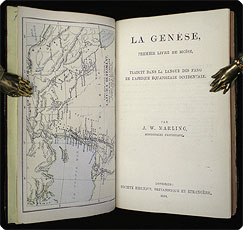
This is the first printing of any portion of the Bible in Fang (here Gabon-Fang). The translator was A.W. Marling of the American Presbyterian Mission.
Rare: We trace only two copies in U.S. libraries.
• North & Nida, Book of a Thousand Tongues (1972), 387. Publisher's black flexible leather (very black, not the charcoal that our photo seems to show!) stamped in blind and gold: chipped at edges and spine repaired. Now in a cloth clamshell case with a leather spine label. (25426)
Bibles,
& indeed Bibles in Languages thatFor
our BIBLES & TESTAMENTS,
Blogg/Bloch onHebrew Blogg, Salomon Ephraim. Aedificium Salomonis, enthaltend: Eine vollständige Geschichte der hebräischen Sprache, des Thalmuds und vieler merkwürdiger Begebenheiten des Alterthums, die bis dahin gänzlich unbekannt geblieben ... Hannover: Ernst August Telgener, 1832. 4to. xv, [1], 143, [1] pp.
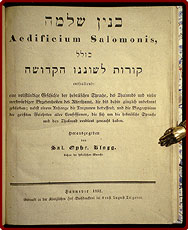
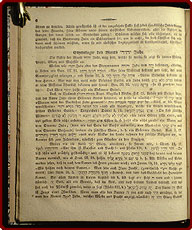 Click the interior images for enlargements.
 • Zedner, Catalogue of the Hebrew Printed Books in the Library of the British Museum, 153. Recent marbled paper–covered boards, spine with gilt-stamped leather title-label. Light age-toning and a bit of faint foxing. (23145)
Twa Ballads in Dialect Bonnie baby Livingstone; to which is added the twa martyr's widows. Glasgow: Pr. for the booksellers, [1850]. 12mo. 8 pp.
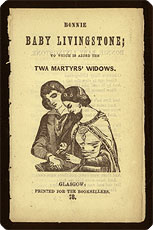 • Uncommon: Two Scots ballads. The title-page has a woodcut vignette of a young woman holding a rose while a young man with his arm around her shoulder holds her other hand, with “[No.] 78" printed at the foot.
 • Not in NSTC. Removed from a nonce volume. (16766)
 For more CHAPBOOKS, click here.
Not Just Your Usual LanguagesBopp, Franz. A comparative grammar of the Sanskrit, Zend, Greek, Latin, Lithuanian, Gothic, German, and Sclavonic languages ... second edition. London & Edinburgh: Williams & Norgate; New York: B. Westermann & Co., 1860. 8vo (22.2 cm, 8.75"). 3 vols. in 1. [8], xvi, 456, [2], [457]–952, [2], [953]–1462, [2] pp.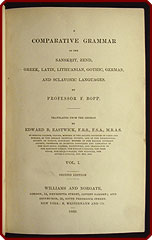
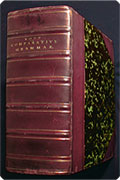
• NSTC 2B41650. Contemporary half red morocco with paper-covered sides, spine with gilt-stamped title; sides and edges showing minor scuffing, spine slightly darkened. Front pastedown with bookseller’s ticket of B. Westermann & Co., private collector’s 19th-century bookplate, and institutional stamp (no other markings). Pages faintly age-toned. A sturdy copy of this hefty tome.

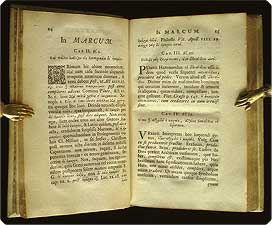
“Greek Studies”Bos, Lambert. Exercitationes philologicae, in quibus novi foederis loca nonnulla ex auctoribus graecis illustrantur & exponuntur ... editio secunda
multis partibus aucta. Accedit dissertatio de etymologia graeca. Franequerae: Wibium Bleck, 1713. 8vo (19.9 cm, 7.8"). [12], 305, [11 (index)], [2], 46 pp.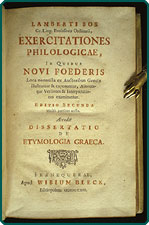
• Brunet, I, 1122. Contemporary vellum, spine with inked title; spine and edges mildly dust-soiled. All edges speckled red and blue. Front pastedown with institutional rubber-stamp; front pastedown torn and back pastedown lifted away from cover. Pages clean.
“Genuine Specimens of Native Literature”Maya & English Presentations — With Notes Brinton, Daniel Garrison, ed. The Maya chronicles. Philadelphia: D.G. Brinton, 1882. 8vo (24 cm, 9.4"). [2], 279, [1] pp.
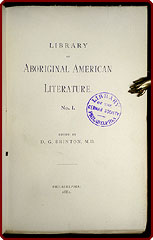
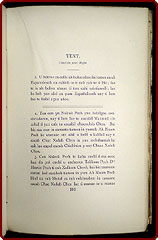
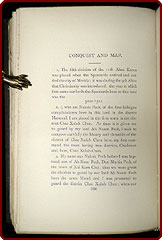 Click the images for enlargements. First printing in the U.S. of any pre-Columbian text in the original Maya. This is no. I in the “Brinton's Library of Aboriginal American Literature” series, opening with a description of the Maya and including selections from the books of Chilam Balam of Mani, Tizimin, and Chumayel, along with the chronicle of Chac Xulub Chen. Each Mayan text is accompanied by an English translation and the editor's notes.
• Not in Pilling, Proof-sheets; not in Newberry Library, Indian Linguistics in the Edward E. Ayer Collection. Publisher's brown textured cloth framed in blind, spine with gilt-stamped title; binding slightly cocked, corners and spine extremities a little rubbed, spine a bit sunned. Ex–social club library: call number on front fly-leaf, half-title and title-page rubber-stamped. No other markings. (26511)

Some
Songs inDIALECT,
Some
--- Not Bundle and go; to which are added, Donald and Mary, The wonders, Sweet Kitty o' the Clyde. Stirling [Scotland]: W. Macnie, [ca. 1825?]. 12mo. 8 pp.
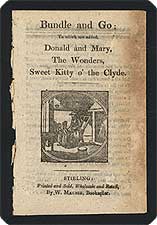
• NSTC 2B57765. Removed from a nonce volume. The front edges of the title and verso are darkened, else very good. (16759)
Japan during theYears of Seclusion, for an American Audience Busk, Mary Margaret, & Philipp Franz von Siebold. Manners and customs of the Japanese, in the nineteenth century. From the accounts of recent Dutch residents in Japan, and from the German work of Dr. Ph. Fr. von Siebold. New York: Harper & Brothers, 1841. 12mo (15.7 cm, 6.2"). Add. engr. t.-p., [2], 298 pp.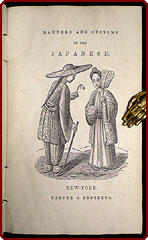
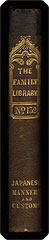 Click the images for enlargements.
 Binding: Publisher's olive-brown vermiform embossed cloth of Krupp's style Mis1, spine with gilt-stamped series and individual title.
• American Imprints 41-3339; Cordier, Bibliotheca Japonica, 475–76. Binding as above, cocked and front board slightly warped, sides with light discolorations; spine faded and head with strip of dark cloth tape extending onto sides. Ex–social club library: 19th-century bookplate and call number on front pastedown, first three leaves pressure-stamped, no other markings. First half of volume with pages faintly waterstained in upper portions and cockled; a sound book and as good a “read” as it was for the club members. (26428)
One of Buxtorf'sTWO Great Lexicons Buxtorf, Johann, the elder. Lexicon hebraicum et chaldaicum: Complectens omnes voces, tam primas quàm derivatas, quae in sacris Bibliis, Hebraeâ, & ex parte Chaldaeâ linguâ scriptis, extant ... Accessit lexicon breve rabbinico-philosophicum, communiora vocabula continens, quae in commentariis passim occurrunt ... editio sexta, de novo recognita, & innumeris in locis aucta & emendata. Basilae: Johannis König, 1655. 8vo (17.4 cm, 6.9"). [24], 976, [76 (index)] pp.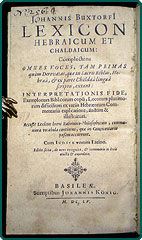
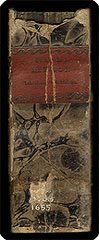 Click the interior image for an enlargement.
 • VD17 12:131988L. 19th-century marbled paper–covered boards, spine with gilt-stamped leather title-label; paper rubbed with spine paper chipped, cracked, and shelving number inked at bottom. Pastedowns with institutional bookplates, free endpapers and lower (closed) edges institutionally rubber-stamped, title-page with early inked numeral in upper portion. First third of work with early inked annotations and underlining (some marginalia shaved), this tapering off in frequency with close of volume untouched. Two leaves with small portions of outer margins excised. Occasional small stains, pages mostly clean. (25818)
A FAMED but UNLUCRATIVEPolyglot Dictionary Castell, Edmund. Lexicon heptaglotton, Hebraicum, Chaldaicum, Syriacum, Samaritanum, Æthiopicum, Arabicum, conjunctim; et Persicum, separatim. London: Thomas Roycroft, 1669. Folio (44.9 cm, 17.6). 2 vols. in I. Frontis., [8] pp., 44 columns (43 & 44 repeated in numbering), [2] pp., 573 columns (402, 403, 421 & 422 repeated in numbering; 340, 341, 399, & 400 skipped), [1] p., 4008 columns (376–78 & 391–93 incorrectly numbered; 484–86, 538, 1936–38, 3220–25, 3773–78, & 3950–51 repeated in numbering; 487–89, 535, & 3226–3231 skipped).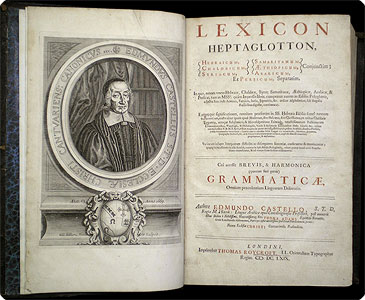
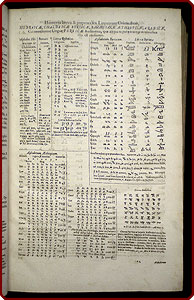
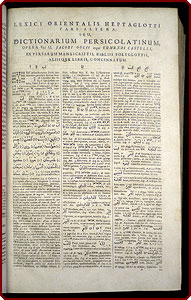 Click the images for enlargements.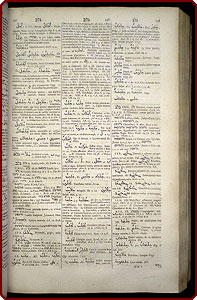
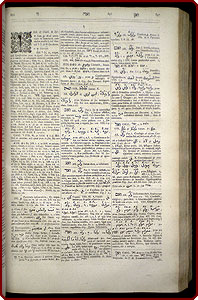
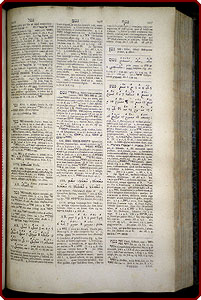
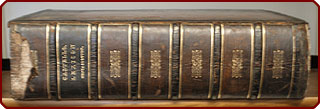
• ESTC R16460; Wing (rev. ed.) C1225; Vancil 46; Lowndes 386; Dibdin, I, 31–35. On Castell, see: Oxford Dictionary of National Biography online. 18th-century speckled calf, covers bordered with a darker calf band blind-rolled and then framed with single gilt fillet; spine with gilt-stamped leather title-label, darker-leather raised bands gilt-stamped/blind-tooled, and compartments gilt- and blind-tooled enclosing gilt-stamped floral decorations. Binding rubbed, with leather significantly lost in top compartment and and lost also at foot. All edges marbled. Front fly-leaf with inked ownership inscription as above dated 1837; title-page with old institutional pressure-stamp. Frontispiece with outer margin reinforced some time ago. One leaf slightly oversized and creased, intermittent soiling in many upper margins, one leaf with text affected but not obscured, small sections with light waterstaining to outer or upper margins; over all, a book both impressive and pleasant. Columns erratically numbered, text complete. (25792)
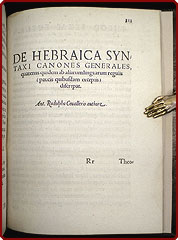
ImportantEarly Christian Hebrew Grammar Chevalier, Antoine-Rodolphe. Rudimenta Hebraicae linguae, accurata methodo & breuitate conscripta. Eor undem rudimentorum praxis, quae viuae vocis loco esse possit. Vitebergae: Iohan. Cratonem, [colophon: 1574]. 4to (20 cm, 7.9"). [16], 331, [1 (blank)] pp.
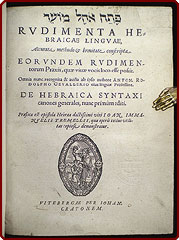
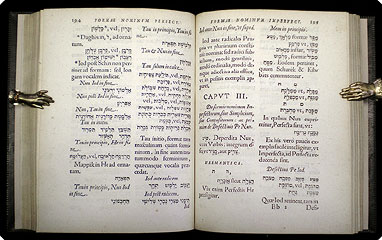 Click the images for enlargements.
 Uncommon: OCLC and NUC Pre-1956 locate only two U.S. holdings of this edition, one since deaccessioned.
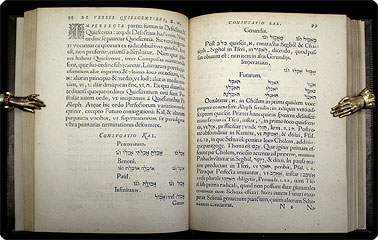 A nice copy. (25649)
By Fr. “Double Leaf/Fixed Star”Cuoq, Jean-André. Études philologiques sur quelques langues
sauvages de l’Amérique. Par N.O. Montréal: Dawson Brothers, 1866. 8vo (24.5 cm, 9.6"). 160 pp.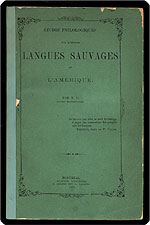
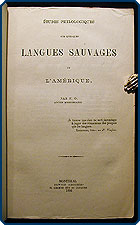
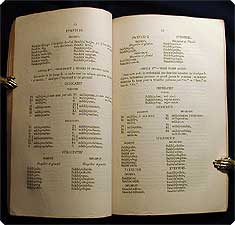 Click the middle or right image for an enlargement.
 Father Cuoq (1821–98) was an extremely accomplished linguist as evidenced by his becoming fluent in both Algonquin and Iroquois; Field (Indian Bibliography, p. 93) writes glowingly of his mastery of these languages. His life as a missionary of the Order of Sulpitians, notably among the Nipissing at Lake of Two Mountains, certainly aided in his scholarly achievement.
• Pilling, Algonquian, 100-101; Pilling, Proof-sheets, 952; Field 391; Newberry Library, Indian Linguistics in the Edward E. Ayer Collection, Algonkin-14; Sabin 17980. Not in Banks; not in Evans, Masinanhikan. Original printed green wrappers, spine reinforced some time ago, edges chipped. Half-title with pencilled annotations. First text page rubber-stamped by a now-defunct institution; pages otherwise clean.
Syriac & English — Greek & LatinCureton, William. Spicilegium syriacum: Containing remains of Bardesan, Meliton, Ambrose and Mara bar Serapion. London: Rivingtons, 1855. 8vo (26.2 cm,
10.3"). [4], iii, [1], xv, [1], 102, [54] pp.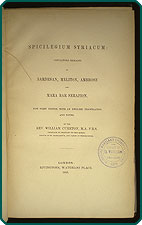
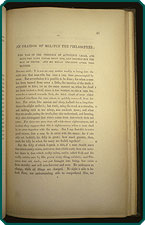
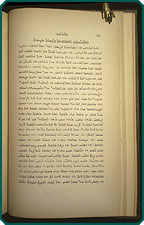 Single-click any image for an enlargement.
• NSTC 2C47117. Publisher’s cloth, covers blind-stamped, spine embossed and with gilt-stamped title; front cover detached, cloth chipped at spine extremities and rubbed at edges. Front pastedown with institutional bookplate, front free endpaper and title-page rubber-stamped, front free endpaper with inked ownership inscription dated 1870. Early inked marginalia to one page.
ABCs around the WORLD — Illustrated Diderot, Denis. Caractères et alphabets de langues mortes et vivantes (Extracted from the Encyclopédie, ou dictionnaire raisonné des sciences, des arts et des métiers). [Paris: ca. 1750–72]. Folio (30.5 cm, 12"). 24 double-p. plts. (of 25).
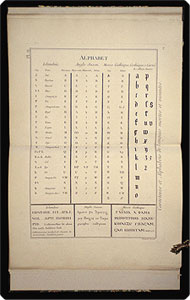
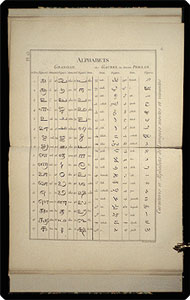
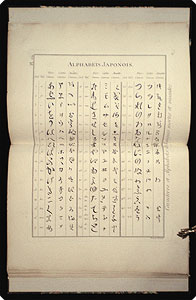 Click the images for enlargements. 24 double-spread engraved plates of alphabets for various languages. They were engraved for the article on alphabets in the Diderot Encyclopédie, a massive 20-year project aiming to encompass every branch of human knowledge that was a landmark of Enlightenment-era philosophy, attacking superstition while promoting science, rationality, and scholarship. Many of the volumes were supplemented with illustrations, such as the plates present here, designed to facilitate comparing and contrasting the alphabets and basic writing conventions of “dead and living” languages.
Languages charted in these tables include “Tartares Mouantcheoux,” Tamoul, Telongou, Persian (ancient and modern), Armenian, Russian (ancient and modern), Coptic, Hebrew, etc., with the engraving done by master artisan Robert Bénard (fl. 1750–85).
• Half green calf with green marbled paper–covered sides, spine with gilt-stamped title; slight wear to corners and spine extremities. Lacking one plate (#25). (24823)
As
If ItJUST
Arrived from the Print
Shop . . . Observations on “Muhhekaneew”EXTRAORDINARY
CONDITION!
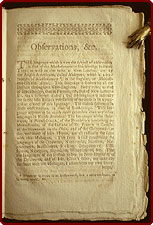
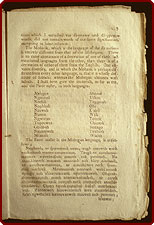
Edwards, Jonathan. Observations
onthe
language of the Muhhekaneew Indians.... New-Haven: Pr. by Josiah
Meigs, 1788. 8vo (21 cm, 8.25"). [1] f., 17, [1 (blank)] pp. 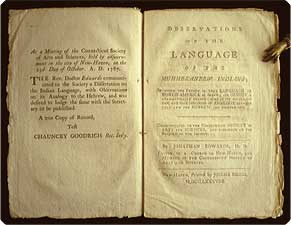
 Click the images for enlargements.
• Evans 21068; Pilling, Algonquian, 124; Newberry Library, Indian Linguistics in the Edward E. Ayer Collection, Mohegan-2; Field 487 (giving date erroneously as 1787); Sabin 21971. Uncut, unopened copy retaining original sewing and preserving the often missing preliminary leaf. In a Mylar envelope.  As darn near a fine copy as is obtainable.
 TO Part
II . . . TO Part
II . . . |