 DICTIONARIES
ALSO GRAMMARS, SIGNIFICANT WORD LISTS, LANGUAGE STUDIES
& SELECTED BOOKS
 IN
“EXOTIC”
LANGUAGESDICTIONARIESIN
“EXOTIC”
LANGUAGES
IN
“EXOTIC”
LANGUAGESDICTIONARIESIN
“EXOTIC”
LANGUAGES A Must for
 Visitors to AMAZONIA
  Figueira, Luis. Arte da grammatica da lingua do Brasil. Lisboa: Na Officina Patriarcal, 1795. Small 4to (20.5 cm; 8"). [2] ff., 103, [1 (blank)] pp.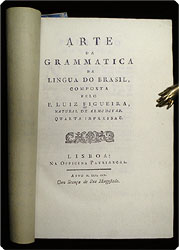
 Click the images for enlargements.
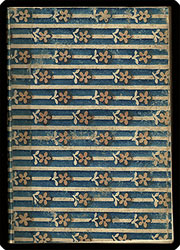
 • Sabin 24313; DeBacker-Sommervogel, III, 721; Viñaza 389; Valle Cabral 6; Rodrigues 1002; Ayrosa 202, Borba de Moraes (rev. ed.), I, 409. Publisher's “wallpaper” wrappers.  Fine, crisp copy. (26520)


 Yes, That Henry Ford Ford, Mr. & Mrs. Henry. Good morning: After a sleep of twenty-five years, old-fashioned dancing is being revived. Dearborn, MI: Dearborn Publishing Co., 1926. 12mo. 169, [1] pp.; illus.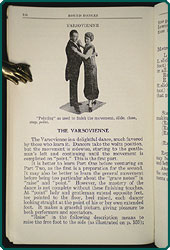
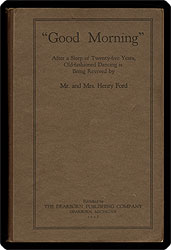 dictionary of dance terms and sheet music for two quadrilles, the Lancers “Oriental,” and a number of other dance tunes.
Click the image for an enlargement.
dictionary of dance terms and sheet music for two quadrilles, the Lancers “Oriental,” and a number of other dance tunes.
Click the image for an enlargement. • Publisher's quarter brown cloth and brown printed paper–covered sides, minimal wear. Clean and fresh. (26829)

“The Yaks are Strong & Hardy” Gerard, Alexander. Account of Koonawur in the Himalaya,
etc. etc. etc. London: James Madden & Co., 1841. 8vo (23 cm, 9"). xiii, [3], 190, [2], [195]–308 (i.e.,
310), xxvi, [2 (adv.)] pp.; 1 fold. map.
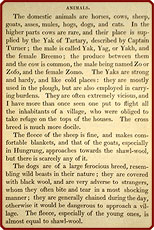
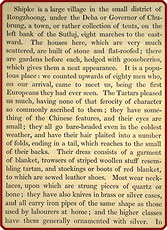 Click the interior images for enlargements.
 Gerard's observations cover botany, linguistics,
culture, and commerce, as well as geography. The area of his travels is depicted
by an oversized, folding map of his own design.
linguistics,
culture, and commerce, as well as geography. The area of his travels is depicted
by an oversized, folding map of his own design.
• NSTC 2G5453; Howgego, II, G7. Contemporary brown cloth, spine with gilt-stamped title; rebacked and 95% of original spine reapplied, with the publisher's name at the foot of the spine chipped. Front pastedown and back of map each with institutional rubber-stamp (no other markings), front free endpaper with inked ownership inscription dated [18]49. Hinges (inside) reinforced. Last preface page with small inked annotation. Pages slightly age-toned; map with light offsetting and one short tear starting along fold, not touching image. (24291)

 GrammarGORGEOUSLY
Got-UpGirault-Duvivier, Charles Pierre. Grammaire des grammaires ou analyse raisonnée des meilleurs traités sur la langue française ... quatorzième édition entièrement revue et corrigée .... Paris: A. Cotelle, 1851. (21.5 cm, 8.5"). 2 vols. I: [4], xx, 702 pp. II: [2], [703]–1380 pp.
GrammarGORGEOUSLY
Got-UpGirault-Duvivier, Charles Pierre. Grammaire des grammaires ou analyse raisonnée des meilleurs traités sur la langue française ... quatorzième édition entièrement revue et corrigée .... Paris: A. Cotelle, 1851. (21.5 cm, 8.5"). 2 vols. I: [4], xx, 702 pp. II: [2], [703]–1380 pp.
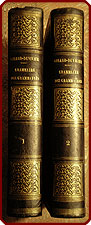
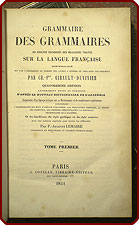
Click the near image for an enlargement.
Bindings: Contemporary black morocco, covers framed in gilt single fillet and blind-embossed using a single elaborately worked plaque, spines gilt extra, board edges with gilt rolls surrounding corners. All edges marbled.
• Brunet, II, 1614. Bindings as above, corners and spine extremities showing minor rubbing. Front pastedowns each with private collector’s bookplate and institutional rubber-stamp, versos of front fly-leaves also rubber-stamped (no other markings). Some light foxing, mostly to first and last few leaves; a few signatures unopened. Four publisher’s leaflets advertising Greek and Latin classics and other works are laid in.  Elegant, and interesting.
 For more SETS, click here.
“The Great Problem of Hieroglyphics”: English Speakers Greppo, J.-G.-Honoré. Essay on the hieroglyphic system of M. Champollion, Jun. and on the advantages which it offers to sacred criticism. Boston: Perkins & Marvin, 1830. 12mo (20.4 cm, 8"). xii, 276 pp.; 2 plts.
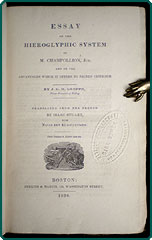
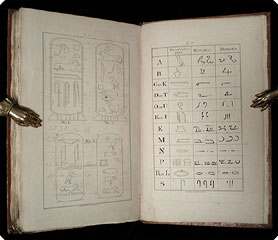 Click the images for enlargements. Two
plates at the back of the volume depict hieroglyphics and compare the “pure,”
hieratic, and demotic forms.
Click the images for enlargements. Two
plates at the back of the volume depict hieroglyphics and compare the “pure,”
hieratic, and demotic forms.
• American Imprints 1679; Allibone 2292. Publisher's red cloth, faded and discolored, recently rebacked preserving original spine label and as much of original spine cloth as possible; spine label darkened with chip. Ex–social club library: 19th-century bookplate, pressure-stamp on title-page, no other markings. Page edges untrimmed; pages moderately age-toned, otherwise clean. In fact quite a decent copy. (26382)

Cree Syllabics Guilloux, N., Father. [three lines in syllabic characters, which are transcribed as] Livre d'apologétique [then]. Winnipeg, Man.: Canadian Publishers Ltd., 1943. 8vo. [4], 114 pp.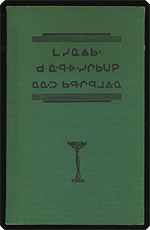
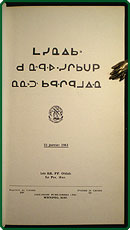 Click the interior image for an enlargement.
 No copy traced via OCLC.
• Not in Banks. Not in Evans. Original printed cloth–covered stiff wrappers. Fine. (14756)

English
Grammar, 1855 Hallock, Edward J. A grammar of the English language. For the use of common schools, academies and seminaries...sixth edition. New York: Ivison & Phinney (pr. by Thomas B. Smith), 1855. 12mo. 250, [14 (illus. adv.)] pp. 
• Contemporary speckled sheep, spine with gilt-stamped leather title label; spine and edges lightly rubbed. Occasional pencilled marginalia and emphasis marks, confined to the first half of the work. (12103)
“I
Speck I
Got You Dis Time,
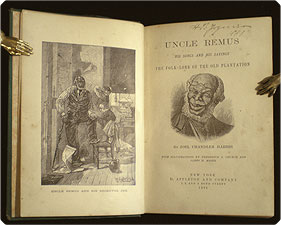
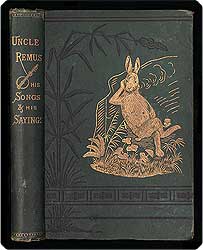
Brer Rabbit”Harris, Joel Chandler. Uncle Remus his songs and his sayings[.] The folk-lore of the old plantation. New York: D. Appleton & Co., 1881 (c. 1880). 12mo (19.5 cm, 7.74"). 231, [1 (blank)], [8 (adv.)] pp.; 8 plts., illus.
I
Got You Dis Time,
Brer Rabbit”Harris, Joel Chandler. Uncle Remus his songs and his sayings[.] The folk-lore of the old plantation. New York: D. Appleton & Co., 1881 (c. 1880). 12mo (19.5 cm, 7.74"). 231, [1 (blank)], [8 (adv.)] pp.; 8 plts., illus.
 the
most genuine reproductions he could muster of legitimate dialect, rather
than “the intolerable misrepresentations of the minstrel stage” (p. 4). The illustrations (eight engraved plates and a number of in-text cuts) were done by Frederick S. Church and James H. Moser.
the
most genuine reproductions he could muster of legitimate dialect, rather
than “the intolerable misrepresentations of the minstrel stage” (p. 4). The illustrations (eight engraved plates and a number of in-text cuts) were done by Frederick S. Church and James H. Moser.
Binding: Publisher’s green cloth, front cover stamped in black with gilt-stamped vignette of Brer Rabbit reclining elegantly at his ease; spine with decorative gilt-stamped title featuring a banjo.
• BAL 7100; Grolier, 100 Influential American Books, 83; Blank, Peter Parley to Penrod, 56. Binding lightly worn with some rubbing to extremities, spine a bit darkened. Title-page with inked inscription dated 1881 in upper margin, front pastedown with similar inscription. Very mild foxing to some pages.
 He BeatMark Twain to the Use of Pike County Vernacular
Hay, John. The Pike County ballads. Boston & New York: Houghton Mifflin Co., 1912. 8vo (22.3 cm, 8.75"). 45, [3] pp.; illus.
He BeatMark Twain to the Use of Pike County Vernacular
Hay, John. The Pike County ballads. Boston & New York: Houghton Mifflin Co., 1912. 8vo (22.3 cm, 8.75"). 45, [3] pp.; illus.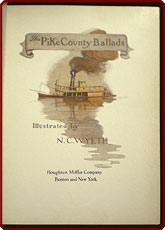
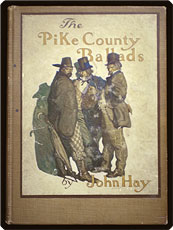
• BAL 7841. Publisher's tan cloth, front cover with affixed color-printed paper illustration; binding somewhat darkened (especially spine), corners and spine extremities rubbed, a few small spots of discoloration to front and back covers. Front pastedown with pencilled gift inscription, front free endpaper with bookseller's small ticket. Pages clean. A very nice book. (20839)

CREE
Horden, John. A grammar
of the Cree language, as spoken by the Cree Indians of North America. London:
Society for Promoting Christian Knowledge, 1881. 12mo (161 mm; 6.375"). viii,
238 pp.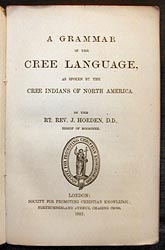
Horden's approach here is rooted in descriptive grammar and is expressed in terms of classic Latin-based structure. He urges his language-learning students to begin with his grammar, but to "use the living voice of the Indians as much as possible" as their guide (p. vi).
A copy of the issue intended for field use: With the flexible, water resistant binding.
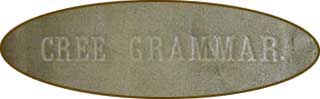
• Pilling, Bibliography of the Algonquian Languages, 237; Newberry
Library, Indian Linguistics in the Edward E. Ayer Collection, Cree-73
(giving incorrect page count); Pilling, Proof-Sheets of a Bibliography
of the Languages of the North American Indians, 1853. Not in Vancil,
Cordell Collection. Publisher's flexible khaki green covers of water
resistant cloth embossed in blind with decoration and stamped in blind with
"Cree Grammar." Slight dog-earing of the lower corner of the front cover.
 A copy of the very uncommon "field use" issue.
Hieroglyphics Illustrated — Sole EditionIdeler, Julius Ludwig. Hermapion sive rudimenta hieroglyphicae veterum Aegyptiorum literaturae. Lipsiae: Fr. Chr. Guil. Vogelii, 1841. 4to (31 cm, 12.1"). x, 314, 75, [1], 15, [1], [77]–95, [11] pp.; 28 plts. (6 folding)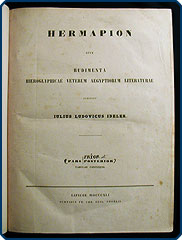
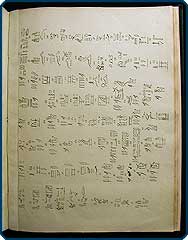
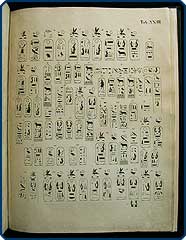
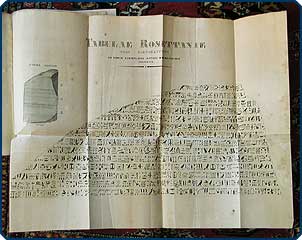 Single-click any image for an enlargement. French in addition to the predominant Latin and the hieroglyphic reproductions. 28 tipped-in plates, many of which are oversized and folded, provide illustrations of cartouches, hieroglyphs, and other characters; the text and plates were originally issued as two separate volumes, but are here bound in one.
• Brunet, II, 402. Recent black moiré cloth, covers framed with blind roll; spine with gilt-stamped leather title, author, and publication labels. Title-page with early inked annotation to volume information. Some mild foxing, with a few leaves more heavily spotted; plates browned. Plate VII with outer edge cropped, with loss of some characters; plate V with short tear from inner margin.
“InvestigatingOur Scottish Dialect”James V, King of Scotland; Callander, John, ed. Two ancient Scottish poems; The Gaberlunzie-man, and Christ's kirk on the green. Edinburgh: Pr. by J. Robertson, 1782. 8vo (21 cm, 8.25"). [2], 179 (i.e., 193), [1] pp. (1 prelim. f. lacking).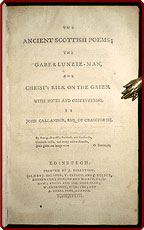
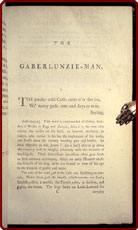 Click either image for an enlargement.
 ESTC notes that one institution reports a frontispiece, but most other listings cite a preliminary leaf (not present here) rather than a plate.  No, this does NOT photograph well! — but it is very interesting in the hand, under the eye.
• ESTC T146717; Allibone 328. 19th-century half morocco and pebbled cloth–covered sides, spine with gilt-stamped title; rubbed and sides sunned. Front pastedown with private collector's bookplate. Lacking one preliminary leaf; title-page partially separated, with faint pencilled annotation beneath author's name. Occasional light spotting, confined to inner and outer margins; one early inked annotation in the addenda to the first poem. (24880)
Last Edition with HIS Revisions Strong & Handsome Johnson, Samuel. A dictionary of the English language: in which the words are deduced from their originals, and illustrated in their different significations by examples from the best writers. To which are prefixed, A history of the language, and An English grammar. . . . In two volumes. London: Pr. by W. Strahan, for
W. Strahan, J. & F. Rivington, T. Davies, J. Hinton, L. Davis, et al., 1773. Folio (45.2 cm, 17.75"). 2 vols. I: [553] ff. II: [478] ff.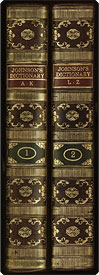
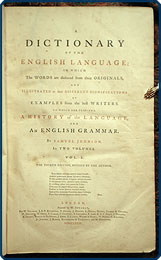 Click the images for enlargements.
 Robert Keating O'Neill, in his English-Language Dictionaries,1604–1900, notes that 1,250 copies of this edition were printed and that it, “unlike its two predecessors, was much revised and is considered generally to be the best edition.”
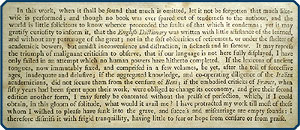 BE
SURE to click THIS image!
BE
SURE to click THIS image! • ESTC T117232; Brunet, III, 553; O’Neill J-52; Vancil 123; Printing and the Mind of Man 201 (for the first edition). 18th century treed calf, with minor surface cracks and chips and small areas rubbed; strongly and splendidly rebacked with speckled calf, spines gilt extra in bars and compartments; new leather spine labels bearing volume numbers and the emblazoned notes, “Johnson's Dictionary. A–K” and Johnson's Dictionary. L–Z.” Old gilt-tooling around covers and on turn-ins; nice old marbled endpapers. Title-pages printed in red and black. Occasional foxing; old waterstaining, generally quite light and inoffensive, in margins of early and later leaves. Paper flaw on B1 costing 4 letters of the footnotes; hole in blank area of outer margin of B1–B4. A few page edges chipped and ragged, with significant portion of paper lost from outer margins of two leaves, without costing any text; several leaves with a fold-in or dog-ear, paper quite strong at folds. Good text in a handsome and sturdy binding. (23890)
For more SETS, click here.This
is a PRB&M “FEATURED BOOK” —
Elegant Two-Volume Abridgement — With the GrammarJohnson,
Samuel. A dictionary of the English language: In which the words are deduced from their originals, explained in their different meanings, and authorized by the names of the writers in whose works they are found. Abstracted
from the folio edition ... the eighth edition. London: Pr. for J.F. & C. Rivington, et al., 1786. 8vo (21.8 cm, 8.6"). 2 vols. I: [289] ff. II: [266] ff.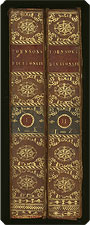
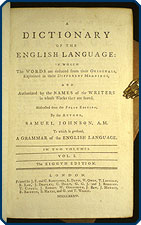
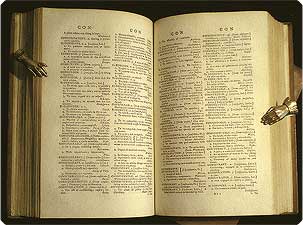 Single-click any image where the hand appears on
• ESTC T83956; Brunet, III, 553; O’Neill J-65; Vancil 123; Printing and the Mind of Man 201 (for the first edition). Contemporary speckled calf, spines gilt extra with gilt-stamped leather title and volume labels; all joints strengthened and bindings otherwise showing only light wear overall. Front pastedowns with bookseller’s stamp; title-pages with upper margins excised. An attractively bound abridgment of Johnson’s magnum opus.
For more SETS, click here.
An Eminently Perusable“Oriental” GrammarJones, William. A grammar of the Persian language...fifth edition, revised. With an index. London: J. Murray & S. Highley (pr. by S. Rousseau), 1801. Folio (25.8 cm, 10.12"). [4], xx, 147, [1 (blank)], [38 (index)] pp.; 1 plt.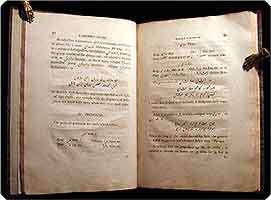 Click the image above for an enlargement.
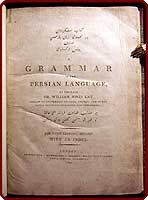
• NSTC J1084 (describing 6th and 7th editions only). On Jones, see: The Dictionary of National Biography, XXX, 174–77. 20th-century half morocco with marbled paper–covered sides, spine with gilt-stamped decorative motifs; binding is clean and all but unworn. Pages foxed, though not nastily so,with occasional pencil and ink marks of emphasis; one leaf with small repair to outer margin.
Special
Type for the
Micmac
Kauder, Christian. Sapeoig oigatigen tan tetli
gômgoetjoigasigel...manual of prayers, instructions, psalms & hymns in Micmac ideograms.
Ristigouche, Quebec: The Micmac Messenger, 1921. 16mo (18 cm, 7.125"). 456 pp. (pp.i–xii never
bound in).
the
Micmac
Kauder, Christian. Sapeoig oigatigen tan tetli
gômgoetjoigasigel...manual of prayers, instructions, psalms & hymns in Micmac ideograms.
Ristigouche, Quebec: The Micmac Messenger, 1921. 16mo (18 cm, 7.125"). 456 pp. (pp.i–xii never
bound in).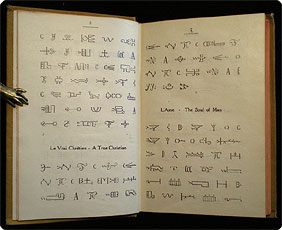
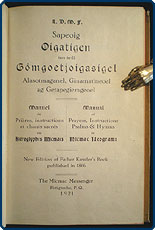 Click the images for enlargements.
 The characters used to print this work were the invention of Father Christian
Leclercq, a 17th-century missionary, and later revised and improved by Abbé
Pierre Maillard. More than 5700 types were cut and cast for the book, and
the characters each represent words rather than sounds. This may well be the sole work printed in these
characters.
This issue without English language front matter (i.e., pp. i–xii).
• Pilling, Algonquian, p. 275 (ref). Publisher's yellow-brown cloth with simply gilt-lettered spine, to which one stain and general light soiling; each cover creased vertically from an old bump. All edges red. Internally clean. (25312)
“Oats, a kind ofGrain for Horses”  Kersey, John. A new English dictionary, or, A compleat collection of the most proper and significant words, and terms of art, commonly used in the language ... London: Pr. for J. and J. Bonwicke, 1748. Small 8vo (17.5 cm; 7"). Unpaginated, unfolioed, but [160] ff.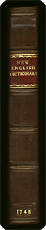
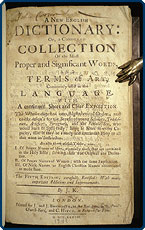
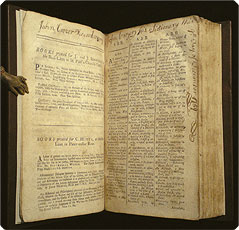 Click the interior images for enlargements.
 Ruth Wallis, writing in the on-line DNB, observes of his lexicography: “He called himself ‘Philobibl.’ when revising and augmenting the folio sixth edition of E. Phillips's New World of Words, or, Universal English Dictionary (1706; 3rd edn, 1721); he had added ‘20,000 hard words in arts and sciences’, while stating that it was ‘no part of our design to teach liberal or mechanical arts and sciences as a late learned author has attempted to do’, referring to the 1704 Lexicon technicum by John Harris. In 1708 he published the octavo Dictionarium Anglo-Britannicum, a condensed ‘portable’ version of the ‘voluminous’ 1706 work. He was ostensibly still alive when a third, corrected and enlarged, edition appeared in 1721.”
• Alston, V, 81; ESTC N20205; Vancil 138; O'Neill K-13. Recent full dark brown calf, old style, by Grace Bindings. Ex-library with small pressure stamp on title-page, five digit number in lower margin of A2. No other markings. Age-toning, occasional foxing. Old writing of the 1750s in some blank areas. Nice. (21730)
 TO Part
III . . . TO Part
III . . . |