 SOUTH
AMERICA
SOUTH
AMERICA
SOUTH
AMERICA
SOUTH
AMERICA
 Please Try to Get Along!
 Triunfo, José del Carmen. Letter Signed to the Ministro de Relaciones Exteriores of Bolivia. On paper, in Spanish. Lima, 12 May 1847. Folio, 3 pp.
On official Consulate stationery.
• Very good condition. Private ownership stamp. Glue and paper adhering along top margin, as from mounting.


 Heroic
Lima — Heroic LiteratureValdés, Rodrigo de. Poema heroyco hispano-latino panegyrico de la fundacion, y grandezas de la muy noble, y leal ciudad de Lima. Obra postuma. Madrid: En la Imprenta de Antonio Roman, 1687. Small 4to (20 cm; 8"). §4–§§§§§§§4 a–g4 A–Z4 Aa4; [56] ff., 184 pp,
[4] ff.
Heroic
Lima — Heroic LiteratureValdés, Rodrigo de. Poema heroyco hispano-latino panegyrico de la fundacion, y grandezas de la muy noble, y leal ciudad de Lima. Obra postuma. Madrid: En la Imprenta de Antonio Roman, 1687. Small 4to (20 cm; 8"). §4–§§§§§§§4 a–g4 A–Z4 Aa4; [56] ff., 184 pp,
[4] ff. 

 Click either image above
for an enlargement.
Click either image above
for an enlargement. 
The poem was left unpublished at the time of the author’s death and Francisco Garabito de León Messía saw to its publication.
• Palau 347681; Medina, BHA, 1806; European Americana 687/140; DeBacker-Sommervogel, VIII, 376–77. Recased in old vellum. A very good copy.

 In This Funeral
Oration . . .
In This Funeral
Oration . . . Pointed Remarks Were Made
Vargas, Casimiro. Oracion fúnebre que
pronunció...en las exequias solemnes que se celebraron en la iglesia
de la Compañía el 5 de diciembre de 1854 por el alma de...José
Gandarillas. Santiago, [Chile]: Imp. de la Sociedad, 1854. 8vo. 21, [1 (blank)]
pp.
Pointed Remarks Were Made
Vargas, Casimiro. Oracion fúnebre que
pronunció...en las exequias solemnes que se celebraron en la iglesia
de la Compañía el 5 de diciembre de 1854 por el alma de...José
Gandarillas. Santiago, [Chile]: Imp. de la Sociedad, 1854. 8vo. 21, [1 (blank)]
pp. 
• Not in Palau. Modern light wrappers, lacking original wrappers; some stains and exseminary library with stamp on title-page.


 First
— First
— VENEZUELAFirst
— First
— LATIN
AMERICA!Venezuela.
Constitution. Constitucion politica del estado de Venezuela, formada por
su segundo congreso nacional, y presentada á los pueblos para su sancion,
el dia 15 de agosto de 1819–9.o. Angostura: Impresa por Andres Roderick,
1819. Small 4to (18.8 cm, 7.4"). 67, [1 (blank)] pp.
First
— First
— VENEZUELAFirst
— First
— LATIN
AMERICA!Venezuela.
Constitution. Constitucion politica del estado de Venezuela, formada por
su segundo congreso nacional, y presentada á los pueblos para su sancion,
el dia 15 de agosto de 1819–9.o. Angostura: Impresa por Andres Roderick,
1819. Small 4to (18.8 cm, 7.4"). 67, [1 (blank)] pp.
 Click
the interior images for enlargements.
Click
the interior images for enlargements.

Bolívar had strong ideas about what the nature of the constitution should be, and he expressed them forcefully to congress as it worked on the constitution, but in the end, the legislators went their own way. Two years later, because Bolívar had freed Colombia and much of Ecuador, Venezuela merged with those two regions to form the free nation of Grand Colombia, being the former territory of the Viceroyalty of New Granada.
 Searches of the standard
library databases fail to find any copy of this important publication held
by any U.S. library. Bolívar himself imported the
press on which this outstanding document was printed, obtaining it in Trinidad.
The man in charge of the press was Andrew Roderick, almost certainly an Englishman,
but at least one source labels him Belgian, which seems most unlikely.
Searches of the standard
library databases fail to find any copy of this important publication held
by any U.S. library. Bolívar himself imported the
press on which this outstanding document was printed, obtaining it in Trinidad.
The man in charge of the press was Andrew Roderick, almost certainly an Englishman,
but at least one source labels him Belgian, which seems most unlikely.
• Not in Palau; not in Medina, Imprenta en algunas ciudades
de la América Española. In modern wrappers.  A
very clean and crisp copy of a certifiable rarity.
A
very clean and crisp copy of a certifiable rarity.
Shortly After the Declaration of IndependenceVenezuela. Junta Suprema Gubernativa. Broadside, begins: “Americanos. El orden politico del otro hemisferio ha reducido la España á ser victima de la perfidio y ooresion y este pueblo generoso conducido de uno en otro infortunio va ya á ser borrado del catalogo de las naciones ... ” [Caracas: Gallagher y Lamb, 1811]. Folio (31 cm; 12.25"). 1 p.
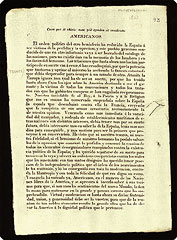 Click the image for an enlargement.
This document dates from immediately after July 5th, as internal evidence shows. Here the Junta Suprema explains what it sees to be the political reality of Spain’s dissolution into non-nationhood under Napoleon and thereby justifies “Venezuela [having] entered now, Americanos, into the number of free nations of the Americas.”
 Very Rare. This broadside was unknown to Medina. Grases located only the copies in the Public Record Office (London) and the Archivo de Indias (Seville). Searches of NUC, OCLC, and RLIN fail to find any copy at all. Further, no copies were found when searching the OPACs of the national libraries of Venezuela, Colombia, Spain, France, and England.
• Not in Medina, Caracas; not in Villasana. Grases, Historia de la imprenta en Venezuela, Repertorio #72. As issued. Worming in foremargin; repaired. Pencilling in margins. A very good copy.


 Venezuela
& Ecuador Combative
Venezuela. Legación. Ecuador. [cover-title] Legacion venezolana en el Ecuador. [drop-title] Documentos relativos a la mision del honorable Señor Coronel Andres Maria Alvarez, encargado de negocios de Venezuela cerca del gobierno del Ecuador. [Quito?, ca. 1858]. Tall 4to. 24 pp.
Venezuela
& Ecuador Combative
Venezuela. Legación. Ecuador. [cover-title] Legacion venezolana en el Ecuador. [drop-title] Documentos relativos a la mision del honorable Señor Coronel Andres Maria Alvarez, encargado de negocios de Venezuela cerca del gobierno del Ecuador. [Quito?, ca. 1858]. Tall 4to. 24 pp.

• In modern wrappers, preserving the original front printed wrapper.
Plan
del Perú . . .
Vidaurre [y Encalada], Manuel Lorenzo de.
Plan del Perú, defectos del gobierno español antiguo. Necesarias
reformas....Contiene al fin...los motivos políticos que obligan á
la isla de Cuba á declarar inmediatamente su independencia. Philadelphia:
Impr. por Juan Francisco Hurtel, 1823. 8vo. 225, [1 (blank)] pp., [2] ff.
In this work printed in Philadelphia, Vidaurre calls for republican reforms in Peru. This was a major change of political stance for him, for he had loyally served the crown in both his native Peru and, after the commencement of the Wars of Independence, in Spain. His attack on the Spanish political system and call for liberal republican reforms involves passionate denunciation of slavery, and his "renuncia" (pp. 197–225) speaks at length about Cuba's current socio-political conditions and explains why Cuba should follow the lead of the former Spanish colonies of the American mainland.
On the basis of this work, which is dedicated to Simón Bolívar, The Liberator appointed Vidaurre head of the supreme court at Trujillo.
• Sabin 99491; Shaw & Shoemaker 14780. On Vidaurre, see: Archivo biográfico de España, Portugal, e Iberoamérica, fiche 1012, frames 251–256 & 261–262. Modern quarter green morocco and marbled paper sides. Foxing, some staining. Complete with the errata leaf, and solid.
Abuses
in Riobamba?
Villaviciencio Torres y Maldonado, José Anselmo
de, complainant. Manuscript on paper, "Informe q[u]e se haze en d[e]r[ech]o
por parte de el G[ene]ral Don J[ose]ph Anselmo de Villavisencio y Thorres sobre
los capitulos...contra el Correg[ido]r de Riobamba.... [Riobamba(?), Ecuador,
ca. 1750–1770]. Folio. [6] ff.
The corregidor seeks the delay knowing that the residencia judge will be his successor and that traditionally residencia judges were lenient: They tended to use the standard investigation and trial as means of learning new scams, singling out troublesome citizens from meek ones and the corruptible from the honest, and so on.
• On Villaviciencio Torres, see: Medina, Biblioteca Hispano-Americana, V, 4432. Now housed in a quarter cloth (faux leather) folder with marbled paper sides. Sewing holes in inner margins, fore-edges a little tattered and dog-eared; in sound and useable condition.
Men
of Cajamarca —
TWOEYEWITNESS
Accounts of Events
Xerez, Francisco de. Libro primo de la Conqvista del Perv & prouincia del Cuzco de le Indie occidentali. [colophon: Vinegia {i.e., Venice}: Stampato per Stephano da Sabio, 1535]. 4to. [62] ff.


 Click the interior images for enlargements.
  true
entertainment cast in the tradition of the romance of chivalry;
not surprisingly, it was a blockbuster.
true
entertainment cast in the tradition of the romance of chivalry;
not surprisingly, it was a blockbuster.


Appended to Xerez's account (fols. [43v] to [55r]) is a translation of Miguel de Estete's account of Pizarro's army's journey from Cajamarca to Pachacamac and then to Jauja. Estete too was present at Cajamarca and is said to have been the first Spaniard to lay hands on Atahuallpa.

 A very good copy.
(25785)
A very good copy.
(25785)
Peruvian
Conquest Illustrated Zárate, Agustín de. Histoire de la decouverte et de laconquete du Perou. Traduite de l'Espagnol...par S.D.C. Paris: La compagnie des libraires, 1716. 8vo (17 cm, 6.75"). 2 vols. I: Frontis., [40], 360 pp.; 13 (2 fold.) plts., 1 fold. map. II: [8], 479, [1 (blank)] pp.

 Click the interior images for enlargements.


• Sabin 106261; Palau 379641. Contemporary mottled sheep and calf as above, corners and edges worn, all joints cracking, both volumes with minor worming to front covers and pinholes to spines; vol. I with loss of leather over spine head (half of top compartment). Pencilled check marks scattered throughout; front free endpaper and recto of last text page of vol. II with annotations.
In
Paper Wrappers,
1774Zárate,
Agustin de. Histoire de la découverte et de la conquête du
Perou, traduite de l’Espagnol d’Augustin de Zarate, par S.D.C. Paris:
Par la compagnie des libraires, 1774. 8vo (18 cm, 7.1"). I: Frontis., xl, 360
pp.; 1 fold. map, 10 engr. plts., 2 fold. engr. plts. II: viii, 479, [1 (blank)]
pp.

• Sabin 106266; Palau 379645. Volumes bound in paper wrappers, back wrapper lacking in both cases; front wrappers reinforced with printed papers taken from other items. Reverse of frontispiece in vol. I and front pastedown in vol. II with small bookplates of private collector. Edges untrimmed. Scattered spots; pages and plates generally in good clean condition.


PLACE AN ORDER | E-MAIL US | GO (BACK) TO TOPIC/INTEREST TABLE | PRB&M HOME
All material © 2010
The Philadelphia Rare Books & Manuscripts
Company