 SOUTH
AMERICA
SOUTH
AMERICA
SOUTH
AMERICA
SOUTH
AMERICA
 A
New Bishop for Buenos
Aires —Manuscript
Decree
A
New Bishop for Buenos
Aires —Manuscript
Decree
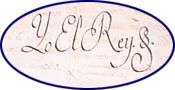
 Carlos IV, King of Spain. Document signed with a wooden stamp ("Yo El Rey") and with evidence of a royal paper and wax seal. Aranjuez, 23 February 1798. Folio (288 x 210
mm.). [3] ff.
Carlos IV, King of Spain. Document signed with a wooden stamp ("Yo El Rey") and with evidence of a royal paper and wax seal. Aranjuez, 23 February 1798. Folio (288 x 210
mm.). [3] ff.
• Stitched.

 One of CHILE’s
 “Padres de la Patria”
 Edgar Allan Poe Connection Carrera, José Miguel de. Autograph Letter Signed to Henry Didier. In Spanish, on paper. Montevideo: 12 December 1817. Small 4to (24.5 cm x 9.5"). [2] pp., with integral address leaf.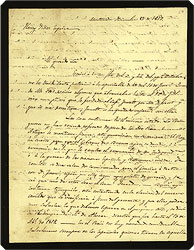
 Click the image for an enlargement.
 Writer Carrera: From one of the leading families of Chile, José Miguel Carrera led the successful coup de etat of 15 November 1811 that overthrew the Junta de Gobierno that was established in the political void after the capture of the king of Spain. As sole leader of the nation he created the first Chilean constitution, designed the first Chilean flag and coat of arms, and was responsible for bringing the first printing press to Chile. Disagreement with the Lautaro Lodge of the Masons led to his overthrow by Bernardo O’Higgins and the rift never healed, eventually leading to Carrera’s exile in Argentina, the U.S., and later Uruguay. His brothers fell into the hands of O’Higgins who had them executed.
Recipient Didier: Henry Didier was the godfather of Edgar Allan Poe’s older brother, William Henry; he was to take the boy into his home for some years, though accounts differ as to whether this happened immediately after the death of the Poe children's parents (1811) or after the death of their guardian grandfather (1816). He ran a counting house in Baltimore and William Henry worked there as a young man. Though the Poe brothers' intimacy varied due to circumstances over the years, clearly Edgar knew Didier; he would surely have visited his brother at the Didier house.
On Uruguay: “Las cosas continuan en el mismo estado. Los Portugueses no han recivido refuerzo despues de los 500 Pernambucanos. Artigas se mantiene firme, esta guarnicion no se mueve. El Rey ha escrito para que el Gobierno de Buenos Ayres se desida.”
On Argentina: “Buenos Ayres continua tranquilo, está entretenido en la eleccion del nuevo cavildo que se verificará a fines del presente.”
On Peru: “En el Perú no hay novedad considerable. [L]os españoles tienenel aquella costa 11 buques de guerra, inclusas dos de 44, pero esto no estorbó al Berg.n chileno el Aguila. . . . No pasa de 9000 veteranos el Ex[erci]to en aquel pais, aseguran que llegando los buques de guerra de Estados Unidos piensan atacar a Arequipa y seguir a Lima; no lo creo por ahora.”
On O’Higgins: “O’Higgins sigue mandando el Ex[erci]to y Brayer es sus m[ay]or gene]ral. — Pueyrredon ha mandado a esta un comisionado para que alcance de Leon que se me eche de aqui; Leon constante en su amistad y systema se negó despresiando al comisionado.”
On Prisoners: “Mi viejo Padre, 85 años de edad, ha estado incomunicado 17 dias, y ultimamente sigue su arresto en casa. . . . Mis hermanos presos aun, y lo mismo muchos de nuestros compatriotas. . . . Mr. Handle continua en su prision con todos sus oficiales y tripulacion.”
• Very good condition. Written in a very clear hand. (24646)

 Colonial Services Recounted
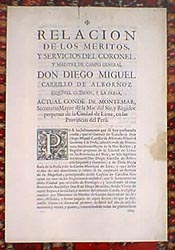
Carrillo de Albornoz, Diego Miguel. [drop-title] Relacion de los meritos, y servicios del coronel, y maestre de campo general Don Diego Miguel Carrillo de Albornoz Esquivel Guzman, y la Presa, actual conde de Montemar.... [Madrid, 1747]. Folio. [2] ff.
Colonial Services Recounted
Carrillo de Albornoz, Diego Miguel. [drop-title] Relacion de los meritos, y servicios del coronel, y maestre de campo general Don Diego Miguel Carrillo de Albornoz Esquivel Guzman, y la Presa, actual conde de Montemar.... [Madrid, 1747]. Folio. [2] ff.
• Palau 259482; not in Alden & Landis, European Americana. Folded with small tear into first line of text.

[AND]
$165.00
• Juan Carrillo succeeded his father, Diego Carrillo, to the title of conde de Montemar, and in this biographical sketch his service to the Crown seems to have just begun, for he plays more heavily on genealogy and current family connections than on actual service. Francisco Eduardo Paniagua certifies the accuracy of the document and signs it at the end.
• Palau 259571. Folded as issued.
 First Printing in Latin America — Montes de Oca Engraved Title Casas, Bartolomé de las. Breve relacion de la destruccion de las Indias Occidentales. México: en la oficina de Don Mariano Ontiveros, 1822. 16mo (15 cm; 5.75"). [1] f., 164 pp.
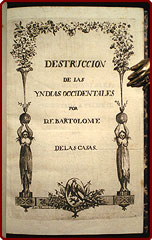
 Click the title-page image above for an enlargement.
 This edition begins with a handsome engraved title by the famous Mexican engraver Luis Montes de Oca, signed in the lower left corner and bearing the Mexican national emblem in the lower center of the plate.  This is one of the first appearances of that emblem, and it is most fitting that it be the work of this artist.
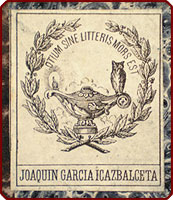
Provenance: Bookplate of the famous 19th-century Mexican collector, bibliographer, and historian of the book, Joaquín García Icazbalceta.
• Palau 46951. 19th-century quarter black morocco with marbled paper sides; spine tooled in gilt to replicate a raised-band spine with spine compartments; two small abrasions. Interior with light, scattered foxing only. A lovely little book. (25216)

Legal Age for Marrying Charles IV, King of Spain. Begins: Don Carlos ... Con fecha de diez de Abril de este año he tenido a bien expedir mi Real Decreto del tenor siguiente.” [Madrid: No publisher/printer, 1803]. Folio. [4] pp. (last blank).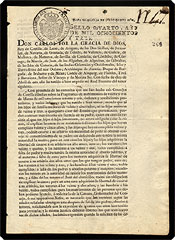
Signed by the crown with a wooden stamp, “Yo el Rey.”
This copy sent to Santiago, Chile, and docketed there.
• Removed from a nonce volume. Clean and untattered. (25817)

Early Commercial Law of ChileChile. Laws, statutes, etc. Reglamento de aduanas y resguardos del estado de Chile. [Santiago, Chile]: Impr. Nacional, 1822. [1] f., vii, [1 (blank)], 27, [1 (blank] pp., [6] ff.
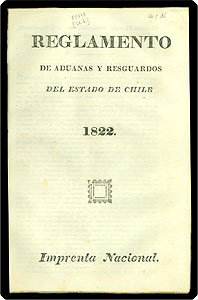
• Briseño, I, 294. Not in Palau. Modern wrappers. Small brown stain on last few leaves. A very good copy.
 “The most important documentary collection for colonial Spanish America” Coleccion de documentos ineditos relativos al descubrimiento, conquista y organizacion de las antiguas posesiones españolas en América y Oceanía. Madrid: Various publishers, 1864–84 & 1966. 8vo. 42 volumes.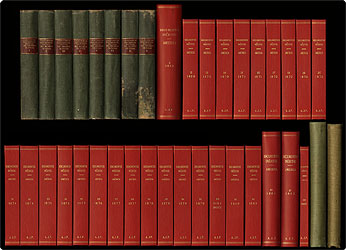
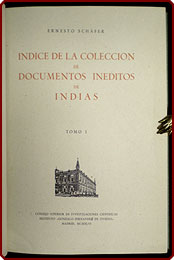
A mixed set in mixed bindings: all volumes except 11 are first editions, the exception being a 1966 reprint. Many original wrappers bound in. Volumes 1–10 in early quarter cloth, 11–42 in modern full cloth.
• Griffin, Latin America: A guide to the historical literature, 2063; Palau 56442. Bindings as above: Vols. 1–10 with abrasion/discoloration to spines, otherwise minor wear; moderate foxing, and some early annotations. Vols. 11–42, cloth bright; mostly clean internally, last 2 pages of last volume supplied in facsimile. Vol. 38 lacking fascicles 3, 4, 5, and 6. (25828)
The Constitution that Came Out of“The
War of the Supremes” Colombia. Constitution. 1843. Constitucion politica de la república de la Nueva Granada reformada por el congreso en sus sesiones de 1842 y 1843. Bogota: imp. del Gobierno, por J.A. Cualla, 1843. 12mo. 31, [1(blank)] pp.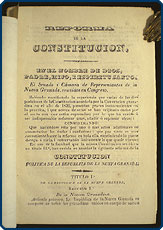
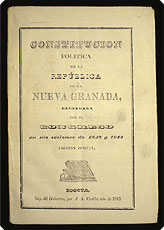 Click the images for enlargements.
 There were two editions of the constitution in 1843: This one, and another that extended to 27 pages.
• Not in Palau. Original printed wrappers, small strip excised from blank area at top of front wrapper. Few dust smudges on wrappers. Very good copy. (15169)
“Official
Edition” — AHuman
Rights MilestoneColombia.
Constitution. 1853. Constitucion política de la Nueva Granada.
Año de 1853. [Bogotá]: no publisher/printer, 1853. Small 8vo (20
cm, 7.9"). 12 pp.
 Click the images for enlargements.
 There were two editions in 1853, the other being 24 pages in length.
• Palau 59737. Original printed yellow wrappers, creased and a little dusty. Very good condition.
 For other ABOLITION items, click here. For a short “shelf” devoted to For
HUMAN RIGHTS more
For other ABOLITION items, click here. For a short “shelf” devoted to For
HUMAN RIGHTS more
A Proto-Constitution — COLOMBIAColombia. Constitution. 1861. Pacto de union de los Estados Unidos de Colombia celebrado por el Congreso de Pleniptenciarios en su sesión del día 20 de setiembre. Bogota: Impr.de la nación, 1861. 12mo (15.8 cm, 6.25"). 28 pp.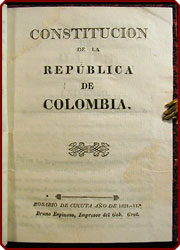

 Not in OCLC.
• Not in Palau. Original printed green wrappers. Waterstaining to inner area of wrappers, same faintly visible in one area of title-page.
Rionegro Printing — NO Library Copies FoundColombia.
Constitution. 1863. Constitucion politica para los Estados UU. de Colombia, sancionada el 8 de mayo de 1863. Rionegro: Imprenta de la Union, por J. Orjuela, [1863]. 4to (26.4 cm, 10.4"). 50 pp., plus wrps. 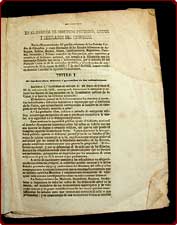
Click the image for an enlargement. This is the first printing of that new liberal constitution, from the small press in the out-of-the-way town of Rionegro. It is very rare: We trace no copies via OCLC, RLIN, or NUC. Further, searches of the OPACs of the National Library of Colombia and of the universities of Cali and the Andes failed to locate a copy.


Very
Early Printing of the  1863
Constitution
Colombia.
Convención nacional. Actos lejislativos de la Convención
Nacional. Instalada en Rionegro, el 4 de febrero de 1863. Bogotá: Impr.
de la Nación, [1863]. 8vo. [1] f., 86 pp., vii pp.
1863
Constitution
Colombia.
Convención nacional. Actos lejislativos de la Convención
Nacional. Instalada en Rionegro, el 4 de febrero de 1863. Bogotá: Impr.
de la Nación, [1863]. 8vo. [1] f., 86 pp., vii pp.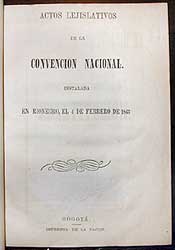
This publication contains the Constitution of 1863 as ratified by the Ríonegro Convention as well as most of the other legislation that the Convention adopted. The constitution incorporated many anti-clerical measures, including: separation of Church and state; full freedom of worship, even for non-Catholics; suppression of religious orders; prohibition of corporate ownership of real property (which amounted to prohibition of Church ownership of property); and governmental supervision of worship. The document also thoroughly decentralized power and made each state a virtual law unto itself.
In an attempt to curb the power of Gen. Mosquera, the presidency was made an office of two-year duration, and immediate re-election or succession was barred.
IMPORTANT AND RARE: NUC Pre-1956 fails to locate any copies, and RLIN finds only one copy (SUNY-Buffalo).
• Removed from a volume of pamphlets and now in later wrappers. Ownership mark eradicated from title-page.  A very good copy of a rare item.
University Matters
Colombia. Laws, statutes, etc. Decretos del poder ejecutivo organizando las universidades. [Bogotá]: Imp. del Estado por J.A. Cualla, 1842. Small 4to. 64 pp.
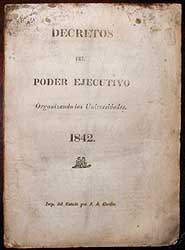
• Printed wrappers, sewn as issued. Covers dust-soiled, pages a little dog-eared; signature on front wrapper. Manuscript index at end.
Saints
ofSIENNA
— A
South American Martyr
[Conti, Sebastiano &
Giambattista Ferrari]. Fasti senenses. [Senis: Per Academiam Intronatorum,
1660]. Folio (35.5 cm, 14"). *4 (-*1) **4 A–Z4
Aa–Mm4 1 (=*1). [1 (blank)], [7] ff., 279, [1] pp., [1 (errata)]
f.; frontis., 2 plts. 
 Click the interior images for enlargements. a
South American martyr, Horatio de Vecchi, S.J., and include
the most famous of Sienese saints, St. Catherine (not the only woman
found herein).
Click the interior images for enlargements. a
South American martyr, Horatio de Vecchi, S.J., and include
the most famous of Sienese saints, St. Catherine (not the only woman
found herein).
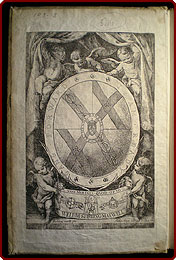
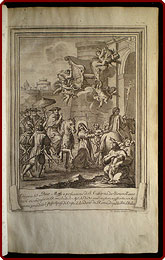
The detailed engraved frontispiece, by “Gio. Batta Sintes” after
“Nicolo Gadim,” shows St. Catherine leading Pope Gregory XI back
into Rome after his decision to leave Avignon. There are also two finely engraved
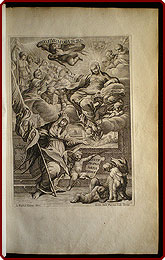
plates by Guillaume Vallet. The first, after Raphael Vanni, shows the B.V.M.
looking down with favor on an allegorical figure of Siena. The other, after
Carlo Maratta, shows (under the title of this work) a woman watering the tree
of the arts from which cherubs gather fruit. This is the first of two editions,
a second having appeared in 1669. It is handsomely printed in a large roman
type with a few woodcut historiated initials and a tailpiece, and it is rare.We
find only two copies reported.
Provenance: Huge (27.8 x 18.3 cm, 11" x 7.25") armorial bookplate of “William Stirling Maxwell” on the front pastedown; his arms also appearing as a supra-libros stamped in blind on the front cover, and his monogram similarly stamped on the rear cover.
• DeBacker-Sommervogel, II, 1390–91 & III, 678 (imprint and authorship information found here). Vellum with two forms of supra-libros as above, rebacked in leather toned to approximate vellum with gilt-stamped maroon leather title-label and gilt-dotted raised bands; boards slightly sprung, edges rubbed, vellum lightly soiled around edges. Pencilled notations on recto of front pastedown, and further notation, in ink and denoting authorship, on verso of front free endpaper. Pages lightly cockled; occasional foxing and soiling; all edges speckled red. (4203)
 The“First
First” amongSTATE
Constitutions
. . .Cundinamarca
(Colombia ). Constitution. Constitucion de Cundinamarca,
su capital Santafe de Bogota. [Santafé de Bogota] : D. Nicolas Calvo, y
Quixano, 1811. Small 4to (20.5 cm, 8.1"). 47, [1] pp.
The“First
First” amongSTATE
Constitutions
. . .Cundinamarca
(Colombia ). Constitution. Constitucion de Cundinamarca,
su capital Santafe de Bogota. [Santafé de Bogota] : D. Nicolas Calvo, y
Quixano, 1811. Small 4to (20.5 cm, 8.1"). 47, [1] pp.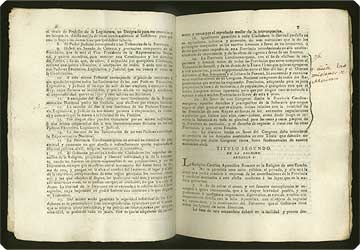
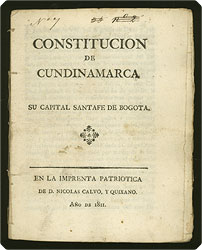 Click
the images for enlargements.
Click
the images for enlargements.
• Posada, Bibliografia bogotana, 231; Palau 59632. Sewn
as issued, without the wrappers. Minor soiling to title-page and last (blank)
page. Old inked numbers at top of title-page. A very good copy.
 TO Part
III . . .
TO Part
III . . . |