 ANTIQUARIAN BIBLES
I:
ENGLISH-LANGUAGE BIBLES, TESTAMENTS, & “PARTS” (Part
A) (Part B)
 II:
POLYGLOTS & ANCIENT LANGUAGES (Part A)
(Part B)
| III: NATIVE AMERICAN LANGUAGES
II:
POLYGLOTS & ANCIENT LANGUAGES (Part A)
(Part B)
| III: NATIVE AMERICAN LANGUAGES
IV: MODERN
LANGUAGES NOT ENGLISH OR AMERIND (Part
A) (Part B)
V: BIBLE STUDY AIDS, COMMENTARY, &
“RELATED”
(Part A) (Part B)
 |
POLYGLOTS, HEBREW, GREEK, LATIN,
SYRIAC
CATALOGUE ORDERED BY DATE
|
 Bible.
Latin. Vulgate. 1513. Biblia cum concordantiis veteris et novi testamenti
necnon et iuris canonici. Lugduni: M. Jacobum Sacon, 1513. Folio (34.5 cm, 13.5").
aa8 bb6 a–z8 A–Q8 R6
AA–BB8 CC10 (-aa1, CC9,10); [13], CCCXVII, [25] ff.
(lacking title-page & last 2 ff. of the Interpretationes).
Bible.
Latin. Vulgate. 1513. Biblia cum concordantiis veteris et novi testamenti
necnon et iuris canonici. Lugduni: M. Jacobum Sacon, 1513. Folio (34.5 cm, 13.5").
aa8 bb6 a–z8 A–Q8 R6
AA–BB8 CC10 (-aa1, CC9,10); [13], CCCXVII, [25] ff.
(lacking title-page & last 2 ff. of the Interpretationes).
$4750.00
 Click any image where the hand appears on
mouse-over, for an enlargement.
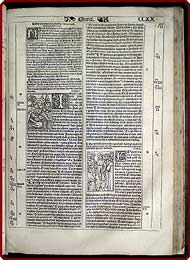
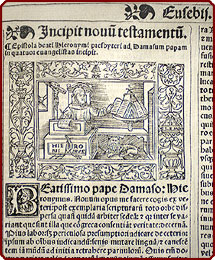
• Revised edition, following the first of 1506, of Jerome’s Vulgate as printed by Jacques Sacon for Anton Koberger of Nuremberg. Darlow and Moule note that Sacon “reprinted the best contemporary editions,” for example Kerver’s 1504 Paris edition.
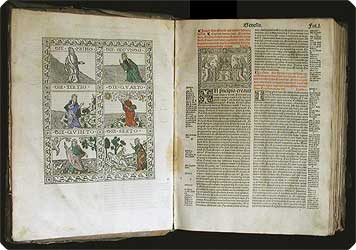
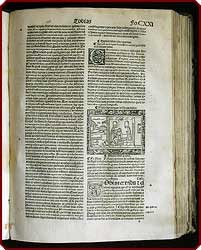
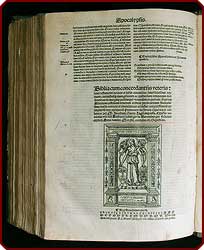
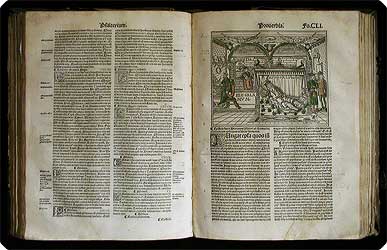
This Bible is illustrated with  two full-page and 130 in-text woodcuts (including some repeated images), a few of which have early hand-coloring, mostly but not entirely in green or
yellow. One full-page cut shows the six days of Creation — partially hand-colored in green, brown, red, blue, and yellow — while another depicts the manger scene. The text is followed by the Interpretationes nominum hebraicorum, a dictionary of Hebrew names often appended to manuscript and early printed Bibles.
two full-page and 130 in-text woodcuts (including some repeated images), a few of which have early hand-coloring, mostly but not entirely in green or
yellow. One full-page cut shows the six days of Creation — partially hand-colored in green, brown, red, blue, and yellow — while another depicts the manger scene. The text is followed by the Interpretationes nominum hebraicorum, a dictionary of Hebrew names often appended to manuscript and early printed Bibles.
Scarce: OCLC and RLIN report two holdings, both in the U.S.
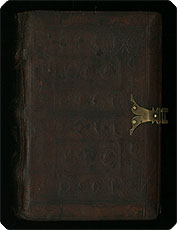
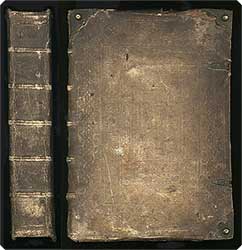
Binding: Contemporary blind-tooled, alum-tawed pigskin over beech boards, elaborately worked using embossing rolls with religious vignettes and busts. Covers with etched metal corner bosses and remnants of leather and metal clasps.
• Adams B988; c.f. Darlow & Moule 6101 & 6091. Binding as above, spine with hand-inked title; overall dust-soiled and darkened with several short tears to leather; leather no longer tight to the boards. Straps, clasp locking-mechanisms, and lower front metal corner now lost. Title-page and final two ff. of Interpretationes lacking; front pastedown separated from board and back pastedown lacking. First and last few leaves with insect damage to outer edges. First text page (contents) with old institutional rubber-stamp and shadow of pencilled numeral. A few leaves separated; a number of leaves with short tears from lower margins, a few extending into text, in many cases with traces of old repairs. Two leaves with lower outer corners torn away, one repaired some time ago. Pages age-toned, some waterstained. Scattered contemporary inked marginalia; some light underlining and a few instances of early inked doodling.  Despite its faults, this is rare and imposing.
Bible.
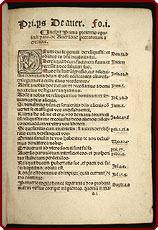
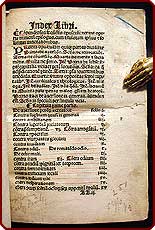
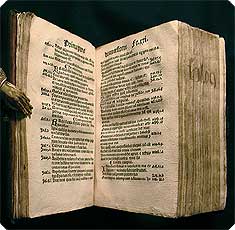
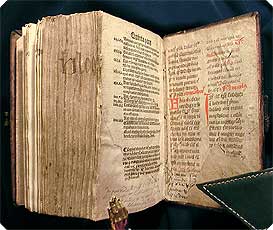
Latin. Selections. Peckham. 1514. Diuinarum sententiarum libro[rum] Biblie ad certos titulos redacte collectariu[m], ingenio siquide[m] eruditissimi sacris literis assuetissimi viri ... Joha[n]nis de Pechano ... compilatu[m] ... Parisius: Venales reperiu[n]tur in vico diui Jacobi ad intersignium diui Claudii [Francois Regnault], 1514. Small 8vo (14.5 cm; 5.875"). AA8 BB4 a–z8 [et]8 A–H8 I4 (-AA1); [11 (of 12)], cclxi [i.e., 260] ff. (without the title-leaf).
$3500.00
• Also known as Collectarium sacrae Bibliae, this is only
the second edition, the first having appeared earlier the same year at the suggestion
of John Fisher (1459–1535), of this medieval compilation from the pen
of the archibishop of Canterbury (d. 1292). An epitome and a particular one,
it saw considerable acceptance if the number of surviving manuscript copies
(whole or partial) are testimony.All
initials are highlighted in red.
Click the images for enlargements.
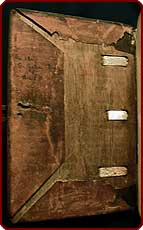
Binding: Contemporary
Flemish panel-stamped binding, calf over bevelled boards with remnants of brass
and leather clasp. Each cover embossed twice with a panel featuring medallions
of mythical and other creatures; thus, the panel is used four times. Binding's
front pastedown not present, which exposes the board, turn-ins, and details
of the volume's sewing structure; the rear pastedown consists largely of an
 older
manuscript leaf.
older
manuscript leaf.
Provenance: 17th-century
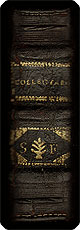
spine label with initials “S.F.” and a tree design between them.
Ownership signature of Gordon Duff; Yale University (bookplate) — deaccessioned.
• Edition: Moreau, II, 930; Shaaber, British Authors Printed
Abroad, P57; not in Darlow & Moule. Binding: Fogelmark, Flemish
and Related Panel-Stamped Bindings, plate XXXII R.46 & pp. 48–49.
Volume rebacked and much of old spine reapplied; lacks title-leaf and
last leaf torn across corner with loss replaced of old, colophon partly supplied
in manuscript. Highlights to initials as above; occasional early underlining
or another mark and a later pencilled note on last leaf. Missing leaf and
torn second one notwithstanding (though they do lower the price), this isa
very nice copy in a notable early binding.
 A
PRB&M “FEATURED BOOK” —
A
PRB&M “FEATURED BOOK” —
for others, click
here.
 An ILLUSTRATED RENAISSANCELarge Folio Bible
Bible. Latin. Vulgate. 1529. Textus Biblie. [colophon: Impressum autem Lugduni {i.e.,Lyons}: per Joha[n]nem Crespin, M.ccccc.xxix {1529}]. Folio extra. [18], 268, [17] ff.
An ILLUSTRATED RENAISSANCELarge Folio Bible
Bible. Latin. Vulgate. 1529. Textus Biblie. [colophon: Impressum autem Lugduni {i.e.,Lyons}: per Joha[n]nem Crespin, M.ccccc.xxix {1529}]. Folio extra. [18], 268, [17] ff.
[SOLD]
Click the images for enlargement.
• Handsome and substantial are two terms that immediately come to mind regarding this large Renaissance-era Latin-language Bible. In addition to the main text, the volume has “concordantiis veteris et noui testamenti . . . quas utriusqz iuris professor . . . Johannes de Gradibus concordantibus congruisqz apposuit locis.” Further we are told it was “reuisa, correcta [et] emendata . . . accedunt . . . ex . . . Iosephi libris exhauste auctoritates, quas . . . Ioha[n]nes de Gradibus concordantibus congruis[que] apposuit locis. . . .”
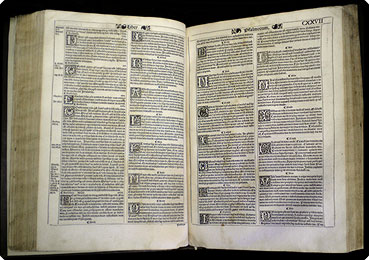
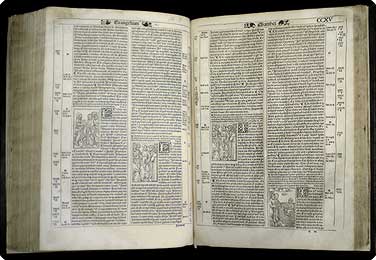
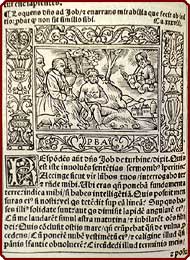
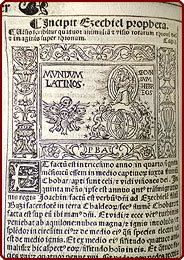
The text is printed in double-column format in a modified gothic type with liberal use of four-line woodcut, historiated, criblé, and other initials, and illustrated withmore than 120 woodcuts. The woodcuts of the Old Testament are of good size, measuring approximately 3.8 x 6 cm (1.5" x 2.25") and with their four-element frames each one fills a text column left to right (5.5 x 8.5 cm; 2.25" x 3.25"). The cuts, “with the exception of the Creation, are close copies of those used in Jacques and Jean Mareschal's Lyons Bibles of 1523–1541" (Mortimer). They are also closely related to those used in Sacon's Bibles, which were by Hans Springinklee. The bottom border element on some has the initials “P B A” and the left and right elements of other frames read “Pour” “LEM.” The New Testament illustrations are smaller, 5.5 x 3.5 cm (2.25" x 1.375"), and each fills only half a column left to right.
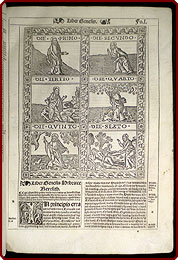
There are three much larger woodcuts: On folio CXXIX verso is a multi-image, half-page cut of King Solomon, measuring 13.5 x 16.2 cm (5.375" x 6.5"), and on D4 recto a three-quarter-page rendering of the Nativity measuring 20.5 x 18 cm (8" x 7").  Genesis opens with a gorgeous six-panel cut that is yet a bit larger, depicting God in His six days of Creation.
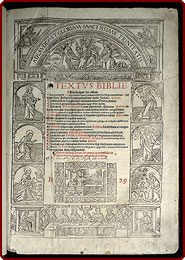
The title-page is printed in black and red, with the type contained in a four-element border that incorporates a scene of the Last Supper, images of the Creation different from those illustrating Genesis, and a very large capital element (i.e., tympanum) with the words “Ad Laudem et Gloriam Sanctissime Trinitatis” above images of God the Father and two angels. In the four corners of the title-page are the four Evangelists. The printing of the Canons is also in black and red, framed within columned “temples” fully printed in red.
Provenance: Inscription of a monastery to title-page, minute name of “Fray Baptista O'Sullivan, with an 1890's date, to a rear blank.
Evidence of readership: Scattered throughout are short marginal notes in a late 17th- or early 18th-century continental hand, in Latin, as well as underscoring and marks in the margins of important passages or words or thoughts.
This is the second Crespin edition, the first having appeared in 1527.
• Mortimer, French, 66; Fairfax-Murray, French, 36. Not in Darlow & Moule. Full calf old style: Round spine with gilt-accented raised bands and with title, place, and date gilt-stamped directly on spine; blind rules extending onto covers from each band to terminate in a trefoil, and covers framed in blind double fillets. Title-leaf crinkled; the occasional stain; moderate soil, light old staining, and/or wear variously to upper outer corners, lower gutter corners, and the odd foremargin, with a number of strengthenings to these instances. Marginalia slightly trimmed in 19th century. Library rubber-stamp on lower edges of closed volume; heavy library pencilling to a rear blank; no other such marks. Overall a good and satisfactory copy of a nicely illustrated Renaissance book. (24810)

 An
EarlyComplete
Bible in GREEK
— O.T. &
N.T., 1545
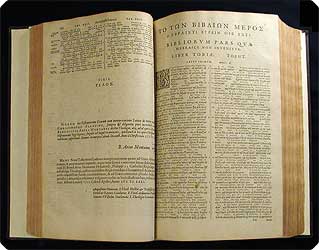
Bible.
Greek. 1545. [three lines in Greek, then] Divinae Scriptvrae, Veteris
ac Novi Testamenti, omnia innumeris locis nunc demum, & optimorum librorum
collatione, & doctorum uirorum opera, multo quàm unquam antea emendatiora,
in lucem edita. Basileae: Per Ioan. Heruagium, 1545. Folio. *4 (-*2,3,4) a–z6A–Z6Aa–Ss6Tt4Vv–Zz6AA–MM6NN4;
969, [1] pp., [3] ff.
An
EarlyComplete
Bible in GREEK
— O.T. &
N.T., 1545
Bible.
Greek. 1545. [three lines in Greek, then] Divinae Scriptvrae, Veteris
ac Novi Testamenti, omnia innumeris locis nunc demum, & optimorum librorum
collatione, & doctorum uirorum opera, multo quàm unquam antea emendatiora,
in lucem edita. Basileae: Per Ioan. Heruagium, 1545. Folio. *4 (-*2,3,4) a–z6A–Z6Aa–Ss6Tt4Vv–Zz6AA–MM6NN4;
969, [1] pp., [3] ff.
$6000.00
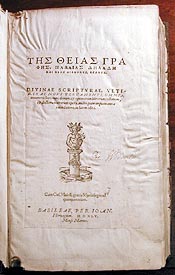
• While Erasmus was creating quite a stir with the first, second, third, and fourth editions of his Greek New Testament, others were busy working at producing complete Bibles in Greek. The accepted sequence of complete Bibles in Greek is: First, the Aldine Bible of 1518, second, the Greek Bible contained in the Complutem polyglot—finished by 1517 but not published until 1520), and third, that printed in Strassburg in 1524–26. This, then, is but the fourth. As with all save the Strassburg Bible, it is folio in format.
Melanchthon (1497–1560), the great Humanist and Luther's friend and supporter, wrote the preface to this edition. The three leaves bearing that essay are missing from this copy and this may be due to a Catholic or Inquisitorial censor removing them so that the text of the Bible proper could be used by Catholic readers. All of Melanchthon's writings, including introductions, were on the Index Librorum Prohibitorum. The text of the Bible proper, here, is complete.
The text of the O.T. "follows the Aldine Bible of 1518; with variant readings, and restoration of the usual order in Provers and Ecclesiasticus. The Apocrypha are grouped together as in No. 4602 [i.e., the Strassburg edition of 1524–26]. The N.T. text appears to agree with the quarto edition printed at Basel in 1545" (Darlow & Moule). The New Testament just referred to was the sole Greek-only Testament that Froben published and it follows the text of the fourth Greek N.T. of Erasmus, meaning that the N.T. here is also a close reprinting of the Erasmus fourth.
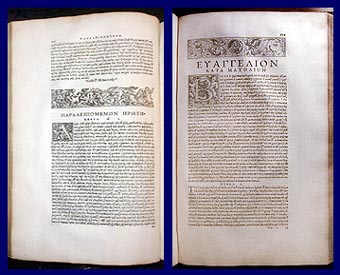
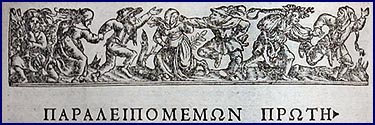
The typography is exquisite and Hervagius has enhanced the presentation on the page with attractive decorative head-pieces, including one that spans the page and depicts a group of six peasants dancing to the tune of a man playing a flute or "pipe."
Provenance:
Late-17th- / early-18th-century ownership signature of "Pet. Wedderburn; 18th-century
bookplate of Lord Eliock; later pencilled signature of "[?].T. Coleridge"
(not Samuel Taylor Coleridge; possibly, however, Justice John Coleridge).
At back, "Ex dono D. Al: Brown, M.D." and another ownership inscription entirely
in Greek.
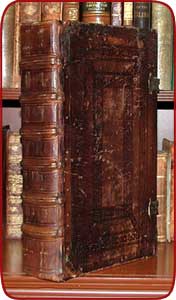
• Darlow & Moule 4614; Dibdin (4th ed.), An Introduction to...Greek and Latin Classics, 86; Rumball-Petre, Rare Bibles, 224. 16th-century calf over wood boards, covers elaborately tooled to produce an interesting embossed binding of concentric panels: Used are a single fillet (repeatedly, usually in triplets) and a roll featuring urns, flowers, and putti. Rebacked and edges and corners renewed. Remains of brass clasps. Endpaper reattached. Title-page cut down and mounted. There are a very few instances of old marginalia. A very clean, handsome copy.

 FIRSTLATIN BIBLE Printed in England
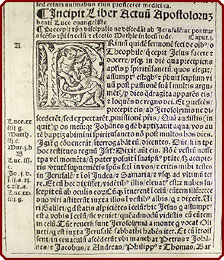
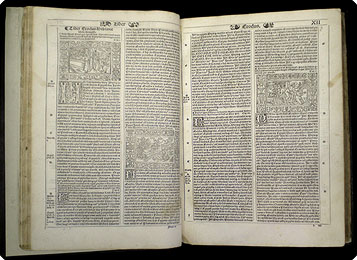
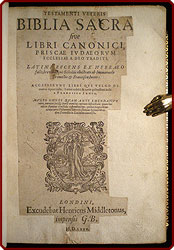
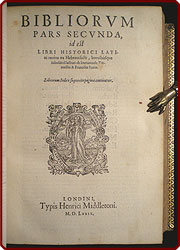
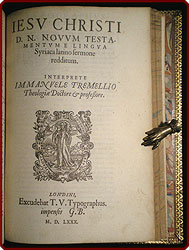
Bible. Latin. 1580. Tremellius–Junius. Testamenti veteris Biblia Sacra sive libri canonici, priscae Iudaeorum Ecclesiae a Deo traditi, Latini recens ex Hebraeo facti, brevibusque scholiis illustrati ab Immanuele Tremellio & Francisco Iunio.... Londini: Henricus Middletonus, impensis G.B., 1579–80. 4to (21.6 cm, 8.5"). [16], 219, [1], 299, [1], 251, [1], 390, [2], 192 (some pp. bound in out of order), [4], 194, [2] pp.
FIRSTLATIN BIBLE Printed in England
Bible. Latin. 1580. Tremellius–Junius. Testamenti veteris Biblia Sacra sive libri canonici, priscae Iudaeorum Ecclesiae a Deo traditi, Latini recens ex Hebraeo facti, brevibusque scholiis illustrati ab Immanuele Tremellio & Francisco Iunio.... Londini: Henricus Middletonus, impensis G.B., 1579–80. 4to (21.6 cm, 8.5"). [16], 219, [1], 299, [1], 251, [1], 390, [2], 192 (some pp. bound in out of order), [4], 194, [2] pp.
$1950.00
Click the interior images for enlargements.
• Variant printing of the first edition of the earliest complete
Latin Bible printed in England, translated by Immanuel Tremellius and Franciscus
Junius. Portions of the Tremellius–Junius Old Testament had been previously
published in various forms; Darlow and Moule note that here, “To Tremellius
and Junius' version of the O.T., and Junius' translation of the Apocrypha, is
added Tremellius' translation of the N.T. made from the Syriac.”
The Old Testament, Apocrypha, and New Testament are here in six parts, each
with separate title-page bearing an engraved vignette and each section including
engraved head- and tailpieces in addition to decorative capitals. The publication
information in some sections gives “Impensis G.B.” (George Bishop),
as opposed to “C.B.” (Christopher Barker) or “I.H.”
(Harrison), in whose names other variants were issued.
Provenance:
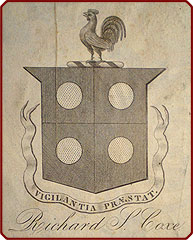
Front pastedown with armorial bookplate of prominent attorney Richard S. Coxe,
of whom it was once said that “he was employed in more cases upon the
docket of the Supreme Court of the United States than any other lawyer in
the country” (Dictionary of American Biography); front free endpaper
with affixed handwritten description of the volume by Coxe; front fly-leaf
with inked presentation inscription by Coxe, dated 1859.
• ESTC S121318; STC (2nd ed.) 2056.4; Rumball-Petre 240;
Darlow & Moule 6166. On Coxe, see: DAB, IV, 487–88.
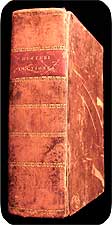
19th-century calf, covers framed and diced in blind with spine also blind-diced,
but smaller, and bearing gilt-stamped leather title, place, and date labels;
rebacked with old spine laid on, and joints strengthened. Edges and extremities
lightly rubbed, spine leather with a few small cracks. Front pastedown with
private bookplate as above and smaller institutional bookplate. Title-page
text excised from original leaf and mounted, some time ago; outer margin of
last page excised and leaf mounted. One early inked textual annotation. First
few leaves with small area of worming in lower margins; one leaf with short
tear from lower margin, extending into text without loss. Pages age-toned,
with scattered light spotting throughout and instances of faint waterstaining;
upper edges trimmed closely, occasionally affecting pagination or headers.
Turn-ins with gilt roll; all edges marbled to match endpapers. (24877)


Bible.
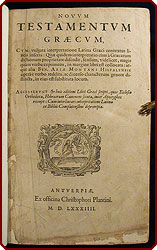
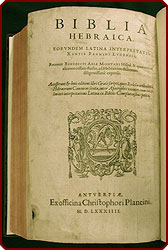
Greek & Hebrew. 1584. Biblia Hebraica & Novum Testamentum Graecum. Antuerpiae: Ex officina Christophori Plantini, 1584. Tall folio (35 cm, 13.9").
¶4 A–Z4 π1 Aa–Qq4, †4 ††6 A–O6 P8
a–x6 y8 z8 aa–gg6 AA–RR6; [viii], 186, 128, [xx], 283, [1], 203, [1] pp.
$6000.00
Click the images for enlargements.
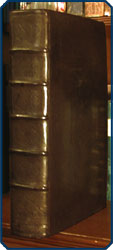
• Here, in one tall thick volume, is the essence ofthe Royal Antwerp Polyglot. It is comprised of two parts in one volume, edited by B. Arias Montanus: A “complete
Bible in the original languages, with an interlinear Latin translation; the whole reprinted from the Antwerp Polyglot. The Hebrew O.T. starts at the end of the volume, and the Greek N.T. at the beginning, followed by the Greek Apocrypha; each of the two parts has its own separate title” (Darlow and Moule).
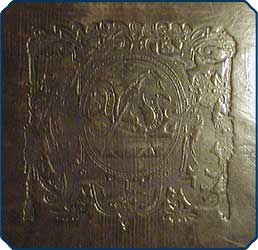
• Adams B972; Darlow & Moule 5106 & 4645. Modern full polished
brown calf, panelled in blind and with blind-stamped decorative corner pieces,
covers with elaborate blind-stamped version of the Plantin Press device, spine
compartments decoratively tooled in blind and with blind-stamped lettering.
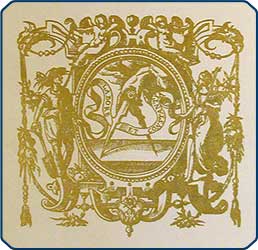
 Front
pastedown with large, gilt-stamped version of the covers' blind Plantin device.
Both title-pages neatly backed and with marginal restoration. Lacks one blank
between New Testament sections (only). One instance of early underlining. One
leaf with tear from lower margin, not touching text. All edges stained red,
with white splotches to top and bottom ones. Overall, a very clean and well
margined copy, solid for use in an appropriate binding.
Front
pastedown with large, gilt-stamped version of the covers' blind Plantin device.
Both title-pages neatly backed and with marginal restoration. Lacks one blank
between New Testament sections (only). One instance of early underlining. One
leaf with tear from lower margin, not touching text. All edges stained red,
with white splotches to top and bottom ones. Overall, a very clean and well
margined copy, solid for use in an appropriate binding.
Bible.
N.T. Polyglot. Hutter.
Selections. 1601. Lectiones evangeliorum
& epistolarum, anniversariae. Ebraicé, cum radice, literis servilibus,
& Latina lectione. Græcé, Latiné, & Germanicé.
Harmonicé & symmetricé...editæ ab Elia Huttero.... Noribergae:
1601. 8vo. (19 cm, 7.5"). A–Z8 Aa–Zz8 Aaa–Ccc8;
781, [1 (blank)] pp., [1 (blank)] f.; plts.
$1750.00
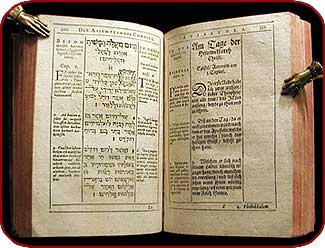 Click
the interior image above for an enlargement.
Click
the interior image above for an enlargement.
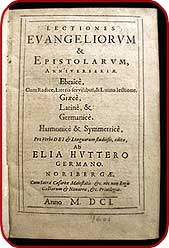
• Altogether Hebrew, italic, Greek, gothic, and roman fonts were
used to print this most unusual polyglot that features a
Hebrew translation of the liturgical epistles and gospels
for use at Mass, accompanied by a transcription of the Hebrew into Latin letters,
as well as the Greek, Latin, and German versions. The Hebrew text incorporates
some small handsome woodcut initials, and the printer has also employed some
interesting woodcut headpieces.
Elias Hutter (1553–1609) was an orientalist and professor of Hebrew
at Leipzig. The text here is drawn from his famous and sought after polyglot
New Testament in 12 languages (Nuremberg, 1599), and so shares in the censure
Hutter received for there translating and inserting "in some versions missing
passages which he found in others" (Darlow and Moule)—but, he was open
about that. The present work was apparently for devout students of Hebrew,
both to further their knowledge of that language and to give them comparative
texts for study and meditation on the week’s lessons. Polyglot
lectionaries are not common, and this is the only polyglot lectionary of the
epistles and gospels listed by NUC
Pre-1956 before the 19th century.
• Not in Darlow & Moule, but see 1430, 1431, 1432, 1433, and
1434 for Hutter’s polyglot New Testament in 12 languages, and his St.
Matthew’s Gospel, St. Mark’s Gospel, polyglot Psalter, and polyglot
New Testament in four languages. Sheep, spine simply gilt with a red leather
title label; leather rubbed and abraded, front joint opening. Pages with some
instances of light waterstaining or browning. All edges red.
Not from the Pepys's Library
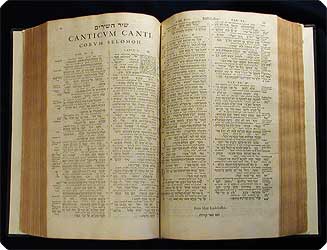
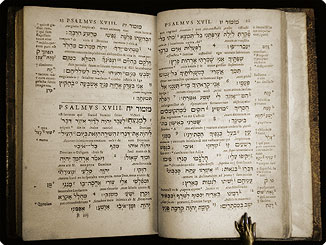
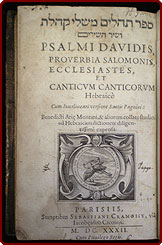
Bible. O.T. Selections. Latin & Hebrew. 1632. [two lines in Hebrew, romanized as] Sefer Tehilim Mishle Kohelet ve-Shir ha-Shirim] Psalmi Davidis, Proverbia Salomonis, Ecclesiastes, et Canticum Canticorum Hebraicè cum interlineari versione Santis Pagnini.... Parisiis: Sebastiani Cramoisy, 1632. 8vo (18.4 cm, 7.25"). [16], 416 pp.
$500.00
Click the images for enlargements.
• Attractive Cramoisy diglot printing of the Psalms and other Old Testament portions, in Hebrew with an interlinear Latin translation. The Latin version was done by the Italian Hebraist Santes Pagnini, a pupil of Savonarola, here edited and with additional commentary by Benito Arias Montano, the supervisor of the 1572 Royal Antwerp Polyglot Bible.
The title-page bears Cramoisy's printer's device, inherited from his grandfather Sébastien Nivelle: two storks with the motto “Honora patrem tuum et matrem tuam ut sis longaevus super
terram.” The work is also decorated with four very large, foliated Hebrew initials
Provenance: First dedication page with inked inscription of Dr. Henry Power (ca. 1626–68), a physician and natural philosopher who became one of the first elected fellows of the Royal Society. The title-page bears an inked inscription reading “S. Pepys” (lined through), but a tipped-in manuscript letter signed by Derek Pepys Whiteley, curator of the Pepys Library at Magdalene College, notes that the handwriting is “quite unlike examples of [the diarist's] signature.”
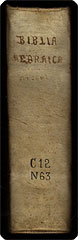
• Steinschneider, Catalogus hebraeorum in Bibliotheca Bodleiana, 459b. Not in Darlow & Moule. On Power, see: Oxford Dictionary of National Biography online. Later calf, spine with gilt-stamped leather label and gilt-ruled raised bands, board edges with gilt roll, rebacked preserving original spine; corners and joints refurbished, edges rubbed. Hinges (inside) unobtrusively reinforced. Back pastedown with institutional bookplate almost entirely obscuring early inked inscription. Title-page with early inscriptions at head and foot mostly trimmed away, also with inscription as above; dedication page with inscription as above. Pages age-toned; first few leaves with staining and minor chipping in lower portions. A very few early pencilled and inked marginalia in both Latin and Hebrew; one instance of inked underlining. (25937)

First Printing of theHebrew Psalms in England
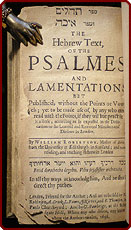
Bible. O.T. Psalms. Hebrew. Robertson. [in Hebrew: Sepher Tehillim u-sepher echah] The Hebrew text, of the Psalmes and Lamentations but published, without the points or vowels; yet to be made use of, by any who can read with the points, if they will but practice it a little.... London: Pr. for the author, 1656. 12mo (15 cm, 5.9"). [12], 156, 149-191, 15, [2 (errata)] pp.
$850.00
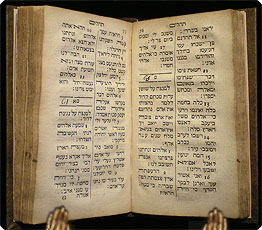
 Click the interior images for enlargements.
• First edition, one of four variants appearing in the same year — all uncommon — of the first printing of Psalms in Hebrew in England. The text was edited by William Robertson, an Edinburgh-educated grammarian and historian who moved to London to teach Hebrew. An octavo edition with points was also published in 1656; Robertson, in the dedication, notes that students should consult both versions, with preference given to the vowel-less rendition as both closer to the “primitive and original” text and likelier to enlighten the scholar. This particular variant is dedicated “To the Right Reverend, and Learned, the Ministers and Divines, in, and about the City of London,” rather than to Jonathan Goddard or John Sadler as seen in some of the other versions.
This is the first stand-alone printing of the Psalms in Hebrew in England, published around the same time as the London (i.e., “Walton”) Polyglot.
• ESTC R210526; Wing (rev.) B2742C; Cowley, Hebrew Printed Books in the Bodleian Library, 92. Not in Darlow & Moule, not in Herbert, not in Rumball-Petre. On Robertson, see: Oxford Dictionary of National Biography online. Recent quarter calf and mottled paper–covered sides; spine with gilt-stamped and
gilt-ruled title, gilt-dotted raised bands, and blind-tooled compartment decorations; leather edges tooled in blind. Title-page with edges chipped, touching lower outer portion of publication information; first and last few leaves also with edges chipped, and slight darkening. (25358)
Edited & Printed by a Would-Be Academic
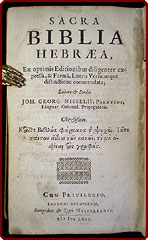
Bible. O.T. Hebrew. 1662. Sacra Biblia Hebraea, ex optimis editionibus diligenter expressa, & formâ, literis versuumque distinctione commendata. Lugduni Batavorum: Nisselianis, 1662. 8vo (19.1 cm, 7.5"). [431] ff. (lacking 1 internal f. [blank]).
Would-Be Academic
Bible. O.T. Hebrew. 1662. Sacra Biblia Hebraea, ex optimis editionibus diligenter expressa, & formâ, literis versuumque distinctione commendata. Lugduni Batavorum: Nisselianis, 1662. 8vo (19.1 cm, 7.5"). [431] ff. (lacking 1 internal f. [blank]).
$800.00
Click the images for enlargements.
• Uncommon first edition, intended for student use and specifically approved by the theological faculty of the University of Leiden for that purpose. Johann Georg Nissel was originally an orientalist rather than a professional printer. He began printing Hebrew works after failing to graduate from Leiden and subsequently finding himself unable to obtain a teaching position; his first types were purchased from Elzevir.
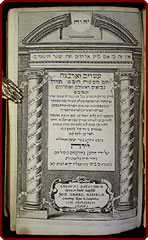
Darlow and Moule note that the text here is based on Stephanus's Bible, with reference to the editions of Bomberg and Mannasseh ben Israel; after Nisselius's death, the work was completed by Allart Uchtmann, who wrote the preface. The Hebrew text is vocalized and, for the most part, set fairly plainly in double columns, but it is occasionally decorated with typographical ornaments. This copy includes the additional engraved title-page, which is handsome.
• Darlow & Moule 5133; Fuks & Fuks-Mansfeld, Hebrew Typography in the Northern Netherlands, 1585-1815, 48 (on Nisselius and this work, see also pp. 45–46). Contemporary vellum, soiled; spine with early inked title and old shelving number. Front free endpaper with early inked annotations; first three leaves institutionally pressure-stamped; title-pages reinforced along inner margin; one internal blank leaf lacking. Pages with light age-toning and offsetting; roughly half of volume with light staining in upper margins. All edges red. (26193)

Respected
Scholar's OwnPrivate
Press
A
Labor
of LOVE
Bible.
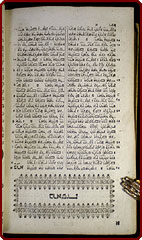
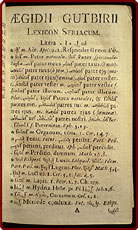
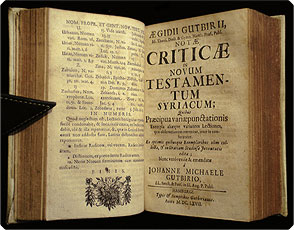
N.T. Syriac. 1664. Novum domini nostri Jesu Christi testamentum
Syriacè, cum punctis vocalibus & versione Latina Matthaei, ita adornatâ,
ut, unicô hôc Evangelistâ intellectô, reliqui totius
Operis libri, fine interprete, facilè inteligi poffint: Ingratiam Studiosae
Juventutis & Studii Linguar, Orient. propagandi causâ plenè
& emendatè editum. Hamburgi: Cum privilegiis, typic & imprensis
Autoris, 1664. 8vo (16.5 cm; 6.75"). [32], 604 p. [also bound in, as issued]
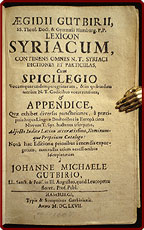
Gutbier, Aegidius. Lexicon Syriacum. Hamburgi, 1667. And his Notae criticae
in Novum Testamentum Syriacum. Hamburgi: Typis & Sumptibus Gutbirianis,
1667. 8vo. [4] ff., 146 pp., [31] ff. [also bound in, as issued, the same
author's] Notae criticae in Novum Testamentum Syriacum. Hamburgi: Typis
& Sumptibus Gutbirianis,1667. 8vo. [3] ff., 55, [1 (blank)] pp.
$1000.00
Click the interior images for enlargements.
• First edition of a work that went on to be reprinted multiple times over the next 150 years. Gutbier (1617–67), a distinguished professor at Hamburg, was universally recognized as one of the leading Orientalists of his era. His work is based on all of the previously published editions of the Syriac N.T. and on two unpublished manuscripts, one of which had belonged to the emperor Constantine.  Incontestably, the culmination of his studies was this volume, still a standard in the field. Having his own printing press, and cutting the Syriac types himself, certainly ensured his total control over the production.
• Darlow & Moule 8966. Contemporary plain vellum over paste boards. Ex-libarary with call number on spine, one small numerical stamp in a lower margin, acquisition information in a gutter margin, and a (touching!) typed note about the purchase of the volume tipped-in among the preliminary leaves. Without the added engraved title-page. Old private bookplates and ownership inscriptions of the 18th and 19th centuries; rubber-stamp on the lower edge of the closed volume. A very good copy. (23163)
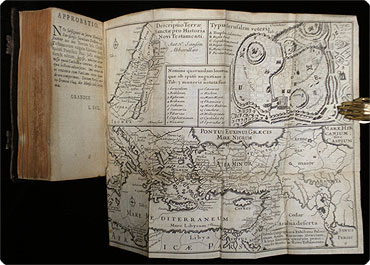
With a Fold-Out“Holy Land” Map
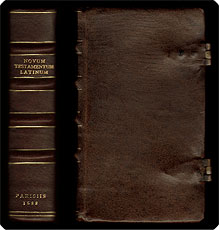
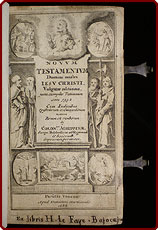
Bible. N.T. Latin. Vulgate. 1688. Novum testamentum Domini Iesu Christi, vulgatae editionis, juxta exemplar Vaticanum anni 1592. Cum indicibus epistolarum et evangeliorum necnon rerum et verborum. Parisiis: Apud Danielem Horthemels, 1688. 16mo (11.3 cm, 4.4"). Engr. t.-p. (incl. in pagination), 488, [24 (index)] pp.; 1 fold. map.
[SOLD]
Click the images for enlargements.
• 17th-century printing of the 1592 Sixtine-Clementine Vulgate, done by the Dutch-born printer Horthemels, known for having published the first printing in the West of any of Confucius's writings. This volume is illustrated with an oversized, folding map depicting Jerusalem and the lands of the Bible; the map is signed CABerey (Charles Amadeus de Berey,
generally considered to have flourished from 1700 to 1720).
• Not in Darlow & Moule. Recent mottled calf with brass clasps, spine with gilt-ruled raised bands and gilt-stamped title. Title-page with early inked ownership inscription in lower margin. Pages age-toned. All edges red. (26308)

PLACE
AN ORDER | E-MAIL
US | PRB&M HOME