 ANTIQUARIAN BIBLES
I:
ENGLISH-LANGUAGE BIBLES, TESTAMENTS, & “PARTS” (Part
A) (Part B)
 II:
POLYGLOTS & ANCIENT LANGUAGES (Part
A) (Part
B) | III: NATIVE
AMERICAN LANGUAGES
II:
POLYGLOTS & ANCIENT LANGUAGES (Part
A) (Part
B) | III: NATIVE
AMERICAN LANGUAGES
IV: MODERN
LANGUAGES NOT ENGLISH OR AMERIND (Part
A) (Part B)
V: BIBLE STUDY AIDS, COMMENTARY, &
“RELATED”
(Part A) (Part B)
 |
POLYGLOTS, HEBREW, GREEK, LATIN,
SYRIAC
CATALOGUE
ORDERED BY DATE
|
 A Scholar's Copy, Annotated — Van der Hooght's Edition
 & the Scholar was . . . ?
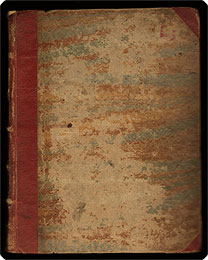
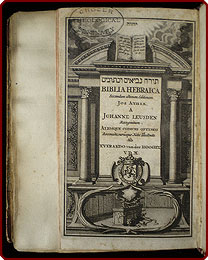
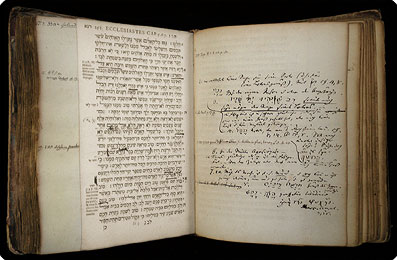
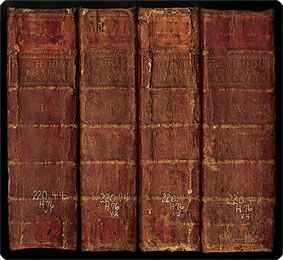
 Bible. O.T. Hebrew. 1705. [Torah, neviim u-khetuvim] Biblia Hebraica, secundum ultimam editionem Jos. Athiae, a Johanne Leusden denuo recognitam, recensita atque ad Masoram, et correctiores Bombergi, Stephani, Plantini, aliorumque editiones, exquisite adornata variisque notis illustrata ab Everardo van der Hooght.... Amstelaedami: Sumpt. & mandatis Societatis, 1705. 8vo in four 4to vols. (20.7 cm, 8.1"). I: Add. engr. t.-p., [50] pp., 178 ff. II: [1], 180–333 ff. III: [1], 160 ff. IV: [1], 162–352, [24 ] ff.
[SOLD]
 Click the images for enlargements.
• Interleaved, heavily annotated copy of the first edition of a famed and influential Hebrew Tanakh (Old Testament). Edited by Everardus van der Hooght, this edition is based on the version originally done by Johannes Leusden, a professor of Hebrew at the University of Utrecht, and Joseph Athias, a Sephardic printer who later commissioned and produced a Yiddish translation of the Bible. Darlow and Moule note that Van der Hooght's rendition of the Athias-Leusden text “became itself 'the parent of the ordinary reprints,'” while the Rev. Horne calls this printing “A work of singular beauty.” In each volume of the present set, the printed text and the larger added leaves are sewn together as an integrated whole.
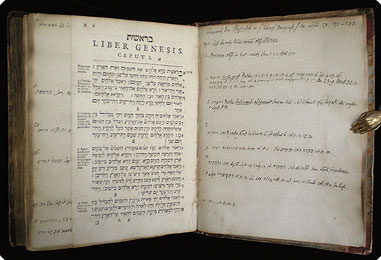
The main title-page of vol. I is printed in red and black and has an engraved vignette of Moses and Aaron flanking a depiction of the Tabernacle, while that volume's  additional copper-engraved title-page bears an architectural border surrounding a heraldic shield with motto “Concordius res parvae crescunt” and an image of the Ark. The additional title-page found in the other volumes is
 wood-engraved and described by OCLC as “cherubim holding tapestry and tableau across front of bird.”
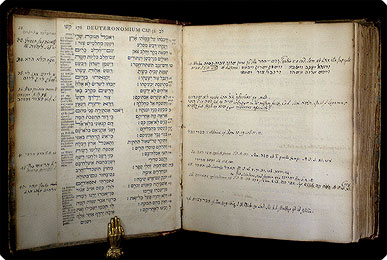
A late-18th-/early-19th-century scholar neatly annotated this text on the added
blank leaves, in both Latin and Hebrew in a small hand.  Almost
every extra leaf has at least one annotation, and many have significantly more;
a few printed pages have been marked as well.
Almost
every extra leaf has at least one annotation, and many have significantly more;
a few printed pages have been marked as well.
Provenance:
Each volume with bookplate of influential German theologian, Bible critic,
and Hebraist/orientalist Wilhelm (or Gulielmus) Gesenius (1786–1842).
It
is entirely possible that the extensive commentary here was done by Gesenius,
who published a commentary on Isaiah in 1821–29.
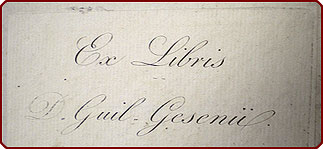
• Darlow & Moule 5141; Horne, Introduction to the Critical Study & Knowledge of the Holy Scriptures, IV, 673. Contemporary half red roan and marbled paper sides, spines with gilt-stamped title and author; bindings much faded and rubbed overall, spines with old inked shelving numbers. Back pastedowns (or front in Western terminology) each with institutional bookplate and with Gesenius's bookplate as above. Engr. t.-ps. and t.-ps. institutionally rubber- and pressure-stamped; numerous other pages stamped; first page of each vol. with inked numeral in lower margin; front pastedowns (or back in Western terminology) each with pocket. Added leaves annotated as above; some printed pages also with inked annotations and marks of emphasis. Some light foxing and offsetting; waterstaining to portion of vol. IV; margins of printed leaves trimmed closely, a few separated. One printed leaf with outer margin torn, touching one shouldernote and three letters; one leaf with lower margin ragged, just touching catchword.  A set “got up” by a scholar for serious work; sound and ready for serious work once again. (26159)
 Mill's Acclaimed Edition — Enhanced by Küster
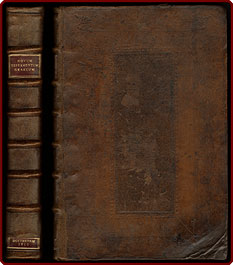
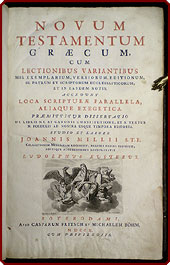
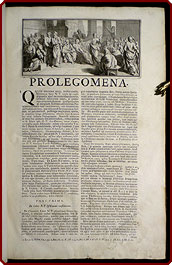
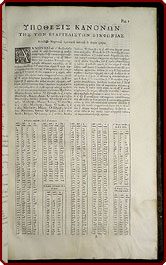
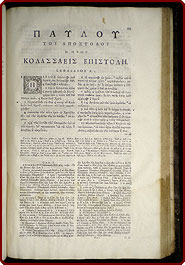
Bible. N.T. Greek. 1710. Mill. Novum testamentum graecum, cum lectionisbus variantibus mss. exemplarium, versionum, editionum, ss. patrum et scriptorum ecclesiasticorum; et in easdem notis. Accedunt loca scripturae parallela, aliaque exegetica. Praemittitur dissertatio de libris N.T. et canonis constitutione, et s. textus N. Foederis ad nostra usque tempora historia. Roterodami: Casparum Fritsch & Michaelem Böhm, 1710. Folio (36.5 cm, 14.4"). [22],168, [2], 632 pp.
Mill's Acclaimed Edition — Enhanced by Küster
Bible. N.T. Greek. 1710. Mill. Novum testamentum graecum, cum lectionisbus variantibus mss. exemplarium, versionum, editionum, ss. patrum et scriptorum ecclesiasticorum; et in easdem notis. Accedunt loca scripturae parallela, aliaque exegetica. Praemittitur dissertatio de libris N.T. et canonis constitutione, et s. textus N. Foederis ad nostra usque tempora historia. Roterodami: Casparum Fritsch & Michaelem Böhm, 1710. Folio (36.5 cm, 14.4"). [22],168, [2], 632 pp.
$1650.00
Click the images for enlargements.
• First edition of Westphalian scholar Ludolph Küster's edition of the Greek New Testament, revised from John Mill's much-lauded 1707 edition derived in turn from the Textus Receptus) — with the prolegomena, notes by Küster, andnew collations of 12 additional manuscripts. The text is printed in double columns with notes in Latin and Greek; the title-page is in red and black, with a copper-engraved vignette done by Gilliam vander Gouwen after Bernard Picart. The volume also features a copper-engraved allegorical headpiece done by Picart after Adrian vander Werf, as well as five unattributed headpieces and assorted decorative capitals.
Provenance: Gift inscription of a Rev. Perry of Middlesex to an institution of old; later deaccessioned.
• This ed. not in Darlow & Moule, but mentioned in 4735. Contemporary speckled calf panelled in plain calf with blind tooling, rebacked with lighter speckled calf and spine with gilt-stamped leather title-label; original leather scuffed and abraded, corners rebuilt/refurbished (most notably the front lower outer one). Front pastedown with inked inscription as above, date partially obscured by institutional bookplate (no other markings). Waterstaining to lower portions of leaves, generally light to moderate with occasionally some other, associated soiling, and with cockling; paper not weakened or embrittled, however, and the volume now quite sound for scholarly use. (26241)

 Printed
in
Printed
in Baskerville
Type
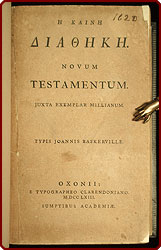
Bible.
N.T. Greek. 1763. [two lines in Greek, then]
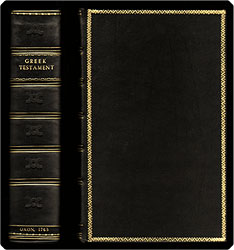
Novum Testamentum juxta exemplar millianum. Oxonii: Typis Joannis Baskerville;
e typographeo Clarendoniano, sumptibus academiae, 1763. 8vo. [1] f., 676 pp.,
without the half-title.
Baskerville
Type
Bible.
N.T. Greek. 1763. [two lines in Greek, then]
Novum Testamentum juxta exemplar millianum. Oxonii: Typis Joannis Baskerville;
e typographeo Clarendoniano, sumptibus academiae, 1763. 8vo. [1] f., 676 pp.,
without the half-title.
$700.00
Click the images for enlargements.
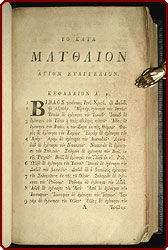
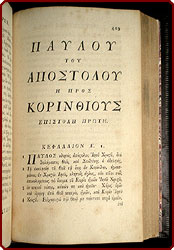
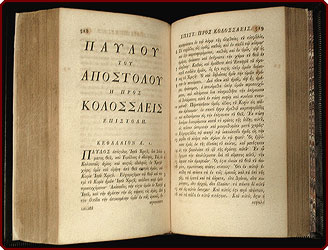
• Sole octavo printing of the Greek New Testament using Baskerville
type (i.e., Greek type that Baskerville designed and cut himself), and indeed
this was printed from the only set of Baskerville type that survives to this
day. An
important example of 18th-century fine printing of the Bible. The
text uses the Mill edition of the Greek N.T.
• Gaskell (enlarged ed.) Add. 2; Darlow & Moule 4756.
Recent full black calf with round spine and raised bands, restrained gilt
tooling on covers and spine. Without the half-title, title-page age-toned
and backed, and foxing variably; occasional old pencilled marginalia and minute
but fairly extended notes on a rear endpaper. An attractive and important
Greek Testament in a pleasing copy. (26563)
The Leipzig Polyglot
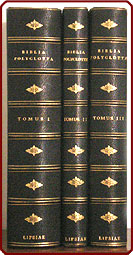
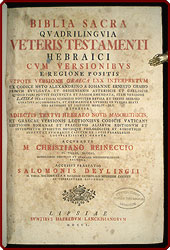
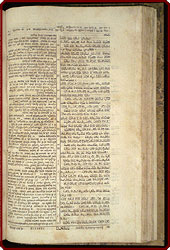
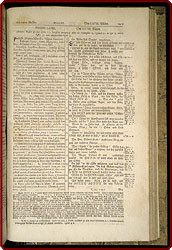
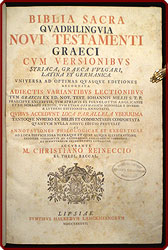
Bible. Polyglot. 1747. Reineccius. Biblia Sacra quadrilinguia Veteris [ac Novi] Testamenti Hebraici ... accurante M. Christiano Reineccio. Lipsiae: Sumtibus Haeredum Lanckisianorum, 1747–51. Folio (37.4 cm, 14.75"). 3 vols. I: [20], 1604 pp. II: [36], 607, [1] pp. III: Add. engr. t.-p., [22], 968 pp.
$8000.00
Click the interior images for enlargements.
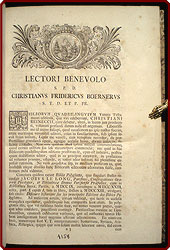
• Uncommon first complete edition, with extensive notes and much supplementary matter. This well-known and generally acclaimed polyglot Bible was edited by Christian Reineccius, a Lutheran scholar; Dibdin calls the work “very excellent and commodious.” The Old Testament is present in German, Greek (ancient and modern), Hebrew and Latin; the Apocrypha in Greek, Latin, and German only; and the New Testament (which has a separate title-page) in Greek, Syriac, Latin, and German. The New Testament was originally published in 1713; Darlow and Moule says it was “reissued with a new title and preface in 1747; and the two volumes containing the O.T. and
Apocrypha followed in 1750 and 1751.”
Each volume is decorated with two engraved headpieces (with the exception of vol. II, which has only one), several tailpieces, and decorative capitals. Vols. I and II have title-pages printed in red and black, while vol. III has an additional engraved title-page signed by Leipzig engraver Johann Gottfried
Kriigner, known for his editions of works by Bach.
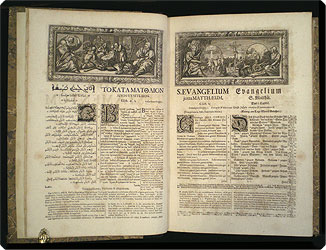
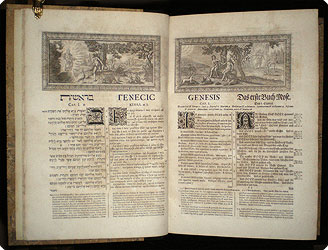
• Darlow & Moule 1451; Dibdin, I, 36–37. Recent quarter morocco and marbled paper–covered sides, leather edges with gilt roll; spines with gilt-stamped title and volume, gilt-ruled raised bands, and gilt-stamped compartment decorations. Title- and final pages each with one institutional pressure- and one rubber-stamp, a few other pages rubber-stamped; lower (closed) book edges rubber-stamped. Title-page of vol. I with unobtrusive small repair; last page of vol. III at one time tattered, now with creases, tiny holes, and small repair. Offsetting and foxing throughout, necessary to note and not sparing title-pages — but not nasty. A sound and satisfactory set. (24891)
Gospels in Hebrew
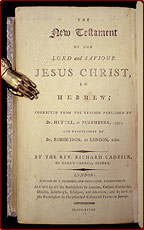
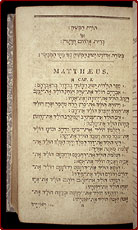
Bible. N.T. Hebrew. 1798. The New Testament of our Lord and Saviour Jesus Christ, in Hebrew; corrected from the version published by Dr. Hutter, at Nuremburg, 1599; and republished by Dr. Robertson, at London, 1661. London: T. Plummer, 1798. 8vo (16.7 cm, 6.56"). 40, 319 (i.e., 320) pp.
$550.00
Click the interior images for enlargements.
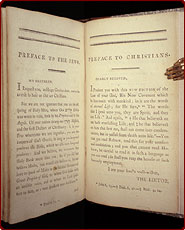
• Interesting 18th-century edition of the earliest translation of the New Testament into Hebrew by a Christian scholar, done by Elias Hutter and later revised and corrected by William Robertson for the Walton Polyglot. The Rev. Richard Caddick sponsored this edition “with the pious and benevolent design of enlightening the minds of the Jews,” as Thomas Hartwell Horne puts it; he supplied one preface aimed at Christians and a second for Jews, and added the text of “a very excellent little tract” (p. x), the “Earnest and affectionate address to the Jews” (originally printed in London, 1774).This volume has the first two parts bound together, comprising the four Gospels; a third part was added in 1800, but is not considered intrinsic to the work by either Darlow and Moule or Lowndes. The Hebrew is printed with the points.
Provenance: Private pressure-stamp of “J.H. Williams, Rector of Llangadwaladr” (Anglesey).
Uncommon: OCLC and ESTC find only six U.S. holdings of this Hebrew-only printing, one having since been deaccessioned.
• ESTC T2307 (for part I); Darlow & Moule 5164; Lowndes 2654; Horne, Introduction to the Critical Study & Knowledge of the Holy Scriptures, 48. Recent quarter calf and marbled paper–covered boards, spine with gilt-stamped leather title-label and gilt-dotted raised bands. Title-page with inner margin reinforced and pencilled inscription dated 1825 in upper margin; additional title-page with inked numeral in lower margin; title-page, additional title-page, final page, and one other pressure-stamped with the Rev. Williams's stamp and/or that of a seminary. Foxing; two pages with ink stains touching but not obscuring text. Final leaf with small central tear, without loss of text. Occasional unobtrusive pencilled corrections, underlining. In fact a nice clean copy. (25810)

Syriac N.T. for Bagster's Polyglot
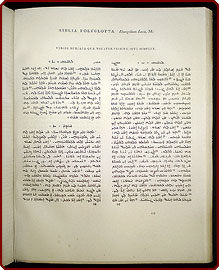
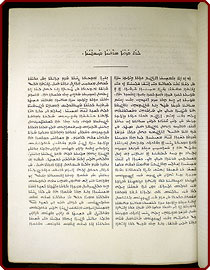
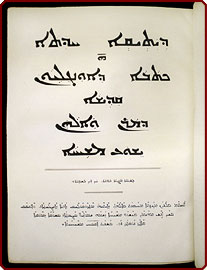
Bible. N.T. Syriac. Peshitta. 1828. [Title-page in Nestorian, romanized as] Dîyatîqi' Hedata'. H. Ketaba' de-Ewangelîyôn Qadîsha' de-Maran we-Alahan Yeshû' Meshîha'. London: S. Bagster, 1828. Large 4to (28.6 cm, 11.25"). [8] pp., 568 columns (i.e., 286 pp).
$750.00
Click the images for enlargements.
• First edition: Fully vocalized and pointed Syriac New Testament, edited by William Greenfield with reference to Widmanstadt's and Lee's earlier editions of the Peshitta text. The title is in Nestorian vocalised Estranglo script, and the text in Jacobite script; Greenfield's preface is in Syriac. The volume was intended to serve as a complement to Bagster's famed and monumental Biblia Sacra Polyglotta, with the running heads reflecting that intent.
This copy, interleaved with lined pages, was apparently meant for a scholar's use — but the added blank leaves have been left blank.
• Darlow & Moule 8987. Recent black moiré cloth, spine with gilt-stamped leather title and publication labels; half-title with institutional perforation-stamp, final page with rubber-stamped numeral, no other markings. Scattered faint spotting, otherwise clean. A handsome copy of an interesting work “got up” in an interesting way. (26950)
Uncommon Edition ofMartyn's Landmark Translation
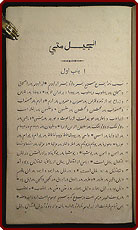
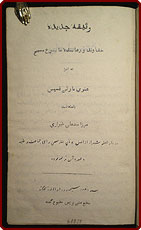
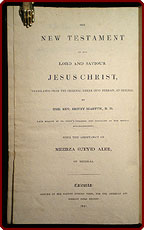
Bible. N.T. Persian. 1841. Martyn. The New Testament of Our Lord and Saviour Jesus Christ, translated from the original Greek into Persian, at Sheeraz.... Calcutta: Pr. at the Baptist Mission Press for the American & Foreign Bible Society, 1841. 8vo (24.2 cm, 9.5"). [4], 584 pp.
$425.00
Click the images for enlargements.
• Revised edition of the Rev. Henry Martyn's Farsi New Testament, translated by Martyn with the assistance of Mirza Saiyad Ali Khan and first published in 1815. Darlow and Moule note that the translation “won the encomiums of Persian scholars for the beauty of its style”; it became the basis of “all other Persian versions of note,” according to The Book of a Thousand Tongues. The present edition states that “there has been made by the editors, a slight alteration in a few of the theological terms.”
Scarce. OCLC and NUC Pre-1956 find only one U.S. holding of this edition.
• Darlow & Moule 7340; Book of a Thousand Tongues (2nd ed.) 1047 (for first ed.). Publisher's blue textured cloth, spine with printed paper label; boards and spine sunned (spine more so), with cloth cracked at joints and rubbed at extremities, spine label chipped and faded, spine with small area of discoloration and inked shelving number. Front pastedown with institutional bookplates. Two leaves towards front and last two leaves each with inner margins reinforced some time ago. Pages slightly age-toned, with occasional small pencilled marks of emphasis and marginalia in both English and Farsi. (25151)
 Limited to 200 Copies — A Polyglot “Song of Moses”
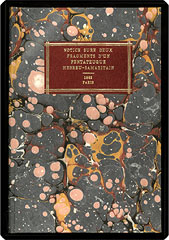
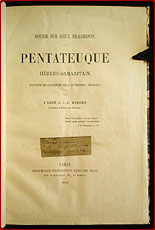
Bargès, Jean Joseph Léandre. Notice sur deux fragments d'un Pentateuque hébreu-samaritain rapportés de la Palestine par M. le sénateur F. de Saulcy. Paris: Imprimerie Polyglotte Édouard Blot, 1865. 8vo (24.5 cm, 9.6"). [6], 91, [1] pp.; 1 fold. plt.
Limited to 200 Copies — A Polyglot “Song of Moses”
Bargès, Jean Joseph Léandre. Notice sur deux fragments d'un Pentateuque hébreu-samaritain rapportés de la Palestine par M. le sénateur F. de Saulcy. Paris: Imprimerie Polyglotte Édouard Blot, 1865. 8vo (24.5 cm, 9.6"). [6], 91, [1] pp.; 1 fold. plt.
$750.00
Click the interior images for enlargements.
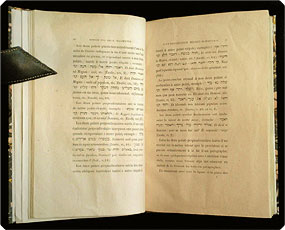
• First edition: Number 60 out of 200 copies printed, with a folded
facsimile leaf showing the Song of Moses in Samaritan, followed by the transcription
in Hebrew and translation in Latin. L'abbé Bargès was a distinguished
bibliophile and Hebraist/Orientalist who published a number of treatises on
Middle Eastern antiquities, including Traditions orientales sur les Pyramides,
Temple de Baal à Marseille, and Examen d'une nouvelle inscription
phénicienne, découverte recemment dans les mines de Carthage.
Uncommon:
OCLC and NUC Pre-1956 locate only five U.S. holdings.
Provenance: Ownership label
of George Williams (1814–78), who served as Vice-Provost of King's College
from 1854 to 1857.
• Recent marbled paper–covered boards, front cover with
gilt-stamped red leather title-label. Title-page with small affixed slip with
ownership inscription of George Williams of King's College. Occasional edge
nicks and short tears, and a number of leaves with old creases or the odd
smudge; last leaf with old, small repairs to margins, and one other leaf with
very good repair from blank reverse to an interior tear (no text lost or even
affected). (25368)

PLACE
AN ORDER | E-MAIL
US | PRB&M HOME