 BROADSIDESBROADSIDES
 Making Notaries Help with
 Sales Tax Collection
  New Spain. Viceroy (1789–94, Revillagigedo). Broadside, begins: “Don Juan Vicente de Guemez ... virrey, gobernador y capitan general de Nueva España ... Conforme a la ley 19. tit. 8. lib. 8 de la Recopilacion de Indias deben los escribanos.... [colophon: Mexico: No publisher/printer, 28 May 1791]. Folio extra (42 cm; 16.5"). [1] p.
 Click the image for an enlargement.
 WorldCat finds only the copy at the National Library of Chile.
• Medina, Mexico, 8090. Folded and a little dog-eared; four instances of worming, two meander-type holes repaired. With manuscript certifications on verso that the document has been recorded in the official acts of three different towns. (26044)

 Taxing Minted Silver New Spain. Viceroy (1813–16, Calleja del Rey). Broadside, begins: Don Félix María Calleja del Rey, ... virey, gobernador y capitan general de esta N.E., ... Recargada mas cada momento la Hacienda pública de multiplicadas é importantes atenciones, y no siendo bastantes á cubrirlas sus ingresos, ni tampoco los productos y rendimientos de los arbitrios hasta ahora adaptados.... Mexico: No publisher/printer, [in text] 13 de Julio de 1813. Folio (44 cm; 17"). [1] p.

 WorldCat locates only one copy.
• Garritz, Impresos novohispanos, 1702. Not in Medina, Mexico. Folded, otherwise as issued. Clean. (26040)


 Infighting! — New York State Senate — 1806 New York (state). Democratic-Republican Party. Broadside. Begins, “To the electors of the Western District. Fellow-citizens, In a few days you will again be called upon to exercise the distinguishing privilege of Freemen — that of electing your Representatives to the Legislature. In discharging this duty, the great body of the people only want correct information, and they will generally choose the most able and faithful men to legislate for them.” New York state: no publisher/printer, [1806?]. Folio (39 cm, 15.5"). [1] f. (verso blank).
 An interesting window into the factional struggles within the party and the growing dominance of the western district in state politics. Text printed in double columns.
Rare. We fail to trace any copies via OCLC.
• Not in Shaw & Shoemaker. As issued, with old folds. Short tear and spot in blank area of inner margin. A clean, very good copy. (24637)
 New York Gubernatorial Election 1820 — The Issue of Patriotism “No Time Server,” & “Red-Jacket”. Broadside. Begins, “Of all the strange and unaccountable things which have appeared during the present electioneering campaign, the Federal Bucktail Address, which has lately been put into circulation is the most so.” New York state: no publisher/printer, 1820. Folio (34 cm, 12.75"). [1] f. (verso blank).
Several lines of text at the base of the document are headed “The Seminole Federalists,” an unflattering soubriquet given to the faction of Federalists who opposed the Clinton administration. This section is signed in type, “Red-Jacket.”
• Not in Shoemaker. As issued, with some later folds. Inch-long tear within first line of text, costing one word and portions of two or three letters, without affecting sense. Tear above center fold snaking five lines of text, touching letters from seven words without costing any text. Thumbnail-sized chip in center, affecting portions of three lines and costing several complete words but little sense. Lightly foxed. (24635)


 Published
in
Published
in  Exile
in “New-York”
Páez, José Antonio.
Broadside. Begins: "A los venezolanos." New-York, 21 October
1853. Folio (30.7 cm, 12"). [1] p.
Exile
in “New-York”
Páez, José Antonio.
Broadside. Begins: "A los venezolanos." New-York, 21 October
1853. Folio (30.7 cm, 12"). [1] p. Click
the image at right for an enlargement.
Click
the image at right for an enlargement.
 Handsomely printed on a single sheet, in two columns.
Rare: We fail to trace this piece of exile writing via OCLC, RLIN, NUC Pre-1956, or Palau.
• In good/very good condition, save for short tears to margins. Good Venezuelan item.

“A
Grind on a [YALE]
Tutor”
(OneWise-Guy
Mexican
ELI)
Peña, Auxcencio Maria. Long Tom's pilgrimage. [New Haven, CT: 1829]. Folio (28.6 cm, 11.25"). [1] f.

Click the image for an enlargement. An issue of the New Haven Journal Courier from December of 1890 recounts the following story of the broadside's origin and subsequent fate: “The late Charles Harvey Townshend, Esq., of New Haven about the year 1880 met Mr. Robert Livingston of New York while crossing the Atlantic. One day while Mr. Livingston was telling him of his experiences while a Yale student, he asked him, if he ever had the chance, to look in the front middle room, fourth story, north entry of old South Middle College, between the ceiling over the wood closet door. He said that in 1829 he placed there a bundle of printed sheets of 'doggerel verse,' a grind on a tutor of those days. These verses were recited by the composer, Peña, a Mexican (who was afterwards expelled) in the college chapel, on a Wednesday afternoon.  Most of the class was expelled afterwards, for various reasons, and Mr. Livingston, who was one of them, said that his father always told him that he did perfectly right in not telling who wrote the verses (our emphasis). A fir [sic] broke out in Old South Middle in December 1890, and Mr. Townshend, with the permission of the then occupants of the room, searched the ceiling of the front middle room in accordance with Mr. Livingstons [sic] directions. He found there the bundle of verse, just as Mr. Livingston described.”
Uncommon: OCLC and NUC Pre-1956 report five U.S. locations, with Yale (predictably) holding several copies.
• American Imprints 39988. As issued (not showing signs of having been bound); creased once horizontally, upper edge darkened, four or five tiny spots of foxing in the lower left portion. A very nice copy of this scarce ephemeral piece. (24643)
“Carry
Off the Cry
& Clamour
THIS
TROUBLESOME WOMAN”(Pollock vs. the Thane of Cawdor). Answers for John Campbel of Calder Esq; and Mr. James Anderson writer to the signet his factor: To the petition of Ruth Pollock, who calls herself relict of Captain George Campbel, son to the deceast Sir Hugh Campbel. [Edinburgh], 1717. Folio (30.5 cm, 12"). 4 pp.
Cry
& Clamour
THIS
TROUBLESOME WOMAN”(Pollock vs. the Thane of Cawdor). Answers for John Campbel of Calder Esq; and Mr. James Anderson writer to the signet his factor: To the petition of Ruth Pollock, who calls herself relict of Captain George Campbel, son to the deceast Sir Hugh Campbel. [Edinburgh], 1717. Folio (30.5 cm, 12"). 4 pp.
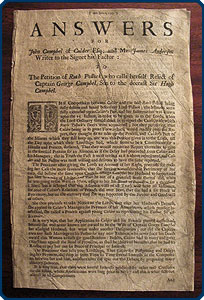 • The battle between Ruth Pollock and the Campbells (or Calders, from their estate of Cawdor) rages on, with the Calder side strenuously denying that any legitimate marriage ever took place between her and Capt. George Campbell. Pollock, who called herself Campbell’s widow despite apparently never having been acknowledged as his wife during his lifetime, was claiming a portion of the estate of his father, Sir Hugh Campbell; in this response to some of her petitions, lawyer John Fleming, acting on behalf of the Campbells, discusses the merits of various claims as pertaining to estate law. OCLC, ESTC, and NUC Pre-1956 record
  no holdings of this item.
• Not in ESTC. Once sewn, now in a Mylar folder. Last leaf with closed tear partially repaired some time ago, costing or or obscuring a few letters to each line of about two paragraphs on either side of leaf. Age-toned, dust-soiled, creased.
It
Says SHE
LIES . . .
(Pollock
vs. the Thane of Cawdor).
Broadside. Begins:
"Memorial for John Campbell of Calder Esq...." [Edinburgh], 1718. Folio (31.2
cm, 12.25"). [1] p.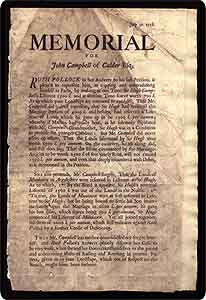 This
is an uncommon legal item, with no holdings described by OCLC, RLIN, or ESTC.
This
is an uncommon legal item, with no holdings described by OCLC, RLIN, or ESTC.
• Not in ESTC. Creased and dust-soiled, with a small hole in lower margin not touching text and a few pinholes within text. Tipped onto a leaf of 19th-century paper, now in a Mylar folder.
In
Multiple Fonts —
One Black-Letter(Pollock
vs. the Thane
of Cawdor [Again]). Broadside.
Begins: “Memorial for John Campbell of Calder....”[Edinburgh], 1718.
Folio (31.5 cm, 12.4"). [2] p.
Black-Letter(Pollock
vs. the Thane
of Cawdor [Again]). Broadside.
Begins: “Memorial for John Campbell of Calder....”[Edinburgh], 1718.
Folio (31.5 cm, 12.4"). [2] p.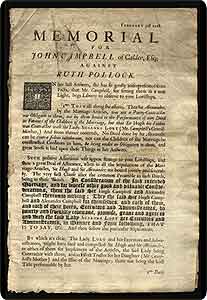
 marriage
articles between Sir Alexander Campbell and Elizabeth Lort,
John Campbell’s parents; the definition of impeachment of waste is discussed.
No
holdings of this uncommon item are listed by ESTC, RLIN, OCLC.
marriage
articles between Sir Alexander Campbell and Elizabeth Lort,
John Campbell’s parents; the definition of impeachment of waste is discussed.
No
holdings of this uncommon item are listed by ESTC, RLIN, OCLC.
• Creased and slightly dust-soiled but in overall good condition. Tipped onto a leaf of 19th-century paper; now in a Mylar folder.
A
“Collection Discount” will be applied should anyone take

 A
Bogotá
Newspaper Prospectus —
1822
[Ricaurte, Manuel]. Broadsheet.
Begins: "Anuncio de un nuevo periodico." [Bogotá: Imprenta de José
Manuel Galagarza, 1822]. Folio (31 x 22.3 cm; 12.25" x 8.75"). [2] pp.
A
Bogotá
Newspaper Prospectus —
1822
[Ricaurte, Manuel]. Broadsheet.
Begins: "Anuncio de un nuevo periodico." [Bogotá: Imprenta de José
Manuel Galagarza, 1822]. Folio (31 x 22.3 cm; 12.25" x 8.75"). [2] pp.

La Indicación survived only long enough to publish 26 numbers and is now a very rare newspaper. Ricaurte had begun his printing career as Galagarza's partner in the operation of the Colombian government's printing press (La Imprenta del Gobierno).
Very rare: No copies located in NUC Pre-1956 or on OCLC or RLIN.
• Not in Posada, Bibliografía bogotana; not in Palau. Removed from a nonce volume but in excellent condition.
Very Early VENEZUELAN ImprintRelating to INDEPENDENCE!Rivas y Galindo, Francisco. Broadside, begins: “Proclama que hizo Don Francisco Rivas y Galindo, joven de edad de quince años, hijo de Don Valentin Rivas uno de los SS. Vocales de la Suprema Junta Gubernativa de Caracas, à los habitantes de Venezuela ... ” Caracas: [Gallagher & Lamb], 20 April 1810. Folio (31 cm; 12.25"). 1 p.  Click the image for an enlargement.
The origins of printing in Venezuela are still, at this late date, shrouded in shadows. There remain questions of whether itinerant printers established themselves now and then for short periods of time, printing a form or booklet — and definitely some playing cards — and then moving on. The accepted date for “the beginning” of printing in Venezuela is October, 1808, with the arrival of the press of Gallagher and Lamb and this issuance of the first issue of Andrés Bello’s Gazeta de Caracas.
Very Rare. This broadside was unknown to Medina and is only the 16th item in Pedro Grases chronological list of things printed in Venezuela. In his entry he located only the copies in the Public Record Office (London) and the Archivo de Indias (Seville). Searches of NUC, OCLC, and RLIN fail to find any copy at all. Further, no copies were found when searching the OPACs of the national libraries of Spain, Venezuela, Colombia, France, and England.
• Not in Medina, Caracas. Graces, Historia de la imprenta en Venezuela, Reportorio #16; Villasana, VI, 108. As issued; minor worming in foremargin; repaired. A very good copy.
“It
WillImmediately
RUIN a
Multitude of Families”(Schism
Act, 1714). Broadside.
Begins: “Reasons humbly offer’d to the Right Honourable the peers
of Great Britain, in Parliament assembled, against the bill to prevent the growth
of schism.... [London, 1714?]. Folio (31.5 cm, 12.4"). [2] pp.

only one U.S. holding
reported by ESTC, OCLC, and NUC Pre-1956.
• ESTC N22343. Tipped onto a leaf of 19th-century paper; now in a Mylar folder. In good untattered condition, with noticeable (but not print-obscuring) stain in lower center portion.
“Minuts”
— The African &
Indian CompanyScotland.
Parliament. Committee concerning the African & Indian Company.
Broadside. Begins: “Minuts [sic]
of the proceedings in Parliament Wednesday 26. February 1707....”Edinburgh:
Heirs of Andrew Anderson, 1707. Folio (31 cm, 12.1"). [1] p.
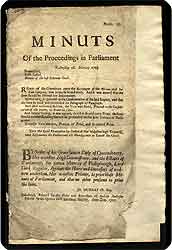 • Number 78 (of 89) of the 1706–07 minutes, this is a brief
account of a committee report “anent the Accompts”of a Scottish company
trading to Africa and the Indies, authorized for printing by Andrew Anderson
by decree of Sir James Murray, Lord Clerk Register. Many of the Parliamentary
documents printed by Anderson and heirs display the same misspelling of minutes
as seen in the header of this example.
• Number 78 (of 89) of the 1706–07 minutes, this is a brief
account of a committee report “anent the Accompts”of a Scottish company
trading to Africa and the Indies, authorized for printing by Andrew Anderson
by decree of Sir James Murray, Lord Clerk Register. Many of the Parliamentary
documents printed by Anderson and heirs display the same misspelling of minutes
as seen in the header of this example.
• ESTC T78547 (for holdings of complete sets). Tipped onto a leaf of 19th-century paper; now in a Mylar folder. Lower margin and bottom of outer margin slightly tattered to a curve; otherwise relatively minor creasing, soiling.

“Prayers
Said, The Rolls Called, The MINUTS
. . . Read”
Scotland.
Parliament. Proceedings, 1703. Broadside.
Begins: "Minuts of the proceedings in Parliament. Tuesday, September 7. 1703...."
[Edinburgh: Heirs and successors of Andrew Anderson, 1703]. Folio (31.3 cm,
12.25"). [1] p.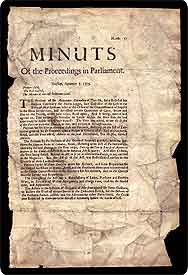
• ESTC T78734 (for holdings of all 63 parts). Tears with slight loss of paper (not touching text) to inner and outer margins; moderate creasing and dustsoiling. Now in a Mylar folder.
The Lovat
Vassals Protest(Simon
“The Fox” Fraser).
Lovat (Scotland). Tenants. Broadside.
Begins: “Petition for the Laird of Kilravock and others the vassals of Lovat....”[Edinburgh,
ca. 1702]. Folio. [1] p.
Lovat
Vassals Protest(Simon
“The Fox” Fraser).
Lovat (Scotland). Tenants. Broadside.
Begins: “Petition for the Laird of Kilravock and others the vassals of Lovat....”[Edinburgh,
ca. 1702]. Folio. [1] p.
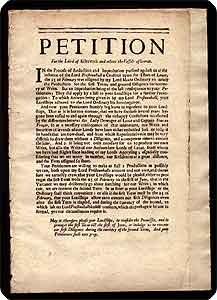
No
holdings are listed by OCLC, RLIN, ESTC, or NUC Pre-1956.
• Not in ESTC. On Fraser, see: Dictionary of National Biography, XX, 216–22. Excellent clean condition, with two small sewing holes at inner margin, one very small spot of foxing, and ink traces from printing process to outer edge. Tipped onto a leaf of 19th-century paper; now in a Mylar folder.
Troublesome Soldiers to FaceCriminal Courts Spain. Sovereigns (1788–1808, Charles IV). Broadside, begins: “El Rey. -- Para evitar en lo sucesivo las disputas entre los Gefes de los Cuerpos de mi Exército en Indias con las Audiencias.... Mexico: No publisher/printer, 1800. Folio. [1] p.
• Not in Medina, Mexico; not in González de Cossío, Cien; not in not in González de Cossío, 510. Removed from a nonce volume. Left margin irregular. (25824)
Censoring
Mexican
CLERGY
Spain.
Consejo de Regencia. Broadside, begins: “...
Los reyes de España, encargados de concordar el decoro de la Santa Iglesia
con la seguridad y tranquilidad del Reyno....” Mexico: no publisher/printer,
12 January 1814. Folio (41 cm; 16"). 1 p. • Viceroy Calleja promulgates this decree issued in Spain on 14 June
1813, which in hopes of bringing rebellious priests and members of religious
orders into the ranks of the tractable, makes it a criminal offense to “utter
insulting or ugly words against the King or royal persons or against the state
or government.” The decree effectively abolishes clerical exemption under
the feudal “fuero.”
• Viceroy Calleja promulgates this decree issued in Spain on 14 June
1813, which in hopes of bringing rebellious priests and members of religious
orders into the ranks of the tractable, makes it a criminal offense to “utter
insulting or ugly words against the King or royal persons or against the state
or government.” The decree effectively abolishes clerical exemption under
the feudal “fuero.”
OCLC locates only the copies at the John Carter Brown and the Bancroft Libraries. NUC Pre-1956 adds no others.
• Garritz 1917. Not in Medina, Mexico; not in Sutro. Folded once, otherwise as issued. With Viceroy Calleja's paraph next to his printed name at the base of the document. (24595)
Educational
& Career
Rights forBlacks in
the Spanish EmpireSpain.
Sovereigns, etc., 1808–33 (Ferdinand VII). Broadside.
Begins: “Don Francisco Xavier Venegas...`Exmô, Señor = La Regencia
del Reyno se ha servido dirigirme el Decreto que sigue...Deseando las Córtes
generales y extraordinarias facilitar á los súbditos Españoles,
que por qualquiera línea traigan su orígen del Africa, el estudio
de las ciencias, y el acceso á la carrera eclesiástica....’”
Mexico, 25 September 1812. Folio extra (48 cm; 17.25"). [1] p. Click
the image to the right
Click
the image to the right While Ferdinand VII remained the prisoner of Napoleon, the Regency promulgated several important human rights acts, and this was one of the most important. The Regency ratified and published it 29 January and on 31 January it was ordered distributed throughout the empire.
• Not in Medina, Mexico; not in Garritz, Impresos novohispanos;
not in Sutro. One horizontal fold, top margin a little crumpled and irregular;
left margin with a V-shaped bit of blank margin missing at fold, otherwise
only a little irregular. Revenue stamps on the verso. Viceroy Venegas’s
paraph (“rúbrica”) below his printed name. A
very good copy.
Freedom
of the Press in
the Spanish
EmpireSpain. Sovereigns,
etc., 1808–33 (Ferdinand VII). Broadside. Begins: “Don Francisco Xavier Venegas...`Exmô. Sr. = ...sabed: que en las Córtes generales y extraordinarias, congregadas en la Real Isla de Leon, se resolvió y decretó lo siguiente...Articulo I. Todos los cuerpos y personas particulares, de qualquiera condicion y estado que sean, tienen libertad de escribir, imprimir y publicar sus ideas politicas sin necesidad de licencia, revision ó aprobacion alguna anteriores a la publicacion....” Mexico, 5 October 1812. Folio extra (48 cm; 17.25"). [1] p.

• Garritz, Impresos novohispanos, 1612. Not in Medina, Mexico; not in Sutro. One horizontal fold; right margin a little crumpled. Revenue stamps on the verso. Viceroy Venegas’s paraph (“rúbrica”) below his printed name. A very good copy.
Abolition
of Torture
Spain.
Cortes. Broadside. Begins: “ ...El Sr.
Secretario del Supremo Consejo de Indias ... me remite la real cédula
del tenor siguiente ... Que abolido para siempre el tormento en todos los dominios
de la monarquia espanola ... “ Mexico: no publisher/printer, 15 October
1811. Folio (44 cm; 17"). 1 p.
Rare. No copies located via OCLC or NUC Pre-1956.
• Not in Medina, Mexico; not in Garritz; not in Sutro. Folded once, otherwise as issued. With Viceroy Venegas's paraph next to his printed name at the base of the document. (24594)
A
LARGE Broadside
— Handsomely
Printed
Spain.
Sovereigns, 1621–1665 (Philip IV). Broadside.
Begins: ": Jayme Miguel de Guzman, Davalos, Spinola, Palavezino, Ramirez de
Haro...Por quanto con Carta de 18. del corriente Don Miguel de Muzquiz...nos
ha remitido un Exemplar de la Real Cedula de Su Mag., su fecha de 17. del mismo...."
[Barcelona, 1662]. Folio extra (412 x 308 mm). [1] f. Click
the image for enlargement.
Click
the image for enlargement.
• Not in Palau. Folds, and part of one margin excised with loss.
Party Strife!“Uniform Republican, A”. Broadside. Begins, “To the
Republican electors of the Western District. Fellow-citizens, At the same time that a bold and aspiring faction at the seat of government of the United States, is making the most daring and unprincipled attack upon the president and the friends of his administration, we find another faction actuated by the same motives, and impelled by the same spirit, commencing an attack upon the administration of this state.” New York state: no publisher/printer, [1806?]. Folio (verticle chain lines; 41 cm, 16.5"). [1] f. (verso blank).
Rare: We fail to trace any copies via OCLC; only one holding listed in Shaw & Shoemaker.
• Shaw & Shoemaker 11490. As issued, with old folds, edges slightly irregular. Two tiny holes within text, at the point where two folds intersect, and costing only a portion of two letters. Fingernail-sized stain. Four words have been redacted by the previous owner in ink, but can still be easily read. (24636)
Unique
Bifolium: AnUnrecorded
Example of Early PrintingUrbis,
& Orbis. Broadside.
Begins: "Vrbis, & Orbis. Sanctissimus D.N. Clemens Papa X de consilio Ementissimorum
Cardinalium Sac. Rituum Congregationi Præpositorum ad preces sibi porrectas...."
Guatemala: José Pineda Ibarra, 1673. 4to. Two copies printed on an uncut
half sheet (one on recto, one on verso); size of sheet 31 x 21 cm. 
Guatemala was the fourth Latin American city to have a printing press (after Mexico, Lima, and Puebla de los Angeles); the press was brought at the instigation of the bishop of Guatemala, Payo Enríquez de Ribera, who wished to have a work of his own published. In reply to the bishop's appeal for a printer, José Pineda Ibarra arrived at Antigua in 1660. He had worked as an assistant to several printers in Mexico, but according to Medina did not have his own press; when Payo de Ribera's representative found him, he had moved to Puebla, but was apparently not doing well there. (Medina does not list him as a printer in Puebla—presumably he was again working for others.) The bishop apparently paid for the press that was taken to Guatemala, and Pineda Ibarra later purchased it from him. Torre Revello (quoted in Furlong) remarks that despite the dearth of materials, Pineda Ibarra managed to print exceedingly well: "Ningún tipógrafo de los que le sucedieron, durante el periodo colonial, logró superar la pulchritud y elegancia de sus trabajos." This example shows not only several sizes of type, but a woodcut of a papal tiara, at the top of the edict, flanked by typographical ornaments; a line of typographical ornament also appears on either side of the date of the edict, near the bottom of the page.
The various religious orders in Guatemala had promised to make it worth the while of a printer to come, by giving him commissions. Judging from the list of over 30 works Pineda Ibarra printed before 1673—eulogies, sermons, constitutions, regulations, descriptions of religious festivities—the orders fulfilled their promise; his major productions, however, were Bishop de Ribera's Explicatio apologetica nonnullarum propositionum . . . , 1663, and Diego Saenz Ovecuri's La Thomasiada, 1667. Also a bookseller and binder, Pineda Ibarra died in 1679. He was succeeded in 1681 by his son, Antonio de Pineda Ibarra, under whom the press operated until 1721.
The text in hand, a papal edict of 23 July 1672, changes the office for St. Peter Nolasco used by Mercedarians from semiduplex to duplex, at the request of the Queen of France. The Orden Real de Nuestra Señora de la Merced, Redemción de Cautivos, was already established in Guatemala (cf. Medina, Guatemala, 38), and probably paid Pineda Ibarra to print this work.
• Not in Medina, Guatemala; on the printer, see: Medina's introduction, pp. xviii–xx. Not in Valenzuela, Imprenta en Guatemala; O'Ryan, Bib. Guatemalteca; NUC; BMC. See, however, Oswald, p. 539; Furlong, Orígenes, p. 91; and Woodbridge and Thompson, Printing in Colonial Spanish America, pp. 81–84.
MEXICO is
one of our great specialties. For a short “shelf” devoted to This
Broadside also appears in the HISPANIC
For a short “shelf” devoted to This
Broadside also appears in the HISPANIC
Shortly After theDeclaration of IndependenceVenezuela. Junta Suprema Gubernativa. Broadside, begins: “Americanos. El orden politico del otro hemisferio ha reducido la España á ser victima de la perfidio y ooresion y este pueblo generoso conducido de uno en otro infortunio va ya á ser borrado del catalogo de las naciones ... ” [Caracas: Gallagher y Lamb, 1811]. Folio (31 cm; 12.25"). 1 p.
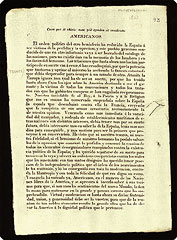
Click the image for an enlargement.
This document dates from immediately after July 5th, as internal evidence shows. Here the Junta Suprema explains what it sees to be the political reality of Spain’s dissolution into non-nationhood under Napoleon and thereby justifies “Venezuela [having] entered now, Americanos, into the number of free nations of the Americas.”
Very Rare. This broadside was unknown to Medina. Grases located only the copies in the Public Record Office (London) and the Archivo de Indias (Seville). Searches of NUC, OCLC, and RLIN fail to find any copy at all. Further, no copies were found when searching the OPACs of the national libraries of Venezuela, Colombia, Spain, France, and England.
• Not in Medina, Caracas; not in Villasana. Grases, Historia de la imprenta en Venezuela, Repertorio #72. As issued. Worming in foremargin; repaired. Pencilling in margins. A very good copy.
Ballad Broadside Waugh, Edwin. Broadside. [drop-title] "Come 'Whoam' to thi' childer an' me." No place [Lancashire?, England]: , no date [1890]. Narrow folio (27.8 cm, 11'). [1] p. 
• One crease in the lower margin, below the bottom of the decorative border. (8269)
Single-click the image, for an enlargement.
Broadside-lovers
should see
also, perhaps,

PLACE AN ORDER | E-MAIL US | GO (BACK) TO TOPIC/INTEREST TABLE | PRB&M HOME
All material © 2010
The Philadelphia Rare Books & Manuscripts
Company